

Man and World
How Spirit Works in Nature
GA 351
13 October 1923, Dornach
Translate the original German text into any language:
Versions Available:
How Spirit Works in Nature, tr. SOL
3. Mensch und Erde im Norden und Süden
3. People and the Earth in the North and South
[ 1 ] Guten Morgen, meine Herren! Vielleicht ist Ihnen etwas am letzten Vortrag besonders aufgefallen, so daß Sie noch eine Frage daranschließen wollen?
[ 1 ] Good morning, gentlemen! Perhaps something in the last lecture caught your attention in particular, so that you would like to ask a follow-up question?
Fragesteller: Gestern hat mir Herr Seefeld eine Photographie gezeigt von Schneeflocken. Die Formen kommen aus dem Weltenall. Es hat mich sehr interessiert; da ist ein Zusammenhang. Das hat mir schon weiter zu denken gegeben.
Questioner: Yesterday, Mr. Seefeld showed me a photograph of snowflakes. Their shapes come from outer space. It really intrigued me; there’s a connection there. It’s given me a lot to think about.
[ 2 ] Dr. Steiner: Ich werde Ihnen einmal auch dieses im Zusammenhang darzustellen versuchen, namentlich weil sich ja der Anschluß dann leicht ergeben wird an das, was wir am letzten Montag besprochen haben. Ich habe Sie ja öfter darauf aufmerksam gemacht, der Mensch ist ein sehr kompliziertes Wesen. Das sieht man nicht so stark an dem Äußeren des Menschen, sondern man sieht es an dem Inneren des Menschen, auch an dem Körperlich-Inneren des Menschen. Da kann ich Sie zum Beispiel darauf aufmerksam machen, daß in den Gegenden, in denen die sogenannte heiße Zone ist, wo der größte Teil des Jahres warm ist und eigentlich nur abwechselnd mit der Wärme ein ganz kurzer regnerischer Winter - sagen wir im südlichen Ägypten, oder sagen wir in Indien -, daß da die Menschen eigentlich in ihrem Inneren ganz anders ausschauen als da, wo es beständig kalt ist, in den Gegenden zum Beispiel, die dem Nordpol naheliegen. Gegenden, die dem Nordpol naheliegen, haben ja sehr viel von dem, worüber Sie jetzt gerade gefragt haben; sie haben sehr viel von den Kräften, die sich dann ausdrücken in den schönen Formen der Schneeflocken. So daß wir also sagen können: Wir haben auf der Erde solche Gegenden, welche stark sonnendurchwärmt und sonnendurchleuchtet sind, wo die Sonne einen großen Einfluß hat, und wir haben Gegenden, wo die Sonne eigentlich wenig Einfluß hat, wo also Schnee, Eis herrscht. - Sie wissen ja, daß nicht nur die Schneeflocken schöne, allerlei wunderschöne Formen haben — die Schneeflocken haben erstens solche Formen, die auf das Sechseck hingehen, aber auch allerlei solche Formen (Zeichnung p. 52) -, sondern Sie haben doch ganz gewiß auch schon ans Fenster gesehen im Winter, wenn dort das Eis ist, das Wasser gefriert, das sonst als Dunst die ganze Fensterfläche bedeckt; da haben Sie gesehen, was da für wunderschöne Blumen sich bilden, wunderschöne Figuren, in die sich das Wasser hineinbildet. So daß wir sagen können: Das Wasser, das ja dem Schnee ebenso wie dem Eis zugrunde liegt - denn wenn es wieder warm wird, so zerfließt sowohl der Schnee wie das Eis zu Wasser -, das bildet, wenn die Sonne nicht recht Kraft hat, die schönsten Figuren. Die können natürlich nicht im Wasser drinnen sein. Denn etwas, was seine eigene Figur aus sich selber bildet, das behält ja seine Figur. Sie haben ja auch alle eine Figur. Von der menschlichen Figur aber kann man nicht sagen, daß Sie alle nur in Bildern die menschliche Figur haben, die, wenn die Sonne kommt, zerfließt. Das wäre auch schlimm, das tut sie nicht. Das Wasser hat diese Figur nicht in sich selber, die kommt von auswärts.
[ 2 ] Dr. Steiner: I will try to explain this to you in context as well, particularly because it will then easily tie in with what we discussed last Monday. As I have often pointed out to you, the human being is a very complex creature. This isn’t so evident from a person’s outward appearance, but rather from their inner being—including their physical inner constitution. For example, I can point out to you that in regions classified as the so-called “hot zone,” where it is warm for most of the year and where a very short, rainy winter alternates with the heat —let’s say in southern Egypt, or let’s say in India—that the people there actually look quite different on the inside than those in places where it is constantly cold, such as the regions near the North Pole. Regions near the North Pole do, in fact, have a great deal of what you just asked about; they possess a great deal of the forces that then express themselves in the beautiful forms of snowflakes. So we can say: We have regions on Earth that are intensely warmed and illuminated by the sun, where the sun has a great influence, and we have regions where the sun actually has little influence—where snow and ice prevail. - As you know, it’s not just snowflakes that have beautiful, all kinds of wonderful shapes—snowflakes have, first of all, shapes that tend toward the hexagon, but also all kinds of other shapes (drawing on p. 52)—but you have certainly also looked out the window in winter, when there is ice there, when the water freezes, which otherwise covers the entire window surface as mist; there you have seen what beautiful flowers form there, beautiful figures into which the water takes shape. So we can say: The water, which is the basis of both snow and ice—for when it gets warm again, both the snow and the ice melt back into water—forms the most beautiful figures when the sun isn’t very strong. Of course, these cannot be inside the water itself. For something that forms its own shape from within retains that shape. After all, you all have a form as well. But one cannot say of the human form that you all possess it only in images—a form that melts away when the sun comes out. That would be terrible; it does not do that. The water does not possess this form within itself; it comes from outside.
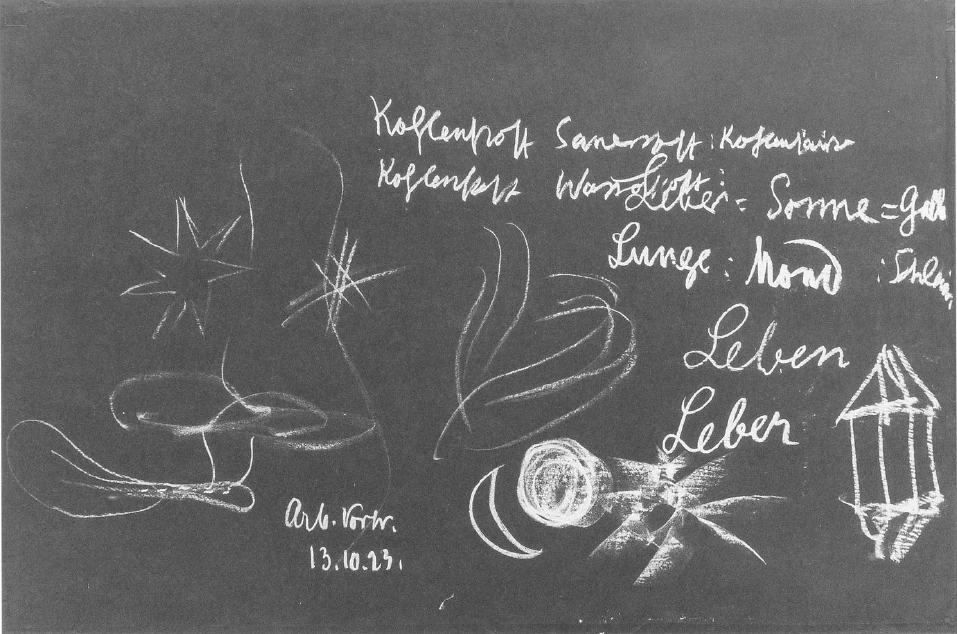
[ 3 ] Nun wollen wir einmal untersuchen, woher das Wasser diese Figur bekommen hat, die da sowohl beim Schneekristall wie bei den Eisblumen diese schönen Bilder hervorruft. Das ist dann die Antwort auf Ihre Frage.
[ 3 ] Now let’s examine where water gets the shape that creates these beautiful patterns in both snow crystals and ice flowers. That will be the answer to your question.
[ 4 ] Wenn man eine solche Frage sich stellt, muß man immer eingehen können auf den ganzen Menschen. Nun sind im Menschen zwei Organe; die sind anders bei einem Menschen, wo die Sonne das ganze Jahr hindurch eine große Kraft hat, wie in den heißen Gegenden Südägyptens und Indiens. Die innere Gestalt dieser Organe unterscheidet sich bei diesen Menschen von denjenigen Menschen, wo es sozusagen das ganze Jahr kalt ist, wo immer so ein Hang ist in der Natur, Schneekristalle und Eisblumen zu bilden, wie bei den Eskimos. Die leben da oben, wo immer eigentlich Schnee und Eis sein will, wo das Wasser wenig zerfließt. Nun schauen wir aber einmal das Äußere an. Da werden die Leute sagen: Nun ja, die Leute in den heißen Gegenden sind äußerlich vielleicht etwas größer; aber die Eskimos, das sind kleine Leute. - Aber das ist nicht dasjenige, was die Sache ausmacht, sondern der große Unterschied zwischen Menschen der heißen Zone und den Eskimos, den Menschen der kalten Zone, der liegt in dem Unterschied ihrer Leberbildung und ihrer Lungenbildung. Die Eskimos haben verhältnismäßig zu ihrem Körper große Lungen und kleine Lebern, und die Menschen in der heißen Zone haben verhältnismäBig eine kleinere Lunge und eine große Leber. Also Sie sehen, da unterscheiden sich die Menschen in Gegenden, in denen Eisblumen entstehen, Eiskristalle entstehen, von den anderen dadurch, daß sie verhältnismäßig zu ihrem Körper eine kleine Leber und eine große Lunge haben. Und bei den Menschen, bei denen die Natur nicht die Neigung hat, solche Figuren zu bilden, sondern wo die Sonne alles immer schmilzt, alles wegschafft, da besteht die Eigentümlichkeit, daß sie eine verhältnismäßig kleine Lunge und eine große Leber haben. Wir müssen immer, wenn wir um etwas in der Natur fragen, also auch um die Eisblumen, auf den Menschen schauen. Wenn man nicht vom Menschen ausgeht, versteht man nichts in der Natur, gar nichts.
[ 4 ] When one asks oneself such a question, one must always be able to take the whole person into account. Now, there are two organs in the human body; these are different in a person where the sun has great power throughout the year, as in the hot regions of southern Egypt and India. The internal structure of these organs differs in such people from that of people living in regions where, so to speak, it is cold all year round—where nature has a tendency to form snow crystals and ice flowers, as is the case with the Eskimos. They live up there, where snow and ice tend to prevail, and where water rarely melts. But now let’s take a look at their outward appearance. People will say: Well, yes, people in hot regions may be somewhat taller on the outside; but the Eskimos—they’re small people. —But that is not what makes the difference; rather, the major distinction between people in the hot zone and the Eskimos—the people of the cold zone—lies in the difference in the structure of their livers and lungs. The Eskimos have lungs that are relatively large and livers that are relatively small in proportion to their bodies, while people in the hot zone have relatively smaller lungs and larger livers. So you see, people in regions where ice flowers and ice crystals form differ from others in that they have a relatively small liver and a relatively large lung in proportion to their bodies. And among people in regions where nature does not tend to form such figures—where the sun always melts everything and clears it away—there is the peculiarity that they have relatively small lungs and large livers. Whenever we ask about something in nature—including ice flowers—we must always look to human beings. If one does not start with human beings, one understands nothing in nature, absolutely nothing.
[ 5 ] Also die Sache ist so: Die Leber im Menschen ist ein sehr wichtiges Organ. Wenn der Mensch keine Leber hätte, hätte er keine Galle, denn die Leber, die sondert fortwährend Galle ab. Die Galle kommt aus der Leber, geht in die Gallenblase über, von da in die Verdauungssäfte, von da in das Blut und geht dann in den ganzen Körper über. So daß wir sagen können: Der Mensch hat in der rechten Seite die Leber; aus der Leber rinnt die Galle heraus in die Gallenblase hinein, von da in das Blut, geht in den ganzen Körper über. - So daß also der Mensch seine Leber eigentlich hat zum Absondern der Galle.
[ 5 ] So here’s the thing: The human liver is a very important organ. If a person didn’t have a liver, they wouldn’t have bile, because the liver constantly secretes bile. Bile comes from the liver, flows into the gallbladder, from there into the digestive juices, from there into the blood, and then spreads throughout the entire body. So we can say: The human liver is located on the right side; bile flows from the liver into the gallbladder, from there into the blood, and spreads throughout the entire body. - So, in essence, the human body has a liver for the purpose of secreting bile.
[ 6 ] Sie können nun fragen: Ja, warum kommt denn aus der Leber fortwährend diese Galle? - Meine Herren, wenn Sie keine Galle hätten, wären Sie sonderbare Leute. Sie verteilt sich natürlich in ganz kleine Mengen, aber sie muß im ganzen Körper sein. Wenn Sie keine Galle hätten, wären Sie fürchterliche Phlegmatiker; die Hände, die Arme, den Kopf ließen Sie hängen, und es wäre Ihnen zuwider, wennSie jemand ein Wort als Antwort geben sollten und so weiter. Also Sie wären ganz latschete, phlegmatische Leute, wenn Sie keine Galle hätten. Galle muß der Mensch haben; die Galle muß aus der Leber kommen. Und wenn die Leber verhältnismäßig klein ist, so wird eben der Mensch phlegmatisch; wenn die Leber verhältnismäßig groß ist, so hat der Mensch viel Feuer in sich, denn die Galle macht Feuer. Und sehen Sie, es kann auch in einem Menschen zuviel Galle sein, er kann zuviel Galle erzeugen; dann hat er eigentlich die Lust, wenn man nur ein bißchen was zu ihm sagt, einem ein paar herunterzuhauen. Namentlich bei den jähzornigen Leuten fließt aus der Leber fleißig Galle heraus; da fließt viel Galle in den Nahrungssaft und in das Blut über. So daß, wenn Sie innerlich den Menschen beobachten, zu dem Sie etwas sagen oder dem irgend etwas nicht gefällt, das auf ihn einen besonderen Eindruck macht - flugs rinnt viel Galle aus der Leber heraus und verbreitet sich sehr schnell in dem ganzen Körper, und er haut Ihnen ein paar herunter, oder er schimpft wie ein Rohrspatz. Das ist es, was man innerlich beobachtet, wenn ein Mensch zuviel Neigung hat, Galle abzusondern. Aber wie gesagt, wenn er gar keine Galle absondern würde, würde er gar kein Feuer haben, sondern so daherschlapfen, wie ich es Ihnen gesagt habe. Also Sie sehen, die Gallenabsonderung ist ja etwas, was unbedingt zur Absonderung des Menschen gehört. Ich weiß nicht, ob schon irgend jemand von Ihnen die Galle gekostet hat: sie schmeckt furchtbar bitter, richtig giftig, und eine größere Menge von der Galle richtig durch den Mund aufgenommen, ist auch ein Gift. Das hängt zusammen mit dem, was ich Ihnen am letzten Mittwoch gesagt habe. Ich hatte Ihnen gesagt: Wenn der Mensch lebendig wird, sich bewegt, geht, auch wenn er schimpft und Ihnen ein paar herunterhaut, ja, da gibt es so viel Gift, daß er die Neigung hat, viel von dem Zyankali, von dem ich Ihnen da gesprochen habe, zu erzeugen. Das muß er mit dem Blut vermischen. Ich habe viele Fälle schon kennengelernt, wo Leute einfach durch ihren Zorn eine innere Blutvergiftung bekommen haben. Man kann so zornig werden, besonders wenn man schnell zornig wird, daß man durch diesen Zorn überflüssig viel Galle absondert - eigentlich zunächst viel Zyan, dann Galle. Dann kriegt man eine furchtbare Giftmischung ins Blut, und da ruiniert man dann das Blut. Es kommt eine furchtbare Blutvergiftung durch den Zorn. Daraus sehen Sie, wie notwendig und wie schädlich wiederum beim Menschen dasjenige sein kann, was irgendein Organ seines Leibes tut. Denn alles, was geschieht, hängt mit dem Seelischen wiederum zusammen. Der Zorn ist etwas Seelisches, die Gallenabsonderung ist etwas Physisches; aber es gibt nichts im Menschen, das nicht zugleich seelisch ist und alles Seelische hat irgendwie eine physische Form.
[ 6 ] You might now ask: “Yes, but why does the liver constantly produce this bile?”—Gentlemen, if you had no bile, you would be strange people. It is naturally distributed in very small quantities, but it must be present throughout the entire body. If you didn’t have bile, you’d be terrible phlegmatics; your hands, arms, and head would hang limply, and you’d find it repulsive to have to say a single word in reply to anyone, and so on. So you’d be completely listless, phlegmatic people if you didn’t have bile. A person must have bile; bile must come from the liver. And if the liver is relatively small, then the person becomes phlegmatic; if the liver is relatively large, then the person has a lot of fire within them, because bile creates fire. And you see, a person can also have too much bile—they can produce too much bile; then, if you say even the slightest thing to them, they’re actually eager to lash out at you. Especially in the case of hot-tempered people, bile flows diligently from the liver; a great deal of bile spills over into the digestive juices and into the blood. So that, if you observe a person inwardly—someone to whom you say something, or who takes particular offense at something—a great deal of bile immediately flows out of the liver and spreads very quickly throughout the entire body, and he’ll lash out at you or rant and rave like a madman. That is what one observes internally when a person has too much of a tendency to secrete bile. But as I said, if he didn’t secrete any bile at all, he wouldn’t have any fire at all, but would just shuffle along as I’ve told you. So you see, bile secretion is something that is absolutely essential to human physiology. I don’t know if any of you have ever tasted bile: it tastes terribly bitter, truly poisonous, and a large amount of bile actually ingested through the mouth is also a poison. This ties in with what I told you last Wednesday. I had told you: When a person comes alive, moves, walks—even when they’re ranting and lashing out at you—yes, there’s so much poison involved that they tend to produce a lot of the cyanide I’ve been talking about. They have to mix this with their blood. I’ve already encountered many cases where people have developed internal blood poisoning simply because of their anger. One can become so angry—especially if one is quick to anger—that this anger causes one to secrete an excessive amount of bile—actually, initially a lot of cyanide, then bile. Then a terrible mixture of toxins enters the blood, and that is how the blood is ruined. A terrible blood poisoning results from the anger. From this you can see how necessary—and yet how harmful—it can be for a person when any organ of the body acts in a certain way. For everything that happens is, in turn, connected to the soul. Anger is a soul phenomenon; the secretion of bile is a physical phenomenon; but there is nothing in a human being that is not at the same time a soul phenomenon, and everything that is a soul phenomenon has, in some way, a physical form.
[ 7 ] Gehen wir weiter. Nehmen wir jetzt an, ein Mensch ist dem, was man oftmals Erkältungen nennt, namentlich Baucherkältungen, sehr häufig ausgesetzt. Also ein Mensch kriegt sehr häufig Baucherkältungen; dann sagt sein Bauch: Ja, ich bin wie ein Eskimo, ich bin wie in der kalten Gegend der Erde. - Und dann kommt es, daß der Bauch fortwährend die Leber zusammenzieht, so daß sie wie bei dem Eskimo klein ist. Wenn also der Mensch viel Baucherkältungen hat, dann zieht sich seine Leber zusammen, und dann preßt sie die Galle aus. Fortwährend träufelt Galle in die Gallenblase herein und von da in den Körper.
[ 7 ] Let’s continue. Let’s now suppose that a person is very frequently exposed to what is often called a cold—specifically, stomach colds. So, a person gets stomach colds very often; then their stomach says: “Yes, I’m like an Eskimo; I’m like I’m in a cold region of the Earth.” - And then it happens that the abdomen constantly contracts the liver, so that it becomes small, just like an Eskimo’s. So if a person has a lot of stomach colds, their liver contracts, and then it squeezes out the bile. Bile constantly drips into the gallbladder and from there into the body.
[ 8 ] Nun, meine Herren, Sie haben alle schon dasjenige erlebt, was man zum Beispiel Sich-Überheben nennt. Man hebt etwas, was einem zu schwer ist; da reißt man sich die Muskeln auseinander, da zerstört man sich die Muskeln. Wenn man zuviel Kraft anwendet für irgendein Organ, so zerstört man sich das Organ. So ist es aber bei der Leber. Wenn sie immer fort und fort zuviel Galle absondert, dann schrumpft die Leber allmählich zusammen, sie wird untauglich. So daß also die meisten Leberkrankheiten, die der Mensch bekommt, dadurch entstehen, daß der Mensch durch Baucherkältungen die Neigung bekommen hat, zuviel Galle abzusondern und daß dadurch seine Leber verkümmert. Lebererkrankungen kommen aus Baucherkältungen durch Zusammenschrumpfen der Leber. Natürlich kommen ja alle möglichen anderen Zustände dazu. Wenn der Mensch Baucherkältungen hat, geht das Herz nicht ordentlich. Da sagen dann die Ärzte, die Leberkrankheiten kommen vom Herzen. Aber in Wahrheit kommen sie von dem, daß der Bauch sich erkältete.
[ 8 ] Well, gentlemen, you have all experienced what is called, for example, overexertion. When you lift something that is too heavy for you, you tear your muscles apart; you destroy your muscles. If you exert too much force on any organ, you destroy that organ. The same is true of the liver. If it constantly secretes too much bile, the liver gradually shrinks and becomes dysfunctional. Thus, most liver diseases that people develop arise because abdominal chills have caused them to secrete too much bile, leading to atrophy of the liver. Liver diseases result from abdominal chills, which cause the liver to shrink. Of course, all sorts of other conditions contribute to this as well. When a person has abdominal chills, the heart does not function properly. Doctors then say that liver diseases originate in the heart. But in reality, they stem from the fact that the abdomen became chilled.
[ 9 ] Alles das aber - das können Sie schon aus dem entnehmen, was ich Ihnen gesagt habe - hat zu tun mit der Sonne. Daher ist es auch immer sehr gut, wenn einer gerade an Baucherkältungen leidet, daß man ihm seinen Unterleib dem Lichte aussetzt. Da ist zum Beispiel die Sonnenkur außerordentlich gut. So also müssen wir sagen: Alles das, was mit der Leber zusammenhängt, hängt auch mit der Sonne zusammen. Sonnentätigkeit fördert Lebertätigkeit. Mangel an Sonnentätigkeit bringt die Lebertätigkeit in Unordnung. Es ist ein sehr interessanter Zusammenhang zwischen der Sonne und der Leber.
[ 9 ] But all of this—as you can already gather from what I’ve told you—has to do with the sun. That’s why it’s always very beneficial, when someone is suffering from a stomach cold, to expose their lower abdomen to the light. Sun therapy, for example, is exceptionally beneficial. So we must say: Everything related to the liver is also related to the sun. Sun exposure promotes liver function. A lack of sun exposure disrupts liver function. There is a very interesting connection between the sun and the liver.
[ 10 ] Ich habe immer bewundert, daß in der deutschen Sprache das Wort Leber existiert. Alle anderen Sprachen haben für dieses Organ in der rechten Seite des Unterleibes gar kein so schönes Wort. Denn nach dem, was ich Ihnen jetzt erklärt habe, müssen wir ja sagen, das Feuer, sogar das, was dem Menschen von der Sonne kommt, diese belebende Feuerkraft, die muß in der Leber erst für den Menschen zurechtgekocht werden; da muß ihm die Galle bereitet werden, die dann in seinen Körper übergeht. Die Sonne bereitet in dem Menschen die Galle. Dasjenige, was der Mensch da tut, das nennen wir leben, und den, der dieses Leben anfeuert, den kann man einen Leber nennen. So wie man sagt: Wagen, Wagner, Zeichnen, Zeichner, so ist leben das Zeitwort, und Leber, der Leber - das hat man nur vergessen, daß das so ist, man sagt «die Leber» statt «der Leber»; eigentlich heißt es der Leber -, der ist das, was da belebt! Die Sprache ist manchmal wunderbar lehrreich, weil in den alten Volksinstinkten immer ein Wissen von dem vorhanden war, und da sind die Dinge richtig benannt worden. Leber ist das, was anfeuert, was den Menschen belebt. Das ist in bezug auf die Leber zu sagen. Nun, wenn man die Leber in ihrer Gallenabsonderung hat, dann muß man sagen: Die Absonderung der Leber ist dasjenige, was mit der Sonne zusammenhängt.
[ 10 ] I have always admired the fact that the German language has the word “Leber.” No other language has such a beautiful word for this organ located on the right side of the lower abdomen. For, based on what I have just explained to you, we must say that fire—even that which comes to humans from the sun, this life-giving fiery force—must first be properly processed in the liver for the human being; there, the bile must be prepared for him, which then passes into his body. The sun prepares the bile within the human being. What a person does there is what we call “living,” and the one who kindles this life can be called a “liver.” Just as we say: “car,” “carriage-maker,” “draw,” “drawer”—so “living” is the verb, and “liver,” “the liver”—we’ve simply forgotten that this is the case; we say “the liver” instead of “the liver”; actually, it’s “der Leber”—that is what gives life! Language is sometimes wonderfully instructive, because there has always been a body of knowledge present in the ancient folk instincts, and there, things were named correctly. “Leber” is what fuels, what gives life to human beings. This is what must be said regarding the liver. Now, when we consider the liver in terms of its secretion of bile, we must say: The secretion of the liver is that which is connected to the sun.
[ 11 ] Jetzt gehen wir zu der Lunge über. Das haben wir ja oft besprochen und Sie wissen es auch: die Lunge atmet. Aber daß die Lunge da den Sauerstoff einzieht, atmet, das ist bei der Lunge nur ein Teil ihrer Tätigkeit. Die Lunge hat noch etwas anderes zu tun. Geradeso wie die Leber die Galle absondert, so sondert die Lunge dasjenige ab, was man den Schleim nennt. Die Lunge also sondert den Schleim ab. Die Lunge kann ebensowenig wie die Leber dasjenige, was sie in sich hat, in sich behalten. Die Leber könnte nicht sich ganz anfüllen mit Galle, die Leber muß die Galle an den Körper abgeben. Aber die Lunge, die muß fortwährend Schleim aussondern, immerfort Schleim aussondern. Und nun ist es so, daß wenn die Lunge Schleim aussondert, so geht der Schleim dann über in alle anderen Teile des Körpers. Er geht mit dem Schweiß fort, er geht sogar in die Ausatmungsluft hinein, er geht mit dem Urin ab, er geht überallhin, der Schleim. Aber das Organ, das den Schleim absondert, das ist die Lunge.
[ 11 ] Now let’s move on to the lungs. We’ve discussed this many times, and as you know, the lungs breathe. But the fact that the lungs take in oxygen—that is, breathe—is only part of their function. The lungs have another function as well. Just as the liver secretes bile, the lungs secrete what is called mucus. So the lungs secrete mucus. Just like the liver, the lungs cannot retain what they contain within themselves. The liver cannot fill itself completely with bile; it must release the bile into the body. But the lungs must constantly secrete mucus—they must secrete mucus continuously. And now, when the lungs secrete mucus, that mucus then spreads to all other parts of the body. It is excreted in sweat; it even enters the exhaled air; it is excreted in urine; it goes everywhere—the mucus. But the organ that secretes the mucus is the lungs.
[ 12 ] Wenn Sie nun die Luft, die der Mensch ausatmet, untersuchen, dann kriegen Sie etwas Wunderschönes heraus. Man muß nur hauptsächlich nicht die vom Munde ausgeatmete Luft untersuchen, die ist zu unregelmäßig; man muß die von den Nasenlöchern ausgeatmete Luft untersuchen.
[ 12 ] If you examine the air that a person exhales, you will discover something wonderful. The key is not to examine the air exhaled from the mouth, as that is too irregular; instead, you must examine the air exhaled from the nostrils.
[ 13 ] Sehr interessant ist es, wenn jemand recht langsam ausatmet. Da muß man sehr achtgeben: Atmet man auf eine Glastafel, dann entsteht im Atem, der ausgeatmet wird, etwas Ähnliches wie beim Schnee. Man muß es sehr sorgsam machen, und zwar so, daß man, wenn man zum Beispiel das linke Nasenloch beim Ausatmen zuhält, nur mit dem rechten Nasenloch langsam ausatmet auf die Glastafel, die man vor sich liegen hat, und dann mit dem linken. Man muß sehr langsam atmen, weil, wenn man schnell atmet, man das Ganze verwischt durch den Atemstoß. Es muß ganz sanft und milde geatmet werden. Das muß man eigentlich erst lernen. Aber da ist es dann interessant: Wenn man da durch ein Nasenloch atmet, dann entstehen auf der Glasplatte durch die ausgeatmete Luft gerade solche Figuren wie beim Schnee! Da ist die Ausatmungsluft nicht einfach solch ein Bröckelchen darauf, sondern solch eine Figur. Und das, ich möchte sagen, verteufelt Interessante dabei ist, daß wenn Sie das linke Nasenloch zuhalten und ausatmen, kriegen Sie eine Figur; wenn Sie das rechte Nasenloch zuhalten und ausatmen, kriegen Sie eine andere Figur. Nicht einmal die gleichen Figuren sind es! So daß wir also sagen können: Die Luft aus Ihnen heraus, aus Ihrem eigenen Menschen heraus, diese Luft geht in Figuren heraus. Sie geht gar nicht bloß als Tropfen heraus, sie geht in Figuren heraus, und sogar so merkwürdig, daß das linke Nasenloch noch eine andere Figur als das rechte Nasenloch gibt.
[ 13 ] It’s very interesting when someone exhales quite slowly. You have to be very careful here: if you breathe onto a glass pane, the exhaled breath creates something similar to what happens with snow. You have to do it very carefully—for example, by holding your left nostril closed as you exhale, breathing out slowly through your right nostril onto the glass plate in front of you, and then through your left. You have to breathe very slowly, because if you breathe quickly, the force of the breath will blur the whole thing. You have to breathe very gently and softly. You actually have to learn how to do this first. But here’s the interesting part: when you breathe through one nostril, the exhaled air creates patterns on the glass plate just like snow! The exhaled air isn’t just a little speck on the surface, but a distinct shape. And what I’d say is incredibly interesting about this is that if you close your left nostril and exhale, you get one shape; if you close your right nostril and exhale, you get a different shape. They aren’t even the same shapes! So we can say: The air coming out of you—out of your very being—takes the form of shapes. It doesn’t just come out as droplets; it comes out as shapes—and it’s so remarkable that the left nostril produces a different shape than the right nostril.
[ 14 ] Nun, meine Herren, dasjenige, was da in der ausgeatmeten Luft drinnen ist, die ja, weil sie Wasserdunst enthält, diese Figuren gibt, die gleich wieder verdunsten, aber diese Figuren bildet, das ist der Schleim, der aus der Lunge in die ausgeatmete Luft übergeht. Der bildet sich zu diesen Figuren. Der Schleim klebt gewissermaßen die einzelnen, ganz winzigen Wassertröpfelchen zusammen zu solchen Figuren. So daß Sie in Ihrer Lunge nicht eben einfach die Neigung haben, Schleim in einer beliebigen Gestalt auszustoßen, sondern Sie haben die Neigung, aus Ihrer Lunge den Schleim eigentlich in Kristallen auszuatmen oder auszustoßen - in Kristallen! Nur verdunsten diese Kristalle gleich, lösen sich gleich auf, weil sie an die Sonne kommen.
[ 14 ] Well, gentlemen, what is contained in the exhaled air—which, because it contains water vapor, forms these shapes that evaporate almost immediately but do form these shapes—is the mucus that passes from the lungs into the exhaled air. It forms these patterns. The mucus, so to speak, binds the individual, tiny water droplets together into such patterns. So that in your lungs, you don’t simply have a tendency to expel mucus in any random shape, but rather you have a tendency to actually exhale or expel the mucus from your lungs in the form of crystals—in crystals! But these crystals evaporate immediately, dissolve right away, because they’re exposed to the sun.
[ 15 ] Gerade so nun, wie die Galle mit der Leber zur Sonne in Beziehung steht, so steht die Lunge mit ihrer Schleimabsonderung zum Mond in Beziehung. Wir wissen ja, daß da in den Kopf hinauf, wie ich Ihnen gesagt habe, die Kohlensäure steigt, und ich habe Ihnen gezeigt, daß wenn der Mensch keine Kohlensäure in seinen Kopf hinaufschicken würde, er dann dumm werden würde. Diese prickelnde Kohlensäure, die sich in ganz kleinen Mengen fortwährend in den Kopf hinaufbringt, die macht, daß wir gescheite Menschen sind. Wir sind ja alle so furchtbar gescheite Menschen, nicht wahr! Sie wissen, wenn man Brausen trinkt, dann prickelt das; das ist dann sehr stark wahrzunehmen. Aber der Mensch erzeugt immer sehr schwach Kohlensäure. Die schickt er in den Kopf hinauf. Und dieses Prickeln im Kopf, das macht den Kopf regsam; dadurch ist er gescheit und nicht dumm. Diejenigen Menschen, die wirklich dumm sind — ich weiß nicht, ob es solche auch gibt -, die haben zuwenig Kraft, um den Kohlenstoff mit dem Sauerstoff zu verbinden und schicken keinen Kohlenstoff hinauf, sondern die verbinden den Kohlenstoff mit einem ganz anderen Gas. Also der Mensch, der gescheit ist, der verbindet den Kohlenstoff mit dem Sauerstoff: da entsteht die prickelnde Kohlensäure. Aber wie gesagt, diejenigen Menschen, die nun wirklich dumm sind, die verbinden den Kohlenstoff nicht mit dem Sauerstoff, sondern mit dem Wasserstoff. Die verbinden also Kohlenstoff mit Wasserstoff, und da entsteht dieses Gas, das man manchmal in Gruben findet: Grubengas, Sumpfgas. Wir alle senden auch etwas von diesem Grubengas in den Kopf; das brauchen wir auch, sonst würden wir nämlich zu gescheit. Damit wir immer auch ein bißchen dumpf bleiben können, auch so ein bißchen nicht ewig gescheit sind, entwickeln wir auch Sumpfgas. Aber diejenigen, die zu dumm werden, entwickeln zuviel Sumpfgas. Bei denjenigen Menschen, die halbwegs gescheit sind, geht die Kohlensäure in den Kopf. Das prikkelt. Und wenn dann sich nach und nach viel Sumpfgas angesammelt hat, dann werden sie schläfrig, dann kommt die Schlafmüdigkeit. Das tritt ein des Nachts, da entwickelt sich viel Sumpfgas. Nur bei denjenigen, die dumm sind, entwickelt sich das Sumpfgas auch wenn sie wachen. Also da muß immerfort die Kohlensäure hinauf. Aber die Kohlensäure allein tut es nicht: es muß von der Lunge aus der Schleim in den Kopf gehen. Er geht ja sogar durch die Nasenlöcher in Form von Kristallen heraus, geradeso wie in Leber und Galle. Nun, das wird Ihnen klar sein durch die Beschreibung, die ich am Mittwoch gegeben habe.
[ 15 ] Just as the gallbladder is related to the sun through the liver, so too are the lungs—with their secretion of mucus—related to the moon. We know, as I’ve told you, that carbon dioxide rises up into the head, and I’ve shown you that if a person didn’t send carbon dioxide up into their head, they would become stupid. This tingling carbon dioxide, which is constantly carried up into the head in very small amounts, is what makes us intelligent people. We’re all such terribly intelligent people, aren’t we! You know, when you drink a fizzy drink, it tingles; you can feel that very strongly. But humans always produce carbon dioxide very weakly. They send it up into the head. And this tingling in the head makes the mind active; that’s why they’re smart and not stupid. Those people who are truly stupid—I don’t know if such people even exist—don’t have enough energy to combine carbon with oxygen, so they don’t send carbon up; instead, they combine carbon with a completely different gas. So the person who is smart combines carbon with oxygen: that’s how the tingling carbon dioxide is produced. But as I said, those people who are truly stupid do not combine carbon with oxygen, but with hydrogen. So they combine carbon with hydrogen, and that produces the gas sometimes found in mines: mine gas, marsh gas. We all send some of this mine gas to our heads; we need it, too, otherwise we’d become too smart. So that we can always remain a little dull—and not be smart all the time—we also produce marsh gas. But those who become too stupid produce too much marsh gas. In people who are reasonably smart, carbon dioxide goes to the head. That gives a tingling sensation. And when a lot of swamp gas has gradually accumulated, they become drowsy—that’s when sleepiness sets in. This happens at night, when a lot of swamp gas builds up. Only in those who are stupid does swamp gas develop even while they’re awake. So the carbon dioxide has to keep rising. But carbon dioxide alone isn’t enough: mucus has to travel from the lungs to the head. It even exits through the nostrils in the form of crystals, just as it does in the liver and gallbladder. Well, that should be clear to you from the description I gave on Wednesday.
[ 16 ] So wie die Leber mit der Sonne zusammenhängt, so hängt nun die Lunge mit dem Mond zusammen. Sehen Sie sich einmal den Mond an. Der Mond ist nur ganz anders als die Sonne. Wenn Sie auf die Sonne schauen, dann ist die Sonne ja rund, aber sie breitet eigentlich ihre Strahlen nach allen Seiten aus. Die Sonne, die scheint nach allen Seiten; sie zerfließt nach allen Seiten, so wie die Galle in dem menschlichen Leib nach allen Seiten hin geht. Man kann dann die Sonne in ihrem Zerfließen, im Auseinanderfließen vergleichen mit dem Zerfließen der Galle. Aber der Mond - ja, meine Herren, wenn Sie den Mond anschauen, der hat immer eine ganz bestimmte Gestalt. Der Mond ist ganz fest. Und er ist in seinem Inneren auch so, daß das, was die Substanz, den Stoff des Mondes ausmacht, kristallisiert, geradeso wie unsere Ausatmungsluftformen, die aus der Nase kommen, kristallisiert sind. Da wirken drinnen die Mondwirkungen, so wie in der Leber und Galle die Sonnenwirkungen. In der Lunge wirken die Mondkräfte, und der Mond bewirkt diese Absonderung von Schleim.
[ 16 ] Just as the liver is connected to the sun, so too are the lungs connected to the moon. Take a look at the moon. The moon is simply very different from the sun. When you look at the sun, it is round, but it actually radiates its rays in all directions. The sun shines in all directions; it flows out in all directions, just as bile flows in all directions within the human body. One can then compare the sun’s flowing out, its spreading, to the flow of bile. But the moon—yes, gentlemen, when you look at the moon, it always has a very specific shape. The moon is quite solid. And its inner nature is such that the substance constituting the moon crystallizes, just as the forms of exhaled air that come out of the nose are crystallized. The lunar forces are at work there, just as the solar forces are at work in the liver and gallbladder. The lunar forces are at work in the lungs, and the moon brings about this secretion of mucus.
[ 17 ] Jetzt können wir sagen: Gehen wir in die heißen Gegenden, ja, dann wirkt die Sonne. Die läßt alles zerfließen; die Leute bekommen viel Feuer. Das Feuer, es braucht ja nicht bloß im Jähzorn zu leben, sondern es lebt auch in den schönen Dingen und in der schönen Weisheit der Eifer. Die Leute bekommen viel Feuer. Gehen wir in die kalten Gegenden, dann muß sich in diesen kalten Gegenden, wo die Sonne nicht die Kraft hat zu wirken, wo namentlich der Mond in den kalten Nächten hineinscheint in die Eiseskälte, die Lunge, die sich verhältnismäßig vergrößert, sehr stark anstrengen: da wird viel Schleim abgesondert. Und derjenige, der das nicht gewöhnt ist, der erkältet sich, der sondert zuviel Schleim ab.
[ 17 ] Now we can say: Let’s go to the hot regions—yes, there the sun exerts its power. It causes everything to melt; people become filled with fire. This fire does not merely dwell in sudden anger, but it also lives in beautiful things and in the beautiful wisdom of zeal. People become filled with fire. If we go to cold regions, then in these cold regions—where the sun lacks the power to act, where, in particular, the moon shines down into the freezing cold on cold nights—the lungs, which become relatively enlarged, must work very hard: a great deal of mucus is secreted. And those who are not accustomed to this catch a cold; they secrete too much mucus.
[ 18 ] Sehen Sie, meine Herren, jetzt haben Sie auch die Ursache der Lungenkrankheiten. Die Lunge muß ein gewisses Quantum von Schleim absondern, so wie die Leber ein gewisses Quantum von Galle absondern muß. Aber geradeso wie die Leber, wenn sie zuviel Galle absondert, sich ruiniert, so ruiniert sich die Lunge, wenn sie zuviel Schleim absondert. Das ist bei den Lungenkrankheiten der Fall. Da wird die Lunge durch dasjenige, was sie erlebt, aufgerüttelt, zuviel Schleim abzusondern. Denken Sie sich also, Sie leben statt in einer mäßig feuchten Luft, statt in einer ein bißchen feuchten Luft in einer stark feuchten Luft: dann muß sich die Lunge sehr stark anstrengen. Aber wenn sich die Lunge anstrengt, so sondert sie Schleim ab. Und da fängt die Lunge dann an, dadurch, daß sie zuviel feuchte Luft atmet, sich zu stark anstrengen muß, krank zu werden. Und der Mensch spuckt, wenn er lungenkrank wird; nach und nach spuckt er seine ganze Lunge aus, wenn er zuviel krank ist.
[ 18 ] You see, gentlemen, now you also have the cause of lung diseases. The lungs must secrete a certain amount of mucus, just as the liver must secrete a certain amount of bile. But just as the liver ruins itself when it secretes too much bile, so too do the lungs ruin themselves when they secrete too much mucus. This is the case with lung diseases. The lungs are stimulated by what they experience to secrete too much mucus. So imagine this: instead of living in moderately humid air, or even slightly humid air, you’re living in very humid air—then the lungs have to work very hard. But when the lungs exert themselves, they secrete mucus. And that is when the lungs begin to become ill—because they have to work too hard from breathing in too much humid air. And when a person develops a lung disease, they cough up phlegm; little by little, they cough up their entire lungs when they are too sick.
[ 19 ] Man kann der Lunge dann zu Hilfe kommen, indem man eine bestimmte Arznei bereitet. Man darf dazu keine Wurzeln verwenden, sondern man muß die Blätter verwenden von Pflanzen, eine bestimmte Arznei daraus bereiten. Es ist das also zum Beispiel der Fall bei ganz bestimmten Pflanzenarten. Wenn man da richtig den Saft nimmt und bestimmte Arzneien bereitet, kann man der Lunge zu Hilfe kommen, wenn sie zuviel tätig ist. Denn solche Arzneien haben die Eigentümlichkeit, daß sie die Lungentätigkeit übernehmen; dann strengt sich die Lunge etwas weniger an. Das Heilende besteht also meistens darinnen, daß man sich frägt: Die Lunge, die sondert also zuviel Schleim ab; das ist ein Zeichen, daß sie sich zu stark anstrengt. Schön, was tue ich? Ich suche mir eine Pflanze, die einen Saft hat, der die Lungentätigkeit übernehmen kann.
[ 19 ] One can then help the lungs by preparing a specific remedy. One must not use roots for this, but must use the leaves of plants to prepare a specific remedy from them. This is the case, for example, with very specific plant species. If one extracts the sap correctly and prepares certain remedies, one can help the lungs when they are overactive. For such remedies have the property of taking over the work of the lungs; then the lungs exert themselves somewhat less. The healing process therefore usually consists of asking oneself: The lungs are secreting too much mucus; this is a sign that they are working too hard. Well, what should I do? I look for a plant whose sap can take over the work of the lungs.
[ 20 ] Oder ich bemerke, daß die Leber zuviel Galle absondert: ich suche mir eine Pflanze, welche die Lebertätigkeit übernehmen kann. Da gibt es zum Beispiel eine Pflanze, die heißt Cichorium intybus, Wegwarte. Wenn man den Saft aus der Wurzel dieser Pflanze zu einer Arznei bereitet und ihn dem Menschen eingibt, dann übernimmt der die Lebertätigkeit, und man kann dann finden, daß der Mensch zwar zunächst nicht weniger Galle absondert, daß auch zunächst seine seelischen Zornzeiten nicht zurückgehen, daß aber seine Leber sich nach und nach wieder kräftigt und allmählich die Besserung eintritt.
[ 20 ] Or I notice that the liver is secreting too much bile: I look for a plant that can take over the liver’s function. For example, there is a plant called Cichorium intybus, or chicory. If you prepare the juice from the root of this plant as a remedy and administer it to a person, it takes over the liver’s function, and you may find that, although the person does not initially secrete less bile and their emotional outbursts of anger do not subside at first, their liver gradually regains its strength and improvement gradually sets in.
[ 21 ] So hilft man einem Menschen also dadurch, daß man weiß, daß zum Beispiel die Säfte der Blätter - nicht die Wurzeln - gewisser Kohlarten bestimmte Lungentätigkeiten übernehmen können, und daß der Saft aus der Wurzel von Cichorium intybus - sie wächst auch da draußen, Sie werden sie alle kennen, sie hat so blaueBlüten-besonders heilsam ist für die Leber.
[ 21 ] So this is how you help a person: by knowing, for example, that the sap from the leaves—not the roots—of certain types of cabbage can support specific lung functions, and that the sap from the root of Cichorium intybus—it grows out there too; you’re all familiar with it; it has those blue flowers—is particularly beneficial for the liver.
[ 22 ] So können wir sagen: In heißen Gegenden, da zerfließt das Wasser; Wärme, Sonnenwärme löst alles auf. - Wenn die Sonne weniger tätig ist, wenn die Sonnenkraft nachläßt oder das ganze Jahr hindurch schwach ist, wie in nördlichen Gegenden, dann wird der Mond um so mächtiger. Wenn die direkten Sonnenstrahlen nicht wirken, so wirken diese merkwürdigen Sonnenstrahlen, die vom Mond zurückgeworfen werden. Die aber erzeugen die Kristallformen und Eisblumenformen. Das ist sehr schön. Wir können also sagen: Wenn wir hier die Erde haben (siehe Zeichnung), dann haben wir hier die heiße Zone. Auf die heiße Zone wirken besonders die Sonnenstrahlen. - Oh, das ist sehr schön, wie da die Sonnenstrahlen wirken! Diese Sonnenstrahlen, die regen die Lebertätigkeit an. Die Leber schickt überall die Galle hinein, und die Galle breitet sich im ganzen Körper aus. Und wenn sich die Galle zum Beispiel in die Federn der Vögel oder in die Flügel der Kolibri hinein ausbreitet, da wird sie zu den schönen Farben. Daher glitzern die Kolibris in der heißen Zone, weil ihre Galle sehr schnell abgesondert wird und sehr schnell in die Federn geht.
[ 22 ] So we can say: In hot regions, water melts; heat—the sun’s heat—dissolves everything. —When the sun is less active, when its power wanes or remains weak throughout the year, as in northern regions, the moon becomes all the more powerful. When the direct rays of the sun are not active, these remarkable rays of the sun—reflected by the moon—take effect. And it is these that create the crystal forms and ice flower patterns. That is very beautiful. So we can say: If we have the Earth here (see drawing), then we have the hot zone here. The sun’s rays have a particular effect on the hot zone. — Oh, it’s so beautiful how the sun’s rays work there! These sun’s rays stimulate liver activity. The liver sends bile everywhere, and the bile spreads throughout the entire body. And when the bile spreads, for example, into the feathers of birds or into the wings of hummingbirds, it turns into those beautiful colors. That’s why hummingbirds shimmer in the hot zone—because their bile is secreted very quickly and enters their feathers very quickly.
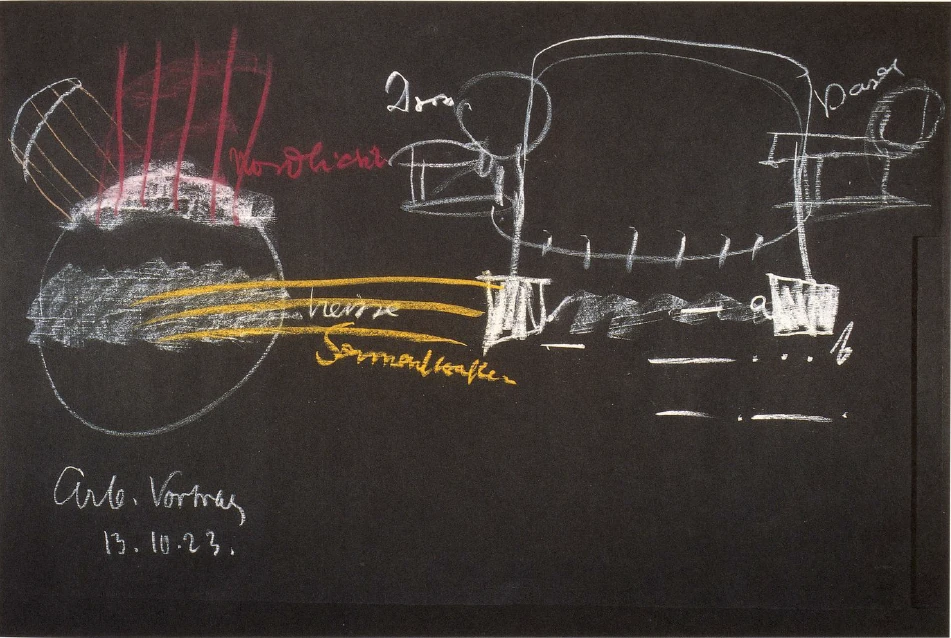
[ 23 ] In kalten Gegenden, da ist das nicht so, da hat die Sonne wenig Kraft. Da ist dafür das zurückgeworfene Sonnenlicht, das Licht des Mondes besonders tätig, und dieses Licht bewirkt, daß der Schnee sich zu Kristallen bildet, daß das Eis die Eisblumen gibt. Bei uns entsteht das nur, wenn eben im Winter die Sonne an Kraft verliert. Aber in den Gegenden des ewigen Eises, am Nordpol oder auf den hohen Bergen, da bilden sich, weil die Sonne auch keine Kraft hat, weil die Sonne die Kraft erst entwickeln kann in der dichten Luft, diese schönen Formen des Eises.
[ 23 ] In cold regions, that’s not the case; there, the sun has little power. Instead, the reflected sunlight and the moonlight are particularly active, and this light causes the snow to form crystals and the ice to produce ice flowers. Here, this only happens when the sun loses its strength in winter. But in regions of perpetual ice, at the North Pole or on high mountains—where the sun also has no strength, since the sun can only develop its strength in dense air—these beautiful ice formations take shape.
[ 24 ] Wir bekommen schon, wenn wir so in die Natur hineinschauen, einen wunderbaren Eindruck! Wir bekommen den Eindruck, daß überall, wo die Sonne hineinscheint, Leben wird, Leben, das zerfließt und verdunstet, das sich ausbreitet. Überall wo der Mond hineinwirkt, entstehen Gestalten, Bildnisse. Das ist schon ein mächtiger Eindruck, den man da bekommt. Und diese Dinge durchschaut man nur, wenn man eben aufs Geistige eingehen kann. Es ist ja wirklich so, daß man sagen muß: In der Lunge, wo derMensch also eigentlich denSchleim erzeugt, da wirken auch die Mondenkräfte. Und sie wirken so, daß sie nicht das direkte Sonnenlicht brauchen, sondern daß sie das zurückgeworfene Sonnenlicht verwenden. Wenn daher hier im Norden die Mondenkräfte vorzugsweise tätig sind, die Sonne sich ausschaltet, dann kommt noch etwas anderes; dann wird die Luft da drüber so, daß etwas, was hier immer in der Erde drinnen ist, herausgeht. In der Erde nämlich ist überall Magnetismus und Elektrizität drinnen. Die Erde ist ganz voll von Magnetismus und Elektrizität. Daß in der Erde überall Magnetismus und Elektrizität ist, das können Sie daraus sehen: Nicht wahr, wenn Sie auf einer Station einen Telegraphenapparat haben (es wird gezeichnet), wenn das also zum Beispiel in Dornach ist, dann haben Sie hier einen, sagen wir in Basel; da können Sie hinein telegraphieren; aber man kann nur telegraphieren, wenn ein Draht geht. Drähte müssen ja durch die Luft gehen; nur dann kann man telegraphieren. Aber das genügt nicht, wenn Sie hier einen Telegraphenapparat aufstellen würden und einen in Basel, und einen Draht ziehen! Da könnten Sie noch so lange mit dem Taster hintelegraphieren: Sie würden hinkommen nach Basel, aber Sie müssen wiederum zurück verbinden, es muß ein geschlossener Strom sein. Und wenn Sie das machen, dann können Sie hier telegraphieren, es kommen dann dort die Zeichen an. Sie wissen ja - das sage ich nur der Vollständigkeit wegen -: da ist hier so umgewickelt ein Papierstreifen, und wenn eine Spitze auf diesen Papierstreifen drückt, entsteht entweder ein Punkt oder ein Strich, wenn es lange drückt, und aus Punkten und Strichen ist dann das telegraphische Alphabet zusammengesetzt, a ·-, b -···, c -·-·. Aber das Merkwürdige ist: Man braucht diesen zweiten Draht doch nicht, wenn man von dem Apparat in die Erde einen Draht hineinleitet und da eine Kupferplatte hineinlegt, und dort auch wiederum eine Platte hineinlegt; den Draht können Sie dann wegtun, denn dann ist eine Verbindung da. Warum? Weil die Erde selber Elektrizität hat und von der einen Platte zu der anderen die Elektrizität geleitet wird. Die Erde ersetzt sich selber den Draht durch ihren eigenen Stoff. Die Erde ist nämlich ganz voll von Elektrizität. Aber wenn die Sonne auf die Erde scheint, wie am Äquator, in der heißen Gegend, da wird diese Elektrizität, wenn sie in die Luft herauskommen will, sogleich vernichtet. Das Sonnenlicht ist eine Kraft, die die Elektrizität auslöscht. Aber da, wo die Sonnenwirkung schwach ist, da geht die Elektrizität hinauf, in die Luft hinein, und man sieht sie, wie sie oberhalb der Erde ist. Sehen Sie, meine Herren, das Nordlicht ist die elektrische Kraft der Erde, die unter dem Einfluß der Mondenkräfte ausströmt. Daher ist das Nordlicht in unseren Gegenden sehr selten; aber es ist häufig, fast immer da in nördlichen Gegenden.
[ 24 ] Just by looking into nature like this, we already get a wonderful impression! We get the impression that wherever the sun shines, life comes into being—life that flows away and evaporates, that spreads out. Wherever the moon exerts its influence, forms and images arise. That is indeed a powerful impression one receives. And one can only perceive these things if one is able to attune to the spiritual realm. It is truly the case that one must say: In the lungs, where human beings actually produce mucus, the forces of the Moon are also at work. And they work in such a way that they do not need direct sunlight, but rather make use of the reflected sunlight. So when the lunar forces are primarily active here in the north—and the sun is not present—something else happens; the air above becomes such that something which is always contained within the earth is released. For there is magnetism and electricity everywhere within the earth. The earth is completely filled with magnetism and electricity. You can see that there is magnetism and electricity everywhere in the earth from this: Isn’t it true that if you have a telegraph machine at a station (it is being drawn)—for example, if it is in Dornach—then you have one here, let’s say in Basel; you can send a telegram there; but you can only send a telegram if there is a wire. Wires must, of course, run through the air; only then can you send a telegram. But that’s not enough if you were to set up a telegraph machine here and one in Basel and run a wire between them! No matter how long you pressed the button to send a telegram, the signal would reach Basel, but you’d have to make a return connection—it has to be a closed circuit. And once you do that, you can send a telegram from here, and the signals will arrive there. As you know—I’m only mentioning this for the sake of completeness—there’s a strip of paper wound around here, and when a stylus presses against this strip of paper, it creates either a dot or a dash if it presses for a long time, and the telegraphic alphabet is then composed of dots and dashes: a ·-, b -···, c -·-·. But here’s the strange thing: you don’t actually need that second wire if you run a wire from the device into the ground, place a copper plate there, and place another plate there as well; you can then remove the wire, because a connection is already established. Why? Because the earth itself contains electricity, and that electricity is conducted from one plate to the other. The earth itself replaces the wire with its own material. The earth is, in fact, completely full of electricity. But when the sun shines on the earth—as at the equator, in hot regions—this electricity is immediately destroyed as it tries to escape into the air. Sunlight is a force that extinguishes electricity. But where the sun’s influence is weak, the electricity rises into the air, and one can see it high above the Earth. You see, gentlemen, the Northern Lights are the Earth’s electrical force, which radiates under the influence of the Moon’s forces. That is why the Northern Lights are very rare in our regions; but they are frequent, almost always present in northern regions.
[ 25 ] Da ist wiederum so ein Punkt, wo die Wissenschaft an einer bestimmten Stelle nicht weiter kann. Natürlich weiß diese Wissenschaft heute, daß die Erde voll von Elektrizität ist. Diese Wissenschaft schaut auch immer das Nordlicht an. Aber wenn Sie in den Büchern nachlesen, was eigentlich dieses Nordlicht ist, so glauben die Leute immer, das ist etwas, was von der Welt hereinströmt auf die Erde. Das ist aber ein Unsinn, es strömt nicht herein, sondern es strömt gerade heraus! Was da die Wissenschaft mit dem Nordlicht macht, ist deshalb so interessant, weil es gleich dem ist, wenn irgendeiner seine Schulden mit seinem Kapital verwechselt. Das ist schon so. Nicht wahr, im Menschenleben macht das etwas aus, wenn man seine Schulden mit seinem Vermögen verwechselt. Aber die Wissenschaft, die kann das ungestraft tun, die kann das Nordlicht ansehen als etwas, was aus der Welt hereinströmt, während das Nordlicht in Wirklichkeit etwas ist, was von der Erde herausströmt. Aber in den heißen Gegenden, da wird es gleich in Empfang genommen vom Sonnenlicht, und da wird es ausgelöscht. In den nördlichen Gegenden, da ist das Mondenlicht vorzugsweise tätig, wenn es scheint; und wenn es nicht scheint, so bleibt es tätig in der Nachwirkung, und da wird das Nordlicht, die ausströmende Elektrizität, sichtbar. Nun, dieses Nordlicht ist dort besonders stark, weil die Mondenkräfte besonders stark sind. Es ist eigentlich überall etwas Nordlicht, nur sieht man es nicht, weil es schwach ist. In unseren Gegenden ist das Nordlicht, das heißt eben die ausströmende Elektrizität, auch schwach. Aber in der drahtlosen Telegraphie ist es so stark, daß es wirkt. Dasjenige, was in der drahtlosen Telegraphie wirkt, ist dasselbe, was man im Nordlicht leuchten sieht. Da haben Sie den Grund. Die Elektrizität im Verein mit dem Mondenlicht, die macht die Eisblumen und die Schneekristalle. Sie müssen Nordlicht und Mondschein studieren, wenn Sie die Eiskristalle, die Eisblumen und Schneekristalle studieren wollen. Weil im Winter die Sonnenkraft geringer ist, die Mondenkraft dadurch die Oberhand bekommt und die Elektrizität weniger bei uns ausgelöscht wird, wird der Schnee in so schöne Kristalle hineingestaltet. Das ist Mond und Elektrizität zusammen, was die schönen Kristalle bildet, was die Eisblumen verursacht.
[ 25 ] Here again is one of those points where science reaches a dead end. Of course, science today knows that the Earth is full of electricity. Science also constantly observes the Northern Lights. But if you look up in the books what the Northern Lights actually are, people always believe they’re something that flows in from outer space onto Earth. But that’s nonsense—it doesn’t flow in; it actually flows right out! What science does with the Northern Lights is so interesting precisely because it’s just like when someone confuses their debts with their capital. That’s certainly true. Isn’t it the case that in human life, it makes a difference if you confuse your debts with your assets? But science can get away with it; it can view the Northern Lights as something that flows in from the world, whereas in reality the Northern Lights are something that flows out from the Earth. But in the hot regions, it is immediately absorbed by sunlight and thus extinguished. In the northern regions, moonlight is primarily at work when it shines; and when it does not shine, its aftereffects remain active, and that is when the Northern Lights—the outflowing electricity—become visible. Now, the Northern Lights are particularly strong there because the moon’s forces are particularly strong. There is actually some Northern Lights everywhere; you just can’t see it because it’s faint. In our regions, the Northern Lights—that is, the radiating electricity—are also faint. But in wireless telegraphy, they are strong enough to have an effect. What is at work in wireless telegraphy is the same phenomenon that you see glowing in the Northern Lights. There you have the reason. Electricity, combined with moonlight, creates the ice flowers and snow crystals. You must study the Northern Lights and moonlight if you want to study ice crystals, ice flowers, and snow crystals. Because the sun’s power is weaker in winter, the moon’s power gains the upper hand, and electricity is less likely to be extinguished here, the snow is shaped into such beautiful crystals. It is the combination of the moon and electricity that forms these beautiful crystals and causes the ice flowers.
[ 26 ] Nun habe ich Ihnen ja gesagt, erinnern Sie sich nur: Wenn einer zuwenig Mondtätigkeit hat, wenn einer zuviel Sumpfgas entwickelt in seinem Kopf, so wird er, wie der Volksmund sagt, ein «Sumser», das heißt ein Dummkopf. Und da entwickelt er also zuwenig Mondenkraft in sich. Nun, was muß man denn also haben in seinem Kopf? Man muß alles das, was vom Mond kommt, die Kohlensäure von der Atmung, den Schleim von der Lunge, die muß man in den Kopf hineinkriegen, also eine Kraft, die da im Kopf fortwährend Kristalle bilden will. Schnee, meine Herren, möchte sich fortwährend in unserem Kopf bilden; wir lösen ihn nur immer wieder auf. Aber der will sich bilden. Denken Sie, meine Herren, Sie haben eigentlich alle in Ihren Gehirnen ein ganz merkwürdiges Organ. Nämlich, wie Herr Seefeld dem Herrn Burle diese schönen Schneekristallfiguren gezeigt hat, da hat ihn das interessiert, und da hat er sich gedacht: Das muß interessant sein, was da eigentlich für ein Zusammenhang ist. Ja, da hat der Herr Burle diese Schneekristalle in sich photographiert! Es ist so, wie wenn man eine ganz geschwinde Photographie machte, und das, was flugs entsteht, wieder verschwindet, wenn man durch die Nasenlöcher ausatmet. Wenn man rasch photographieren könnte, was da drinnen im Kopfe von Herrn Burle vorgeht, oder in Ihren Köpfen allen, so würde man dieselben Photographien finden. Es würden sich solche Stückchen bilden von Schneekristallen, von Eisblumen, Fensterblumen; die könnten photographiert werden von Ihren Ätherköpfen, und die wären gleich! Ihr Kopf ist ein ganz merkwürdiges Ding. Wenn Sie einen solchen Photographenapparat hätten, wie es ihn ja noch nicht gibt- man müßte es furchtbar schnell machen, weil es sich immer sogleich auflöst-, so würden Sie finden: Da schauen wir ja aus in unserem Gehirn wie ein recht schönes Stückchen Schnee oder wie ein recht schönes Eisblumenfenster!- Es muß gleich wieder verschwinden, sonst würden sie uns stechen, diese spitzen Kristalle, wir würden nicht mit ihnen denken. So daß also, wenn wir hinausschauen auf den Schnee, oder wenn wir hinausschauen auf unsere Fensterblumen, Eisblumen, wir uns da sagen können: Donnerwetter, das ist ja dasselbe, was in unserem eigenen Kopf vor sich geht!- nur daß dieses da sich immer wieder schnell auflöst. Es denkt ja die ganze Natur! Und im Winter, wenn es kalt wird, fängt sie erst recht an zu denken. Im Sommer ist es ihr nur zu warm zum Denken. Da läßt sie die Sonne auseinanderstieben und macht sie zu Nahrungsmitteln und so weiter. Aber im Winter, wenn es kalt ist, bilden sich die Gedanken im Schnee, im Eis. Wenn da draußen keine Gedanken wären, hätten wir in unserem Kopfe auch keine. Also Sie sehen, es ist eigentlich wunderschön, dieses Entsprechen von der Natur draußen im Winter, wo die Natur so gescheit wird, daß sie das sichtbar, äußerlich macht, was in unserem Kopfe immer als unsere Gescheitheit vor sich geht. Wir können überall in der Natur sehen, was in uns selber vor sicht geht. Wir müssen es nur in der richtigen Weise auffassen.
[ 26 ] Now, I’ve told you this before—just remember: If someone has too little lunar activity, if someone produces too much swamp gas in their head, then they become, as the saying goes, a “Sumser”—that is, a fool. And so they’re not developing enough lunar power within themselves. Well, what, then, must one have in one’s head? One must take in everything that comes from the moon—the carbon dioxide from breathing, the mucus from the lungs—and get it into the head, that is, a force that constantly seeks to form crystals there. Snow, gentlemen, constantly wants to form in our heads; we just keep dissolving it. But it wants to form. Just think, gentlemen, you actually all have a very remarkable organ in your brains. Namely, when Mr. Seefeld showed Mr. Burle those beautiful snow crystal formations, it piqued his interest, and he thought to himself: It must be interesting to understand what the connection actually is. Yes, Mr. Burle photographed these snow crystals within himself! It’s as if one took a very quick photograph, and what appears in an instant disappears again when one exhales through the nostrils. If one could quickly photograph what’s going on inside Mr. Burle’s head—or in all of your heads—one would find the same photographs. Such tiny fragments would form—snow crystals, ice flowers, window flowers; they could be photographed from your etheric heads, and they would be exactly the same! Your mind is a truly remarkable thing. If you had a camera like that—which, of course, doesn’t exist yet—you’d have to take the picture incredibly fast, because it dissolves instantly—then you’d find: We look, inside our brains, just like a beautiful little piece of snow or a beautiful window covered in ice flowers! - It has to disappear right away, otherwise these sharp crystals would prick us; we wouldn’t be able to think with them. So when we look out at the snow, or when we look out at our window frost—ice flowers—we can say to ourselves: Good heavens, that’s exactly the same thing that’s going on inside our own heads!—only that this one dissolves quickly over and over again. All of nature thinks, after all! And in winter, when it gets cold, it really starts to think. In summer, it’s just too warm for nature to think. Then it lets the sun scatter and turns it into food and so on. But in winter, when it’s cold, thoughts form in the snow, in the ice. If there were no thoughts out there, we wouldn’t have any in our heads either. So you see, it’s actually beautiful—this correspondence with nature out there in winter, when nature becomes so wise that it makes visible, externally, what’s always going on inside our heads as our own wisdom. We can see everywhere in nature what’s going on within ourselves. We just have to perceive it in the right way.
[ 27 ] Nun, aber das alles hat eine große, auch praktische Bedeutung. Denken Sie also, meine Herren, einer bekommt, sagen wir, eine ganz bestimmte Art von Kopfkrankheit dadurch, daß er zuwenig Schleim absondert. Man kann dadurch eine Kopfkrankheit bekommen. Wenn man dann, wenn einer zuwenig Schleim absondert, ihm etwas kieselsaures Eisen gibt als Heilmittel, dann übernimmt auch wiederum dieses kieselsaure Eisen die Schleimabsonderungstätigkeit und stößt ihm den Schleim in den Kopf hinauf, und man kann damit wiederum Heilung hervorrufen. Sehen Sie, das ist ja der Unterschied der anthroposophischen Medizin von der anderen Medizin, die nur immer probiert. In der Anthroposophie lernt man, daß ein Mensch, der eine bestimmte Kopfkrankheit hat, zu schwach ist, um in seinem Gehirn Kristalle zu bilden, dieses immerwährende Entstehen und Vergehen von Eisblumen. Nun muß man ihm helfen. Das kann man durch bloße Kieselsäure. Wenn Sie hinaufgehen auf die hohen Berge und dort den schönen Quarz sehen, der ist Kieselsäure. Er ist ein wunderschöner Kristall. Der hat die Tendenz, diese Kristalle zu bilden. Wenn Sie diesen Quarz entsprechend behandeln, so kriegen Sie ja das auch unter unseren Heilmitteln so wirksame Kieselsäurepräparat. Und dieses Kieselsäurepräparat ist so wirksam für alle Krankheiten, die vom menschlichen Kopf ausgehen. Bildet er vom Inneren nicht Kristalle, so muß man ihm von außen durch solche schönen Kristalle, die solche schöngebildete Kristallbildungen in sich haben, zu Hilfe kommen. Aber wenn er vor seinem schönen Schneefenster mit den Eisblumen in seiner Stube steht wie der Ochse am Sonntag, wenn er die ganze Woche Gras gefressen hat, wie es unsere Wissenschaft tut, ja, dann steht er auch mit der Wissenschaft so vor dem Menschenkopf; dann kann er ja nichts machen, weil er nichts darüber weiß. Alle diese Dinge zeigen Ihnen, wie man durch eine wirkliche Erkenntnis des Menschen die Wissenschaft vertiefen muß.
[ 27 ] Well, but all of this has great significance, including practical implications. So consider this, gentlemen: a person develops, let’s say, a very specific type of mental illness because he secretes too little mucus. One can develop a mental illness as a result. If, then, when someone secretes too little mucus, you give him some ferric silicate as a remedy, this ferric silicate in turn takes over the function of mucus secretion and pushes the mucus up into his head, thereby bringing about a cure. You see, that is precisely the difference between anthroposophical medicine and other forms of medicine, which merely keep trying different approaches. In anthroposophy, we learn that a person suffering from a specific brain disorder is too weak to form crystals in their brain—that constant process of the formation and dissolution of ice flowers. Now we must help them. This can be done simply with silicic acid. When you go up into the high mountains and see the beautiful quartz there—that is silicic acid. It is a magnificent crystal. It has the tendency to form these crystals. If you process this quartz appropriately, you obtain the silicic acid preparation that is so effective among our remedies. And this silicic acid preparation is so effective for all illnesses that originate in the human head. If the body does not form crystals from within, then one must come to its aid from the outside through such beautiful crystals, which contain such beautifully formed crystalline structures within them. But when it stands in front of its beautiful snowy window with the ice flowers in its room like an ox on Sunday—after having eaten nothing but grass all week, just as our science does—well, then it stands before the human head just as science does; then it can do nothing, because it knows nothing about it. All these things show you how science must be deepened through a true understanding of the human being.
[ 28 ] Das geht dann natürlich bis in die Erziehungskunst hinein, weil man erst wissen muß: Wenn man dem Menschen meinetwillen selbst die Buchstaben beibringt, so ist das eine so starke Mondentätigkeit, daß es, wenn es zu stark gemacht wird, wenn es unrichtig gemacht wird, ganz austilgt die Kristallisationskraft des Ätherkopfes. Der Mensch kann, es ist wirklich so, durch vieles Lernen noch dümmer werden, wenn er nämlich nicht in der richtigen Weise lernt. Es ist schon so. Aber damit man das einsieht, werden wir das nächste Mal noch etwas zu besprechen haben. Es ist nötig, dies alles zu wissen.
[ 28 ] This, of course, extends into the art of education, because one must first understand: If one teaches a person the letters of the alphabet simply for their own sake, this is such a powerful lunar influence that, if done too strongly or incorrectly, it completely eradicates the crystallizing power of the etheric head. It is truly the case that a person can actually become even more foolish through excessive learning, if they do not learn in the right way. That is indeed the case. But in order to understand this, we will have more to discuss next time. It is necessary to know all of this.