

Man and World
How Spirit Works in Nature
GA 351
13 October 1923, Dornach
Translated by Steiner Online Library
3. People and the Earth in the North and South
[ 1 ] Good morning, gentlemen! Perhaps something in the last lecture caught your attention in particular, so that you would like to ask a follow-up question?
Questioner: Yesterday, Mr. Seefeld showed me a photograph of snowflakes. Their shapes come from outer space. It really intrigued me; there’s a connection there. It’s given me a lot to think about.
[ 2 ] Dr. Steiner: I will try to explain this to you in context as well, particularly because it will then easily tie in with what we discussed last Monday. As I have often pointed out to you, the human being is a very complex creature. This isn’t so evident from a person’s outward appearance, but rather from their inner being—including their physical inner constitution. For example, I can point out to you that in regions classified as the so-called “hot zone,” where it is warm for most of the year and where a very short, rainy winter alternates with the heat —let’s say in southern Egypt, or let’s say in India—that the people there actually look quite different on the inside than those in places where it is constantly cold, such as the regions near the North Pole. Regions near the North Pole do, in fact, have a great deal of what you just asked about; they possess a great deal of the forces that then express themselves in the beautiful forms of snowflakes. So we can say: We have regions on Earth that are intensely warmed and illuminated by the sun, where the sun has a great influence, and we have regions where the sun actually has little influence—where snow and ice prevail. - As you know, it’s not just snowflakes that have beautiful, all kinds of wonderful shapes—snowflakes have, first of all, shapes that tend toward the hexagon, but also all kinds of other shapes (drawing on p. 52)—but you have certainly also looked out the window in winter, when there is ice there, when the water freezes, which otherwise covers the entire window surface as mist; there you have seen what beautiful flowers form there, beautiful figures into which the water takes shape. So we can say: The water, which is the basis of both snow and ice—for when it gets warm again, both the snow and the ice melt back into water—forms the most beautiful figures when the sun isn’t very strong. Of course, these cannot be inside the water itself. For something that forms its own shape from within retains that shape. After all, you all have a form as well. But one cannot say of the human form that you all possess it only in images—a form that melts away when the sun comes out. That would be terrible; it does not do that. The water does not possess this form within itself; it comes from outside.
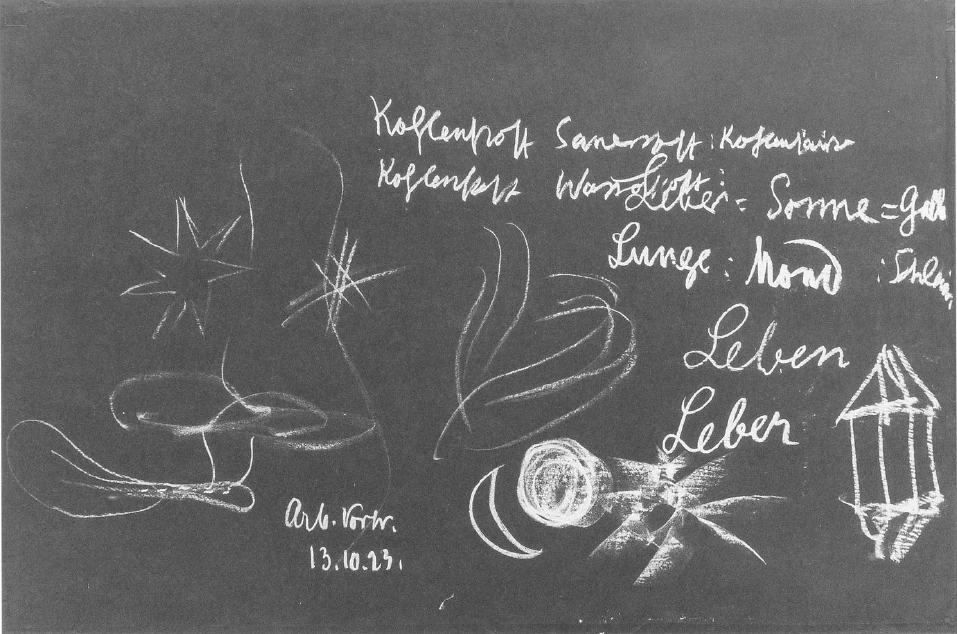
[ 3 ] Now let’s examine where water gets the shape that creates these beautiful patterns in both snow crystals and ice flowers. That will be the answer to your question.
[ 4 ] When one asks oneself such a question, one must always be able to take the whole person into account. Now, there are two organs in the human body; these are different in a person where the sun has great power throughout the year, as in the hot regions of southern Egypt and India. The internal structure of these organs differs in such people from that of people living in regions where, so to speak, it is cold all year round—where nature has a tendency to form snow crystals and ice flowers, as is the case with the Eskimos. They live up there, where snow and ice tend to prevail, and where water rarely melts. But now let’s take a look at their outward appearance. People will say: Well, yes, people in hot regions may be somewhat taller on the outside; but the Eskimos—they’re small people. —But that is not what makes the difference; rather, the major distinction between people in the hot zone and the Eskimos—the people of the cold zone—lies in the difference in the structure of their livers and lungs. The Eskimos have lungs that are relatively large and livers that are relatively small in proportion to their bodies, while people in the hot zone have relatively smaller lungs and larger livers. So you see, people in regions where ice flowers and ice crystals form differ from others in that they have a relatively small liver and a relatively large lung in proportion to their bodies. And among people in regions where nature does not tend to form such figures—where the sun always melts everything and clears it away—there is the peculiarity that they have relatively small lungs and large livers. Whenever we ask about something in nature—including ice flowers—we must always look to human beings. If one does not start with human beings, one understands nothing in nature, absolutely nothing.
[ 5 ] So here’s the thing: The human liver is a very important organ. If a person didn’t have a liver, they wouldn’t have bile, because the liver constantly secretes bile. Bile comes from the liver, flows into the gallbladder, from there into the digestive juices, from there into the blood, and then spreads throughout the entire body. So we can say: The human liver is located on the right side; bile flows from the liver into the gallbladder, from there into the blood, and spreads throughout the entire body. - So, in essence, the human body has a liver for the purpose of secreting bile.
[ 6 ] You might now ask: “Yes, but why does the liver constantly produce this bile?”—Gentlemen, if you had no bile, you would be strange people. It is naturally distributed in very small quantities, but it must be present throughout the entire body. If you didn’t have bile, you’d be terrible phlegmatics; your hands, arms, and head would hang limply, and you’d find it repulsive to have to say a single word in reply to anyone, and so on. So you’d be completely listless, phlegmatic people if you didn’t have bile. A person must have bile; bile must come from the liver. And if the liver is relatively small, then the person becomes phlegmatic; if the liver is relatively large, then the person has a lot of fire within them, because bile creates fire. And you see, a person can also have too much bile—they can produce too much bile; then, if you say even the slightest thing to them, they’re actually eager to lash out at you. Especially in the case of hot-tempered people, bile flows diligently from the liver; a great deal of bile spills over into the digestive juices and into the blood. So that, if you observe a person inwardly—someone to whom you say something, or who takes particular offense at something—a great deal of bile immediately flows out of the liver and spreads very quickly throughout the entire body, and he’ll lash out at you or rant and rave like a madman. That is what one observes internally when a person has too much of a tendency to secrete bile. But as I said, if he didn’t secrete any bile at all, he wouldn’t have any fire at all, but would just shuffle along as I’ve told you. So you see, bile secretion is something that is absolutely essential to human physiology. I don’t know if any of you have ever tasted bile: it tastes terribly bitter, truly poisonous, and a large amount of bile actually ingested through the mouth is also a poison. This ties in with what I told you last Wednesday. I had told you: When a person comes alive, moves, walks—even when they’re ranting and lashing out at you—yes, there’s so much poison involved that they tend to produce a lot of the cyanide I’ve been talking about. They have to mix this with their blood. I’ve already encountered many cases where people have developed internal blood poisoning simply because of their anger. One can become so angry—especially if one is quick to anger—that this anger causes one to secrete an excessive amount of bile—actually, initially a lot of cyanide, then bile. Then a terrible mixture of toxins enters the blood, and that is how the blood is ruined. A terrible blood poisoning results from the anger. From this you can see how necessary—and yet how harmful—it can be for a person when any organ of the body acts in a certain way. For everything that happens is, in turn, connected to the soul. Anger is a soul phenomenon; the secretion of bile is a physical phenomenon; but there is nothing in a human being that is not at the same time a soul phenomenon, and everything that is a soul phenomenon has, in some way, a physical form.
[ 7 ] Let’s continue. Let’s now suppose that a person is very frequently exposed to what is often called a cold—specifically, stomach colds. So, a person gets stomach colds very often; then their stomach says: “Yes, I’m like an Eskimo; I’m like I’m in a cold region of the Earth.” - And then it happens that the abdomen constantly contracts the liver, so that it becomes small, just like an Eskimo’s. So if a person has a lot of stomach colds, their liver contracts, and then it squeezes out the bile. Bile constantly drips into the gallbladder and from there into the body.
[ 8 ] Well, gentlemen, you have all experienced what is called, for example, overexertion. When you lift something that is too heavy for you, you tear your muscles apart; you destroy your muscles. If you exert too much force on any organ, you destroy that organ. The same is true of the liver. If it constantly secretes too much bile, the liver gradually shrinks and becomes dysfunctional. Thus, most liver diseases that people develop arise because abdominal chills have caused them to secrete too much bile, leading to atrophy of the liver. Liver diseases result from abdominal chills, which cause the liver to shrink. Of course, all sorts of other conditions contribute to this as well. When a person has abdominal chills, the heart does not function properly. Doctors then say that liver diseases originate in the heart. But in reality, they stem from the fact that the abdomen became chilled.
[ 9 ] But all of this—as you can already gather from what I’ve told you—has to do with the sun. That’s why it’s always very beneficial, when someone is suffering from a stomach cold, to expose their lower abdomen to the light. Sun therapy, for example, is exceptionally beneficial. So we must say: Everything related to the liver is also related to the sun. Sun exposure promotes liver function. A lack of sun exposure disrupts liver function. There is a very interesting connection between the sun and the liver.
[ 10 ] I have always admired the fact that the German language has the word “Leber.” No other language has such a beautiful word for this organ located on the right side of the lower abdomen. For, based on what I have just explained to you, we must say that fire—even that which comes to humans from the sun, this life-giving fiery force—must first be properly processed in the liver for the human being; there, the bile must be prepared for him, which then passes into his body. The sun prepares the bile within the human being. What a person does there is what we call “living,” and the one who kindles this life can be called a “liver.” Just as we say: “car,” “carriage-maker,” “draw,” “drawer”—so “living” is the verb, and “liver,” “the liver”—we’ve simply forgotten that this is the case; we say “the liver” instead of “the liver”; actually, it’s “der Leber”—that is what gives life! Language is sometimes wonderfully instructive, because there has always been a body of knowledge present in the ancient folk instincts, and there, things were named correctly. “Leber” is what fuels, what gives life to human beings. This is what must be said regarding the liver. Now, when we consider the liver in terms of its secretion of bile, we must say: The secretion of the liver is that which is connected to the sun.
[ 11 ] Now let’s move on to the lungs. We’ve discussed this many times, and as you know, the lungs breathe. But the fact that the lungs take in oxygen—that is, breathe—is only part of their function. The lungs have another function as well. Just as the liver secretes bile, the lungs secrete what is called mucus. So the lungs secrete mucus. Just like the liver, the lungs cannot retain what they contain within themselves. The liver cannot fill itself completely with bile; it must release the bile into the body. But the lungs must constantly secrete mucus—they must secrete mucus continuously. And now, when the lungs secrete mucus, that mucus then spreads to all other parts of the body. It is excreted in sweat; it even enters the exhaled air; it is excreted in urine; it goes everywhere—the mucus. But the organ that secretes the mucus is the lungs.
[ 12 ] If you examine the air that a person exhales, you will discover something wonderful. The key is not to examine the air exhaled from the mouth, as that is too irregular; instead, you must examine the air exhaled from the nostrils.
[ 13 ] It’s very interesting when someone exhales quite slowly. You have to be very careful here: if you breathe onto a glass pane, the exhaled breath creates something similar to what happens with snow. You have to do it very carefully—for example, by holding your left nostril closed as you exhale, breathing out slowly through your right nostril onto the glass plate in front of you, and then through your left. You have to breathe very slowly, because if you breathe quickly, the force of the breath will blur the whole thing. You have to breathe very gently and softly. You actually have to learn how to do this first. But here’s the interesting part: when you breathe through one nostril, the exhaled air creates patterns on the glass plate just like snow! The exhaled air isn’t just a little speck on the surface, but a distinct shape. And what I’d say is incredibly interesting about this is that if you close your left nostril and exhale, you get one shape; if you close your right nostril and exhale, you get a different shape. They aren’t even the same shapes! So we can say: The air coming out of you—out of your very being—takes the form of shapes. It doesn’t just come out as droplets; it comes out as shapes—and it’s so remarkable that the left nostril produces a different shape than the right nostril.
[ 14 ] Well, gentlemen, what is contained in the exhaled air—which, because it contains water vapor, forms these shapes that evaporate almost immediately but do form these shapes—is the mucus that passes from the lungs into the exhaled air. It forms these patterns. The mucus, so to speak, binds the individual, tiny water droplets together into such patterns. So that in your lungs, you don’t simply have a tendency to expel mucus in any random shape, but rather you have a tendency to actually exhale or expel the mucus from your lungs in the form of crystals—in crystals! But these crystals evaporate immediately, dissolve right away, because they’re exposed to the sun.
[ 15 ] Just as the gallbladder is related to the sun through the liver, so too are the lungs—with their secretion of mucus—related to the moon. We know, as I’ve told you, that carbon dioxide rises up into the head, and I’ve shown you that if a person didn’t send carbon dioxide up into their head, they would become stupid. This tingling carbon dioxide, which is constantly carried up into the head in very small amounts, is what makes us intelligent people. We’re all such terribly intelligent people, aren’t we! You know, when you drink a fizzy drink, it tingles; you can feel that very strongly. But humans always produce carbon dioxide very weakly. They send it up into the head. And this tingling in the head makes the mind active; that’s why they’re smart and not stupid. Those people who are truly stupid—I don’t know if such people even exist—don’t have enough energy to combine carbon with oxygen, so they don’t send carbon up; instead, they combine carbon with a completely different gas. So the person who is smart combines carbon with oxygen: that’s how the tingling carbon dioxide is produced. But as I said, those people who are truly stupid do not combine carbon with oxygen, but with hydrogen. So they combine carbon with hydrogen, and that produces the gas sometimes found in mines: mine gas, marsh gas. We all send some of this mine gas to our heads; we need it, too, otherwise we’d become too smart. So that we can always remain a little dull—and not be smart all the time—we also produce marsh gas. But those who become too stupid produce too much marsh gas. In people who are reasonably smart, carbon dioxide goes to the head. That gives a tingling sensation. And when a lot of swamp gas has gradually accumulated, they become drowsy—that’s when sleepiness sets in. This happens at night, when a lot of swamp gas builds up. Only in those who are stupid does swamp gas develop even while they’re awake. So the carbon dioxide has to keep rising. But carbon dioxide alone isn’t enough: mucus has to travel from the lungs to the head. It even exits through the nostrils in the form of crystals, just as it does in the liver and gallbladder. Well, that should be clear to you from the description I gave on Wednesday.
[ 16 ] Just as the liver is connected to the sun, so too are the lungs connected to the moon. Take a look at the moon. The moon is simply very different from the sun. When you look at the sun, it is round, but it actually radiates its rays in all directions. The sun shines in all directions; it flows out in all directions, just as bile flows in all directions within the human body. One can then compare the sun’s flowing out, its spreading, to the flow of bile. But the moon—yes, gentlemen, when you look at the moon, it always has a very specific shape. The moon is quite solid. And its inner nature is such that the substance constituting the moon crystallizes, just as the forms of exhaled air that come out of the nose are crystallized. The lunar forces are at work there, just as the solar forces are at work in the liver and gallbladder. The lunar forces are at work in the lungs, and the moon brings about this secretion of mucus.
[ 17 ] Now we can say: Let’s go to the hot regions—yes, there the sun exerts its power. It causes everything to melt; people become filled with fire. This fire does not merely dwell in sudden anger, but it also lives in beautiful things and in the beautiful wisdom of zeal. People become filled with fire. If we go to cold regions, then in these cold regions—where the sun lacks the power to act, where, in particular, the moon shines down into the freezing cold on cold nights—the lungs, which become relatively enlarged, must work very hard: a great deal of mucus is secreted. And those who are not accustomed to this catch a cold; they secrete too much mucus.
[ 18 ] You see, gentlemen, now you also have the cause of lung diseases. The lungs must secrete a certain amount of mucus, just as the liver must secrete a certain amount of bile. But just as the liver ruins itself when it secretes too much bile, so too do the lungs ruin themselves when they secrete too much mucus. This is the case with lung diseases. The lungs are stimulated by what they experience to secrete too much mucus. So imagine this: instead of living in moderately humid air, or even slightly humid air, you’re living in very humid air—then the lungs have to work very hard. But when the lungs exert themselves, they secrete mucus. And that is when the lungs begin to become ill—because they have to work too hard from breathing in too much humid air. And when a person develops a lung disease, they cough up phlegm; little by little, they cough up their entire lungs when they are too sick.
[ 19 ] One can then help the lungs by preparing a specific remedy. One must not use roots for this, but must use the leaves of plants to prepare a specific remedy from them. This is the case, for example, with very specific plant species. If one extracts the sap correctly and prepares certain remedies, one can help the lungs when they are overactive. For such remedies have the property of taking over the work of the lungs; then the lungs exert themselves somewhat less. The healing process therefore usually consists of asking oneself: The lungs are secreting too much mucus; this is a sign that they are working too hard. Well, what should I do? I look for a plant whose sap can take over the work of the lungs.
[ 20 ] Or I notice that the liver is secreting too much bile: I look for a plant that can take over the liver’s function. For example, there is a plant called Cichorium intybus, or chicory. If you prepare the juice from the root of this plant as a remedy and administer it to a person, it takes over the liver’s function, and you may find that, although the person does not initially secrete less bile and their emotional outbursts of anger do not subside at first, their liver gradually regains its strength and improvement gradually sets in.
[ 21 ] So this is how you help a person: by knowing, for example, that the sap from the leaves—not the roots—of certain types of cabbage can support specific lung functions, and that the sap from the root of Cichorium intybus—it grows out there too; you’re all familiar with it; it has those blue flowers—is particularly beneficial for the liver.
[ 22 ] So we can say: In hot regions, water melts; heat—the sun’s heat—dissolves everything. —When the sun is less active, when its power wanes or remains weak throughout the year, as in northern regions, the moon becomes all the more powerful. When the direct rays of the sun are not active, these remarkable rays of the sun—reflected by the moon—take effect. And it is these that create the crystal forms and ice flower patterns. That is very beautiful. So we can say: If we have the Earth here (see drawing), then we have the hot zone here. The sun’s rays have a particular effect on the hot zone. — Oh, it’s so beautiful how the sun’s rays work there! These sun’s rays stimulate liver activity. The liver sends bile everywhere, and the bile spreads throughout the entire body. And when the bile spreads, for example, into the feathers of birds or into the wings of hummingbirds, it turns into those beautiful colors. That’s why hummingbirds shimmer in the hot zone—because their bile is secreted very quickly and enters their feathers very quickly.
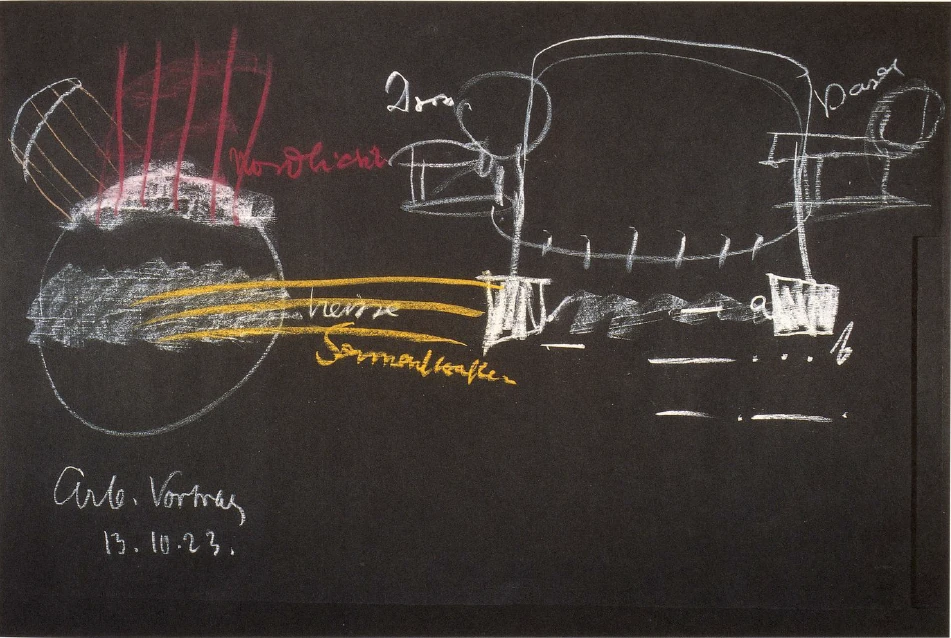
[ 23 ] In cold regions, that’s not the case; there, the sun has little power. Instead, the reflected sunlight and the moonlight are particularly active, and this light causes the snow to form crystals and the ice to produce ice flowers. Here, this only happens when the sun loses its strength in winter. But in regions of perpetual ice, at the North Pole or on high mountains—where the sun also has no strength, since the sun can only develop its strength in dense air—these beautiful ice formations take shape.
[ 24 ] Just by looking into nature like this, we already get a wonderful impression! We get the impression that wherever the sun shines, life comes into being—life that flows away and evaporates, that spreads out. Wherever the moon exerts its influence, forms and images arise. That is indeed a powerful impression one receives. And one can only perceive these things if one is able to attune to the spiritual realm. It is truly the case that one must say: In the lungs, where human beings actually produce mucus, the forces of the Moon are also at work. And they work in such a way that they do not need direct sunlight, but rather make use of the reflected sunlight. So when the lunar forces are primarily active here in the north—and the sun is not present—something else happens; the air above becomes such that something which is always contained within the earth is released. For there is magnetism and electricity everywhere within the earth. The earth is completely filled with magnetism and electricity. You can see that there is magnetism and electricity everywhere in the earth from this: Isn’t it true that if you have a telegraph machine at a station (it is being drawn)—for example, if it is in Dornach—then you have one here, let’s say in Basel; you can send a telegram there; but you can only send a telegram if there is a wire. Wires must, of course, run through the air; only then can you send a telegram. But that’s not enough if you were to set up a telegraph machine here and one in Basel and run a wire between them! No matter how long you pressed the button to send a telegram, the signal would reach Basel, but you’d have to make a return connection—it has to be a closed circuit. And once you do that, you can send a telegram from here, and the signals will arrive there. As you know—I’m only mentioning this for the sake of completeness—there’s a strip of paper wound around here, and when a stylus presses against this strip of paper, it creates either a dot or a dash if it presses for a long time, and the telegraphic alphabet is then composed of dots and dashes: a ·-, b -···, c -·-·. But here’s the strange thing: you don’t actually need that second wire if you run a wire from the device into the ground, place a copper plate there, and place another plate there as well; you can then remove the wire, because a connection is already established. Why? Because the earth itself contains electricity, and that electricity is conducted from one plate to the other. The earth itself replaces the wire with its own material. The earth is, in fact, completely full of electricity. But when the sun shines on the earth—as at the equator, in hot regions—this electricity is immediately destroyed as it tries to escape into the air. Sunlight is a force that extinguishes electricity. But where the sun’s influence is weak, the electricity rises into the air, and one can see it high above the Earth. You see, gentlemen, the Northern Lights are the Earth’s electrical force, which radiates under the influence of the Moon’s forces. That is why the Northern Lights are very rare in our regions; but they are frequent, almost always present in northern regions.
[ 25 ] Here again is one of those points where science reaches a dead end. Of course, science today knows that the Earth is full of electricity. Science also constantly observes the Northern Lights. But if you look up in the books what the Northern Lights actually are, people always believe they’re something that flows in from outer space onto Earth. But that’s nonsense—it doesn’t flow in; it actually flows right out! What science does with the Northern Lights is so interesting precisely because it’s just like when someone confuses their debts with their capital. That’s certainly true. Isn’t it the case that in human life, it makes a difference if you confuse your debts with your assets? But science can get away with it; it can view the Northern Lights as something that flows in from the world, whereas in reality the Northern Lights are something that flows out from the Earth. But in the hot regions, it is immediately absorbed by sunlight and thus extinguished. In the northern regions, moonlight is primarily at work when it shines; and when it does not shine, its aftereffects remain active, and that is when the Northern Lights—the outflowing electricity—become visible. Now, the Northern Lights are particularly strong there because the moon’s forces are particularly strong. There is actually some Northern Lights everywhere; you just can’t see it because it’s faint. In our regions, the Northern Lights—that is, the radiating electricity—are also faint. But in wireless telegraphy, they are strong enough to have an effect. What is at work in wireless telegraphy is the same phenomenon that you see glowing in the Northern Lights. There you have the reason. Electricity, combined with moonlight, creates the ice flowers and snow crystals. You must study the Northern Lights and moonlight if you want to study ice crystals, ice flowers, and snow crystals. Because the sun’s power is weaker in winter, the moon’s power gains the upper hand, and electricity is less likely to be extinguished here, the snow is shaped into such beautiful crystals. It is the combination of the moon and electricity that forms these beautiful crystals and causes the ice flowers.
[ 26 ] Now, I’ve told you this before—just remember: If someone has too little lunar activity, if someone produces too much swamp gas in their head, then they become, as the saying goes, a “Sumser”—that is, a fool. And so they’re not developing enough lunar power within themselves. Well, what, then, must one have in one’s head? One must take in everything that comes from the moon—the carbon dioxide from breathing, the mucus from the lungs—and get it into the head, that is, a force that constantly seeks to form crystals there. Snow, gentlemen, constantly wants to form in our heads; we just keep dissolving it. But it wants to form. Just think, gentlemen, you actually all have a very remarkable organ in your brains. Namely, when Mr. Seefeld showed Mr. Burle those beautiful snow crystal formations, it piqued his interest, and he thought to himself: It must be interesting to understand what the connection actually is. Yes, Mr. Burle photographed these snow crystals within himself! It’s as if one took a very quick photograph, and what appears in an instant disappears again when one exhales through the nostrils. If one could quickly photograph what’s going on inside Mr. Burle’s head—or in all of your heads—one would find the same photographs. Such tiny fragments would form—snow crystals, ice flowers, window flowers; they could be photographed from your etheric heads, and they would be exactly the same! Your mind is a truly remarkable thing. If you had a camera like that—which, of course, doesn’t exist yet—you’d have to take the picture incredibly fast, because it dissolves instantly—then you’d find: We look, inside our brains, just like a beautiful little piece of snow or a beautiful window covered in ice flowers! - It has to disappear right away, otherwise these sharp crystals would prick us; we wouldn’t be able to think with them. So when we look out at the snow, or when we look out at our window frost—ice flowers—we can say to ourselves: Good heavens, that’s exactly the same thing that’s going on inside our own heads!—only that this one dissolves quickly over and over again. All of nature thinks, after all! And in winter, when it gets cold, it really starts to think. In summer, it’s just too warm for nature to think. Then it lets the sun scatter and turns it into food and so on. But in winter, when it’s cold, thoughts form in the snow, in the ice. If there were no thoughts out there, we wouldn’t have any in our heads either. So you see, it’s actually beautiful—this correspondence with nature out there in winter, when nature becomes so wise that it makes visible, externally, what’s always going on inside our heads as our own wisdom. We can see everywhere in nature what’s going on within ourselves. We just have to perceive it in the right way.
[ 27 ] Well, but all of this has great significance, including practical implications. So consider this, gentlemen: a person develops, let’s say, a very specific type of mental illness because he secretes too little mucus. One can develop a mental illness as a result. If, then, when someone secretes too little mucus, you give him some ferric silicate as a remedy, this ferric silicate in turn takes over the function of mucus secretion and pushes the mucus up into his head, thereby bringing about a cure. You see, that is precisely the difference between anthroposophical medicine and other forms of medicine, which merely keep trying different approaches. In anthroposophy, we learn that a person suffering from a specific brain disorder is too weak to form crystals in their brain—that constant process of the formation and dissolution of ice flowers. Now we must help them. This can be done simply with silicic acid. When you go up into the high mountains and see the beautiful quartz there—that is silicic acid. It is a magnificent crystal. It has the tendency to form these crystals. If you process this quartz appropriately, you obtain the silicic acid preparation that is so effective among our remedies. And this silicic acid preparation is so effective for all illnesses that originate in the human head. If the body does not form crystals from within, then one must come to its aid from the outside through such beautiful crystals, which contain such beautifully formed crystalline structures within them. But when it stands in front of its beautiful snowy window with the ice flowers in its room like an ox on Sunday—after having eaten nothing but grass all week, just as our science does—well, then it stands before the human head just as science does; then it can do nothing, because it knows nothing about it. All these things show you how science must be deepened through a true understanding of the human being.
[ 28 ] This, of course, extends into the art of education, because one must first understand: If one teaches a person the letters of the alphabet simply for their own sake, this is such a powerful lunar influence that, if done too strongly or incorrectly, it completely eradicates the crystallizing power of the etheric head. It is truly the case that a person can actually become even more foolish through excessive learning, if they do not learn in the right way. That is indeed the case. But in order to understand this, we will have more to discuss next time. It is necessary to know all of this.