

Man and World
How Spirit Works in Nature
GA 351
20 October 1923, Dornach
Translated by Steiner Online Library
4. On the Nature of Hydrogen
[ 1 ] Is there perhaps something else on your mind that you'd like to ask about?
Questioner: We've only heard about oxygen and nitrogen. But there's also hydrogen. Could you tell us a little about that?
[ 2 ] Dr. Steiner: Well, I’ve already mentioned hydrogen a bit. So let’s start with your question. People of every age carry within themselves, as their primary material, their primary substance, protein. After all, they originated from protein. Breast milk is primarily composed of protein. Human beings contain protein. This protein essentially consists of five elements: carbon, nitrogen, hydrogen, oxygen, and sulfur. In addition to the other elements present in the body—and there are quite a few—these elements are already present in the original protein from which human beings are formed.
[ 3 ] Now, as I have told you: Carbon is constantly at work within us; the food we eat is converted into carbon. — We breathe in oxygen and also some nitrogen. Carbon combines with oxygen to form carbonic acid. Carbonic acid, as I told you, is present in the bubbles found in seltzer water, as well as in naturally carbonated water. But this carbonic acid is also within us, and it is important because it is constantly carried to the head through breathing. And if we didn’t have this carbon dioxide in our heads, we wouldn’t be sharp-minded—and we all are, after all. We wouldn’t be if we didn’t get carbon dioxide into our heads; not in such large quantities as, for example, in carbonated water, but we must constantly refresh our minds with carbon dioxide, even in very small amounts. But as I told you the other day: If we’re stupid, it’s because carbon isn’t carrying enough oxygen into our heads—so that not enough oxygen is getting in—but rather because carbon is combining with hydrogen. Carbon dioxide has a refreshing effect; but when carbon combines with hydrogen—well then, gentlemen—that’s when marsh gas is produced, the gas found specifically in caves, cellars, and so on, where things decompose; that’s where marsh gas forms. This is not a refreshing gas; it is a gas that kills, that paralyzes. And if there is such an irregularity in our body that carbon combines with hydrogen, then marsh gas is produced, and it goes up into the head. So when we get that “cellar head,” we become stupid. That’s why it’s very important whether we get enough carbon dioxide or too much marsh gas—that is, hydrogen—up there; after all, we always need a little marsh gas, otherwise we’d become too smart as human beings, and if we became too smart, we’d end up with poor digestion. It is precisely through such mixtures that life establishes itself in the right way. But the hydrogen—which is actually undesirable in the head when present in excess, and which plays a rather unpleasant role in the swamp gas—this hydrogen is spread throughout the entire universe—everywhere. Today, through what is known as spectral analysis, we can determine which substances are at work in the universe. Wherever you point the spectroscope out into the universe, you see a specific coloration that allows you to conclude: hydrogen is at work everywhere. Hydrogen is everywhere.
[ 4 ] Now, this hydrogen is, in turn, extremely important for certain things. I told you that it has a harmful effect on the mind when there is too much of it. So, when introduced into the mind, hydrogen prevents a person from developing their thinking. A person is able to think precisely because they do not have too much hydrogen in their mind.
[ 5 ] But let’s now consider the other end of thinking. The other end—what is that? Yes, the other end of thought—that is reproduction, the creation of new living beings. That is the other end. Just as the North Pole relates to the South Pole, so does reproduction relate to thought.
[ 6 ] Now we can observe something quite interesting in living beings. It happens that living beings change their entire mode of reproduction when hydrogen plays a different role in them than usual. There are certain snakes; these snakes lay eggs, and new snakes hatch from those eggs. What actually happens when a snake lays an egg and another snake hatches from it? The egg must be laid somewhere—and the snake does just that; the animal’s instinct works very effectively here—where it can receive the necessary warmth. You can see from a bird’s egg that an egg needs warmth for an animal to hatch from it. The bird’s egg is laid; but a new bird would not hatch unless the parent bird sat on it and incubated it. This warmth radiating from the parent bird is necessary for a new bird to emerge from the egg. So the egg needs not only what it contains within itself, but also the warmth coming from the entire universe. It is simply not enough for an egg to be laid; rather, it needs the warmth coming from the entire universe. This warmth contains the power that drives the new being out of the egg. The same is true of snakes. The eggs are laid. Through the action of the sun’s warmth, the life force of the new snake is drawn out of the egg.
[ 7 ] The story I just told you happens with certain snakes, but only if they live very regular lives. What I’m telling you isn’t true of all snakes, but only of a certain genus of snakes. If such a snake is a truly decent snake, then it lays its eggs, and when these are incubated, new snakes crawl out of them. What does it mean, then, for a snake to be a decent snake? Well, with humans, it means a great deal when one says that someone is a decent person; but with snakes, it means a little less. Above all, to be “decent,” a snake needs quite a lot of what is sometimes quite difficult even for humans: a new outfit—that is, a new skin. So a snake is truly a “decent” snake only if it sheds its skin every year, discarding the old skin and growing a new one over its body. So the snake must not go around in last year’s old rags, but must have a new skin every year. We can therefore distinguish between decent and indecent snakes. Such indecent snakes are those that go around in last year’s old rags.
[ 8 ] Now you might ask: Does that actually happen? Does nature really give the snake a new skin? It would certainly be very pleasant for us if nature would give us a new skin, too. — But humans are much more valuable beings than snakes. That is why he has been given the freedom to provide himself with a new skin. ... (Gap.) You can lock up such snakes, and if you lock them up and deprive them of the proper amount of water—if you don’t provide them with enough moisture—then something peculiar happens: the snake suddenly becomes indecent—it keeps its old skin! And so one can artificially induce this—nature does not do us this favor—so that certain snakes become “indecent” snakes that retain their old skins from the previous year.
[ 9 ] Yes, but, gentlemen, that is not the only thing—that the snake is then wearing its old, worn-out skin; but if one then induces such snakes to mate, if one causes them to reproduce, they do not lay eggs, but give birth to live little snakes! So these snakes, which are deprived of the opportunity to have enough water to shed their skin—and are thus forced to become “indecent” snakes, wearing their old, worn-out skins—that is the cause of it—these snakes now begin to give birth to live young, that is, real little snakes, instead of laying eggs.
[ 10 ] You see, this is a highly remarkable story; for what actually happened there? We deprived the snake of water. Water consists primarily of hydrogen; it contains oxygen, but primarily hydrogen, for water is composed of oxygen and hydrogen. Yes, gentlemen, when we deprive the snake of water, we simultaneously deprive it of the ability to reproduce by taking away its ability to form a new skin and to form an eggshell inside itself. The animal can no longer form the hard structure if it lacks hydrogen. It cannot form the hard structure within itself; it cannot form an eggshell on the inside nor a skin on the outside. And the consequence of this is that the baby snake must crawl out without a shell. The snake must use its own body heat to care for the baby snake at first.
[ 11 ] It is extremely important to know this about such a serpentine creature. For now we know: Just as it is harmful to the living being at one end—the head—when oxygen is deprived from it, so too is it harmful to reproduction when hydrogen is deprived from it. And now we see why, all over the world, wherever we look—we can look in any direction—hydrogen is present. Why is hydrogen present all over the world? Yes, gentlemen, hydrogen is present all over the world for the simple reason that the world would be destroyed immediately if there were no hydrogen. Wherever there is reproduction, hydrogen must also be at work. Now, the world is constantly being destroyed. You see, the world is constantly turning into dead matter everywhere. Rocks are worn away; everything is pulverized everywhere. Living beings decay; all manner of fermentation processes—which are also processes of decay—arise in the world. We actually live because something is constantly fermenting within us. And it is only through this fermentation that the Higher can arise. This is even the case with wine; if the grape juice did not ferment—that is, if it were to expel the decaying matter outward—the wine, which is so desirable to many and has such a life-giving quality, could not arise from the grape juice. This is how it is throughout the entire world. That which causes life to arise from decay—yes, that is precisely hydrogen.
[ 12 ] But now you might raise an objection. You might say: “But you’re telling us now that hydrogen is what gives life. But hydrogen is precisely what’s in swamp gas, and there it doesn’t give life—it kills.”—“Yes, why is that? You see, gentlemen, when hydrogen forms in darkness—and that’s the case with mine gas or swamp gas—it has a harmful effect when it develops cut off from the light, just as it does in our brains. But when hydrogen develops in the light—just as it is spread throughout the world in the light—it is the life-giving force; there it brings forth new life from what is decaying and fermenting. For hydrogen, as it is found everywhere, is essentially the same substance we find in our matches when we light them: phosphorus. Certainly, in chemistry, hydrogen is a completely different substance from phosphorus; but that is only because chemistry cannot go so far as to convert phosphorus into hydrogen! But if chemistry could go further than it does today, it would be able to convert phosphorus into hydrogen. So we can say: What, then, is this hydrogen that is spread throughout the world?—The hydrogen that is spread throughout the world is the world’s phosphorus. Wherever we look—everywhere, everywhere—there is phosphorus. And with that, I have described to you what is present everywhere in the world: phosphorus. So now we have truly come to know something of immense significance: we have come to know hydrogen in its magnificently significant effect throughout the universe.
[ 13 ] Now let’s look at this from the other side. I told you: The carbon dioxide is at the other end. — Well, gentlemen, let’s take a very close look at what I’ve told you. Imagine there is the Earth (a drawing is made), and all around it is hydrogen—which is actually phosphorus. So everywhere in the universe around the Earth, we have hydrogen—which is actually phosphorus—in other words, little burning fires everywhere. But now let’s look at the Earth itself. Let’s move from the universe to the Earth. There you will find, everywhere, what is called lime. But it is not only lime that is present; there is also, everywhere in the soil, a substance that you know very well. Just as I have now shown you that hydrogen—that is, phosphorus—is spread out all around our Earth—for phosphorus is indeed spread out everywhere—so too is that which we can now take a good look at.
[ 14 ] As you know, when your wives or anyone else wants to do laundry, they add what’s called soda to the wash water. You’re familiar with that. You may also know that this same substance—soda, which looks like salt and is, in fact, a salt—is used in a wide variety of other ways. For example, if you go to a soap factory, you’ll see that soda is the most important raw material; it’s also one of the most important raw materials in glass manufacturing, particularly in the production of window panes; and when you do laundry, you know that you add soda to the water. Likewise, laundry is bleached when treated with soda; it becomes lighter and more luminous because of the soda. Now there are many other things for which soda is used. For example, if you visit factories where paints are manufactured, you’ll find that soda is needed everywhere. In particular, soda is required to produce blue pigments. Prussian blue can only be produced by using soda. Then there is a substance that is also introduced into the human body, and which, in its natural state, would be much more harmful to the human body if it were ingested without first being treated in some way: this is tobacco. Tobacco must first be cured. Certain substances must be removed from it that would otherwise be too harmful to the human body. Tobacco, in turn, is cured with soda. So you see, this soda, which you know as an additive to laundry water, actually plays a major role in industry all over the world. But it also plays a major role in the global cosmetics industry. Soda is actually found everywhere, just in small quantities.
[ 15 ] Well, gentlemen, what exactly is this strange substance called soda? There is a white, silvery-shining metal called sodium, and when this sodium combines with carbonic acid—now we’re back to the carbonic acid we have in our heads—soda is formed. So sodium and carbon dioxide—together they form soda. Sodium, this metal—it’s a peculiar thing: we say “sodium,” so it’s neuter, not a “Mr.” or a “Ms.”—is a strange creature in nature; it stores carbon dioxide and carries it within itself. Wherever soda is found in nature, carbon dioxide is stored there and is as salt-like as it is in soda. The carbon dioxide is hidden inside, stored there.
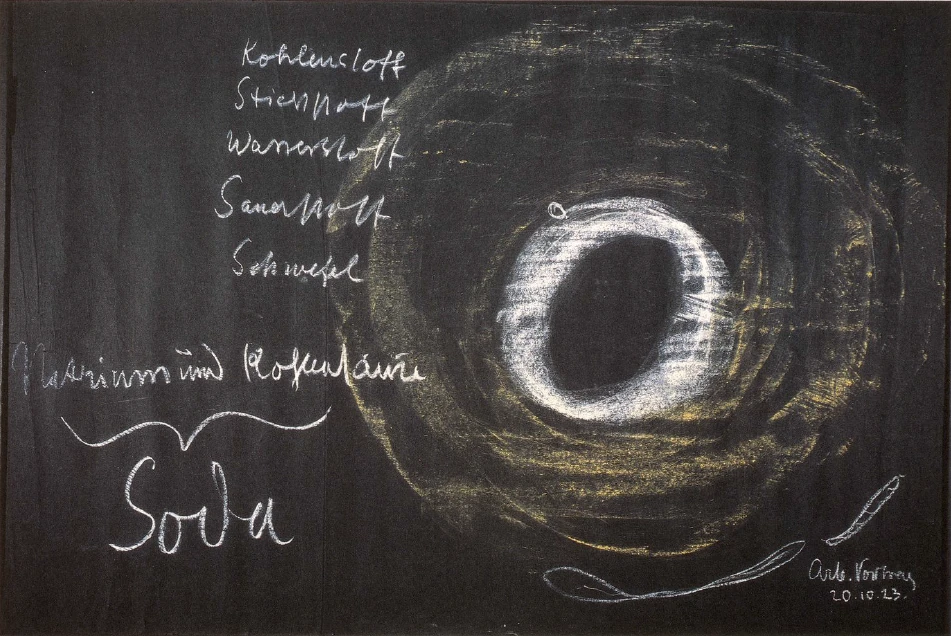
[ 16 ] Now I have shown you, within this yellow circle (drawing on p. 74), the world’s phosphorus in hydrogen; I must now show you soda as a whitish circle within the Earth itself. Of course, it is not found everywhere, but this soda is distributed in small quantities almost all over the earth. Just as we can use it in industry for all sorts of purposes—for bleaching laundry, for glassmaking, and so on—so nature uses this soda to a very great extent. But let us now turn to what nature can do with this soda. Nature is truly even smarter than humans. Humans think they’re terribly clever when they can say: “I extract soda ash and use it to make glass, soap, and paints. I cure my tobacco, I bleach and wash my laundry with soda ash—I invented all of this,” humans tell themselves, “I’m terribly clever.” - Yes, but nature is even much smarter! That is precisely what one must always remind oneself: Nature is still much, much smarter. Just think about what is actually all around us when we use soda ash. Let’s start with soap manufacturing. We use soap to clean ourselves; otherwise, we would constantly look like coal burners. So soap promotes cleanliness; but it does so only because it contains soda. Soda is needed for glass manufacturing. Glass is transparently clear. To make the glass transparently clear, you need soda. Furthermore: We wash laundry with soda. We wash it, we make it clean so that it shines like light. We use soda for bleaching. Bleaching means making something light in color. We use soda everywhere where light is to be created in some way, where light is to emerge from the darkness. Now, as you know, colors arise from light. I have told you this in many different ways. We need soda in paint factories. And it is curious: wherever soda is used, some light must be created. In the curing of tobacco: Human beings need light to live; if they were given only dark tobacco, they would have no stimulation, but rather something destructive. Soda is found wherever it has stored sodium and carbonic acid and releases the carbonic acid, so that we can bring some light into the world. Nature does this on a much, much larger scale; she is simply much wiser than humans. Humans are just fumbling around and have gradually come to realize that soda can be used in the world. But nature, however, uses soda in a most remarkable way. She has it everywhere I’ve marked in white for you. And so it is that wherever soda—that is, sodium bicarbonate—comes into contact with the surrounding phosphorus of the world, new life arises. Otherwise, everything would constantly die. Thus, through the interaction of the Earth’s soda and hydrogen—that is, the phosphorus of the universe—everything is actually continually being renewed.
[ 17 ] But now you have a great understanding of the importance of hydrogen. The fact that hydrogen is everywhere is extremely useful in the universe; but it is only useful if soda is present in the Earth at the same time. For through this interaction, the death of all things is prevented. Hydrogen—that is, phosphorus—always acts in conjunction with soda, and this prevents death. New life is constantly being created. Otherwise, we would only be able to breathe the air of the dead, and we would all die as well. Indeed, is there anything that could prove this to us even more clearly? We say that all life actually arises from the coming together, from the proper interaction of hydrogen—that is, phosphorus—and soda, or sodium bicarbonate. This brings us to something quite significant. As you know, human beings themselves come into being as physical beings through the union of the female egg cell, which consists essentially of protein, and the male seminal fluid. Let’s ask ourselves what this male seminal fluid is primarily composed of. You see, this male seminal fluid, in turn, consists of soda—which is contained within it—and of cosmic phosphorus, or hydrogen. So when you look out into the world, all life arises through hydrogen and soda. If we look at the process of conception, new life on Earth arises from the soda and phosphorus contained in the male seed. You can find both of these substances within the male seed. In a sense, human beings draw a little of what is at work in the world—some soda from the earth, some phosphorus and hydrogen from the universe—and form from these the male seed that brings about procreation. Thus, one can see—both on the smallest scale, namely in procreation, and on the largest scale everywhere outside—what role hydrogen plays on the one hand, and carbonic acid together with sodium (soda) on the other. You see, gentlemen, nature uses soda in an even wiser way than humans do. For we have seen that soda must be present wherever light acts, wherever light arises, wherever light is formed. When hydrogen is used in the dark, marsh gas is produced; there it kills. But when hydrogen is treated with light, it does not kill; it creates. Now, nature treats hydrogen—phosphorus—with soda. It thus does, on a grand scale, what we do when bleaching and washing: it brings light to the hydrogen, and through this, life arises. It is truly astonishing when one looks out into the world and sees how, everywhere, through the illuminated hydrogen, new life arises from the old, which would otherwise perish; and when one then looks into the smallest emerging form and finds the same thing—it is actually only through such observation that true science arises!
[ 18 ] Now let’s return to our example of the snake. If we simply leave the snakes to their own nature—this species of snake I’ve been talking about—well, then the water that the snake absorbs to form a new skin contains this soda. And the young snake acquires its skin through the water it absorbs, just as the adult snake acquired its skin—the tough skin that is not composed solely of soda, but for which the power of soda is necessary. So it is not so much the absorption of the water that is important, but rather the absorption of the soda contained throughout the water. So it is this soda, which the snake absorbs along with the water, that first provides the snake with a new skin. The snake can, so to speak, form substances on the outside—it gets a new skin—and, furthermore, during reproduction, it can form the harder eggshell on the inside—it is not completely hard; it is still somewhat soft. ... (Gap.) A person can become immoral when drinking wine. If you deprive the snake of water, it can become immoral. So it varies in nature. If the snake does not receive soda, then it does not form an eggshell; the young must then be born without an eggshell, must be incubated inside the snake itself, and emerges as a live young. This is something most remarkable. Suppose a live snake crawls out of the old snake; then what has taken place inside the snake is the same as the effect of hydrogen or phosphorus on soda. That is what happened inside the snake. The snake had to use up the soda it still had in its body; it had to sacrifice it to allow the young to be born. Therefore, if one continues this process for a long time, one can cause the snakes to become infertile; and once they have given birth to live young once or twice, they become infertile and no longer give birth, because they must draw all the soda out of their bodies. That soda is depleted if you do not allow new soda, dissolved in water, to flow into them.
[ 19 ] But what happens when snakes remain decent and shed their old skin? Well, then the egg is laid, and what the little living snake would otherwise draw from the old soda stored in its body—from the phosphorus and hydrogen—it now draws from the universe. And you can see: when a living animal is formed within such a snake, soda, hydrogen, and phosphorus are combined internally; when an egg is formed, hydrogen or phosphorus from the universe is combined with soda externally. In this creature, you have a constant reminder that what happens in the great world is the same as what happens within the human being during reproduction. The whole world is reproduction. For in this snake, which—when its water is withdrawn so it can shed its skin—gives birth to living young, we see that once it gives birth, it uses what is inside its body—the internal hydrogen, phosphorus, and soda. And when it lays eggs, it uses the external hydrogen, phosphorus, and soda. This is the strongest proof, when one observes such a thing, that the nature around us is not something dead, but something just as alive as we ourselves are. One must pay attention to such evidence. One must not merely gaze thoughtlessly at the highly remarkable phenomenon that arises when such a snake—which cannot shed its skin due to water deprivation, that is, primarily due to a lack of soda—suddenly begins to give birth to live young; one must not merely gaze thoughtlessly at such a thing, but rather relate it to the forces of the entire universe. It is indeed something of the utmost significance.
[ 20 ] Well, isn’t it true that humans do not lay eggs from which new humans emerge, but rather must be born as living young; even higher animals must be born as living young. On what, then, is this higher evolution actually based? You see, this higher development is based on the fact that what is contained out there in the world enters inwardly into beings, into higher animals, and into human beings—that human beings take in the forces of the world. What is outside is also inside the higher beings.
[ 21 ] But what about the very lowest forms of life? Well, you see, gentlemen, that is the eternal debate in science: how the very first living beings came into being. People speak of *generatio aequivoca*; by spontaneous generation, as they say. Yes, but then the scholars say to themselves: The first living beings must have come into existence at some point. But when the scholars now consider what substances these first living beings were formed from, they find there are no such substances at all. But that is not nature’s fault; it is only because these scholars do not know the substances. Namely, they do not know what hydrogen really is—the substance found everywhere—that it is a form of phosphorus, the very same substance still contained in male semen and which gives male semen its distinctive odor, which is phosphorus-based. When male semen is combined with certain plants, it acts just as when soda is combined with certain plants—bleaching and the like. All of this is contained in ancient alchemical teachings, which of course are not meant to resurface today; for we do not want the old ways. All of this has been investigated. And today one can rediscover it through genuine anthroposophical science. And that which in male semen presupposes soda, phosphorus, or hydrogen—that can develop in the great nature out there. So there is no need to ask now: How did the first living beings come into being? — When the Earth did not yet have higher life forms, the lower life forms arose precisely through the interaction of phosphorus with the Earth’s soda. And then we have spontaneous generation, the generatio aequivoca.
[ 22 ] So you see, one need only study things through to their conclusion, and then certain so-called mysteries of the universe—which otherwise cannot be solved—will resolve themselves. Of course, if someone asks, “How do carbon, oxygen, hydrogen, and nitrogen come together in such a way that a living being is created?” they cannot rely on modern chemistry, because it does not show that when phosphorus acts on one side and soda and carbonic acid with sodium on the other, this living being is formed. That is precisely the point: one cannot, of course, get to the bottom of this subtle matter using the crude instruments available in our laboratories. But one must view such phenomena correctly. So if you have a snake that simply lays its eggs, and living snakes emerge from those eggs, then the great forces of nature—phosphorus and soda from the great forces of nature—are still at work within them. If one isolates the snake from the greater nature—if one places it in an environment where it has too little water to shed its skin and to produce eggshells internally—then it functions as a “small nature,” as that which it has retained from the greater nature and carries within itself as an inheritance; then, in a certain sense, it functions as a higher being.
[ 23 ] You see, the further development of humankind in the world consists, for example, in the fact that it isolates itself from nature in a certain way. Humanity separates itself; above all, it does so through culture. And progress would not arise if humans did not, in a certain sense, separate themselves. For in a certain respect, the snake becomes a higher being when it learns, through dehydration, to give birth to living young. The entire development of humanity is based on the fact that people have increasingly separated themselves from nature and now not only give birth to living offspring, but also develop all their other powers in separation from nature, thereby bringing forth from within the human being everything that previously came from nature.
[ 24 ] Yes, gentlemen, what used to come from nature is now gradually emerging from human beings. I can give you several examples of this. I’ll mention just one: Today we write on paper. This paper isn’t all that old. You know that in the past people had to write on completely different materials. And today’s paper is essentially made from linen rags. That’s why, when it first appeared—around the same time as gunpowder—it was called “linen rag paper.” So it was relatively late in history that humans, drawing on their wisdom, began to produce paper pulp. But in nature there is something that has existed as paper pulp for a long, long time: namely, the very material from which wasps build their nests! That is genuine paper pulp. One would only need to process the wasp nest a little further and bleach it to obtain paper pulp from it. Wasps are, in fact, nature’s finest paper producers. So one can say: Thousands and thousands of years ago, the small, tiny wasps discovered paper manufacturing! Paper manufacturing was taking place out there in the great outdoors. Later, humans did it on their own. In paper manufacturing, you have roughly the same process as you do with snakes and their live young; you isolate the snake from the outside world by depriving it of water, and then it gives birth to live young, appearing at a somewhat higher stage of generation. If you increasingly isolate humans by creating their culture, then they produce paper—which nature once produced—just as the snake produces live young from within itself. Thousands upon thousands of years ago, wasps produced paper from nature; from within himself, man produces paper with his intellect. Yes, the intellect has moved inward just as the snake’s power to produce live young has moved inward.
[ 25 ] And so it is also with human semen. As we have said, it contains soda, as well as hydrogen and phosphorus. If we examine the nerves that extend from the brain, we find that the most important substances in these nerves are, once again, soda and phosphorus. The only difference is that they are connected to one another differently than in the seed—they are, so to speak, fused together. It is not at all surprising that something like this—namely, thoughts—arises from within the human being. By absorbing what is otherwise found only in the seed, the human being processes soda and phosphorus in the nervous system. Just as phosphorus and hydrogen are contained everywhere out in the world, [and] soda, so too are soda and phosphorus contained within this human brain. But now you can also see why we need carbon dioxide inside our heads. The soda is constantly being transformed. The carbon dioxide separates from the sodium, and we would eventually end up with a hard skull made of sodium—which is a silvery-white metal—if carbon dioxide weren’t constantly fizzing in and producing soda within us. So we absorb carbon dioxide into the sodium so that the soda is properly distributed throughout our head. And from what is all around us, we absorb phosphorus and hydrogen through our hair and skin. We just have to make sure not to let too much hydrogen from marsh gas rise up from within, but rather from the outside. This human head is truly a kind of egg; just as an egg that is laid absorbs soda from the earth and hydrogen from the air, so the human head draws soda upward from its “earth” below, and receives hydrogen and phosphorus from the outside when it cannot obtain them from within. Then these two work together and produce a substance inside that can act as a mediator of thoughts—that is, it generates thoughts.
[ 26 ] That is how one discovers how human beings are embedded within natural phenomena; one must simply observe these phenomena in the right context. If the scholar deprives his snakes of water and then stares in amazement as they give birth to live young instead of laying eggs, he will learn nothing at all. But if he knows what he has actually brought into his laboratory, then he uncovers the secrets of the world.
[ 27 ] More on that next Wednesday.