

Man and World
How Spirit Works in Nature
GA 351
24 October 1923, Dornach
Translated by Steiner Online Library
5. On the Nature of Comets
[ 1 ] Good morning, gentlemen! Does anyone have a question?
Questioner: In some of the previous lectures, there was talk of the vast cosmos; I would like to ask about comets with long tails. What is the significance of this?
[ 2 ] Dr. Steiner: Well, you see, gentlemen, we must remember what I have been saying recently. I would like to repeat some of what we said in previous lectures.
[ 3 ] When we consider human beings, we must say: Two things are necessary for their entire life, particularly for their spiritual development. First, that carbon dioxide rises to the head. After all, human beings are constantly excreting carbon from their bodies. In fact, one could say: Insofar as a human being is a solid body, it is composed of carbon. So human beings are constantly excreting carbon from their bodies. Now, if this carbon were to remain within us, we would eventually all turn into black columns. We would become black columns if this carbon were to remain. We need it to live, but we must constantly convert it so that it becomes something else. This happens through oxygen. Ultimately, we exhale the oxygen combined with the carbon as carbon dioxide. There is carbon dioxide in the air we exhale. But you need this carbon dioxide. You can also find it, for example, in seltzer water; there is carbon dioxide inside the bubbles. This carbon dioxide, which isn’t exhaled, constantly rises to the human head, and we need it so that we aren’t stupid, so that we can think; otherwise, marsh gas—which consists of carbon and hydrogen—would rise to the human head. So, to think, we need carbon dioxide.
[ 4 ] Well, I’ve already hinted at what we need for will, for the act of willing. So let’s start with walking, with moving our hands, with moving our arms—that’s actually where this willing begins: there, we must constantly form and dissolve a bond between carbon and nitrogen. But this cyanide—or hydrocyanic acid—must constantly flow into our limbs, so to speak. It then combines with potassium in the limbs. This produces potassium cyanide, which is immediately broken down again. In order for us to live at all, there must be a constant process of poisoning within us, followed by detoxification and breakdown. That is the secret of human life: carbonic acid on the one hand, and potassium cyanide—which combines with potassium—on the other. With every movement, with every finger, a little hydrocyanic acid is formed, and the way it works is that we immediately break it down again by moving our fingers. So this must also be present in human beings.
[ 5 ] But everything that must exist within the human being must also exist out there in the universe; it must be present in the universe in some way. The fact is that comets have been studied time and again. And it is precisely with comets that a sort of—I would say—little story has unfolded within the anthroposophical movement. I once gave lectures in Paris and, speaking purely from inner knowledge, stated that there must be some hydrocyanic acid present in comets—that is, that hydrocyanic acid is present in comets. Up until then, scientists had not yet pointed out that hydrocyanic acid is present in comets. But then, shortly afterward, a comet appeared. It was, in fact, the one you are talking about. And it was precisely with this comet that scientists, using more sophisticated instruments—which were not available earlier—discovered that there really is hydrocyanic acid in the comet, in the comet’s material! So one can point this out when people keep asking: Has anthroposophy predicted anything at all?—Yes, this discovery of cyanide in comets, for example, was quite clearly predicted. This has also been the case with many other things; but in this instance, with the comet, it was quite obvious. Well, even in conventional science there is actually no doubt today that the comet’s atmosphere—the comet is, after all, composed of very fine matter; it is essentially just ether, just air—contains hydrocyanic acid.
[ 6 ] Yes, what does that mean, gentlemen? It means that what we must continually form within our own bodies is also present out there in the comet’s atmosphere. Now just think how often I have said here that the egg is formed from the entire universe—and so too are humans, animals, and plants; since they are formed from the egg, they are formed from the entire universe. I would like to explain this to you using the human being as an example, so that you may understand exactly what significance these comets actually have in the entire universe.
[ 7 ] Let’s start—it may seem strange to some, but you’ll see that this is the best way to explain what you’re looking for—let’s begin with a bit of history. Centuries before Christianity was founded, there was an ancient people in what is now Greece: the Greeks. The ancient Greeks contributed so much to intellectual life that even today our college students are required to learn Greek, because it is believed that learning Greek today makes one a particularly intelligent person. Well, the Greeks truly made an extraordinary contribution to intellectual life. Today we don’t learn Indian or Egyptian, but Greek. By this, people want to express that the Greeks contributed a great deal to intellectual life. This is evident in the simple fact that we cultivate the study of Greek with our college students. The Greeks themselves taught only Greek to their children, even though they contributed so much to intellectual life.
[ 8 ] There were mainly two tribes in Greece that were of particular importance, but which were very different from one another: one was the people of Sparta, and the other was the people of Athens. Sparta and Athens were the two most important cities in Greece. There were also a few others that were significant, but not as significant as Sparta and Athens. The inhabitants of these two cities were thus very different from one another. I will set aside the other differences today, but they were already different in that they behaved quite differently when speaking. The Spartans always sat quietly together and spoke little. They did not like to talk. But when they did speak, they wanted what they said to have a certain significance; it was meant to have power over people. But since people cannot always say something meaningful when they chatter, they remained silent when they had nothing meaningful to say, and they always spoke in short sentences. These short sentences were famous throughout antiquity. People spoke of the short sentences of the Spartan people, and it was these that became famous—often as profound aphorisms of wisdom.
[ 9 ] It was not like that with the Athenians. The Athenians loved eloquent speech; they loved it when people spoke eloquently. The Spartans: brief, measured, and calm in their speech. The Athenians, on the other hand, wanted to speak quite eloquently. They learned the art of rhetoric by speaking eloquently. They simply chattered more; not as much as we do today, but they still chattered more than the Spartans.
[ 10 ] What, then, was the basis for the difference between the verbose Athenian and the Spartan, who spoke less but with greater significance and power? It was based on upbringing. The art of education is, of course, little studied today. But what I am saying is based on upbringing. Spartan boys, in particular, were educated quite differently from Athenian boys. Spartan boys had to engage in much more physical exercise: dance, wrestling, and all kinds of athletic skills. And the art of rhetoric—the actual exercise of the tongue—was not practiced at all among the Spartans. They let speech come entirely naturally.
[ 11 ] Everything that is inherent in language is, in fact, shaped by the rest of the human body’s movements. You can observe this clearly: When a person makes slow, measured movements—truly gymnastic in nature—they also speak properly. In particular, when a person walks with proper strides, they also speak properly. Of course, it depends on a person’s age. If a person develops gout in old age, it no longer matters; by then, they have already learned to speak. It depends on the time when one learns to speak. But the Spartans placed great emphasis on practicing a great deal of gymnastics, and they further supported this gymnastics by rubbing the children’s bodies with oil and coating them with sand; then they had them do gymnastics. The Athenians also practiced gymnastics—gymnastics was practiced throughout Greece—but to a much lesser extent, and they had the older boys practice rhetoric and the art of speech. The Spartans did not do that.
[ 12 ] Well, that has a very specific consequence. You see, when those little Spartan boys did their gymnastics with their bodies oiled and rubbed with sand, they had to generate a great deal of internal heat—a great, great deal of internal heat. And when the Athenians practiced their gymnastics, it was something quite special among the Athenians. If it had been a day like today and the boys hadn’t wanted to do their gymnastics outdoors with the Spartans, well, all hell would have broken loose! The gymnasts and the instructors would have really put those boys in their place! When the Athenians had a day like today—so stormy—they gathered their boys indoors and had them practice rhetoric. But they called them outside when the sun was shining beautifully, when everything was sparkling. Then the Athenian boys had to do their gymnastic exercises outdoors. For the Athenians thought differently than the Spartans did. The Spartans believed that whatever movements the boys performed had to come from within their own bodies; it didn’t matter if it was storming, hailing, raining, or windy outside—that was completely irrelevant. They said to themselves: “It must come from the person himself.”
[ 13 ] The Athenian said otherwise. He said: We live by the sun, and when the sun awakens us to movement, then let us move; when the sun is not there, let us not move. So said the Athenian, and that is why the Athenians focused on the sun’s external warmth. The Spartans focused on the sun’s internal warmth—the warmth that the human body has already processed—while the Athenians focused on the external sun, which shines beautifully on the skin—the skin not rubbed with sand, at least not as much as with the Spartans, but rather the sun was meant to work on the skin. That was the difference. And when school textbooks today describe the difference between the Athenians and the Spartans, they really only create a mental image of what must have been marvelous about why the Spartans, in particular, were quiet, measured in their speech, and, moreover, highly hardened people, and why the Athenians practiced the art of rhetoric, which was then further developed by the Romans. People today cannot pursue history and natural science at the same time. History speaks for itself, and natural science speaks for itself. But if I tell you: The Spartans rubbed their boys with oil and sand and then had them practice their Spartan arts in all kinds of weather, while the Athenians didn’t rub their boys with sand and oil nearly as much and otherwise practiced the art of rhetoric inside the palaestrae—then you’ll understand how this difference between the Spartans and Athenians, who were neighbors after all, was actually brought about by natural facts.
[ 14 ] So let's say that if we have the Earth there (as shown in the drawing) and the Sun here: When one looks at the sun as it shines, and the Athenian is there, then the Athenian is formed; and when one does not look so much at the sun itself, but rather at what the sun has already created within the human being—and at that innerer warmth—then the Spartan is formed from this. You see, this is where history and natural history come together. That is how it is.
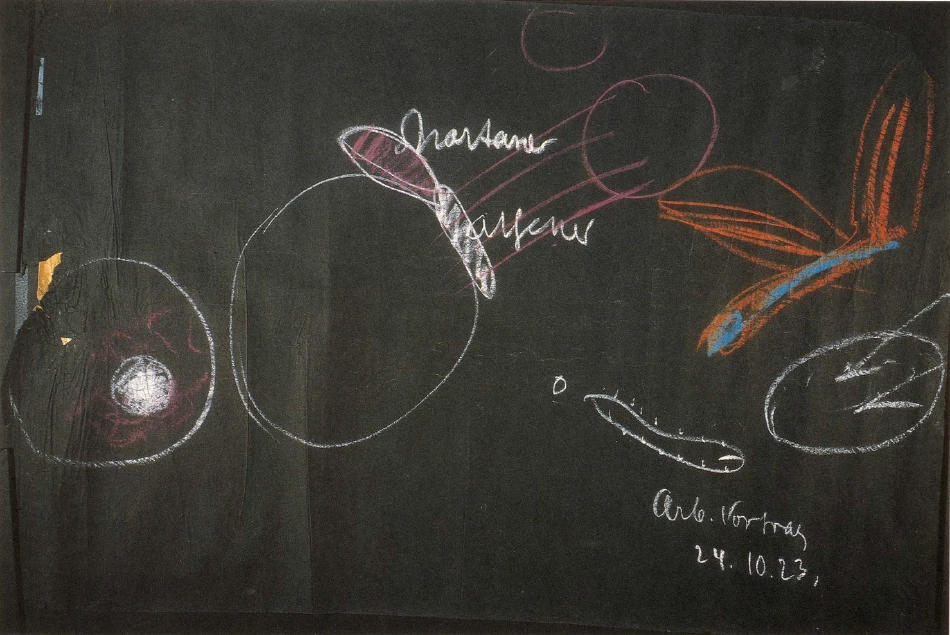
[ 15 ] So now we can say: When a person becomes aware that he is generating a great deal of warmth within himself, his speech becomes brief and measured. — Why? Because he turns his entire mind more toward the universe. But when a person allows himself to be bathed in the sun’s light, like the Athenian, he turns his intellect less toward the universe; instead, he turns his intellect more inward, while directing his warmth outward; the Spartan, on the other hand, directs his warmth inward and his intellect outward. And through his intellect, the Spartan has learned the language of the universe; it is wise, and it has been cultivated within him. The Athenian has not learned the language of the universe, but only the movement of the universe, because he has given himself over to gymnastics in the warmth of the sun.
[ 16 ] When we look today at what remains of the Spartans, we say to ourselves: Oh, these Spartans have captured the wisdom of the world in their concise phrases. - The Athenians began to express, in their beautiful turns of phrase, more of what lies within the human mind. What the Spartans possessed in their language has, for the most part, been lost to humanity; it vanished from Greece along with the Spartans. People today can no longer live with the language of the universe. But what the Athenians began to do—crafting beautifully twisted sentences—really flourished in Rome with the art of eloquent speech. And the Romans, at least, still spoke beautifully. Even in the Middle Ages, people still learned to speak beautifully. Today, however, people speak in terrible sentences. One need only take a closer look at this—well, one could take any other city, but in Vienna, for example, the elections have been going on for weeks: Yes, there is no beautiful speech there, but rather a terrible, veritable deluge of speeches—yet not beautiful! And that is what has gradually become of what was still cultivated among the Athenians, albeit in beauty. That comes from within human beings. The universe, truly, does not deliver campaign speeches—but human beings do! The Spartans did not give campaign speeches; the Spartans expressed in their short sentences how the universe speaks. They looked up at the stars and thought: Man runs about in the world like this and is a “Gschaftlhuber.” The star moves slowly, so that it does not move sometimes slowly, sometimes quickly, but always at a steady pace. Then the proverb arose that has endured for all time: “Haste makes waste”—and so on. The star reaches its destination after all! And so the Spartans, in particular, learned a great deal from what exists out there in the universe.
[ 17 ] And now we can move on to something I’ve already noticed about you here; we can move from heat to light. I’d just like to say the following about heat. Consider this: if a person needs to generate a great deal of heat, then he would have to become a strong person. And if a person has the opportunity to spend a great deal of time in the sun, that very fact would make him a very talkative person. Now you need only look a little at geography: Go to Italy, where people are more exposed to the sun, and you’ll see what a chatty people they are! And go to the north, where people are more exposed to the cold: Yes, there you can sometimes become desperate—people don’t talk because, when you constantly have to generate inner warmth, it drives away the inner urge to speak. Even here, it seems almost comical when someone from the north comes along; he stands there to speak—yes, he stands there, but doesn’t say a word yet. Isn’t it true that when an Italian agitator steps onto the podium, he’s already talking before he even gets up there—he’s already talking while he’s still down below. Then it just keeps going—it just bubbles right out! When a northern person—who has to generate a lot of warmth because there’s no external warmth—is supposed to speak: such a northern person stands there—it’s enough to drive you to despair, because he doesn’t even start; he wants to say something, but he just doesn’t get started. It’s true: inner warmth dispels the desire to speak, while external warmth stokes the desire to speak. Of course, all of this can then be transformed through art. The Spartans did not achieve this through external means, but through their own racial character; even though they were neighbors with the Athenians—because they had intermingled extensively with people coming from the north—they developed this reticence in speech. Among the Athenians, for example, there were many who came from hot regions and intermingled racially with the Athenians; through this, they developed their eloquence. So here we see how even the eloquent person is connected to the sun and to heat. Now let’s move on to light.
[ 18 ] All we need to do is recall something I’ve already told you. Think of a mammal. A mammal develops the embryo for a new mammal internally. The embryo is carried internally by the mother; everything takes place internally. Take the butterfly, on the other hand. I’ve told you: The butterfly lays an egg; the caterpillar crawls out of the egg; the caterpillar forms a cocoon; and the sunlight draws the multicolored butterfly out of the cocoon. Now look at the mammal (it is being drawn); this mammal develops the new animal completely hidden within its uterus. Here again we have two opposites—wonderful opposites. Look: the egg is exposed. As soon as the caterpillar crawls out, the light is already there. The caterpillar, as I told you, moves toward the light, spins its cocoon—the shell that transforms it into a pupa—toward the light, and the light, in turn, brings forth the butterfly. And the light neither rests nor ceases; it gives the butterfly its colors. The colors are brought forth by the light; the light acts upon the butterfly.
[ 19 ] Take, for example, the cow or the dog. Yes, the little child that is in there, in the mother’s uterus, cannot see the light from the outside; it is completely enclosed in darkness from the outside world. So it must develop in there, in the darkness.
[ 20 ] But nothing that is alive can develop in darkness. It’s simply nonsense to believe that anything can develop in darkness. But what exactly is the story here? Let me give you an analogy. One can certainly hope that, once the Earth becomes very low on coal, we’ll be able to use direct solar heat—through some kind of conversion—for heating; but today, it’s simply not yet possible to use solar heat directly for heating. It may not be long before we figure out how to do it; but today, for example, we use coal. Yes, gentlemen, coal is nothing other than solar heat—simply solar heat that streamed down to Earth many, many thousands of years ago, became trapped in wood, and was stored as coal. When we heat our homes, we release from the coal the solar heat that accumulated in the Earth millennia and millennia ago.
[ 21 ] Don’t think that coal is the only thing that behaves toward the sun the way I just described! Just as I have described, other beings—namely, all living beings—also behave this way toward the sun. If you look at a mammal, you have to say: Every little young animal has a mother, who in turn has a mother, and so on. They have always absorbed the Sun’s warmth; it is still inside the animal itself and is passed down through the generations. And just as we extract the Sun’s warmth from coal, so the little child in the mother’s womb draws the sunlight—which is stored there—from within. — Now you see the difference between what develops in a dog or a cow and what develops in a butterfly. The butterfly enters the external sunlight right from the moment it is an egg, allowing itself to be fully transformed by the external sunlight until it becomes the colorful butterfly. The dog or the cow is just as colorful on the inside, but you cannot see it. Just as you cannot yet perceive the sun’s warmth in a piece of coal—you must first draw it out—so, with a higher perspective, you must first draw out from the dog and the cow the light that is stored inside them. There is stored light inside them! The butterfly is colorful on the outside; there, the sunlight from the outside has done its work. Yes, in the dog or the cow, I would say, there is invisible light everywhere inside.
[ 22 ] What I have described to you here, people could easily determine today using our sophisticated equipment and verify in their laboratories, if they wanted to. People need only set up a laboratory—one that is completely dark, utterly dark—and then, in that laboratory, compare a freshly laid egg with a cow or dog germ in its early stage; then one would see that, due to the dimming that can occur in a dark room, the difference I am describing becomes quite apparent. And if one were to photograph what cannot be seen with the eyes—the eyes are not sensitive enough for this—one would in fact be able to prove that the butterfly has a yellow spectrum and the dog and cow eggs have a blue spectrum in the photograph. These things, which one can see mentally—one does not need the external form if one can see them mentally—will still be proven even with the most perfect instruments.
[ 23 ] So now we can say: The butterfly is formed by the external sunlight, while the cow or the dog is formed by the sunlight that is stored internally. - Thus we have come to understand the difference between the heat that acts from the outside—which makes people talkative—the light that acts from the outside—which brings out the many colors in the butterfly—and the heat within, which makes people silent and measured—the light within a being that gives birth to living young, who must receive the light from within. And now, from there, we can move on to the subject of our inquiry.
[ 24 ] There are also things that a person needs within themselves, but which they must not allow to develop in excess within themselves, because otherwise they would die from it. And one of these is cyanide, hydrocyanic acid. If a person were to continuously produce cyanide all day long, beyond the small amount of cyanide that is already present within them—well, that would not be possible; it would be too much. A person does produce some cyanide within themselves, but very little. Yet they also need some from the outside; they take it in through what they breathe. It is not much, but a person does not need more than that.
[ 25 ] Well, gentlemen, this cyanide is not present in ordinary air. If comets did not appear from time to time, there would be no cyanide in the air. Comets, and then these meteors—shooting stars—which, as you know, streak through the air in such great numbers, especially in midsummer—they bring this cyanide down. And it is actually from this that human beings draw their strength. That is why people whose muscles have lost their strength must be sent into air that has been refreshed not only from the earth but from the entire universe—air that has been influenced by meteors. And this means, for example, that people who suffer from what used to be called consumption—those whose muscles have lost their strength and in whom this weakness is particularly pronounced toward spring—should be sent in the fall into this air that has been refreshed by the entire universe. In the spring, there is nothing that can be done; that is why such people die most easily in the spring. One must take precautions, for it is really only in the fall that anything can be done for such people. When, in summer, the meteorological forces deposit their cyanide along with the small amounts of cyanide entering from the cosmos, these people—as August draws to a close and fall arrives—must, with their weakened limbs, go to regions where summer has deposited its best, namely cyanide. Then their limbs will regain their strength. So, in the case of people whom you notice are headed for a very difficult year ahead—because they are losing their strength—you should actually take precautions, since there isn’t much you can do with external remedies in the spring. You should tell yourself: When spring comes, I will give such people—depending on how weak they have become—the juice of certain plants, for example, the juice of blackthorn. If you preserve the blackthorn juice—you know the astringent, sour-tasting plant—and administer it into the mouth of such a person who becomes weak in the spring, then you can sustain them through the spring and summer. Why? Well, you see, when you give a person blackthorn juice, that juice forms all kinds of salts. These travel to the head and carry the carbon dioxide with them. In this way, we help the person get through spring and summer. And in the fall, we must then take them to a region where they are able to absorb the other elements, which must go more toward the limbs. Carbon dioxide goes to the head; we direct it to the head by administering blackthorn. If we are fortunate enough to have helped such a person get through the summer, we can take them to a suitable region in the fall—not for very long; for two or three weeks they should stay in such air, which is known to have just been influenced by meteorological conditions—then, because they have been strengthened during the spring and summer, the person will truly regain the strength of their limbs.
[ 26 ] Yes, gentlemen, there you have the two effects right next to each other. There you have the earthly effect—which is actually a lunar effect—the earthly effect in the blackthorn sap; and there you have the cosmic effect in what the comets—and when there are no comets, the shooting stars—have left behind—it is the same with them, only on a smaller scale; but there are simply so many of them—what acts upon us from the universe. Just as, in essence, there is nothing earthly in the butterfly with its metamorphosis, but rather light from the universe, and just as there is warmth from the universe—from the sun—in the protected eggs, so too do you possess within yourselves inner human warmth, which you must develop internally within your own substance and which stimulates precisely the opposite of external warmth.
[ 27 ] Thus we can see everywhere how there is a variety within human beings, just as there is a variety throughout the entire universe: sometimes things come from outside the universe, and sometimes from within the Earth or within human beings. Now you will say: Yes, certain things are regular; but they alone cannot bring about what they are supposed to bring about. Day and night alternate regularly; they bring about that which emanates from the Earth. — Well, comets appear more or less irregularly; so do shooting stars. And that is indeed the case. With shooting stars, there is not the same regularity as with the rest. If an astronomer wants to observe a solar eclipse, he can determine the exact time it begins—that can be calculated—; it is part of the regular cycle, but its effect does not originate from the Sun. So he can even go out for dinner first and still make it back in time for the solar eclipse. If he wants to observe the meteor shower at the right time, he has to stay up all night; otherwise, he won’t be able to see it. That is precisely the difference between what arrives on Earth irregularly from outer space and what is regular.
[ 28 ] Now you can raise an interesting question. You might say: The comets, which are connected to the cyan—which is linked to our will as human beings—these comets appear irregularly; one comes along, and then it’s gone for a long time. —This always gives rise to superstition among people; it is precisely that which does not always appear that makes them superstitious when it does come. Only the minds of people in the past, who were open to it, saw the divine in the sunrise and sunset; later, superstitious minds then conjured up all sorts of nonsense about comets. You might now ask: Why isn’t it the case with comets that, just as the sun appears in the morning at certain times of the year, a comet also appears?—Well, if that were the case—if comets could appear and disappear with their tails just as regularly as the sun and moon rise and set—then we humans would have no freedom; then everything else within us would be as regular as the rising and setting of the sun and moon. And whatever within us is connected to this regularity in the universe is also a natural necessity within us. We must eat and drink with a certain regularity, and we must sleep with a certain regularity. If comets rose and set just as regularly as the sun and the moon, then we could not begin to move of our own free will, but would first have to wait: we would be frozen in place; when the comet appeared, then we could go! If it disappeared again, we would once more be frozen in place. We would have no freedom. These so-called wandering stars are what grant humans freedom from the universe. And so we can say: What is necessary in human beings—hunger, thirst in their natural course, sleep, wakefulness, and so on—comes from the regular phenomena; and that which is arbitrary in human beings, which is freedom, comes from the comet-like phenomena, and this gives human beings the strength for the power that acts in their muscles.
[ 29 ] In recent times, people have completely forgotten how to even look at what constitutes freedom in human beings. People no longer have any sense of freedom. That is why, even in recent times, people have become completely obsessed with what is merely necessity. Now, people express their mindset through their festivals. For example, they celebrate festivals associated with necessity: Christmas and Easter; but they have abandoned the harvest festival, the Feast of St. Michael, because it is connected to freedom, to the inner strength of the human being. And so, when it comes to comets, people study at most only the material aspects. As for the other aspects, they say: “Well, there’s just nothing we can know about that.” — And on the one hand, you see today that people shy away from freedom; on the other hand, you see that they lack the proper understanding, the reason, to study the irregularities in the universe. If those irregularities weren’t there, then there would be no freedom. So we can say: The Athenians embraced what was within the human being. That made them talkative. — On the one hand, materialism has become terribly talkative. But that also makes it insensitive, numb to everything that could strengthen one against the influences of the meteors. That is why the Feast of Michaelmas is, at best, a peasant holiday, and the other feasts are tied to practical necessities, although they are no longer held in such high regard as in days of old, because people have forgotten the connection to the spiritual world altogether.
[ 30 ] In this way, everything becomes clear. When people come to understand once again how beneficial the influence of comets is, they will probably remember to celebrate some kind of festival in the fall—a sort of festival of freedom. That belongs in the fall: a kind of Michaelmas, a festival of freedom. People let this pass them by today because they have no understanding of it at all; they have no understanding of freedom in nature out there, and therefore no understanding of freedom within human beings either. You see, the venerable Lady Moon and the majestic Lord Sun, sitting on their thrones, want everything to be measured, because they have no real sense of freedom in the universe, in the cosmos. Of course, that is only natural. But comets—they are the heroes of freedom in the universe; they therefore also possess within themselves that very substance which, in human beings, is connected to activity, to free activity, to arbitrariness, and to the exercise of the will. And so we can say: When we look up at the Sun, we find in it that which constantly drives steady, rhythmic processes within us—the heart and the breath. When we look at a comet—in fact, every time a comet appears—we should compose a poem of freedom, because it is connected to our own freedom! — We can say: Human beings are free because freedom also reigns in the cosmos for these dreamers of the cosmos, the comets. - And just as the sun owes its nature primarily to the acidic character, so does the comet to the cyan character.
[ 31 ] You see, gentlemen, this brings us to the nature of comets, and this is an extraordinarily significant connection—as we can see, there is suddenly something in the entire universe that lives, but lives in a way similar to us humans. So one might also say: The Spartans had a greater sense of not withdrawing from the sun, and that is why they valued everything—and this did not arise from mere external caprice—that was connected to the universe. And Lycurgus, the lawgiver of Sparta, had iron coins minted. In school textbooks you’ll find: Lycurgus had iron coins minted so that the Spartans would remain truly Spartan. — That is nonsense. In truth, Lycurgus sought guidance from those in Sparta who still knew these things; they told him that comets contain cyanide bound to iron, and that is why he had iron minted into coins in Sparta as a symbol of the comets. This was something that arose from wisdom; whereas other peoples have turned to gold coinage, which expresses that which is more in the sun—the image of solar life within us.
[ 32 ] Thus, one can see that the customs of ancient peoples contain something more of what they knew about the universe.