

A Spiritual Scientific View
of Nature and Man
GA 352
2 February 1924, Dornach
Translate the original German text into any language:
Versions Available:
A Spiritual Scientific View of Nature and Man, tr. SOL
4. Das menschliche Auge — Albinismus
4. The Human Eye — Albinism
[ 1 ] Meine Herren, die Frage, die gestellt worden ist, lautet:
[ 1 ] Gentlemen, the question that has been asked is:
[ 2 ] Ist die Iris im Auge der Spiegel des Seelischen im gesunden und kranken Zustande?
[ 2 ] Is the iris in the eye a mirror of the soul in both healthy and diseased states?
[ 3 ] Ich glaube, die zweite Frage kann gleich dazugenommen werden, sie sind wohl miteinander gemeint:
[ 3 ] I think the second question can be addressed right away; they are probably related:
[ 4 ] Was bewirkt, daß bei schwarzen Menschen der Albinismus oder Leukopathie hervorgerufen wird?
[ 4 ] What causes albinism or leukopathy in Black people?
[ 5 ] Wir müssen, wenn wir diese Frage beantworten wollen, vor allen Dingen noch ein wenig auf die Wesenheit des menschlichen Auges eingehen. Die Frage bezieht sich ja darauf, daß von gewissen Leuten aus der Beschaffenheit der Iris, also des gefärbten ringförmigen Körpers in dem Auge, der das Schwarze der sogenannten Pupille umgibt, dieser Iris, die wirklich bei verschiedenen Menschen die denkbar größte Verschiedenheit aufweist, auf die gesunde oder kranke Beschaffenheit des ganzen Körpers geschlossen wird. Die Iris ist ja nicht nur, wie Sie wissen, bei einem Menschen blau oder schwarz oder braun oder grau oder auch grünlichbraun gefärbt, sondern die Iris hat auch so oder so gezeichnete Linien, die durch feine Gefäße entstehen. So daß wirklich, geradeso wie der allgemeine Gesichtsausdruck bei dem einen Menschen verschieden ist von dem des anderen, der feinere Bau dieser Iris oder Regenbogenhaut bei den verschiedenen Menschen ganz verschieden voneinander ist, und zwar viel mehr voneinander verschieden, als eigentlich die Physiognomie der Menschen voneinander verschieden ist.
[ 5 ] If we are to answer this question, we must first and foremost discuss the nature of the human eye a little more. The question relates to the fact that certain people draw conclusions about the healthy or diseased condition of the entire body based on the appearance of the iris—that is, the colored, ring-shaped structure in the eye that surrounds the black part known as the pupil. This iris, as you know, exhibits the greatest possible variation among different people. As you know, the iris is not only colored blue, black, brown, gray, or even greenish-brown in a person, but it also has lines of one kind or another that are formed by fine blood vessels. So just as the general facial expression differs from one person to another, the finer structure of this iris—or rainbow membrane—differs greatly from person to person, and in fact differs far more from one another than human physiognomy actually does.
[ 6 ] Nun müssen wir schon ein wenig auf den Bau des Auges eingehen, wenn wir über eine solche Sache sprechen wollen. Das hängt ja zusammen eben mit der anderen Frage, die von Ihnen gestellt worden ist. Das ist nämlich diese, daß insbesondere bei Negern, aber auch sonst, bei nicht schwarzen Menschen, eine abnorme, eine nicht ganz gewöhnliche Hautfärbung auftritt, die verbunden ist mit der besonderen Färbung der Regenbogenhaut oder Iris. Das hängt in einer gewissen Weise zusammen. Nun ist diese Hautfärbung bei natürlich schwarzen Menschen besonders auffallend, weil die eben sonst schwarz sind, und dann haben sie allerlei weiße Flecken, sind dann gesprenkelt wie ein Tiger. Sie sind sehr selten ganz blaß und ganz weiß; das kommt sehr selten unter Negern vor, außerordentlich selten. Aber auch bei anderen nicht ganz schwarz gefärbten Rassen kommen solche sogenannten Albinos vor. Aber dieser Albinismus kommt auch bei weißen Menschen vor, bei den sogenannten Kakerlaken — so nennt man sie -; die haben eine sehr blasse Hautfarbe, fast milchweiße Hautfarbe. Dann haben sie die Iris gewöhnlich hellrötlich gefärbt, und die Pupille, die sonst beim Menschen schwarz ist, ist dann dunkelrot. Ein solcher weiblicher Kakerlak, den ich einmal gesehen habe, stellte sich sogar in allerlei Schaubuden aus und ließ sich sehen. Er hatte ganz milchweiße Haut, rote Iris oder Regenbogenhaut, dunkelrote Pupillen statt schwarzen Augensternen, und sagte dann mit einer ungemein schwachen Stimme: «Ich bin ganz weiß, habe rote Augen und sehe sehr schwach.» Das stimmte auch, er sah sehr schwach.
[ 6 ] Now, if we are to discuss such a matter, we must go into the structure of the eye a little. This is, after all, connected to the other question you asked. Namely, that—particularly among Black people, but also among non-Black people—an abnormal, somewhat unusual skin pigmentation occurs, which is associated with the distinctive coloration of the iris. These two phenomena are connected in a certain way. Now, this skin coloration is particularly striking in naturally black people because they are otherwise black, and then they have all sorts of white spots; they are speckled like a tiger. They are very rarely completely pale and completely white; this occurs very rarely among Black people—extremely rarely. But such so-called albinos also occur among other races that are not entirely black. But this albinism also occurs among white people, among the so-called “cockroaches”—that’s what they’re called—; they have a very pale skin color, almost milky white. Their irises are usually a light reddish color, and the pupil, which is otherwise black in humans, is dark red. One such “white” woman, whom I once saw, even exhibited herself in all sorts of sideshows. She had completely milky-white skin, red irises, dark-red pupils instead of black pupils, and then said in an incredibly faint voice: “I am completely white, have red eyes, and see very poorly.” That was true; she could see very poorly.
[ 7 ] Wenn man auf diese Sache eingehen will, muß man vor allen Dingen den Bau des Auges selber studieren. Nun habe ich Ihnen ja über das Auge im Laufe der Zeit so mancherlei gesagt. Sie werden daher heute das, was ich zu sagen habe, vielleicht einsehen. Sehen Sie, das Auge sitzt ja in dem ganz festen Knochenkörper des Kopfes drinnen. Der Knochenbau des Kopfes wölbt sich ja da drinnen, und in dieser Knochenhöhlung, die nach rückwärts hier gegen das Gehirn zu offen ist (siehe Zeichnung), sitzt das Auge drinnen. Das Auge ist nun zunächst von außen von einer harten Haut, die hier undurchsichtig ist, begrenzt. Der sogenannte Augapfel ist von der Hornhaut begrenzt. Diese Haut wird nach vorn, hier, wo sie sich etwas auswölbt, durchsichtig. Sonst könnte man ja mit dem Innern des Auges nicht ans Licht heran, wenn nicht diese äußere Hornhaut durchsichtig wäre. Sie heißt Hornhaut, weil sie eben hornig ist. Da drinnen sitzt dann nach innen gehend eine Haut, welche aus feinen Adern besteht. Das Blutnetz des Körpers dehnt sich ins Auge hinein aus und schickt auch ganz kleine, feine Adern ins Auge hinein. Man hat also hier die harte Hornhaut, die nach vorn durchsichtig wird, und dann die anliegende sogenannte Aderhaut. Die dritte Haut, die da drinnen ist, ist aus Nerven gebildet; das ist die sogenannte Netzhaut. Ich muß also noch eine dritte Haut zeichnen, die Netzhaut. Und die Netzhaut geht nach rückwärts ins Gehirn hinein, die Aderhaut natürlich auch. Und das hier nennt man, weil es Nervensubstanz ist, zum Sehen hingeht, den Sehnerv. Sie wissen ja, daß die Leute sagen: Durch die Nerven empfindet man. — Also mit dem Sehnerv sieht man.
[ 7 ] If one wants to delve into this subject, one must first and foremost study the structure of the eye itself. Now, I have told you many things about the eye over the years. You will therefore perhaps understand what I have to say today. You see, the eye is situated inside the very solid bony structure of the head. The bony structure of the head curves inward there, and the eye is situated within this bony cavity, which is open toward the back here, toward the brain (see drawing). The eye is first bounded on the outside by a tough membrane that is opaque here. The so-called eyeball is bounded by the cornea. This membrane becomes transparent toward the front, here, where it bulges slightly. Otherwise, the interior of the eye could not be exposed to light if this outer cornea were not transparent. It is called the cornea because it is horny in texture. Inside, moving toward the interior, there is a membrane consisting of fine blood vessels. The body’s blood network extends into the eye and also sends very small, fine blood vessels into the eye. So here we have the hard cornea, which becomes transparent toward the front, and then the adjacent choroid. The third layer inside is made up of nerves; this is the retina. So I still need to draw a third layer, the retina. And the retina extends backward into the brain, as does the choroid, of course. And because this is nerve tissue that is involved in vision, it is called the optic nerve. As you know, people say: “We perceive through our nerves.” — So it is with the optic nerve that we see.
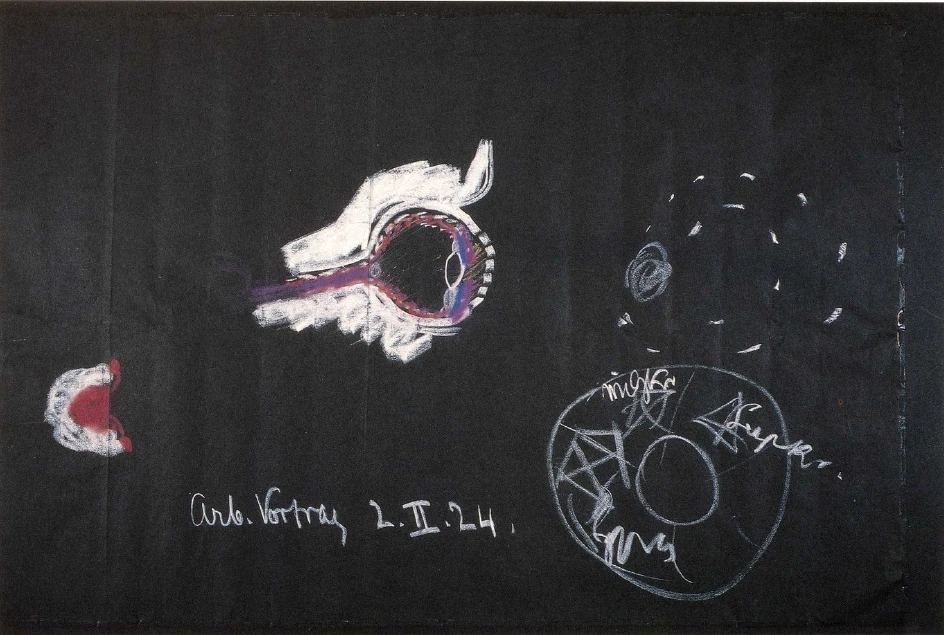
[ 8 ] Nun, das Eigentümliche ist nur, daß jeder zugeben muß, daß man, wie die Leute sagen, mit dem Sehnerv hier überall sieht, nur just da nicht, wo er hereinkommt; da ist er blind, da sieht man nichts! Wenn also einer gerade so schaut, daß er irgendwie da herausschaute, oder daß die Nerven ringsherum erkrankt sind und nur noch die Stelle gesund ist, wo der Sehnerv hereinkommt, dann sieht man trotzdem da, wo der Sehnerv hereinkommt, nichts. Jetzt sagen die Leute: Mit dem Sehnerv sieht man, der ist dazu da, daß man sieht. - Haben Sie nun schon das Folgende gehört? Denken Sie sich einmal: Da ist eine Partie von Arbeitern, sagen wir dreißig Arbeiter. Fünfundzwanzig von diesen müssen recht fleißig arbeiten; die stehen überall da. Und da steht eine Gruppe von fünf - man wird das nicht machen, aber ich will einmal voraussetzen, daß man das macht -, diese fünf, die dürfen faulenzen, während die anderen fleißig arbeiten. So daß wir also sagen können: da sind die fünfundzwanzig fleißigen Arbeiter, und da sind fünf, die faulenzen die ganze Zeit, sitzen auf gepolsterten Sesseln und faulenzen. Wenn Ihnen nun einer sagt, die Arbeit wird von den fünf Faulenzern ebensogut gemacht — oder vielleicht kann er das nicht sagen, weil er das nicht sieht, aber die Arbeit kommt dadurch zustande, daß gefaulenzt wird -, so werden Sie das nicht glauben, nicht wahr? Das ist doch Unsinn. Nun aber lehrt einen die Wissenschaft: Der Sehnerv sieht. — Aber just an der Stelle, wo er am meisten ist, da sieht er nichts! Das ist geradeso, wie wenn Sie sagen würden: Die Arbeit wird von dem geleistet, was die fünf faulenzenden Menschen machen. - Sehen Sie, solche Dinge weiß man - das ist eben gerade das Kuriose -, solche Dinge weiß man, aber man behauptet dennoch immerfort einen ganz gewöhnlichen Unsinn. Nicht wahr, daraus, daß hier der sogenannte blinde Fleck ist — so heißt er nämlich -, und daß man an der Stelle, wo der Sehnerv am meisten angreift, gar nichts sieht, daraus geht ja ganz klar hervor, daß der Sehnerv nicht das sein kann, womit man sieht.
[ 8 ] Well, the strange thing is simply that everyone has to admit that, as people say, you can see everywhere with the optic nerve—except right where it enters; there you’re blind—you can’t see anything there! So if someone happens to look in such a way that they’re somehow looking out of there, or if the nerves all around are diseased and only the spot where the optic nerve enters is healthy, then you still see nothing right where the optic nerve enters. Now people say: You see with the optic nerve; that’s what it’s there for—so you can see. - Have you heard the following yet? Just imagine: There’s a group of workers—let’s say thirty workers. Twenty-five of them have to work quite hard; they’re standing all over the place. And there’s a group of five—we wouldn’t actually do this, but let’s assume for a moment that we do—these five are allowed to loaf around while the others work diligently. So we can say: there are the twenty-five hardworking laborers, and there are five who loaf around the whole time, sitting in upholstered armchairs and doing nothing. Now, if someone were to tell you that the work is done just as well by the five slackers—or perhaps they can’t say that because they don’t see it, but the work gets done precisely because they’re slacking off—you wouldn’t believe it, would you? That’s nonsense. But science teaches us: the optic nerve sees. — But right at the spot where it’s most concentrated, it sees nothing! That’s just like saying: The work is done by what those five loafers are doing. — You see, we know such things—and that’s precisely the curious part—we know such things, but we still keep asserting the most ordinary nonsense. Isn’t it true that the fact that this is the so-called blind spot—that’s what it’s called, after all—and that one sees nothing at all at the point where the optic nerve is most active, clearly shows that the optic nerve cannot be what we use to see.
[ 9 ] Die Sache ist nämlich so: Es gibt etwas im menschlichen Körper, das sehr ähnlich ist dieser Sache beim Sehnerv; das sind nämlich Ihre beiden Arme und Hände. Denken Sie sich, Sie heben einen Stuhl auf. Sie strengen die Arme an bis hinunter zu den Händen. Aber das, was sie da verbindet, das bleibt dabei oben, nicht wahr. Geradeso ist es beim Sehnerv. Sie streben da etwas an, was das Licht angreift, und in der Mitte ist es da so, wie es ist zwischen den beiden Armansätzen hier. Aber es ist nicht der Sehnerv, der da angreift - denn wenn der Sehnerv es wäre, so müßte er da am allermeisten sehen —, sondern dasjenige, was da angreift, ist etwas von dem ganz Unsichtbaren, das ich Ihnen beschrieben habe. Das ist gerade das Ich, die Ich-Organisation. Es ist nicht der physische Körper, nicht der Ätherkörper, es ist sogar noch nicht einmal der Astralkörper; es ist das Ich. Und so muß ich Ihnen hier noch etwas außer dem, was schon da drinnen ist, einzeichnen: Da ist das unsichtbare Ich, das sich da ausbreitet. Nur daß es nicht so ist, wie wenn da zwei solche Arme wären, sondern so, daß da die Arme sich schließen würden und eine Kugel würden. Mit den Händen fangen wir schon an eine Kugel zu machen, wenn wir etwas anfassen. So ist da drinnen das übersinnliche Ich; das greift da an. Und wozu ist denn der Nerv da? Ja, meine Herren, der Nerv ist dazu da — weil das eine Arbeit ist, die ja der unsichtbare Mensch verrichtet -, daß abgesondert wird. Da wird überall Substanz abgesondert, die bleibt da überall liegen. Mit dem übersinnlichen Ich sieht man. Aber der Nerv ist dazu da, daß etwas abgesondert wird.
[ 9 ] Here’s the thing: There’s something in the human body that’s very similar to this aspect of the optic nerve; namely, your two arms and hands. Imagine you’re lifting a chair. You strain your arms all the way down to your hands. But what connects them stays up there, doesn’t it? It’s exactly the same with the optic nerve. You’re reaching for something that captures the light, and in the middle, it’s just like it is between the two shoulder joints here. But it is not the optic nerve that perceives it—for if it were the optic nerve, it would have to see it most clearly there—but rather, what perceives it is something of the completely invisible realm that I have described to you. That is precisely the “I,” the “I”-organization. It is not the physical body, not the etheric body—it is not even the astral body; it is the “I.” And so I must sketch something else for you here, in addition to what is already there: there is the invisible “I” spreading out there. Except that it is not as if there were two such arms, but rather as if the arms were closing together to form a sphere. We already begin to form a sphere with our hands when we touch something. So there, within, is the supersensible “I”; that is what takes hold. And what is the nerve there for? Yes, gentlemen, the nerve is there—because this is a task performed by the invisible human being—to secrete. Substance is secreted everywhere, and it remains there everywhere. With the supersensible “I,” one sees. But the nerve is there so that something may be secreted.
[ 10 ] Denken Sie, was da die Wissenschaft für einen Unsinn sagt, geradeso wie wenn man den Dickdarm und das, was im Dickdarm drinnen ist, untersucht und man unmittelbar von dem, was aus dem Dickdarm jetzt ausgeschieden wird, sagen würde, daß sich der Mensch damit nährt! Geradeso wie im Dickdarm drinnen ist, was dann ausgeschieden wird, so wird hier die Nervensubstanz ausgeschieden. Und das hier (der blinde Fleck) ist dann die Stelle, wo sie am meisten ausgeschieden wird. Da wird ins Gehirn hinein dasjenige, was man nicht braucht im Auge, ausgeschieden, geht dann weiter und wird überhaupt ausgeschieden. Sehen Sie, das ist etwas, was Sie ganz leicht einsehen können, worüber Ihnen aber heute die tollsten Geschichten erzählt werden. Nur kommen die Leute nicht darauf, was es heißt, wenn man behauptet, es wird mit der Nervensubstanz gesehen oder empfunden oder irgend etwas wahrgenommen. Das wäre geradeso, als wenn man sich mit dem Inhalte des Mastdarmes nähren würde. Also sehen Sie, daß diese Geschichte mit dem blinden Fleck gar keine Bedeutung hat für das Sehen, denn der Sehnerv sieht auch daherum nicht, nur wird hier, wo der blinde Fleck ist, eben am meisten ausgeschieden. Und geradeso, wie im Mastdarm die Ernährung aufhört, wie das nur zum Ausscheiden da ist, so hört auch hier eben das Sehen auf, weil da am meisten ausgeschieden wird, und weil es auch gar keinen Sinn hat, daß da in der Mitte gesehen wird.
[ 10 ] Just think what nonsense science is spouting here—it’s exactly as if you were to examine the large intestine and its contents, and then immediately conclude, based on what is being excreted from the large intestine, that this is what nourishes the human being! Just as what is inside the large intestine is eventually excreted, so too is the nervous substance excreted here. And this (the blind spot) is the place where it is excreted the most. What the eye doesn’t need is excreted into the brain, then continues on and is excreted altogether. You see, this is something you can understand quite easily, yet today you’re told the wildest stories about it. It’s just that people don’t realize what it means when someone claims that one sees, feels, or perceives something through the nervous substance. That would be just like nourishing oneself with the contents of the rectum. So you see that this story about the blind spot has no significance whatsoever for vision, because the optic nerve doesn’t fail to see around it—it’s just that here, where the blind spot is, the most is simply excreted. And just as nourishment ceases in the rectum—since it exists solely for excretion—so, too, does vision cease here, because that is where the most waste is excreted, and because it makes no sense at all to see in the center.
[ 11 ] Denken Sie, Sie hätten da einen Stock liegen und wollten ihn mit dem Kopf aufheben! Das können Sie nicht. Sie müssen ihn mit dem Arm, mit der Hand aufheben, mit dem, was sich seitlich ansetzt. Ebensowenig können Sie mit dem Nerv sehen. Man muß mit dem sehen, was da angreift.
[ 11 ] Imagine you have a stick lying there and want to pick it up with your head! You can’t do that. You have to pick it up with your arm, with your hand—with what extends from the side. Nor can you see with a nerve. You have to see with what actually makes contact.
[ 12 ] Nun, meine Herren, alles was da ist (auf die Zeichnung deutend), endet hier in eine Art Muskel. Dieser Muskel trägt die Linse. Das ist ein ganz durchsichtiger Körper. Warum durchsichtig? Damit man ans Licht herankommen kann. Und hinter diesem Körper hier ist eine dickliche Flüssigkeit. Vorne ist eine noch dicklichere Flüssigkeit, und in dieser dicklichen Flüssigkeit da vorne schwimmt die Iris oder Regenbogenhaut darin, die sich hier ansetzt in der Nähe der Adern. Sie schwimmt wirklich darinnen in der Flüssigkeit und läßt ein Loch für das Licht offen. Dieses Loch erscheint schwarz, wenn man hineinschaut, weil man durch das ganze Auge durch bis an den Hintergrund schaut, der eben schwarz ist.
[ 12 ] Well, gentlemen, everything you see here (pointing to the drawing) ends here in a kind of muscle. This muscle supports the lens. It is a completely transparent structure. Why is it transparent? So that light can pass through it. And behind this structure here is a thick fluid. In front is an even thicker fluid, and floating in that thick fluid up front is the iris, which is attached here near the blood vessels. It really floats there in the fluid and leaves an opening for the light. This opening appears black when you look into it, because you’re looking all the way through the eye to the back, which happens to be black.
[ 13 ] Diese Regenbogenhaut oder Iris ist vorn ziemlich durchsichtig, an der hinteren Seite ist sie schwarz. Diese schwarze Haut, die da hinten ist, ist bei manchen Menschen recht dünn. Weil, wenn sie dünn ist, man da durch das Durchsichtige in Schwarz hineinschaut, haben gewisse Menschen blaue Augen. Und bei denjenigen, bei denen die Haut hier dicker ist, bei denen man auf die dicke hintere Haut aufschaut bei der Regenbogenhaut, bei denen sind es schwarze Augen oder dunkle Augen. Wir wollen von den braunen Augen gleich nachher sprechen.
[ 13 ] This iris is fairly transparent at the front and black at the back. This black layer at the back is quite thin in some people. Because when it is thin, you can see the black through the transparent part, which is why certain people have blue eyes. And for those whose membrane is thicker here—where you look up at the thick back membrane through the iris—they have black or dark eyes. We’ll talk about brown eyes in a moment.
[ 14 ] Nun, meine Herren, müssen wir uns einmal darüber unterrichten, worauf es denn beruht, daß bei manchen Menschen diese Haut hier, die eigentlich das Blau oder Braun oder Schwarz ausmacht, dicker oder dünner ist. Ich habe Ihnen ja gesagt: Da ins Auge hinein geht das, was man das Ich nennt, dieser edelste, übersinnliche Teil des Menschen. Da geht das Ich hinein. Das Ich ist bei den Menschen verschieden stark oder schwach. Nehmen Sie nun an, das Ich sei sehr stark bei einem Menschen, ein Mensch hätte ein sehr starkes Ich. Sehen Sie, ein solcher Mensch ist imstande, das Eisen, das er im Blute hat und das er auch durch diese Aderhaut ins Auge hineinkriegt, ganz aufzulösen. Wer also ein sehr starkes Ich hat, löst das Eisen ganz auf, und die Folge davon ist, daß eben in diese Haut, die ja am alleräußersten Rand des Körpers liegt, wenig Eisen hineinkommt, weil es ganz aufgelöst ist. Es kommt also wenig Eisen hinein, und die Folge davon ist, daß diese Haut dünnlich wird. Dadurch, daß sie dünnlich wird, bekommt man blaue Augen. Denken Sie sich nun, ein Mensch hat ein schwaches Ich; dann löst er das Eisen nicht so stark auf, und die Folge davon wird sein, daß noch viel unaufgelöstes Eisen in diese Haut hineinkommt. Von diesem unaufgelösten Eisen wird die Haut dicker und der Mensch bekommt dunkle, schwarze Augen. Es hängt also von dem Ich ab, ob der Mensch schwarze oder blaue Augen hat.
[ 14 ] Well, gentlemen, we must now examine the reason why, in some people, this skin here—which actually determines whether the skin is blue, brown, or black—is thicker or thinner. As I have already told you: what is called the “I,” this noblest, supersensory part of the human being, enters through the eye. That is where the “I” enters. The “I” varies in strength from person to person. Now suppose the “I” is very strong in a person—that a person has a very strong “I.” You see, such a person is capable of completely dissolving the iron that is in their blood and that also enters the eye through this choroid. So anyone with a very strong “I” completely dissolves the iron, and the result is that very little iron enters this membrane—which, after all, lies at the very outermost edge of the body—because it is completely dissolved. Thus, little iron enters, and the result is that this membrane becomes thin. As it becomes thin, one develops blue eyes. Now imagine a person with a weak ego; this person does not dissolve the iron as thoroughly, and the result is that a great deal of undissolved iron enters the skin. This undissolved iron causes the skin to thicken, and the person develops dark, black eyes. Whether a person has black or blue eyes therefore depends on the ego.
[ 15 ] Nun, meine Herren, im Blut drinnen ist aber auch noch ein Stoff: das ist der Schwefel. Und wenn auch das Ich das Eisen verarbeiten kann, ist es halt trotzdem manchmal unfähig, den Schwefel zu verarbeiten. Wenn das Ich den Schwefel unverarbeitet in diese Haut hereinläßt, dann entsteht ein Gelblichbraunes in der Iris, da kommen die bräunlichen Augen zustande. Und wenn besonders viel Schwefel in die Augen hineinkommt, dann entsteht eine rötliche Iris. Von dem Schwefel, der da dahinter schimmert, wird sogar die Pupille nicht schwarz. Man sieht nicht das Schwarze, sondern der ausgestrahlte, ausgespritzte Schwefel macht selbst die Pupille dunkelrot. So ist es bei dem Kakerlaken, so ist es bei den Menschen, die sonst eben auch ihre Haut nicht richtig mit der Hautfarbe versorgen können. So daß man sagen kann: Es gibt eben Menschen, die können den Schwefel in ihre Augen wie hineinspritzen. Das Ich kann das hineinspritzen, und es kommt dadurch diese besondere Färbung der Iris zustande.
[ 15 ] Well, gentlemen, there is also another substance in the blood: sulfur. And even though the “I” can process iron, it is sometimes still unable to process sulfur. If the “I” allows unprocessed sulfur to enter the skin, a yellowish-brown color develops in the iris, resulting in brownish eyes. And if a particularly large amount of sulfur enters the eyes, a reddish iris develops. Because of the sulfur shimmering behind it, even the pupil does not turn black. You do not see the black; rather, the sulfur that radiates and is expelled turns even the pupil dark red. This is the case with cockroaches, and it is the case with people who, for other reasons, are also unable to properly supply their skin with its natural color. So one can say: There are simply people who can inject sulfur into their eyes, as it were. The “I” can inject it, and this results in this particular coloring of the iris.
[ 16 ] Aber dasjenige nun, was da ins Auge hineinkommt an Schwefel oder Eisen, das kommt ja in den ganzen Körper hinein, denn es kommt aus dem Blut. Das sind ja nur kleine Blutadern hier im Auge. Wenn also einer hier im Auge Schwefel hineinspritzt, so spritzt er in seine ganze Haut überall Schwefel aus. Und die Folge davon, daß er in seine ganze Haut überall Schwefel ausspritzt, ist, daß er an den Stellen, wo der Schwefel hingespritzt ist, nicht seine natürliche Hautfärbung hat; denn die natürliche Hautfärbung kommt von der Eisenverarbeitung. Wenn also der Mensch sein Eisen nur gering verarbeitet, dafür aber Schwefel ausspritzt, dann bekommt er solche scheckigen Flecken in der Haut, und zugleich kann man das an der Augenfärbung sehen.
[ 16 ] But whatever sulfur or iron enters the eye actually enters the entire body, because it comes from the blood. These are just small blood vessels here in the eye. So if someone injects sulfur into the eye here, he is spraying sulfur all over his skin. And the consequence of spraying sulfur all over his skin is that in the places where the sulfur has been sprayed, his skin does not have its natural color; for the natural skin color comes from the processing of iron. So if a person processes very little iron but expels sulfur instead, they develop such mottled patches on their skin, and at the same time, this can be seen in the color of their eyes.
[ 17 ] Sie sehen also: Gerade wenn man diesen unsichtbaren Menschen, der in jedem Menschen steckt, betrachtet, so kann man auch bis in die Materie hinein, bis in den Stoff hinein den Menschen verstehen. Anthroposophie ist ja nicht so blödsinnig, daß sie nicht den Stoff versteht. Der Materialismus gerade versteht den Stoff nicht. Lesen Sie irgendwo nach über den Albinismus, was können Sie da lesen? Derjenige von Ihnen, der mich gefragt hat, wird ja wahrscheinlich irgendwo etwa gelesen haben: Die Ursache des Albinismus ist unbekannt! — Der Materialismus kommt eben überall zu diesem merkwürdigen Satz: Die Ursache ist unbekannt! — weil er sich überhaupt nicht bekümmert um diejenigen Fälle, wo die Ursachen zu finden sind. Es ist natürlich leicht, zu sagen: Da ist eine rote Pupille. - Ja, aber man muß kennen, was da drinnen eigentlich arbeitet, und was die Geschichte hineinspritzt, denn die Rotfärbung und die Blaßfärbung des Körpers kommt vom Schwefel.
[ 17 ] So you see: it is precisely when we consider this invisible human being that lies within every person that we can also understand the human being right down into matter, right down into the substance itself. Anthroposophy is certainly not so nonsensical that it fails to understand matter. Materialism, on the other hand, does not understand matter. Look up albinism somewhere—what do you find? The one of you who asked me probably read somewhere: “The cause of albinism is unknown!” — Materialism always arrives at this curious conclusion: “The cause is unknown!” — because it pays no attention whatsoever to those cases where the causes can actually be found. Of course, it is easy to say: “There is a red pupil.”—Yes, but one must know what is actually at work inside it and what history has injected into it, for the red and pale coloring of the body comes from sulfur.
[ 18 ] Jetzt aber können Sie verstehen, was wirkliche Wissenschaft ist. Denken Sie sich, Sie kommen irgendwo an eine Stelle auf der Erde hin, da ist etwas gearbeitet; es schaut sich einer das an und sagt: Die Arbeit ist schon da, die Ursache ist unbekannt. — Er kümmert sich nicht darum, was vorher geschehen ist; deshalb konstatiert er: Ursache ist unbekannt. — Daß da also zum Beispiel dreißig Leute gearbeitet haben viele Tage lang, darum kümmert er sich nicht. So macht es die Wissenschaft, wenn sie sagt: Für die Rotfärbung der Pupille und die Bleichfärbung der Haut ist die Ursache unbekannt. — Aber die Ursache liegt eben in dem Ich, das da in der Materie, in dem Stoff arbeitet.
[ 18 ] But now you can understand what real science is. Imagine you come to a place somewhere on Earth where work has been done; someone looks at it and says: “The work is already there; the cause is unknown.” — He doesn’t care about what happened before; which is why he states: “The cause is unknown.” — So the fact that, for example, thirty people worked there for many days—he doesn’t care about that. This is how science operates when it says: “The cause of the red coloration of the pupil and the pale coloration of the skin is unknown.” — But the cause lies precisely in the “I” that is at work there in matter, in the substance.
[ 19 ] Daraus sehen Sie aber auch wiederum: In der Iris ist ja wirklich etwas von einem getreuen Spiegelbild enthalten von dem, wie der ganze Körper mit Eisen und Schwefel arbeitet. Aber nehmen Sie einmal solch einen Albino, solch einen Kakerlaken; das ist eigentlich eine Art von Krankheit. Es wird zu viel mit Schwefel in dem Körper gearbeitet, aber der Körper gewöhnt sich daran, und es ist das organisiert. Nun aber kann das eintreten, daß das in viel schwächerem Maße in die Augen hineinkommt. Sehen Sie, außer diesem Kakerlaken, von dem ich Ihnen erzählt habe, außer dieser Dame, die sich in der Schaubude ausgestellt hat, habe ich manchen Kakerlaken gesehen. Immer kann man nachweisen, daß bei solchen Kakerlaken etwas ganz Besonderes vorliegt. Man kann sagen: Da ist ein Kakerlak, ein solcher Albino, und er hat diese eigentümliche rötliche Färbung der Iris, blaßrot, hat die dunkelrote Färbung der Pupille, hat den bleichen Körper. Wenn man ihn jetzt weiter prüft, bekommt man aus der Beschaffenheit seines Körpers die Ansicht, daß bei ihm besonders die Verbindung zwischen Herz und Niere eine sehr schwächliche ist. Er ist nicht nur schwach in den Augen, er ist in der Verbindung zwischen Herz und Niere schwach. Die Nieren werden bei einem solchen Menschen sehr mühsam mit Blut versorgt, arbeiten also sehr schwer. Wenn er den Schwefel, den er durch seine ganze Leibesbeschaffenheit in sich trägt, auf die Nieren ablagern würde, dann würde er als Kind schon sterben. Deshalb schiebt er den Schwefel nach der Körperoberfläche ab - die Haut wird weiß, die Augen werden rot —, so daß die Nieren zart arbeiten können. Solche Albinos haben die zartest arbeitenden Nieren zum Beispiel. Es kann das auch bei anderen Menschen auftreten. Wenn aber bei Menschen, die nicht Kakerlaken sind — die meisten sind ja nicht Kakerlaken -, irgendein Fehler bei den Nieren auftritt, ja, muß er sich denn dann nicht auch in der Iris zeigen? Dasjenige, was dort Schwefel und Eisen miteinander machen, drückt sich ja auch hier aus. Man kann also schon aus der Beschaffenheit der menschlichen Iris darauf schließen, ob im menschlichen Körper da oder dort etwas geschädigt ist. Daher kann man an diesem feinen Aussehen der Iris, wenn da oder dort ein Flecken ist, was nicht eigentlich normal ist, sehen: Da ist ein Schaden im Körper. Aber, meine Herren, das müssen Sie bedenken: Der ganze Körper des Menschen ist eine Einheit, und dasjenige, was man in der Iris sieht, würde man auch, wenn man nur gescheit genug wäre, dann sehen, wenn man ein kleines Stückchen der Haut herausschneiden und herausnehmen würde — da würde auch in der Haut etwas auftreten, was nicht normal wäre -, oder selbst wenn man den Nagel der großen Zehe abschneiden würde. Da ist auch eine sehr feine Gliederung, an der man sehen könnte, wenn Leber oder Niere oder Lunge nicht in Ordnung wären, wenn auch wieder ein wenig anders. Also wenn einer besonders gescheit wäre und statt der Irisuntersuchung eine Untersuchung der abgeschnittenen Fingernägel zum Beispiel machen würde — es würde ja viel schwerer sein, weil es nicht so ausgesprochen ist —, so würde er auch da die gesunde oder kranke Beschaffenheit erkennen können. Beim Auge ist es nur auffällig, weil das Auge ein besonders zartes Gebilde ist, und da ist nun wieder das Zarte leicht zu ergreifen. Beim Auge kommt es am stärksten heraus. Aber Sie können ja auch sonst sehen, daß an der Oberfläche des Körpers die Dinge am stärksten herauskommen. Ich habe zum Beispiel selten gesehen, daß einer, wenn er einen besonders feinen Stoff befühlen will oder so irgend etwas, daß er das auf die Schultern legt. Wenn das der Fall wäre, daß das vorteilhafter wäre, würden wir daher schon etwas machen, daß, wenn wir etwas Feines befühlen sollten, wir uns da oben auf der Schulter frei machen könnten und es befühlen könnten. Aber das hilft uns nichts. Wir befühlen es mit den Fingerspitzen. Und an den Fingerspitzen sind wir für das Gefühl von Sachen besonders empfindlich. Da haben Sie ja wieder dieselbe Sache. Wenn das Nervensystem dasjenige wäre, was eigentlich das Gefühl ausmacht, müßte man dort, wo man in der Nähe vom Gehirn ist, am meisten fühlen. Aber wir fühlen ja gar nicht in der Nähe vom Gehirn am meisten, sondern da, wo es vom Gehirn am weitesten weg ist, fühlen wir, gerade in den äußersten Fingerspitzen, weil das Ich am meisten an der Oberfläche des Körpers sitzt. Dasjenige, was der Mensch in seinem Innern als Ich ist, das kann man an der äußersten Oberfläche am besten erkennen. Daher kann man, weil die Augen am allermeisten an der Oberfläche sind, auch da am allermeisten erkennen, weil die Augen zart sind und vom Hirn weg sind.
[ 19 ] But this also shows you once again: The iris truly contains a faithful reflection of how the entire body works with iron and sulfur. But take, for example, an albino—or a cockroach; that is actually a kind of disease. Too much sulfur is being processed in the body, but the body gets used to it, and it’s organized that way. Now, however, it can happen that this affects the eyes to a much weaker degree. You see, aside from this cockroach I told you about, aside from that lady who put herself on display in the freak show, I’ve seen many a cockroach. One can always demonstrate that there is something quite special about such cockroaches. One might say: Here is a cockroach, an albino of this kind, and it has this peculiar reddish coloring of the iris—pale red—a dark red pupil, and a pale body. If one examines it further, the nature of its body suggests that the connection between its heart and kidneys is particularly weak. It is not only weak in the eyes; it is weak in the connection between heart and kidneys. In such a person, the kidneys are supplied with blood with great difficulty and therefore work very hard. If he were to deposit the sulfur—which he carries within him due to his entire physical constitution—in his kidneys, he would die even as a child. That is why he expels the sulfur to the body’s surface—the skin turns white, the eyes turn red—so that the kidneys can function delicately. Such albinos, for example, have the most delicately functioning kidneys. This can also occur in other people. But if, in people who are not cockroaches—most of them are not cockroaches, after all—some kind of kidney dysfunction occurs, well, shouldn’t that also manifest itself in the iris? After all, the interaction between sulfur and iron is also expressed here. So one can already infer from the condition of the human iris whether something is damaged here or there in the human body. Therefore, by observing this delicate appearance of the iris—if there is a spot here or there that isn’t actually normal—one can see: There is damage in the body. But, gentlemen, you must bear this in mind: The entire human body is a unified whole, and what one sees in the iris—if one were only wise enough—one would also see if one were to cut out and remove a small piece of skin—something abnormal would also appear in the skin—or even if one were to cut off the toenail of the big toe. There is also a very fine structure there that would reveal if the liver, kidneys, or lungs were not functioning properly—albeit in a slightly different way. So if someone were particularly astute and, instead of an iris examination, were to examine the cut fingernails, for example—though it would be much more difficult, since the signs aren’t as pronounced—they would also be able to discern the healthy or diseased condition there. With the eye, it’s only noticeable because the eye is a particularly delicate structure, and that delicacy is easy to perceive. It stands out most clearly with the eye. But you can also see in other contexts that things are most evident on the surface of the body. For example, I’ve rarely seen someone who, when wanting to feel a particularly fine fabric or something like that, would place it on their shoulders. If that were the case—if that were more advantageous—we would have evolved a way so that, when we needed to feel something delicate, we could free up our shoulders and feel it there. But that doesn’t help us. We feel it with our fingertips. And at the fingertips, we are particularly sensitive to the sensation of objects. There you have the same principle again. If the nervous system were what actually constitutes sensation, one would have to feel the most near the brain. But we do not feel the most near the brain at all; rather, we feel the most where it is farthest from the brain—precisely at the very tips of our fingers—because the “I” is located most on the surface of the body. What a person is at their core—their “I”—can best be recognized on the outermost surface. Therefore, because the eyes are closest to the surface, we can also perceive the most there, since the eyes are delicate and located far from the brain.
[ 20 ] Sie können sagen: Die Augen sind ja im Schädel und nahe vom Gehirn. — Aber damit sie recht weit weg sind, sind da recht viele Knochen, und da, wo das Auge mit dem Hirn in Verbindung ist, wo der Knochen nicht ist, da wird eben nichts gesehen. Also bei den Fingerspitzen, da ist es durch die Weite des Raumes bedingt, daß sie besonders empfindlich sind; bei den Augen ist es, weil sie am meisten geschützt sind vor dem Gehirn.
[ 20 ] You might say: The eyes are, after all, inside the skull and close to the brain. — But to keep them quite far away, there are quite a few bones, and where the eye is connected to the brain—where there is no bone—nothing can be seen. So, in the case of the fingertips, it is due to the vastness of the space that they are particularly sensitive; in the case of the eyes, it is because they are most protected from the brain.
[ 21 ] Dazu kommt noch etwas anderes, das merkwürdig ist. Wenn Sie irgendein niederes Tier haben, das sein Hirn ausbildet, so bildet es das Hirn so aus, daß das Hirn für das Auge die Höhle frei läßt, und das Auge wächst nicht so heraus aus dem Hirn, sondern es setzt sich da von der Seite an und wächst hinein (es wird gezeichnet). Von außen, nicht vom Hirn heraus wächst das Auge; ins Hirn herein wächst das Auge. Es ist also von außen hineingebilder.
[ 21 ] There is something else that is strange. If you have any lower animal that develops its brain, it develops the brain in such a way that the brain leaves a cavity free for the eye, and the eye does not grow out of the brain in that way, but rather attaches itself there from the side and grows inward (this is illustrated). The eye grows from the outside, not from within the brain; it grows into the brain. It is thus formed from the outside in.
[ 22 ] Aus alldem können Sie sehen, daß das, was da an der Oberfläche, sei es in der Haut, sei es im Auge, gebildet wird, mit dem zusammenhängt, wodurch der Mensch eigentlich mit der Außenwelt am meisten in Verbindung steht. Bei einem Menschen, der immer im Bett liegt, der seinen Willen nicht gebrauchen kann für seinen Körper, bei dem kann man nicht gut sagen, daß er sein Ich stark ausbildet. Bei einem Menschen, der viel beweglich ist, wird man schon sagen, daß er sein Ich stark ausdrückt. Und dasjenige, was uns sonst mit der Außenwelt in Berührung bringt, das ist eben in dem Riechen, Sehen und so weiter, das sind die Sinne. Und das Auge ist eben der zarteste Sinn, der uns mit der Außenwelt in Berührung bringt. So daß man schon sagen kann: Weil da das Ich besonders stark wirkt in diesem feinen Geäder - es ist ja ein furchtbar feines Geäder in dieser Regenbogenhaut oder Iris —, kann man an dieser viel sehen, wie das ganze Ich nach innen arbeitet, ob also der Mensch gesund oder krank ist.
[ 22 ] From all this you can see that what is formed on the surface—whether in the skin or in the eye—is connected to the very means by which a person is most closely linked to the outside world. In the case of a person who is always bedridden, who cannot exercise their will over their body, one cannot really say that they are developing a strong sense of self. In the case of a person who is very active, one would certainly say that they are expressing their sense of self strongly. And what else brings us into contact with the outside world is precisely through smelling, seeing, and so on—that is, the senses. And the eye is precisely the most delicate sense that brings us into contact with the outside world. So one can indeed say: Because the “I” acts particularly strongly in this delicate network of blood vessels—it is, after all, an incredibly delicate network in the iris—one can see a great deal from it about how the entire “I” works inwardly, and thus whether a person is healthy or ill.
[ 23 ] Das ist die ursprüngliche Wahrheit und Erkenntnis, die man über diese Sache haben kann. Aber diese Tatsache, die ich Ihnen jetzt beschrieben habe, gehört auch zu gleicher Zeit zu den allerschwierigsten, denn man muß schon sehr gründlich unterrichtet sein darüber, was so eine kleine Unregelmäßigkeit in der Iris zu bedeuten hat, wenn man daraus auf den gesunden oder kranken Menschen schließen will. Ich will Ihnen ein Beispiel sagen. Sehen Sie, es kann zum Beispiel sein, daß bei irgendeiner Iris da oder dort Pünktchen auftreten, dunkle Pünktchen auftreten. Diese dunklen Pünktchen bedeuten natürlich, daß der Mensch etwas hat, was sonst nicht da ist, wenn diese dunklen Pünktchen in der Iris nicht sind. Aber nehmen Sie an, der Mensch, bei dem diese dunklen Pünktchen auftreten, wäre ein furchtbar dummer Kerl. Dann wird er irgendeine Krankheit haben, auf die diese dunklen Pünktchen hinweisen. Aber bei dem Menschen, bei dem diese dunklen Pünktchen auftreten, kann das auch so sein, daß er in seiner Jugend überanstrengt worden ist mit irgendeinem Lernen, über seine physischen Kräfte hinaus hat lernen müssen. Dann kann er dadurch, daß er gewisse Organe in seiner Jugend zu stark gebraucht hat, eine gewisse schwächere Tätigkeit nach den Augen getrieben haben, und dann können diese kleinen Eisenablagerungen, diese ganz feinen Eisenablagerungen durch eine Überanstrengung in der Kindheit auftreten. Sie können also auftreten durch eine Krankheit im späteren Leben, sie können aber auch auftreten durch eine Überanstrengung in der Kindheit. Die meisten Menschen denken: wenn ich da schwarze Pünktchen sehe in der Iris, dann muß das oder jenes im Körper sein. - Es kommt aber darauf an, daß man nicht nur das gegenwärtige Leben des betreffenden Menschen weiß, sondern gerade dann, wenn man so etwas auf die Krankheitsursachen hin erkennen will, so muß man das ganze Leben des Menschen mit ihm durchgehen; man muß ihn erinnern lassen, was er da oder dort in der Kindheit schon getan hat. Es kann also dasjenige, was man in der Iris sieht, auf mancherlei deuten. Und gerade von so etwas auf etwas zu schließen, das gehört zu dem allerkompliziertesten Wissen.
[ 23 ] This is the fundamental truth and understanding one can have regarding this matter. But this fact, which I have just described to you, is also one of the most difficult, because one must be very thoroughly educated about what such a small irregularity in the iris signifies if one wants to use it to determine whether a person is healthy or sick. Let me give you an example. You see, it may be, for example, that small spots—dark spots—appear here and there in the iris. These dark spots naturally indicate that the person has something that is not normally present when these dark spots are absent from the iris. But suppose the person with these dark spots is a terribly foolish fellow. Then he will have some illness to which these dark spots point. But it may also be the case that the person with these dark spots overexerted himself in his youth with some kind of study, having had to study beyond his physical limits. In that case, by overusing certain organs in their youth, they may have caused a certain degree of weakened function in the eyes, and these small iron deposits—these very fine iron deposits—may then arise as a result of overexertion during childhood. So they can arise from an illness in later life, but they can also arise from overexertion during childhood. Most people think: if I see little black dots in the iris, then there must be this or that going on in the body. — But it is essential not only to know the person’s current life, but especially when one wants to identify the causes of illness in this way, one must go through the person’s entire life with them; one must help them recall what they did here and there during their childhood. So what one sees in the iris can indicate many different things. And drawing conclusions from such observations is among the most complex forms of knowledge.
[ 24 ] Daher ist es so empörend, daß heute allerlei Büchelchen geschrieben werden; die Dinge, die da geschrieben werden, sind meist sehr kurz und heißen: Über Augendiagnose. Da kriegt man eine Anleitung auf fünfzig Seiten, wie man die Iris untersuchen soll. So, nicht wahr: Da ist die Iriseinteilung, da ist die Pupille, ganz schematisch gezeichnet, dann ist da die Krankheit angegeben; Milzkrankheit steht dann da; Lungenkrankheit, Syphilis und so weiter. Nun braucht ja der betreffende Augendiagnostiker, der das kennt, was so aufgezeichnet wird, wenn er mit einem mäßigen Vergrößerungsglas die Iris ansieht, dann nur an sein Büchelchen zu gehen; und wenn er das bemerkt, was gerade dort eingezeichnet ist wo Lungenkrankheit steht, so konstatiert er: Lungenkrankheit! Und so machen es heute zahlreiche Augendiagnostiker nach einem Studium von einer Stunde. Das übrige überlassen sie dann dem Büchelchen, das sie haben; sie machen eben die Diagnose. Ja, meine Herren, das ist aber empörend. Denn dasjenige, was am allerschwersten ist, will da auf die allerleichteste Weise erlernt werden. Dadurch kommt nicht etwas zustande, was etwas Wertvolles ist, sondern im Gegenteil, dadurch kommt zustande eine Schädigung des ganzen medizinischen Wesens. Und man muß schon unterscheiden, ob irgend jemand etwas Ernsthaftiges will im medizinischen Wesen, oder ob einer bloß Geld verdienen will.
[ 24 ] That is why it is so outrageous that all sorts of little booklets are being written today; the things written in them are usually very brief and are titled: “On Eye Diagnosis.” You get a fifty-page guide on how to examine the iris. You see: there’s the iris classification, there’s the pupil—drawn very schematically—and then the disease is listed: spleen disease, lung disease, syphilis, and so on. Now, the iridologist in question, who is familiar with what is recorded there, simply needs to consult his little booklet when he looks at the iris through a moderate-magnification magnifying glass; and when he notices what is marked right where “lung disease” is listed, he declares: “Lung disease!” And that is how numerous iridologists do it today after just one hour of study. They then leave the rest to the little handbook they have; they simply make the diagnosis. Yes, gentlemen, but that is outrageous. For what is most difficult is being taught in the easiest possible way. This does not result in anything of value; on the contrary, it causes damage to the entire field of medicine. And one must distinguish whether someone is serious about the field of medicine, or whether they merely want to make money.
[ 25 ] Natürlich, die Leute sind heute aufgebracht über die Wissenschaft; mit Recht, weil die Wissenschaft nach dem Beispiel mit dem Sehnerv, von dem ich Ihnen erzählt habe, eigentlich nicht auf das achtet, was der Mensch wirklich ist, sondern den Unrat des Menschen am meisten schätzt, den Unrat im Auge zum Beispiel, der der Sehnerv ist. Das wissen ja natürlich die Leute nicht, aber sie fühlen es und werden empört über die Wissenschaft. Diese Empörung kann man begreifen. Aber was da von dem Augendiagnostiker meistens gemacht wird, das ist nicht besser als die Wissenschaft, sondern meistens viel schlechter. Die Wissenschaft hält ahnungslos, weil sie heute durch den Materialismus nicht anders kann, Dreck für die edelsten Bestandteile des Menschen. Natürlich ist der Dreck auch sehr notwendig, denn wenn er im Körper bleiben würde, würde er den Körper sehr bald töten; also ist er notwendig. Aber die Wissenschaft hält den Dreck für das Wertvollste des Menschen! Aber damit ist sie doch auf dem Wege des Guten und will nicht bloß Geld verdienen. Sie ist nur mit Blindheit geschlagen. Sie hat eben einen sehr großen blinden Fleck in ihrer Erkenntnis; aber bei alledem muß man den guten Willen anerkennen. Aber da, bei solchen Augendiagnostikbüchelchen, kann man nicht mehr vom guten Willen sprechen, sondern nur noch von der Sucht, Geld zu verdienen. Deshalb müssen Sie schon bei all diesen Sachen sich immer sagen: Es kann irgendeiner Bestrebung eine gute Wahrheit zugrunde liegen, aber gerade die besten Wahrheiten, meine Herren, werden von der Welt am meisten mißbraucht. Sehen Sie, es ist wirklich wunderbar, daß in dieser kleinen Iris sich tatsächlich der gesunde und kranke Mensch ganz spiegelt. Aber auf der andern Seite ist deshalb, weil sich der gesunde und kranke Mensch ganz spiegelt, auch die Iris in ihrem Bestand am schwersten zu erkennen, und man muß schon sagen: Wer, ohne den ganzen Menschen zu erkennen, ohne wirklich etwas zu wissen vom ganzen Menschen, Augendiagnose treibt, der treibt Unfug.
[ 25 ] Of course, people today are upset with science; and rightly so, because—as illustrated by the example of the optic nerve I told you about—science doesn’t really pay attention to what a human being truly is, but instead values most the filth within a human being, the filth in the eye, for example, which is the optic nerve. People don’t know this, of course, but they sense it and are outraged by science. This outrage is understandable. But what the eye diagnostician usually does is no better than science—in fact, it’s usually much worse. Science, unaware—because materialism leaves it no other choice today—considers filth to be the noblest components of the human being. Of course, this filth is also very necessary, for if it were to remain in the body, it would kill the body very quickly; thus, it is necessary. But science considers this filth to be the most valuable part of the human being! Yet it is still on the path of goodness and does not merely seek to make money. It is simply struck by blindness. It has a very large blind spot in its understanding; but despite all this, one must acknowledge its good will. However, when it comes to such little eye-diagnosis booklets, one can no longer speak of good will, but only of the obsession with making money. That is why, with all these things, you must always tell yourselves: There may be a good truth underlying any endeavor, but it is precisely the best truths, gentlemen, that are most abused by the world. You see, it is truly marvelous that the healthy and sick human being is actually fully reflected in this small iris. But on the other hand, precisely because it fully reflects both the healthy and the sick person, the iris is also the most difficult to interpret in its entirety, and one must say: Anyone who practices eye diagnosis without recognizing the whole person—without truly knowing anything about the whole person—is engaging in nonsense.
[ 26 ] Und den ganzen Menschen erkennen, was heißt denn das? Sehen Sie, wir haben gelernt, wie der Mensch besteht aus seinem physischen Leib, dem Ätherleib, dem Astralleib und dem Ich. Man muß also nicht nur etwas wissen vom physischen Menschen, sondern man muß, gerade wenn man Augendiagnose treibt, etwas vom geistigen Menschen wissen. Nicht wahr, die gewöhnliche Anatomie, die nur an den Leichnam geht, kann unter Umständen ausreichen mit dem, was sie bietet, kann eigentlich verhältnismäßig noch ganz Gutes bieten; wenn sie auch nicht weiß, daß der Augennerv der Dreck des Auges ist, so finder sie wenigstens den Augennerv. Aber der Augendiagnostiker, der hat ja meistens keine Ahnung davon, wie der Nerv verläuft, sondern er hat sein Büchelchen von fünfzig Seiten und die Einteilung der Iris und diagnostiziert darauflos, untersucht nicht den Menschen. Jetzt braucht er natürlich dann noch irgendein Büchelchen, wiederum von fünfzig Seiten. Da steht die Rubrik «Lungenkrankheit» und das Heilmittel dazu. Aber die Lungenkrankheit ist etwas, was von vielerlei Ursachen kommen kann. Damit, daß man weiß, die Lunge ist affiziert, damit hat man noch nicht viel erreicht. Die Lunge kann affiziert sein von der Verdauung aus. Man muß wissen, woher es kommt. Lungenkrank sind viele Menschen. Bei vielen hat die Lungenkrankheit die verschiedensten Ursachen. Das ist gerade dasjenige, wo man ungeheuer vorsichtig sein muß, weil da, wo die schönsten Sachen vorliegen, am meisten Unfug vorliegt. Wieviel habe ich Ihnen in diesen Stunden davon erzählt, daß der Mensch nicht bloß von der Erde abhängt, sondern von dem ganzen Sternenhimmel. Aber das ist es auch gerade, was die allerkomplizierteste Einsicht erfordert. Damit darf man keinen Unfug treiben. Der Schwindel und Unfug wird ja heute von den verschiedenen Astrologen, die in der Welt sind, im Großen getrieben. Es ist etwas Ähnliches mit der Augendiagnostik wie mit der Astrologie. Da hat man auch in der Astrologie etwas sehr Edles, Großartiges zugrunde liegen; aber bei denen, die heute Astrologie treiben, liegt nichts sehr Edles zugrunde. Bei denen liegt meistens die Spekulation auf die Geldbörse ihrer Mitmenschen zugrunde.
[ 26 ] And to recognize the whole human being—what does that mean? You see, we have learned that the human being consists of the physical body, the etheric body, the astral body, and the I. So one must not only know something about the physical human being, but—especially when performing eye diagnosis—one must also know something about the spiritual human being. Isn’t it true that ordinary anatomy, which deals only with the corpse, can under certain circumstances be sufficient with what it offers—and can actually provide relatively good results? Even if it doesn’t know that the optic nerve is the “dirt” of the eye, it at least locates the optic nerve. But the eye diagnostician usually has no idea how the nerve runs; instead, he has his little fifty-page booklet with the classification of the iris and diagnoses based on that, without actually examining the person. Now, of course, he needs yet another little booklet, again fifty pages long. It lists the category “lung disease” and the corresponding remedy. But lung disease is something that can stem from many different causes. Simply knowing that the lungs are affected doesn’t get you very far. The lungs can be affected by issues originating in the digestive system. One must know where it comes from. Many people suffer from lung disease. For many, lung disease has a wide variety of causes. This is precisely where one must be extremely cautious, because where the most beautiful things exist, the most nonsense also exists. How much have I told you in these lectures about how human beings depend not only on the Earth but on the entire starry sky? But that is precisely what requires the most complex understanding. One must not engage in nonsense with this. Deception and nonsense are, after all, widely practiced today by the various astrologers in the world. Eye diagnosis is similar to astrology in this respect. Astrology, too, is based on something very noble and magnificent; but among those who practice astrology today, there is nothing particularly noble at its core. For them, it is mostly speculation aimed at the wallets of their fellow human beings.
[ 27 ] Und so können Sie den Zusammenhang begreifen, meine Herren: Auf der einen Seite sind die Erscheinungen, die die ganze Oberfläche des Menschen schon äußerlich verändern. Der Mensch bekommt bleiche Stellen, während er sonst dunkler ist auf der Haut; er bekommt anders gefärbte Augen, er ist ein Albino. Da wird eine gewisse Tätigkeit an die Oberfläche getrieben, abgelenkt von den inneren Organen. Wenn aber der Mensch kein Kakerlak ist, kein Albino, dann sind dieselben Dinge, das äußere Aussehen des Auges, in der Regenbogenhaut vorhanden; aber die feinere Struktur, die feinere Gliederung weist dann auf das Innere hin. Der Albino ist nicht dadurch ein ganz kranker Mensch, daß er Albino ist, sondern er ist nur mit einer Krankheitsanlage behaftet dadurch, daß er eben schon von Jugend auf das hat und sich nachher die körperliche Einrichtung daran gewöhnt.
[ 27 ] And so you can understand the connection, gentlemen: On the one hand, there are the manifestations that already alter the entire surface of the human being externally. The person develops pale patches, whereas the rest of their skin is darker; their eyes take on a different color—they are an albino. A certain activity is driven to the surface, diverted from the internal organs. But if a person is not a cockroach, not an albino, then the same features—the external appearance of the eye—are present in the iris; yet the finer structure, the finer organization, points to the inner being. The albino is not a completely sick person simply because he is an albino; rather, he is merely predisposed to illness because he has had this condition since childhood and his physical constitution has subsequently adapted to it.
[ 28 ] Sehen Sie, es ist gar nicht gut, den Albino auch Leukopath zu nennen. Dadurch wird schon hingewiesen darauf, weil Leukozyten zum Beispiel gewisse Körper im Blute sind, daß das Blut solcher Menschen anders beschaffen ist. Man kennt die Ursache nicht. Wenn aber das Blut an der Oberfläche bleicher wird, so tritt nicht die allgemeine Bleichsucht ein, sondern es tritt an der Oberfläche das Bleicherwerden der Haut ein. Das ist der Unterschied zwischen der Krankheit der Bleichsucht, wo einfach das Blut im Innern bleicher wird, und der Leukopathie oder dem Albinismus, bei dem das Blut mehr an die Oberfläche gedrängt wird. Das ist also so, daß bei Bleichsüchtigen eine Tätigkeit im Innern nicht in Ordnung ist. Das Ich ist mehr an der Oberfläche tätig, der Astralleib mehr im Innern. Daher sind alle Körper, mit denen man sieht und hört, mehr an die Oberfläche gedrängt. Die braucht man zum Ich. Die Leber brauchen Sie im Innern. Und wenn Sie alles so stark fühlen würden, wie das Ihre Leber tut, dann würden Sie fortwährend nur Ihr Inneres beobachten und sagen: Aha, jetzt habe ich eben in meinen Magen hinein ein bißchen Kohlsuppe gekriegt, die Magenwände fangen an, das aufzusaugen. Das ist so wie ein Ausstrahlen, sehr interessant. Jetzt geht das durch den Magenpförtner in den Dünndarm hinein; jetzt geht es da in die Zotten, die an den Darmwänden sind. Sie würden das alles beobachten, und das alles, das wäre sehr interessant; aber Sie hätten gar keine Zeit, die Außenwelt zu beobachten! Es ist sehr interessant und reichlich zu beobachten und in manchen Dingen viel schöner als die Außenwelt, aber der Mensch ist eben recht davon abgelenkt. Also im allgemeinen kommt das da drinnen nicht zum Bewußtsein; das, was an der Oberfläche liegt, kommt zum Bewußtsein. Wenn also jemand das Eisen nicht recht verarbeitet in seinem Innern, wo gerade der astralische Mensch mehr tätig ist, wird er bleichsüchtig. Wenn er das Eisen außen nicht richtig verarbeitet, sondern auflöst, wie ich es Ihnen beschrieben habe, dann wird er ein Albino - das ist sehr selten -, bekommt er Leukopathie.
[ 28 ] You see, it is not at all appropriate to also call an albino a “leukopath.” This implies—since leukocytes, for example, are certain cells in the blood—that the blood of such people is of a different nature. The cause is unknown. However, when the blood becomes paler on the surface, it is not a case of general pallor, but rather the skin becomes paler on the surface. That is the difference between the condition of pallor, where the blood simply becomes paler internally, and leukopathy or albinism, in which the blood is pushed more toward the surface. So it is that in people with pallor, an internal function is not working properly. The ego is more active on the surface, while the astral body is more active internally. Therefore, all the organs with which one sees and hears are pushed more toward the surface. These are needed for the ego. You need the liver internally. And if you were to feel everything as intensely as your liver does, then you would constantly be observing only your inner self and say: “Ah, I’ve just had a little cabbage soup go into my stomach, and the stomach walls are beginning to absorb it.” It’s like a radiating process—very interesting. Now it passes through the pylorus into the small intestine; now it enters the villi on the intestinal walls. You’d observe all of that, and it would all be very interesting; but you wouldn’t have any time at all to observe the outside world! It is very interesting and there is plenty to observe—and in some respects much more beautiful than the outside world—but people are simply quite distracted by it. So, in general, what goes on in there does not enter consciousness; what lies on the surface is what enters consciousness. So if someone does not properly process iron internally—where the astral human is particularly active—he becomes anemic. If he does not properly process the iron externally but dissolves it, as I have described to you, then he becomes an albino—which is very rare—and develops leukopathy.
[ 29 ] Sie sehen also, dasjenige, was ich da von Ihnen gefragt worden bin, hängt damit zusammen: Der Albinismus kommt von einer unregelmäßigen Schwefel- oder Eisenverarbeitung durch das Ich. Die Bleichsucht kommt von einer unregelmäßigen Eisenverarbeitung durch Ihren astralischen Leib und schlägt sich mehr nach dem Innern des Blutes. So kann man, wenn man den Menschen nur richtig versteht in dem, was da vorgeht in seinem Innern, auch hinschauen darauf, welcher übersinnliche Teil des Menschen eigentlich dabei beschäftigt ist. Wer den physischen Menschen ordentlich versteht, versteht auch den überphysischen, den übersinnlichen Menschen. Aber beim Materialismus ist gerade das der Fall: Er versteht den übersinnlichen Menschen gar nicht, und er versteht daher auch nicht den physischen Menschen.
[ 29 ] So you see, what I was asked about in this context is related to this: Albinism stems from an irregular processing of sulfur or iron by the ego. Pallor stems from an irregular processing of iron by your astral body and manifests more within the blood itself. Thus, if one only understands the human being correctly in terms of what is going on within him, one can also look at which supersensible part of the human being is actually involved in the process. Whoever properly understands the physical human being also understands the supraphysical, the supersensible human being. But with materialism, precisely the opposite is true: it does not understand the supersensible human being at all, and therefore it does not understand the physical human being either.
[ 30 ] Ob ich am nächsten Mittwoch schon zurück sein werde, werde ich Ihnen dann sagen lassen. Vielleicht hat dann bis zur nächsten Stunde wieder jemand eine Frage, so daß durch diese Frage wieder eine ähnliche Besprechung zustande kommen kann.
[ 30 ] I’ll let you know whether I’ll be back by next Wednesday. Perhaps by the next class, someone will have another question, so that this question can lead to a similar discussion again.