

Human History and the
World Views of Civilized Nations
GA 353
26 March 1924, Dornach
Translate the original German text into any language:
Versions Available:
Human History and the World Views of Civilized Nations, tr. SOL
7. Christus-Vorstellungen in alter und neuerer Zeit
7. Mental Images of Christ in Ancient and Modern Times
[ 1 ] Guten Morgen, meine Herren! Nun, wollen wir heute noch etwas über die Frage hinzufügen, die das Christentum betrifft. Leider konnte ich nicht sprechen am letzten Samstag, weil ich nach Liestal fahren mußte. Wir haben ja versucht, einiges von dem zu sagen, was man als das eigentliche Wesen des Christentums bezeichnen kann, desjenigen, was das Christentum angenommen hat in der Entwickelung der Menschheit. Wir haben dann von den Kämpfen gesprochen, die in Europa eigentlich um das Christentum herum entstanden sind, und die im wesentlichen, wie ich gesagt habe, durch lange Zeit hindurch darauf beruhten, daß die eine Partei mehr das Vaterprinzip, wie das Christentum im Osten, betont hat, die andere Partei mehr das Sohnesprinzip, wie die römisch-katholische Kirche, und eine dritte Partei, die evangelische Kirche, mehr das Geistprinzip betont hat.
[ 1 ] Good morning, gentlemen! Well, let’s add a few more thoughts today on the question concerning Christianity. Unfortunately, I was unable to speak last Saturday because I had to travel to Liestal. We have, after all, tried to say something about what might be called the very essence of Christianity—that which Christianity has embraced in the course of human development. We then spoke of the conflicts that actually arose in Europe around Christianity and which, as I said, were essentially based, over a long period of time, on the fact that one side emphasized the Father principle more—as in Eastern Christianity—while the other side emphasized the Son principle more—as in the Roman Catholic Church— and a third party—the Protestant Church—placed greater emphasis on the principle of the Spirit.
[ 2 ] Es ist heute eigentlich schwer, über diese Dinge zu reden, weil die meisten Menschen heute denken: Kann man sich denn um solche Dinge in der Welt streiten? - Heute, nicht wahr, geht es in der Welt um ganz andere Dinge, um die man kämpft; und daß sich einmal Menschen in der allerentsetzlichsten Weise auch bekriegt haben aus dem Grunde, weil sie das eine oder andere Prinzip betont haben, das ist heute für die Menschen schwer zu begreifen. Aber sehen Sie, meine Herren, man muß so etwas eben auch einsehen, denn es werden ja auch Zeiten kommen, wo man dann wiederum nicht wird begreifen können, warum sich die Menschen um die heutigen Dinge gestritten haben! Das wird vielleicht in gar nicht so ferner Zukunft sein. Und wenn man das bedenkt, so wird man auch einsehen, warum sich die älteren Menschen um ganz etwas anderes gestritten haben als heute. Aber wissen sollte man doch, um was sich die Menschen gestritten haben, denn es lebt ja noch unter uns.
[ 2 ] It’s actually hard to talk about these things today, because most people these days think: Can people really argue about such things in the world? —Today, after all, the world is preoccupied with entirely different matters that people are fighting over; and the fact that people once waged war against one another in the most horrific ways simply because they emphasized one principle or another is difficult for people today to comprehend. But you see, gentlemen, one must also understand such things, for there will come a time when people will in turn be unable to understand why people fought over the issues of today! That may be in the not-too-distant future. And when one considers this, one will also understand why older generations fought over things quite different from what we fight over today. But we should still know what people argued about, because it still lives on among us.
[ 3 ] Worin besteht denn die äußere Anschauung, die sich vom Christentum in der allerstärksten Weise erhalten hat? Die stärkste Anschauung vom Christentum war ja durch lange Zeiten hindurch der sterbende Jesus - das Kreuz, und darauf der tote Jesus. Nicht gleich im Anfange des Christentums hat man in dieser Weise auf den toten Jesus hingeschaut. Wenn man in die allerältesten Zeiten zurückgeht, dann findet man, daß dasjenige Bild des Christus Jesus das allerhäufigste, das allerverbreitetste ist, das den Christus darstellt als einen jüngeren Mann mit einem Lamm um die Schultern und als Hirten. Und man nannte das den Guten Hirten. Im 1., 2., 3. christlichen Jahrhundert war eigentlich das das allerverbreitetste Bild, der Gute Hirte. Und eigentlich erst im 6. Jahrhundert nach Christus kamen die Abbildungen herauf, welche den Christus darstellen am Kreuze hängend und tot; wie man sagt: den Crucifixus darstellend, den Gekreuzigten. Den Gekreuzigten haben die ersten Christen nicht eigentlich dargestellt.
[ 3 ] What, then, is the external image of Christianity that has endured in the most powerful way? For a long time, the most powerful image of Christianity was, after all, the dying Jesus—the cross—and on it, the dead Jesus. People did not look upon the dead Jesus in this way right from the beginning of Christianity. If one goes back to the very earliest times, one finds that the most common and widespread image of Christ Jesus is that which depicts him as a young man with a lamb draped over his shoulders, acting as a shepherd. And this was called the Good Shepherd. In the 1st, 2nd, and 3rd Christian centuries, this was actually the most widespread image: the Good Shepherd. And it was not until the 6th century A.D. that depictions began to emerge showing Christ hanging on the cross and dead—as they say, depicting the Crucifixus, the Crucified One. The early Christians did not actually depict the Crucified One.
[ 4 ] Dahinter steckt auch etwas Wichtiges. Sehen Sie, die ersten Christen haben durchaus noch die Anschauung gehabt, daß der Christus in den Jesus hineingekommen ist aus der Sonne, daß der Christus ein außerirdisches Wesen ist. Das Ganze ist später mißverstanden worden. Denn das Ganze ist ja später zu dem Dogma gemacht worden von der sogenannten unbefleckten Empfängnis, nach der Jesus, als er geboren wurde, schon nicht auf gewöhnliche menschliche Weise empfangen und geboren worden wäre. Erst als man so etwas nicht mehr verstanden hat, daß Jesus ein Mensch war zunächst, wenn auch ein sehr bedeutender Mensch, und daß erst im dreißigsten Jahr seines Lebens der Geist, den man den Christus nennt, als Sonnengeist in ihn gekommen ist - in der Zeit, als man das nicht mehr verstanden hat, hat man auf der einen Seite die Anschauung gefaßt, den toten Christus auf dem Kreuz darzustellen, den sterbenden Christus, und auf der andern Seite hat man das Hereinkommen des Christus auf geistige Weise schon in die Geburt verlegt. Das war ein Mißverständnis, welches im 6. Jahrhunderte erst aufgekommen ist. Aber das läßt sehr, sehr tief blicken. Denn zwischen der Zeit, in der die Christen den Jesus Christus noch als Guten Hirten dargestellt haben, und der Zeit, in der er dargestellt worden ist als der Gekreuzigte, liegt eine ganz bestimmte Tatsache zwischendrinnen, nämlich die Tatsache, daß auf einem Konzil beschlossen worden ist, daß der Mensch nicht aus drei Teilen besteht, aus Leib, Seele und Geist, sondern nur besteht aus zwei Teilen, aus Leib und Seele, und die Seele, sagte man, hätte einige geistige Eigenschaften.
[ 4 ] There is also something important behind this. You see, the early Christians certainly still held the view that Christ entered into Jesus from the sun, that Christ is an extraterrestrial being. The whole thing was later misunderstood. For it was later turned into the dogma of the so-called Immaculate Conception, according to which Jesus, when he was born, was not conceived and born in the ordinary human way. It was only when people no longer understood that Jesus was first and foremost a human being—albeit a very significant one— and that it was only in the thirtieth year of his life that the Spirit, whom we call the Christ, entered him as the Solar Spirit—at the time when this was no longer understood, on the one hand the view arose to depict the dead Christ on the cross, the dying Christ, and on the other hand, the coming of the Christ was already spiritually attributed to the moment of birth. This was a misunderstanding that first arose in the 6th century. But it offers a very, very deep insight. For between the time when Christians still depicted Jesus Christ as the Good Shepherd and the time when he was depicted as the Crucified One, there lies a very specific fact in between, namely the fact that a council decided that human beings do not consist of three parts—body, soul, and spirit—but consist only of two parts—body and soul—and that the soul, it was said, possessed certain spiritual qualities.
[ 5 ] Das ist sehr wichtig, meine Herren! Denn sehen Sie, im ganzen Mittelalter war, wie man sagte, die Trichotomie, die Dreiteilung des Menschen, die Dreigliederung des Menschen eine ketzerische Anschauung. Da durfte niemand, der rechtgläubig war, an die Dreigliedrigkeit des Menschen glauben. Da durfte man nicht sagen: Der Mensch hat auch einen Geist; sondern man mußte sagen: Der Mensch hat Leib und Seele, und die Seele hat einige geistige Eigenschaften. - Aber dadurch, daß man gewissermaßen den Geist abgeschafft hat, ist überhaupt der ganze Weg der Menschen zum Geist versperrt worden, und erst heute muß eben wiederum die Wissenschaft vom Geist aufkommen, um dasjenige, was da der Menschheit genommen worden ist, ihr wiederzugeben.
[ 5 ] This is very important, gentlemen! For you see, throughout the Middle Ages, as they said, the trichotomy—the division of the human being into three parts—was considered a heretical view. No one who was orthodox was allowed to believe in the tripartite nature of the human being. One was not allowed to say, “The human being also has a spirit”; rather, one had to say, “The human being has a body and a soul, and the soul has certain spiritual qualities.”—But by effectively abolishing the spirit, so to speak, the entire path of human beings toward the spirit has been blocked, and only today must the science of the spirit emerge once again to restore to humanity what was taken from it.
[ 6 ] Die ersten Christen haben vor allen Dingen gewußt: Dasjenige, was als Christus in ihnen lebt, das kann überhaupt nicht geboren werden und sterben. Das ist nicht etwas, was menschlich ist. Der Mensch wird geboren und stirbt. Aber der Christus, der in den Jesus bei Lebzeiten gegangen ist, der ist nicht geboren worden auf menschliche Art, und der kann auch nicht, als der Jesus am Kreuze gestorben ist, vom Tode berührt worden sein, sondern der hat eben, so wie der Mensch einen andern Rock anzieht und bleibt, eine andere Form angenommen, nämlich eine geistige Form. Will man aber dasjenige, was geistig ist, darstellen - nicht wahr, das kann man nicht mit Augen sehen -, dann muß man es bildlich darstellen. Und daß der Geist wacht über dem Menschen, daß der Geist ein guter Berater des Menschen ist, das wollte man darstellen, indem man den Christus Jesus als Guten Hirten darstellte.
[ 6 ] The first Christians knew one thing above all else: that which lives within them as Christ cannot be born or die at all. It is not something human. Human beings are born and die. But the Christ who entered Jesus during his lifetime was not born in the human way, nor could he have been touched by death when Jesus died on the cross; rather, just as a person puts on a different coat and remains the same, he took on a different form—namely, a spiritual form. But if one wants to depict that which is spiritual—after all, it cannot be seen with the eyes—then one must represent it figuratively. And the fact that the Spirit watches over humankind, that the Spirit is a good counselor to humankind—this is what one sought to depict by portraying Christ Jesus as the Good Shepherd.
[ 7 ] Und etwas ist ja noch geblieben, nur verstehen es die Leute heute nicht mehr. Es ist sehr häufig so, daß von einem Bild nur ein Teil zurückbleibt. Man sagt heute noch oftmals, wenn man vom Christus spricht: das «Lamm Gottes». Das war auf den Bildern zu sehen, die in den ersten Jahrhunderten da waren; ein Teil davon, der abbildet das Lamm, das der Christus auf den Schultern hatte, ist geblieben. Und dieser Teil nur ist eben zurückgeblieben. Man bezeichnete in den älteren Zeiten überhaupt den Menschen nach irgendeinem Teile. Nehmen wir zum Beispiel an - es gibt ja solche Namen -, es hieße einer Kappa - Cappa, das ist einmal eine kleine Kopfbedeckung gewesen. Von dieser Kopfbedeckung bekamen gewisse Leute den Namen. Wenn einer «Adler» heißt, so hat er einmal in seinem Wappen einen Adler gehabt und so weiter. Nicht wahr, so ist auch der Name «Lamm Gottes» geblieben, weil das eben ein Teil war der älteren Abbildungen.
[ 7 ] And something has indeed remained, though people today no longer understand it. It is very common for only a part of an image to remain. Even today, when speaking of Christ, people often say: the “Lamb of God.” This was depicted in the images that existed in the first centuries; a part of it—depicting the lamb that Christ carried on his shoulders—has remained. And it is precisely this part that has survived. In earlier times, people were generally named after some part of their body. Let’s take an example—there are names like this—someone might be called “Kappa” or “Cappa,” which was once a small head covering. Certain people were named after this head covering. If someone is named “Eagle,” it’s because he once had an eagle in his coat of arms, and so on. Isn’t that right? That is also why the name “Lamb of God” has remained, because it was simply a part of the older depictions.
[ 8 ] Nun, im 6. Jahrhunderte ist eigentlich schon alle Ansicht vom Geist gewichen gewesen, und die Folge davon war, daß man geglaubt hat, man könne nur noch hinschauen auf dasjenige, was in dem Christus Jesus ein menschliches Schicksal gehabt hat. Man schaute nicht auf den lebendigen Christus, der Geist ist, sondern man schaute auf den sterblichen Menschen Jesus und legte es so aus, als ob er der Christus wäre. Daher wurde dieses Ereignis des Sterbens vom 6. Jahrhunderte an ganz besonders wichtig.
[ 8 ] By the 6th century, any conception of the Spirit had essentially given way, and the result was that people came to believe they could only focus on what had been the human destiny of Christ Jesus. People did not look to the living Christ, who is Spirit, but rather to the mortal man Jesus, interpreting him as if he were the Christ. Consequently, this event of his death became particularly significant beginning in the 6th century.
[ 9 ] Ja, sehen Sie, da spielt schon der Materialismus eine Rolle. Und wir sehen gerade, wenn wir die Entwickelung des Christentums verfolgen, den Materialismus erst recht sich entwickeln. Und dadurch ist in der späteren Zeit manches gekommen, was sonst nicht gekommen wäre.
[ 9 ] Yes, you see, materialism does play a role here. And as we trace the development of Christianity, we see materialism developing even more so. And as a result, many things came about in later times that otherwise would not have come about.
[ 10 ] Ich habe Ihnen gesagt, meine Herren: Dieses Wissen, daß der Christus ein Wesen von der Sonne ist, das in dem Menschen Jesus gelebt hat, das wird durch dieses Zeichen ausgedrückt, das man heute noch bei jedem Hochamt auf dem Altare sehen kann: Das ist das Sanktissimum, die Monstranz (siehe Zeichnung S. 128): die Sonne in der Mitte und der Mond, auf dem die Sonne darauf ist. Solange man wußte, daß es sich in dem Christus um ein Wesen von der Sonne handelt, hatte das seinen guten Sinn. Denn was ist denn das, was dadrinnen ist in der Monstranz? Das ist zusammengebackenes Mehl. Wodurch konnte dieses zusammengebackene Mehl entstehen? Es konnte dadurch entstehen, daß die Sonnenstrahlen auf die Erde fallen, daß die Sonne Licht und Wärme auf die Erde fallen läßt, daß Getreide wächst und aus dem Getreide das Mehl wird. Das ist also richtiges Sonnenprodukt. Es ist wirklich, wenn man es so ausdrücken will: Körper, vom Sonnenlichte gemacht. Solange man das gewußt hat, so lange hatte das Ganze einen Sinn.
[ 10 ] I have told you, gentlemen: This knowledge—that Christ is a being of the sun who lived within the man Jesus—is expressed by this symbol, which can still be seen on the altar at every High Mass today: This is the Most Holy Sacrament, the monstrance (see illustration on p. 128): the sun in the center and the moon, upon which the sun rests. As long as people knew that Christ was a being from the sun, this made perfect sense. For what is it that is inside the monstrance? It is baked flour. How could this baked flour come into being? It could come into being because the sun’s rays fall upon the earth, because the sun sends light and warmth down to the earth, so that grain grows and the grain becomes flour. It is, therefore, a true product of the sun. It is, if one wishes to put it that way, a body made from sunlight. As long as people knew this, the whole thing had meaning.
[ 11 ] Ferner: Beim Mond stellte man gerade diese Gestalt dar, weil einem da die Mondessichel als das Wichtigste vorkommt. Und ich habe Ihnen gesagt: Der Mensch hat die Kräfte, die ihm seine physische Gestalt geben, von den Mondenkräften. Das Ganze hatte einen Sinn, solange man wußte, wie diese Dinge sind. Aber diese Dinge verlieren allmählich ganz ihre Bedeutung. Ich will Ihnen eines sagen, woraus Sie ersehen können, welche Bedeutung solche Dinge haben.
[ 11 ] Furthermore: In the case of the Moon, it was precisely this form that was depicted, because the crescent Moon appears to be the most important feature there. And I have told you: Human beings derive the powers that give them their physical form from the forces of the Moon. The whole thing made sense as long as people knew how these things really are. But these things are gradually losing all their significance. I want to tell you something that will help you see the significance of such things.
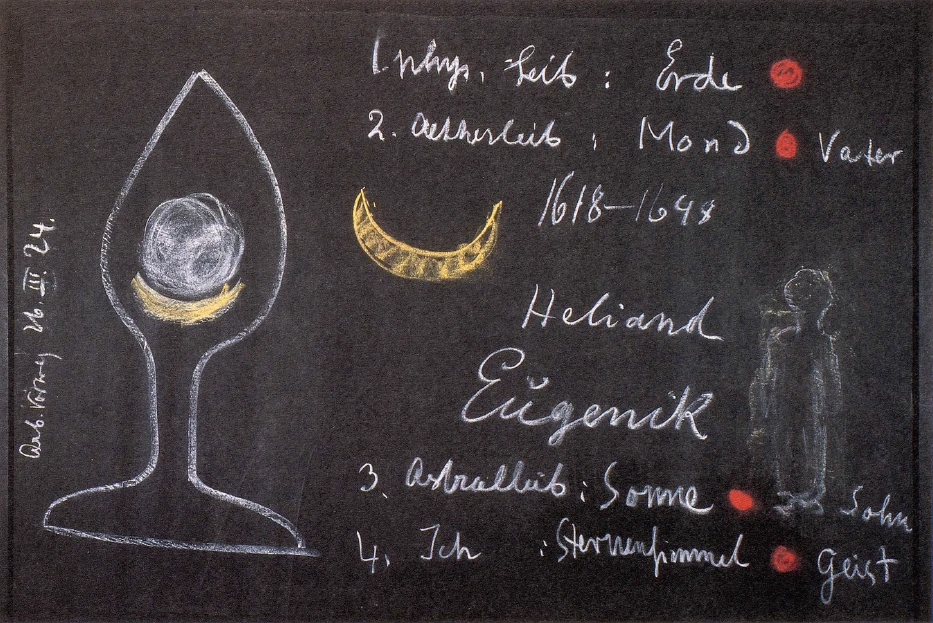
[ 12 ] Denken Sie, daß die Türken, also die Mohammedaner, wie ich Ihnen gesagt habe, wiederum den einen Gott bloß, nicht die drei Gestalten festgelegt haben; sie haben alles wiederum auf den Vatergott zurückgelegt. Was mußten sie denn da für ein Zeichen annehmen? Natürlich den Mond! Daher haben die Türken gerade ihr Bild: den Halbmond.
[ 12 ] Do you think that the Turks—that is, the Muslims, as I have told you—have, in turn, affirmed only the one God, not the three forms; they have, in turn, traced everything back to the Father God. What symbol, then, were they to adopt? The moon, of course! That is why the Turks have their symbol: the crescent moon.
[ 13 ] Die Christenheit müßte wissen, daß sie in diesem ihrem Zeichen dasjenige hat, wo die Sonne den Mond besiegt. Und das war hauptsächlich von den ersten Christen dargestellt worden: daß die Sonne den Mond besiegt hat durch das Mysterium von Golgatha. Was heißt das aber? Sehen Sie, jetzt geht ja eigentlich alles im Geistigen drunter und drüber! Denn wenn man versteht, was mit dem Sonnenbild gegeben ist, so sagt man sich: Derjenige, der von diesem Sonnenbild weiß, der nimmt an, daß der Mensch im Leben einen freien Willen hat, daß da noch etwas in ihn hineinkommen kann, was für das Leben eine Bedeutung hat. Derjenige, der nur an den Mond glaubt, der denkt sich, daß der Mensch mit der Geburt alles bekommen hat, daß er nichts mehr aus sich selber machen kann. Ja, das ist aber gerade der Fatalismus der Türken! Und die Türken wissen eigentlich noch etwas davon. In gewisser Beziehung sind die Türken gescheiter als die Europäer, denn die Europäer haben einmal die Sonne als ihr Zeichen gehabt, haben aber vergessen, was das für eine Bedeutung hat.
[ 13 ] Christianity should realize that in this symbol of theirs lies the very thing where the sun conquers the moon. And this was primarily depicted by the early Christians: that the sun conquered the moon through the Mystery of Golgotha. But what does that mean? You see, right now everything in the spiritual realm is actually in utter disarray! For when one understands what the image of the sun signifies, one says to oneself: The one who knows this image of the sun assumes that human beings have free will in life, that something can still enter into them that has meaning for their lives. The one who believes only in the moon thinks that human beings have received everything at birth, that they can no longer achieve anything on their own. Yes, but that is precisely the fatalism of the Turks! And the Turks actually still know something about it. In a certain respect, the Turks are wiser than the Europeans, for the Europeans once had the sun as their symbol but have forgotten what that signifies.
[ 14 ] Nun, wenn Sie das bedenken, daß man im 6. Jahrhunderte von dem geistigen Christus eigentlich nichts mehr gewußt hat, dann werden Sie auch verstehen, warum man im Mittelalter - so im 10., 11., 12., 13. Jahrhundert, und dann etwas später - plötzlich anfängt, sich zu streiten: Was bedeutet denn eigentlich das, was man das Abendmahl nennt? - Das bedeutet nur für denjenigen etwas, der ein Bild vom Geistigen annimmt. Aber das haben die nicht mehr gekonnt; daher stritten sie sich jetzt. Die einen sagten: Auf dem Altar in der Kirche, da verwandelt sich wirklich das Brot in den Leib Christi. - Das glaubten die anderen nicht, weil sie sich nicht vorstellen konnten, daß das Brot, das hinterher doch geradeso ausschaut wie vorher, zu Fleisch geworden sei. Das konnten sie nicht verstehen. Und da entstanden denn jene mittelalterlichen Streite, die zu so furchtbaren Resultaten geführt haben. Denn diejenigen, welche gesagt haben: Uns ist es einerlei, ob man die Sache versteht oder nicht, wir glauben daran, daß das Brot wirkliches Fleisch ist - das war die eine Partei, die römische Katholiken geworden sind. Die anderen sagten: Das können wir nicht glauben, sondern es kann höchstens das, was da geschieht, die Bedeutung haben, die sinnbildliche Bedeutung haben. - Das waren diejenigen, aus denen dann das Evangelische geworden ist.
[ 14 ] Well, if you consider that by the 6th century people had actually forgotten all about the spiritual Christ, then you will also understand why, in the Middle Ages—in the 10th, 11th, 12th, 13th centuries, and then a little later—people suddenly began to argue: What does this thing called the Lord’s Supper actually mean?—It only means something to those who can conceive of the spiritual. But they were no longer able to do that; that is why they were now arguing. Some said: On the altar in the church, the bread is truly transformed into the body of Christ. — The others did not believe this, because they could not form a mental image of the bread, which afterward looks exactly the same as before, becoming flesh. They could not understand that. And that is how those medieval disputes arose, which led to such terrible consequences. For those who said: “It makes no difference to us whether one understands the matter or not; we believe that the bread is real flesh”—that was one faction, which became the Roman Catholics. The others said: “We cannot believe that; at most, what happens there can have a symbolic meaning.”—Those were the ones who later became the Protestants.
[ 15 ] Und um diese Sache ging eigentlich alles dasjenige los, was im Mittelalter Religionskriege geworden sind, und was sich zu dem furchtbaren Dreißigjährigen Krieg vom Jahre 1618 bis 1648 zugespitzt hat. Begonnen hat dieser Dreißigjährige Krieg dadurch, daß Katholiken und Protestanten durcheinandergekommen sind. Bekanntlich hat ja der Dreißigjährige Krieg mit dem sogenannten Prager Fenstersturz angefangen. Die kaiserlichen Statthalter in Prag sind durch die Gegenpartei zum Fenster herausgeworfen worden; sie sind nur, trotzdem sie vom zweiten Stock heruntergefallen sind, so gut gefallen, daß es ihnen nichts gemacht hat, weil sie auf einen Misthaufen gefallen sind! Aber der Misthaufen war nicht aus Kuhoder Pferdemist, sondern aus Papierschnitzel und dergleichen, weil damals in Prag so eine Ordnung war, daß man Papierschnitzel, Kuverts und so weiter einfach zum Fenster herausgeworfen hat. Aber es hat dann gute Dienste getan, weil, als sich Katholiken und Protestanten stritten und die kaiserlichen Statthalter Martinitz und Slawata samt dem Geheimschreiber Fabricius zum Fenster herausgeworfen worden sind - das hat man in der damaligen Zeit öfters getan, das war etwas, was gar nicht so selten war -, dann alle drei gerettet worden sind. Aber eben damals ging der Dreißigjährige Krieg los.
[ 15 ] And it was actually this issue that sparked all the events that led to the religious wars of the Middle Ages and culminated in the terrible Thirty Years’ War from 1618 to 1648. This Thirty Years’ War began when Catholics and Protestants came into conflict with one another. As is well known, the Thirty Years’ War began with the so-called Defenestration of Prague. The imperial governors in Prague were thrown out the window by their opponents; even though they fell from the second story, they landed so well that they were unharmed, because they fell onto a manure pile! But the manure pile wasn’t made of cow or horse manure, but of scraps of paper and the like, because back then in Prague, it was customary to simply throw scraps of paper, envelopes, and so on out the window. But it ended up being quite useful, because when Catholics and Protestants were fighting and the imperial governors Martinitz and Slawata, along with the secretary Fabricius, were thrown out the window—something that happened quite often back then; it wasn’t all that rare—all three were saved. But it was precisely then that the Thirty Years’ War broke out.
[ 16 ] Natürlich dürfen Sie nicht glauben, daß es sich im ganzen DreiRigjährigen Krieg nur darum gehandelt hat, Religionsstreiti auszufechten. Da würde wahrscheinlich doch der Dreißigjährige Krieg früher geendet haben. Was dann hinzukam, waren die Streitigkeiten der Fürsten. Die haben sich das zunutze gemacht, daß die Leute aufeinander losgingen. Der eine hat sich zu der einen, der andere zu der andern Partei geschlagen, und die haben dann unter dem Deckmantel der Religionsstreitigkeiten ihre Ziele verfolgt, so daß der Dreißigjährige Krieg eben dann dreißig Jahre gedauert hat. Aber ausgegangen ist er wirklich von dem, was ich Ihnen hier erzählte.
[ 16 ] Of course, you must not believe that the entire Thirty Years’ War was merely about settling religious disputes. If that had been the case, the Thirty Years’ War would probably have ended sooner. What came into play as well were the disputes among the princes. They took advantage of the fact that the people were turning against one another. One sided with one faction, another with the other, and they then pursued their own goals under the guise of religious disputes, which is why the Thirty Years’ War lasted thirty years. But it really did stem from what I’ve told you here.
[ 17 ] Nun, sehen Sie, bis zu diesem Dreißigjährigen Krieg, 1618 bis 1648, also bis ins 17. Jahrhundert hat es gedauert; das ist noch gar nicht so lange her, daß die Leute sich um solche Sachen gestritten haben. Und aus diesem Streit ist ja eigentlich der Protestantismus, ist die evangelische Kirche herausgewachsen.
[ 17 ] Well, you see, it lasted until the Thirty Years' War, from 1618 to 1648—that is, well into the 17th century; it wasn't all that long ago that people were arguing about such things. And it was actually out of this conflict that Protestantism—the Evangelical Church—emerged.
[ 18 ] Sie werden nun sagen: Ja, wenn aber der Geist eigentlich abgeschafft war, wie kannst du uns sagen, daß die protestantische, die evangelische Kirche von den drei Gottesgestalten den Geist angenommen habe? - Ja, meine Herren, darauf muß man schon sagen, daß die Evangelischen zwar nicht gewußt haben, daß sie den Geist anbeten, denn der Geist war eben eigentlich abgeschafft worden. Gewußt haben sie es nicht. Aber ich habe Ihnen ja schon öfter gesagt: Dasjenige, was man nicht weiß, kann deshalb doch da sein. Und es war schon ein Geistiges, wenn auch nicht ein sehr großes Geistiges in der evangelischen Kirche tätig. Nur haben die Evangelischen nichts davon gewußt. - Sehen Sie, wenn alles dasjenige nicht wäre, wovon zum Beispiel die Professoren nichts wissen, ja, wieviel wäre denn dann auf der Welt? Meine Herren, das ist es eben: Man muß sich klar sein, daß man von etwas schon sprechen kann, was der Mensch tut, auch wenn er nichts davon weiß! Und so darf man bei der Entstehung des Protestantismus schon davon reden, daß diese dritte Gestalt, der Geist, eigentlich das Wirksame war.
[ 18 ] You will now say: Yes, but if the Spirit had actually been abolished, how can you tell us that the Protestant, the Evangelical Church, accepted the Spirit as one of the three persons of the Trinity? - Yes, gentlemen, one must say that the Evangelicals did not know that they were worshiping the Spirit, for the Spirit had, in fact, been abolished. They did not know it. But as I have told you many times before: Something that one does not know about can still be there. And there was indeed a spiritual presence at work in the Evangelical Church, even if it was not a very great one. It’s just that the Evangelicals knew nothing about it. – You see, if everything that the professors, for example, know nothing about did not exist, well, how much would there be left in the world? Gentlemen, that is precisely the point: one must realize that one can speak of something that a person does, even if he knows nothing about it! And so, when considering the origins of Protestantism, one can indeed say that this third element—the Spirit—was actually the active force.
[ 19 ] Sie sehen aber da förmlich den Materialismus entstehen! Die älteren Menschen im Christentum, die brauchten darüber nicht zu streiten, daß sich dieses plattgebackene Mehl physisch in wirkliches Fleisch verwandle, weil sie gar nicht daraufgekommen sind, so etwas zu denken. Erst als sie alles materiell denken wollten, ist auch das materiell gedacht worden. Das ist überhaupt sehr interessant. Der Materialismus hat nämlich zwei Gestalten: Zuerst hat man alle Geistigkeit materiell gedacht, und nachher hat man den Geist geleugnet. Das ist eigentlich der Weg, den der Materialismus nimmt.
[ 19 ] But you can literally see materialism emerging there! The early Christians didn’t need to argue about whether this baked flour physically turned into real flesh, because it never even occurred to them to think such a thing. It was only when they wanted to think of everything in material terms that this, too, came to be thought of in material terms. That is very interesting indeed. Materialism, you see, takes two forms: first, one conceived of all spirituality in material terms, and later one denied the spirit altogether. That is actually the path that materialism takes.
[ 20 ] Es ist nun interessant zu sehen, wie auch noch später, noch nach dem 6. Jahrhunderte, in Mitteleuropa eine viel geistigere Anschauung des Christentums vorhanden ist als später. Materialistisch ist das Christentum zuerst im Süden geworden. In Mitteleuropa gibt es zwei sehr schöne Dichtungen. Die eine Dichtung ist im Elsaß entstanden, im 9. Jahrhunderte, und heißt Otfrieds «Evangelienharmonie». Die andere Dichtung aber ist in Gegenden, die heute sächsisch sind, entstanden und heißt der «Heliand», Heiland. Wenn Sie den «Heliand» lesen, so wird Ihnen eines auffallen. Da werden Sie sich sagen: Nun, dieser Mönch - denn ein Mönch aus dem Bauerntum war es, der den «Heliand» geschrieben hat - hat wohl den Christus Jesus geschildert, aber er schildert ihn auf ganz besondere Weise; er schilderte ihn ungefähr so, wie die Deutschen einen Herzog schildern, der an der Spitze von deutschen Heeresmassen kämpfend einherreitet und seine Feinde besiegt. Wenn man den «Heliand» liest, fühlt man sich ganz in Deutschland, gar nicht in Palästina. Gewiß, es werden dieselben Ereignisse erzählt, die im Evangelium erzählt werden; aber sie werden so erzählt, als ob der Christus Jesus eigentlich ein deutscher Herzog, ein deutscher Fürst gewesen wäre. Und die Taten des Jesus werden auch so erzählt.
[ 20 ] It is interesting to note how, even later—after the 6th century—a much more spiritual view of Christianity existed in Central Europe than it did in subsequent periods. Christianity first became materialistic in the south. In Central Europe, there are two very beautiful literary works. One was written in Alsace in the 9th century and is called Otfried’s “Harmony of the Gospels.” The other, however, originated in regions that are now part of Saxony and is called the “Heliand,” meaning “Savior.” When you read the “Heliand,” one thing will strike you. You’ll say to yourself: Well, this monk—for it was a monk from a peasant background who wrote the “Heliand”—has certainly depicted Jesus Christ, but he depicts him in a very special way; he depicted him much as the Germans would depict a duke riding at the head of German armies, fighting his way forward and defeating his enemies. When you read the *Heliand*, you feel as if you are right in Germany, not at all in Palestine. Certainly, the same events are recounted as in the Gospel; but they are told as if Jesus Christ had actually been a German duke, a German prince. And the deeds of Jesus are also recounted in this way.
[ 21 ] Ja, meine Herren, was bedeutet denn das? Das bedeutet, daß dem Manne, der den «Heliand» geschrieben hat, die äußeren Tatsachen, die man einmal in Palästina mit Augen sehen konnte, ganz gleichgültig waren; die hat er gar nicht treu schildern wollen. Das äußere Bild war ihm gleichgültig. Er wollte den geistigen Christus schildern und dachte sich: Es kommt nicht darauf an, ob er in der Menschengestalt eines deutschen Herzogs in der Welt herumreist oder in der Gestalt eines palästinensischen Juden. Also in der Zeit, als der «Heliand» entstanden ist, hat man in Mitteleuropa noch an den geistigen Christus wirklich geglaubt, war man noch nicht materialistisch geworden. Im Süden war das schon dazumal der Fall; die romanischen Völker, die griechischen Völker auch waren dazumal schon materialistisch geworden. Aber in Mitteleuropa war noch ein gewisser Sinn für das Geistige und daher schilderte dieser sächsische Mönch, der den «Heliand» geschrieben hat, eigentlich noch den Christus, nur eben in dem Bilde eines deutschen Herzogs. Daraus können Sie schon sehen, daß man selbst hier in Mitteleuropa die Möglichkeit findet, zu beweisen, daß der Christus zunächst ganz geistig vorgestellt worden ist, eben als der Sonnengeist, als den ich ihn schilderte.
[ 21 ] Yes, gentlemen, what does that mean? It means that the man who wrote the *Heliand* was completely indifferent to the external facts that could once be seen with one’s own eyes in Palestine; he had no intention of depicting them faithfully. The external image was of no concern to him. He wanted to depict the spiritual Christ and thought to himself: It does not matter whether he travels the world in the human form of a German duke or in the form of a Palestinian Jew. So, at the time when the *Heliand* was written, people in Central Europe still truly believed in the spiritual Christ; they had not yet become materialistic. In the south, this was already the case back then; the Romance peoples, and the Greek peoples as well, had already become materialistic by that time. But in Central Europe there was still a certain sense of the spiritual, and that is why this Saxon monk, who wrote the *Heliand*, was actually still depicting Christ—only in the image of a German duke. From this you can already see that even here in Central Europe one can find evidence that Christ was initially conceived of as entirely spiritual—precisely as the Sun Spirit, as I have described him.
[ 22 ] Und wenn man dann eingeht auf den Charakter, den der Christus in diesem Heliand hat, dann findet man, daß hauptsächlich darauf gesehen wird, daß der Heliand, der Christus, in diesem sächsischen Buche ein «freier Mensch» ist, das heißt, das Sonnenhafte in sich hat, nicht bloß das Mondenhafte, also ein freier Mensch ist.
[ 22 ] And when one then examines the character of Christ as portrayed in this *Heliand*, one finds that the main emphasis is on the fact that the *Heliand*, that is, Christ, is a “free person” in this Saxon book—that is, he possesses the solar quality within himself, not merely the lunar quality; thus, he is a free person.
[ 23 ] Es ist wirklich so, daß der ganze Zusammenhang des Christus mit der Welt außerhalb der Erde eben einfach vergessen worden ist und heute gar nicht mehr erkannt wird.
[ 23 ] It is truly the case that the entire context of Christ’s relationship with the world beyond Earth has simply been forgotten and is no longer recognized at all today.
[ 24 ] Nun möchte ich Ihnen aber noch etwas sagen. Wenn man wiederum zurückgeht zu jenen Mysterien, von denen ich Ihnen erzählt habe, daß sie im Altertum zugleich Unterrichtsstätten, Religionsstätten und Kunststätten waren, wenn man in diese alten Mysterien zurückgeht, so findet man, daß Feste gefeiert werden in diesen alten Mysterien, Feste, die mit dem Jahr zusammenhängen. Im Frühling wurde eigentlich immer das Fest der sogenannten Auferstehung gefeiert. Die Natur steht ja auch auf zur Osterzeit. Da wurde das Fest der Auferstehung gefeiert. Man sagte sich: Die menschliche Seele, die kann geradeso eine Auferstehung feiern wie die Natur. Die Natur hat den Vater. Im Frühling werden die Kräfte der Natur neu. Aber im Menschen, wenn er richtig auf sich achtet, wenn er an sich arbeitet, werden die Seelenkräfte neu. - Und das strebte man vorzugsweise in den alten Mysterien an - von den eigentlich wissenden Leuten, von den Leuten, von denen man sagte, sie haben Weisheit -, daß die Seele ein Erlebnis hat, das, ich möchte sagen, eine Art Frühlingserlebnis im menschlichen Leben ist. Sehen Sie, ein Frühlingserleben, wo man von sich sagen kann: Ach, was ich früher eigentlich gewußt habe, das ist alles nichts! Ich bin wie neugeboren! - Es kann einem einmal im Leben die Erkenntnis aufgehen, daß man wie neugeboren, das heißt aus dem Geiste heraus wiedergeboren ist. So sonderbar Ihnen das klingen wird: Im ganzen asiatischen Morgenlande hat man die Menschen unterschieden in solche, welche einmal geboren waren, und in solche, welche zweimal geboren waren. Man sprach überall von zweimal geborenen Leuten. Die einen, die nur einmal geboren waren, die waren durch die Mondenkräfte geboren, sind so geblieben ihr ganzes Leben hindurch. Die anderen, die Zweimalgeborenen, die waren in den Mysterien unterrichtet worden, hatten etwas gelernt und hatten gewußt: Der Mensch kann sich frei machen, der Mensch kann seinen eigenen Kräften folgen. - Aber das stellte man im Bilde dar.
[ 24 ] But now I would like to tell you something else. If we go back to those mysteries I told you about—which in ancient times served as places of learning, places of worship, and centers of art—if we go back to these ancient mysteries, we find that festivals were celebrated within them, festivals connected to the cycle of the year. In the spring, the festival of what is called the Resurrection was always celebrated. Nature, after all, also awakens at Eastertime. That was when the festival of the Resurrection was celebrated. People used to say: The human soul can celebrate a resurrection just as nature does. Nature has the Father. In spring, the forces of nature are renewed. But in human beings, if they truly take care of themselves, if they work on themselves, the soul’s powers are renewed. - And this was what was primarily sought in the ancient mysteries—by those who truly knew, by those of whom it was said they possessed wisdom—that the soul might have an experience that is, I would say, a kind of springtime experience in human life. You see, a springtime experience where one can say of oneself: Oh, what I actually knew before—it’s all nothing! I am like a newborn!—Once in a lifetime, the realization may dawn on one that one is like a newborn—that is, reborn out of the spirit. As strange as this may sound to you: Throughout the Asian East, people were distinguished between those who were born once and those who were born twice. Everywhere, people spoke of those who had been born twice. Those who had been born only once were born through the forces of the moon and remained that way throughout their entire lives. The others—those born twice—had been instructed in the mysteries; they had learned something and had come to know: Human beings can set themselves free; human beings can follow their own powers. —But this was depicted in symbolic form.
[ 25 ] Man kann weit, weit zurückgehen: Überall um die Frühlingszeit gibt es ein bestimmtes Fest, wo man in den Mysterien darstellte, wie ein Gott, der in Menschengestalt da ist, stirbt und begraben wird, und wiederum aufersteht nach drei Tagen. Das war eine wirkliche Darstellung, die in den alten Mysterien in der Frühlingszeit immer gegeben worden ist. Da kamen die Leute zusammen. Das Bild dieses Gottes in Menschengestalt war da. Man stellte dar, wie der Gott stirbt; man begrub das Bild. Nach drei Tagen wurde das Bild wiederum herausgenommen aus dem Grab und in feierlicher Prozession, in feierlichem Umzug durch die Gegenden getragen, und alle schrieen: Der Heiland ist uns wiedererstanden! - Während sie in den drei Tagen, in denen der Heiland bildlich im Grabe lag, eine Art Trauerfest hatten, folgte diesem Trauerfest ein Fröhlichkeitsfest.
[ 25 ] One can go back a long, long way: Everywhere around springtime there is a specific festival in which the mysteries depicted how a god, present in human form, dies and is buried, and then rises again after three days. This was a real reenactment that was always performed in the ancient mysteries during the spring. People would gather together. The image of this god in human form was present. They reenacted the god’s death; they buried the image. After three days, the image was taken out of the tomb again and carried through the countryside in a solemn procession, and everyone shouted: “The Savior has risen again for us!” — While they held a kind of mourning festival during the three days in which the Savior lay symbolically in the tomb, this mourning festival was followed by a festival of joy.
[ 26 ] Sehen Sie, meine Herren, das bedeutet viel; denn das bedeutet, daß dasjenige, was dann geschehen ist auf Golgatha, sich im Bild in den Mysterien immer, jedes Jahr, abgespielt hat.
[ 26 ] You see, gentlemen, this means a great deal; for it means that what then took place on Golgotha has always been reenacted, year after year, in the Mysteries.
[ 27 ] Wenn nun in den Evangelien erzählt wird, daß auf Golgatha das Kreuz war, der Christus da gestorben ist, so ist das ein historisches Ereignis. Aber das Bild davon war dadurch das ganze Altertum. Und deshalb empfanden die ersten Christen dasjenige, wassich wirklich zugetragen hat, wie eine erfüllte Prophezeiung. Und sie sagten: Diejenigen, die in den alten Mysterien gelebt haben, das waren die Propheten desjenigen, was sich als Mysterium von Golgatha zugetragen hat.
[ 27 ] When the Gospels recount that the cross on which Christ died was located at Golgotha, this is a historical event. But this image had permeated all of antiquity. And that is why the early Christians perceived what actually took place as a fulfilled prophecy. And they said: Those who lived within the ancient mysteries were the prophets of what took place as the Mystery of Golgotha.
[ 28 ] Also Sie sehen: Auch im Altertum gab es gewissermaßen ein Christentum. Nur war das Christentum nicht das Christentum des Jesus Christus, sondern es war ein geistiges Christentum, das im Bilde gefeiert worden ist.
[ 28 ] So you see: Even in ancient times, there was, in a sense, a form of Christianity. Only, this Christianity was not the Christianity of Jesus Christ, but rather a spiritual Christianity that was celebrated symbolically.
[ 29 ] Sehen Sie, einer der wichtigsten Heiligen der katholischen Kirche ist der heilige Augustinus, der im 4. bis 5. Jahrhundert gelebt hat. Dieser heilige Augustinus war ja zunächst Heide, hat sich dann zum Christentum bekehrt und ist später einer der angesehensten Priester und Heiligen der katholischen Kirche geworden. Nun, in den Schriften dieses Augustinus finden Sie ein merkwürdiges Wort. Er sagt: Das Christentum war schon vor dem Jesus Christus da; die alten Weisen waren schon Christen, nur hat man sie noch nicht Christen genannt.
[ 29 ] You see, one of the most important saints of the Catholic Church is Saint Augustine, who lived in the 4th to 5th centuries. This Saint Augustine was initially a pagan, then converted to Christianity, and later became one of the most respected priests and saints of the Catholic Church. Well, in the writings of this Saint Augustine, you’ll find a curious statement. He says: Christianity already existed before Jesus Christ; the ancient sages were already Christians, only they weren’t yet called Christians.
[ 30 ] Ja, meine Herren, das ist etwas ungeheuer Bedeutendes, daß noch zur Zeit des Christentums zugegeben wird, daß eben dasjenige, was einmal in den alten Mysterien schon als Christentum vorhanden war, eben nur dargestellt worden ist durch Jesus Christus in der Zeit, in der man die Mysterien nicht mehr hatte, so daß es als ein einheitliches Ereignis für die ganze Erde verbleiben mußte.
[ 30 ] Yes, gentlemen, this is something of immense significance—that even in the age of Christianity it is acknowledged that precisely what was already present as Christianity in the ancient mysteries was merely embodied by Jesus Christ at a time when the mysteries no longer existed, so that it had to remain a unified event for the entire world.
[ 31 ] Auch das Bewußtsein davon, daß ja das Christentum schon im alten Heidentum gelebt hat, auch das ist wiederum verlorengegangen. Der Materialismus hat ungeheuer viel von dem, was die Menschheit schon gefunden hat, eben einfach zerstört. Und in diesem Bilde, wo in der Frühlingszeit immer die Auferstehung des gestorbenen Menschengottes dargestellt worden ist, in diesem Bilde hat der Weise des Altertums sein eigenes Schicksal verbildlicht gesehen. Er hat gesagt: So muß ich werden; ich muß auch in mir eine Wissenschaft entwickeln, durch die ich mir sage, der Tod hat ja nur eine Bedeutung für dasjenige in mir, was durch Naturkräfte geworden ist, aber nicht für das, was später in mir zum zweiten Mal geworden ist, was ich mir durch meine eigenen Menschenkräfte erwerbe.
[ 31 ] The awareness that Christianity was already present in ancient paganism has, too, been lost. Materialism has simply destroyed an immense amount of what humanity had already discovered. And in this image—where the resurrection of the deceased human-god has always been depicted in the springtime—in this image, the sage of antiquity saw his own destiny symbolized. He said: This is what I must become; I, too, must develop within myself a science through which I tell myself that death has meaning only for that part of me which has come into being through natural forces, but not for that which later came into being within me a second time—that which I acquire through my own human powers.
[ 32 ] Es war in dem ersten Christentum noch etwas, wo sich die Menschen sagten: Der Mensch muß, um unsterblich zu sein, die Seele in sich während des Lebens erwecken; dann ist er im richtigen Sinne unsterblich. - Natürlich, gegen so etwas kam ja eigentlich eine falsche Anschauung nicht an. Aber gekämpft hat schon eine falsche Anschauung. Denn während in den ersten Jahrhunderten das Christentum so ausgebreitet worden ist, daß die Leute gesagt haben: Man muß die Seele des Menschen pflegen, damit die Seele des Menschen nicht stirbt -, hat später die Kirche eine andere Anschauung gepredigt: Sie wollte nicht mehr den Menschen für seine Seele sorgen lassen, sondern sie wollte selber für seine Seele sorgen! Immer mehr soll die Kirche für die Seele des Menschen sorgen, nicht die Menschen selber. Dadurch ist auch das herausgekommen, daß man eigentlich dasjenige im Menschen nicht mehr gesehen hat, wodurch für die Seele in der richtigen Weise gesorgt wird dadurch, daß in der Seele der Geist wiederum geboren wird, das Sonnenhafte wiederum geboren wird. - Nicht wahr, für das Sonnenhafte kann man nicht auf materialistische Weise sorgen. Wie würde man denn auf materialistische Weise für das Sonnenhafte sorgen? Ja, da müßte man eine Expedition ausrüsten und immer von der Sonne herholen dasjenige, was man dem Menschen geben sollte! Aber das kann man natürlich nicht. Und so stellte man das Ganze in einer falschen Weise dar.
[ 32 ] In early Christianity, there was still a belief that people held: In order to be immortal, a person must awaken the soul within themselves during their lifetime; only then are they immortal in the true sense. — Of course, a false view could not really stand up against something like that. But a false view did indeed put up a fight. For while in the early centuries Christianity spread in such a way that people said, “One must nurture the human soul so that it does not die,” the Church later preached a different view: It no longer wanted people to care for their own souls, but wanted to care for them itself! The Church is increasingly supposed to care for the human soul, not people themselves. This also led to the fact that people no longer saw within the human being that which truly cares for the soul in the right way—namely, the rebirth of the Spirit within the soul, the rebirth of the solar aspect. - Isn’t it true that one cannot care for the solar aspect in a materialistic way? How, after all, would one care for the solar aspect in a materialistic way? Well, one would have to organize an expedition and constantly bring back from the sun whatever was to be given to people! But of course, that is impossible. And so the whole matter was presented in a false light.
[ 33 ] Sehen Sie, meine Herren, alles, was ich Ihnen da sagen muß, zeigt Ihnen, wie im Laufe der Zeit eigentlich der Materialismus mehr und mehr um sich gegriffen hat und im Menschen Geistiges eigentlich gar nicht mehr verstanden hat. Heute ist es schon so, daß ja dieses Prinzip, nicht die Seele des Menschen für sich selber sorgen zu lassen, sondern die Seele von der Kirche besorgen zu lassen, noch nicht zur Ertötung der menschlichen Seele geführt hat. Wenn aber dasselbe Prinzip weiterleben würde, dann brauchte es jetzt nicht mehr lange, dann würden die Seelen mit den Körpern sterben. Heute leben die Seelen der Menschen noch; sie können noch aufgeweckt werden, wenn eine richtige Geisteswissenschaft kommt. In ein oder zwei Jahrhunderten würden sie das nicht mehr können, wenn nicht eine Geisteswissenschaft käme, wenn nur in der alten Weise fortgefahren würde.
[ 33 ] You see, gentlemen, everything I have to say to you here shows you how, over the course of time, materialism has actually taken hold more and more, and how people have essentially lost all understanding of the spiritual. Today, it is already the case that this principle—not allowing the human soul to care for itself, but having the Church care for the soul—has not yet led to the death of the human soul. But if this same principle were to continue, it would not be long before souls died along with their bodies. Today, people’s souls are still alive; they can still be awakened if a true Spiritual Science were to emerge. In one or two centuries, they would no longer be able to be awakened if no Spiritual Science were to emerge and if things were to continue merely in the old way.
[ 34 ] Was würde denn geschehen, wenn der Materialismus bleiben würde? Ja, sehen Sie, nach und nach müßte dieser Materialismus über sich selber lachen; denn schon in der Erziehung muß man ja auf geistige Weise verfahren. Man kann gar nicht erziehen und unterrichten, ohne vom Geist zu sprechen. Aber wenn es wirklich so weit kommt, wie es jetzt schon an manchen Stellen ersichtlich ist, so wird der Materialismus entweder über sich lachen müssen, wenn er vom Geiste redet, oder er muß dann ehrlich werden.
[ 34 ] What would happen if materialism were to persist? Well, you see, little by little, this materialism would have to laugh at itself; for even in education, one must proceed in a spiritual manner. It is simply impossible to educate and teach without speaking of the spirit. But if things really come to the point where they are already evident in some places, then materialism will either have to laugh at itself when it speaks of the spirit, or it will have to become honest.
[ 35 ] Als ich und einige andere anthroposophische Freunde im Jahre 1922 auf dem Kongreß in Wien gesprochen hatten, kam nachher ein Artikel, der damit endete, daß der Verfasser sagte: Wir müssen den Kampf gegen den Geist führen! - Er wollte uns dadurch abtun, daß er sagte: Wir müssen den Kampf gegen den Geist führen! - Ja, wohin würde es denn dadurch kommen, daß man den Kampf gegen den Geist ehrlich weiterführen würde? Dann würde man sagen, wenn man ein Kind mit sechs Jahren ehrlich anfangen wollte zu erziehen: Donnerwetter, das ist ja Materie, das setzt ja den Geist voraus! Wollen wir doch lieber dem Kind ein Pülverchen oder etwas anderes verschreiben, damit seine Materie gewandelt wird; dann wird es gescheit, dann wird es etwas wissen! - Das ist dasjenige, was herauskommt, wenn der Materialismus ehrlich wird. Er müßte die Kinder in die Schule kommen lassen, und, wie man heute vielleicht gegen Pocken impft, so müßte ein Kind nach dem anderen mit der Gescheitheit geimpft werden; denn wenn die Gescheitheit materialistisch ist, so muß sie sich einimpfen lassen. Also es müßten die Menschenkinder mit der Gescheitheit geimpft werden. Das würde den Materialismus ehrlich machen. Denn wenn einer sagt, er denke nicht mit seiner Seele und seinem Geist, sondern mit dem Gehirn das Gehirn ist ein Stoff -, so muß man das Gehirn auch auf stoffche Weise, nicht auf geistige Weise gescheit machen. In solche furchtbaren Widersprüche würde der Materialismus hineinkommen. Da kann nur retten, daß man wiederum lernt, vom Geiste etwas zu wissen. Es mußte schon in unserer Zeit eine Geisteswissenschaft kommen, weil sonst die Menschenseelen ersterben würden.
[ 35 ] After I and a few other anthroposophical friends had spoken at the 1922 congress in Vienna, an article appeared afterward that concluded with the author saying: “We must wage war against the spirit!”—He sought to dismiss us by saying: “We must wage war against the spirit!”—Yes, where would it lead if one were to honestly continue waging war against the spirit? Then one would say, if one wanted to honestly begin educating a six-year-old child: “Good heavens, that’s matter—that presupposes the spirit! Let’s rather prescribe a little powder or something else for the child so that its matter is transformed; then it will become intelligent, then it will know something!”—That is what emerges when materialism becomes honest. It would have to send the children to school, and, just as we might vaccinate against smallpox today, one child after another would have to be vaccinated with intelligence; for if intelligence is materialistic, then it must be vaccinated. So human children would have to be vaccinated with intelligence. That would make materialism honest. For if someone says that they do not think with their soul and spirit, but with the brain—the brain being a material substance—then one must also make the brain intelligent in a material way, not in a spiritual way. Materialism would find itself caught up in such terrible contradictions. The only salvation is to learn once again to know something of the spirit. A Spiritual Science had to emerge in our time, because otherwise human souls would wither away.