

Human History and the
World Views of Civilized Nations
GA 353
26 March 1924, Dornach
Translated by Steiner Online Library
7. Mental Images of Christ in Ancient and Modern Times
[ 1 ] Good morning, gentlemen! Well, let’s add a few more thoughts today on the question concerning Christianity. Unfortunately, I was unable to speak last Saturday because I had to travel to Liestal. We have, after all, tried to say something about what might be called the very essence of Christianity—that which Christianity has embraced in the course of human development. We then spoke of the conflicts that actually arose in Europe around Christianity and which, as I said, were essentially based, over a long period of time, on the fact that one side emphasized the Father principle more—as in Eastern Christianity—while the other side emphasized the Son principle more—as in the Roman Catholic Church— and a third party—the Protestant Church—placed greater emphasis on the principle of the Spirit.
[ 2 ] It’s actually hard to talk about these things today, because most people these days think: Can people really argue about such things in the world? —Today, after all, the world is preoccupied with entirely different matters that people are fighting over; and the fact that people once waged war against one another in the most horrific ways simply because they emphasized one principle or another is difficult for people today to comprehend. But you see, gentlemen, one must also understand such things, for there will come a time when people will in turn be unable to understand why people fought over the issues of today! That may be in the not-too-distant future. And when one considers this, one will also understand why older generations fought over things quite different from what we fight over today. But we should still know what people argued about, because it still lives on among us.
[ 3 ] What, then, is the external image of Christianity that has endured in the most powerful way? For a long time, the most powerful image of Christianity was, after all, the dying Jesus—the cross—and on it, the dead Jesus. People did not look upon the dead Jesus in this way right from the beginning of Christianity. If one goes back to the very earliest times, one finds that the most common and widespread image of Christ Jesus is that which depicts him as a young man with a lamb draped over his shoulders, acting as a shepherd. And this was called the Good Shepherd. In the 1st, 2nd, and 3rd Christian centuries, this was actually the most widespread image: the Good Shepherd. And it was not until the 6th century A.D. that depictions began to emerge showing Christ hanging on the cross and dead—as they say, depicting the Crucifixus, the Crucified One. The early Christians did not actually depict the Crucified One.
[ 4 ] There is also something important behind this. You see, the early Christians certainly still held the view that Christ entered into Jesus from the sun, that Christ is an extraterrestrial being. The whole thing was later misunderstood. For it was later turned into the dogma of the so-called Immaculate Conception, according to which Jesus, when he was born, was not conceived and born in the ordinary human way. It was only when people no longer understood that Jesus was first and foremost a human being—albeit a very significant one— and that it was only in the thirtieth year of his life that the Spirit, whom we call the Christ, entered him as the Solar Spirit—at the time when this was no longer understood, on the one hand the view arose to depict the dead Christ on the cross, the dying Christ, and on the other hand, the coming of the Christ was already spiritually attributed to the moment of birth. This was a misunderstanding that first arose in the 6th century. But it offers a very, very deep insight. For between the time when Christians still depicted Jesus Christ as the Good Shepherd and the time when he was depicted as the Crucified One, there lies a very specific fact in between, namely the fact that a council decided that human beings do not consist of three parts—body, soul, and spirit—but consist only of two parts—body and soul—and that the soul, it was said, possessed certain spiritual qualities.
[ 5 ] This is very important, gentlemen! For you see, throughout the Middle Ages, as they said, the trichotomy—the division of the human being into three parts—was considered a heretical view. No one who was orthodox was allowed to believe in the tripartite nature of the human being. One was not allowed to say, “The human being also has a spirit”; rather, one had to say, “The human being has a body and a soul, and the soul has certain spiritual qualities.”—But by effectively abolishing the spirit, so to speak, the entire path of human beings toward the spirit has been blocked, and only today must the science of the spirit emerge once again to restore to humanity what was taken from it.
[ 6 ] The first Christians knew one thing above all else: that which lives within them as Christ cannot be born or die at all. It is not something human. Human beings are born and die. But the Christ who entered Jesus during his lifetime was not born in the human way, nor could he have been touched by death when Jesus died on the cross; rather, just as a person puts on a different coat and remains the same, he took on a different form—namely, a spiritual form. But if one wants to depict that which is spiritual—after all, it cannot be seen with the eyes—then one must represent it figuratively. And the fact that the Spirit watches over humankind, that the Spirit is a good counselor to humankind—this is what one sought to depict by portraying Christ Jesus as the Good Shepherd.
[ 7 ] And something has indeed remained, though people today no longer understand it. It is very common for only a part of an image to remain. Even today, when speaking of Christ, people often say: the “Lamb of God.” This was depicted in the images that existed in the first centuries; a part of it—depicting the lamb that Christ carried on his shoulders—has remained. And it is precisely this part that has survived. In earlier times, people were generally named after some part of their body. Let’s take an example—there are names like this—someone might be called “Kappa” or “Cappa,” which was once a small head covering. Certain people were named after this head covering. If someone is named “Eagle,” it’s because he once had an eagle in his coat of arms, and so on. Isn’t that right? That is also why the name “Lamb of God” has remained, because it was simply a part of the older depictions.
[ 8 ] By the 6th century, any conception of the Spirit had essentially given way, and the result was that people came to believe they could only focus on what had been the human destiny of Christ Jesus. People did not look to the living Christ, who is Spirit, but rather to the mortal man Jesus, interpreting him as if he were the Christ. Consequently, this event of his death became particularly significant beginning in the 6th century.
[ 9 ] Yes, you see, materialism does play a role here. And as we trace the development of Christianity, we see materialism developing even more so. And as a result, many things came about in later times that otherwise would not have come about.
[ 10 ] I have told you, gentlemen: This knowledge—that Christ is a being of the sun who lived within the man Jesus—is expressed by this symbol, which can still be seen on the altar at every High Mass today: This is the Most Holy Sacrament, the monstrance (see illustration on p. 128): the sun in the center and the moon, upon which the sun rests. As long as people knew that Christ was a being from the sun, this made perfect sense. For what is it that is inside the monstrance? It is baked flour. How could this baked flour come into being? It could come into being because the sun’s rays fall upon the earth, because the sun sends light and warmth down to the earth, so that grain grows and the grain becomes flour. It is, therefore, a true product of the sun. It is, if one wishes to put it that way, a body made from sunlight. As long as people knew this, the whole thing had meaning.
[ 11 ] Furthermore: In the case of the Moon, it was precisely this form that was depicted, because the crescent Moon appears to be the most important feature there. And I have told you: Human beings derive the powers that give them their physical form from the forces of the Moon. The whole thing made sense as long as people knew how these things really are. But these things are gradually losing all their significance. I want to tell you something that will help you see the significance of such things.
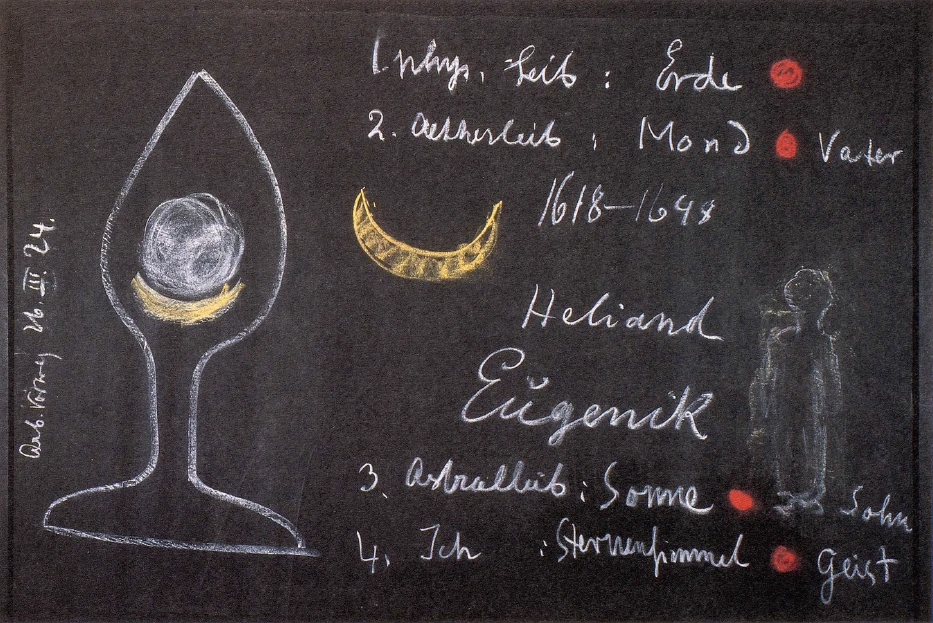
[ 12 ] Do you think that the Turks—that is, the Muslims, as I have told you—have, in turn, affirmed only the one God, not the three forms; they have, in turn, traced everything back to the Father God. What symbol, then, were they to adopt? The moon, of course! That is why the Turks have their symbol: the crescent moon.
[ 13 ] Christianity should realize that in this symbol of theirs lies the very thing where the sun conquers the moon. And this was primarily depicted by the early Christians: that the sun conquered the moon through the Mystery of Golgotha. But what does that mean? You see, right now everything in the spiritual realm is actually in utter disarray! For when one understands what the image of the sun signifies, one says to oneself: The one who knows this image of the sun assumes that human beings have free will in life, that something can still enter into them that has meaning for their lives. The one who believes only in the moon thinks that human beings have received everything at birth, that they can no longer achieve anything on their own. Yes, but that is precisely the fatalism of the Turks! And the Turks actually still know something about it. In a certain respect, the Turks are wiser than the Europeans, for the Europeans once had the sun as their symbol but have forgotten what that signifies.
[ 14 ] Well, if you consider that by the 6th century people had actually forgotten all about the spiritual Christ, then you will also understand why, in the Middle Ages—in the 10th, 11th, 12th, 13th centuries, and then a little later—people suddenly began to argue: What does this thing called the Lord’s Supper actually mean?—It only means something to those who can conceive of the spiritual. But they were no longer able to do that; that is why they were now arguing. Some said: On the altar in the church, the bread is truly transformed into the body of Christ. — The others did not believe this, because they could not form a mental image of the bread, which afterward looks exactly the same as before, becoming flesh. They could not understand that. And that is how those medieval disputes arose, which led to such terrible consequences. For those who said: “It makes no difference to us whether one understands the matter or not; we believe that the bread is real flesh”—that was one faction, which became the Roman Catholics. The others said: “We cannot believe that; at most, what happens there can have a symbolic meaning.”—Those were the ones who later became the Protestants.
[ 15 ] And it was actually this issue that sparked all the events that led to the religious wars of the Middle Ages and culminated in the terrible Thirty Years’ War from 1618 to 1648. This Thirty Years’ War began when Catholics and Protestants came into conflict with one another. As is well known, the Thirty Years’ War began with the so-called Defenestration of Prague. The imperial governors in Prague were thrown out the window by their opponents; even though they fell from the second story, they landed so well that they were unharmed, because they fell onto a manure pile! But the manure pile wasn’t made of cow or horse manure, but of scraps of paper and the like, because back then in Prague, it was customary to simply throw scraps of paper, envelopes, and so on out the window. But it ended up being quite useful, because when Catholics and Protestants were fighting and the imperial governors Martinitz and Slawata, along with the secretary Fabricius, were thrown out the window—something that happened quite often back then; it wasn’t all that rare—all three were saved. But it was precisely then that the Thirty Years’ War broke out.
[ 16 ] Of course, you must not believe that the entire Thirty Years’ War was merely about settling religious disputes. If that had been the case, the Thirty Years’ War would probably have ended sooner. What came into play as well were the disputes among the princes. They took advantage of the fact that the people were turning against one another. One sided with one faction, another with the other, and they then pursued their own goals under the guise of religious disputes, which is why the Thirty Years’ War lasted thirty years. But it really did stem from what I’ve told you here.
[ 17 ] Well, you see, it lasted until the Thirty Years' War, from 1618 to 1648—that is, well into the 17th century; it wasn't all that long ago that people were arguing about such things. And it was actually out of this conflict that Protestantism—the Evangelical Church—emerged.
[ 18 ] You will now say: Yes, but if the Spirit had actually been abolished, how can you tell us that the Protestant, the Evangelical Church, accepted the Spirit as one of the three persons of the Trinity? - Yes, gentlemen, one must say that the Evangelicals did not know that they were worshiping the Spirit, for the Spirit had, in fact, been abolished. They did not know it. But as I have told you many times before: Something that one does not know about can still be there. And there was indeed a spiritual presence at work in the Evangelical Church, even if it was not a very great one. It’s just that the Evangelicals knew nothing about it. – You see, if everything that the professors, for example, know nothing about did not exist, well, how much would there be left in the world? Gentlemen, that is precisely the point: one must realize that one can speak of something that a person does, even if he knows nothing about it! And so, when considering the origins of Protestantism, one can indeed say that this third element—the Spirit—was actually the active force.
[ 19 ] But you can literally see materialism emerging there! The early Christians didn’t need to argue about whether this baked flour physically turned into real flesh, because it never even occurred to them to think such a thing. It was only when they wanted to think of everything in material terms that this, too, came to be thought of in material terms. That is very interesting indeed. Materialism, you see, takes two forms: first, one conceived of all spirituality in material terms, and later one denied the spirit altogether. That is actually the path that materialism takes.
[ 20 ] It is interesting to note how, even later—after the 6th century—a much more spiritual view of Christianity existed in Central Europe than it did in subsequent periods. Christianity first became materialistic in the south. In Central Europe, there are two very beautiful literary works. One was written in Alsace in the 9th century and is called Otfried’s “Harmony of the Gospels.” The other, however, originated in regions that are now part of Saxony and is called the “Heliand,” meaning “Savior.” When you read the “Heliand,” one thing will strike you. You’ll say to yourself: Well, this monk—for it was a monk from a peasant background who wrote the “Heliand”—has certainly depicted Jesus Christ, but he depicts him in a very special way; he depicted him much as the Germans would depict a duke riding at the head of German armies, fighting his way forward and defeating his enemies. When you read the *Heliand*, you feel as if you are right in Germany, not at all in Palestine. Certainly, the same events are recounted as in the Gospel; but they are told as if Jesus Christ had actually been a German duke, a German prince. And the deeds of Jesus are also recounted in this way.
[ 21 ] Yes, gentlemen, what does that mean? It means that the man who wrote the *Heliand* was completely indifferent to the external facts that could once be seen with one’s own eyes in Palestine; he had no intention of depicting them faithfully. The external image was of no concern to him. He wanted to depict the spiritual Christ and thought to himself: It does not matter whether he travels the world in the human form of a German duke or in the form of a Palestinian Jew. So, at the time when the *Heliand* was written, people in Central Europe still truly believed in the spiritual Christ; they had not yet become materialistic. In the south, this was already the case back then; the Romance peoples, and the Greek peoples as well, had already become materialistic by that time. But in Central Europe there was still a certain sense of the spiritual, and that is why this Saxon monk, who wrote the *Heliand*, was actually still depicting Christ—only in the image of a German duke. From this you can already see that even here in Central Europe one can find evidence that Christ was initially conceived of as entirely spiritual—precisely as the Sun Spirit, as I have described him.
[ 22 ] And when one then examines the character of Christ as portrayed in this *Heliand*, one finds that the main emphasis is on the fact that the *Heliand*, that is, Christ, is a “free person” in this Saxon book—that is, he possesses the solar quality within himself, not merely the lunar quality; thus, he is a free person.
[ 23 ] It is truly the case that the entire context of Christ’s relationship with the world beyond Earth has simply been forgotten and is no longer recognized at all today.
[ 24 ] But now I would like to tell you something else. If we go back to those mysteries I told you about—which in ancient times served as places of learning, places of worship, and centers of art—if we go back to these ancient mysteries, we find that festivals were celebrated within them, festivals connected to the cycle of the year. In the spring, the festival of what is called the Resurrection was always celebrated. Nature, after all, also awakens at Eastertime. That was when the festival of the Resurrection was celebrated. People used to say: The human soul can celebrate a resurrection just as nature does. Nature has the Father. In spring, the forces of nature are renewed. But in human beings, if they truly take care of themselves, if they work on themselves, the soul’s powers are renewed. - And this was what was primarily sought in the ancient mysteries—by those who truly knew, by those of whom it was said they possessed wisdom—that the soul might have an experience that is, I would say, a kind of springtime experience in human life. You see, a springtime experience where one can say of oneself: Oh, what I actually knew before—it’s all nothing! I am like a newborn!—Once in a lifetime, the realization may dawn on one that one is like a newborn—that is, reborn out of the spirit. As strange as this may sound to you: Throughout the Asian East, people were distinguished between those who were born once and those who were born twice. Everywhere, people spoke of those who had been born twice. Those who had been born only once were born through the forces of the moon and remained that way throughout their entire lives. The others—those born twice—had been instructed in the mysteries; they had learned something and had come to know: Human beings can set themselves free; human beings can follow their own powers. —But this was depicted in symbolic form.
[ 25 ] One can go back a long, long way: Everywhere around springtime there is a specific festival in which the mysteries depicted how a god, present in human form, dies and is buried, and then rises again after three days. This was a real reenactment that was always performed in the ancient mysteries during the spring. People would gather together. The image of this god in human form was present. They reenacted the god’s death; they buried the image. After three days, the image was taken out of the tomb again and carried through the countryside in a solemn procession, and everyone shouted: “The Savior has risen again for us!” — While they held a kind of mourning festival during the three days in which the Savior lay symbolically in the tomb, this mourning festival was followed by a festival of joy.
[ 26 ] You see, gentlemen, this means a great deal; for it means that what then took place on Golgotha has always been reenacted, year after year, in the Mysteries.
[ 27 ] When the Gospels recount that the cross on which Christ died was located at Golgotha, this is a historical event. But this image had permeated all of antiquity. And that is why the early Christians perceived what actually took place as a fulfilled prophecy. And they said: Those who lived within the ancient mysteries were the prophets of what took place as the Mystery of Golgotha.
[ 28 ] So you see: Even in ancient times, there was, in a sense, a form of Christianity. Only, this Christianity was not the Christianity of Jesus Christ, but rather a spiritual Christianity that was celebrated symbolically.
[ 29 ] You see, one of the most important saints of the Catholic Church is Saint Augustine, who lived in the 4th to 5th centuries. This Saint Augustine was initially a pagan, then converted to Christianity, and later became one of the most respected priests and saints of the Catholic Church. Well, in the writings of this Saint Augustine, you’ll find a curious statement. He says: Christianity already existed before Jesus Christ; the ancient sages were already Christians, only they weren’t yet called Christians.
[ 30 ] Yes, gentlemen, this is something of immense significance—that even in the age of Christianity it is acknowledged that precisely what was already present as Christianity in the ancient mysteries was merely embodied by Jesus Christ at a time when the mysteries no longer existed, so that it had to remain a unified event for the entire world.
[ 31 ] The awareness that Christianity was already present in ancient paganism has, too, been lost. Materialism has simply destroyed an immense amount of what humanity had already discovered. And in this image—where the resurrection of the deceased human-god has always been depicted in the springtime—in this image, the sage of antiquity saw his own destiny symbolized. He said: This is what I must become; I, too, must develop within myself a science through which I tell myself that death has meaning only for that part of me which has come into being through natural forces, but not for that which later came into being within me a second time—that which I acquire through my own human powers.
[ 32 ] In early Christianity, there was still a belief that people held: In order to be immortal, a person must awaken the soul within themselves during their lifetime; only then are they immortal in the true sense. — Of course, a false view could not really stand up against something like that. But a false view did indeed put up a fight. For while in the early centuries Christianity spread in such a way that people said, “One must nurture the human soul so that it does not die,” the Church later preached a different view: It no longer wanted people to care for their own souls, but wanted to care for them itself! The Church is increasingly supposed to care for the human soul, not people themselves. This also led to the fact that people no longer saw within the human being that which truly cares for the soul in the right way—namely, the rebirth of the Spirit within the soul, the rebirth of the solar aspect. - Isn’t it true that one cannot care for the solar aspect in a materialistic way? How, after all, would one care for the solar aspect in a materialistic way? Well, one would have to organize an expedition and constantly bring back from the sun whatever was to be given to people! But of course, that is impossible. And so the whole matter was presented in a false light.
[ 33 ] You see, gentlemen, everything I have to say to you here shows you how, over the course of time, materialism has actually taken hold more and more, and how people have essentially lost all understanding of the spiritual. Today, it is already the case that this principle—not allowing the human soul to care for itself, but having the Church care for the soul—has not yet led to the death of the human soul. But if this same principle were to continue, it would not be long before souls died along with their bodies. Today, people’s souls are still alive; they can still be awakened if a true Spiritual Science were to emerge. In one or two centuries, they would no longer be able to be awakened if no Spiritual Science were to emerge and if things were to continue merely in the old way.
[ 34 ] What would happen if materialism were to persist? Well, you see, little by little, this materialism would have to laugh at itself; for even in education, one must proceed in a spiritual manner. It is simply impossible to educate and teach without speaking of the spirit. But if things really come to the point where they are already evident in some places, then materialism will either have to laugh at itself when it speaks of the spirit, or it will have to become honest.
[ 35 ] After I and a few other anthroposophical friends had spoken at the 1922 congress in Vienna, an article appeared afterward that concluded with the author saying: “We must wage war against the spirit!”—He sought to dismiss us by saying: “We must wage war against the spirit!”—Yes, where would it lead if one were to honestly continue waging war against the spirit? Then one would say, if one wanted to honestly begin educating a six-year-old child: “Good heavens, that’s matter—that presupposes the spirit! Let’s rather prescribe a little powder or something else for the child so that its matter is transformed; then it will become intelligent, then it will know something!”—That is what emerges when materialism becomes honest. It would have to send the children to school, and, just as we might vaccinate against smallpox today, one child after another would have to be vaccinated with intelligence; for if intelligence is materialistic, then it must be vaccinated. So human children would have to be vaccinated with intelligence. That would make materialism honest. For if someone says that they do not think with their soul and spirit, but with the brain—the brain being a material substance—then one must also make the brain intelligent in a material way, not in a spiritual way. Materialism would find itself caught up in such terrible contradictions. The only salvation is to learn once again to know something of the spirit. A Spiritual Science had to emerge in our time, because otherwise human souls would wither away.