

Human History and the
World Views of Civilized Nations
GA 353
12 April 1924, Dornach
Translated by Steiner Online Library
8. About Easter
[ 1 ] Good morning, gentlemen! Since I won’t be able to be here next week because I have to be in Bern, I actually wanted to tell you something today that relates to what we’ve already discussed about Easter. Or do you have another question about something that’s particularly important right now?
[ 2 ] Mr. Burle: I actually have a question as well, but it has nothing to do with Easter. A newspaper article recently came out of Paris stating that it is possible to read and see using one’s skin. - Can the doctor say anything about this? I was very surprised to hear that.
[ 3 ] Dr. Steiner: Well, when one is told about something like this in the way it appears in such newspaper articles, one must of course be cautious at first. The facts must, of course, be verified. The point is that certain individuals—though the man claims it applies to everyone—can be made to see with their skin, to be able to read using any part of their skin.
[ 4 ] But this is something that has been known for a long time and that can be done with certain individuals, so that if you train these individuals—if you really teach them how to do it—you can develop their ability to read using their skin, any part of their skin. But I would like to take this opportunity to point out that one shouldn’t be too surprised by such things. After all, just consider this: People don’t learn everything they’re capable of; they don’t train themselves in it. And some things can be taught very quickly if one sets out to do so. Of course, one could train all children to read with their fingers by starting with simple letters and letting the children feel the paper. Where there is no letter, the paper feels quite different from where there is a letter. Just suppose you made letters that protrude slightly, carved out of the paper—why shouldn’t they be easy to read! After all, if you make letters out of wood, you can read them by feeling them with your eyes closed. And this ability just needs to be refined a little.
[ 5 ] You see, for example, when I was a boy, I practiced something that very few people practice: namely, holding a pencil between my big toe and the next toe and writing with it. You can learn to do that, too. You can learn all these things that you wouldn’t otherwise learn, and through that, certain abilities develop; they become more refined, and this results in something that people think they should marvel at. But it’s not at all surprising. It’s based on the development of the sense of touch. You can feel with any part of your body. Just as you can feel a prick from a needle, you can also feel the tiny indentations that form the letters. And in this way, such a skill can be developed.
[ 6 ] But that’s not quite what this case is about, because the man claims that he can awaken in anyone the ability to actually learn to read using their skin. Now, that description isn’t precise enough to allow for a thorough examination of all the details. Once a scientific explanation has been published on the subject, it will be easier to determine whether it’s true that if you place a page from a book on your stomach, you can read it. We first need to figure out whether this involves a very subtle sensory or tactile ability that can be developed, or whether the man is simply deceiving people. The description doesn’t yet reveal what lies behind it. I wasn’t all that surprised by this report, because I can imagine that it might be possible; but what did surprise me was the foolish remark the journalists added: if that were really true, it would have been discovered long ago. - Can anyone say, for example, when the telephone was invented: “If that were really true, then it would have been discovered long ago; then humanity would have known about it long ago”? It surprised me much more that such a statement is possible than the matter itself. The matter itself isn’t all that remarkable, because as human beings we can learn a great deal to enhance our sensory and tactile faculties. People simply fail to realize how much their judgment of objects depends on focusing their eyes on them. For example, the fingers can be trained very finely to perceive all sorts of things. So any judgment as to whether the man who claims he can make every part of his body “see”—whether he has achieved this through years of training or not—must be based on genuine scientific rigor. I have read German, English, and French newspaper reports on this; it is impossible to determine from them whether the man is insane, a charlatan, or a truly scientific person. That is the point. Now I would like to say a few more words to you about Easter. Easter is particularly well-suited for building on what we have discussed regarding the Mystery of Golgotha precisely because, as you know, Easter is what is known as a movable feast. It is celebrated at a different time each year. It varies. Why does it vary? It varies for the reason that it is not determined according to earthly conditions, but rather according to heavenly conditions. It is determined by asking: When is the beginning of spring? The beginning of spring is, of course, always on March 21. So Easter is not set before spring begins. But then—since the beginning of spring is always on March 21—we wait until the full moon occurs. When the full moon occurs, we wait again until the next Sunday and designate as Easter Sunday the first Sunday following the first full moon after the beginning of spring. Now, the first full moon might fall on March 22; in that case, the next Sunday is Easter Sunday for us, because it’s the first Sunday after the spring full moon. Then Easter comes very, very early. But the full moon might also fall as late as twenty-nine days after March 21. For example, if the full moon is on March 19, the start of spring comes first, followed by the full moon twenty-eight days later. In that case, Easter Sunday is not until the next Sunday four weeks later. Thus, Easter falls well into April. Consequently, Easter can fall anywhere between March 21 and the end of April. It fluctuates back and forth.
[ 7 ] Well, gentlemen, why was Easter set according to the celestial calendar? Yes, that has to do with what I have already told you—namely, that people knew long ago that the moon and the sun have an influence on everything on Earth.
[ 8 ] Consider a plant growing out of the ground. If the ground is there (see drawing), then—if you want the plant—you take a very small seed and place it in the ground. The entire plant—the plant’s entire life—is condensed into this tiny seed. What comes from this seed? First, the root. There, the whole life expands into the root.
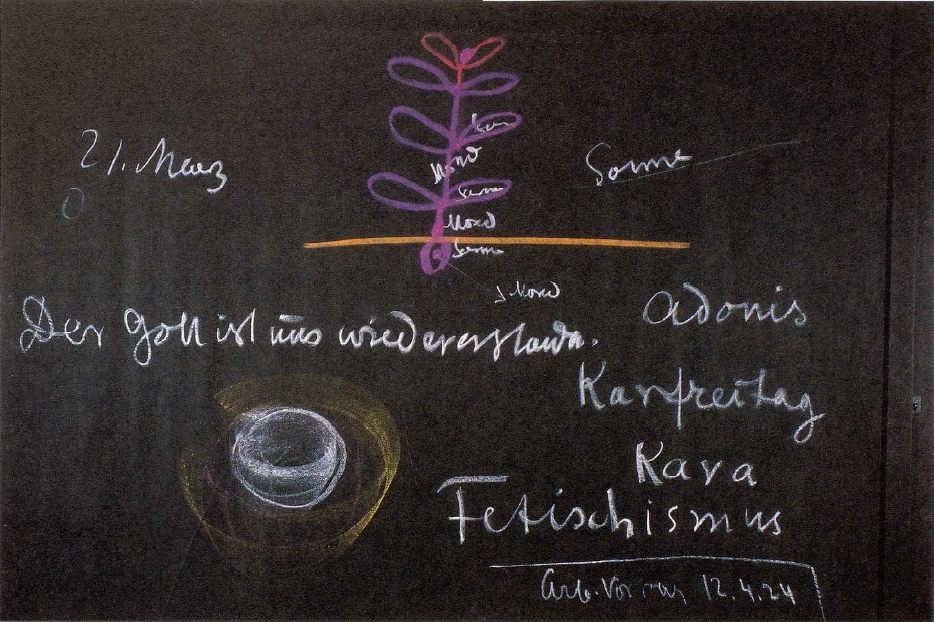
[ 9 ] But then it contracts again, and as it grows while contracted, it becomes a stem. Then it expands again, and leaves form. Then a flower develops from it. And then it contracts once more into the seed, which waits there until the following year. So what do we see in the plant? In the plant, we see expansion, contraction, expansion, contraction, expansion, contraction.
[ 10 ] Well, every time the plant expands—for example, when the leaf unfolds—it is the sun that causes this; every time the plant contracts—whether it is the seed or the stem—it is the moon that causes this contraction. So there, between the leaves, the moon is at work. So one can say that when you have a plant like this, where the leaves are spread out and the root is spread out—starting with the seed: the moon, then the sun, then the moon again, then the sun again, then the moon, then the sun, and it concludes with the moon. So in every plant we can observe, in alternation: the sun’s influence, the moon’s influence, the sun’s forces, the moon’s forces. So we look around us at the field with the growing plants and see there the workings of the sun and the moon. I have told you: Even when a human being comes into the world, the way he is formed in his physical body depends on the moon; the inner forces he possesses to transform himself depend on the sun. I told you this in my description of the Mystery of Golgotha.
[ 11 ] Yes, you see, people used to know this; they’ve just forgotten it. They asked themselves: When is the greatest power present in spring so that plants can thrive properly and in the way most beneficial to humans? When the sun and moon work together in harmony. This is the case when the full moon shines upon the Earth for the first time with its full radiance and supports the sun’s rays. Thus, the sun and moon come together when the sun—which has its greatest power in spring—and the moon—which always reaches its greatest power after four weeks—work together in harmony; that is why Easter falls on the Sunday dedicated to the sun, following the spring full moon. Thus, in establishing the date of Easter, it was understood that this was something intended to mark the beginning of spring following the winter solstice.
[ 12 ] But the Easter festival did not originate in Christian times; rather, it actually evolved from an ancient pagan festival—the one I have already alluded to and now wish to describe in more detail: the so-called Adonis Festival. What, then, was the Adonis Festival? You see, gentlemen, the Adonis Festival originated in those centers of art, education, and religion that I have described to you as the Mysteries. And Adonis was a kind of image that people created to represent that which is spiritual and soulful in human beings. So, under the figure of Adonis, people created a mental image of what is spiritual and soulful in human beings. And they thought: Yes, but what is spiritual and soulful in human beings also corresponds to the entire world. - And one must simply take into account that the Adonis festival, which resembles our modern Easter, originated among the ancient pagans—who still took the entire spiritual context into account—in such a way that they celebrated it in the fall! So the ancient Easter was celebrated in the fall. And it was celebrated in the following manner.
[ 13 ] It was celebrated by taking the image of this eternal, immortal part of the human being—the spiritual and soul aspect—and submerging it in a pond or in seawater, if it was on the coast, leaving it there for three days; and as the image was lowered into the water, the people accompanied the act with dirges and lamentations. This lowering of the image was associated with a solemnity of the kind one might otherwise experience when witnessing the death of someone from a close circle of family or friends—a true funeral rite. And this was always observed on a day that we now call Friday. The name “Good Friday” actually didn’t come into use until the tradition spread to Central Europe, to the Germanic regions, and to the German regions. And “kar” comes from “kara,” which actually means “lament.” So it is “Lamentation Friday.”
[ 14 ] People today know so little about how this matter originally was that the English call this Friday “Good Friday,” whereas in ancient times it was called “Dead Friday,” “Mourning Friday,” or “Lamentation Friday.” It was a true festival of the dead, celebrated in honor of Adonis. And where there was no water at all, they would create some kind of artificial body of water where they could submerge his image—it was a statue—and retrieve it again after three days, specifically on Sunday. You see, gentlemen, that was a true festival of the dead.
[ 15 ] As he was lifted out, songs of joy were sung—true songs of joy. So that within those three days, every human soul experienced both the deepest sorrow and, after three days, the greatest joy. Songs of jubilation were sung. And the message of these songs of jubilation was always this: “God has risen again for us!”
[ 16 ] Yes, gentlemen, what did this festival mean?—I must always emphasize: it was first celebrated in the fall—what did this festival mean?
[ 17 ] Well, I have also told you the following on other occasions: When a person dies, they shed their physical body. When a person dies, their loved ones and friends mourn, and depending on the people’s dispositions, a funeral ceremony like the one these people held for the burial of Adonis will naturally arise. But something else is missing. As I have told you: For three days after death, a person remains in a state where they look back on their earthly life. They have shed their physical body, but they still have their etheric body. This body grows larger and larger and eventually dissipates into the world. Then the person remains only in their astral body and in their I.
[ 18 ] The people who established the Adonis Festival told themselves: People should know that a human being does not die only when his physical body dies, but that he rises again in the spiritual world after three days. - And so that people might become aware of this every year, the Adonis Festival was established. During the Adonis Festival in the fall, people would say: “Look, nature is dying. The trees are losing their leaves, the earth is covered with snow, cold and biting winds are coming, the earth is losing its fertility; it looks just as if the physical human being were dying.” - But when one looks at the earth, one must wait until spring for it to rise again. When one looks at the human being: in the soul, in the spirit, he rises again after three days. This must be brought to consciousness. That is why there is a Festival of the Dead, followed immediately by a Festival of Resurrection—but in the fall, when one can make it clear to people: The human being is the opposite of nature. Nature must submit; it remains dead throughout the winter because it is merely nature; the human being lives on after death in the spiritual world, standing in contrast to nature. When nature sheds its leaves, becomes snow-covered, when nature is swept by cold winds, then one must make the human being aware: You are different from nature; when you die, you will rise again in three days.
[ 19 ] That was a beautiful festival throughout those ancient times. People would gather at the sites of the mystery cults, stay there for the entire Easter holiday, and then join in the lament; on the third day, they came to realize: Every soul, every “I,” and every astral body rises again in the spiritual world three days after death. —For people, turning away from the physical world during the Easter festival was a way of drawing into the spiritual world. You see, this could indeed have happened that way historically; for in earlier times, things were not as they are now. Nowadays, people celebrate Easter in the spring, when they also have other work to do if they are farmers. The ancient Easter festival—the Adonis Festival—was celebrated after the last fruits had been harvested, after the grape harvest was over, and when people were settling into their winter rest; then they sought to awaken spiritually. That is when they celebrated the Festival of Adonis. And this Festival of Adonis—Adonis was known by different names in different places—but this Festival of Adonis was celebrated everywhere where ancient religions existed. For all ancient religions spoke to people in this way about the immortality of the soul.
[ 20 ] Well, in the early centuries of Christianity, Easter wasn’t celebrated the way it is today; it only gradually came into being during the 3rd and 4th centuries. But at that time, people no longer understood anything about the spiritual world—they understood nothing at all—and instead wanted to look only to nature. They were concerned only with nature. And so they said: “Well, how can we celebrate the Resurrection in the fall? Nothing rises then!”—They no longer knew that human beings rise again, and so they said to themselves: “Nothing rises in the fall; the snow covers everything. In the spring, everything rises again; that is why we celebrate Easter in the spring.” - This is indeed something that arose from materialism, albeit from a materialism that looked up to the heavens and fixed the date of Easter according to the sun and moon. Materialism was already present in the 3rd and 4th centuries A.D., but at least it was still a materialism that looked out into the world—not “earthworm materialism,” where people look only at the earth—earthworm materialism because earthworms are always underground and come out at most only when it rains. And so it is with people today; people today look at nothing more than what is in the earth. In the early days, when Easter was celebrated, materialism was at least still such that people believed: The millions of stars have an influence on human beings. - That, too, was forgotten beginning in the 15th century. And so Easter came to be associated with spring. And it was able to become associated with spring because there was a certain striving among Christians to completely eradicate the old truths from the world. I have already explained this to you when I spoke about the Mystery of Golgotha: that people were actually striving to eradicate the old truths from the world. And so, in the 8th and 9th centuries A.D., people became completely unaware that the appearance of Christ had anything to do with the sun at all.
[ 21 ] You see, it’s quite interesting to note how there were two emperors in succession in the 4th century. There was Emperor Constantine, an extraordinarily vain man. He founded Constantinople. He had a treasure—which had once been carried from Troy to Rome and buried there—transported from Rome to Constantinople, buried it there, and erected a column over it; on this column he placed a statue of the ancient pagan god Apollo, but had wood brought from the East—it is said, from the cross of Christ—and had a halo made from it. But where the wood was supposed to form the halo, the people saw Constantine! And so, from that time on, Constantine was worshiped, standing atop the statue that had been erected upon Rome’s greatest treasure. He arranged things outwardly in such a way that the people knew nothing more of the mysteries of the world, that no one knew anymore that Christ is one with the sun.
[ 22 ] Then the other one intervened—Julianus, who had been initiated into the Mysteries, which still existed in his time but were struggling to survive. Although they were later eradicated by Emperor Justinian, they had already been struggling for centuries prior to that. People no longer wanted them; Christianity was their sworn enemy. Well, that Julianus, however, had still been educated in the Mysteries and still knew: There is not just one sun, but there are three suns. — When people heard that Julianus had said there are three suns, they went wild. For that was a secret of the ancient Mysteries.
[ 23 ] You see, the sun is, first of all, the physical body that you see—that whitish-yellow physical body. That is, first and foremost, the physical body. But this sun has a soul: that is the second sun. And then there is the third sun: the spiritual sun. Just as a human being has body, soul, and spirit, so too does the sun have body, soul, and spirit. Julianus spoke of three suns and wanted people to come to know Christianity in such a way that they would understand: Christ came from the sun and first entered into the human being Jesus.
[ 24 ] The Church did not want people to know that! The Church did not want knowledge of Jesus Christ, but only what it commanded. And so it came to pass that when Emperor Julian undertook a campaign to Asia, he was treacherously murdered in order to remove him from the world. This led to Julian always being called “Julianus Apostata”—the apostate, the heretic: Julian the Heretic! But he simply wanted to preserve the connection between Christianity and the ancient wisdom for the people. He reasoned that Christianity would fare better if it contained wisdom rather than merely the commands of the priests, if people were not merely expected to believe what the priests said. —And so it came to pass that, at the time when Easter was moved to spring, people still knew that Easter was connected to a resurrection. Even though they no longer knew anything about the resurrection of a human being, they still celebrated the resurrection of nature. But then even that was forgotten—in places where Easter was still celebrated, but where people no longer knew what it meant. And today it has come to the point where people ask themselves: Why does Easter have to be set according to the sun, moon, and stars? It should simply be the first Sunday in April—then we’d have an easier time with our accounting! —Today, it’s supposed to be set according to commercial considerations! Actually, those who want to set the date of Easter according to commercial considerations are more honest than the others; the others set the date of Easter according to the heavens, but no longer know anything about it. Those who, from their own standpoint, say, “We don’t need this kind of dating,” are the more honest ones. But that is precisely what is so sad: we can only be honest because no one knows anymore what the true connection really is. Our task today is to point out once again that the spiritual is the determining factor in everything.
[ 25 ] In ancient times, people used to wait for the first full moon after the beginning of autumn. And on the Sunday following the first full moon after the beginning of autumn, the Adonis Festival was set—also based on the moon—but people knew this: If the heavens send us snow—the Adonis Festival always fell between late September and late October—then that is the best time to remember the resurrection of humankind. - People didn’t need the resurrection in nature back then. But at least in the early days of Easter, they still knew that Easter was a festival of the dead and of resurrection. That, too, has been lost.
[ 26 ] And so one must say: It is actually necessary that, on such holidays, we recall what they once were, for we must return to the spirit. If we want to return to the spirit, we should not celebrate Christmas and Easter thoughtlessly, but rather we should be clear that these holidays must have a meaning.
[ 27 ] Now, we cannot turn the world upside down overnight; people would not be enthusiastic about moving Easter to the fall anyway. But we can certainly attach meaning to it so that people remember: When a person passes through death, they shed their physical body and look back on their earthly life. They then shed their etheric body, enter the spiritual world in a purely spiritual and soul-like state, and are resurrected in the spiritual world. This, in turn, deepens our understanding of the Mystery of Golgotha. For the Mystery of Golgotha actually reveals in external reality what has always been symbolized by the Adonis Festival. The ancients had a symbol. Christians have the historical event. But the historical event fades just as the ancient symbolism does. During the Adonis Festival, the figure of Adonis was submerged and then raised again after three days. It was a true Easter celebration. But then what had always been depicted in the symbol actually happened: Christ was in Jesus; he died. He rose again, just as I have told you. And that is all we should remember now—celebrating this Easter as a commemoration every year.
[ 28 ] That would have been quite good at first; for why did people in the past always have an image during the Festival of Adonis? Because they needed a sensory representation. Precisely when people in ancient times still viewed the world spiritually, they wanted to have an image in the realm of the senses. But once Christ had gone through the Mystery of Golgotha, people were no longer to have an image, but were to remember only in spirit what had happened there. Easter was to be celebrated more spiritually. One was not to form a pagan image, but only to remember in the soul. People thought that this—and mysteries did indeed still exist at the time of Christ Jesus—would spiritualize the Easter festival. After all, what was the old Adonis festival all about? Yes, you see, you in Europe cannot really grasp what such festivals meant to the ancient pagans. For if a festival like the Adonis festival were celebrated among you, you would say: “That is merely a symbol—a symbol, in fact, for those who were initiated into the mysteries; but for the broadest circles of the people, the statue—the god—was brought out every year and then submerged.” —This gave rise to what is called fetishism. Such a statue was a fetish, a statue in which a god dwells; the entire worship of such an object was called fetishism. Naturally, one had to move away from that. But in a certain sense, this has remained in Christianity; for what I have described to you as the monstrance, upon which the so-called Most Holy, the Host, rests, is venerated in Catholicism as the real Christ. It is said: Even physically, the bread and wine are transformed into the body and blood of Christ. — It is simply a remnant, not of enlightened paganism, which saw the spiritual behind everything, but of degenerate paganism, where fetishism existed, where the statue was taken to be the god.
[ 29 ] Look, gentlemen, I’m telling you: you have absolutely no mental image; because these days you really have to experience such things for yourself to truly grasp how strongly people come to believe in such a statue-god. For example, I once met a very intelligent professor—there are still intelligent people there, after all; in fact, they’re all intelligent, but modern science prevents them from reaching the spiritual realm. The man was Russian and was traveling through Siberia from the east, coming from Japan. When he reached the heart of Siberia, he began to feel somewhat uneasy. He felt lonely and abandoned. What did he do then? Something you certainly wouldn’t do, nor would any Westerner; but he was, after all, half-Asian, even though he was educated. So he carved a wooden idol for himself. And he took this idol with him on the rest of his journey, and he truly worshipped it. He made himself a wooden god. When I first met the man, he was terribly nervous. He had picked that up from his wooden god. You can’t even imagine what it means to worship such a wooden god!
[ 30 ] And so the mysteries that existed at the time of Christianity’s origins were truly intended to help people connect more deeply with the spiritual realm. Thus, what had previously unfolded before people’s eyes during the Festival of Adonis was to be revived solely in memory, through prayer.
[ 31 ] And instead of the matter becoming spiritual, it has, unfortunately, become all the more materialistic; it has become external, it has become formal. Gradually, in the 3rd and 4th centuries, the custom arose that when Good Friday came, the priests would pray; the people were put into all sorts of moods. And at three o’clock in the afternoon, the time when Christ is said to have died, the bells would stop ringing. Everything was silent. And then, just as the ancient Adonis festival had been celebrated, the Crucifixus—Christ on the cross—was first lowered and later merely covered with a cloth; and three days later, Easter became the Feast of the Resurrection. But it is the very same as the ancient Adonis festival was back then. It is precisely in the way it is celebrated that the establishment of dominion over souls gradually emerged from Rome. For in some regions—for example, where I grew up (though I don’t know if it’s the same here)—it goes like this: When Good Friday arrives and Christ is laid out, the boys go around with their rattles—the instruments that stand in for the bells—rattling them and reciting the words:
[ 32 ] We ring the bells, we ring the bells at the cathedral. The bells are calling us to Rome.
[ 33 ] So, the fact that everything points back to Rome is most evident to each individual during every Easter celebration.
[ 34 ] And that is precisely the task of people today: to emerge once again from materialism and return to a life of spiritual understanding, to learn to perceive things spiritually—and thus also to perceive something like the Easter celebration in a spiritual way. And consider this: Why is Easter celebrated? Every year at Easter, we can remember that when a person passes through death and enters the mourning period—the Chara—this mourning is meant to serve as a reminder that the person is departing from the physical world. But they look back on the physical world for only three more days; then they shed their etheric body as a second corpse. Then they rise in the spiritual world as the “I” and the astral body. We must remember this as well. Now, it would be bleak and brutal if, every time a person dies, people were to break into songs of joy after just three days. But one can still recall such songs of joy when thinking in general about the immortality of the human soul, as it rises in the spiritual world after three days.
[ 35 ] And this has also given rise to many strange things. You see, as a result, Easter is connected to every single human death. For every single human death, we should actually say to ourselves: We mourn; but Easter is coming. Then we will remember that every soul rises again in the spiritual world after it has died. Now, as you know, the festival that commemorates the death of all people is still celebrated today in the fall: the so-called All Souls’ Day. Even when people no longer knew that Easter was connected to it, they moved All Saints’ Day forward to precede it. But the two belong together, and in fact, All Souls’ Day should be celebrated as the Day of the Dead, and Easter as the Day of Resurrection. These things belong together—yet they are separated by more than half a year! Thus, given today’s division of the year, it is often no longer possible to understand what actually lies behind these traditions.
[ 36 ] But you see, the fact is that everything on Earth is oriented not toward the Earth itself, but toward Heaven. People are surprised when it still snows at Easter; it really shouldn’t be snowing anymore, but rather the plants should already be sprouting, because we know that Easter is meant to be a celebration commemorating the Resurrection, the immortality of the human soul.
[ 37 ] When you look at it this way, emotional and spiritual content comes into the entire Easter celebration. And then the people who celebrate Easter can use the occasion to remember something that is connected to humanity itself. Then Easter becomes a celebration of strength, and then one knows why one commemorates it. Today we know that human beings are connected to the cycle of the year simply because we have to wear winter coats in winter and summer dresses in summer, and because we sweat in summer and freeze in winter. So we only know the material aspects. But we do not know that, when spring approaches, spiritual forces are at work that draw everything forth from the earth, and that in the fall, spiritual forces in turn destroy everything. Once this is understood, we will find life throughout all of nature; we will find all of nature to be animated. Today, people mostly talk nonsense about nature. When they see a plant, they pull it out of the ground and engage in botany, because they know absolutely nothing about the subject. If I pluck out a hair and describe it, that is nonsense, for a hair can only grow on a human being or an animal; it cannot arise on its own. You cannot place something on a lifeless stone somewhere and expect a hair to grow there. There must be something living underlying it. Well, plants are therefore the hair of the Earth, because the Earth is alive. And just as human beings need air to live, so does the Earth need starlight with its spirituality; it breathes this in so that it can live. And just as human beings move about on Earth, so does the Earth move through outer space. It lives throughout the entire universe. The Earth is a living being.
[ 38 ] So we can say—at least this much can still be achieved during the Easter celebration—that we remember: the Earth itself is a living being. When it brings forth plants, it becomes young, just as a child is young when it grows fresh hair. The old man loses his hair, just as the earth loses its plants in the fall. — This is a life that is simply organized rhythmically in a different way: the life of youth in spring, the life of old age in the fall, then youth again, then old age again. In humans, this process simply takes longer. And so, in fact, everything in the universe lives in this way. And when you think of Easter, consider that the Easter celebration—at least today—can be the occasion when, upon seeing nature reawakening, we say to ourselves: Isn’t it true that not everything is dead? Beings must simply pass through death. Life is the original reality. Everywhere, after all, life triumphs over death. And the Easter celebration is meant to remind us of this victory of life over death and thereby give us strength. — If people gain strength in this way once again, then they will also be able to proceed with reason toward improving external conditions, not as is often the case today. But first we need this spiritual dimension in Spiritual Science so that we may once again come into harmony with the spiritual world, which is alive and not dead.
[ 39 ] With that in mind, gentlemen, I would also like to wish you a truly beautiful Easter—one that is as beautiful in your hearts as the spring flowers sprouting from the earth! After Easter, we’ll resume our discussions on scientific topics.
[ 40 ] So during the Easter celebration, we should feel that people can once again approach their work with renewed courage and joy. Even if there aren’t often many opportunities these days to look forward to work, perhaps this is one! Perhaps this is the very occasion when one can look forward to work after all! But in any case, gentlemen, I wanted to see you one last time to tell you this, and to wish you a truly wonderful Easter in the spirit that can be drawn from Spiritual Science! See you after Easter!