

Human History and the
World Views of Civilized Nations
GA 353
19 March 1924, Dornach
Translated by Steiner Online Library
6. The Trinity — The Three Forms of Christianity and Islam — The Crusades
[ 1 ] The question that was asked, gentlemen, is quite a detailed one, and we will need to discuss some parts of it a few more times.
[ 2 ] Today I would like to say a few more specific things about the later spread of Christianity. When viewed today, Christianity manifests itself in three forms. One must take these three forms into account if one wishes to trace back correctly, from today’s concepts, to what actually took place through the Mystery of Golgotha.
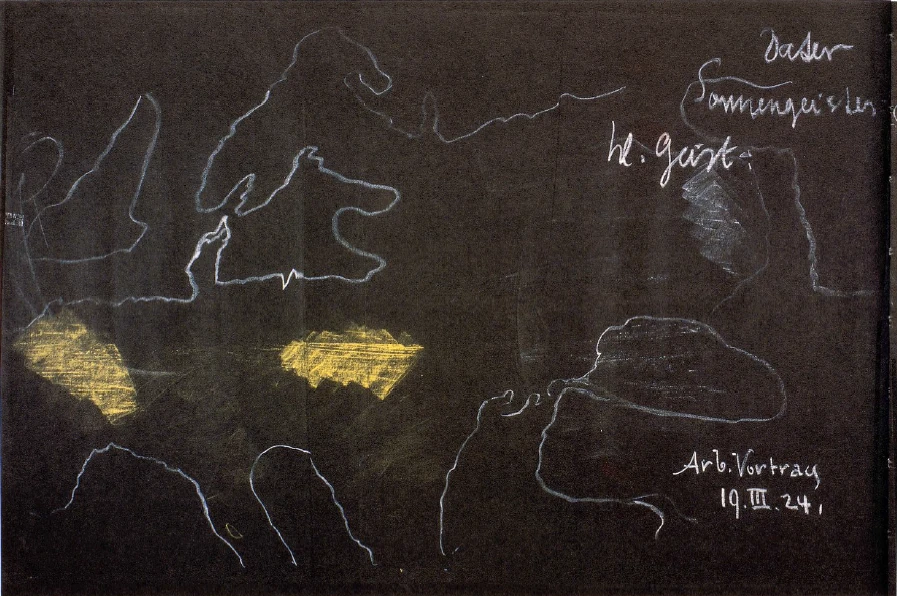
[ 3 ] Let’s first consider the matter in relation to Europe. I already told you the other day how it is: We have Asia over there, and Europe is actually a kind of peninsula of Asia. As you know, it looks like this (a map is sketched). Here would be Norway; here it extends toward Russia; here we cross over to the northern coast of Germany; here we have Denmark. From there we cross over to the Netherlands and France, and here would be Spain. Here we go to Italy and Greece; here would be the Black Sea, and from there it extends into Asia. At the bottom is Africa.
[ 4 ] Well, you see, in our present times it is difficult to speak about the spread of Christianity, because there are currently special circumstances surrounding these matters. But if one looks at Christianity in these regions of Russia, as it was back then, before the World War, one is led to say to oneself: This Eastern Christianity still retains more of the original religious character of Asia, which I have spoken to you about in its various forms among the Egyptians, the Indians, and the Assyrians. Much of what was customary in terms of religious rituals—for example, sacrificial rites—which were very well understood in Asia, has flowed into the religion that was subsequently permeated by Christianity in these eastern regions. When one becomes acquainted with the religion in these eastern regions, one immediately gets the impression: That it actually depends much more on the cult than on doctrine in any way. Doctrine seeks to express in human words what belongs to the spiritual world, or at least what human feeling can grasp of the spiritual world. Doctrine is also that which human beings constantly seek to approach with their reason. Worship, on the other hand, is something one possesses, something that remains much more conservative. And where worship is particularly dominant, religion also takes on a conservative character. So one must say: Eastern religion here has a conservative character; it places much greater emphasis on worship than on the actual inner impulse of religion—that is, religious life within the human being—than do the more Western religions.
[ 5 ] Well, the second branch of Christianity originated in Rome and spread northward; it was then strongly influenced by Ireland, from where the missionaries came. This southern Central European Christianity, influenced by Rome, did indeed preserve the liturgy, but placed much greater emphasis on doctrine than the Eastern tradition. Consequently, Roman Catholicism attaches far less importance to the liturgy than to preaching and doctrine. And there were far more disputes regarding the actual content of doctrine within the Roman Catholic Church than in the Eastern Church.
[ 6 ] But Christianity has also been influenced by another factor. You see, Christianity emerged at the beginning of our calendar. About six centuries later—five or six centuries later—Islam emerged. I recently drew a map of Arabia for you. If I were to draw a map of Asia Minor again, we would come down here to Arabia, cross over here toward India; then Africa would be there, and Egypt here. Well, here in Arabia, Islam arose through Muhammad. Islam spread very rapidly during the second half of the first Christian millennium. It spread from Asia, first toward Syria as far as the Black Sea, then across Africa to Italy, Spain, and all the way up into Western Europe. This religion has a distinctive characteristic: it combines the fantastical element with an incredibly sober, rational element. The fundamental principle of the Muslim religion, which spread rapidly throughout southern and western Europe and across Asia in the 7th, 8th, and 9th centuries, is this: There is one God, who is proclaimed to you through Muhammad.
[ 7 ] One must now truly understand what it actually means in the context of world history that Muhammad championed the principle: “There is only one God.” Why, then, did Muhammad emphasize this so strongly? Muhammad was already familiar with Christianity; and while Christianity does not have three gods, it does have three divine figures. It’s just that people no longer sense this today. Today, people do not realize that from its very origins, Christianity did not have three gods, but rather three divine figures: the Father, the Son, and the so-called Holy Spirit.
[ 8 ] What does that mean? You see, in Latin, the word “person” originally meant nothing other than a form, a mask—that which reveals itself to the outside world. And in early Christianity, people did not speak of three gods, but of three forms in which the one God reveals Himself. And they also had a sense of what these three forms entailed.
[ 9 ] Let’s take a look at what the situation actually is with these three figures. Isn’t it true that today, when there is a distinct science alongside religion, one can no longer understand this at all? For science today is pursued entirely independently of religion, and one does not really look to religious life when speaking of scientific life. That was not the case in ancient times, nor even in the early days of Christianity; rather, back then, people received all the science that existed along with religion. There were also no separate priests and separate teachers; instead, there were those who were both priests and teachers. This was particularly the case with what I have described to you as the last mysteries.
[ 10 ] Well, at first one saw that the human being is a natural being. The human being is a natural being in that, with the help of natural forces, he is born as a physical human being from the womb. There, it was thought—and felt—that the forces of nature are at work within the human being. When I look at how a human being comes into being as a physical being, I see forces that I also find when I watch a tree grow outside, forces that are ultimately present when water evaporates and rain falls. These are natural forces. But in ancient times, people saw spiritual forces behind these natural forces. Spiritual forces are at work everywhere in nature. When a crystal forms inside a mountain—that is, when the rock grows—spiritual forces are at work. When a plant sprouts in the spring, spiritual forces are at work. When water evaporates, a cloud forms, and rain falls, spiritual forces are at work. These same spiritual forces are at work in human beings as they develop as a human embryo in their mother’s womb. These same spiritual forces are at work when their blood flows through their veins and their breath moves in and out. In everything that was regarded as spirit in nature—which is also seen in the physical human being—people recognized the Father principle, the Father, because natural science was, at the same time, religion.
[ 11 ] It was said: “The one who has attained the highest enlightenment in the Mystery is an image of this Father Spirit, who knows everything that exists throughout nature.” - That was the seventh stage, the stage a person could reach in the Mysteries once they had ascended to the dignity of the Father.
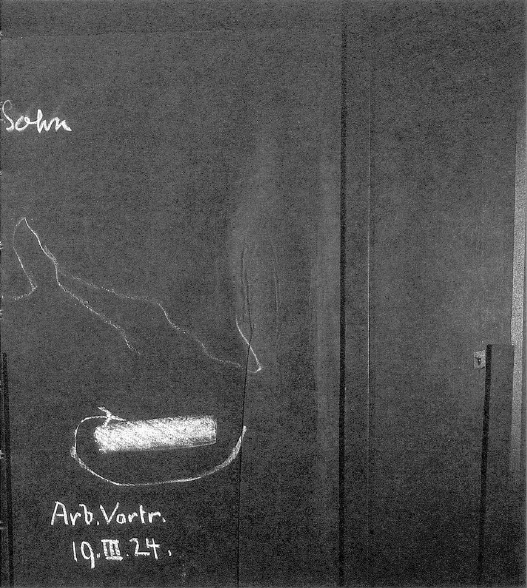
[ 12 ] The next rank—as I have told you—was that of the Sun Spirit. What, then, was meant by the Sun Spirit, who was later referred to as the Son? What was meant by this? I have already explained to you that Christ himself referred to himself as the Sun Spirit. People said to themselves: Certainly, human beings are born through natural forces—the same forces by which plants grow and so on—but as they live on Earth, they do develop. Just as they are born through natural forces, one cannot speak of good and evil in relation to them any more than one can in relation to plants. It would not occur to you to call a belladonna “evil” simply because it acts as a poison on humans. You would say: it can’t help it. There is no will living in the belladonna as there is in humans. And so one cannot say, when a child is born, that it can be good or evil through the forces of nature. It becomes good or evil as its human will gradually emerges; and in contrast to the forces at work in nature, what acts within the human will—that which can become good or evil in a human being—was called the Son of God or the Sun Spirit. And the one who was able to ascend to the sixth stage in the Mystery was merely its representative. All these individual representatives of the sixth stage were vicars of God on earth. And then it was understood that the sun is not merely a gaseous body; the sun provides not only light and heat, but also the forces that develop the will. Therefore, it is from the sun that not only light and heat come, but also the Sun Spirit. The God the Son is also the one who is the Sun Spirit. Thus, it was said: The Father God is everywhere in nature; the Son God is everywhere where human beings develop free will.
[ 13 ] But then people began to feel something quite peculiar. They asked themselves: Yes, but does a person—by developing free will and standing under the Son of God—become more valuable or less valuable as a result? —This question was also being asked at the time when Christianity was founded.
[ 14 ] Gentlemen, take a look at any natural product—even an animal, for all I care. It is true that when a cow grows old, you can say that you pay less for her now than you did when she was young. So she would be worth less than she was when she was young. Well, that is quite true; but that is not the point here. Rather, it is clear that the cow has not become less valuable because of something acting within her as a will, but rather she has become less valuable through the course of nature. But a human being who acts in a bad sense—who develops his will in a bad sense—becomes less valuable than he actually is by nature! That is why human beings need a third divinity to guide them in making their will good again—truly good—and in sanctifying their unhealthy will. And that was the third form of the divinity: the Holy Spirit, who was depicted throughout the mysteries through the fifth stage of initiation, which was designated differently depending on the people.
[ 15 ] And so these ancient people said: There are three ways in which the Divine reveals itself. — You see, they could have said: There is a God of Nature, a God of Will, and a God of Spirit, where the will is once again sanctified and spiritualized. - They also put it that way, because the ancient words certainly mean that. “Father” actually refers to something connected with the origin of the physical world, something natural. Only in the newer languages has the meaning of these words been lost. But then these ancient people added something else when they said: There is a God of Nature, the Father; a God of Will, the Son; and a God who heals everything in human beings that can become pathological through the will—the Holy Spirit; but—they added—these three are one. - So their most important statement, their most fundamental conviction, was: There are three forms of the Godhead, but these three are one.
[ 16 ] And then they said something else. When you look at a human being, they said, you see a great difference from nature. When you look at a stone: what is at work inside it? The Father. When you look at a plant: what is at work inside it? God the Father. When you look at a human being as a physical being: what is at work within? God the Father. But when you look at a human being as a spiritual being, in his will: what is at work within? God the Son. And when you consider the future of humanity, as it is to become, when everything is to be restored to health in the will: there God the Spirit is at work. All three Gods, they said, are at work within the human being. There are three Gods or divine figures; yet they are one, and they also work within human beings as a unity.
[ 17 ] That was the original belief of Christianity. And if we go back to the earliest days of Christianity, people expressed another belief as well. They said: “Well, that’s right—this healing, life-giving Spirit must work in two ways.” First, because nature can become ill, it must act upon the physical realm—that which comes from God the Father. And because the will must also be healed, it must act upon that which originates from the Son. So they said: This Holy Spirit must act in such a way that it proceeds from both the Father and the Son at the same time. —That was the original belief of Christianity.
[ 18 ] Well, Muhammad actually became somewhat afraid. He saw how the old paganism, which had many gods, would degenerate, become corrupt, and ruin humanity. Then he saw Christianity emerge and said to himself: That, too, carried the danger of falling into polytheism—namely, having three gods. —He did not fully grasp that these were three divine figures. Therefore, he took a stand against it and emphasized this point in particular: There is only one God, and it is Muhammad who proclaims Him to you. Everything else that is said about the gods is false.
[ 19 ] This doctrine was then spread with tremendous fanaticism. Well, as a result, this concept of the three divine figures was completely absent from Islam, from Mohammedanism. Instead, the focus was more on speaking of the one God, whom people actually perceived as the Father of all things. And that is why Islam came to believe more and more: Just as a stone has no free will to grow the way it does, and just as a plant has no free will but is given yellow or red flowers by nature, so too does everything in human life grow from nature. - This gave rise to the rigid concept of fate in Islam—known as fatalism—that humans must submit to an utterly unconditional, rigid fate: if they are happy, it is determined by God the Father; if they are unhappy, it is determined by God the Father. They must simply throw themselves into this so-called fate.
[ 20 ] You see, gentlemen, that was the religious aspect of Islam. But precisely because Muhammad viewed everything in human nature exactly as it is in nature, he was able to assimilate all of the ancient art and the entire way of life of the past much more easily than Christianity did. Christianity, after all, focused primarily on the way in which the human will can be healed. Islam did not concern itself with that. Why should one concern oneself with it? If it is predestined that a person will become evil, then it is predestined by God the Father. In Christianity, it was said: The ancient pagans focused primarily on God the Father; therefore, one must set God the Son against him. - Muhammad, and especially his later followers, did not say this; they said: The ancient pagans, even though they had many gods, also worshipped the natural world, in which the one God is at work. - That is why much of the ancient science and art has been preserved within Islam. And it was indeed the case that, for example, in the 9th century in Europe, Charlemagne—who is known as one of the greatest rulers of the Middle Ages and is cited throughout history—reigned over the Frankish Empire; he struggled to learn the alphabet, he could not yet write—what he accomplished in art and science was a mere trifle compared to what emerged in Asia under the ruler—his name was Harun al-Rashid—who was active in Islam, in the Muslim faith, during the time of Charlemagne. There was a great deal of art and science there, as it had been preserved from ancient paganism. And such art and science then spread to Europe via the south, into Spain.
[ 21 ] Christianity spread from Rome. Coming from Asia, I would say, Christianity was bypassed by Islam. There were, after all, fierce battles between Christianity and Islam. Truly, Islam did something very remarkable there. As you know, when a large army is stationed somewhere, one can achieve a great deal in strategy by bypassing it unnoticed and then attacking it from the other side. That is essentially what Islam did to Christianity; it bypassed Christianity in the south and then attacked it from the left flank.
[ 22 ] Yes, but, gentlemen, if that had not happened—if Christianity alone had spread—then we would still have no science today! The religious element of Islam was repelled; it was fought against through wars. But the intellectual element—which did not concern itself with religious disputes but rather carried on the ancient tradition of science—came to Europe along with Islam. And what the Europeans learned from that has flowed into modern science. That is why we actually have two things in our souls in Europe today: we have the religion inspired by Christianity, and we have the science inspired by Islam, albeit indirectly. And Christianity itself could only develop here in such a way that Islam influenced it scientifically.
[ 23 ] This, however, has given rise—especially in this part of Western Europe—to an even greater desire to defend Christianity more and more. Where worship prevails, there is less need to defend religion; there, worship exerts a great influence on people. Here, starting from Rome, cult practices were less dominant—although they were preserved—and doctrine became dominant. But this doctrine now had to be continually defended against the onslaught of Islam. In fact, the entire Middle Ages passed amid these struggles stemming from Islam—struggles that began as military conflicts and later became spiritual ones. In the second half of the Middle Ages, what is called European culture or civilization gradually developed. What, then, gradually came into being?
[ 24 ] Over in the East, all the way into Russia—and even as far as Greece—Christianity had no choice but to remain faithful to the ancient traditions in its worship. But what does that mean? It means performing external acts, even if they are only symbolic in nature. One must follow nature in this regard. There, people are much more inclined to emphasize God the Father than God the Son. And just as with Muhammad, where this principle of fate emerged intellectually—that one must strictly submit to what God the Father determines—so too has God the Father come to the fore in Eastern Christianity, coming to the fore in spirit more than God the Son. However, a curious shift in thinking has taken place there: these people in the East have held fast to Christ, but they have transferred the attributes of God the Father onto Christ. The story has been somewhat obscured here; people did not speak much of the God the Son, but rather became Christians, recognized Christ as their God, yet viewed him with the attributes of the Father God. As a result, the view “Christ, our Father” actually emerged within this Eastern religion. And this idea is actually alive throughout the entire Eastern religion: Christ, our Father.
[ 25 ] And when we turn our attention to Europe, a profound understanding of the three divine persons arose precisely because people wanted to defend themselves against Islam—against the belief in a single God who has no three forms.
[ 26 ] Well, you see, gentlemen, as you surely know, people can argue for a while; they can sit down together and argue and argue and argue; one says this to the other, the other says that to the one! Well, they’ll argue. But what usually comes of it? They end up parting ways, going their separate ways! The end result of these disputes is that people fall out and go their separate ways. Reconciliation takes place in very few cases, especially not when the disputes become widespread. You know, at first there was a socialist party; it argued a great deal. There was a left wing and a right wing. But later, the wings became separate party leaderships. And so it was with the spread of Christianity. It spread. Over in Asia—that is, in the East—people placed greater emphasis on God the Father, though they certainly held fast to Christ; in Europe, people distinguished more clearly between the Father and the Son. There, they debated and argued about this all the way into the 9th and 10th centuries. Then the Great Schism occurred. The Eastern Church—which is called the Orthodox Church today because it held fast to the original, ancient traditions—and the Western Church, the Roman Catholic Church, separated from one another. Thus, this major difference first arose between the Eastern Church, Eastern Christianity, and Western Christianity.
[ 27 ] This went on for a while. People settled into this Eastern and this Western way of life during the 11th, 12th, and 13th centuries. Yes, but then an event occurred that, I would say, threw the whole thing into disarray in a certain sense. And that was precisely the Crusades.
[ 28 ] Those among whom Muhammad originally ministered—those who first embraced Islam—were the Arabs. These Arabs practiced a distinct form of natural religion. They were therefore actually quite well-suited to understanding the “Father” and to recognizing the Father as God. And thus, even in the early days of Islam, this conception of the Father God—who works through all of nature and also through human nature—developed.
[ 29 ] But then other peoples came from the vast regions of Asia, whose descendants are the Turks of today. Mongol and Tatar peoples arrived. They fought in wars against the Arab peoples. And the peculiar thing about this Mongolian population—whose descendants are the Turks—is that they actually had no god of nature at all. They had what humans had in the earliest times: no appreciation for nature, which the Greeks later developed so strongly. They preserved that. The Turks did not bring with them from their original homelands a sense of nature, but rather an immense sense of a spiritual God—a God whom one can grasp only in thought, whom one cannot see anywhere at all. And this particular way of perceiving God was now transferred to Islam, to Mohammedanism. The Turks adopted the Muslim religion from the vanquished, but they reshaped it according to their own mindset. And while the Muslim religion actually incorporated much from antiquity—from art and science—the Turks effectively discarded everything related to art and science and became hostile to both. And they were the terror of the Western population, the terror of all those who had embraced Christianity.
[ 30 ] You see, for Christians, the region where Christianity originated—Palestine, including Jerusalem—was a particularly holy place. Many people made pilgrimages there from all over the West, making great sacrifices. There were many people who were very poor and who had to scrimp and save terribly to gather what they needed to make a journey to Palestine, to the so-called Holy Sepulcher. Yes, but they made that journey! And it was only when the Turks arrived that this journey became dangerous, for the Turks extended their rule over Palestine as well, and they mistreated the Christian pilgrims who came there. And the Europeans wanted Palestine to be free so that people could travel there. They wanted to establish their own European rule in Palestine. That is why they undertook these great military campaigns, which became known as the Crusades—campaigns that did not achieve their goal, but which actually embodied the war, the struggle between Western Christianity, as well as between Eastern Christianity and Islam, which had become Turkish in character. Christianity was to be saved from Islam, which had become Turkish in character.
[ 31 ] Well, many people initially set out for Asia as warriors. What did they see there? The Crusades began in the 12th century, lasted for several centuries, and thus fall right in the middle of the Middle Ages. What did those who set out for Asia as crusaders, as warriors of the Cross, see first? First, they saw that the Turks were terrible enemies. In the Turks, they thus faced terrible enemies. But if one or another of the crusaders had looked around a bit on days when there was no fighting, he might have had some remarkable experiences. For example, he might have met some old man who had withdrawn to a humble room somewhere, who paid no heed to Turks, Christians, or Arabs, but who, with remarkable fidelity, had carried on and developed what had been lived as culture, as science, and as religious science in the old pagan era. The Turks paid no attention to this. All of this had, in fact, been eradicated by official culture; but there were such people—many such people. And there the Europeans came to know much of the ancient wisdom, much of what was no longer present in Christianity. They brought this back with them when they returned to Europe.
[ 32 ] Now, gentlemen, just imagine what was there. Even in earlier times, the Arabs migrated through Italy and Spain, bringing this art and this scientific way of thinking with them. It spread and became our science. Then this ancient Eastern science was brought over, and the two blended together. And as a result, something truly special emerged in Europe.
[ 33 ] You see, the Roman Church adopted this form of worship, although it practiced it less than the Eastern Church; it adopted the worship, but it also placed a very strong emphasis on doctrine. But this doctrine, this teaching—this religious instruction—was tied to the person in the early Church. It remained tied to the individual right up until the time of the Crusades. What was proclaimed from the pulpit, what the councils that were held had approved—that was what was taught. And alongside that, there was also the so-called New Testament, the Bible. But reading the Bible was actually forbidden to people who were not priests, and this prohibition was strictly enforced. It was actually a terrible thing in those early days before the Crusades if someone wanted to read the Bible—the New Testament. That was not permitted. And as a result, people really had only what the priesthood taught. As a layperson, as a believer, one did not have the Bible in one’s hands.
[ 34 ] But now something had come about—as a result of the Arabs bringing science and people becoming acquainted with ancient Eastern wisdom—that led many to feel: “The priests who are teaching there don’t know this at all! There is much more wisdom than what they are teaching.” - And from this arose the intention: “Now let’s take a look at where they get their wisdom from.” - And so there arose a tendency, an intention, to actually read the Bible and become acquainted with the New Testament. And from this arose the third form of Christianity: Protestant Christianity, which then found a particular representative in Luther, but which had actually already taken shape earlier in terms of its intent.
[ 35 ] Take, for example, these regions of present-day Czechoslovakia, Bohemia, and Bavaria; take these regions here along the Rhine, stretching from Holland into Germany—I could also name many other regions—brotherhoods formed everywhere. Here, the “Brotherhood of Common Life” formed, extending from the Netherlands into the Rhine region. Here (pointing to the drawing), the brotherhoods known as the “Moravian Brethren” were formed. What did these brotherhoods seek? These brotherhoods said: Yes, true Christianity was not actually spread from Rome; rather, Christianity is such that one must first come to know it—through inner life. —And initially, this intention to come to know Christianity in its original form was actually something sought after inwardly. Only later did people say: One must come to know the Gospel. - But both stem from the same source.
[ 36 ] You see, that is the major difference between Hus, who was active in what is now Czechoslovakia, and Luther. Hus focused even less on the Gospel than on the idea that a person experiences Christianity inwardly. Later, this focus shifted more toward an outward understanding of the Gospel.
[ 37 ] But the Gospel, the New Testament—that was written under completely different circumstances. It used figurative language; and later on, people no longer understood that figurative language at all. Let me give you an example.
[ 38 ] One passage in the Gospel recounts how Christ healed the sick. Now, at the time when Christ was healing the sick, the illnesses prevalent in the regions where he taught—what we today call nervous disorders—were far more common than those affecting the actual organs. Now, nervous disorders can often be healed through encouragement, love, and so on, from person to person. Most of the healings mentioned there can be attributed to this kind of healing. But then it says in one passage: “When the sun had set, Christ gathered the people around him and healed them.” When you read this passage in the Gospel today, it seems to people as if it were meaningless, as if the intention were merely to state the time. But why is the time specified at this particular point? Because the intention is to say: The powers that a person develops when seeking to heal others are stronger when the sun is not in the sky—when its rays pass through the earth—than when the sun is in the sky. —This is a very significant passage: “When the sun had set, the Christ gathered the people around him and healed them.” People don’t pay any attention to that anymore. The intention was precisely to suggest how Christ uses the natural forces inherent in human beings for healing. And so, in fact, the Gospel was only translated at a time when people could no longer understand it. Basically, the Gospel is understood very, very little.
[ 39 ] Well, actually, this was the case in all these areas—in Eastern Christianity as well as in Western and Protestant Christianity—just as it has been in some other instances that I have had to examine, where something that was originally well understood was later retained but no longer understood. Christianity, in all three of its forms, was simply no longer properly understood. I would say that each of these three forms focused primarily on one aspect: Eastern Christianity focused on God the Father, even though He is also called Christ. The Roman Catholic Western religion has taken the God-Son; it looks up to the Father only as the old man with a flowing beard who is still depicted in paintings, but little is said there about the God-Father. And Protestant Christianity has the God-Spirit. In Protestant Christianity, there has been a particular focus on the question: How does one be freed from sin? How is a person healed of sin? How is a person justified before God, and so on? So, while Christianity originally had the one Godhead in three forms, Christianity has actually fragmented into three creeds. Each creed has a piece—a genuine piece—of Christianity.
[ 40 ] However, simply combining these three elements will not be enough to rediscover original Christianity. One must rediscover it for oneself through genuine human effort, as I have already begun to show in the presentation I gave recently. But I also wanted to show you this so that you can see how difficult it is today to arrive at original Christianity. For if you ask about Eastern Christianity: “Which is the true Christianity?”—well, they will tell you everything that relates to the Father, and then call the Father “Christ.” - If you ask the Roman Catholic Church about the essence of Christianity, they’ll tell you everything that relates to human sinfulness and the wickedness of human nature—that human beings must be redeemed from their sufferings, and so on. They’ll tell you everything that relates to the Son, to Christ. - If you ask Protestant Christianity what the essence of Christianity is, they’ll tell you: It all comes down to the principle of the will’s restoration—the healing and recovery of the will, and justification before God. - They’ll then speak of the Holy Spirit and call Him Christ.
[ 41 ] And that is how everything we have today came about; not that people thought, “Now we must unite the three different aspects of Christianity”—but rather they said, “We don’t understand anything anymore!”—And that is precisely how the current mood came about, along with the need to rediscover Christianity.
[ 42 ] And so, next Saturday, I would like to speak to you about the Mystery of Golgotha. I will try to wrap up my answers to these questions by then.