

Knowledge and Immortality
In 1910, in response to the Theosophical Society taking a definitive Eastern stance by declaring Krishanmurti as the reincarnated savior, Rudolf Steiner firmly rooted himself in the Christ. In this public lecture from that year, Rudolf Steiner describes the Christ as the living force of Truth and Knowledge within us. He incorporates reincarnation into an understanding of Christianity and contemplates the continuous evolution of humanity. This excerpt highlights these points. The link to the full lecture follows.
"While man is limited to a small space in the outer world by his physical body, which he repeatedly tires through the work of the day, and he must always compensate for this wear and tear of the body through sleep, he feels when the soul is truly “with itself” that it can also draw forces from the spiritual world while awake. He gets the feeling that a source is opening up for the soul, through which healing potions flow to us from the spiritual world, so that he can become master of the body. He feels that we can consciously enter the spiritual world, as we unconsciously do every night while sleeping. He feels that we can then consciously enter the realm of eternity when our knowledge becomes life. Then it will become something completely new, something that it cannot be for the ordinary consciousness of today's man. Plato said that in ancient times people developed the highest knowledge out of enthusiasm. Even if this ability of enthusiasm may have been lost to today's people, what has not been lost to them is that the knowledge of the world of ideas can become a life force in them, that they can feel how they connect with the root of existence and eternity by penetrating into things with their spiritual self through knowledge.
In this way we come to know knowledge as a living thing, as a healing process that extends into the physical body. It takes a long time before we get to know this knowledge, that is, this source of life in our soul. And we also get to know the connection with a very different factor of our culture. All our knowledge must be incorporated into what we can call being imbued with the living Christ. What is this living Christ in the human soul? It is nothing other than what we can experience when knowledge and truth come to life in us, as has just been explained, when we can feel our personality as if it were being filled by a second personality, by something that is truth itself. This is the living Christ, who is truth and life in the human soul. When one grasps the Christ in this way, He is not an abstract idea, but He is the living Entity Who at a certain point in time intervened in the evolution of humanity, an Entity Who fulfilled the Mystery of Golgotha and thereby entered into the life of human souls.
In the past of human evolution, the way people recognized each other was different than after the Mystery of Golgotha. In ancient times, people looked to the origin of man and they felt: Man is not valuable for the development of humanity as a sensual being; as spiritual beings we have descended from a spiritual world into this sensual world to live in a physical body, after we were previously in an ocean of divine spiritual life; through our soul we can in turn find our way back to this common human origin.
This is no longer appropriate for our time; something else corresponds to our time. In ancient times, the human soul sought the origin of humanity in order to become aware of what united people. Today we look at what the human being can become, at a common goal for all people. Looking towards this goal, people must be able to say to themselves: This concerns every human being; something must come alive in the innermost being of every human being – this is the living Christ. In the future, human souls will come together in him. The earth, the physical body – it will fragment in its material existence. But the human souls that have the living Christ within them will advance to other levels of existence. When the body of the entire planet has disintegrated, all mankind will be one again, not as it was before it descended to the earth, but one in which the Christ will live as a common soul-blood in this humanity.
All our knowledge must be dedicated to the great moment in the evolution of mankind when the human soul can turn to the God-man who accomplished the Mystery of Golgotha. When we look into the future of mankind, we look for the Christ-consciousness in every human being. This has a completely different sense and a completely different meaning than when the Buddhist teaching speaks of a Nirvana and means by that a detachment of the soul from all earthly things. No, the soul should not detach itself from the earthly. We look to the living Christ, who can grasp our souls with his life, and to how the soul can shape itself ever more richly through the life of Christ in it, through immersion in the source of wisdom and truth in ever new incarnations.
Thus we see that spiritual science does not stand in opposition to that without which our culture cannot be imagined - to Christianity. It does not want to fight Christianity, but to deepen it by pointing to the living Christ. We, as Westerners, look to the event of Golgotha as to the point in time that is also known from history, but which only acquires its deep value, its deep meaning for us through the fact that we gain the Christ-idea not only from the historical Christ, but deepen this Christ-idea through spiritual science. Only when we have imbued our knowledge with soul, light and spirit through the idea of Christ does this idea of Christ become for us that through which the true idea of immortality is revealed to us ever more surely. And when the Christ in us has become the light of knowledge and the life of knowledge, then we connect with the power through which we pass through many deaths and through many lives. Knowledge of Christ is the way for man to absorb within himself the forces that lead him to true immortality, that is, to victory over death.
This idea can only be gained from higher knowledge - not with ordinary knowledge, which only wants to deal with the material. Nowadays, only the external, the material, is pursued in man, and that is the most fleeting, the most transient. The words of Hamlet, for example, point this out, showing how dying and death must appear to him in his melancholy mind, in which the light of Christ does not yet shine. He speaks of the great Alexander, saying:
Alexander turned to dust;
Dust is earth;
From earth we make clay.
And he speaks of the great Caesar:
The great Caesar, dead and turned to clay,
Might stop a hole as well as the rough north;
Oh that the earth,
Before the wind and weather, might stick a wall.
But Hamlet is only talking about where the earth that became Caesar's body may have gone. He pursues the fleeting, transient material instead of reflecting on where the great, richly developed souls of the great Alexander and the great Caesar have gone. You don't see what is important in man if you only look at the transitory, at the material, and think about what might have become of it. You should look beyond what goes through death and birth to recognize what true immortality is.
In recent centuries, when knowledge of the material world has made such great strides, we have become more and more accustomed to regarding matter, that which forces the spirit into its fetters, as the essential. But matter will perish, disintegrate; the earthly body, consisting of matter, will disintegrate. The spiritual researcher, for example, views today's radium research in such a way that he knows: here is the beginning of the disintegration of the atoms that form the earthly body. The material of the earth will perish, but the eternal, even of the earthly body, will merge into the eternal essence of things. Today's striving for knowledge pursues the material, forcing the soul into its spell. One believes that one can speak of eternity, of the indestructibility of matter. In the face of words such as those spoken by Hamlet, it must be said, based on the realization of the true nature of the human being and at the same time on the realization of the true nature of materiality: Not only the great Alexander, the great Caesar, no, all human souls are parts of eternity; they take on a physicality from the materials of the earth in ever new lives, they go through ever new lives, which are only steps towards immortality. This applies to every human being:
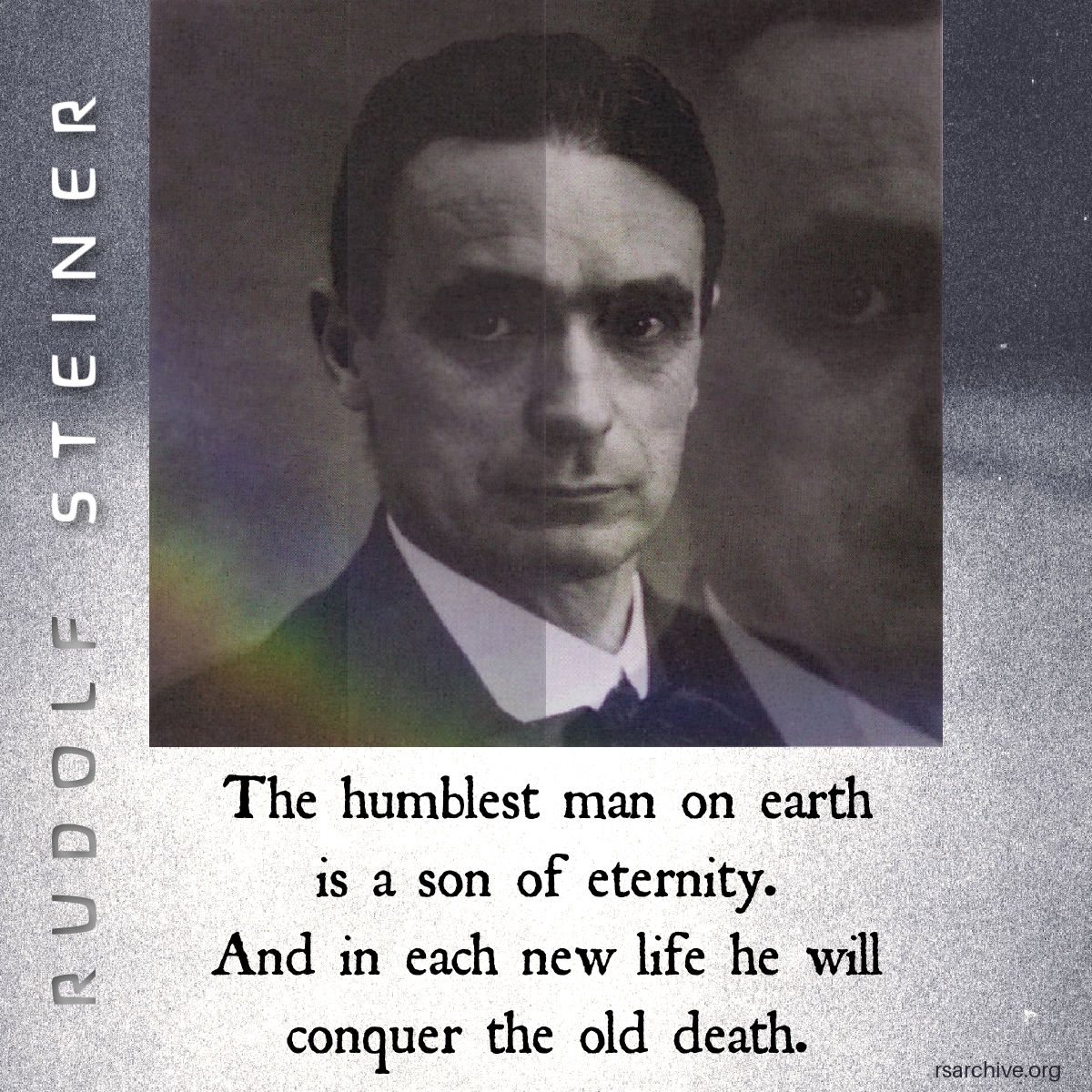
The humblest man on earth
is a son of eternity.
And in each new life he will
conquer the old death."
Read more: Rudolf Steiner, Knowledge and Immortality, Lecture III, GA 69b, 27 November 1910, Bremen.