

Spun Light
Rudolf Steiner's collected works, Volumes 347 to 354, document his discussions with the workers at the Goetheanum. They wanted to know about everything from the evolution of the world, the influence of the stars, nutrition, the sense of smell, Chinese culture, and volcanoes, to mention a few. One can also call these lectures dialogues, because their content was always determined by the workers themselves, at Rudolf Steiner's request. They were allowed to choose their topics themselves; he encouraged them to ask questions and share their thoughts, and he encouraged them to express themselves and to voice their objections. The following discussion about butterflies transpired on 8 October 1923.
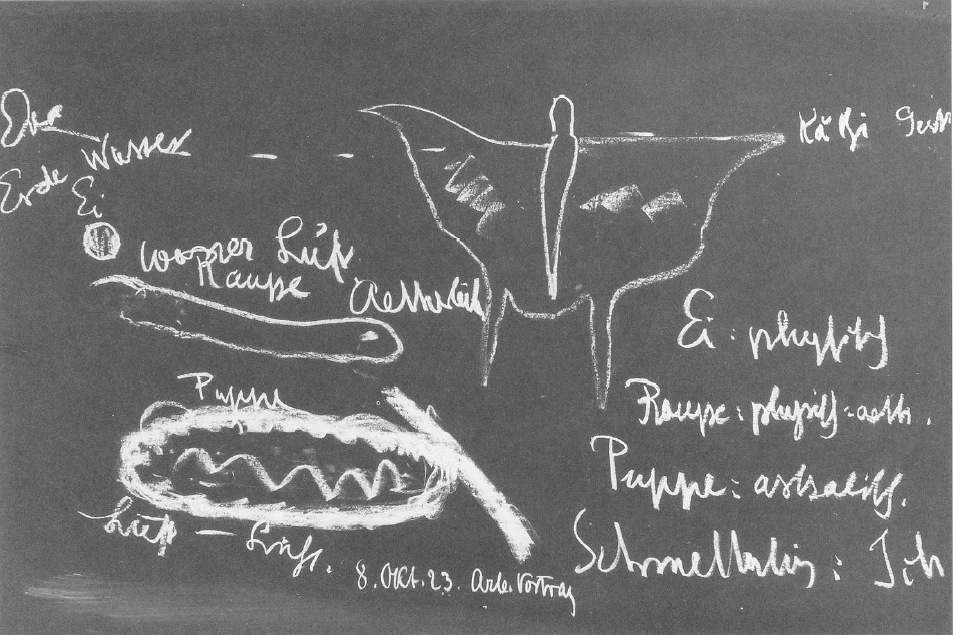
"Thus before the butterfly exists as such, four things are required. First of all the egg, secondly the caterpillar, thirdly the chrysalis, and fourthly the actual butterfly. The egg is laid in some place. The caterpillar crawls around, the chrysalis remains quite still, and the butterfly gaily flutters forth into the air. It can then lay another egg and the same story is repeated in the course of the year. This is what happens.
Now people see this and learned folk explain it by observations under a microscope or other such means. The matter, however, is not so simple. One has to take into account where and how the egg can live, how the caterpillar and chrysalis live, and finally how the butterfly lives. If the egg is to reach the stage of hatching out a caterpillar, it above all requires moisture—often just a drop in which a little salt is dissolved. No egg can thrive without a certain amount of humidity in which salt is present. For this reason the butterfly's instinct must lead it to lay the egg where it will find moisture containing some salt. Otherwise nothing happens. What I am telling you in regard to butterflies applies also to bees. It is likewise necessary for bees to lay their eggs where salt—even if very little—has penetrated. It suffices for mist to seep in, as mist always possesses a certain amount of saline moisture. Nature comes to the rescue. Such things do not always dawn on human understanding. Nature indeed is far cleverer than man. The egg, however, always requires moisture containing a certain amount of salt. This is necessary to the butterfly, too, as it enables the caterpillar to be hatched. So the egg just requires this moisture containing salt; it has no eyes, so sees nothing and just lives for itself in a world of total darkness. The moment the caterpillar is hatched it meets the light and remains in it. It has some organs, has reached the light, and now becomes quite another kind of creature than it was as an egg. The egg has entirely transformed itself into a caterpillar. Inner sensation is produced in the caterpillar because it is exposed to the light and has sense organs. Such things are made evident in the case of certain phenomena. You have no doubt noticed the astonishing fact when a lamp has been lit that all sorts of insects flutter around in the room, feel drawn to the light, and are even so stupid as to hurl themselves into the flame and get burnt. Why is this? Of course this does not happen in the case of the caterpillar, but it has the same urge. I may say that the caterpillar is drawn to the sunlight by the same urge as that felt by the insect who plunges into the candle flame, only the caterpillar cannot rise to the sun. Could it rise from the ground and fly to the sun, very soon we should no longer have any caterpillars. They would all fly up and away to the sun. For that is their urge, gravity only binds them to the earth. So when we see a caterpillar we know that it really has the urge to follow the light. This is impossible, so what does it do?
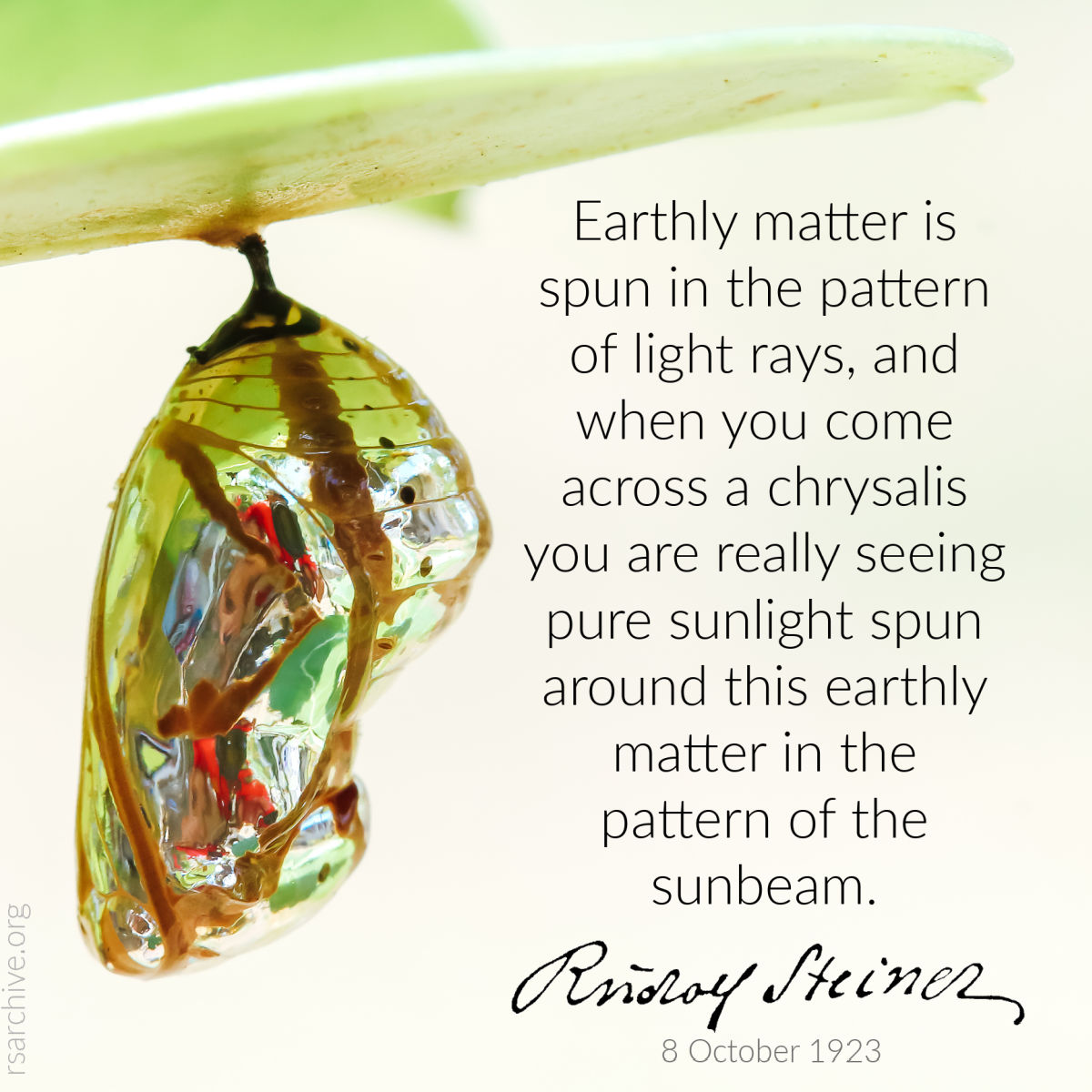
Just imagine that here is the beam of light and here the caterpillar (drawing). As the caterpillar crawls along, it spins a thread in the pattern of the beam of light. It spins in exact accordance with the beam of light and at night when there is no light it rolls up the thread. It spins it out in the sunlight and rolls it up again at night. In this way it forms its sheath. The caterpillar completely surrenders to the light, it dies in the light. Just as the insect surrenders to the flame, so the caterpillar dies into the light, but being unable to reach the sun it does not enter the sunbeam. However, it spins its own body into these threads and so forms the cocoon—as threads spun in this way are called. The silkworm spins the silk according to the light, so when you take its silk you can certainly say: This is spun light! Earthly matter is spun in the pattern of light rays, and when you come across a chrysalis you are really seeing pure sunlight spun around this earthly matter in the pattern of the sunbeam. We have now reached the point where spun light surrounds the chrysalis, and naturally something different occurs from what does in the case of the insect which burns by plunging into the flame and so can accomplish nothing further. In the short time the insect takes to hurl itself into the flame, could it but spin such a cocoon modelled on light, a new animal would arise from the fire. This is only hindered by the burning. By reason of this it is interesting to learn the real impulse of the insect which flutters around the room at night and plunges into the flame. Its urge is indeed to propagate itself and perish in order to re-emerge as a new being. Only it deceives itself because it cannot create a cocoon so rapidly. The caterpillar, however, has the time to create this sheath, to hang it up, so the sun forces, imprisoned inside, can now create the butterfly which is then able to fly out and enjoy the activity of a sun-being.
This is the way to observe things in Nature. First, quite a significant idea is implied in what I have told you. One might think that the insect by plunging into the flame just has the urge to perish, whereas this is not the case. It wants to reappear in another form. It would fain be transformed by the flame. This is always so in death. Death does not annihilate, but when it comes about in the right way it transforms the creature. This is the first thing we see. The second is the deep connection between all things in outer Nature. The butterfly you see is created out of light, but light had first to take up matter, form a case and be turned into threads inside the chrysalis. All animal entities are created out of light. This applies to man as well, by reason of the fertilisation of the female ovum. A sheath encloses the light within the mother's body, so man is really created by this light. So the possibility arises for man to be born out of light. Thus we see how the butterfly arises from light which has first been imprisoned.
Now the butterfly flutters about in many different colours. These colours are seen to be prevalent where the light is most effective. In regions where the birds have wonderful colours the sun has greater power. What effect is produced by the action of imprisoned sunlight? In every instance colour is produced and this applies to the butterfly as well. The butterfly owes its colour to the action of imprisoned light. The butterfly is understood only when viewed as a complete creature of light which is responsible for its manifold colours."
Read more: Rudolf Steiner, How Spirit Works in Nature, 1. On the Nature of Butterflies, GA 351, 8 October 1923, Dornach.