

In October of 1923, in the wake of the burning of the First Goetheanum, Rudolf Steiner called for a spiritual awakening among his students. He warned the Anthroposophical Society would collapse if members did not have the courage for the self-reflection necessary to awaken to the spiritual world.1The Anthroposophic Movement, Lecture 8, GA 258, 17 June 1923, Dornach. Facilitating their awakening would be his primary task the rest of his life.
"And when the height of summer draws to a close, the Earth once again begins to inhale its spiritual essence, so that from the time of St. John onward, as the Earth inhales its spiritual essence, the time is once again being prepared when the Earth will carry its spiritual essence within itself.
People today are not very inclined to pay attention to this inhalation and exhalation of the Earth. Human breathing is more of a physical process, whereas the Earth’s breathing is a spiritual process—it is the outward movement of the Earth’s elemental beings into the spaces of the cosmos and their sinking back into the Earth. But truly, just as human beings experience what takes place in their blood circulation as part of their inner life, so too do they, as fully human beings, experience the course of the year. Just as the circulation of blood is internally essential to their existence, so too—in a broader sense—is this circulation of the elemental beings from the Earth up to the heavens and back to the Earth again essential to human existence. And it is only the coarseness of human sensibility that prevents people today from even suspecting what within themselves actually depends on this external course of the year. But as human beings will have to strive, over the course of time, to take in the ideas that spiritual science and supersensible knowledge provide, and as they will have to develop the inner activity necessary to truly make present within their own souls the findings of spiritual science entrusted to them, such an understanding of these findings will also refine their capacity for feeling.
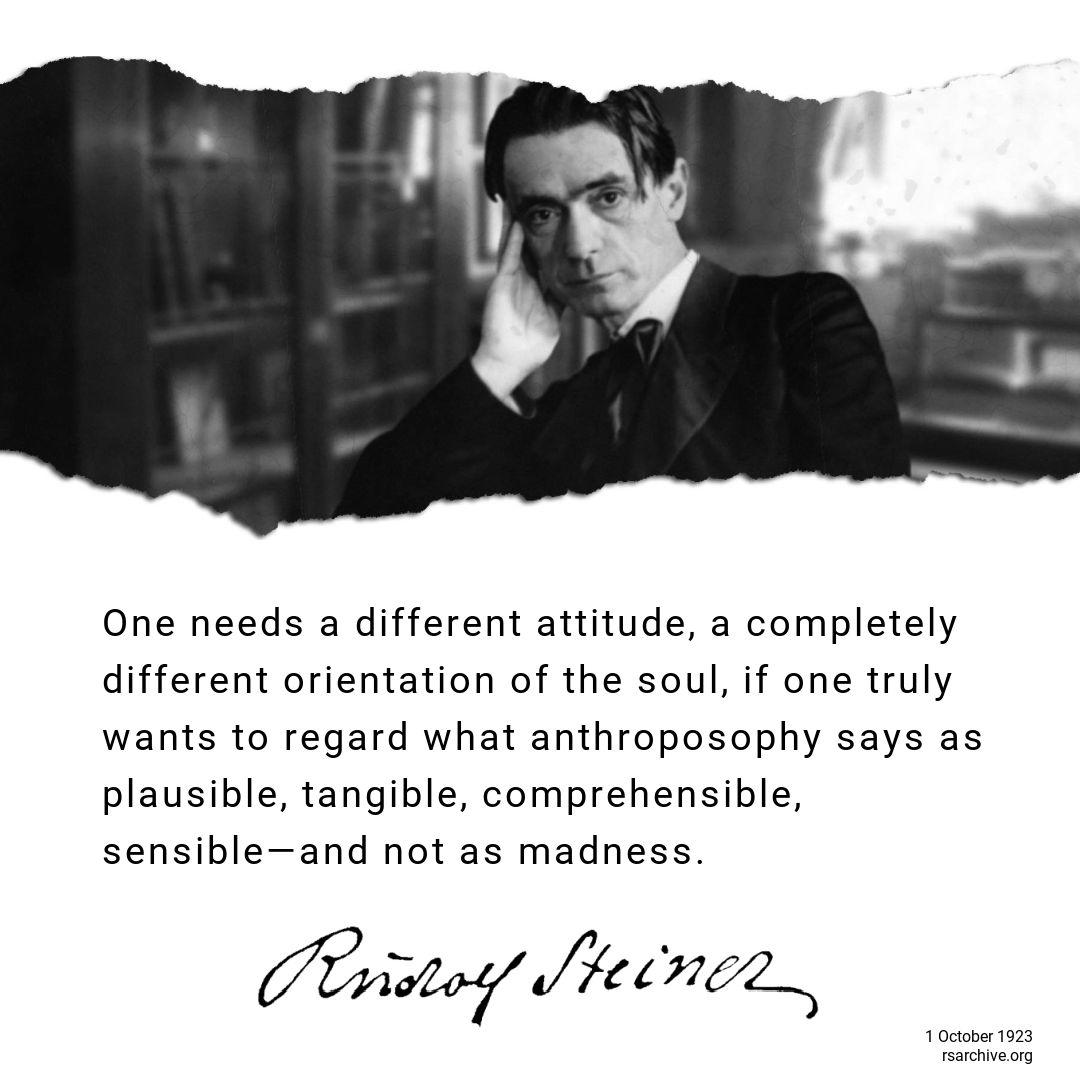
This is actually what you should all expect from delving into the supersensible knowledge that anthroposophy refers to. If you read an anthroposophical book—or, for that matter, even a lecture series—and you read it in such a way that your reading is no different from reading any other book, that your reading proceeds just as abstractly as when reading any other book, then you really have no need to read anthroposophical literature at all. In that case, I would rather advise you to read cookbooks or technical manuals or the like, for that is more useful, or a guide on how best to do business. Reading anthroposophical books or listening to anthroposophical lectures only makes sense if you realize that, in order to absorb these insights, you must attune yourself in a completely different way than you would for other kinds of knowledge. This is already evident from the fact that those people who today actually consider themselves particularly intelligent regard this anthroposophical literature as sheer madness. Yes, they must surely have reasons for considering it madness. The reasons are these: they say, “Everything else says something different; everything else presents the world to us in a different way. We simply cannot accept that these anthroposophists come along and portray the world in a completely different way!” — Yes, what emerges into the world as anthroposophical insights is indeed different from what one is otherwise told today. I must say: The approach sometimes taken by some of our friends—seeking to make anthroposophy look good to the world by presenting the matter as if there were no contradictions whatsoever with the trivial opinions of others—these efforts cannot really be considered sound, even though one encounters them time and again. One needs a different attitude, a completely different orientation of the soul, if one truly wants to regard what anthroposophy says as plausible, tangible, comprehensible, sensible—and not as madness.
But once one acquires this different orientation, after some time not only will the human intellect undergo a process of refinement, but the human soul will also undergo such a process; this soul will become more finely attuned. And one will not merely experience winter in the sense of putting on a winter coat when it gets cold, nor will one experience summer merely by taking off a few layers of clothing when it gets warm again; rather, over the course of the year, one will feel those subtle transitions from the frosty snow of winter to the sultry height of summer in earthly existence. And one will learn to truly perceive the course of the year in the same way that we perceive the expressions of a living, animated being. Indeed, through the proper study of anthroposophy, one can develop one’s soul to such an extent that the course of the year becomes so vividly real that one feels, in the face of its manifestations, as if one were hearing the words of encouragement or reproach from a dear friend. Just as one can sense, from the words of a friend’s soul and from the friend’s entire demeanor, the warm pulse of an animated being—which speaks to one in a truly different way than anything lifeless or inanimate—so too will nature, which is at first silent, begin to speak to human beings as if animated. Human beings will learn to perceive nature as a soul—a soul in the process of becoming throughout the course of the year—and will learn to listen to what the year has to say, just as they would to a great living being, whereas otherwise in their lives they deal with small living beings; they will learn to place themselves within the entire animated cosmos. But when summer gives way to autumn and winter draws near, it is precisely through this transition that something special will speak to him from nature.
Anyone who gradually develops that subtle sensitivity toward nature that I have sought to describe—and the anthroposophist will notice after some time that this can be the emotional and spiritual outcome of his or her anthroposophical striving—will learn to distinguish between: an awareness of nature that arises during the spring and summer, and true self-awareness, which feels at home during the fall and winter. Awareness of nature: when spring comes, the earth develops its sprouting, budding life. And whoever has the right feeling toward this sprouting, budding life, whoever allows what is actually present during spring to speak within them—one need not be consciously aware of it; it also speaks in the subconscious to the fullness of human life—whoever possesses all this does not merely say: “The flower blooms, the plant sprouts”—but truly feels a sense of surrender to nature, so that they can say: “My ‘I’ blooms in the flower, my ‘I’ sprouts in the plant.”—Only through this does an awareness of nature arise: learning to participate in what develops and unfolds within this sprouting, budding life. To be able to sprout with the plant, to be able to bloom with the plant, to be able to bear fruit with the plant: this is what it means for a human being to step out of their inner self, what it means to merge with outer nature. To develop spirituality truly does not mean to abstract oneself. To develop spirituality means to be able to follow the spirit in its weaving and becoming. And when a person, by blooming with the flower, sprouting with the seed, and bearing fruit with the fruit, develops this sense of nature within their own subtle perception of nature throughout the spring and summer, they thereby prepare themselves to live, especially in the height of summer, in devotion to the universe and the starry sky. Then every little firefly becomes something like a mysterious revelation of the cosmic; then, I would say, every breath of air in the atmosphere during the height of summer becomes an announcement of the cosmic within the earthly."
Read more: Rudolf Steiner, The Annual Cycle as the Earth's Breathing Process and the Four Major Festival Seasons, Anthroposophy and the Human Soul IV, GA 223, 1 October 1923, Vienna.