

A Cultural Carcinoma
1916 was a time of perseverance for Rudolf Steiner. In the midst of the First World War, a “war catastrophe," he repeatedly pointed out that he had already warned of a “cultural carcinoma” that would arise from the unhealthy processes of the economy having terrible consequences. In this context, he began his collaboration with the painter and sculptor Edith Maryon. With her assistance, Steiner would produce the central sculpture of the First Goetheanum, “The Representative of Humanity” depicting the Christ holding a balance between the polarized forces of Lucifer and Ahriman. In January, he emphasizes the Christ as the sole path for Anthroposophy, "Everything that happens in the course of earthly evolution has its meaning only through the Mystery of Golgotha." In September, Rudolf Steiner published The Riddle of Man, which portrays a struggle to develop a new sense for what man is — an immortal soul rather than accepting man as a mere machine. On December 31st, New Year's Eve, he delivered the following address on these themes.
"Humanity has still not come very far in terms of broadening the horizons of its worldview. Broader horizons for our view of the world—in a sense, we do not want them. And contemporary science is actively striving to narrow those horizons more and more. Underlying this, however, is a secret fear—the fear of what the truth is. This fear of the truth is taking hold of humanity more and more, both in specific, everyday instances and on a broader scale. And if this were not the case on a broader scale, it could not occur in everyday situations. For example, the war would not be prolonged now, for the simple reason that there is a fear that, in a genuine discussion aimed at reaching an understanding, certain things would come to light—well—things that people simply fear.
Some of you may recall that I summarized much of what has been said over the years regarding the trends of our time in a series of lectures I gave in Vienna in the spring of 1914. There, I pointed out that one could speak of a “social carcinoma.” I must admit: I am always somewhat surprised that such remarks, which shed deep light on certain existing realities, are very often simply accepted—well, as something that is commonly said these days, something that merely satisfies one’s curiosity a little.
I wanted to point out that in our present life—at the beginning of 1914—certain impulses are at work that can be compared to the impulse in the physical human organism that underlies carcinoma, or cancer. And I said at the time that it must increasingly become a task for humanity to study the social organism just as one studies the diseased physical organism—even though the disease-causing toxin is not present in the social organism in the same way as it is in the physical organism, it is nonetheless a disease-causing toxin. But then one must have a sense for the spiritual. One cannot have a sense of the spiritual if one denies it. In the social realm, of course, there is no bacterial toxin or the like seeping in, as there is in the physical organism. It can only be found in the social organism if one has a sense for that which passes through existence in a spiritual sense. But if one has the ability not merely to draw analogies—which are inadmissible—but to truly trace things, I would say, across the various planes, then one will already be able to imagine what lies behind these things.
Now the question might arise: How is something like what I have described actually brought about—that, in the social life of the globe, a whole collective of souls is, so to speak, directed from one point to another, similar to the artificial cultivation of certain diseases in the human organism? — If one understands these things, if one first studies them, so to speak, independently of what one encounters in human life, one can already become aware of certain aspects. Let us consider that plant life, animal life, and of course mineral life as well, have the characteristic of secreting certain poisons. As you know, these poisons have two distinct properties. On the one hand, they are precisely what is expressed by the word “poison”: they destroy the respective higher form of life; they destroy and kill, for example, the human organism. On the other hand, however—when taken in the appropriate doses and prepared accordingly—they are remedies.
his is based on a profound connection within the whole of natural existence. We must gradually form certain concepts about it. We must not, of course, derive these concepts from hypotheses, much less from flights of fancy; but if we pursue spiritual science, we can already form certain concepts. We have, for example, the truth that the evolution of humanity and the world connected with it has proceeded through Saturn, the Sun, and the Moon right down to our present existence on Earth, and we know: Before our existence on Earth came our existence on the Moon. — I have described this in part, but so far, I would say, more from a physical perspective than from the substantial realities of the lunar existence itself. You can see from the descriptions I have given that this lunar existence was entirely physical, that—at least in certain stages of development—it was just as physical as our earthly existence. Even though the mineral kingdom did not yet exist, lunar existence was physical. The physical forms existed under different conditions; but it was physical. And this raises the question: How can the substantial reality that existed on the Moon be compared to the substantial reality that exists on our Earth—to that which, so to speak, flows and pulses within the substances of our Earth?
Through occult research, we find that what now exists on our Earth—such as the substances the human body needs for nourishment—actually came into being in its present form only during the Earth’s existence. It has, of course, gone through earlier stages, but in its present form, it came into being during the Earth’s existence. One could not speak of “wheat” or “barley” on the Moon.
What, then, was present on the Moon of the substantial elements found in the kingdoms of our Earth? What today flows as poison in the mineral, plant, and animal kingdoms—what we today call poison and what acts as poison—that was the normal substance on the Moon! You need only recall what I have pointed out on several occasions: how hydrocyanic acid was present on the Moon as something entirely normal. I have also mentioned this frequently since 1906, when I first drew attention to it in Paris. All these things are connected with hydrocyanic acid.
Well, for the Moon, today’s poisons were essentially the same as what plant sap—which humans can tolerate—is for the Earth. Why, then, do poisons still exist today? For the same reason that Ahriman exists: they are simply what has been left behind, what has remained in physical forms. So we have what humans can tolerate—that which has progressed normally—and that which has remained behind in the lunar stage, that is, in the poison stage.
But there is another side to this matter as well. We know that we only developed the capacity for our present spiritual life with the transition from the Moon to the Earth. What developed normally proceeded, so to speak, in parallel with our development, even in the substantial realm of the lower kingdoms. Only the poisons were left behind. However, there is a connection between what constitutes—not in the spiritual but in the physical sense—the substantial foundation of our higher human nature, that is, the higher organs that actually make us human; there is a connection between the substantial foundation of these organs in human beings—which developed only on Earth—and the toxic substances of the Moon. We carry within us, so to speak, the later stage of development of these toxins. What we regard as a poison today is in a residual stage. That which human beings can tolerate in the lower kingdoms has, so to speak, developed in a descending manner; but that which has developed in an ascending manner—that which lives within us in such a way that it can be transformed into the bearer of our “I”—these are the transformed toxic substances of the Moon.
It is only because we carry within us these transformed toxic substances from the Moon that we possess a certain capacity to be self-aware beings. I have even drawn attention to this in public lectures, stating that human beings need not only constructive but also destructive forces to live; for if we were unable to break things down, we could not possess ego-intelligence. Breakdown, aging, and death are necessary from the moment of birth, because it is precisely in breakdown—not in construction—that we find the foundations for our spiritual development. The constructive lulls us to sleep; wherever the constructive is at work within us, there is a soporific, proliferating activity. This clouds our consciousness. Consciousness can only live through the consumption of spiritual forces. The structures within us, with their substances required for this consumption of spiritual forces, are transformed toxic substances from the Moon; however, they have been transformed in a certain way so that they do not act as they did on the Moon.
Now, it is difficult to imagine this for certain toxic substances; but the fact remains that we must conceive of the evolution of these toxins in such a way that their intensity has decreased to one-seventh, two-sevenths, or three-sevenths of what it was. So if you have certain toxic substances in plants, these, as they are today, are remnants from the Moon. Other toxic substances have had their toxic effects weakened many times over and have been instilled in us in the course of evolution. This enables us to age during our lives. This also enables us to exert that toxic effect—for it is indeed a toxic effect—which consists in the fact that, in the procreation of humanity, the masculine acts upon the feminine. This toxic effect is expressed in the fact that the purely feminine possesses, at any rate, only the tendency to bring forth an ethereal being. This tendency exists even without the toxic effect. In order for this etheric being to take physical form, the proliferating etheric life must be poisoned. I alluded to this in my physiological lecture in Prague at the time. And this poisoning is the act of fertilization, just as in plant life the influence of the substance from the etheric upon the pistil—the act of fertilization in the plant—is a light-poison effect.
Here you see something that arose for human beings even during the Earth era: procreation. It is, in a sense, a distilled toxic effect—an effect that existed on the Moon with the intensity of a toxic effect, just as it has been preserved in the poisons found in the lower kingdoms. From this you can see the statement I would like to put forward first today: The actual poisons—which are, in essence, Ahrimanic in nature from the lunar era—are the opponents of regularly advancing evolution; distilled, or diluted, so to speak, they are the very substance that sustains our spiritual life.
Now, when any kind of diseased formation arises—and medical science will have to take such things into account more and more in order to gain insights from the spiritual sciences—what actually happens? Evolution proceeds at a certain pace, and within it, so does our own physical organization. Now, when any formation arises—and a formation need not merely be a tumor; for my part, it can also be anything that manifests itself in the organism in a fluid form, or even in a non-fluid form—when something like this arises, what is essentially present is that a part of the organism is developing at a greater rate than the normal course of evolution. A carcinoma, in particular, is based on the fact that a part breaks away and, in its evolution, assumes a greater speed than that of the rest of the human organism. In substantial life, this is something Luciferic. It has nothing to do with the moral-Luciferic; it is simply objectively Luciferic. It is compensated for by the poison, because the poison is the Ahrimanic—that is, the opposite. So if you find the correct polar opposite, then you compensate for the Ahrimanic—the Luciferic—through the poison; these two can balance each other out when they act in the right way.
You can see from this that the concepts of the Luciferic and the Ahrimanic can indeed be traced all the way down into the natural world. But they can also be traced up into human life, into social life. Someone who wanted to be wiser than the gods might say: Why didn’t the gods create the world without these toxic effects? — But then one would have to be just as clever as that king of Spain who first said this in reference to a specific case. Well, just as such toxic effects are substantively present in the human organism, so are they spiritually present in social life. And in social life, they can indeed be directed and guided. And what, after all, is gray magic? Gray magic is nothing other than directing these toxic effects so that they have a harmful impact in a certain direction, so that they produce pathological conditions.
With that, I have begun today by drawing your attention to something that anyone who has a sincere desire to understand life should take into account. To avoid piling up such topics, let us continue these reflections on poison, illness, and health tomorrow.
You may now be wondering: What, then, follows from all this? The conclusion is—and if you reflect on this, you will already see the connection—that humanity, having evolved from earlier atavistic knowledge of such connections, now has the task of truly striving for the truth with the new consciousness it has attained. Without this, it is not possible. The connection to the old atavistic insights has been severed precisely because humanity was meant to become free and to bring its sense of self into ever fuller and fuller expression. That is why we see the connections fading away—connections that were still perfectly clear to the old atavistic consciousness and that are expressed in certain myths. And I have now once again clarified for you the connection between a myth such as the Baldur myth and major, far-reaching phenomena in human development.
While our scholarly mythologists can get no further than the assertion that such myths, as they put it, express the creative imagination of the people, they actually contain deeply meaningful truths, which are evident in particular in the fact that they are, in the true sense of the word, well-developed right down to the smallest details. The Baldur myth, for example, provides a good understanding of the gradation of toxicity, as well as of many other things. The fact that a parasitic plant exerts a certain degree of toxic effect is expressed in such a marvelous way by the fact that Baldur was killed precisely by mistletoe; it attests to the fact that there was an awareness of the gradation of toxicity in the world: that the sap of the mistletoe has a different level of toxicity than what humans can tolerate. For everything differs in degree.
When people say that certain things are “poison,” it simply means that they are a stronger poison and have remained at the lunar stage; they have not evolved further. But after all, everything contains a little poison—at least there is a little of it in everything—it just varies in degree. — Although I do not wish to agree with that doctor and professor who defended alcohol and claimed he could prove that far more people have died from the poison “water” than from the poison “alcohol,” he did point out something important: that all poisons are a matter of degree; for it is true that more people have died from water than from alcohol. The point is simply that something may well be true, but it cannot be applied to a specific case without becoming untrue. I have therefore often said: The fact that something is true is not enough in itself to be able to assert it; rather, what matters is that it fits into reality, that it has real-world value.
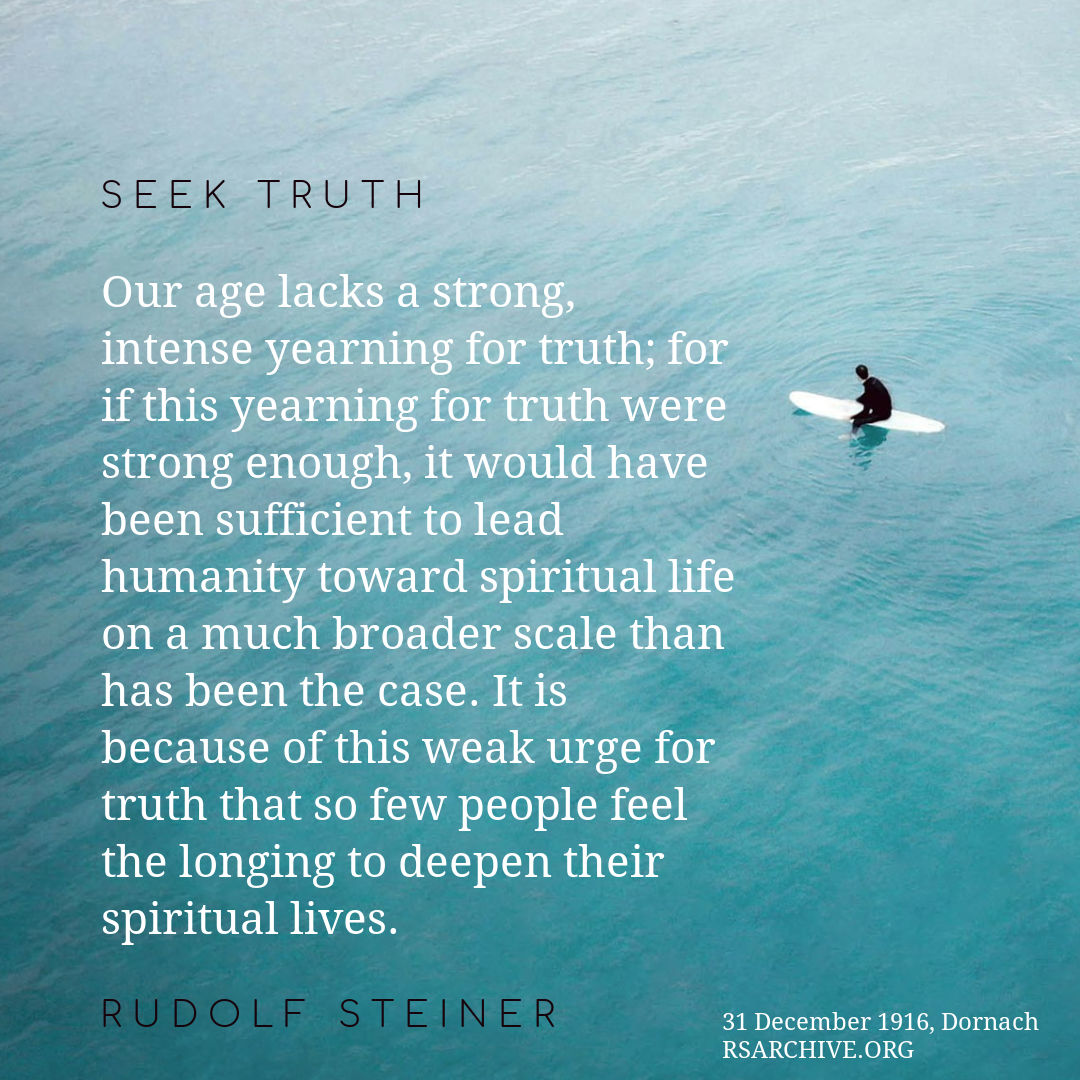
The ancient truths have largely faded away. Consequently, even meaningful references to the truths of ancient myths—such as those still found, for example, in the writings of the so-called “Unknown Philosopher” and in those of Saint-Martin—have remained entirely misunderstood by those who followed him. Saint-Martin, who described himself as a disciple of Jakob Böhme, barely managed to point out the significance—the true essence—of the myths. But that was in the 18th century; and the 19th century truly produced the most unbelievable of all interpretations of the myths. All of this, however, is connected to the fact that our age lacks a strong, intense yearning for truth; for if this yearning for truth were strong enough, it would have been sufficient to lead humanity toward spiritual life on a much broader scale than has been the case. It is because of this weak urge for truth that so few people feel the longing to deepen their spiritual lives.
But this is also evident in the external, concrete realm; it is precisely in these sad, painful events of the day that we see that the sense of truth often—through no fault of human beings—does not pulse through the world like spiritual blood. The sense of truth is what must be properly awakened. And for this reason, it has been necessary in recent weeks to point out certain sensory and concrete aspects, insofar as they are the expression of the spiritual impulses and spiritual events lying behind them. For it is closely connected to all the striving for truth—or rather, the striving away from truth—of the present day, the way things are handled today, and the way things can be said today that are believed by the widest circles, yet are nothing but a complete reversal of the truth. In an age in which it is possible for the truth to be shaped in any way one wishes, according to one’s antipathies, passions, and instincts—in this age, much is already required if that strong sense of truth is to be awakened, which then leads to spiritual life. This can indeed be seen in the details."
Read more: Rudolf Steiner, Reflections on Contemporary History II The Karma of Untruthfulness, Twelfth Lecture GA 173b, 31 December 1916, Dornach.