

Spelling
With the end of World War I, Rudolf Steiner wrote and lectured on a new conception of social organization, shedding light on socialist theories, Marxism, world-historical events and offering practical indications of requirements for a healthy social structure. In 1919, in addition to his ideas for social reform, he offered another remedy to the social problems of the time through education. Volume 294 of Rudolf Steiner's collected works contains Practical Course for Teachers.This lecture from August 26, 1919 is on writing and reading.
"We assume, then, that the child has already come to the point at which he can master straight-lined and round forms with his little hand. We began with the fish and the F. You do not need to proceed alphabetically; I am only doing it now so that you have it in encyclopaedic form. Let us see what success we have in beginning to evolve writing and reading on the lines of your own free imagination. I should first say to the child at this point: “You know what a bath is”—and here I will say in parenthesis that much depends in teaching on being able to make use of any situation in a rational way, that is, on always having between the lines of the lesson anything that may help your purpose. It is well to use the word “bath” for what I now intend to do, so that the child remembers, in connection with being at school, baths, washing, and cleanliness. It is well to have something like this in the background, without having to moralize or give orders. It is well to select your examples so that the child is compelled to think of something which contributes at the same time to a moral-aesthetic attitude. Then go on to say: “Look; when the grown-ups want to write down what a bath is, they write it like this: BATH. So this is the picture of what you mean when you say Bath and when you give a name to it.” Then, again, I simply let a number of children write this after me, so that whenever they come to something of this kind they get it into their little hand; they do not merely look at it, but they grasp it with their whole being. Now I shall say: “Watch yourself beginning to say ‘bath.’ We will just get the beginning clear: ‘B.’” The child must be guided from saying the whole word “bath” to breathing the first sound, as I illustrated with “fish.” And now it must be made clear to the child that just as Bath is the sign for the whole bath, “B” is the sign for the beginning of the word “bath.”
Then I draw the child's attention to the presence in other words of a similar beginning. I say: “When you say ‘band’ you begin just the same way; when you say ‘bow,’ which many women wear on their heads, a bow of ribbon, you begin just the same way; and perhaps, too, you have seen a bear at the zoo; for that, too, you begin to breathe the same way; each of these words begins with the same breathing out.” In this way I try to pass with the child from the whole of the word to the initial letter, to lead him to nothing but the single sound, to the letter, always to develop the initial letter from the word.

Now the problem for you is to try, let us say, first to evolve the initial letter yourself in the same visualizing way from drawing. You will be able to do this easily if you simply call your imagination to your aid and say to yourselves:
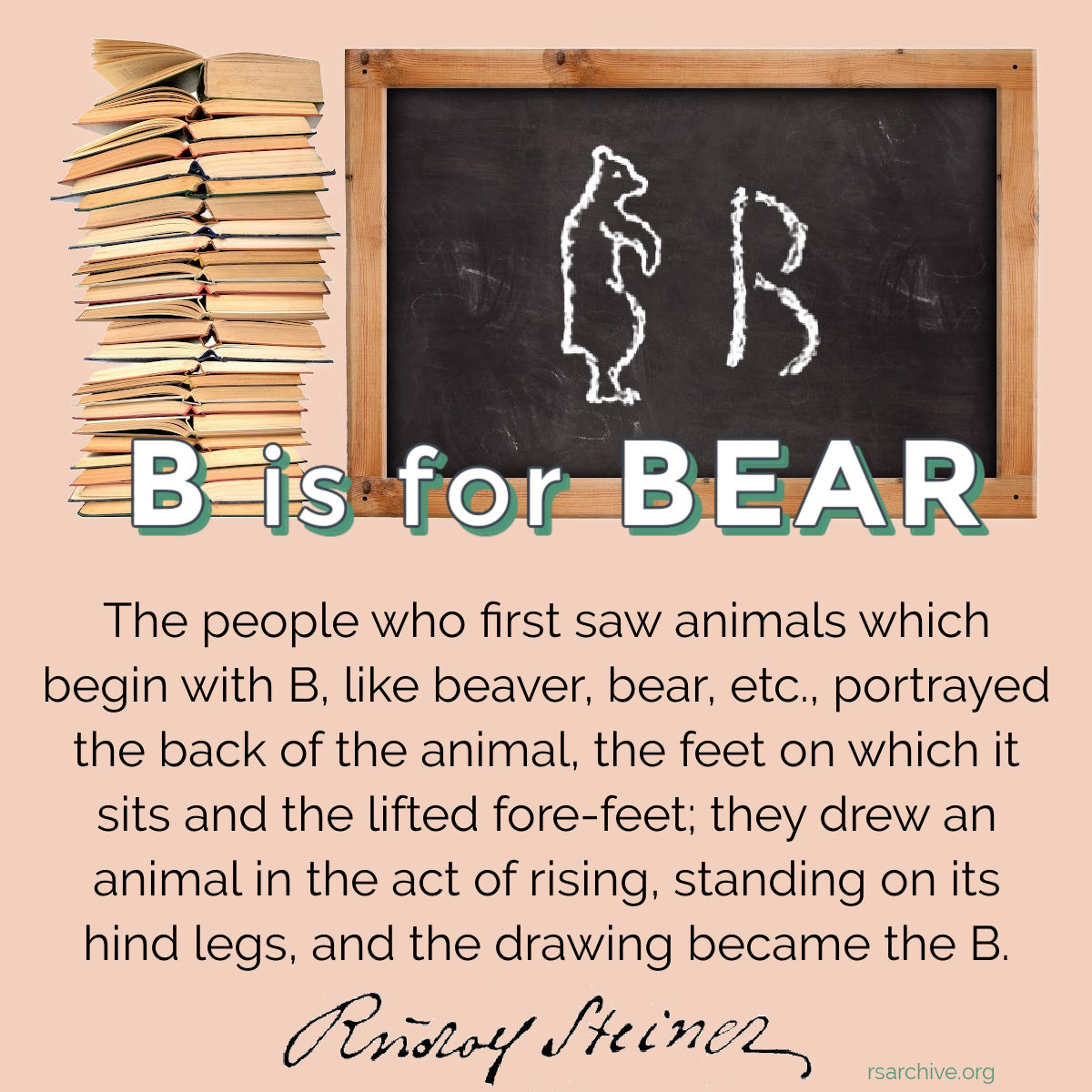
“The people who first saw animals which begin with B, like beaver, bear, etc., portrayed the back of the animal, the feet on which it sits and the lifted fore-feet; they drew an animal in the act of rising, standing on its hind legs, and the drawing became the B. You will find in every word—” and here you can give full rein to your imagination; there is no need to go into histories of civilizations, which are incomplete in any case—you will find that the initial letter is pictorial, representing the form of an animal or plant or even an external object. This is historically the fact: if you go back to the most ancient forms of the Egyptian writing, which was still hieroglyphic, you find that everywhere the letters are imitations of such things. And not until the transition from the Egyptian civilization to the Phoenician was the process completed which we can call a development from the “picture” to the “sign” to represent a sound. Let the child follow the same line. It leads to the following:
In the earliest periods of the evolution of writing in Egypt, literally every detail which had to be written down was written down in picture-writing, was drawn—indeed, was so drawn that it became necessary to learn the easiest possible way of making the drawings. Anyone who made a mistake, when he was appointed to copy these hieroglyphics, if, for instance, the error occurred in a sacred word, was condemned to death. In ancient Egypt, then, matters of writing were taken very, very seriously. But all writing which existed was picture-writing of the kind I have described. Then civilization passed over to the Phoenicians, who lived more in the world outside them. Here the initial image was always retained and transferred to the sound. As an example I will show you from a word where the process is most easily paralleled in our language (though we cannot here study Egyptian) and is also true of the Egyptian language. The Egyptians saw that the sound M could be best shown by watching chiefly the upper lip. So they took the sign for M from the picture of the upper lip. From this sign there then evolved the letter which we have for the beginning of the word Mouth and which then remained for every similar beginning, for everything beginning with M. The picture of the word was taken over. Thus transferring the picture of the word to the initial letter one came to the sign for the sound.

This principle, which is contained in the history of the evolution of writing, can also be very well applied to teaching, and now is the moment to apply it. That is: we shall try to arrive at the letter from the drawing: just as we get from the “fish” with his two fins to F, we get from the bear, dancing, standing up, to B. We get from the upper lip to the mouth, to the M, and we try with our imagination to trace for the child a path like this from drawing to writing. I said that you have no need to study the history of writing in civilized life and refer to it for what you need. For what you look up in this research is of far less value to you in teaching than are the discoveries of your own soul's making, of your own imagination. The activity which you apply to the study of the history of writing deadens you so that your influence on your pupil is far less living than when you think out for yourself something like the B from the picture of the bear. This thinking out for yourself refreshes you so that what you want to convey to your pupil is much more living than when you embark on excursions into the history of civilizations to discover something for your lesson. And from these two points of view both life and teaching must be considered. For you must ask yourself: “What is more important, to have learnt an historical, most elaborately ascertained fact and incorporated it painfully into your teaching—or to feel yourself so astir in your soul that you transmit to the child with your own enthusiasm the discovery you make?” You will always feel joy, even if it is a quite calm joy, in transferring to letters the form of some animal or some plant which you have found yourself. And this joy which you yourself feel will live in what you make of your pupil."
Read more: Rudolf Steiner, Practical Course for Teachers, Lecture V. Writing and Reading—Spelling, GA 294, 26 August 1919, Stuttgart.