

The Will
In 1901, now 40 years old, Rudolf Steiner had gained prominence in Europe as a respected intellectual. With this foundation, he was now able to publicly appear as a teacher of occultism and Theosophy. Now taking a leadership role in die Kommenden, he began to introduce more spiritual insights to the materialistic group of leading artists, scientists and thinkers. He published Mysticism at the Dawn of the Modern Age which constitutes the earliest public exposition of his spiritual scientific research. In October, he began a cycle of lectures, Ancient Mysteries and Christianity, that were later edited and published in 1902 as Christianity As Mystical Fact. This early, fundamental work shows Christianity as something unique and independent from the pre-Christian Mysteries out of which it arose. The twenty-four lectures were given by Rudolf Steiner at the invitation of Countess Sophie and Count Cay Lorenz von Brockdorff in the so-called "Theosophical Library" in Berlin in front of members of the Theosophical Society. Dr. Steiner was asked to join the Theosophical Society and undertake the leadership of the German section. He agreed on the condition that Marie von Sivers (then in Italy) work with him. As these doors opened, his teaching at the Berlin Worker's Education School came to an end because he refused to toe the line for the social democrats, unions, and Marxists sponsoring the school. The following is an excerpt from his book, Christianity As Mystical Fact.
"Of special interest, when interpreted in this way, is the legend of Prometheus. He and his brother Epimetheus are sons of the Titan Iapetus. The Titans are the offspring of the oldest generation of gods, Uranus (Heaven) and Gæa (Earth). Kronos, the youngest of the Titans, dethroned his father and seized control of the world. In return, he and the other Titans were overpowered by his son Zeus, who became the chief of the gods. In the struggle with the Titans, Prometheus was on the side of Zeus. By his advice, Zeus banished the Titans to the nether-world. But in Prometheus there still lived the Titan spirit: he was only half a friend to Zeus. When the latter wished to exterminate men on account of their arrogance, Prometheus espoused their cause, taught them the art of numbers writing, and other things that lead to culture, especially the use of fire. This aroused the wrath of Zeus against Prometheus. Hephaistos, the son of Zeus, was commissioned to create a female form of great beauty whom the gods adorned with every possible gift. She was called Pandora, the all-gifted one. Hermes, messenger of the gods, took her to Epimetheus, the brother of Prometheus. She brought him a casket as a present from the gods. Epimetheus accepted the present although Prometheus had warned him against receiving any gift from the gods. When the casket was opened all sorts of human ills flew out. Hope alone remained, and this because Pandora quickly closed the box. Hope has, therefore, been left to man as a doubtful gift of the gods. By order of Zeus, Prometheus, on account of his relation to man, was chained to a rock in the Caucasus. An eagle perpetually gnaws his liver, which is constantly renewed. He has to pass his life in agonizing loneliness till one of the gods voluntarily sacrifices himself, that is, gives himself up to death. The tormented Prometheus bears his sufferings steadfastly. He had been told that Zeus would be dethroned by the son of a mortal woman unless Zeus consented to wed her. It was important for Zeus to know this secret. He sent the messenger Hermes to Prometheus in order to learn something about it. Prometheus refused to divulge anything.—The legend of Heracles is connected with that of Prometheus. In the course of his wanderings Heracles comes to the Caucasus. He slays the eagle that was devouring the liver of Prometheus. The centaur Chiron who cannot die, although suffering from an incurable wound, sacrifices himself for Prometheus, who is thereupon reconciled with the gods.
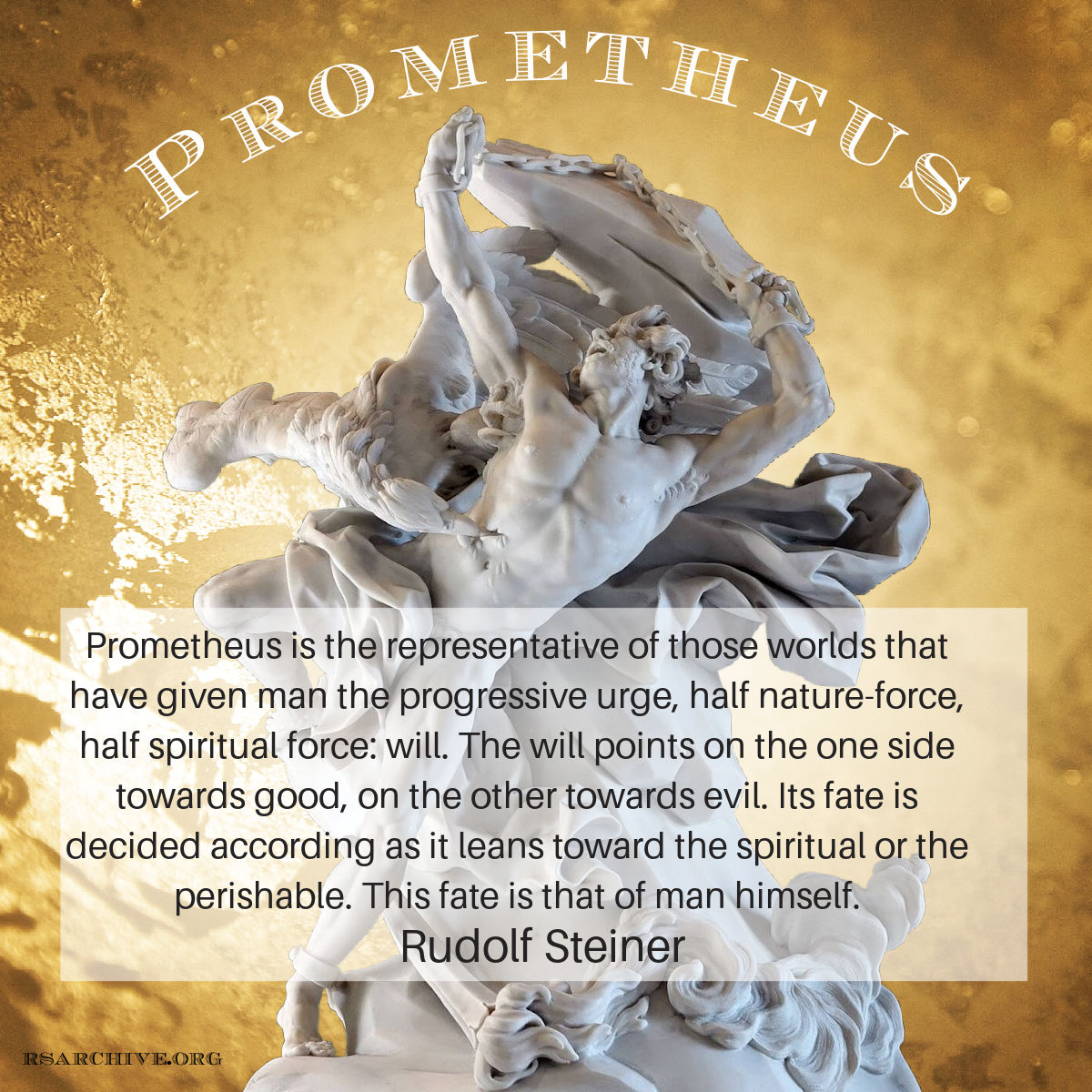
The Titans are the force of will, proceeding as nature (Kronos) from the original universal spirit (Uranus). Here we must think not merely of will-forces in an abstract form, but of actual will-beings. Prometheus is one of them, and this characterizes his nature. But he is not altogether a Titan. In a certain sense he is on the side of Zeus, the Spirit who enters upon the rulership of the world after the unbridled force of nature (Kronos) has been subdued. Prometheus is thus the representative of those worlds that have given man the progressive urge, half nature-force, half spiritual force: will. The will points on the one side towards good, on the other towards evil. Its fate is decided according as it leans toward the spiritual or the perishable. This fate is that of man himself. He is chained to the perishable, the eagle gnaws him, he has to suffer. He can reach the highest only by seeking his destiny in solitude. He has a secret, which is that the Divine (Zeus) must marry a mortal woman (human consciousness bound up with the physical body), in order to beget a son, human wisdom (the Logos) that will deliver the deity. By this means consciousness becomes immortal. He must not betray this secret until an initiate (Heracles) comes to him and eliminates the power that was perpetually threatening him with death. A being half animal, half human, a centaur, is obliged to sacrifice itself to redeem man. The centaur is man himself, half animal, half spiritual. He must die in order that the purely spiritual man may be delivered. That which is disdained by Prometheus (human will) is accepted by Epimetheus (mind, intelligence). But the gifts offered to Epimetheus are only troubles and sorrows, for the mind clings to the transitory and perishable. Only one thing is left—the hope that even out of the perishable the Eternal may some day be born."
Read more: Rudolf Steiner, Christianity as Mystical Fact, Lecture V, The Wisdom of the Mysteries and the Myth, GA 8, 1902.