

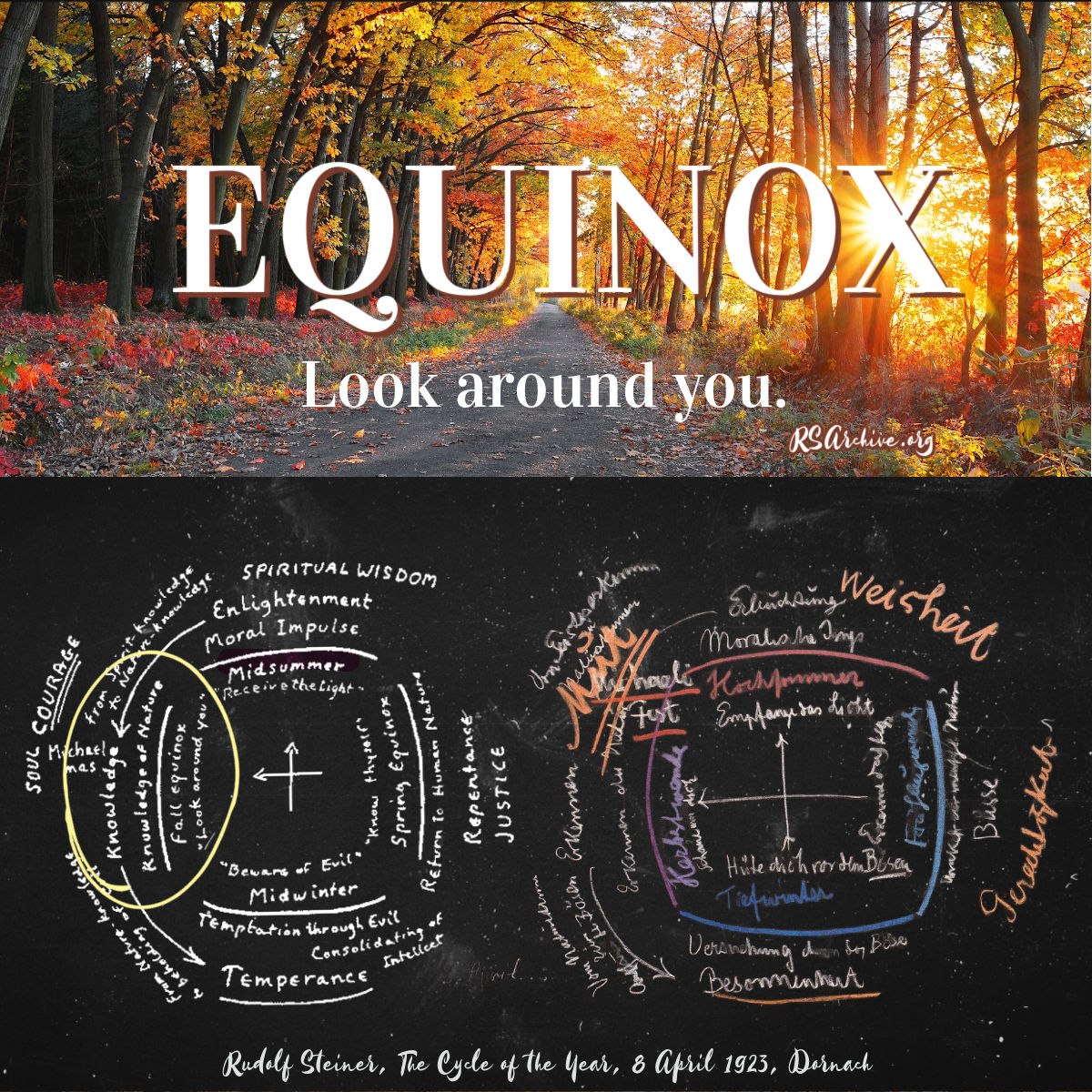
Beginning the Summer of the Soul
“When summer drew to a close and autumn set in, when the leaves withered and the crops ripened—in other words, when the full, exuberant life of summer faded and the trees became bare—one sensed this, because the insights of the mysteries flowed into these very sensations: The divine-spiritual world withdraws once more from the human being. He feels himself being turned back upon himself; he grows, as it were, out of the spiritual and into nature. — Thus, human beings experienced this immersion into autumn as a withdrawal from the spiritual, as an immersion into nature. The leaves of the trees mineralized; the seeds withered and mineralized. Everything, as it were, was drawing toward the annual death of nature.[...]
But even during the autumn equinox, human beings had already experienced and sensed something of the earthly realm. At that time, however, they experienced and sensed something of the nature of the earth that was, in a sense, still in harmony with them—something that still had a connection to them. We could also say, for example: During the autumnal equinox, human beings felt the natural in their inner life, in their emotional world. Now, however, they felt as if the Earth were laying claim to them, as if they were being ensnared by the forces of the Earth with regard to their volitional nature. He felt this as the opposite of the moral world order. At the same time as this darkness, which enveloped him like a cloud, he felt the counterforces to the moral world ensnaring him. He felt the darkness rising from the earth like a serpent and winding itself around him. But at the same time as this, he felt something else as well. Already during the fall he had sensed that something was stirring within him—what we today call the intellect. While in summer the intellect dissipates and the moral and wisdom-filled enters from without, during the fall the intellect consolidates. The human being draws closer to evil, but his intellect consolidates. People certainly felt something like a serpentine revelation in the depths of winter, but at the same time they sensed the consolidation, the growing strength of cleverness and thoughtfulness—that which made humans shrewd and cunning, and spurred them on to pursue the principles of utility in life. All of this was experienced in this way. And just as the insight into nature gradually arose in the fall, so too did the temptation of hell—the temptation from the side of evil—come upon people during the depths of winter. That is how it was perceived. So that when we write here (see diagram): ‘Moral impulse, recognition of nature—,’ we must now write here, in the depths of winter: ‘Temptation by the evil one.’"

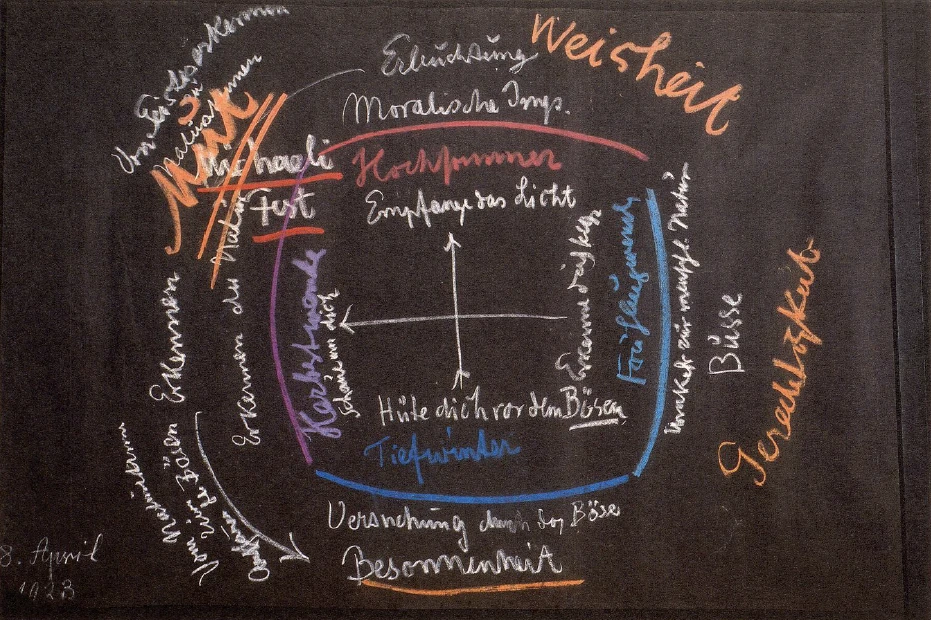
And that was precisely the time when human beings had to develop what was, in any case, naturally inherent within them: the rational, the clever, the cunning, and that which was directed toward the useful. Human beings were to subdue this through prudence. It was precisely the time when human beings had to develop—not the open receptivity to wisdom that was demanded of them in the spirit of the ancient mystery wisdom during the Age of Enlightenment. Precisely at the time when evil revealed itself in the manner described, human beings could feel resistance to evil in a corresponding way: they were to become prudent. Above all, at this turning point he was now undergoing—having passed from enlightenment to knowledge, specifically from spiritual knowledge to knowledge of nature—he was to move from knowledge of nature to the contemplation of evil. That is how it was understood. And to the students of the Mysteries, to whom one wished to impart teachings that might serve as guiding words—just as one told them in midsummer, ‘Receive the light,’ and in autumn, 'Look around you—one said to them in the depths of winter, ‘Beware of evil.’
And it was hoped that through this prudence, through this guarding against evil, people would arrive at a kind of self-knowledge that would then lead them to realize how they had strayed from their moral impulses over the course of the year.”
Rudolf Steiner, The Annual Cycle as the Earth's Breathing Process and the Four Major Festival Seasons, Lecture V, GA 223, 8 April 1923, Dornach.