

Recognizing the Supernatural in our Time
and its Significance for Modern Life
GA 55
28 February 1907, Berlin
Translated by Steiner Online Library
11. Who Are the Rosicrucians?
[ 1 ] Very few people today can associate the Rosicrucians—the subject of our discussion—with a concept that even remotely corresponds to the reality of the matter. It is, however, not so easy to associate any specific concept with the name “Rosicrucians.” For many people, there seems to be something vague behind this name. When one or the other looks it up in books on cultural history or other subjects—the kinds of books people usually turn to for information on such matters—they do find some things said about it, for example, that the Rosicrucians were a sect or something similar during the earlier centuries of German intellectual development. On the one hand, some emphasize that it is impossible to determine for certain whether, behind all the fraud and charlatanism that once spread under the name of Rosicrucianism, there may ever have been anything sensible and clear. And on the other hand, one also finds all sorts of accounts in scholarly books.
[ 2 ] It must indeed be said that if what is written in the relevant literature about the Rosicrucians were true, then one could pretty much agree that what lies behind this name should be regarded as empty hot air, pure fraud, and perhaps even something much worse. And even those who still try to defend Rosicrucianism—whether condescendingly or perhaps by claiming to possess special knowledge or to be in a position to provide insights—do not inspire much confidence among our contemporaries or in light of our current views. Not much comes of the defense of the Rosicrucians either, especially when it is said: Certainly, Rosicrucianism is associated with alchemy, with the preparation of the Philosopher’s Stone, and all manner of other alchemical feats. But to the genuine, true Rosicrucian, these feats signify nothing more than a symbol of the inner, moral purification of the soul and the cultivation of specific human virtues. And when it is said that Rosicrucianism speaks of the ability to transform base metals into gold, this means nothing other than that one can transform the base metals of various human vices into the gold of human virtues, and that this process of transformation is merely a symbolic representation of how one should develop morally from within.
[ 3 ] If that were the case, the whole story would be nothing more than a triviality—or something even more insignificant—for it is simply hard to understand why one would invent all sorts of alchemical concepts, such as the transmutation of metals and so on, to demonstrate something so obvious: that human beings should purify themselves and transform their vices. This objection can always be raised against those who view the great work of Rosicrucianism as something merely symbolic. But in fact, there is something much deeper behind it.
[ 4 ] I do not wish to dwell any longer on the historical aspects. Today, as I intend to present an objective discussion of Rosicrucianism, the historical background is of little concern to us. We need not concern ourselves with the historical background any further than to learn that Rosicrucianism is an organization that has indeed existed in the Western world since the fourteenth century, and that it traces its origins to a figure who is, as one might say, almost shrouded in legend, yet about whom history has little to report: Christian Rosenkreutz.
[ 5 ] What emerges as a certain underlying theme from the various accounts can be summarized as follows: Christian Rosenkreutz—which is not his true name, but rather the name by which he has become known—is said to have traveled at the end of the fifteenth and the beginning of the sixteenth centuries, and that during his travels through the Orient he encountered the so-called Book M. . . — that very book about which we are told, in a most mysterious way, that Paracelsus, the great medieval physician and mystic, drew his knowledge from it. This is indeed a true fact, but only the initiated know: first, what the Book M... is, and second, what the study of the Book M. . . entails.
[ 6 ] The outside world has repeatedly been made aware of Rosicrucianism through the two writings dating from the early seventeenth century. In 1614, the so-called “Fama Fraternitatis” was published, and a year later, the so-called “Confessio”—two books that have been the subject of much scholarly debate. And not only regarding the issue typically debated in connection with so many books—namely, whether Valentin Andreae, who in his later years was an ordinary superintendent, actually authored the book —but there has also been debate regarding these books as to whether their authors took them seriously, or whether they were intended merely as a mockery of the notion that there was a certain mysterious Rosicrucian brotherhood with such-and-such tendencies and goals. Then, in the wake of these writings, there is a whole series of others that convey all manner of information from the realm of Rosicrucianism. If you pick up the writings of Valentin Andreae and other Rosicrucian texts, you will find nothing of particular note in them unless you are familiar with the actual foundations of Rosicrucianism. For even up to the present day, it has not been possible to learn even the most basic elements of this spiritual movement, which has truly existed since the fourteenth century and still exists today. Everything that has found its way into literature—that which has been written and printed—consists of isolated fragments, individual lost items that were revealed to the public through betrayal, and which have been distorted in many ways by charlatanism, fraud, ignorance, and stupidity. True, authentic Rosicrucianism has, ever since its inception, been the subject of oral transmission only to those who were required to swear an oath of secrecy. For this reason, nothing of substance has found its way into public literature. Only when one is familiar with what can today—for certain reasons that would take too long to explain here—be publicly communicated in elementary Rosicrucianism, and which we can discuss today, can one find any meaning in the often grotesque, often merely comical, but often also fraudulent and rarely accurate accounts found in the literature. Rosicrucianism is one of the methods by which one can attain what is called initiation. What initiation means has already been discussed here on several occasions. Initiation means awakening the abilities that lie dormant in every human soul, through which one can glimpse the spiritual worlds that lie beyond our sensory world, and of which our sensory world is merely an outward expression, an effect. An initiate is one who has applied the precisely defined, scientifically developed methods of initiation—methods that are just as scientifically developed as those of chemistry, physics, or other scientific fields. What one undergoes in such methods, however, is not something to be applied to an external object, but rather something that initially pertains only to oneself—to the instrument, the tool through which one looks into the spiritual world. The true connoisseur of the spirit knows how profound and true Goethe’s saying is:
Mysterious in Broad Daylight
Nature cannot be stripped of its veil,
And what it chooses not to reveal to your mind,
You cannot force from it with levers and screws.
[ 7 ] Deep, deep are the mysteries of nature, but not unfathomably deep, as some would have us believe—those who, in a higher sense, are simply too complacent to delve into the mysteries of nature. They are not unfathomably deep, but can be fathomed by the human spirit—not by the spirit of everyday life, but by the human spirit that draws forth the hidden powers of the soul through certain, strictly defined methods. If a person prepares himself step by step, he will gradually come to receive the revelation of that which, as knowledge, belongs only to those who are truly initiated: that great mystery of what, to quote Goethe, “holds the world together at its very core.” The unveiling of this mystery is, in fact, the fruit of true initiation.
[ 8 ] It has often been discussed here that the first stages of initiation can be traversed quite safely by anyone, but that the higher stages demand the greatest possible human devotion to the most uncompromising pursuit of truth. When a person approaches those gates through which he can gain insight into entirely different worlds, he knows, however, that there is a grain of truth behind the oft-repeated saying that it is dangerous to reveal the sacred mysteries of existence to large crowds. To the extent that it is possible today—and to the extent that it is feasible to prepare people to gradually find their way to the highest mysteries of nature and the spiritual world—to that extent it is also possible to unveil the higher mysteries. What is called the spiritual science movement is a path that has been opened up to lead people so that they may find the way to the higher mysteries. There are a great many such paths to the higher mysteries. Not that the ultimate wisdom that human beings can attain could take on many forms; that is not the case. The highest wisdom is one and the same. Wherever and whenever people live or have lived, once they have attained the highest wisdom, this highest wisdom is one and the same for all people, just as the view from the summit of a mountain is one and the same when one is at the very top. But there are different paths to reach the summit of the mountain, and one will choose the path that is most suitable from the starting point where one stands. If one stands at a certain point on the mountain and can see a path from one’s own vantage point, one will not first go all the way around the mountain. The same is true of the path that leads upward to the highest knowledge. The point here is that the starting points one must choose must be taken from human nature itself. People today pay far too little attention to what is at stake here: the great diversity of human nature must be taken into account. The higher members of the ancient Indian people were organized differently than people are today—perhaps not in terms of gross anatomy and physiology, but certainly in terms of finer spiritual research—so that it was possible to preserve, to this day, a wondrous esoteric or spiritual science, along with the corresponding method of initiation: the so-called yoga training. This Eastern yoga training is the path that leads to the summit of knowledge for a nature organized as that of the ancient Indian people. For today’s European, the same path would be as nonsensical as if someone standing at a specific base of a mountain were first to walk around the mountain to seek and use a path. The nature of today’s European is entirely different from the Eastern nature. Human nature was also organized differently around the time of the emergence of Christianity—several centuries before and several centuries after.
[ 9 ] If we hold fast to what has just been said—that initiation means drawing out inner forces, awakening inner forces through specific methods, so that the human being becomes the instrument through which he can look into and explore the spiritual world—then we must admit that this aspect of human nature must be taken into account. Just as the ancient holy Rishis—those great teachers of the ancient Indian people—developed the wonderful method that is still valid today for members of the Indian people, and just as in the early days of Christianity the Christian-Gnostic method had to lead people up into the spiritual realms, so too must a different method be suitable for modern humanity—for the person living in our present-day environment, who belongs entirely to this modern world and derives the conditions of his existence from it. That is why the great Masters of Wisdom, who guide the destinies of humanity, have, over the course of centuries and millennia, repeatedly renewed the methods through which the summit of wisdom can be attained. For humanity today—for people who have grown out of the modern conditions of existence—the Rosicrucian methods have been established precisely by the Rosicrucian movement. They are thus methods of initiation that lead just as surely to the summit of wisdom as other methods, except that they address the specific, currently prevailing conditions of modern humanity.
[ 10 ] It is not as though the Rosicrucian methods are unchristian or antichristian. That is out of the question. Whatever Christianity can offer humanity in terms of training is also offered by the Rosicrucian method. But at the same time, those who undergo Rosicrucian training acquire the ability to see the achievements of esoteric and spiritual science in full harmony with all of modern education, with everything that modern sensibilities and modern views of the nature of the spirit necessitate. For many centuries to come, the Rosicrucian methods will be the true methods of initiation into spiritual life. When they were first established, certain rules applied to their followers. These rules essentially still apply today. Because these rules are strictly observed by all who are truly Rosicrucians, it is impossible for outsiders to recognize a Rosicrucian. “Never let one recognize the other”—that is the first rule, which has undergone only a slight change in recent times. You are to cultivate wisdom within the innermost circle, but you are to make the results—the fruits of wisdom—accessible to all people. That is why, until recently, the Rosicrucian never revealed to the public that which enables him to peer into the depths of nature. No theory, no concept, no idea—nothing of any kind of notion or insight—was ever presented there; rather, work was carried out that advanced civilization and through which wisdom was instilled in the people in such a way that outsiders could not perceive much of it.
[ 11 ] This is the first principle, which would take too long to elaborate on here; regarding its essence, I would only like to note that it is sometimes violated today, but that the higher Rosicrucian wisdom must not be revealed. The second principle concerns the manner of conduct and states: Blend in with the masses and the cultural currents into which you have been placed. Be a member of the people and the social class corresponding to the level of education and culture into which you have been placed. Do not wear distinctive clothing, as is commonly put; wear the ordinary clothing that others wear. — Therefore, you will find that the Rosicrucian, wherever he is active, seeks to act as little as possible out of ambition or self-interest. He will try to connect with cultural currents here and there, strive to deepen them, and make use of what already exists, but he will always keep in mind something that is much deeper—something that connects him to the central wisdom of Rosicrucianism itself. We need not concern ourselves with the other principles at this time, for we now wish to address Rosicrucian training as it has existed for centuries and continues to exist. The things that can be communicated are, in a certain sense, elementary; they are only the beginning of the entire system of Rosicrucian training. It must be said, however, that the same applies to this training as can be said of any training in spiritual science: that people should not seek knowledge through books alone, but should only engage with the subject in a practical way when they have the personal guidance of a knowledgeable teacher. Everything that can be said in this regard can be found in the journal Luzifer-Gnosis, starting with issue No. 13, under the title: “How Does One Attain Knowledge of the Higher Worlds?”
[ 12 ] The Rosicrucian training program requires students to complete the following seven stages in order to enter the spiritual world. These stages do not necessarily have to be completed by the student in the order in which I will list them. Depending on the student’s individuality, the teacher will highlight from one point or another what is specifically necessary for that student, and will thus have to provide a kind of course, a kind of inner path of development, tailored personally to the student in question. Here, however, it is necessary to list the stages of Rosicrucian training. There are seven:
[ 13 ] 1. What is called “Studium” in the Rosicrucian sense.
[ 14 ] 2. What is referred to as the appropriation of so-called imaginative knowledge.
[ 15 ] 3. What is known as the study of occult writings.
[ 16 ] 4. What is referred to either by the unpretentious term “rhythmization of life,” or—in the truest sense—as “the preparation of the philosopher’s stone.” This is something that exists, though it is certainly not that foolish thing you might read about in books.
[ 17 ] 5. What is called the knowledge of the microcosm, that is, one’s own human nature.
[ 18 ] 6. What is known as: merging with the macrocosm or the great world outside.
[ 19 ] 7. What is known as: the attainment of godliness.
[ 20 ] The order in which the student goes through these stages depends entirely on his or her individuality. However, he or she must go through them as part of the elementary Rosicrucian training. Consider what I have told you regarding Rosicrucian training—and what I am about to describe—as a kind of ideal. Do not think that this can be accomplished overnight, but one must become acquainted with what is still distant from one today—at least in terms of its deeper meaning, if not in every detail. A person can begin at any time, provided they are aware that they must have patience, energy, and perseverance.
[ 21 ] The first point—study—includes a word that sounds pedantic to many. However, it does not refer to scholarly learning. To be an initiate, one need not be learned. Scholarly knowledge has little to do with spiritual insight. The “study” referred to here means something else entirely. This study, however, is indispensable, and no one may be initiated into higher degrees by a truly knowledgeable teacher of Rosicrucianism unless they have a genuine inclination to truly complete the stage of study. Through this study, the student is to acquire a completely rational, thoroughly logical way of thinking—a way of thinking that will prevent him from losing his footing as he passes through the subsequent stages, as might easily happen. It must be firmly emphasized that anyone who is to enter the spiritual world must first become acquainted with it, since it can lead one down many wrong paths—a danger from which one can escape only if one has, above all, cast off everything fantastical, everything illogical, and everything that could in any way be unreasonable. A fantasist who conjures up all sorts of unreal ideas is of no use to the spiritual world.
[ 22 ] That is one reason. The other reason is that when one enters the higher worlds, one experiences a vast variety of perceptions that are entirely different from what surrounds us here in the sensory world. Those who are able to look into—when the inner senses of the soul are opened to them—the spiritual worlds closest to us, which we are accustomed to calling the astral and spiritual worlds, the worlds from which human beings are born just as they are born from the physical world, come to know things that are fundamentally different from the perceptions in our sensory world. Anyone who enters the astral or spiritual world knows how fundamentally different these worlds are from what they are accustomed to seeing with their eyes and hearing with their ears here. But one thing is the same throughout all three worlds—the physical, astral, spiritual, or devachanic worlds—and that is logical thinking. Because logical thinking is the same in all three worlds, it can already be learned here in this physical world, so that through it we will have a firm foundation in the other worlds. But if one learns to think in such a way that one’s thoughts wander aimlessly—so that one cannot distinguish between figments of the imagination and reality—so that, for example, as our physicists do today, treat atoms—which no one has ever seen in our physical world—as something real, and if one indulges in such fantasies even in the physical world, then one is incapable of raising oneself up into the higher worlds. Just imagine what a person who is not accustomed to strict and relentless logic might say about the higher worlds.
[ 23 ] However, this is not what is commonly referred to as “thinking.” Ordinary thinking is merely a combination of sensory realities. Here, however, we are dealing with a form of thinking that has become free of the senses. Scholars and philosophers today deny the very existence of such thinking. You can read in the works of many philosophers who are well-known today that human beings cannot think in mere thoughts, but must always think only in thoughts that contain a remnant of sensory images. When a philosopher says this, it proves nothing more than that he cannot think in pure thoughts, and it is an indescribable lack of modesty to present what one cannot do oneself as a general inability. Human beings must be capable of forming thoughts that are no longer dependent on perceptions from the eyes and ears, so that they can live in a world of pure thought—the world they find within themselves when they turn their attention away from external, sensory realities. In spiritual science and also in Rosicrucianism, this kind of thinking is called self-generating thought. Anyone who wishes to undertake such a course of study may consult the textbooks of modern spiritual science. What you will find there are not merely sensory combinations, but thoughts that originate from higher worlds—thoughts that constitute a coherent system of thought that anyone can understand, so that they need not remain stuck in the ordinary, trivial mode of thinking.
[ 24 ] To make the first stage of Rosicrucian training possible, it is necessary that what has been safeguarded within the innermost circle for centuries be made accessible to humanity through literature and lectures. What is made accessible, however, is nothing other than the basics—the beginning of the vast and immeasurable knowledge of the world. Over time, more and more of this will flow into humanity. For several decades now, the elementary part of this knowledge has been revealed to humanity. You can use this to train your thinking. For those who wish to delve deeper into this—that is, who wish to embark on such rigorous training of the mind—my two books, Truth and Science and The Philosophy of Freedom, are intended. These books are not written like other books, in such a way that a sentence from one passage could simply be moved to another part of the book in question. These books are not aggregates of thoughts, but organisms of thought. A thought grows like an organism; it grows organically out of the one before it. These books are therefore not written in such a way that one thought is simply added to another, but rather so that the later thoughts have grown out of the preceding ones, just as in an organism. In the same way, the thoughts must grow out of the reader; he must feel himself being drawn toward this way of thinking; and then he makes his own that peculiar kind of thinking—self-generating thinking—without which one cannot attain the higher stages of Rosicrucian training, although this more thorough approach is not absolutely necessary, and one can very well remain with the elementary literature of spiritual science, since this, too, provides sufficient material for study.
[ 25 ] The second is the mastery of imaginative thinking. What I call imaginative thinking should only be mastered once one has internalized a rigorous inner necessity of thought in this way, so that one possesses a solid core of knowledge. Otherwise, one can easily lose one’s footing. What, then, is imaginative thinking? Goethe, who in his Rosicrucian poem “The Mysteries” demonstrated how deeply he was initiated into the Rosicrucian mysteries, offers a clue in a beautiful line from the Chorus Mysticus in the second part of Faust, for which he wrote the preface: “All that is transitory is but a parable.” This was systematically developed wherever inner Rosicrucian training existed. The Rosicrucian had to become capable of traversing the entire world and, alongside logical knowledge, acquiring an imaginative understanding of it—that understanding which sees a spiritual, imperishable aspect in everything around us. When you encounter a person and see a cheerful smile on their face, you will not stop at merely describing those distinctive facial features—the physiognomy—that present themselves to your eye. Rather, your soul will be fully aware that in that distinctive expression of cheerfulness, the inner life of the soul reveals itself—just as you would not stop merely to examine tears streaming down a face. You will be fully aware that the tears are the expression of inner pain, of inner suffering. The outer is an expression of the inner. In physiognomy, you see right down to the depths of the soul. The Rosicrucian student must learn this in relation to the rest of nature as well. Just as the human face and the movement of the hands are means of expression for human soul life, so everything that takes place in nature is an expression of a soul-spiritual life. Just as a gesture is an expression of our soul, so for the Rosicrucian everything—not merely as a poetic image, but as a profound reality—the entire earth around us becomes an expression of soul-spiritual life: the stones, plants, and animals; the stars; every breath of air. Everything around us thus becomes an expression of the soul-spiritual, not merely in a poetic sense, but in reality, just as the shining eye, the furrowed brow, and the glistening tear are physiognomic expressions of inner states of the soul. Only then will you know what imaginative insight means—when what Goethe says about the Earth Spirit in his Faust is no longer a poetic image for you but reality; when you do not stop at the materialistic mindset of our people today, but are able to recognize reality in the words of the Earth Spirit, whereas today people are content merely to enjoy a poetic image in them:
In the torrents of life, in the storm of deeds
I surge back and forth,
Weaving to and fro!
Birth and grave,
An eternal sea,
A shifting weave,
A blazing life,
Thus I create at the whirring loom of time
And weave a living garment for the Deity.
[ 26 ] If these words of the Earth Spirit have become a reality for you, and if you can calmly accept being regarded as a fool by materialists—since you know that you possess a deeper logic, since you know that they are the ones who are more fanciful and merely believe they know, whereas you know that you are facing a free reality of the spirit, and just as true and real as a human soul lives in human physiognomies, so too does an Earth Spirit live in the Earth’s physiognomy. When you perceive the serenity of the Earth Spirit in a plant, when the Earth becomes to you the expression of the sorrow-filled Earth Spirit, when nature appears to you as if it were speaking to you, as if it were truly revealing its secret to you—when you experience this, then you begin to decipher its secrets and understand what it means to acquire imaginative knowledge. Then you will come to understand how this was presented in Rosicrucianism—and also by the forerunners of Rosicrucianism—in the great occult ideal of the Holy Grail as the purest and most beautiful expression of the striving for imaginative knowledge.
[ 27 ] Let us take a look at the true nature of this ideal of the Holy Grail. It is presented to you in every Rosicrucian school in the way I am about to describe. I will use the form of a dialogue for this purpose, though such a dialogue has never actually taken place in real Rosicrucian schools. What I am about to summarize in this dialogue was achieved there through long processes of development in life. It conveys what the ideal of the Holy Grail truly encompasses.
[ 28 ] Look at the plant as it grows out of the earth; its root is sunk into the soil, pointing toward the center of the earth; the stem reaches upward; the flower opens upward, containing within it the reproductive organs that will produce the seed, through which the plant lives on beyond itself. It was not only Darwin, the great naturalist, who spoke of the fact that, when comparing the plant to the human being, it is not the flower but the root that must be compared to the head. The root of the plant corresponds to the head of the human being—as Rosicrucian occultism has long taught—and that which in the plant chastely reaches toward the sun as the calyx is precisely what the human being turns downward as reproductive organs. Human beings are inverted plants. They modestly turn the organs that the plant chastely directs upward toward the light downward and cover them. Human beings are inverted plants: this is a fundamental principle of Rosicrucian occultism and of occultism throughout the ages. The plant chastely directs its reproductive organs toward the sun. Man has directed his reproductive organs toward the center of the Earth, with his head freely reaching out into the solar space. Between the two, right in the middle, stands the animal. The three directions resulting from the plant, the animal, and man are referred to as the cross. The plant is the vertical beam pointing downward, the animal is the horizontal beam, and man is the vertical beam pointing upward. When Plato, the great initiated philosopher of antiquity, says that the World Soul is crucified on the cross of the World Body, this means nothing other than that human beings represent the highest manifestation of the World Soul, and that the World Soul has passed through the three kingdoms: the plant kingdom, the animal kingdom, and the human kingdom. The World Soul is crucified on the cross of the plant kingdom, the animal kingdom, and the human kingdom—the three kingdoms of nature. — A wonderfully profound image from Plato, expressed entirely from the perspective of spiritual science.
[ 29 ] This image was repeated countless times in the Rosicrucian schools: Look at the plant with its head pointing downward, its reproductive organs pointing upward, reaching toward the sun’s rays. — This ray of sunlight was called the sacred lance of love, which must penetrate the plant so that the seed can grow and ripen. Now the student was told: Lift your gaze up to the human being, look at the plant and then at the human being, and compare the human being’s matter and substance with those of the plant. Man is the inverted plant; he has become so because he has permeated his substance, his flesh, with physical desire, passion, and sensuality. The plant may stretch its reproductive organs toward the fertilizing lance—the noble lance of love—chastely and purely. Humanity will reach a similar state at the time when it has completely purified its desire, so that it looks toward a future that will bring it the fulfillment of the ideal: “You are as chaste and pure as the calyx of the plant.” Then you will have reached the pinnacle of earthly development; then impure desire will no longer course through your lower organs; then you will extend the spiritual lance of love—your creative power, which will then be entirely spiritual—toward the calyx, just as the plant’s calyx opens to the sacred lance of love in the sunbeam. Thus does humanity pass through the realms of nature and purify itself upward to the development of those organs that are today only in the process of formation. When a person brings forth something that is holy and noble, they are at the beginning of a future, productive power that they will possess once their lower nature has undergone its complete purification. Then they will have a new organ. The calyx of the plant will arise anew on a higher plane and will be held out to meet Amfortas’s lance, just as the calyx meets the spiritual lance of the Sun’s love.
[ 30 ] So imagine, at a lower level, that which—given as a lofty ideal—will be the future of the human race when all that is base has been purified and all that is chaste and pure is held up before the spiritualized sun of the future, when this plant calyx has passed through human nature—which, in a certain sense, will be higher, in some respects lower than the plant, when it will have been purified upward to the highest spirituality and held up to the spiritualized sun as the holy chalice, the exalted plant chalice that has passed through humanity.
[ 31 ] This was spiritually grasped by the Rosicrucian disciple; it is the mystery of the Holy Grail, the highest ideal that can be set before humanity. Thus, the whole of nature appears to be permeated and infused with a spiritual meaning. When one perceives everything in this way, seeing everything as a parable of the spiritual, then one is on the path to acquiring imaginative knowledge. Then colors emerge from things and take on a life of their own; tones emerge from them and take on a life of their own; space fills with an independent world of colors and tones, and within this world spiritual beings make their presence known. We ascend from imaginative knowledge to the true knowledge of the spiritual realm. This is the path the Rosicrucian takes on the second stage of his training.
[ 32 ] The third is knowledge of occult script. Occult script is not ordinary script, but rather one that is connected to the mysteries of nature. I would like to make it clear to you right away what you should understand by the term “occult script.” A common symbol of this writing is the so-called “swirl.” You can picture it as two sixes intertwined. This symbol is used to denote certain phenomena that exist throughout the natural and spiritual worlds and to characterize their inner nature. If you take a plant and observe it, you will find that it develops all the way to the seed. If you plant this seed in the earth, a similar plant develops that is identical to the old one. The idea that something material passes from the old plant into the new one is a materialistic prejudice that is in no way justified and will be refuted by future knowledge. Only the formative power passes into the new plant. The old plant perishes completely in a material sense, and the new plant is, materially speaking, something entirely new. Not even the slightest material substance passes from the old plant into the new one. This new approach to the origin and passing away of a plant is represented by drawing two spirals intertwined with one another—that is, a vortex—without connecting the two lines.
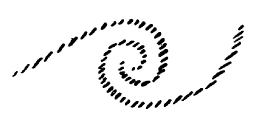
[ 33 ] Such vortices are found in both the external and the spiritual realms. For example, spiritual research tells us that such a vortex once existed in the development of humanity, when the ancient Atlantean culture gave way to the new post-Atlantean culture. Spiritual science reveals to you here something that modern natural science is only beginning to grasp at the most elementary level. It shows you that what is now the ocean between Europe and America was once filled with a continent, that an ancient culture had developed there, and that this continent was flooded and disappeared as a result of the “Great Flood.” This shows us that what Plato tells us about the downfall of the island of Poseidonis is based on truth, and that it was a remnant of the ancient Atlantic continent. That culture disappeared in terms of its spiritual nature, and a new culture emerged, so that this process can be symbolized by the two spirals intertwining within one another—the vortex. The old is represented by the inward-coiling spiral, the new by the outward-coiling one.
[ 34 ] As the transition from the Atlantic culture to the post-Atlantic culture was taking place, the sun appeared in the constellation of Cancer in the spring. You know that the sun moves forward over the course of the year. In those ancient times, as I said, it rose at the beginning of spring in the constellation of Cancer, then for a time in the constellation of Gemini, then in the constellation of Taurus, and then in that of Aries. People have always regarded as particularly auspicious whatever sends them the first rays of sunlight from the heavens. That is why, as you can see, when the sun began to rise in the constellation of Aries, people began to worship Aries. This is the origin of all the legends about the lamb, the legend of the Golden Fleece, and so on. In the past, before the sun rose in the constellation of Aries, it rose in the constellation of Taurus. That is why the cultures that preceded the Aries cultures revered the bull as a sacred animal. You will therefore find, for example, the worship of the Egyptian bull Apis during that time. During the transition from the Atlantean to the post-Atlantean era, the constellation of Cancer held dominion. And that is why you have the two intertwined spirals as the symbol of Cancer in the calendar.
[ 35 ] There are hundreds, thousands of these symbols that one learns little by little. These are not arbitrary symbols. Once you know them, they show you the ways to delve into things and live within them. Just as study seizes the intellect and imaginative insight seizes the mind, so does the understanding of occult writing seize the will. It shows us the ways of creation and production. Therefore, just as study brings us knowledge and imagination brings us insight, so does the knowledge of occult script bring us magic—the knowledge of the natural laws slumbering within things, the knowledge that leads us deeper into the essence of things. You can find many occult symbols in the works of many authors—Eliphas Levi, for example. But those who know nothing of these things will learn little from them. You may, however, find a hint as to what they look like. The works you find in print on this subject usually contain inaccuracies. These occult symbols were held sacred by all peoples—at least by the initiates. And if we go further back in history, we find strict regulations regarding their secrecy, so that those permitted to use such symbols might never use them unworthily. The strictest penalties are imposed for violating these regulations.
[ 36 ] The fourth is what is called the preparation of the Philosopher’s Stone. What you find about it in the literature is quite inaccurate—indeed, for the most part, utter nonsense. If the Philosopher’s Stone were what is described there, everyone would be justified in mocking it. You will recognize a part of it if you follow my discussion: it will give you great insight. At the end of the eighteenth century, a reputable Central German journal published a note about the Philosopher’s Stone. Anyone who reads this note and understands the subject will realize that the writer had heard something about it somewhere at some point. His words are entirely correct, but one can also see that he himself does not fully understand what he is saying. The author of the note writes: “The Philosopher’s Stone is something that all people know, something that most people hold in their hands time and again, something found in many places on earth, and yet people do not realize that it is the Philosopher’s Stone.” — That is a strange description of what the Philosopher’s Stone is supposed to be, and yet it is literally true. One simply has to understand the matter correctly.
[ 37 ] Consider for a moment the human respiratory process, for what is known as the discovery or preparation of the Philosopher’s Stone is connected to the regulation of breathing. Today, humans inhale oxygen and exhale carbon dioxide—that is, the compound of oxygen and carbon is exhaled. Humans inhale oxygen—the breath of life—and exhale carbon dioxide, a true poison. Neither humans nor animals can live on this carbon dioxide. If animals, which breathe just as humans do, were the only living beings on Earth and had always breathed as they do today, they would have polluted the air around them, and neither animals nor humans would be able to breathe today. So how is it that they can still breathe? It is because plants absorb carbon dioxide, retain the carbon, and release the oxygen back into the atmosphere, so that humans and animals can use that oxygen again for breathing. It is, therefore, a beautiful cycle between the respiration of the animal and human worlds and the respiration—or assimilation process—of the plant world—assimilation process, so that no pedantic scholar can object to it. Someone who earns five marks every day and spends two marks every day creates a surplus; their situation is different from that of someone who spends five marks and earns only two. The same can be said of respiration. The essential point here, however, is that this exchange process exists between humans and the plant world.
[ 38 ] This exchange process is highly peculiar. Let’s therefore take a closer look at it. Oxygen enters the human body, and carbon dioxide leaves it. Carbon dioxide consists of oxygen and carbon. The plant retains the carbon and returns the oxygen to the human being. In the coal that you excavate from the earth millions of years after the plant in question was formed, you can once again see the carbon that the plant absorbed. The ordinary respiratory process, which proceeds as just described, shows how essential plants are to human life today, and how what takes place within a person during respiration is, in fact, only a half-process. Humans need plants—as something that is not within them—so that they can convert carbon into oxygen for them.
[ 39 ] Now, there is a rhythmic structuring of the breathing process in the Rosicrucian sense, the details of which, however, can only be communicated from person to person. While it is possible to allude to this here, it must be done without going into specifics. But the Rosicrucian student received—and continues to receive—specific instructions: he must breathe in a certain way, at a certain rhythm, and with very specific thought forms. Through this, his breathing process is transformed. You can only imagine this transformation if you consider the saying: “Constant dripping wears away the stone.” Even for the most advanced individuals, the entire inner life process is not transformed overnight when breathing is practiced in the Rosicrucian manner. But what is transformed within the human body through such breathing moves in a specific direction—namely, toward the person’s future ability to convert carbon dioxide back into usable oxygen within themselves, so that what takes place today outside in the plant— the conversion of carbon dioxide into carbon—that which the plant currently takes from the human being—will, as the breathing process continues to take effect more and more deeply within the initiate, be carried out by the human being in a specific organ of which physiology and anatomy are as yet unaware, but which is nonetheless in the process of development. Human beings will thus bring about this transformation themselves. Instead of exhaling carbon [with carbon dioxide] and releasing it to the plant, they will utilize it within themselves and build up their own bodies with the help of the carbon that they previously had to release to the plant (see notes).
[ 40 ] Keep in mind what I have just said, together with what I have shared about the ideal of the Holy Grail: namely, that the pure, chaste nature of the plant will have passed through human nature, and that this human nature, in its highest spiritual form, will have returned to the plant of today. Human beings will one day be able to undergo the plant process within themselves. They will increasingly transform the physical substances they currently possess into that ideal, so that the body will become a plant body and the bearer of a much higher and more spiritual consciousness. Thus the student learns alchemy, through which he is enabled to transform the human fluids and substances into carbon. What the plant does today by building its body out of carbon, the human being will one day do himself. He will form a bodily structure out of carbon that will be the structure of the future human body.
[ 41 ] A great mystery lies behind what is called the “rhythmization” of the breathing process. Now you can probably understand that allusion to the Philosopher’s Stone contained in the note quoted earlier. So what does the human being learn regarding the structure of his future physical form? He learns to produce ordinary carbon—which is also the substance of the diamond—in order to build his body with it. With an elevated and expanded consciousness, the human being will be able to draw this carbon from within himself and utilize it within himself. They will be able to form their own substance—the plant substance built upon the carbon structure. This is the alchemy that leads to the formation of the Philosopher’s Stone. The human body itself is that retort which is transformed in the sense just indicated here.
[ 42 ] Thus, behind the regulation of the respiratory process—behind what is often alluded to in connection with the Philosopher’s Stone, though usually in a completely nonsensical way—lies what is called the discovery or preparation of the Philosopher’s Stone. These are the hints that have only recently found their way into the public domain from the Rosicrucian schools. You will search for them in vain in books. This is a small part of the fourth stage: the search for the Philosopher’s Stone.
[ 43 ] The fifth consists of what is called the knowledge of the microcosm, the small world. This brings us back to what Paracelsus said and to which I have often referred: All things around us, if we could extract an essence from them, would, as an extract, constitute the human being. Human beings possess within themselves those substances and forces that appear as a brief recapitulation of the rest of nature, so that when we look at nature around us, we can say that what exists out there in nature is, on a grand scale, the archetype of what appears within all of us as a reflection. Take light, for example. What effect has this light had on human beings? If there were no human eye, it could not perceive the light. The world would be dark and gloomy to us. But just as animals lose their sight when they migrate into dark caves—such as the caves of Kentucky—so, on the other hand, the eye is created by the light itself. We would have no eye if there were no light. It was light that first drew our organs of sight forth from the skin, from the organism. The eye, as Goethe said, is created by light and for light; the ear, by sound and for sound. All things are born from the great world, the macrocosm. Herein lies the secret that, under certain guidance and instructions, through deep immersion into the body, one can fathom not only the physical but also the spiritual world and learn to recognize the nature that surrounds us. Whoever, under certain conditions, learns to immerse themselves meditatively—using certain thought forms—deep into the innermost part of the eye, learns to recognize the inner, essential nature of light. Between the eyebrows, at the root of the nose, there is a point that is also of great significance in this regard. When one concentrates on it, one comes to know significant, important processes in the spiritual world that took place as this part of the head emerged from the surrounding world. In this way, one comes to know the spiritual composition of the human being. Human beings are formed entirely from spiritual beings and forces. Therefore, when one contemplates one’s own form, one comes to recognize the beings and spiritual forces that have built up one’s organism and one’s form.
[ 44 ] One further remark must be made here. This immersion into the inner self, just like the other exercises that work their way down into the physical body—through which the “I” works its way into the physical body—Atman comes from “breathing”—should not be undertaken without preparation. When one begins to work with these exercises, one must in fact have already done the necessary mental groundwork. That is why the Rosicrucian training places such strict emphasis on training the mind. In this training as well, the student must possess a strong inner core of character. If he lacks this, he may stumble. He can immerse himself meditatively in every limb, and worlds will open up within him. No one can come to know the true nature of the Old Testament without such immersion into the very depths of the human soul—though this must be done according to specific guidelines that can be provided through training in spiritual science. All these things are written from the perspective of spiritual science, based on insights into the spiritual world. Therefore, one can only understand them if one is able to seek them out within oneself. Human beings are born from the macrocosm, and as microcosms, they must rediscover within themselves the forces and laws at work there. One cannot come to know the human being within oneself as an anatomist would. One can do so only by learning to look into one’s own inner being, which then begins to shine and resound in specific areas. Each organ has its own specific color and tone when the whole is laid bare before the soul that looks inward. Once a person has come to know within themselves, through Rosicrucian training, what has been created from the macrocosm, they can then come to know within themselves the things that exist in the macrocosm. Once a person has recognized their inner self through contemplation of their eye or the point above the bridge of the nose, they can then go out and spiritually recognize the great laws in the great cosmos. And they then learn, through their own spiritual insight, to recognize what an inspired genius described in the Old Testament; they see it in the Akashic Records and can trace the development of humanity over millions of years.
[ 45 ] One can truly come to understand all of this through such training. But this is a different kind of training than the ordinary kind. One must not believe that self-knowledge is attained by aimlessly brooding over oneself, or that, when one looks within, the God within begins to speak, as is often taught today. No, one must delve deeply into one’s own organs in order to then be able to recognize the great Self of the world. It is true that the saying “Know thyself” has been passed down through the ages, but it is equally true that the higher Self cannot be recognized through one’s own inner being, but rather, as Goethe, the great seer, already said, by expanding one’s spirit to encompass the universe. This occurs at the sixth stage of Rosicrucian training, if one patiently follows this path. The path is not an easy one. One must immerse oneself in one’s own being. One cannot be satisfied with platitudes and generalities. One must immerse oneself in every being, lovingly taking it into oneself. All comfort must become alien to one. One must immerse oneself in beings, getting to know them concretely and specifically, rather than talking around what is so-called: harmony with the world, becoming one with the world soul, merging with the world. Such phrases are worthless compared to the Rosicrucian training, which does not prattle on about harmony with the Infinite or indulge in similar platitudes, but rather brings the forces within the human soul to life.
[ 46 ] When a person has sought to expand their self in this way, the seventh stage of the soul will no longer be far off. Then knowledge transforms into feeling; then what is alive in their soul becomes sensation, and they cease to feel only within themselves. They begin to feel themselves in every being. When they are immersed in every stone, every plant, every animal, they feel with the plant, the stone, and the animal, and each individual thing reveals its essence to them—not in words, not in concepts, but in the innermost feeling. Then begins that time when a universal web of sympathy connects them to all beings, when they live themselves into all beings. This immersion in all beings is called the seventh stage, divinity, the blissful repose in all beings. When a person feels his self connected to all other beings, no longer lives within his own skin but has entered into all beings, feels in sympathy with all beings, when he is spread out throughout the entire universe, so that he can say to everything: “That is you”—when he has become all feeling, all bliss—then what Goethe expresses in his poem “The Mysteries,” drawn from the Rosicrucian teachings, may be said:
“Who placed roses beside the cross?”
[ 47 ] But this must not only be said from the highest vantage point; rather, it must be said from the very first steps, when one adopts as one’s watchword that which is expressed in the cross entwined with roses. The cross is the expression of the fact that man overcomes that self into which he is immersed—and which is merely the lower self, incapable of ever perceiving the higher self—that he steps out of the lower self, merges into the higher, which blissfully leads him into the life and interweaving of all beings, when he understands what is written in a poem from Goethe’s Goethe’s West-Eastern Divan:
“And as long as you don’t have that,
This: Die and Be Reborn,
You are but a gloomy guest
On this dark earth.”
[ 48 ] Yes, whoever cannot understand this transcending of the narrowly limited self and this merging into the higher self—whoever cannot grasp that symbol of dying and becoming, the withering of the lower self and the blossoming of the roses of the higher self—cannot comprehend that motto that Goethe articulated and with which we wish to conclude the essential aspects of Rosicrucianism—the watchword, the sign of the seven members, which must stand above the cross entwined with roses:
“From the force that binds all beings,
the person who overcomes themselves is set free.”