

Scientific Disciplines and Anthroposophy
GA 73a
1 April 1920, Dornach
Translated by Steiner Online Library
8. Question following Oskar Schmiedel’s lecture on “Anthroposophy and the Theory of Colors”
Preliminary remark: A question was asked regarding the field of electrical forces. The exact wording of the question was not recorded by the stenographer.
[ 1 ] Rudolf Steiner: This is a question that really warrants not just one, but a whole series of lectures—not to mention that the question isn’t even related to the topic of this evening.
[ 2 ] What was presented yesterday [in Mr. Stockmeyer’s lecture] sought to point out how we must, so to speak, make distinctions within the realm of the imponderable—in contrast to the realm of the ponderable—namely: a realm of light, a chemical realm, and a realm of life. As we descend from the imponderable to the ponderable, we pass through the realm of heat—which, in a sense, participates in both—then to the realm of air, then to the realm of liquids, and finally to the realm of solids. Within these realms—especially for those capable of viewing things phenomenologically—there is nothing to be found that belongs to the realm of electrical forces. After all, the question here was only about electrical forces. And to arrive at an answer to this question—one that, I would say, is not in any way amateurish—is only possible if one relates the entire realm of phenomena, the entire realm of what is empirically given to human beings in their environment, to human beings themselves. I do not mean to say that there cannot also be a way of looking at things that, so to speak, disregards the human being and focuses only on what, in natural phenomena—to put it bluntly—is of no concern to the human being. But one arrives at an understanding from various points of view, and one of these points of view should at least be characterized here in terms of its significance.
[ 3 ] If you consider everything that belongs to the realm of the ponderable—that is, all solids, liquids, expandable substances, and gases—you will find, starting from this realm, effects that also have more or less material parallels in the human organism. However, the closer you approach the realm of the imponderable, the more you will encounter parallel phenomena—which, at least initially, are apparent to consciousness—that are attributable to the soul. Anyone who is not content with all sorts of verbal definitions or coinages, but who wishes to delve into the essence of things, will find that even the act of explaining and experiencing thermal phenomena rises into the realm of the soul.
[ 4 ] When we enter the realm of the light-related, we first have the realm of light as our field of light—something that lies within the realm of sensory visual perceptions—and thus these perceptions take on a spiritual character. If I may use the expression: we have filtered the scope of visual perceptions into a certain set of mental images.
[ 5 ] If we now move on to the realm of so-called chemical effects, it might indeed seem doubtful or questionable—according to the conventional views of modern chemistry—to say that we are dealing here as well with a progression toward the spiritual realm when we speak of the effects of the chemical realm on human beings. However, one need only delve a little into what the physiological-psychological study of the process of vision already provides today, and one will find that this [process of vision] already incorporates many elements related to chemical effects. It has in fact become necessary—and rightly so—to speak of a kind of “chemism” when describing the processes that take place within the eye during the act of seeing.
[ 6 ] Attempts in this field are, of course, thoroughly tainted by current materialistic conceptions; but on this point even contemporary science has, to a certain extent—I would say—been brought to see, at least in a specific area, the very first, most elementary beginnings of what is correct. And when we speak of chemical processes in the external world, insofar as it relates to the realm of our conscious representations through the process of vision, we are actually speaking in a manner similar to how we speak, say, when we simply take in with our eyes the shaped body—that is, the mere surface form and what we form in our minds as an inner image of some solid body based on that surface form. Anyone who, as a competent psychologist, can analyze the relationships between the mental image of a shaped, solid body and the external reality that gives rise to this image will find that this analysis must run quite parallel to the one that relates to what is taking place, so to speak, beneath the surface—beneath the shaped surface of the external body—as chemical processes, that is, what is thus turned away from the surface, and what then, through the process of seeing, becomes an inner, psychological property of the human being.
[ 7 ] Something very similar applies to the manifestations of life. Thus, as we move from the ponderable to the imponderable, we are led to assume—in regard to the parallel experiences within the human being—processes of consciousness that, however, bear a strong resemblance to the imaginative. We can therefore say: As we—recalling yesterday’s schema [by Mr. Stockmeyer]—ascend from the solid to the liquid, to the gaseous, to the heat-like, to the light-like, to the chemical element—as we ascend here, we reach realms that have their counterpart in the human being through the realm of imagination.
[ 8 ] [We ascend] outwardly in nature from the ponderable to the imponderable, and inwardly within the human being from the processes taking place in the organism—which certainly underlie consciousness but do not, as such, enter into consciousness—all the way up to the realm of imagination. However, there is still no proper method in psychology today to—I would say—truly present this entire spectrum of human inner experience clearly to human attention.
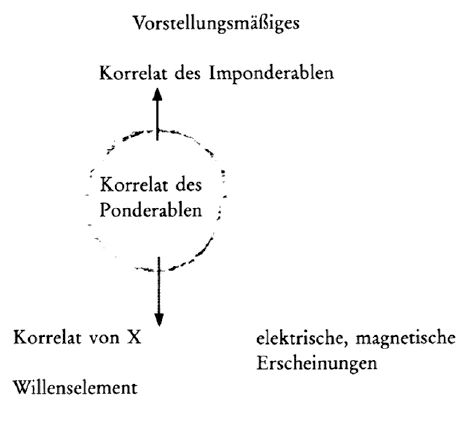
[ 9 ] People today tend to ramble on quite a bit when they talk about the actual mental states—about imagination, emotion, will, and so on. Psychology, too, has suffered from the materialistic worldview, and it has suffered from this materialistic worldview to the extent that it is incapable of forming proper concepts of what pertains to the soul. Anyone who wishes to form such proper concepts of what pertains to the soul must, of course, completely turn away from the empty talk of figures like Wundt—or the like—which so many still regard as highly scientific today. All this verbiage is, in essence, nothing that even remotely touches upon the matter at hand. Anyone who studies Wundt’s many books will find that it is indeed very evident that Wundt came from the field of materialistic physiology into the realm of psychology and then even into the realm of philosophy. One will find that there is simply no possibility whatsoever of arriving at a proper understanding of the nature of representation and the nature of the will. I could name many others besides Wundt about whom the same could be said. For if one can arrive at such an appropriate understanding of the nature of representations, one sees: Just as one must elevate the correlate of the ponderable to the correlate of the imponderable—see the following diagram—and thereby find the representational aspect in human beings, so too must one descend to the correlate of the ponderable within human beings in order to make further progress. And there one arrives at the correlate of something I would like to designate for the time being as X. Let us seek it out in human beings themselves. We find it in the element of will within human beings. To analyze what lies between the two and how it lies between them would take us too far afield today.
[ 10 ] We come to the element of human will and must then ask: What, then, is the nature of this element of human will and its relationship to external nature? What, then, is this X? To what is the will just as much a correlate as the ideas are to what is given by the affects in the imponderable? From a spiritual-scientific perspective, one must then say: this correlate in nature consists of the electrical and also the magnetic phenomena—or rather, processes. And just as there is a relationship in the subjective-objective realm between the realm of ideas and what was yesterday referred to as the realm of the imponderable, so too is there such a relationship between the element of will in human beings and the electrical, electromagnetic, and magnetic realm in nature outside of humanity. If today—now that, I might say, the recalcitrant materialist minds have been reined in by empiricism—if today you are once again seeking something that can lead you, well, I would say at least to take the first step toward acknowledging these things from a materialist perspective—then you will find that physics has indeed been compelled in recent years to move beyond the old concept of matter and, in the electron and wave theories, has come to recognize a certain identity between what—if I may put it simply—flies through space as “free electricity” and what flies through space as electricity bound to so-called matter; in any case, it has been compelled to acknowledge that which flies through space as electricity and exhibits a certain velocity as it traverses space. This velocity, when expressed in a mathematical formula, exhibits exactly the same properties as matter itself. As a result, the concept of matter merged with the concept of electrical effects.
[ 11 ] If you consider this, you will say to yourself: There is certainly no reason to speak of an electromagnetic or any other theory of light, but what does exist is this: when we look at the external world—where we do not directly perceive electricity through the senses—we must somehow assume its existence in what is commonly called the material world. It also lies beyond what is perceptible through the senses; and this “beyond” is expressed precisely by the fact that it is related to what is, at first glance, farther removed from human subjective consciousness than the world of ideas—namely, the world of the will. If you descend within the human being into the realm I have designated as the middle one, and then descend further, you will find this descent to be very much identical to the descent into the nature of the will. You need only observe how, while a person lives with their soul in the world of their ideas, the actual entity of the will is not present in their consciousness, but lies deep down in the unconscious.
[ 12 ] From a spiritual scientific perspective, this would have to be expressed as follows: In our life of imagination, we are actually only awake; in our life of will, we are asleep, even when we are awake. We have only mental images in our volitional life. But the nature of this element of the will itself—even when I simply extend a hand—eludes ordinary consciousness. It eludes us internally as a correlate, just as, externally in the material world, the electrical aspect of immediate perception—which one generally has in relation to color or the visible—eludes us.
[ 13 ] And so, when we seek a path toward the realms of light, chemistry, and so on, we ascend from the ponderable into the imponderable. But then, as we descend, we arrive, so to speak, at the realm that lies beneath the ponderable. And one will then enter the realm of electrical and magnetic phenomena. Anyone who wishes to see with open eyes how, for example, the Earth itself acts like a magnet—how the Earth as such is the bearer of electrical effects—will find, precisely in this perspective, which is nothing other than a continuation of phenomenology, a fruitful path opening up, to truly penetrate not only the realm of [extraterrestrial] electrical phenomena, but also that of, let us say, electrical phenomena bound to the Earth. And an immensely fruitful field opens up here for the study of telluric and also extratelluric electrical phenomena, so that one can say—not just almost, but in every respect—: If one does not close the door to the essential nature of things by stipulating from the outset what may be thought about these phenomena of the external world and their connection to human beings—for example, that which can be expressed mathematically—but instead has the will to engage with the actual phenomena, then the phenomena actually begin to speak their own language.
[ 14 ] And it is simply a misunderstanding of Kantianism—which is, in fact, a misunderstanding of the worldview—when people constantly claim that one cannot penetrate from the external world of phenomena into the essence of things. Anyone who can logically grapple with such ideas in any way—anyone who possesses logic and the inner conviction that they can grapple with such matters—will realize that all this talk of phenomena and of what lies behind them as the “thing-in-itself” means nothing more than if I were to say: here I have written down S and O; the other I do not see, I cannot go from $S and O to the thing-in-itself; that tells me nothing; it is a theoretical phenomenon. But if I do not merely look at the $ and O, but if I am able to read further—and in this case, to read the letters further—and do not merely regard the phenomena in such a way that I say: “Here I have the phenomenon”; I cannot get beyond this phenomenon; I do not penetrate the “thing-in-itself”—but if I observe the phenomena as they illuminate one another, just as darkness gives way to light, then reading the phenomena becomes speech and expresses that which is alive in the essence of things. It is mere empty talk to speak of the contrast between the appearances and the essence of things; it is like philosophizing about the logic of the letters in Goethe’s *Faust* and the meaning of Goethe’s *Faust*: if one were to let all the letters belonging to *Faust* speak one by one, then the essence of *Faust* would be revealed. In true phenomenology, phenomena are not such that they are homogeneous or stand side by side; rather, they relate to one another, illuminate one another, and so on. The one who engages in true phenomenology arrives at the essence of things precisely through the very act of engaging in true phenomenology.
[ 15 ] It would really be a matter of the Kantian mind—which has been rendered sluggish by philosophy—finally breaking free from the inertia of accumulating “contradictions in themselves” and the “thing-in-itself”—concepts that have long enough confused minds and spirits—so that it can now truly look upon the immense progress that has also been made in the epistemological realm through Goetheanism.
[ 16 ] This is precisely what is so important for anthroposophically oriented spiritual science: that attention be drawn to such things, thereby truly enriching that which in turn leads to an inner relationship between the human being and the essential nature of the world—while one has artificially put on, so to speak, blinders of all manner of “critique of practical and -theoretical-reason—through which one cannot see beyond. These are the issues at stake today.
[ 17 ] Anthroposophically oriented spiritual science is certainly not meant to be sectarian in any way; it is certainly not meant to consist merely of explaining to people in some closed circles—where they drink tea—that the human being consists of a physical body, an etheric body, an astral body, and an “I”—whereupon, of course, one can then make a good deal of fun of those who, through such auntie-like goings-on, gain some external—but also, in turn, misunderstood—insight. But spiritual science—as one can surely sense when one truly familiarizes oneself with it—is in fact capable of revitalizing many things that truly need to be revitalized if we are to make progress. What we are experiencing today in terms of signs of decadence, signs of destruction, and the onset of social chaos has by no means arisen solely from the realm of the outer life of our time, but also from what are the inner human forces of destruction; and these inner human forces of destruction have truly not in the least come from what people have thought over the course of long ages.
[ 18 ] At a time like this, it is, of course, hardly surprising that there are people who think it appropriate to refer to Goethe’s recollections of an old mystic, which he expresses in his maxim:
If the eye were not like the sun
How could we see the light?
If God’s own power did not dwell within us,
How could the divine delight us?
[ 19 ] to which one might respond with the saying: “If the eye were not like ink, how could we see the writing ...”.
[ 20 ] However, my dear friends here today, I could go on at length about the application of Goethe’s saying—that is to say, it would take until tomorrow. But in closing, I would at least like to summarize what I have said about Goetheanism and the present day in something akin to a maxim that ties in with what I have just mentioned. It is indeed true that the present age, with all its chaos, could not be what it is if it were not haunted by the views of people like Ostwald and others like him:
[ 21 ] If the present world were not so Ostwaldian, how could it view all external natural phenomena in such a distorted way? If there weren’t so much of Ostwald’s influence in the people of today, how could they achieve so much in all sorts of materialistic-physical matters and the like, which today truly do not contribute to—but rather work against—the true progress of science to a high degree.