

Scientific Disciplines and Anthroposophy
GA 73a
1 April 1920, Dornach
Translate the original German text into any language:
Versions Available:
Scientific Disciplines and Anthroposophy, tr. SOL
8. Fragenbeantwortung nach dem Vortrag von Oskar Schmiedel über «Anthroposophie und Farbenlehre»
8. Question following Oskar Schmiedel’s lecture on “Anthroposophy and the Theory of Colors”
Vorbemerkung: Es wurde eine Frage gestellt über das Gebiet der elektrischen Kräfte. Der Wortlaut der Frage ist vom Stenographen nicht notiert worden.
Preliminary remark: A question was asked regarding the field of electrical forces. The exact wording of the question was not recorded by the stenographer.
[ 1 ] Rudolf Steiner: Das ist eine Frage, über die man eigentlich nicht einen, sondern eine ganze Reihe von Vorträgen halten müßte — abgesehen davon, daß ja die Frage gar nicht mit dem Thema des heutigen Abends zusammenhängt.
[ 1 ] Rudolf Steiner: This is a question that really warrants not just one, but a whole series of lectures—not to mention that the question isn’t even related to the topic of this evening.
[ 2 ] Dasjenige, was gestern dargestellt worden ist [im Vortrag von Herrn Stockmeyer], das versuchte ja mit darauf hinzuweisen, wie wir zu unterscheiden haben gewissermaßen im Gebiete des Imponderablen — im Gegensatze zu dem Gebiete des Ponderablen —: ein Lichtgebiet, ein chemisches Gebiet und ein Lebensgebiet. Wenn wir von dem Imponderablen zu dem Ponderablen heruntersteigen, kommen wir durch das Wärmegebiet, das gewissermaßen an beiden teilnimmt, dann zum Luftgebiet, dann zu dem Gebiet der flüssigen und zu dem Gebiet der festen Körper. Innerhalb dieser Gebiete ist ja— namentlich für den, der imstande ist, die Dinge phänomenologisch zu betrachten — nichts von dem zu finden, was in das Gebiet der elektrischen Kräfte gehört. Es wurde ja hier nur nach den elektrischen Kräften gefragt. Und in dieser Frage zu einer Beantwortung zu kommen, die, ich möchte sagen, nicht irgendwie laienhaft ist, ist nur möglich, wenn man das ganze Gebiet der Erscheinungen, das ganze Gebiet desjenigen, was dem Menschen in seiner Umgebung empirisch gegeben ist, auf den Menschen selbst bezieht. Ich will nicht sagen, daß es nicht auch eine Betrachtungsweise geben kann, die gewissermaßen vom Menschen absieht und nur das ins Auge faßt, was in den Naturerscheinungen, nun, trocken gesagt, den Menschen nichts angeht. Aber man kommt da zu einem Begreifen von verschiedenen Gesichtspunkten aus, und einer der Gesichtspunkte soll hier wenigstens seiner Bedeutung nach gekennzeichnet werden.
[ 2 ] What was presented yesterday [in Mr. Stockmeyer’s lecture] sought to point out how we must, so to speak, make distinctions within the realm of the imponderable—in contrast to the realm of the ponderable—namely: a realm of light, a chemical realm, and a realm of life. As we descend from the imponderable to the ponderable, we pass through the realm of heat—which, in a sense, participates in both—then to the realm of air, then to the realm of liquids, and finally to the realm of solids. Within these realms—especially for those capable of viewing things phenomenologically—there is nothing to be found that belongs to the realm of electrical forces. After all, the question here was only about electrical forces. And to arrive at an answer to this question—one that, I would say, is not in any way amateurish—is only possible if one relates the entire realm of phenomena, the entire realm of what is empirically given to human beings in their environment, to human beings themselves. I do not mean to say that there cannot also be a way of looking at things that, so to speak, disregards the human being and focuses only on what, in natural phenomena—to put it bluntly—is of no concern to the human being. But one arrives at an understanding from various points of view, and one of these points of view should at least be characterized here in terms of its significance.
[ 3 ] Wenn Sie all das ins Auge fassen, was in das Gebiet des Ponderablen gehört, also alles Feste, Flüssige, Ausdehnungsfähige, Ausdehnbare, Gasförmige, so werden Sie, ausgehend von diesem Gebiete, solche Wirkungen finden, die auch in dem menschlichen Organismus mehr oder weniger materielle Parallelerscheinungen haben. Je weiter Sie aber sich nähern dem Gebiete des Imponderablen, umso mehr kommen Sie zu solchen, für das Bewußtsein wenigstens zunächst gegebenen Parallelerscheinungen, welche dem Seelischen zuzuschreiben sind. Derjenige, der nicht sich begnügt mit allerlei Wortdefinitionen oder Wortprägungen, sondern der auf die Sachen eingehen will, der wird finden, daß schon das Erklären, das Erleben des Wärmemäßigen ins Seelische heraufgeht.
[ 3 ] If you consider everything that belongs to the realm of the ponderable—that is, all solids, liquids, expandable substances, and gases—you will find, starting from this realm, effects that also have more or less material parallels in the human organism. However, the closer you approach the realm of the imponderable, the more you will encounter parallel phenomena—which, at least initially, are apparent to consciousness—that are attributable to the soul. Anyone who is not content with all sorts of verbal definitions or coinages, but who wishes to delve into the essence of things, will find that even the act of explaining and experiencing thermal phenomena rises into the realm of the soul.
[ 4 ] Kommen wir dann in das Gebiet des Lichtmäßigen, so haben wir zunächst einmal das Lichtgebiet gegeben als unser Lichtfeld, als etwas, was im Gebiet der sinnlichen Augenwahrnehmungen liegt, und damit gewinnen diese einen Charakter des Seelischen. Gestatten Sie den Ausdruck: Filtriert haben wir den Umfang der Augenwahrnehmungen in einer gewissen Summe von Vorstellungen gegeben.
[ 4 ] When we enter the realm of the light-related, we first have the realm of light as our field of light—something that lies within the realm of sensory visual perceptions—and thus these perceptions take on a spiritual character. If I may use the expression: we have filtered the scope of visual perceptions into a certain set of mental images.
[ 5 ] Schreiten wir nun weiter zu dem Gebiete der sogenannten chemischen Effekte, so könnte es nach den gewöhnlichen Auseinandersetzungen der heutigen Chemie allerdings zweifelhaft oder bezweifelbar erscheinen zu sagen, daß wir es auch da zu tun haben mit einem Heraufrücken zu dem Seelischen, wenn wir von der Wirkung des chemischen Gebietes auf den Menschen sprechen. Allein, man braucht ja nur ein wenig einzugehen auf das, was heute doch schon die physiologisch-psychologische Betrachtung des Sehvorganges liefert, und man wird finden, daß in diesen [Sehvorgang] schon vieles von der Art hineingemischt ist, das sich auf chemische Effekte bezieht. Es ist in der Tat notwendig geworden, und zwar mit Recht, von einer Art von Chemismus zu sprechen, wenn man jene Vorgänge schildern will, die sich abspielen beim Sehvorgang im Innern des Auges.
[ 5 ] If we now move on to the realm of so-called chemical effects, it might indeed seem doubtful or questionable—according to the conventional views of modern chemistry—to say that we are dealing here as well with a progression toward the spiritual realm when we speak of the effects of the chemical realm on human beings. However, one need only delve a little into what the physiological-psychological study of the process of vision already provides today, and one will find that this [process of vision] already incorporates many elements related to chemical effects. It has in fact become necessary—and rightly so—to speak of a kind of “chemism” when describing the processes that take place within the eye during the act of seeing.
[ 6 ] Die Versuche auf diesem Gebiete sind ja natürlich durchaus angekränkelt von den gegenwärtigen materiellen Vorstellungen; aber es ist an diesem Punkte sogar die zeitgenössische Wissenschaft schon bis zu einem gewissen Grade, ich möchte sagen herangebändigt, in einem bestimmten Gebiete wenigstens die allerersten, elementarsten Anfänge eines Richtigen zu sehen. Und wenn wir vom Chemismus im äußeren Leben sprechen, insofern er sich durch den Sehvorgang auf unser Bewußtseinsgebiet der Vorstellungen bezieht, so sprechen wir eigentlich ähnlich, wie wir sprechen, sagen wir, wenn wir einfach ins Auge fassen den gestalteten Körper, also die bloße Oberflächengestaltung und dasjenige, was wir uns nach der Oberflächengestaltung als inneres Bild von irgendeinem festen Körper machen. Wer analysieren kann als ordentlicher Psychologe die Beziehungen zwischen der Vorstellung eines gestalteten, festen Körpers und dem Äußeren, das Veranlassung gibt zu dieser Vorstellung, der wird finden, daß diese Analyse ziemlich parallel sein muß derjenigen, die sich bezieht auf das, was gewissermaßen unter der Oberfläche, unter der gestalteten Oberfläche des äußeren Körpers vor sich geht als Chemismus, was also durch die Oberfläche abgewendet ist, und dem, was dann durch den Sehvorgang innerliches, seelisches Eigentum des Menschen wird.
[ 6 ] Attempts in this field are, of course, thoroughly tainted by current materialistic conceptions; but on this point even contemporary science has, to a certain extent—I would say—been brought to see, at least in a specific area, the very first, most elementary beginnings of what is correct. And when we speak of chemical processes in the external world, insofar as it relates to the realm of our conscious representations through the process of vision, we are actually speaking in a manner similar to how we speak, say, when we simply take in with our eyes the shaped body—that is, the mere surface form and what we form in our minds as an inner image of some solid body based on that surface form. Anyone who, as a competent psychologist, can analyze the relationships between the mental image of a shaped, solid body and the external reality that gives rise to this image will find that this analysis must run quite parallel to the one that relates to what is taking place, so to speak, beneath the surface—beneath the shaped surface of the external body—as chemical processes, that is, what is thus turned away from the surface, and what then, through the process of seeing, becomes an inner, psychological property of the human being.
[ 7 ] Etwas ganz Ähnliches liegt vor für die Lebenserscheinungen. Wir kommen also, indem wir von dem Ponderablen zu dem Imponderablen vorrücken, dazu, bei den Parallelerlebnissen im Innern des menschlichen Wesens Bewußtseinsvorgänge annehmen zu müssen, die aber stark den Charakter des Vorstellungsmäßigen tragen. Wir können also sagen: Indem wir — wenn wir uns an das gestrige Schema [von Herrn Stockmeyer] erinnern — aufsteigen vom Festen zum Flüssigen, zum Gasförmigen, zum Wärmehaften, Lichthaften, zum chemischen Elemente —, wenn wir hier aufsteigen, so kommen wir bis zu Gebieten, die ihr Korrelat im menschlichen Wesen durch das Vorstellungsmäßige haben.
[ 7 ] Something very similar applies to the manifestations of life. Thus, as we move from the ponderable to the imponderable, we are led to assume—in regard to the parallel experiences within the human being—processes of consciousness that, however, bear a strong resemblance to the imaginative. We can therefore say: As we—recalling yesterday’s schema [by Mr. Stockmeyer]—ascend from the solid to the liquid, to the gaseous, to the heat-like, to the light-like, to the chemical element—as we ascend here, we reach realms that have their counterpart in the human being through the realm of imagination.
[ 8 ] [Wir steigen auf] draußen in der Natur vom Ponderablen ins Imponderable und im Innern des Menschen von den Vorgängen, die sich im Organismus abspielen — die ja gewiß auch dem Bewußtsein zugrundeliegen, die aber als solche nicht eingehen ins Bewußtsein — bis herauf zu dem Vorstellungsmäßigen. Nun besteht heute allerdings noch nicht eine sachgemäße Methode in der Psychologie, um, ich möchte sagen diese ganze Skala des inneren Erlebens des Menschen wirklich vor die menschliche Aufmerksamkeit ordentlich hinzustellen.
[ 8 ] [We ascend] outwardly in nature from the ponderable to the imponderable, and inwardly within the human being from the processes taking place in the organism—which certainly underlie consciousness but do not, as such, enter into consciousness—all the way up to the realm of imagination. However, there is still no proper method in psychology today to—I would say—truly present this entire spectrum of human inner experience clearly to human attention.
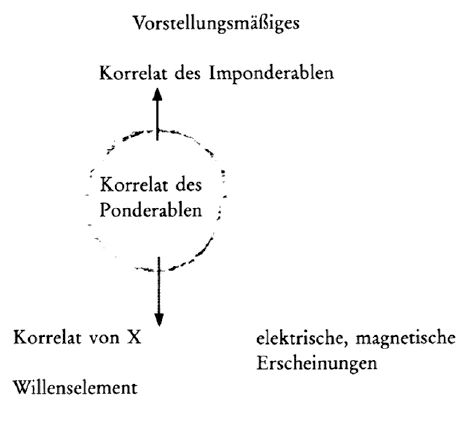
[ 9 ] Man redet im ganzen heute ziemlich herum, wenn man von den eigentlichen Seelenaffekten spricht, von Vorstellen, von Gefühl, Wille und so weiter. Auch die Psychologie hat ja gelitten unter der materialistischen Weltanschauung, und sie hat insofern gelitten unter dieser materialistischen Weltanschauung, als sie nicht imstande ist, überhaupt ordentliche Vorstellungen über das Seelengemäße zu finden. Wer solche ordentliche Vorstellungen über das Seelengemäße finden will, der muß natürlich vollständig abgehen von den heute noch von so vielen als sehr wissenschaftlich angesehenen Redereien etwa Wundts oder dergleichen. Alle diese Redereien sind im Grunde genommen gar nichts, was an die Sache auch nur im entferntesten heranrührt. Wer die vielen Bücher Wundts studiert, der wird finden, daß sich da allerdings sehr stark geltend gemacht hat, daß Wundt von der materialistischen Physiologie hergekommen ist in das Gebiet der Psychologie und dann gar in das Gebiet der Philosophie hinein. Man wird finden, daß da überhaupt gar nicht die Möglichkeit besteht, zu einer sachgemäßen Anschauung über das Wesen der Vorstellung und über das Wesen des Willens zu kommen. Ich könnte noch viele andere Namen sagen, nicht nur den Wundts, über die dasselbe zu sagen wäre. Wenn man nämlich zu einer solchen sachgemäßen Anschauung über das Wesen der Vorstellungen kommen kann, so sieht man: Geradeso wie man das Korrelat des Ponderablen hinaufheben muß zu dem Korrelat des Imponderablen — siehe das folgende Schema — und dadurch das Vorstellungsmäßige im Menschen findet, so muß man sich unter das Korrelat des Ponderablen begeben im Menschen, um weiterzukommen. Und da kommt man zu dem Korrelat von etwas, das ich zunächst als X bezeichnen möchte. Suchen wir es im Menschen selber auf. Wir finden es im Willenselement des Menschen. Auseinanderzusetzen was zwischen beiden liegt und wie es zwischen beiden liegt, würde heute zu weit führen.
[ 9 ] People today tend to ramble on quite a bit when they talk about the actual mental states—about imagination, emotion, will, and so on. Psychology, too, has suffered from the materialistic worldview, and it has suffered from this materialistic worldview to the extent that it is incapable of forming proper concepts of what pertains to the soul. Anyone who wishes to form such proper concepts of what pertains to the soul must, of course, completely turn away from the empty talk of figures like Wundt—or the like—which so many still regard as highly scientific today. All this verbiage is, in essence, nothing that even remotely touches upon the matter at hand. Anyone who studies Wundt’s many books will find that it is indeed very evident that Wundt came from the field of materialistic physiology into the realm of psychology and then even into the realm of philosophy. One will find that there is simply no possibility whatsoever of arriving at a proper understanding of the nature of representation and the nature of the will. I could name many others besides Wundt about whom the same could be said. For if one can arrive at such an appropriate understanding of the nature of representations, one sees: Just as one must elevate the correlate of the ponderable to the correlate of the imponderable—see the following diagram—and thereby find the representational aspect in human beings, so too must one descend to the correlate of the ponderable within human beings in order to make further progress. And there one arrives at the correlate of something I would like to designate for the time being as X. Let us seek it out in human beings themselves. We find it in the element of will within human beings. To analyze what lies between the two and how it lies between them would take us too far afield today.
[ 10 ] Wir kommen zu dem Willenselement des Menschen und müssen dann fragen: Wie verhält es sich denn nun mit diesem Willenselement des Menschen und seinem Verhältnis zur äußeren Natur? Was ist denn dieses X? Von was ist denn der Wille ebenso das Korrelat wie die Vorstellungen das von den Affekten Gegebene im Imponderablen? Da muß man sich dann sagen, geisteswissenschaftlich: dieses Korrelat in der Natur, das sind die elektrischen, auch die magnetischen Erscheinungen — Vorgänge könnte ich besser sagen. Und ebenso wie im Subjektiv-Objektiven eine Beziehung besteht zwischen dem Vorstellungsmäßigen und dem gestern als dem Gebiete des Imponderablen bezeichneten, so besteht eine solche Beziehung zwischen dem Willenselement im Menschen und dem elektrischen, elektro-magnetischen und magnetischen Gebiet in der außermenschlichen Natur. Wenn Sie heute, wo ja, ich möchte sagen herangebändigt werden durch die Empirie die widerstrebenden materialistischen Gemüter, wenn Sie heute ja auch wiederum etwas aufsuchen, welches Sie führen kann dazu, nun, ich möchte sagen wenigstens den ersten Bekenntnisschritt des Materialismus zu diesen Dingen zu machen, so werden Sie finden, daß ja die Physik gezwungen worden ist in den letzten Jahren, abzusehen von dem alten Materiebegriff und in der Elektronen- und Tonen-Theorie dazu gekommen ist, eine gewisse Identität [anzuerkennen] zwischen dem, was — wenn ich mich trivial ausdrücken darf — als freie Elektrizität durch den Raum fliegt und dem, was als an die sogenannte Materie gebundene Elektrizität durch den Raum fliegt; jedenfalls ist sie zur Anerkennung desjenigen gezwungen worden, was da durch den Raum als Elektrizität fliegt und eine gewisse Geschwindigkeit darstellt in dem Durchfliegen des Raumes. Diese Geschwindigkeit zeigt nun in mathematischer Formel ausdrückbar ganz dieselben Eigenschaften wie die Materie selbst. Dadurch schmolz der Materiebegriff zusammen mit dem Begriff der elektrischen Effekte.
[ 10 ] We come to the element of human will and must then ask: What, then, is the nature of this element of human will and its relationship to external nature? What, then, is this X? To what is the will just as much a correlate as the ideas are to what is given by the affects in the imponderable? From a spiritual-scientific perspective, one must then say: this correlate in nature consists of the electrical and also the magnetic phenomena—or rather, processes. And just as there is a relationship in the subjective-objective realm between the realm of ideas and what was yesterday referred to as the realm of the imponderable, so too is there such a relationship between the element of will in human beings and the electrical, electromagnetic, and magnetic realm in nature outside of humanity. If today—now that, I might say, the recalcitrant materialist minds have been reined in by empiricism—if today you are once again seeking something that can lead you, well, I would say at least to take the first step toward acknowledging these things from a materialist perspective—then you will find that physics has indeed been compelled in recent years to move beyond the old concept of matter and, in the electron and wave theories, has come to recognize a certain identity between what—if I may put it simply—flies through space as “free electricity” and what flies through space as electricity bound to so-called matter; in any case, it has been compelled to acknowledge that which flies through space as electricity and exhibits a certain velocity as it traverses space. This velocity, when expressed in a mathematical formula, exhibits exactly the same properties as matter itself. As a result, the concept of matter merged with the concept of electrical effects.
[ 11 ] Wenn Sie das ins Auge fassen, dann werden Sie sich sagen: Ein Grund, von einer elektro-magnetischen oder sonstigen Lichttheorie zu sprechen, ist zwar nicht vorhanden, aber was wohl vorhanden ist, das ist, daß wir — wenn wir auf die Außenwelt blicken, wo wir ja das Elektrische nicht direkt durch die Sinne wahrnehmen —es in dem, was nun gewöhnlich das Materielle genannt wird, irgendwie vermuten müssen. Es liegt uns ferner als das, was durch die Sinne wahrnehmbar ist; und dieses Fernerliegende, das drückt sich eben dadurch aus, daß es verwandt ist mit dem, was ja zunächst dem subjektiven Bewußtsein des Menschen ferner liegt als seine Vorstellungwelt, nämlich seine Willenswelt. Wenn Sie bei dem Menschen in das Gebiet hinuntersteigen, das ich als das mittlere bezeichnet habe, und dann weiter hinuntersteigen, so finden Sie dieses Hinuntersteigen sehr identisch mit dem Hinuntersteigen in die Willensnatur. Sie brauchen nur darauf zu sehen, wie der Mensch zwar mit seiner Seele in der Welt seiner Vorstellungen lebt, wie aber das, was die eigentliche Entität des Willens ist, nicht präsent ist in seinem Bewußtsein, wie es tief unten im Unbewußten liegt.
[ 11 ] If you consider this, you will say to yourself: There is certainly no reason to speak of an electromagnetic or any other theory of light, but what does exist is this: when we look at the external world—where we do not directly perceive electricity through the senses—we must somehow assume its existence in what is commonly called the material world. It also lies beyond what is perceptible through the senses; and this “beyond” is expressed precisely by the fact that it is related to what is, at first glance, farther removed from human subjective consciousness than the world of ideas—namely, the world of the will. If you descend within the human being into the realm I have designated as the middle one, and then descend further, you will find this descent to be very much identical to the descent into the nature of the will. You need only observe how, while a person lives with their soul in the world of their ideas, the actual entity of the will is not present in their consciousness, but lies deep down in the unconscious.
[ 12 ] Geisteswissenschaftlich gesagt würde das so ausgesprochen werden müssen: Im Vorstellungsleben wachen wir eigentlich nur, im Willensleben schlafen wir, auch wenn wir wachend sind. Wir haben nur Vorstellungen in unserem Willensleben. Wie aber dieses Element des Willens selber beschaffen ist, wenn ich nur eine Hand ausstrecke, das entzieht sich dem gewöhnlichen Bewußtsein. Es entzieht sich das innerlich als Korrelat, wie sich äußerlich in dem Materiellen das Elektrische der unmittelbaren Anschauung, die man etwa gegenüber dem Farbigen oder dem Sichtbaren überhaupt hat, entzieht.
[ 12 ] From a spiritual scientific perspective, this would have to be expressed as follows: In our life of imagination, we are actually only awake; in our life of will, we are asleep, even when we are awake. We have only mental images in our volitional life. But the nature of this element of the will itself—even when I simply extend a hand—eludes ordinary consciousness. It eludes us internally as a correlate, just as, externally in the material world, the electrical aspect of immediate perception—which one generally has in relation to color or the visible—eludes us.
[ 13 ] Und so kommen wir, wenn wir einen Weg suchen für die Felder des Leuchtenden, des Chemismus und so weiter, nach aufwärts steigend aus dem Ponderablen ins Imponderable. Aber dann beim Abwärtssteigen kommen wir gewissermaßen zu dem Gebiete, das unterhalb des Ponderablen liegt. Und man wird dann in das Gebiet der elektrischen, der magnetischen Erscheinungen eindringen. Wer da mit offenen Augen sehen will, wie zum Beispiel die Erde selber magnetartig wirkt, wie die Erde als solche der Träger von elektrischen Effekten ist, der wird gerade in dieser Anschauung, die ja auch nichts anderes ist als eine Fortsetzung der Phänomenologie, einen fruchtbaren Weg eröffnet sehen, um nun wirklich einzudringen nicht nur in das Gebiet der [außerirdischen] elektrischen Erscheinungen, sondern auch der, sagen wir an den Erdplaneten gebundenen elektrischen Erscheinungen. Und es öffnet sich da ein ungeheuer fruchtbares Feld für das Studium des Tellurischen und auch der außertellurischen elektrischen Erscheinungen, so daß man fast, ja nicht nur fast, sondern auf allen Gebieten sagen kann: Verschließt man sich nicht die Türe zu dem Wesenhaften der Dinge dadurch, daß man von vornherein irgend etwas statuiert, was über diese Erscheinungen der Außenwelt und ihren Zusammenhang mit dem Menschen gedacht werden dürfe — zum Beipiel dasjenige, was mathematisch ausdrückbar ist —, sondern hat man den Willen, einzugehen auf die wirklichen Phänomene, dann beginnen die Phänomene eigentlich ihre eigene Sprache zu sprechen.
[ 13 ] And so, when we seek a path toward the realms of light, chemistry, and so on, we ascend from the ponderable into the imponderable. But then, as we descend, we arrive, so to speak, at the realm that lies beneath the ponderable. And one will then enter the realm of electrical and magnetic phenomena. Anyone who wishes to see with open eyes how, for example, the Earth itself acts like a magnet—how the Earth as such is the bearer of electrical effects—will find, precisely in this perspective, which is nothing other than a continuation of phenomenology, a fruitful path opening up, to truly penetrate not only the realm of [extraterrestrial] electrical phenomena, but also that of, let us say, electrical phenomena bound to the Earth. And an immensely fruitful field opens up here for the study of telluric and also extratelluric electrical phenomena, so that one can say—not just almost, but in every respect—: If one does not close the door to the essential nature of things by stipulating from the outset what may be thought about these phenomena of the external world and their connection to human beings—for example, that which can be expressed mathematically—but instead has the will to engage with the actual phenomena, then the phenomena actually begin to speak their own language.
[ 14 ] Und es ist einfach ein mißverstandener Kantianismus, der ja auch ein Mißverständnis der Weltanschauung ist, wenn immerfort davon geredet wird, daß man nicht eindringen kann von der Außenwelt der Erscheinungen in das Wesen der Dinge. Wer irgendwie solchen Gedanken logisch beikommen kann, wer Logik hat, Wissen hat in seiner Seele, daß er solchen Dingen beikommen kann, der sieht ein, daß diese Rederei von Phänomenen und von dem was als «Ding an sich» dahintersteht, nichts weiter bedeutet, als wenn ich sage: hier habe ich S und O aufgeschrieben, das andere sehe ich nicht, ich kann nicht von dem $S und O auf das Ding an sich kommen, das sagt mir nichts, das ist eine Theorie-Erscheinung. Wenn ich aber nicht bloß das $ und O ansehe, sondern wenn ich weiter zu lesen vermag und die Phänomene, hier aber in diesem Falle die Buchstaben weiter zu lesen vermag, nicht bloß so betrachte, daß ich sage: da habe ich das Phänomen; hinter dieses Phänomen kann ich nicht kommen, ich dringe nicht ein in das «Ding an sich», sondern wenn ich die Phänomene betrachte, wie sie sich gegenseitig aufhellen, so wie sich die Dunkelheit aufhellt, dann wird das Lesen der Phänomene zum Sprechen und drückt dasjenige aus, was in dem Wesen der Dinge Lebendiges ist. Es ist nur eine Rederei, von dem Gegensatz der Erscheinungen und des Wesens der Dinge zu sprechen; das ist so, wie wenn man herumphilosophieren würde über die Buchstabenlogik in Goethes «Faust» und den Sinn des Goetheschen «Faust»: wenn man alle die Buchstaben nach und nach hat sprechen lassen, die zum «Faust» gehören, so sei eben das Wesen des «Faust» enthüllt. Bei einer wirklichen Phänomenologie sind die Phänomene ja auch nicht so, daß sie gleichartig sind oder nebeneinanderstehen, sie beziehen sich aufeinander, sie hellen sich gegenseitig auf und dergleichen. Derjenige, der wirkliche Phänomenologie treibt, der kommt eben durch das wirkliche Phänomenologietreiben auf die Wesenheit der Dinge.
[ 14 ] And it is simply a misunderstanding of Kantianism—which is, in fact, a misunderstanding of the worldview—when people constantly claim that one cannot penetrate from the external world of phenomena into the essence of things. Anyone who can logically grapple with such ideas in any way—anyone who possesses logic and the inner conviction that they can grapple with such matters—will realize that all this talk of phenomena and of what lies behind them as the “thing-in-itself” means nothing more than if I were to say: here I have written down S and O; the other I do not see, I cannot go from $S and O to the thing-in-itself; that tells me nothing; it is a theoretical phenomenon. But if I do not merely look at the $ and O, but if I am able to read further—and in this case, to read the letters further—and do not merely regard the phenomena in such a way that I say: “Here I have the phenomenon”; I cannot get beyond this phenomenon; I do not penetrate the “thing-in-itself”—but if I observe the phenomena as they illuminate one another, just as darkness gives way to light, then reading the phenomena becomes speech and expresses that which is alive in the essence of things. It is mere empty talk to speak of the contrast between the appearances and the essence of things; it is like philosophizing about the logic of the letters in Goethe’s *Faust* and the meaning of Goethe’s *Faust*: if one were to let all the letters belonging to *Faust* speak one by one, then the essence of *Faust* would be revealed. In true phenomenology, phenomena are not such that they are homogeneous or stand side by side; rather, they relate to one another, illuminate one another, and so on. The one who engages in true phenomenology arrives at the essence of things precisely through the very act of engaging in true phenomenology.
[ 15 ] Es würde sich wirklich darum handeln, daß der kantisch träge gemachte Verstand der Philosophie nun endlich einmal loskäme von der Trägheit des Häufens von den «Gegensätzen an sich» und dem «Ding an sich», die nun lange genug die Geister und die Gemüter verwirrt haben, um nun wirklich hinschauen zu können auf den ungeheuren Fortschritt, der auch in der erkenntnistheoretischen Beziehung hat gemacht werden können durch den Goetheanismus.
[ 15 ] It would really be a matter of the Kantian mind—which has been rendered sluggish by philosophy—finally breaking free from the inertia of accumulating “contradictions in themselves” and the “thing-in-itself”—concepts that have long enough confused minds and spirits—so that it can now truly look upon the immense progress that has also been made in the epistemological realm through Goetheanism.
[ 16 ] Das ist es gerade, was für anthroposophisch orientierte Geisteswissenschaft so wichtig ist, daß auf solche Dinge hingewiesen und damit in der Tat dasjenige befruchtet werden kann, was nun wiederum zu einer inneren Beziehung des Menschen zu dem Wesenhaften in der Welt führt — während man künstlich sich ein Scheuleder, sagen wir, angelegt hat, diese Formen von allerlei Kritik-der-praktischen-und-theoretischen-Vernunft-Scheuklappen, durch die man nicht hindurchsehen kann. Das sind die Dinge, um die es heute geht.
[ 16 ] This is precisely what is so important for anthroposophically oriented spiritual science: that attention be drawn to such things, thereby truly enriching that which in turn leads to an inner relationship between the human being and the essential nature of the world—while one has artificially put on, so to speak, blinders of all manner of “critique of practical and -theoretical-reason—through which one cannot see beyond. These are the issues at stake today.
[ 17 ] Anthroposophisch orientierte Geisteswissenschaft soll wahrhaftig nicht irgendwie sektiererisch sein, sie soll wahrhaftig nicht bloß darin bestehen, daß in irgendwelchen abgeschlossenen Zirkeln, bei denen man Tee trinkt, den Leuten erklärt wird, der Mensch bestehe aus physischem Leib, Ätherleib, Astralleib und Ich — wobei man dann freilich über diejenigen, die von solchem tantenhaften Getriebe irgendwelche äußere, aber auch wiederum mißverstandene Erkenntnis gewinnen, sich weidlich lustig machen kann. Sondern Geisteswissenschaft — man kann das wohl fühlen, wenn man sich wirklich bekannt macht damit —, Geisteswissenschaft ist tatsächlich geeignet, manches neu zu befruchten, das wirklich befruchtet werden muß, wenn wir weiterkommen wollen. Was wir heute erleben an Dekadenzerscheinungen, an Zerstörungserscheinungen, an Hereinbrechen von sozialem Chaos, das ist durchaus nicht bloß aus dem Gebiet des äußeren Lebens unserer Zeit heraus entstanden, sondern auch aus dem, was innere menschliche Zerstörungskräfte sind; und diese inneren menschlichen Zerstörungskräfte sind wahrhaftig nicht zum geringsten aus demjenigen gekommen, was die Menschen durch lange Zeiten hindurch gedacht haben.
[ 17 ] Anthroposophically oriented spiritual science is certainly not meant to be sectarian in any way; it is certainly not meant to consist merely of explaining to people in some closed circles—where they drink tea—that the human being consists of a physical body, an etheric body, an astral body, and an “I”—whereupon, of course, one can then make a good deal of fun of those who, through such auntie-like goings-on, gain some external—but also, in turn, misunderstood—insight. But spiritual science—as one can surely sense when one truly familiarizes oneself with it—is in fact capable of revitalizing many things that truly need to be revitalized if we are to make progress. What we are experiencing today in terms of signs of decadence, signs of destruction, and the onset of social chaos has by no means arisen solely from the realm of the outer life of our time, but also from what are the inner human forces of destruction; and these inner human forces of destruction have truly not in the least come from what people have thought over the course of long ages.
[ 18 ] In dieser Zeit ist es natürlich auch gar nicht verwunderlich, daß Menschen auftreten, die es angemessen finden, den Erinnerungen Goethes an einen alten Mystiker, die er in seinem Spruch ausdrückt:
[ 18 ] At a time like this, it is, of course, hardly surprising that there are people who think it appropriate to refer to Goethe’s recollections of an old mystic, which he expresses in his maxim:
Wär’ nicht das Auge sonnenhaft
Wie könnten wir das Licht erblicken?
Lebt nicht in uns des Gottes eigne Kraft,
Wie könnt uns Göttliches entzücken?
If the eye were not like the sun
How could we see the light?
If God’s own power did not dwell within us,
How could the divine delight us?
[ 19 ] zu begegnen mit dem Ausspruch: «Wär’ nicht das Auge tintenhaft, wie könnten wir die Schrift erblicken ...».
[ 19 ] to which one might respond with the saying: “If the eye were not like ink, how could we see the writing ...”.
[ 20 ] Allerdings, meine sehr verehrten Anwesenden, über die Anwendung des Goetheschen Spruches könnte ich heute noch lange reden, das heißt, das würde dann bis morgen dauern. Aber so möchte ich zum Schluß wenigstens noch das, was ich über Goetheanismus und die heutige Zeit gesagt habe, in so etwas Ähnlichem wie einem Spruch zusammenfassen, der anknüpft an das, was ich soeben erwähnt habe. Es ist in der Tat wahr, die heutige Zeit mit alle dem, was chaotisch ist in ihr, sie könnte nicht so sein, wenn nicht in ihr drinnen spukten die Anschauungen von Leuten wie Ostwald und ähnlichen:
[ 20 ] However, my dear friends here today, I could go on at length about the application of Goethe’s saying—that is to say, it would take until tomorrow. But in closing, I would at least like to summarize what I have said about Goetheanism and the present day in something akin to a maxim that ties in with what I have just mentioned. It is indeed true that the present age, with all its chaos, could not be what it is if it were not haunted by the views of people like Ostwald and others like him:
[ 21 ] Wär nicht die gegenwärtige Welt so ostwaldhaft, wie könnte sie alle äußeren Naturwirkungen so verkehrt erblicken? Läg nicht in den Menschen der Gegenwart so viel von Ostwaldkraft, wie könnten sie so ungeheuer viel von allerlei Materialistisch-Physikalischem und dergleichen erreichen, das nun wahrhaftig heute dem wahren Fortschritt der Wissenschaft in hohem Grade nicht zu —, sondern entgegenarbeitet.
[ 21 ] If the present world were not so Ostwaldian, how could it view all external natural phenomena in such a distorted way? If there weren’t so much of Ostwald’s influence in the people of today, how could they achieve so much in all sorts of materialistic-physical matters and the like, which today truly do not contribute to—but rather work against—the true progress of science to a high degree.