

The Philosophy of Thomas Aquinas
GA 74
24 May 1920, Dornach
Translated by Steiner Online Library
3. The Significance of Thomism Today
[ 1 ] Yesterday, at the conclusion of my reflections on high scholasticism, I sought to point out that the most essential aspect of any school of thought is the problems—the problems that manifested themselves in a very specific way within the human soul, and which, in fact, all culminated in a certain longing to understand: How does a person attain the insights necessary for life, and how do these insights fit into what dominated people’s minds at that time in a social context? How does the body of knowledge that can be gained fit into the doctrine of the Western Christian Church?
[ 2 ] The struggling scholastics were initially concerned with human individuality, which, as we have seen, was increasingly asserting itself as such, but which at first was no longer capable, as such, elevate the life of knowledge to genuine, concrete spiritual content, as it still shone forth over time from what remained of Neoplatonism, what remained of the Areopagite, and of Scotus Eriugena. I have also already pointed out that the impulses provided by High Scholasticism lived on in a certain way. But they lived on in such a way that one can say: The problems themselves are vast and formidable, and the way in which they were posed—we saw yesterday how they were posed—continued to have an impact for a long time afterward. And—this is precisely the focus of today’s reflection—what was regarded at the time as the greatest problem, namely, the relationship of the human being to sensory and spiritual reality, continues to have an effect, albeit in a completely altered methodological form; it continues to have an effect, even if one does not see it in the present day, even if it takes on a form in the present day that appears to be entirely opposed to scholasticism. It continues to have an effect. In a sense, all of this is still present in the intellectual activities of the present, but it has been fundamentally transformed by everything that has since been introduced into the philosophical development of European humanity by significant figures.
[ 3 ] We also see, when we move from Thomas Aquinas to the Franciscan monk—who was likely of Irish origin and taught in Paris at the beginning of the 14th century and later in Cologne—Duns Scotus, we immediately see, when we turn to this figure, how the problem, so to speak, becomes too great even for all that remained of the marvelous, intense technique of thought from the era of true mastery in that technique—from the era of Scholasticism.
[ 4 ] Duns Scotus has recently been confronted with the question: How does the human-spiritual aspect exist within the human-physical aspect? This was still the case with Thomas Aquinas, who—as I explained yesterday—conceived of the soul as actively permeating the entirety of the body. Thus, although a human being, upon entering physical-sensory existence through conception and birth, is endowed only through physical-bodily inheritance with the vegetative powers, with the entire range of mineral powers, and with the powers of sensory perception; yet the actual intellect—the active intellect, that which Aristotle called the *nous poietikos*—is incorporated into the human being without having preexisted. But for Thomas, the situation is such that this *Nous poietikos* now, as it were, absorbs the entire soul—the vegetative soul, the animal soul—and permeates only the physical body in order to transform it, to metamorphose it in his own sense, so that it may then live on immortal with that which he—who himself, from eternal heights, has entered the human body, but without having previously existed.
[ 5 ] Duns Scotus cannot even conceive of such an absorption of the entire system of forces of the human being by the active intellect. He can only imagine that the human body exists, as it were, as something complete; that the vegetative and animal principles persist in a certain independent manner throughout life, are then cast off at death, and that only the truly spiritual principle, the intellectus agens, then passes into immortality. Scotus can no more conceive of what Thomas Aquinas still had in mind—the permeation of the entire body by the human, soul, and spiritual—than his student, William of Ockham—who later died in Munich in the 14th century and who, above all, returned to nominalism—because the human intellect had become something abstract to him, something that no longer represented the spiritual world to him, but which seemed to him to be derived solely from reasoning, from sensory perception. He could no longer conceive that what constitutes reality is found solely in universals, in ideas. He relapsed into nominalism once more, once more into the view that what takes root in human beings as ideas, as general concepts, is conceived solely from the sensory environment, that it is actually nothing more than something that lives in the human mind—I would say, for the sake of a convenient summary of existence—as names, as words. In short, he returned once more to nominalism.
[ 6 ] This is, in essence, a significant fact, for one can see that nominalism—as it appeared, for example, in Roscellin, for whom even the Trinity fell apart because of his nominalism—is interrupted only by the intensive intellectual work of Albertus Magnus, Thomas Aquinas, and a few others; and immediately afterward, European humanity falls back once more into nominalism, into that nominalism which, in essence, is the inability of human individuality—as it increasingly asserts itself—to grasp what is present in the mind as ideas as a spiritual reality, to grasp it in such a way that it is something that lives within the human being and, in a certain sense, also lives within things. Ideas are immediately transformed once again from realities into names, into mere empty abstractions.
[ 7 ] One can see the difficulties that European thought faced more and more as it raised the question of knowledge. For we humans must, after all, know—at least at the beginning of the process of knowing, we must make use of ideas—we must know through ideas. The great question must arise again and again: How do ideas convey reality to us? But fundamentally, there is scarcely any possibility of an answer if ideas appear to us merely as names devoid of reality. And these ideas—which for ancient Greece, at least for the initiated Greeks, were still the ultimate revelations of a real spiritual world descending from above—became increasingly abstracted in European consciousness. We see this process of abstraction—the transformation of ideas into words—essentially intensifying more and more as we trace the development of Western thought.
[ 8 ] Certain figures stand out later on, such as Leibniz, who essentially does not address the question: “How does one come to knowledge through ideas?”, because he is likely still, in the traditional sense, imbued with a certain spiritual worldview and traces everything back to individual world monads, which are in fact spiritual. Leibniz towers head and shoulders above the others in that he still has the courage to conceive of the world as spiritual. Yes, for him the world is spiritual; for him, it consists entirely of spiritual entities. But I would like to say that what, in an earlier era—whose understanding was, admittedly, more instinctive, and whose understanding had not yet been illuminated by a logic such as that of Scholasticism—constituted differentiated spiritual individualities, are for Leibniz more or less gradually graded points of spirit, monads. Spiritual individuality is assured, but it is assured only in the form of the monad, in the form, so to speak, of a spiritual point-entity.
[ 9 ] If we set Leibniz aside, we see throughout the Western world a vigorous struggle for certainty regarding the fundamental principles of existence, but at the same time, everywhere, an inability to truly resolve the question of nominalism. This is particularly evident in the thinker who is, quite rightly, always regarded as the starting point of modern philosophical history—namely, Cartesius, Descartes, who lived at the beginning or in the first half of the 17th century. Throughout the history of philosophy, one learns that the very source of Cartesian philosophy lies in the statement: *cogito ergo sum*: I think, therefore I am. — This statement still reflects an influence of Augustinianism. For Augustine struggles his way out of that doubt I spoke of in the first lecture by telling himself: I can doubt everything, but the fact of doubting still exists, and I am still alive while I doubt. I can doubt that sensible objects exist around me; I can doubt that God exists, that clouds exist, that stars exist—but when I doubt, the doubt is there. I cannot doubt what is happening within my own soul. There is a certainty there, a secure starting point to grasp.—Descartes takes up this thought again: “I think, therefore I am.”
[ 10 ] In such matters, one naturally exposes oneself to serious misunderstandings when compelled to contrast something simple with something historically esteemed. And yet it is necessary. Is it not true that Descartes and many of his successors—for in this regard he has had countless successors—envision the following: If I have the content of thought in my consciousness, if I think, then the fact that I think cannot be denied; therefore, I am; therefore, my existence is secured by my thinking. I am, so to speak, rooted in the being of the world by having secured my existence through my thinking.
[ 11 ] This is actually where modern philosophy begins—as intellectualism, as rationalism, as something that seeks to operate entirely through thought—and in this respect is merely an echo of Scholasticism, which, after all, had taken the turn toward intellectualism so vigorously. Two things are evident in Descartes. First, one must raise the simple objection: Is my existence really established by the fact that I think? Every night’s sleep proves the contrary. — That is precisely the simple point that must be raised: Every morning when we wake up, we know that we must have existed from evening until morning, yet we were not thinking. Thus, the proposition “I think, therefore I am” (cogito ergo sum) is simply refuted. This simple point—which, I would say, is like a kind of Egg of Columbus—must at least once be held up against a renowned proposition that has found an immense following.
[ 12 ] That is one thing that can be said about Descartes. But the other point is the question: What, then, is the actual focus of Descartes’ entire philosophical endeavor? It is no longer directed toward intuition; it is no longer directed toward the reception of a cosmic mystery by consciousness; it is truly entirely intellectualistic, entirely oriented toward thought. It is directed toward the question: How do I attain certainty? How do I escape doubt? How do I know that things exist, and that I myself exist? It is no longer a material question, a question of the substantive results of observing the world; it is a question of securing knowledge.
[ 13 ] This question arises from the nominalism of the Scholastics, which only Albertus and Thomas overcame for a certain time, but which reappeared immediately after them. And so what people perceive is what they harbor in their souls—to which they can only assign a nominal character, which they dig into the soul to find somewhere within it a point from which they cannot yet form a worldview, or a worldview, but rather the certainty that not everything is an illusion, not everything is untrue—that when one looks out into the world, one sees a reality, and when one looks into one’s soul, one sees a reality.
[ 14 ] What I alluded to at the end of yesterday’s talk is clearly discernible in all of this: namely, that human individuality has arrived at intellectualism, but has not yet, in a sense, perceived the Christ problem within intellectualism, within the realm of thought. For Augustine, the Christ problem arises, for example, as he still looks upon all of humanity. The Christ within the human soul—who, I might say, is just beginning to dawn—then emerges for the Christian mystics of the Middle Ages; but he does not dawn clearly and distinctly for those who sought to find him solely through thought—that thought which is so necessary for the emerging individuality, or that which would arise from such thinking. This thinking, in its primal state as it wells up from the human soul, rejects precisely that which, for the innermost being of the human being, ought to be the Christian essence. It rejects transformation, the inner metamorphosis; it refuses to approach the life of knowledge in such a way that one would say: Yes, I think; I think first and foremost about myself and the world. But this thinking is still undeveloped. This thinking is, in a sense, the thinking that exists after the Fall. It must rise above itself. It must transform itself; it must ascend into a higher sphere.
[ 15 ] In fact, this necessity has only truly become clear once in the mind of a thinker, and that was in the case of Descartes’ successor, Spinoza. Spinoza truly made a deep impression on people like Herder and Goethe for good reasons; for Spinoza, even though he appears to be entirely caught up in the intellectualism that either remained from Scholasticism or was transformed from it, he nevertheless conceives of this intellectualism in such a way that human beings ultimately arrive at the truth—which for Spinoza ultimately consists of a kind of intuition—by transforming the intellectual, the inner, thinking life of the soul, rather than remaining stuck with what exists in everyday life and in ordinary scientific life. And this is precisely where Spinoza comes to say to himself: Through the development of thought, this thought is once again filled with spiritual content. — In a sense, the spiritual world we have come to know in Plotinus’s philosophy yields itself once again to thought when this thought seeks to move toward the Spirit. The Spirit, as intuition, in turn fills thought.
[ 16 ] I think it is very interesting “that it is, in fact, Spinoza who says: Let us survey the existence of the world as it continues to develop in its highest substance, the Spirit; let us then take this Spirit into our soul by elevating our thinking to intuition—on the one hand, being so intellectual that we prove things as rigorously as in mathematics, yet at the same time developing and elevating ourselves through this process of proof, so that the Spirit may meet us. — When we elevate ourselves in this way, we also comprehend, from this perspective, the historical development of what lies at the heart of human evolution. And it is remarkable that the following statement shines forth from the writings of the Jew Spinoza: The highest revelation of the divine substance is given in Christ. — In Christ, intuition has become a theophany, the incarnation of God; and Christ’s voice is therefore, in truth, God’s voice and the path to salvation. — That is to say, the Jew Spinoza concludes that human beings can develop from their intellectualism in such a way that the Spirit comes to meet them. If he is then able to direct himself toward the mystery of Golgotha, the filling with the Spirit becomes not merely intuition—that is, the manifestation of the Spirit through thought—but intuition is transformed into “theophany,” into the manifestation of God Himself. Man meets God spiritually. One might say that Spinoza was not reticent about what had suddenly dawned on him, for this statement proves it. But what he discovered in this way from the development of humanity permeates his “Ethics” like a mood, like a fundamental tone.
[ 17 ] And once again, the focus turns to a receptive person. That is why one can understand that for someone who was certainly able to read between the lines of this *Ethics*—who could feel in his own heart the heart that lives in this *Ethics*—Spinoza’s *Ethics* became such a defining work for Goethe. After all, these things should not be viewed merely in such an abstract way, as is usually done in the history of philosophy; they must be viewed from a human standpoint, and one must look at what shines through from Spinozism into Goethe’s soul. But ultimately, what shines through between the lines of Spinoza’s work is something that did not, in the end, come to dominate the era. What did come to dominate the era, however, was the inability to move beyond nominalism. Indeed, nominalism initially takes such a form that one might say: Human beings become increasingly entangled in the thought that they live in something the external world cannot grasp—in something from which they cannot step outside to immerse themselves in the external world and absorb something of its nature. — And so it comes to pass that this mood—that one is so alone within oneself that one cannot step outside of oneself to receive anything from the external world—already appears in Locke in the 17th century in the form of Locke’s statement: Even what we perceive as colors and sounds in the external world is no longer something that leads us to the reality of the external world; it is, in essence, merely the effect of the external world on our senses—it is something with which we are ultimately also entangled within our own subjectivity. — That is one side of the matter.
[ 18 ] The other side of the matter is that, for thinkers such as Bacon of Verulam in the 16th and 17th centuries, nominalism became a thoroughly pervasive worldview; this is evident in Bacon’s statement: We must do away with all of man’s superstition regarding the reality of that which, in essence, exists only as a name. Reality exists for us only when we look out at the sensory world. In empirical knowledge, the senses alone provide realities. — Alongside these realities, those realities upon which Albertus and Thomas had actually based their rational epistemology no longer play a truly scientific role in Bacon’s thought. In Bacon’s view, the spiritual world has, so to speak, already evaporated into something that can no longer spring forth from within the human being with scientific certainty and assurance. That which constitutes the spiritual world becomes merely a matter of faith—one that must not be conflated with what is called knowledge or understanding. In contrast, knowledge is to be gained solely from external observation and from experimentation, which is, after all, merely an intensified form of external observation.
[ 19 ] And so it continues all the way to Hume in the 18th century, for whom even the connection between cause and effect becomes something that exists only within human subjectivity—something that humans ultimately attribute to things merely out of a certain external habit. One can see how nominalism—the legacy of Scholasticism—weighs upon humanity like a nightmare.
[ 19 ] And so it continues all the way to Hume in the 18th century, for whom even the connection between cause and effect becomes something that exists only within human subjectivity—something that humans ultimately attribute to things merely out of a certain external habit. One can see how nominalism—the legacy of Scholasticism—weighs upon humanity like a nightmare.
[ 20 ] What, first of all, is the most important characteristic of this development? The most important characteristic of this development is surely this: that Scholasticism, with its keen intellect, arises at a time when the realm of reason is to be distinguished from the realm of truth in a spiritual world. The task of the scholastic was, on the one hand, to look toward the realm of truth in a spiritual world, which for him was, of course, handed down through the content of faith, through the content of the Church’s revelation. On the other hand, he had to look toward that which can arise through the power of human cognition alone. The scholastics’ perspective initially failed to adapt to the shift that the course of history would have made necessary. When Thomas and Albertus were developing their philosophies, there was still no scientific worldview. Galileo, Giordano Bruno, Copernicus, and Kepler had not yet made their contributions; people had not yet begun to view the external natural world through the powers of the human intellect. At that time, there was no need to grapple with what human reason can discover from the depths of the soul, as opposed to what is derived from the external empirical, sensory world. At that time, people only had to grapple with what reason could discover from the depths of the soul in relation to the spiritual body of truth as handed down by the Church—as it stood before these people, who could no longer, through inner spiritual development, rise to this body of wisdom itself in its reality, but who saw it in the form in which the Church had handed it down to them—simply as tradition, as the content of Scripture, and so on.
[ 22 ] And now let’s turn our attention to the 19th century. There we see a curious fact: In the 1870s, at a famous gathering of natural scientists in Leipzig, Du Bois-Reymond delivered his impressive speech “On the Limits of Natural Knowledge” and, shortly thereafter, “The Seven Mysteries of the World.” What has become of the question there? (A diagram is drawn.) There stands the human being; there is the boundary of knowledge; but beyond this boundary lies the material world, lie the atoms, lies that which Du Bois-Reymond describes: We do not know what it is that haunts space as matter. — And on this side of the boundary lies that which develops within the human soul.
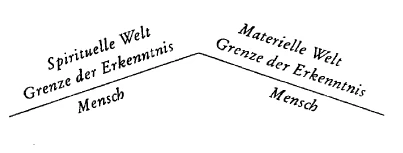
[ 23 ] Even though what we encounter in the 1970s through Du Bois-Reymond is a trifle compared to the imposing body of work that shines forth from the Middle Ages as Scholasticism, it is nonetheless its true counterpart: there, the question of the mysteries of the spiritual world; here, the question of the mysteries of the material world; here the boundary between man and atoms, there the boundary between man and the angels and God. We must look into this period if we wish to examine everything that now emerges as a more or less direct consequence of Scholasticism. Emerging from this scholasticism as something significant—at least for contemporary history—is Kant’s philosophy, influenced by Hume; this Kantian philosophy continues to shape the thinking of philosophers even today, after the 1960s, when Kant’s philosophy had receded somewhat and the philosophers of Germany raised the call: Back to Kant! and since then an immense body of literature on Kant has emerged, and independent Kantian thinkers such as Volkelt, Cohen, and so on—one could list a whole host of them—have appeared.
[ 24 ] Of course, today we can only sketch out a rough characterization of Kant. We need only point out what is essential about him. I do not believe that anyone who truly studies Kant can find him any different from the way I attempted to portray him in my short essay “Truth and Science.” At the end of the 1760s and the beginning of the 1770s, what stood before Kant with all its force was not a question of the content of his worldview—not anything that would have appeared in him in the form of specific figures, images, concepts, or ideas about things—but rather the formal question of knowledge: How do we gain certainty about anything in the external world, about a being in the external world? — Kant is more tormented by the question of the certainty of knowledge than by any content of knowledge. I mean, one should even sense this when undertaking Kant’s “Critique”—that what emerges in Kant is not the content of knowledge, but rather the quest for a principle of certainty in knowledge. Just read the *Critique of Pure Reason* and the *Critique of Practical Reason*, and see for yourself how—once the, in a certain sense, classic chapter on space and time has been overcome—the doctrine of the categories then appears, one might say, enumerated in a purely pedantic manner, merely to achieve a certain completeness. Truly, the exposition in this “Critique of Pure Reason” does not flow in the same way as it would in someone who writes sentence by sentence with his heart and soul.
[ 25 ] For Kant, what is more important—much more important—is this: How does that which we call concepts, which is, in fact, the entire content of knowledge, relate to an external reality? — rather than this content of knowledge itself. He pieced together the content, so to speak, from everything that had been handed down to him philosophically. He schematizes and systematizes. But the question arises everywhere: How does one arrive at certainty, at such certainty—as he states quite clearly—as exists in mathematics? — And he arrives at such certainty in a way that is, in essence, nothing more than a transformed—and, moreover, extraordinarily concealed and masked—form of nominalism; merely a nominalism that is now extended not only to ideas and universals but also to the forms of sensibility, space, and time. He says: What we develop in our soul as the content of knowledge has, in essence, nothing at all to do with anything we derive from things. We superimpose it onto things. We derive the entire form of our knowledge from within ourselves. When we say: A is connected to B according to the principle of causation—this principle of causation exists only within us. We superimpose it onto A and B, onto the two contents of experience. We project causality into things.
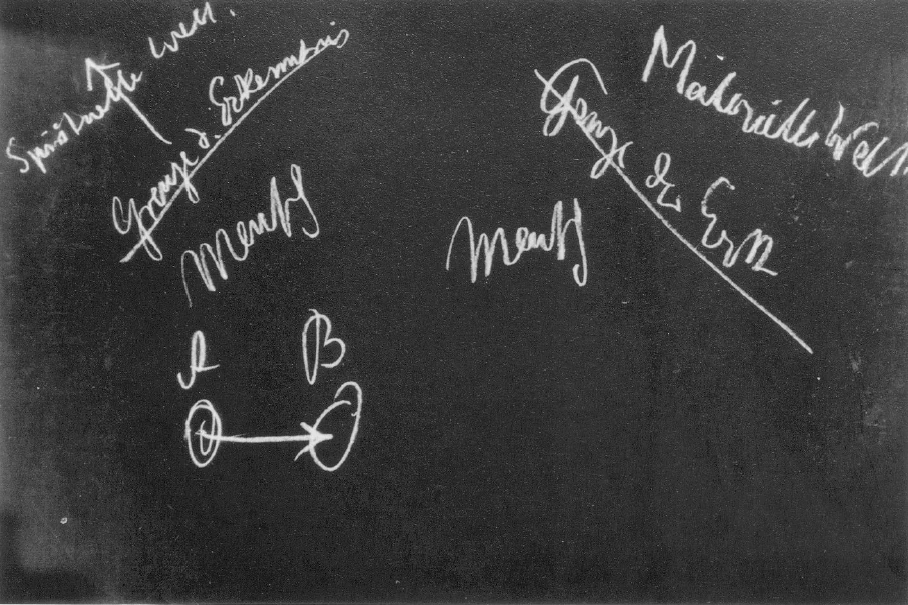
[ 26 ] In other words, as paradoxical as it may seem—though it is really only historically paradoxical in relation to something that enjoys such immense prestige as Kantian philosophy—this paradox must nevertheless be stated: Kant seeks a principle of certainty by denying altogether that we derive the content of our knowledge from things, and by asserting that we derive it from ourselves and project it onto things. In other words—and this is precisely the paradox—we have truth because we create it ourselves; we have truth in the subject because we generate it ourselves. We are the ones who first project truth onto things.
[ 27 ] There you have the ultimate consequence of nominalism. Scholasticism grappled with universals, with the question: How does that which we take up into our ideas exist out there in the world? It could not arrive at a true solution to the problem that would have been fully satisfactory for the time being. Kant says: Very well, ideas are mere names. We form them only within ourselves, but we project them as names onto things; thereby they become reality. They may not be reality for a long time, but by confronting things, I insert the names into experience and turn them into realities, for experience must be as I command it to be through the names.
[ 28 ] Kantianism is thus, in a certain sense, the proliferation of nominalism; in a certain sense, the ultimate extreme of nominalism; in a certain sense, the ultimate decline of Western philosophy; the complete bankruptcy of humanity with regard to its quest for truth; and the despair that one could somehow derive truth from things themselves. Hence the dictum: Truth can only exist if we ourselves bring it into things. — Kant has destroyed all objectivity, all possibility for humanity to immerse itself in the reality of things. Kant has destroyed every possible form of knowledge, every possible pursuit of truth, for truth cannot exist if it is created solely within the subject.
[ 29 ] This is a consequence of Scholasticism, because it was unable to engage with the other side, where the other boundary—the one that had to be overcome—arose. Because the age of natural science dawned and Scholasticism failed to shift its focus toward natural science, Kantianism emerged, which essentially began as subjectivity and then, from that subjectivity—in which it had eradicated all knowledge—gave rise to the so-called postulates of freedom, immortality, and the idea of God. We are to do what is good, to fulfill the categorical imperative; therefore, we must be able to do so. This means we must be free, but we cannot be so while living here in the physical body. We will only attain a perfection that allows us to fully carry out the categorical imperative once we are outside the body. Therefore, there must be immortality. But even this we cannot yet comprehend as human beings. That which constitutes the content of our actions in the world—when we strive to do what we ought to do—must be ordered into the world by a deity. Therefore, a deity must exist.
[ 30 ] Three tenets of faith, the roots of which in reality itself cannot be known—that is what Kant established, according to his own statement: “I had to destroy knowledge in order to make room for faith.” — And Kant is not now making room for a content of faith in the sense of Thomas Aquinas—for a traditional content of faith—but rather for an abstract content of faith—freedom, immortality, and the idea of God—for a content of faith that is, in fact, born out of the human individual who dictates truth, that is, appearance.
[ 31 ] Thus, Kant becomes the embodiment of nominalism. He becomes the philosopher who, in essence, denies humans everything they could possibly have that would allow them to immerse themselves in any kind of reality. Hence the reaction against Kant undertaken, for example, by Fichte, then Schelling, then Hegel, and other 19th-century thinkers as well. One need only look to Fichte, who sought to extract everything that Kant had essentially designated as merely an illusory world or a world of appearances from the actual creative self—which he, however, conceived as rooted in the essence of being of the world. One need only look at Fichte to see how he was compelled to delve into an ever more intense—one might say increasingly mystical—experience of the soul in order to move beyond Kantianism. Fichte could not even believe that Kant could have meant what is actually contained in Kant’s Critiques. At first, he believed—I might say, with a certain philosophical naivety—that he was merely drawing the ultimate consequences of Kant’s philosophy. If one does not draw these “ultimate consequences,” Fichte argued, one would have to believe that the strangest of coincidences had cobbled together this philosophy, and certainly not a human mind capable of thought.
[ 32 ] All of this essentially lies outside the trend emerging in the development of Western civilization through the burgeoning natural sciences, which appeared as a reaction around the middle of the 19th century—a trend that, in essence, understands nothing of philosophy and has therefore degenerated into blatant materialism among many thinkers. And so we see how philosophical development unfolds into the last third of the 19th century. We see, as it were, this philosophical striving come to a complete standstill in futility, and we then see how, out of all manner of things attached to Kantianism and the like, an attempt arose to grasp something of what actually lies as the essential nature of the world. What would have seemed so significant, had it been grasped—Goethe’s worldview—was, in fact, completely lost as a worldview for the 19th century, with the exception of those thinkers who drew on Schelling, Hegel, and Fichte. For in this Goethean worldview lies the beginning of what must actually—merely by shifting its focus toward the natural sciences—become Thomism, as it rises to the current level of development and becomes a genuine current of development.
[ 33 ] Thomas could only go so far as to state in abstract terms that the soul and spirit truly exert their influence down to the very last activities of the human organs. Thomas Aquinas expressed this in abstract terms: Everything that lives within the human body, right down to the vegetative functions, is directed by the soul and must be understood from the perspective of the soul. Goethe initiates a shift in perspective in his *Theory of Colors*, which is for this very reason so thoroughly misunderstood; Goethe initiates this shift with his *Morphology*, with his studies of plants and animals. The complete fulfillment of this Goetheanism, however, is only achieved when one has a spiritual science that, through its own power, brings clarity to the facts of natural science.
[ 34 ] A few weeks ago, I attempted to explain here how our spiritual science seeks to serve as a corrective to natural science—for example, with regard to the theory of the heart. The mechanical-materialistic view has reduced this heart to a pump that drives blood through the human body. The opposite is true of this heart: the blood circulation is a living process—embryology can prove this precisely, if it so chooses—and the heart is set in motion by the internally moving blood. The heart is the place where the activity of the blood ultimately takes shape, where the activity of the blood is incorporated into the entire human individuality. The activity of the heart is a consequence of the activity of the blood, not the other way around. And so, as has already been demonstrated here in detail in a course for physicians, one can certainly show—with regard to the individual organs of the body—how the understanding of the human being as a spiritual being truly explains its material nature. In a certain sense, one can make real what Thomism had envisioned in abstract form, when it stated: “The spiritual-soul aspect permeates everything physical.” — This becomes a concrete, real insight. Inspired by Goetheanism, Thomistic philosophy—which in the 13th century was still an abstract concept—continues to live on in our present as a spiritual science.
[ 35 ] If I may share a personal experience here, it would be the following. It is intended merely to illustrate my point, in all modesty. When I spoke at the “Wiener Goethe-Verein” in Vienna in the late 1980s on the topic “Goethe as the Father of a New Aesthetic,” there was a very learned Cistercian monk among the audience. I was explaining how one should conceive of Goethe’s ideas about art, and at that moment Father Wilhelm Neumann—a Cistercian who was also a professor in the Faculty of Theology at the University of Vienna—made the remarkable remark: “The seeds of this lecture you have given us today can already be found in Thomas Aquinas!” — It was an extraordinarily interesting experience for me to hear from Father Wilhelm Neumann that he, who was of course thoroughly versed in Thomism—since this was already after the emergence of Neo-Thomism within the Catholic clergy— who was thus thoroughly versed in Thomism, felt that there is something in Thomism akin to the seeds of what was said there as the consequence of Goethe’s worldview with regard to aesthetics.
[ 36 ] It must be said: When viewed in the light of truth, things appear quite different from how they are presented in the history of philosophy under the influence of a powerless nominalist worldview, which, for the most part, can be traced back to Kant and modern physiology, which has been shaped by Kantian thought. And so you would discover many things if you were to look into spiritual science. Read my *Seelenrätsel* (*Mysteries of the Soul*), which was published several years ago, to see how, on the basis of thirty years of study, I attempt to divide the human being into three parts; how I attempt to show how one aspect of the human physical body is connected to the organization of thought and the senses, how the rhythmic system—everything pertaining to breathing and heart activity—is connected to the emotional system, and how metabolism is connected to the volitional system. Throughout, an attempt is made to rediscover the spiritual-soul aspect in its creative activity within the physical realm. That is to say, the shift toward natural science is being undertaken in earnest. An attempt is being made to penetrate the realm of natural existence in the age of natural science in the same way that, before the age of scholasticism and Thomism—as we have seen with the Areopagite and Plotinus—human knowledge had penetrated the spiritual realm. The Christ principle is being taken seriously, just as it would have been taken seriously if it had been said: Human thinking can transform itself so that it can truly ascend, provided it sheds the “original sin” of the limits of knowledge and develops upward into the spiritual world purely through thinking free from sensuality—following this shift in focus. What reveals itself as nature can be penetrated as the veil of natural existence. One penetrates beyond the boundary of knowledge that dualism believed it had to erect, just as the Scholastics erected the boundary on the other side. One penetrates this material world and discovers that it is in fact the spiritual one, that behind the veil of nature there are in truth not material atoms, but spiritual beings.
[ 37 ] This shows you how one actually thinks in a progressive way about the further development of medieval Thomism. Examine the most important psychological ideas of Albertus and Thomas in their abstract form. They do not, however, delve so deeply into the human-physical realm as to describe how the spirit or the soul acts upon the heart, the spleen, the liver, and so on; but they do point out that the entire human body must be conceived as having emerged from the spiritual-soul realm.
[ 38 ] The next step in this line of thought is the task of truly tracing the spiritual and psychological aspects right down into the details of the physical. This is not the task of philosophy, nor is it that of the natural sciences; it can only be accomplished by a human science that does not shy away from bringing into our time the ideas that were once conceived as great ideas in the development of humanity—such as the ideas of High Scholasticism—and applying them to all that our age has produced in terms of views of nature. To this end, however, it was necessary—if the matter was to stand up scientifically—to engage with Kantianism.
[ 39 ] I first attempted this examination of Kantianism years ago in my short work *Truth and Science*, then in the 1880s in my short work *The Epistemology of Goethe’s Worldview*, and again in my *Philosophy of Freedom*. Just very briefly—and without regard to the fact that these matters, when presented concisely, may seem difficult—I would like to present to you the fundamental idea that underlies these books.
[ 40 ] These books proceed from the assumption that, in the world of perception that surrounds us, the truth cannot be found directly. In a certain sense, one sees how nominalism takes root in the human soul, how it can adopt the false conclusion of Kantianism—but Kant by no means saw what these books actually took seriously. That is, a consideration of the world of perception itself, when conducted entirely objectively and thoroughly, leads to the realization: This world of perception is not a whole; this world of perception presents itself as something we bring into being.
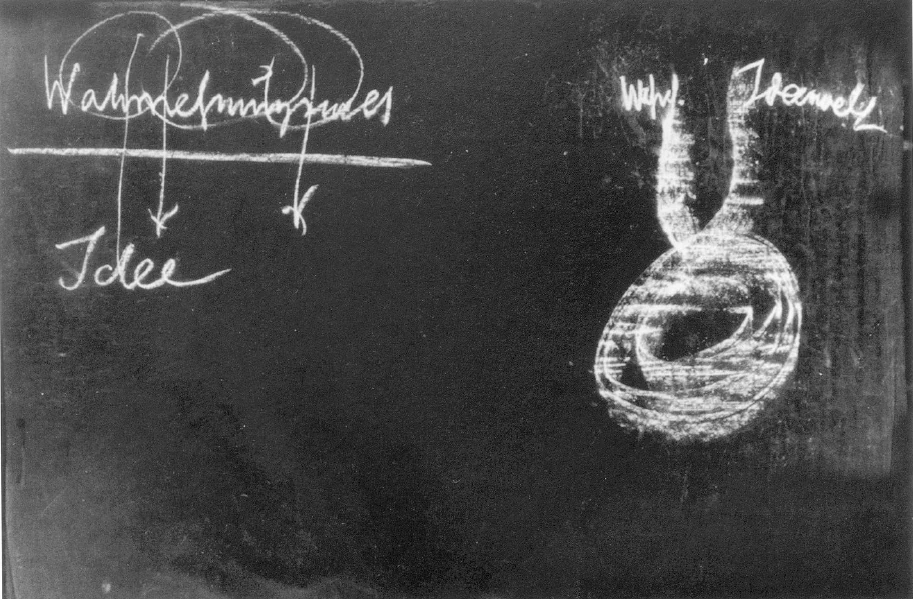
[ 41 ] What, then, was the actual origin of the difficulty of nominalism? What was the origin of Kantianism as a whole? It stems from the fact that one takes the world of perception, observes it, and then, through the life of the soul, projects the world of ideas onto it. Now one has the impression that this world of ideas is supposed to represent external perceptions. But the world of ideas is within. What does this world of ideas, located within the human being, have to do with what is out there? Kant could not answer this question in any other way than by saying: So let’s simply superimpose the world of ideas onto the world of perception—that is how we establish the truth. — That is not how it is. The fact is that, when we regard perception impartially, it is something unfinished, something that is not self-contained anywhere. I attempted to prove this rigorously, first in my book *Truth and Science*, then in my book *Philosophy of Freedom*. Perception is such everywhere that it appears as something incomplete. By placing ourselves within the world—by being born into the world—we split the world. The fact is that, in a sense, we have the content of the world right here (as illustrated). By placing ourselves as human beings within the world, we divide the content of the world into perception, which appears to us from the outside, and the world of ideas, which appears to us within the soul. Because we are in the world, the world divides itself for us into a world of perception and a world of ideas.
[ 42 ] Anyone who regards this division as absolute, anyone who simply says, “There is the world, there am I”—such a person cannot at all cross over from the world of ideas into the world of perception. But the fact is this: I look at the world of perception; it is incomplete in itself everywhere—something is missing everywhere. I myself, however, have stepped out of the world—which also includes the world of perception—with my entire being. Then I look within myself: what I perceive through myself is precisely what is missing from the world of perception. I must reunite, through my own existence, that which, when the “I” entered the world, split into two parts. I work my way toward reality. By virtue of my being born, the illusion arises in which that which is one splits into two—into the world of perception and the world of ideas. By virtue of my living, of my becoming, of my developing, I bring the two currents of reality together. I, in my experience of cognition, work my way into reality. I would never have attained consciousness if, by entering the world, I had not separated the world of ideas from the external world of perception. But I would never find the bridge to the world if I did not, in turn, reunite that which I have separated—the world of ideas—with that which, without this world of ideas, is simply not reality.
[ 43 ] Kant seeks reality solely in external perception and has no inkling that the other half of reality lies precisely in what we carry within us. We have only just wrested from external reality that which we carry within us as the world of ideas. Now nominalism is resolved, for now we do not simply superimpose space, time, and ideas—which would be mere names—upon external perception in some formal way; rather, in our cognition of perception, we now give back to it what we took from it when we entered sensory existence at birth.
[ 44 ] In this way, man’s relationship to the spiritual world first presents itself to the soul in a purely philosophical form. And whoever now takes to heart my *Philosophy of Freedom*—which rests entirely on these epistemological foundations of the elaboration of reality, of living into reality through human cognition—whoever internalizes this fundamental idea, which is already expressed in the title of the work *Truth and Science*: that true science unites the world of perception with the world of ideas and sees in this unification not merely an ideal process but a real one—whoever can now perceive something of a world process in this unification of the world of perception and the world of ideas is on the verge of overcoming Kantianism, but is also on the verge of finally resolving the problem which we have seen emerge in Western development, which gave rise to nominalism, which shed some light on Scholasticism in the 13th century, but which ultimately stood powerless in the face of the separation between perception and the world of ideas.
[ 45 ] This problem of individuality can now be approached from an ethical perspective. That is why my *Philosophy of Freedom* has become what it is: a philosophy of reality. Since cognition is not merely a formal act—since cognition itself is a process of reality—ethical, moral action presents itself as an outflow of what the individual experiences in this becoming, within a real process, through moral imagination as intuition. And what emerges is what is presented in the second part of my *Philosophy of Freedom*: ethical individualism, which—though this is not explicitly stated in my *Philosophy of Freedom*—is in fact founded on the Christ impulse within the human being. It is built upon that which the human being attains as freedom by transforming ordinary thinking into what is called “pure thinking” in my *Philosophy of Freedom*—thinking that rises into the spiritual world and draws from the spiritual world the impulses for moral actions, drawing them forth by the fact that something otherwise bound to human physicality—the impulse of love—is spiritualized. And as moral ideals are borrowed from the spiritual world through moral imagination, they express themselves in their power and become the power of spiritual love.
[ 46 ] Therefore, Kant’s “Philistine principle” had to be countered with: Duty! O sublime name, which bears no trace of flattery but demands strict submission—this Philistine principle, against which Schiller had already rebelled—to this, the “Philosophy of Freedom” had to oppose the transformed self, which has developed upward into the sphere of spirituality and, once there, begins to love virtue—and therefore practices virtue because it loves it out of its own individuality.
[ 47 ] Thus, what for Kant remained a mere matter of faith also presented itself as a real aspect of the world. For Kant, knowledge is something formal; for the *Philosophy of Freedom*, it is something real. It is a genuine process that takes place. Therefore, even that which constitutes higher morality is, through this process, linked to a reality—but to a reality that philosophers of value such as Windelband and Rickert fail to grasp entirely, since they do not realize how that which is morally valuable is rooted in the world. Of course, those who do not regard the process of cognition as a real process ultimately fail to ground morality in the world of being; they do not arrive at a philosophy of reality at all.
[ 48 ] The philosophical foundation of what appears here as spiritual science was, in fact, drawn from the entire history of Western philosophical development. And today, I have essentially attempted to show you how that Cistercian monk was not entirely wrong back then: how there truly is an attempt to introduce the realistic elements of high scholasticism into our age of natural science through spiritual science, how seriously the transformation of the human soul was taken, along with the true fulfillment of the human soul through the Christ impulse, even in intellectual life. The life of knowledge has been made a real factor in the unfolding of the world, a process that takes place solely on the stage—as I have explained in my book *Goethe’s Worldview*—of human consciousness. But what takes place there on the stage of human consciousness is at the same time a world process; it is an event in the world; and it is the very event that propels the world—and, within the world, ourselves—forward.
[ 49 ] This is where the problem of knowledge takes on an entirely different form. Here, what we experience becomes, in our mind and soul, a factor that is truly shaping our development. Here, we are what emerges from what we call knowledge. Just as magnetism acts in shaping iron filings, producing the figures we know as the results of magnetism’s effect on loose iron filings, so does that which is reflected within us as knowledge act within us. It acts at the same time as our formative principle, and we then recognize at the same time the immortal, the eternal within us, and we no longer pose the problem of knowledge in a merely formal way.
[ 50 ] How has the problem of knowledge always been posed? The problem of knowledge has always been posed in the Kantian tradition in such a way that one asked: How does a person come to perceive a representation of the external world within this inner world? — But knowledge is not primarily intended to create representations of the external world, but rather to develop us, and the fact that we represent the external world is a secondary process. In the external world, we allow—in a secondary process—what we first separated from it at birth to converge again, and the modern problem of knowledge is just like someone who has wheat or other field crops and, when wanting to investigate the nature of the principle of growth in wheat, examines the wheat for its nutritional value. Certainly, one can become a food chemist, but what is at work in the wheat—from the ear to the root and beyond—cannot be understood through food chemistry. Food chemistry merely addresses something that is added to the linear flow of development inherent in the wheat plant.
[ 51 ] Thus there is a current of development within our spiritual life that strengthens us, one that is connected to our very being—much like the development of a plant from the root, through the stem and the leaves, to the flower and the fruit, and from there back again to the seed and the root. And just as the fact that we eat it should truly play no role in explaining the nature of plant growth, so too the question of the epistemological value of what lives within us as a developmental impulse must not serve as the foundation for a theory of knowledge; rather, it must be clear that what we call knowledge in our outer life is a side effect of the work of the ideal in our human being. This brings us to the reality of that which is ideal. It is at work within us. And false nominalism—Kantianism—arose solely because the question of knowledge was posed in the same way that one would pose the question of the nature of wheat from the perspective of food chemistry.
[ 52 ] So one might say: Only when one comes to understand what Thomism can be in our time, what Thomism can mean for the present, and how it springs forth precisely from what constituted its most significant aspect in the Middle Ages—only then does one see it sprouting in its form for the 20th century within the humanities, and only then is it back as a branch of the humanities. And this already sheds some light on the question: What does it look like when one now comes along and says that, in contrast to contemporary philosophy, we must return to Thomas Aquinas, and that Thomas Aquinas must be studied—at most with a few critical commentaries and a few other elements—just as he wrote in the 13th century? — Here we see what it means to place oneself, honestly and sincerely, within the current of development that emanates from high scholasticism, and what it means to transport oneself back to the 13th century while simply overlooking everything that has taken place in the development of European humanity since the 13th century. This is, in essence, what happened as a result of the 1879 encyclical “Aeterni patris,” which instructs Catholic clergy to regard Thomas Aquinas as the official philosopher of the Catholic Church. I do not wish to discuss here the question: “Where is Thomism?” for one would have to ask: Is the rose I now have before me best viewed if I disregard the blossom, dig down into the soil just to look at the roots, and overlook the fact that something has already sprung from this root—or if I look at everything that has sprung from this root?
[ 53 ] Well, you can picture all of this for yourself. We are witnessing what is gaining ground among us—a revival of Thomism as it was in the 13th century—alongside those who sincerely wish to participate in the development of the European West. In contrast, we may ask: Where does Thomism live today? One need only raise the question: How did Thomas Aquinas himself relate to what was before him at the time—to the content of revelation? He sought to establish a relationship with it. We face the necessity of establishing a relationship with the content of natural revelation. We cannot stop at dogmatics. As I wrote back in the 1880s, “the dogma of experience” must be overcome just as much as, on the other hand, the dogma of revelation. We must indeed turn to the spiritual and soul-related content of the human being, to the world of ideas that takes in the transforming power of the Christ principle, in order to find the spiritual world again through the Christ within us—that is, within our world of ideas. Are we to stop there, leaving the world of ideas solely at the stage of apostasy? Should the world of ideas not share in salvation?
[ 54 ] In the 13th century, the Christian principle of redemption could not yet be found in the world of ideas; for this reason, it was set in opposition to the world of revelation. This must be the path of humanity’s progress into the future: that the principle of redemption be found not only for the outer world, but also for human reason. Unredeemed human reason alone could not rise into the spiritual world. Redeemed human reason, which has a genuine relationship with Christ, penetrates the spiritual world.
[ 55 ] Entering the spiritual world from this perspective is 20th-century Christianity—a Christianity so powerful that it penetrates to the very core of human thought and the life of the human soul. This is not pantheism; it is nothing like what it is slandered as being today; it is the seriousness of Christianity. And perhaps, even though it may have had to stray into abstract realms in certain respects, one can see from this examination of the philosophy of Thomas Aquinas how spiritual science takes the problems of the West seriously, how spiritual science, however, always seeks to stand on the ground of the present, and how spiritual science cannot stand on any other ground, no matter what may be brought against it.
[ 56 ] I know, my esteemed audience, just how many untruths are currently circulating. I can also imagine that some might now say: “Yes, he has changed his tune many times; now that things are getting dicey, he’s even turning to Thomism.” — Well, it is true that in ancient times, in certain creeds, priests were also called “snakes.” Snakes shed their skin. So that today, this “shedding of skin” can be understood precisely on the part of the attacker, even though it is certainly a lie in the sense in which it is reproached—as you will find in my writings. For I have shown today how the philosophically faithful foundation of spiritual science is to be found precisely in my earliest writings. But now—shedding one’s skin or not—from the tone of the polemics currently being waged, one can see that these people have certainly not understood this shedding of skin; that is why they have accumulated so many skins and have become such thick-skinned individuals. But one might perhaps say that what I have said in recent days—at least in tone—has been a response to what we are experiencing as attacks on spiritual science.
[ 57 ] Perhaps I may now point out two facts: In 1908, I gave a lecture in Stuttgart on the philosophical development of the West. In that lecture, I felt no need to mention that my discussion of Thomism might meet with disapproval from Catholic clerical circles, for at that time I did full justice to Thomism; I highlighted all that could be emphasized as its merits, even in much clearer terms than is done by the neo-Thomists—such as Kleutgen or others of their ilk. Therefore, it did not even occur to me at the time that the Catholic clergy might take offense at my praise of Thomism, and I said: If one speaks disparagingly of Scholasticism, one does not run the risk of being condemned as a heretic by the so-called free spirits; but if one speaks about it objectively, there is a strong likelihood of being misunderstood—precisely because today, within the positive and, indeed, the most intolerant church movements, there is often a philosophically misleading reliance on Thomism. I therefore did not fear at all that I would be attacked by the Catholic clergy precisely because of my praise of Thomism, but rather by the so-called free thinkers.
[ 58 ] Things turned out differently, and people will say: “After all, we were the ones who were wronged in the first place.” — In recent days, reference has also been made to my books, which were written around the turn of the 19th and 20th centuries, including the book dedicated to Ernst Haeckel. At that time, I wrote my *Worldviews and Views on Life in the Nineteenth Century*. On page 172 of that book, you will find the following sentence. It points out how contemporary thinking is by no means astute or logical; it then points out how Neo-Scholasticism attempted to rely on the strict logic of Thomism: “These thinkers were truly able to move within the world of ideas without embodying that world in a crude, sensory form.” That is how I spoke of the Scholastics, and then I went on to speak of the Catholic thinkers who, at that time, had resumed the study of Scholasticism: “And the Catholic thinkers who are striving today to renew this art of thought are certainly worthy of consideration in this regard.” What one of them, the Jesuit Father Joseph Kleutgen, says in his book *The Philosophy of Antiquity* (Innsbruck, 1878) will always hold true: ‘The various doctrines concerning our cognition, which we have just reviewed, are based on two propositions: the first, that our reason…’ and so on. You see, even though the Jesuit Joseph Kleutgen did something commendable, it was acknowledged in the book dedicated to Ernst Haeckel. Nowhere was anything denied that needed to be pointed out in the pursuit of truth. Why, when mentioning the fact—which is indeed justified in that book—that it is dedicated to Ernst Haeckel, is it not also mentioned that the Jesuit Father Joseph Kleutgen is given his due there? Yet this had the consequence that people said at the time that I myself was a Jesuit in disguise. You see, back then I was a Jesuit in disguise; now you read in numerous writings, in numerous critical articles, that I am a Jew. I just wanted to mention this at the end to shed a little light on what actually lies at the root—as the innermost impulse—for what I have set forth in this reflection on Thomism. In any case, I do not believe that anyone can draw the conclusion from this reflection that the intention here was to disparage Thomism; rather, I believe that anyone can draw the opposite conclusion.
[ 59 ] These reflections were offered to demonstrate that 13th-century Western scholasticism marked a culmination of European intellectual development, and that the present age has every reason to examine the unique nature of this culmination of European intellectual development; that we can learn an infinite amount from such an examination—above all, with regard to what we need in the most eminent sense: a deepening of our life of ideas—so that we may rise above all nominalism, so that, through the Christianization of ideas, we may rediscover Christianity, which penetrates into the spiritual being from which humanity must surely originate, since, if a person is entirely honest and sincere with himself, nothing else can satisfy him but the awareness of his spiritual origin.