

The Philosophy of Thomas Aquinas
GA 74
23 May 1920, Dornach
Translated by Steiner Online Library
2. The Essence of Thomism
[ 1 ] What I particularly sought to emphasize yesterday was that in that intellectual development of the West, which then found its expression in Scholasticism, it is not merely that which can be grasped in abstract concepts—and which, so to speak, took place in abstract concepts or in the development of abstract concepts—that plays a role, but rather that behind it lies a real development of the impulses of Western humanity. What I mean is this: One can, as is usually done in the history of philosophy, first focus on what is found in the individual philosophers. One can trace how, so to speak, the ideas found in a figure from the 6th, 7th, 8th, 9th centuries are then further developed by thinkers of the 10th, 11th, 12th, and 13th centuries; and through such an examination, one might gain the impression that one thinker adopted certain ideas from another and that there is a certain evolution of ideas.
[ 2 ] This is a historical perspective on spiritual life that should gradually be abandoned. For what unfolds in this way—what is revealed from within individual human souls—is, after all, merely a symptom of a deeper process that lies, so to speak, behind the scenes of external events. And this process, which began some two centuries before Christianity was founded, continued through the first centuries of the Christian era, and extended into the period of Scholasticism, is a wholly organic process in the development of Western civilization. Without directing our gaze toward this organic process, it is just as impossible to gain insight into it as it is into what we call development, let us say from the twelfth to the twentieth year of human life, if one were not to take into account the significant turning point at this age, which is connected with sexual maturity and all the forces that well up from the depths of the human being. Thus, something wells up from the depths of this entire great organism of European humanity that can be characterized precisely by this—one could also devise other characteristics—by saying: Those ancient poets spoke very honestly and sincerely when, like Homer, they began their epic poems: “Sing to me, O Goddess, of the wrath of Achilles, son of Peleus”—or: “Sing to me, O Muse, of the deeds of the man who wandered far and wide.” — These people did not intend to utter a mere phrase; they felt, as an inner reality of their consciousness, that it was not a single individual “I” that wished to express itself, but rather that which was in fact perceived as a higher spiritual-soul element that intervenes in the ordinary state of human consciousness.
[ 3 ] And once again—as I said yesterday—Klopstock was sincere and, in a certain sense, understood this reality, even if perhaps only instinctively, when he began his “Messiah” poem; not with the words: “Sing, O Muse—” or “Sing, O Goddess, of the redemption of mankind—,” but when he said: “Sing, immortal soul—,” that is: “Sing, individual being, which dwells within each human being as an individuality.” — When Klopstock wrote his *Messiah*, this individual feeling within the individual soul had, admittedly, already progressed far. But this inner drive to express individuality, to shape life individually, developed in the most eminent sense during the era spanning roughly from the founding of Christianity to the High Scholastic period. In what the philosophers have thought, one can see only the highest aspect—that which rises to the very outermost surface of what is taking place in the depths of all humanity: the individualization of the consciousness of European people. And a crucial factor in the spread of Christianity throughout these centuries is the fact that those who were the agents of this spread had to speak to a humanity that, from the depths of its being, was driving people more and more toward an inner, individual sense of self.
[ 4 ] Only from this perspective can the individual events unfolding in this age be understood. And only by looking at these facts can we understand the inner struggles that took place within such personalities—who sought, in the very depths of the human soul, to grapple with Christianity on the one hand and philosophy on the other—such as Albertus Magnus and Thomas Aquinas. Today, the standard writers of the history of philosophy have far too little information about the true nature of these inner struggles—which, in a sense, found their ultimate resolution in Albert and Thomas—for this era to be described even approximately clearly enough in the standard histories of philosophy. Many factors play a role in the inner lives of Albert and Thomas.
[ 5 ] On the surface, it appears as though Albertus Magnus, who lived at the turn of the 12th and 13th centuries, and Thomas, who lived in the 13th century, sought only—in a dialectical sense—to reconcile, on the one hand, Augustinianism, which we discussed yesterday, and, on the other, Aristotelianism. One was the “bearer of ecclesiastical ideas,” the other the bearer of sophisticated philosophical ideas. The search for harmony between the two, however, runs like a thread through everything they wrote. But in all that is captured in thought—as in a blossoming of Western feeling and will—there lives within it an infinite amount of what did not carry over into that era, which extends roughly from the middle of the 15th century to the present day, and from which we derive our common ideas for all the sciences and also for public life as a whole.
[ 6 ] To people today, it actually seems like nothing more than a paradox when they hear what we had to hear yesterday about Augustine’s view of life: that Augustine actually held the view that a portion of humanity was predestined from the outset to receive divine grace without merit—for, in fact, they would all be doomed to perish as a result of original sin—to receive divine grace and be saved, to be saved spiritually and mentally; while another part of humanity must perish spiritually and mentally, no matter what it does. — To people today, this seems paradoxical, perhaps even senseless. Anyone who can put themselves in the mindset of the era in which Augustine lived—the era in which Augustine received all those ideas and feelings that I described yesterday—will feel differently. They will feel that one—especially a person like Augustine, who stood right in the midst of the struggle between the idea that encompassed all of humanity as a single entity and the idea that sought to crystallize the individuality of the human being out of this unified humanity —that one can find it understandable that Augustine, in this way, still wanted to hold fast to the ideas that, as archaic concepts, did not yet take the individual human being into account, but were still, under the influence of ideas such as those of Plotinus—which I described yesterday—concerned solely and exclusively with the universal human condition. But on the other hand, the urge for individuality was also stirring in Augustine’s soul. That is why these ideas take on such a vivid form—one that resonates deeply with the soul and the heart—and why they are so imbued with human experience; and it is precisely this that makes Augustine that infinitely sympathetic figure who makes such a deep impression when we look back on the centuries that preceded Scholasticism.
[ 7 ] Beyond Augustine, what held individual Westerners together as Christians with their Church—but only in Augustine’s ideas—was preserved for many. However, as I showed you yesterday, these ideas were simply unacceptable to Western humanity, which could not bear the thought of regarding all of humanity—that unified whole—as a single entity and seeing itself within it merely as a member, and moreover as a member belonging to that part of humanity doomed to ruin and destruction. And so the Church found itself compelled to seek a way out.
[ 8 ] Augustine was still waging his formidable struggle against Pelagius, that man who was already entirely imbued with the Western impulse toward individuality. This was the figure in whom, as a contemporary of Augustine, we can see how far ahead of his time the sense of self as an individual was—a sense that people of later centuries would otherwise have been the first to experience. Therefore, he cannot help but say: There can be no question that human beings must remain entirely uninvolved in their fate in the sensory world; the power through which the soul finds a connection to that which lifts it from the snares of sensuality into the pure spiritual realms—where it can find its redemption and return to freedom and immortality—must be able to arise from human individuality itself. — This was precisely what Augustine’s opponents argued: that the individual must find the strength to overcome original sin.
[ 9 ] The Church stood right in the middle between the two opposing sides, and it sought a way out. This way out was discussed at length. There was, so to speak, a back-and-forth debate, and then a middle ground was adopted—and I’ll leave it up to each of you to decide whether, in this case, you view this middle ground as the golden mean or the copper mean. A middle ground was adopted: Semipelagianism. A formula was found that was neither quite black nor quite white, which proclaimed: It is true that things are as Augustine said, but they are not quite exactly as Augustine said; nor are they quite exactly as Pelagius said, but in a certain sense they are also as he said. And so one could say that, although it is not through a wise, eternal decree of the Godhead that some are condemned to sin and others to grace—and although human beings have a part in their own descent into sin or in their being filled with grace—the matter is nevertheless such that, while there is no divine predestination, there is divine foreknowledge. The Deity knows in advance whether one person will be a sinner or another will be filled with grace.
[ 10 ] When this dogma was propagated, no further consideration was given to the fact that it was not really a matter of foreknowledge at all, but rather a matter of take a clear and unambiguous stance on whether the individual human being can connect with the forces within his or her own soul life that can lift him or her out of separation from the divine-spiritual essence of the world and lead him or her back to that divine-spiritual essence. Thus, for the dogmatic system, the question remains fundamentally unresolved, and I would like to say: On the one hand compelled to turn their gaze toward the dogmatic teachings of the Church, yet on the other hand, out of their innermost feelings and filled with the deepest reverence for the greatness of Augustine, Albertus and Thomas, in the era of High Scholasticism, stood in opposition to what was developing as Western intellectual thought within the Christian tradition. And yet, many influences from earlier times still played a role. It lived on in such a way that one can see it—if one looks closely at the soul of Albertus and Thomas—one can see it at work in the depths of their souls, yet one also realizes that they themselves are not fully aware of it, that it influences their thoughts, but that they cannot articulate it precisely.
[ 11 ] One must take this into account—and give it even greater consideration in the context of the high scholasticism of Albert and Thomas than one would need to for a similar phenomenon in our own time, for example. I have already taken the liberty of highlighting the “why” in my *Worldviews and Philosophies of Life in the Nineteenth Century*, which was later expanded into my book *The Riddles of Philosophy*; there, the task was framed differently, and therefore the passage in question could not be included again, as I would like to note. It is certainly true—and this will occupy us in detail tomorrow; for now I merely wish to mention it—that from this surge of individuality among thinkers, who now developed this surge of individuality philosophically, we experience what is the highest flowering of logical judgment; one might say, the highest flowering of logical technique.
[ 12 ] One can rail all one wants against this or that party position on scholasticism—but all such railing is, as a rule, devoid of any real expertise. For whoever has a sense of the way—leaving aside for the moment the factual content—in which the acuity of thought unfolds in anything that is explained scientifically or otherwise; whoever has a sense of how connections are conceived that must be conceived if life is to make sense— who has a sense for all of this and for many other things—it becomes clear to them that never before, and never since, has thought been carried out with such precision, such inner logical rigor, as during the era of High Scholasticism. This, precisely, is the essential point: that pure thought proceeds with mathematical certainty from idea to idea, from judgment to judgment, from conclusion to conclusion, in such a way that these thinkers always account for even the smallest step and the tiniest little step.
[ 13 ] One need only consider the context in which this thinking took place. It was not a form of thinking that unfolded in the same way as thinking does today in our noisy world. It was a way of thinking that took place in the quiet monastery cell or elsewhere far removed from the hustle and bustle of the world. It was a way of thinking that was wholly absorbed in the life of thought, and it was a way of thinking that, thanks to other circumstances, was also able to develop a pure technique of thinking. It is indeed difficult today to cultivate this pure act of thinking, for as soon as one attempts in any way to present such thinking to the public—which, by its very nature, seeks nothing more than to string thoughts together based on their content—the unobjective people, the illogical people, pounce on every possible point and hurl their brutal partisan opinions in response. And since one is, after all, a human being among other human beings, one must grapple with these things, which are really nothing more than brutal outbursts thrown into the mix—outbursts that often have absolutely nothing to do with the matter at hand. Very soon, one loses that inner peace to which the thinkers of the 12th and 13th centuries were able to devote themselves—thinkers who did not have to pay so much attention to the objections of the unprepared in their social lives.
[ 14 ] This and many other factors gave rise, particularly in this era, to that mode of thought which is, on the one hand, wonderfully vivid but also characterized by subtle nuances—a mode of thought that defines Scholasticism and that was consciously pursued by figures such as Albertus and Thomas.
[ 15 ] But now consider this: On the one hand, there are demands of life that appear to involve dogmas that have not been clarified, which in numerous cases were similar to the characterized semi-Pelagianism, and that one struggled to uphold that which one believed must be upheld because the Church, which was entitled to do so, had established it—and that one sought to uphold it with the most acute reasoning. Just imagine what it means to shed light—precisely with the most astute reasoning—on something of the nature I had to describe to you in terms of Augustinianism. One must look into the very heart of scholastic endeavor and not merely attempt to characterize this development from parristics to scholasticism by following the thread of concepts one has picked up along the way.
[ 16 ] Many semi-unconscious elements played a role in shaping these figures of High Scholasticism, and one can truly come to terms with them only by looking beyond what I characterized yesterday and considering a figure such as the one who, in a somewhat mysterious way, entered European intellectual life from the sixth century onward—a figure who has become known as Dionysius the Areopagite. I cannot go into all the disputes today—since there would not be enough time—regarding whether there is any truth to the claim that these writings were composed only in the sixth century, or whether the other view is correct, which at least traces the traditional origins of these writings back to much earlier periods. None of that really matters, however; what matters is that the ideas of Dionysius the Areopagite were available to thinkers of the seventh and eighth centuries right up to the time of Thomas Aquinas, and that these writings, imbued with a distinctly Christian nuance, contained in a particular form what I characterized to you yesterday as Plotinism—that is, the Neoplatonism of Plotinus—but precisely in a particular form, thoroughly imbued with a Christian nuance. And it became particularly significant for Christian thinkers from the late antiquity and the beginning of the Middle Ages through to the middle of the Middle Ages—that is, up to High Scholasticism—how the author of the Dionysian writings addressed the ascent of the human soul toward a vision of the divine.
[ 17 ] This Dionysius is usually described as if he had two paths to the Divine. And indeed, he does. One path is this: if a person wishes to ascend from the external things that surround us in the world to the divine, he must try to discover, in all the things that exist, their perfections, their essence; he must try to go back to the most perfect of all; he must have the. be able to name the Most Perfect in such a way that he has a content for this Divine Most Perfect, which in turn can, as it were, pour itself out and, through individualization and differentiation, bring forth the individual things of the world from within itself. — Thus, one might say, for this Dionysius, the deity is that entity which must be endowed with names to the fullest extent, which must be attributed with the predicates that—as the most distinctive predicates—can only be discovered from all the perfections of the world that can be gathered together: Take everything that strikes you as perfection in the things of the world, name it, and then use that to name the deity; then you will arrive at a conception of the deity. — That is the one path that Dionysius proposes.
[ 18 ] The other way is for him to say: You will never attain the Divine if you give it even a single name, for the entire process of the soul—which aims to find perfection in things, which seeks the essence of things, summarizes it, and then attaches it to the Divine in this summary—never leads to what can be called the recognition of the Divine. You must become such that you free yourself from everything you have recognized in things. You must completely purify your consciousness of everything you have experienced in things. You must know nothing more of what the world tells you. You must forget all the names you are accustomed to giving to things and place yourself in a state of soul where you know nothing of the whole world. If you can experience this in your state of soul, then you will experience the Nameless One, who is immediately misunderstood the moment any name is attached to Him; then you will recognize God, the Super-God, in His transcendent beauty. But even the names “Supergod” and “Supreme Beauty” would be a distraction. They can only serve to point you toward that which you must experience as the Nameless.
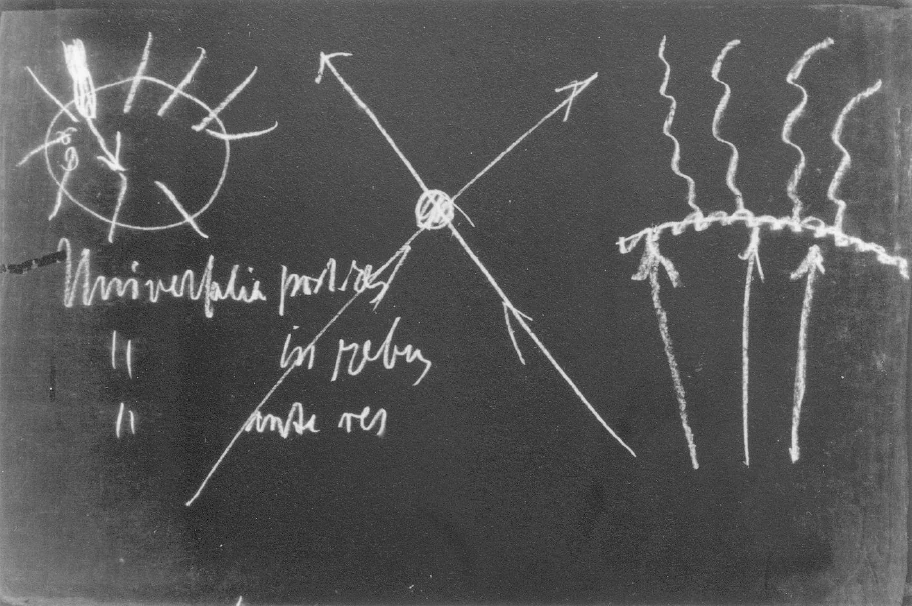
[ 19 ] How does one come to terms with a figure who does not offer a single theology, but rather two—one positive and one negative, one rationalistic and one mystical? Anyone who can immerse themselves in the spiritual climate of the eras from which Christianity emerged will find it quite easy to come to terms with this. However, if one describes the course of human development—including the early Christian centuries—in the same way that today’s materialists do, then something like the writings of the Areopagite appears more or less like folly, like madness. Then, as a rule, one simply rejects them. But if one can put oneself in the shoes of those who lived and felt as they did back then, one comes to understand what a person like the Areopagite actually wanted: essentially, merely to express what countless others were striving for. For them, the deity was a being that could not be known at all by taking just any path toward it. For him, the Deity was a being one had to approach by rational means—through naming and the discovery of names. But if one follows only this one path, one loses the way; one loses oneself in what is, so to speak, the godless expanse of the universe. Then one does not reach God. Yet one must walk this path, for without walking it, one cannot reach God either. But one must also take another path. This is precisely the one that strives toward the Nameless. If one takes each path alone, one will find the Divine just as little; but if one takes both, they intersect, and one finds the Divine at the point of intersection. It is not enough to argue about whether one path or the other is correct. Both are correct; but each one, taken on its own, leads nowhere. When both are taken, and the human soul finds itself at the point of intersection, they lead to that which is sought.
[ 20 ] I can understand how some people today, who are accustomed to what is considered polemics, recoil from what the Areopagite demands here. But what is called for here was embodied by the people who were the leading intellectual figures in the early centuries of Christianity, and it then lived on traditionally in the Christian-philosophical tradition of the West, continuing through Albertus Magnus and Thomas Aquinas. It lived on, for example, through that figure whose name I mentioned yesterday—Scotus Erigena, who lived at the court of Charles the Bald. This Scotus Erigena vividly brings to mind what I told you yesterday: I have never known a gentler person than Vincenz Knauer, the historian of philosophy. Vincenz Knauer was always gentle, but he would start ranting like a magpie whenever the conversation turned to Plotinus or anything similar to Plotinus. And Franz Brentano, the witty philosopher who was always solemn, became quite unsolent and railed in his book *What Kind of Philosopher Sometimes Marks an Epoch*—he means “Plotinus.”
[ 21 ] Those who, to a greater or lesser extent—albeit with acumen and wit—are inclined toward rationalism will surely grumble when they catch sight of—or, so to speak, perceive intellectually—what emanated, as it were, from the Areopagite, and what then found its final significant expression in Erigena. In the final years of his life, he was still a Benedictine prior. But his own monks—as the legend goes (the legend; I’m not saying it’s literally true, but even if it isn’t entirely true, it’s close to the truth)—they pricked him with pins until he died, because he was still introducing Plotinus’s teachings into the ninth century. But his ideas lived on beyond him; these ideas were, at the same time, a further development of the ideas of the Areopagite. His writings had more or less disappeared until much later; they did, after all, eventually reach posterity. In the 12th century, Scotus Erigena was declared a heretic. But that did not carry the same significance then as it did later and as it does today. Nevertheless, Albertus Magnus and Thomas Aquinas were also deeply influenced by the ideas of Scotus Erigena.
[ 22 ] This is one thing we must, so to speak, recognize as a legacy from earlier times lying at the very core of the soul when we wish to speak of the essence of Thomism. But there is yet another aspect to consider. In Plotinism—which I attempted to characterize for you yesterday in terms of its cosmology—there is a very significant characterization of human nature that arose from a sensory-supersensory vision. One actually regains a sense of respect for these things only when one rediscovers them from the foundations of spiritual science. Then one readily makes the following admission: one says, “If one reads something like Plotinus—or what has been handed down from him—without proper preparation, it looks rather chaotic and convoluted.” But when one rediscovers the corresponding truths for oneself, these views—even if they were expressed differently in that era than they must be expressed today—take on a very special character. And so, in Plotinus, one finds a perspective that I would like to characterize in roughly the following way:
[ 23 ] Plotinus considers the human being with its physical, soulful, and spiritual characteristics. He initially examines it from two perspectives. First, he considers it from the perspective of the soul’s work on the body. If I were to speak in today’s terms, I would have to say the following. Plotinus first says to himself: When one observes a child growing into the world, one sees how, in a sense, that which takes shape as the human body—arising from the spiritual-soul aspect—is still being fully developed. For Plotinus, everything that appears in a material form, particularly in human beings—if I may use the expression, please do not take offense—is an exudation of the spiritual-psychic, a sort of encrustation of the spiritual-psychic. We can regard everything that appears physically as a crusting of the spiritual-psychic. But then, when the human being has grown to a certain degree, the spiritual-psychic forces cease to work into the physical body.
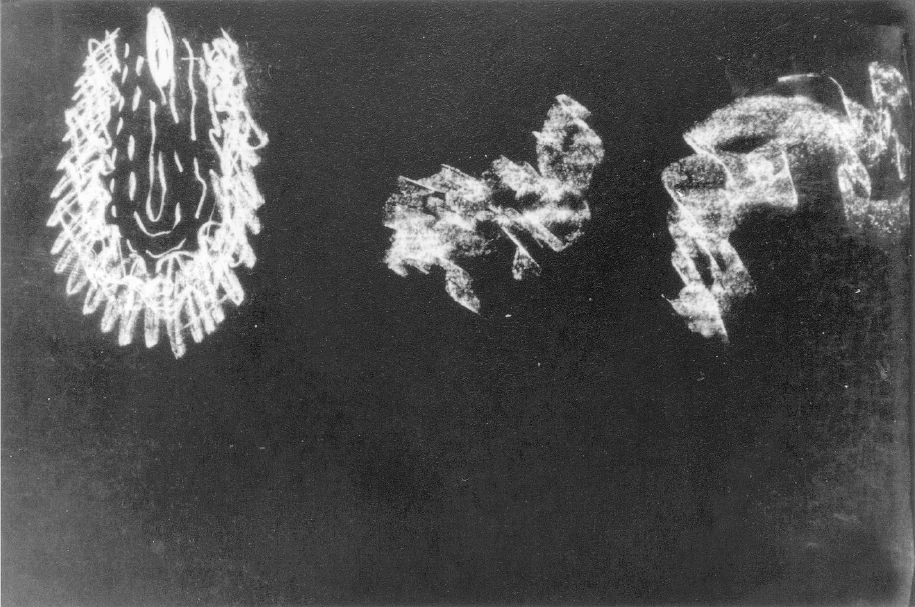
[ 24 ] One could therefore say (as is illustrated): First of all, we are dealing with a process in which the spiritual-soul aspect acts upon the physical, such that the physical is shaped and organized out of the spiritual-soul aspect. The organization of humanity is worked out from the spiritual-soul aspect. When a certain state of maturity has been reached for something in organic activity—let us say, for example, for the activity to which the forces are applied that later appear as the forces of memory—then precisely these forces, which previously worked their way into the body, emerge in a spiritual-soul metamorphosis. Thus, that which initially worked in a material sense from the spiritual-psychic realm frees itself once its work is complete and emerges as an independent entity: one might call it a “mirror of the soul,” to use Plotinus’s terminology.
[ 25 ] It is extremely difficult to characterize these things using our current concepts. One can come close to them by considering the following: Consider how a person, once their memory has reached a certain stage of maturity, is able to remember things. A small child cannot do this. Where are the forces with which the child remembers? They first act upon the organism; they shape the organism. Once they have acted upon the organism, they emancipate themselves into the purely spiritual-soul realm and now influence the organism—but still as spiritual-soul forces. Only then does the actual core, the “I,” dwell once more within this mirror of the soul. In characterizations, in a body of ideas that is extraordinarily vivid, these insights into what the soul actively works upon and into what then remains—what, so to speak, becomes passive in relation to the external world, so that, like memory, it takes in the impressions of the external world and then retains them— in an extraordinarily vivid manner, this twofold work of the soul—this division of the soul into an active part, which actually builds up the body, and a passive part—is described by that older stratum of human feeling and human worldview that found its ultimate expression in Plotinus and was subsequently passed on to Augustine and his successors.
[ 26 ] Rationalized and translated into more physical terms, we find this view in Aristotelianism. Aristotle, in turn, had this perspective at his disposal, derived from Plato and from the sources on which Plato himself was based. But when one reads Aristotle, it is as if one were compelled to say: Aristotle himself strives to express everything he encountered in ancient conceptions in abstract terms. And so we see in the Aristotelian system—which subsequently spread and was, in a sense, the rationalistic form of what Plotinus had presented in a different form—we see in what spread as Aristotelianism all the way to Albertus and Thomas Aquinas a kind of rationalized mysticism, a rationalistic description of the spiritual mystery of human existence.
[ 27 ] Albertus and Thomas are aware that Aristotle, in a sense, brought down to earth through abstract concepts what others had experienced in visions. That is why they truly do not view Aristotle in the same way as today’s philosophers of philosophy, who have engaged in curious disputes over two concepts that originate with Aristotle. But since Aristotle’s writings have not been preserved in their entirety for posterity, one finds these two concepts without seeing them in context in Aristotle—which is, after all, a fact that can make all the difference in many scholarly disputes—one finds two ideas in Aristotle. Aristotle, after all, sees in human nature that which unites into a single unity the vegetative principle of man, the animal principle of man, the lower human principle, and then the higher human principle—that which Aristotle calls the Nous and which Scholasticism later called the intellect. But Aristotle distinguishes between the *nous poietikos* and the *nous pathetikos*, between the active and the passive mind of man. The terms are no longer as descriptive as the Greek ones were, but one can still say that Aristotle distinguishes between the active intellect—the active mind of man—and the passive intellect of man. What is meant by this?
[ 28 ] One cannot understand what is meant by this unless one goes back to the origin of these concepts. Just as the other powers of the soul are involved in the structure of the human soul through a different metamorphosis, so too are the two types of intellect: the intellect, insofar as it acts as an active power, is still at work in the formation of the human being—but as intellect, not like memory, which ceases at one point and then emancipates itself as memory, but rather as intellect acting throughout one’s entire life; this is the *nous poietikos*, that is, that which, emerging from the cosmos and becoming individualized, builds up the body in the sense of Aristotle. It is nothing other than what Plotinus’ active soul—which constructs the human body—also is. And that which then emancipates itself, which exists solely to receive the external world and dialectically process the impressions of the external world—that is the Nous pathetikos, the suffering intellect, the intellectus possibilis. What confronts us in Scholasticism—with its sharp dialectics and precise logic—traces back to these ancient traditions. And one cannot make sense of what was taking place in the minds of the Scholastics unless one takes into account the influence of these ancient traditions.
[ 29 ] Because everything I have described to you resonated deeply within the souls of the Scholastics, it gave rise to the great question that is so commonly regarded as the very problem of Scholasticism. In the era when humanity possessed a mode of perception that gave rise to such things as Platonism or its rationalistic interpretation, Aristotelianism—but in which individual feeling had not yet reached its zenith—the problems of Scholasticism could not yet exist. For what we today call reason, what we today call intellect—and which, on the one hand, has its origin in Scholastic terminology—is precisely an outflow of the individual human being. If we all think alike, it is only because we are all organized individually in the same way and because reason is linked to this individuality, which is organized equally in all human beings. You do think differently, insofar as you are differentiated. But these are nuances that have nothing to do with logic proper. True logical and dialectical thinking, however, is an outflow of the general human, yet individually differentiated, organization.
[ 30 ] This, then, is how a person stands when he feels that he is an individual, and says to himself: It is within the person that thoughts arise through which the external world is represented internally; it is, as it were, from within that thoughts are assembled, and their assembly, in turn, is meant to provide a picture of the world. On the one hand, there are ideas at work within the human being that are linked to individual things, such as a single bull or a single human being—to use Augustine’s terminology. But then the human being comes to other inner experiences, such as dreams, for which he initially finds no such external counterpart. There he arrives at those experiences that he creates for himself, which are pure chimeras—just as the centaur or similar chimeras were for Scholasticism.
[ 31 ] On the other hand, however, there are those concepts and ideas that actually shimmer in both directions: humanity, the lion archetype, the wolf archetype, and so on. These are the general concepts that the Scholastics, following ancient usage, called “universals.” When things stood for people as I described them to you yesterday—when they rose, so to speak, to these universals and perceived them as the lowest threshold of the spiritual world revealed to human beings through intuition—it was precisely these universals — humanity, animality, lionhood, and so on — were precisely that through which the spiritual world, the intelligible world, revealed itself; they were what the soul experienced as an outflow from the supersensible world. To experience it in this way, it was necessary not yet to possess within oneself that individual feeling which then found its full expression in the centuries I have described. That individualized feeling led people to say to themselves: One ascends from sensory things up to that boundary where the more or less abstract, yet still experienced things lie—the universals of humanity, lionhood, and so on.
[ 32 ] Scholasticism recognized very well that one cannot simply say: “These are mere concepts, mere summaries of the external world”—but for Scholasticism, this became a problem with which it grappled. We must form such general concepts, such universal concepts, out of our individuality. But when we look out into the world, we do not see humanity, but individual human beings; not wolfness, but individual wolves. On the other hand, however: We cannot view what we conceive as “wolfness” or “lambness” merely in such a way that, so to speak, we have at one time formed the material in a lamb-like manner and at another time in a wolf-like manner, and that “wolfness” and “lambness” are merely such combinations, while the material contained within these generalizations is the only reality. Nor can we simply accept this, for if we did, we would have to conclude: If we lock up a wolf and ensure that, for a certain period of time—until its metabolism has completely adapted—it eats only lambs, it will then become entirely filled with lamb-like matter; yet it will not become a lamb. Matter alone does not make it so; it remains a wolf. “Wolfness,” then, is something that cannot simply be reduced to the material, for in material terms the entire wolf is a lamb, yet it remains a wolf.
[ 33 ] Today, this is often a problem that people do not take seriously at all. It was a problem that people grappled with with every fiber of their being during the Scholastic period, especially during its heyday. And this problem was directly connected to the interests of the Church. We can get an idea of how it relates to the interests of the Church if we consider the following.
[ 34 ] Before Albertus Magnus and Thomas Aquinas emerged with their particular interpretations of philosophy, it was true that people such as Roscellin, for example, had already appeared who put forward the claim and were also firmly of the opinion that: These general concepts, these universals, are actually nothing other than what we summarize from external individual things; they are, in fact, mere words, mere names.—And a certain form of nominalism had developed that saw only words in general things, in universals. But Roscellin took nominalism seriously in a dogmatic sense, applied it to the Trinity, and said: If—as he considered correct—that which is a generalization is merely a word, then the Trinity is merely a word, and the individuals are the only reality: the Father, the Son, and the Holy Spirit. Then let the human mind grasp these three—Father, Son, and Holy Spirit—through a single name. —Medieval thinkers took such ideas to their ultimate logical conclusions. At the Synod of Soissons, the Church was compelled to declare Roscellin’s view to be a form of partial polytheism and his doctrine to be heretical. Thus, there was a certain crisis regarding nominalism. It was, therefore, a dogmatic concern that merged with a philosophical one.
[ 35 ] Today, of course, one no longer perceives such a situation as something real. At that time, however, it was perceived as something very real, and it is precisely the relationship between universals and individual things that Thomas and Albertus grapple with intellectually; for them, this is the most important problem. Essentially, everything else is merely a consequence—that is, a consequence insofar as everything else has taken on a certain nuance due to the way they approached this problem. But it is precisely in the way Albertus and Thomas approached this problem that all the forces I have described to you so far come into play—all the forces that had remained as tradition from the Areopagite, that had remained from Plotinus, that had passed through the soul of Augustine, through Erigena, and through many others— — all of this plays a role in the particular mode of thought formation that now came to light, first through Albertus and then in a comprehensive philosophical exposition by Thomas. And it was still known that: There have been people who looked beyond concepts into the spiritual world, into the intellectual world, into that world of which Thomism also speaks as a reality—in which it perceives the immaterial intellectual beings it calls angels. These are not mere abstractions; they are real entities that simply have no bodies. These are the beings that Thomas places in the tenth sphere. As he envisions the Earth circling the spheres of the Moon, Mercury, Venus, the Sun, and so on, he then moves beyond the eighth to the ninth sphere and to what was the Empyrean—that is, to the tenth sphere. He conceives of all this as thoroughly permeated by intelligences, and the intelligences to which he initially refers are those that, as it were, allow what lies at their lowest boundary to shine down so that the human soul can experience it.
[ 36 ] But as I have just expressed it, in this form—which is more closely aligned with Plotinus—it does not transcend the mere individual feeling to which Scholasticism had just managed to arrive; rather, for Albertus and for Thomas, it remained a belief that, above the abstract concepts, there is a revelation of these abstract concepts. And for them, the question arose: What reality do these abstract concepts actually have?
[ 37 ] Now, both Albertus and Thomas still had a conception of the process by which the soul-spiritual works upon the physical, and of the subsequent reflection of the soul-spiritual once sufficient work has been done on the physical. They had ideas about all of this. They also had ideas about what a person becomes in his or her individual life, how he or she develops from year to year, from decade to decade, precisely through the impressions of the external world that he or she takes in and processes. And so the idea took shape that, while we certainly have the world around us, this world is a revelation of what is supraterrestrial, of what is spiritual. As we observe the world, as we turn our attention to individual minerals, plants, and animals, we sense, in a sense, that behind them lies that which reveals itself from higher spiritual worlds.
[ 38 ] If we then examine the world of the natural realms through logical analysis—using all that our soul enables us to do, all the power of thought within us—we arrive at what has been implanted in the natural realms by the spiritual world. But then we must become clear about this: We turn our gaze, our other sense organs, toward this world. There we are in communion with the world. We then turn away from the world. We preserve, as it were, as a memory, that which we have taken in from the world. We look back again in memory. It is only then that the universal, the general—something like “humanity” and the like—actually appears to us; it appears to us only in its inner conceptual form. Thus, as Albertus and Thomas say: When you look back, as your soul reflects upon what it has experienced in the outer world, you then have the universals alive within your soul. You then possess universals. From all the people you have encountered, you form the concept of humanity. After all, if you remembered only individual things, you could live solely in earthly names. Since you do not live solely in earthly names, you must experience universals. There you have the universalia post res—those that live in the soul after the things themselves. While a person turns his soul toward things, he does not have within his soul the same thing that he has afterward when he recalls them—when they are, so to speak, reflected back to him from within—but rather he stands in a real relationship to the things. He experiences their spiritual aspect in the things themselves; he merely translates it into the form of universals post rem.
[ 39 ] By assuming that, at the moment when a human being relates to his surroundings through his capacity for thought, he relates to a real entity, that is, not merely to what the wolf is insofar as the eye sees it, the ear hears it, and so on, but insofar as human beings can think about it and form the concept of “wolf,” they experience something that is grasped intellectually in an abstract way within things, something that is not subsumed under sensory entities. They experience the universalia in rebus, in things.
[ 40 ] Now, this distinction is not entirely easy to make, because one usually thinks that what one has within one’s soul—ultimately as a reflection—is the same as what exists in things. No, it is not the same in the sense of Thomas Aquinas. What a person experiences as an idea in his soul—and explains to himself with his intellect—is that through which he experiences the real, the universal. Thus, in form, the universals from things differ from the universals concerning things that then remain in the soul; but internally, they are the same. Here you have one of the scholastic concepts that people do not usually bring before their minds in all its sharpness. The universals in things and the universals derived from things in the soul are the same in content, differing only in form.
[ 41 ] But then there is the additional fact that what is now spread out and exists in an individualized form within things points back to that which I characterized yesterday as lying within Plotinus’s philosophy—the truly intelligible world. There, once again, are the same contents that exist in things and, through things, in the human soul—identical in content, yet different in form—contained once more in a different form, yet again with the same content: these are the universalia ante res, prior to things. These are the universals as they are contained in the divine intellect and in the intellect of the servants of the Divine, the English entities.
[ 42 ] Thus, what in earlier times was direct spiritual-sensory-supersensory perception becomes perceptions that were merely represented in sensory images, because—even according to the Areopagite—one cannot even give a name to what one perceives supersensory if one wishes to treat it in its true form. One can only point to it and say: It is none of the things that external objects are. — Thus, what was contemplation for the ancients—what presented itself to them as a reality in the spiritual world—becomes, for Scholasticism, something to be decided upon by precisely all that acuity of thought, all that flexibility, and all that subtle logic of which I have spoken to you today. The problem that was previously resolved through intuition has been brought down into the sphere of thought, into the sphere of reason. This is the essence of Thomism, the essence of Albertinism, the essence of high Scholasticism. It recognizes, above all, that in its time, the experience of human individuality has reached its culmination. It sees, above all, all problems before it in their rational form, in their logical form, in the form in which the thinker must grasp them.
[ 43 ] Scholasticism is fundamentally grappling with this conception of the world’s problems as they present themselves in the realm of thought. And through this struggle and this thinking, scholasticism stands at the very heart of church life, which I have illuminated for you from various angles—both yesterday and today—albeit only with scattered glimpses. On the one hand, there is what people in the 13th and 12th centuries believed could be attained through thought and sharp logic; on the other hand, there is what has been handed down as ecclesiastical dogmas—the content of faith.
[ 44 ] Let’s take an example of how a thinker like Thomas Aquinas views these two things. Thomas Aquinas says: Can one prove the existence of God through logic? Yes, one can. — Thomas Aquinas provides a whole series of proofs. One of them, for example, is his assertion that we can initially gain knowledge only by approaching the universalia in rebus—by looking into things. We cannot penetrate the spiritual world through mere observation—that is simply a personal experience of our age. We can penetrate the spiritual world with human powers only by delving deeply into things, extracting from them what we can call universalia in rebus. Then, he says, one can deduce how things stand with these universalia ante res beforehand. We see the world in motion; one thing always moves another because it itself is moved. Thus we proceed from one moving thing to another moving thing, and from that other moving thing to yet another moving thing. This cannot go on indefinitely; rather, we must arrive at a first mover. But if that first mover were itself moved, we would then have to proceed to yet another mover. We must therefore arrive at an unmoved mover. — This is precisely where Thomas has arrived—and Albertus, too, reaches the same conclusion—at the Aristotelian unmoved mover, at the first cause. To recognize God as a necessarily first being, as a necessarily unmoved first mover, is a given of logical thinking.
[ 45 ] There is no line of reasoning that leads to the Trinity. Yet it has been handed down. Human reasoning can only go so far as to test whether the Trinity is absurd. One finds that it is not absurd, but it cannot be proven; one must believe in it, one must accept it as a reality to which human intellect, left to its own devices, cannot ascend.
[ 46 ] Scholasticism thus faced the question that was so significant at the time: How far can one go with human reason left to its own devices? But due to historical developments, it was drawn into the depths of this problem in a very special way, for other thinkers had gone before it. They had accepted something that seemed utterly absurd. They had said that something could be theologically true and philosophically false. One could say outright: It is entirely possible that certain things are handed down dogmatically, such as the Trinity; yet when one reflects on the same question, one arrives at the opposite conclusion. It is entirely possible that reason leads to conclusions different from those of faith. — And that is important; that was the other challenge facing the Scholastics: the doctrine of double truth. This is what the two thinkers, Albertus and Thomas, placed particular emphasis on: reconciling the content of faith with the content of reason, seeking no contradiction between what reason can conceive—though only up to a certain limit—and the content of faith. But what reason can conceive must not contradict the content of faith, and the content of faith must not contradict reason.
[ 47 ] At the time, this was considered radical, for the majority of influential church authorities firmly adhered to the doctrine of double truth: that, on the one hand, human beings simply had to think rationally—in one form—while the content of faith could present itself to them in another form, and they had to live with these two forms of truth. — I believe one could gain a sense of how history unfolded if one considered that, just a few centuries ago, people were grappling with such problems with all their spiritual powers. For these issues still resonate in our own time. We, too, still live with these problems. How we live with them is what we will discuss tomorrow. Today, I wanted to characterize the essence of Thomism in general, as it was lived out in that era.
[ 48 ] Well, you see, the main problem facing Albertus and Thomas was this: How does the content of human reason relate to the content of faith? How can what the Church prescribes to be believed be, first, understood, and second, defended against what is opposed to it? People like Albertus and Thomas certainly had their hands full with this. For what I have described was by no means the only thing prevalent in Europe at the time; all sorts of other views were also prevalent. With the spread of Islam and the expansion of the Arabs, other worldviews also gained a foothold in Europe. And some of those views—which I characterized yesterday as Manichaean—had persisted throughout Europe.
[ 49 ] But something akin to what is known as “representation” also existed in the teachings of the 12th-century philosopher Averroës, who said: “What a person thinks with his pure intellect does not belong to him alone; it belongs to all of humanity.” — Averroës says: We do not have a mind of our own; each of us has a body of our own, but not everyone has a mind of their own. A has his own body, but the mind—that is the same one that B and, in turn, C also have.—One could say that, for Averroes, humanity is such that there is a unified intelligence, a mind, into which all individuals are immersed. There, they live, so to speak, with their minds. When they die, the body withdraws from this universal intellect. There is no immortality in the sense of an individual’s continued existence after death. What endures is only the universal intellect—that which is common to all human beings. .
[ 50 ] For Thomas, the situation was such that he had to reckon with this universality of the intellect, but he also had to adopt the standpoint that what constitutes the universal intellect is not only intimately united with what is now, at the highest level, individual memory in the individual human being, but that which, during the course of life, is also united with what constitutes the active forces of the organism—the physical organism— unites in such a way, forming such a unity, that everything acting within the human being—the formative, vegetative, and animal forces, as well as the forces of memory—is, so to speak, drawn during life toward the universal intellect and the spirit. Thus, Thomas conceives it in such a way that the human being draws in the individual through the universal and then draws into the spiritual world that which his universal has drawn in, so that he carries it into that realm. Thus, for Albertus and Thomas, there can be no pre-existence, but there can certainly be a post-existence. This is, after all, what Aristotle also held. In this regard, Aristotelianism is also continued by these thinkers.
[ 51 ] Thus, the great logical questions of universals are intertwined with the questions concerning the fate of individual human beings in the world. Ultimately, everything—even if I were to describe to you the cosmology of Thomas Aquinas, or the extraordinarily vast natural history of Albertus, which spans nearly all fields and comprises numerous volumes—even in all these details, what I had to characterize as the general logical essence of Albertism and Thomism plays a role. This logical essence consisted in the following: We cannot reach beyond the limits of our reason—what was then called the intellect; up to a certain limit, we can penetrate everything through sharp logic and dialectics, but then we must turn to the content of faith. And as I have characterized it, both stood in relation to these two things without contradicting one another: what we grasp with our reason and what is revealed through the content of faith—both can coexist.
[ 52 ] But what was actually at issue here? I believe this question can be approached from a variety of angles. What, in terms of world history, was the essence of Albertinism and the essence of Thomism? You see, what is actually characteristic and important for Thomas is that, in exerting his reason to prove the existence of God, he must at the same time add: One arrives at a conception of God as rightly designated in the Old Testament as Yahweh. — That is to say, by proceeding from the rational paths that the individual human soul can take, Thomas arrives at that unified God whom the Old Testament also designated as the God Yahweh. If one wishes to arrive at Christ, one must turn to the content of faith; one cannot reach him through what the human soul experiences in its own spiritual life.
[ 53 ] Now, within the controversies that high scholasticism was compelled to reject simply because of the spirit of the times—within these views of “double truth”—that is, the idea that something could be theologically true and philosophically false— there is still something deeper at work within them—something that, admittedly, could not be fully grasped in an age when humanity was universally driven by a quest for rationalism and logic; there was indeed something profound underlying it all. Namely, the following lay behind it: that those who spoke of double truth did not, in fact, hold the view that what is theologically revealed and what is attainable through reason are ultimately two different things, but rather that they are, for the time being, two different truths; and that human beings arrive at these two truths because they have experienced the Fall right down to the innermost depths of the soul.
[ 54 ] This question smolders, as it were, in the depths of the soul all the way back to Albertus and Thomas. In the depths of the soul, the question smolders: Yes, have we not also taken on original sin in our thinking, in what we regard as reason within ourselves? Is it not precisely because reason has fallen away from spirituality that reason deceives us into believing in truths other than the real truth? — If we receive Christ into our reason—if we receive into our reason something that thus transforms this reason, that further develops this reason—only then does it come into harmony with the truth that is the content of faith. The sinfulness of reason lay, in a certain sense, at the root of the fact that thinkers of the pre-Alberti and pre-Thomist eras spoke of two truths. They wanted to take the doctrine of original sin and the doctrine of redemption through Christ seriously. They did not yet possess the intellectual power or the logical rigor to do so, but they wanted to do so earnestly. They posed the following question: How does Christ within us redeem the truth of reason that contradicts the spiritually revealed truth? How do we become Christians to the very core of our being? For our reason is already corrupted; original sin dwells within it, and therefore it contradicts the pure truth of faith.
[ 55 ] And now Albertus and Thomas spoke up, and at first it seemed to them that it is incorrect to say that, when we delve purely logically into the universalia in rebus—when we take into ourselves that which is reality in things—we then act sinfully toward the world. Ordinary reason must not be sinful. Fundamentally, the question of Christology lives within this question of High Scholasticism. And what could not be resolved for High Scholasticism was the question: How does Christ enter into human thought? How is human thought “Christified”? How does Christ lead one’s own human thought upward into the sphere where it can grow together with what is purely the spiritual content of faith?
[ 56 ] That was still the true driving force within the souls of the scholastics. That is why, even though scholasticism embodies the most perfect logical technique, it is above all important not to take the results of scholasticism at face value, but rather to look beyond the answers to the questions themselves; to look beyond what people in the 12th and 13th centuries were able to grapple with; and to focus on the great problems that were raised at that time. Christology had not yet advanced far enough to trace humanity’s redemption from original sin all the way into human thought. Therefore, Albertus and Thomas had to deny reason the right to transcend the stages beyond which, by ascending, it could enter the spiritual world itself. And the question remained from high scholasticism: How does human thought develop upward toward a vision of the spiritual world?
[ 57 ] Even the most important result of High Scholasticism is a question; it is not the content that High Scholasticism itself constitutes. It is the question: How does one incorporate Christology into thought? How is thought made Christian? — This question stands in world history at the very moment when Thomas Aquinas died in 1274. Up to that moment, he had only just managed to bring himself to ask the question. The question stands with all the intensity of the heart within European intellectual culture. What was to become of it could only be hinted at initially by saying: Human beings penetrate to a certain degree into the essence, into the spiritual essence of things. But then the content of faith must come into play. And the two must not contradict one another; they must be in harmony with one another. Yet ordinary reason cannot, on its own, comprehend the content of the highest truths—such as the Trinity, the Incarnation of Christ in the man Jesus, and so on. Reason can only comprehend to the extent that it can say: The world could have come into being within time, but it could also have existed from eternity. But revelation says that it came into being within time. If you consult reason once more, you will find the reasons why coming into being within time is the more reasonable, the wiser option.
[ 58 ] Thus, the scholastic is situated within the whole of history. More than one might think, what remains of Scholasticism still lives on in all of today’s scholarship and in the entire public life of the present—albeit in a particular form. Tomorrow we will discuss just how alive Scholasticism still is, fundamentally speaking, in our souls, and what stance modern people must actually take toward what still lives on from Scholasticism.