

The Philosophy of Thomas Aquinas
GA 74
22 May 1920, Dornach
Translated by Steiner Online Library
1. Thomas and Augustine
[ 1 ] Over the course of these three days, I would like to speak about a topic that is usually viewed from a more formal perspective, and whose substance is typically understood solely in terms of how the underlying philosophical movement of the Middle Ages, to a certain extent, defined the relationship between the philosophical worldview and Christianity. Since this very aspect of the matter has recently been revived, so to speak, by Pope Leo XIII’s call to his clergy to make Thomism the official philosophy of the Catholic Church, our current “topic” certainly has a certain significance from this perspective.
[ 2 ] However, I do not wish to view the matter solely from this formal perspective—which, in a sense, crystallized as medieval philosophy around the figures of Albertus Magnus and Thomas Aquinas—but rather, over the course of these days, I would like to highlight the deeper historical background from which this philosophical movement, which is still far too little appreciated today, emerged. One might say: In the 13th century, Thomas Aquinas attempted in a very incisive way to grasp the problem of knowledge and the overall worldview in a manner that—one must admit—is actually difficult to conceive of today, because such contemplation requires prerequisites that are scarcely met by people of the present day, even if they are philosophers. It is necessary to be able to fully immerse oneself in the mode of thinking of Thomas Aquinas, his predecessors, and his successors—to understand how the concepts are to be understood, how they lived in the minds of these medieval people, about whom the history of philosophy actually reports in a rather superficial manner.
[ 3 ] If we now turn our attention to the focal point of this discussion—Thomas Aquinas—we might say that in him we find a figure who, when viewed against the backdrop of the mainstream of medieval Christian philosophy, actually fades into the background; one might one might say, is really only the coefficient or the exponent for that which lives within a broad worldview and finds expression—precisely through this one personality—with a certain universality. So that when one speaks of Thomism, one can focus one’s attention on something extraordinarily impersonal, on something that actually reveals itself only through the personality of Thomas Aquinas. In contrast, one immediately sees that one must place a full, complete personality—with everything that manifests itself in a personality—at the center of one’s consideration when one looks at the one to whom Thomism primarily traces its origins, namely Augustine: with Augustine, everything is personal; with Thomas Aquinas, everything is, in fact, entirely impersonal. With Augustine, we are dealing with a man in struggle; with Thomas Aquinas, with the medieval Church, which defines its position toward heaven, earth, humanity, history, and so on—a Church that, one might even say—albeit with certain qualifications—expresses itself as a Church through the philosophy of Thomas Aquinas.
[ 4 ] A significant event lies between the two, and without focusing on this event, it is impossible to determine the relationship between these two medieval figures. The event I am referring to is the condemnation of Origen carried out by Emperor Justinian. The full character of Augustine’s worldview becomes understandable only when one takes into account the entire historical context from which Augustine emerged. This historical background, however, takes on a completely different character when that powerful influence—it was indeed a powerful influence, despite much of what is said in the history of philosophy—on the Western world, which originated in the philosophical schools of Athens, comes to an end; an influence that essentially lasted well into the sixth century, then ebbed away, leaving behind something that, in the subsequent philosophical current of the West, was in fact quite different from the one in which Augustine was still actively engaged.
[ 5 ] I must ask you to bear in mind that today’s session is more of an introduction, that tomorrow we will address the very essence of Thomism here, and that my goal—the reason why I am presenting everything I intend to say over the next few days—will not fully come to light until the third day. For you see, even with regard to medieval Christian philosophy—specifically Thomism—I am, in fact—please forgive this personal remark at the outset—in a very special situation. I have often emphasized, even in public lectures, what happened to me once when I presented to a proletarian audience what I must regard as the truth in the course of Western history. This led to a situation where, although there was a loyal following among the students, the leaders of the proletarian movement at the turn of the 19th to the 20th century concluded that what was being presented there was not genuine Marxism. And although one could have argued that a future humanity would surely have to recognize something like academic freedom, I was told at the decisive meeting at that time that this party knew no academic freedom, but only reasonable coercion! — And my teaching career had to be brought to an end, even though a large number of students had been recruited from the proletariat at that time.
[ 6 ] I had a similar experience elsewhere with what I wanted to say about nineteen or twenty years ago regarding Thomism and everything related to medieval philosophy. That was the time, right around the turn of the 19th to the 20th century, when what has come to be called monism had reached a particularly high tide. As a particular variant of monism—namely, materialistic monism—the “Giordano Bruno Society” had been founded in Germany at that time, ostensibly to foster a free, independent worldview, but in essence merely to promote this materialistic variant of monism. Because it was impossible for me to go along with all the empty rhetoric that was being passed off as monism at the time, I gave a lecture on Thomism at the Berlin “Giordano Bruno Society.” In this lecture, I sought to demonstrate that Thomism embodies a genuine spiritual monism, and that this spiritual monism is, moreover, revealed through the most incisive thinking conceivable—a mode of thought of which the more recent, philosophy—which is influenced by Kant and emerged from Protestantism—fundamentally has no conception of, and to which it certainly no longer has the capacity. And so I had ruined monism as well! It is indeed extraordinarily difficult today to speak of things in such a way that what is said resonates from the reality of the matter itself and does not serve any partisan agenda. I would like to strive once again over these three days to speak in this way about the phenomena I have alluded to.
[ 7 ] Augustine’s personality emerges in the fourth and fifth centuries as, as I have already said, a figure who struggles in the most profound sense. The very nature of Augustine’s struggle is what cuts deep into one’s soul when one is able to grasp the unique character of this struggle. There are two questions that arise with such intensity in Augustine’s soul that today—now that the true questions of knowledge and the soul have faded—we, in turn, have virtually no idea of them. The first question is one that can be characterized, for example, by saying: Augustine wrestles with the essence of that which human beings can actually recognize as truth—a truth that sustains them and fulfills their souls. The second question is this: How can one explain, in a world that has only one purpose—provided that the purpose of this world has at least something to do with the Good—how can one explain the presence of evil in this world? How can one explain, in human nature, specifically the sting of evil—which, at least in Augustine’s view, never falls silent—and the voice of evil, which never falls silent, even when a person develops an honest and sincere striving for the good?
[ 8 ] I do not believe that one can truly understand Augustine if one approaches these two questions in the way that the average person today—even if he is a philosopher—tends to do. One must look for the particular context in which these two questions existed for this man of the fourth and fifth centuries. Augustine, after all, initially led a turbulent—one might even say dissolute—life. But even amid this dissolute and turbulent life, these two questions kept surfacing for him. Personally, he was caught in a conflict. His father was a pagan; his mother, a devout Christian. His mother went to great lengths to win her son over to Christianity. At first, the son could only be won over to a certain kind of seriousness, and this seriousness was initially directed toward Manichaeism. We will later take a closer look at this worldview, which first entered Augustine’s field of vision as he transitioned from a somewhat dissolute life to one of profound seriousness. But then, though only after many years, he felt increasingly repelled by Manichaeism, and a certain skepticism took hold of him once again—not merely from the depths of his soul or from some abstract heights, but from the entire current of philosophical thought of the time—the skepticism into which Greek philosophy had drifted at a certain point and which had persisted right up to Augustine’s time.
[ 9 ] But now skepticism is receding more and more. For Augustine, skepticism is, in a sense, merely something that connects him to Greek philosophy. And this skepticism contributes to that which undoubtedly exerted an extraordinarily profound influence on his subjectivity—on the entire disposition of his soul—for some time. Skepticism leads him in a completely different direction: toward what is usually called Neoplatonism in the history of philosophy. And Augustine was drawn to this Neoplatonism far more than is generally thought. Augustine’s entire personality and all his struggles can only be understood if one grasps how deeply the Neoplatonic worldview permeated his soul. And if one objectively examines Augustine’s development, one will find that the rupture that occurred in his personality during the transition from Manichaeism to Plotinism hardly repeated itself with the same intensity when Augustine moved from Neoplatonism to Christianity. For one can actually say: In a certain sense, Augustine remained a Neoplatonist; to the extent that he could become a Neoplatonist, he remained one. It’s just that he could only become one to a certain degree. And because he could only become one to a certain degree, fate then led him to become acquainted with the figure of Jesus Christ. And in fact, there is no enormous leap here at all; rather, there is a natural progression in Augustine from Neoplatonism to Christianity. $o, to understand how this Christianity is embodied in Augustine, one cannot judge this Augustinian Christianity without first looking at Manichaeism—a unique form of overcoming the ancient pagan worldview at the same time as the Old Testament and Judaism.
[ 10 ] By the time Augustine was growing up, Manichaeism was already a philosophical movement that had spread well beyond North Africa—where Augustine, after all, grew up—and was embraced by many people in the West. It originated in Asia in the third century through Mani, a Persian; historically, very little of Manichaeism has survived to posterity. If one wishes to characterize Manichaeism, one must say: What matters most is the overall attitude of this worldview rather than what one might today literally describe as its content.
[ 11 ] What is most characteristic of Manichaeism is that, for it, the division of human experience into a spiritual side and a material side makes no sense at all. The words or concepts “spirit” and “matter” have no meaning for Manichaeism. Manichaeism perceives the spiritual in what appears materially to the senses and does not rise above what presents itself to the senses when it speaks of the spiritual. To a much greater extent than is usually thought—in a world that has become so abstract and intellectualistic—it is indeed the case for Manichaeism that it sees spiritual phenomena and spiritual realities in the stars and their movements, and that it sees in the mystery of the sun precisely what is unfolding here on earth as the spiritual. To speak of matter on the one hand and of spirit on the other makes no sense to Manichaeism. For it, what is spiritual manifests itself at the same time as material, and what manifests itself materially is, for it, the spiritual. Therefore, it is entirely natural for Manichaeism to speak of astronomical phenomena and worldly events in the same way that it speaks of moral matters and events within human development. Thus, for Manichaeism, the opposition it introduces into its worldview—light and darkness, in imitation of an ancient Persian concept—is far more significant than one might think; for Manichaeism, it is at the same time an entirely self-evident spiritual reality. And it goes without saying that Manichaeism also speaks of what appears to move across the vault of heaven as the sun as something that is connected to the moral entities and moral impulses within human evolution, and that it speaks of the relationships between this moral-physical entity, which moves across the vault of heaven, and the signs of the zodiac as twelve beings through which the primordial being—the primordial being of light in the world—specifies its activities.
[ 12 ] But there is another characteristic unique to this Manichaeism. It focuses on human beings, and to it, these human beings do not at all appear as what they appear to us today. To us, human beings appear as a kind of crown of earthly creation. Whether one thinks in more or less materialistic or spiritualistic terms, human beings today appear to us as a kind of crown of earthly creation, the human kingdom as the highest kingdom, or at least as the crowning achievement of the animal kingdom. Manichaeism cannot accept this. For Manichaeism, what has walked the earth as a human being—and was, in fact, still walking the earth in its own time—is really only a meager remnant of what was meant to become human on earth through the divine being of light. Something entirely different was meant to become human than what now walks the earth as a human being. That which now walks the earth as a human being came into being because the original human—whom the being of light had created to strengthen his battle against the demons of darkness—lost this battle against the demons of darkness but was transferred to the sun by the good powers, that is, was received by the realm of light itself. But the demons have nevertheless managed, to snatch, so to speak, a part of this primordial human being from the true human being who fled into the sun, and to form from it what constitutes the human race on Earth—this human race that thus walks the Earth as a inferior version here on Earth of that which could not live here at all, because it had to be carried away into the sun during the great spiritual struggle. In order to lead the human being—who appeared on Earth in this way as a inferior version—back to his original destiny, the Christ Being then appeared, and through its activity the effect of the demonic is to be removed from the Earth.
[ 13 ] I am well aware, my esteemed audience, that everything that can still be put into words about this worldview in today’s language can hardly be sufficient; for the whole of it arises from depths of spiritual experience that are fundamentally different from those of the present. But the essential point that must be emphasized today is precisely what I have already highlighted. For as fantastical as it may seem, what I am telling you about the course of Earth’s evolution in the Manichaean sense—Manichaeism did not at all present this as something that one must merely perceive in the mind, but rather as something that unfolds before the physical eyes as a spiritual phenomenon, just like what we today call a sensory phenomenon.
[ 14 ] That was the first thing that had a powerful effect on Augustine. And the issues tied to Augustine’s personality can really only be understood by taking into account this powerful influence of Manichaeism—its spiritual-material principle. One must ask: What was the source of Augustine’s dissatisfaction with Manichaeism? Not so much from what one might call the mystical content—as I have just characterized it for you—but rather, his dissatisfaction stemmed from the entire attitude of Manichaeism.
[ 15 ] At first, Augustine found himself, in a certain sense, captivated and deeply moved by the sensory vividness and the imagery with which this vision presented itself to him. But then something stirred within him that could not be satisfied with precisely this pictorial quality, with which the material was viewed spiritually and the spiritual materially. And one really has no other choice than to move from what is often merely a formal consideration to reality—that is, to recognize that Augustine was, after all, a human being who, fundamentally speaking, was already more similar to the people of the Middle Ages and perhaps even to those of more recent times than he could possibly have been to those people whose spiritual disposition made them the natural bearers of Manichaeism. Augustine already possesses something of what I would like to call a renewal of spiritual life.
[ 16 ] On other occasions, it has also been necessary to frequently draw attention to the matters under consideration here in public lectures. In our present-day intellectual age, with its penchant for the abstract, one actually always sees in what becomes history for a given century the effect that is supposed to arise from what the previous century brought about, and so on. When it comes to the individual human being, it is pure nonsense to say that what happens, for example, at the age of eighteen is merely an effect within him of what happened at the ages of thirteen or fourteen; for in between lies something that works its way up from the deepest depths of human nature—something that is not merely an effect of what preceded it, in the sense that one can rightly speak of an effect as arising from a cause, but rather something that enters human life as sexual maturity emerging from the very essence of humanity. And such leaps in development must also be recognized at other stages of individual human development, where something struggles upward from the depths to the surface; so that one cannot say: What happens is merely the immediate, linear effect of what has gone before.
[ 17 ] Such leaps also occur within humanity as a whole, and one must assume that what preceded such a leap was Manichaeism, and that what followed it was the state of mind, the spiritual disposition, in which Augustine himself found himself. Augustine simply could not find peace in his inner life without rising from what a Manichaean had before him—both materially and spiritually—to a purely spiritual realm, to that which is constructed and perceived solely in the spirit. Augustine had to ascend to something far freer from sensuality than a Manichaean did. That is why he had to turn away from the pictorial, the visual worldview of Manichaeism. That was the first thing that played out so intensely in his soul, and we can read it, for example, in his own words: “That when I wanted to think of God, I had to imagine physical bodies and believed that nothing could exist other than such things—that was the most significant and almost the only reason for the error that I could not avoid.”
[ 18 ] Thus he looks back to the time when Manichaeism, with its sensual spirituality and spiritual sensuality, lived within his soul; thus he points to this time, and thus he characterizes this period of his life as an error. He needed something to which he could look up as lying at the foundation of human existence. He needed something that, unlike the principles of Manichaeism, could not be directly perceived in the sensory universe as a spiritual-sensual reality. Just as everything in him struggles intensely, seriously, and powerfully to the surface of the soul, so too does this: “I asked the earth, and it said: ‘I am not it. And what is upon it confessed the same.”
[ 19 ] What is Augustine asking? He asks what the divine truly is, and he asks the earth, and it tells him: “I am not it.” — In Manichaeism, the answer would have been: “I am it as earth, insofar as the divine expresses itself through earthly action.” — And Augustine goes on to say: “I asked the sea and the abysses and all the living things they harbor: ‘We are not your God; seek above us.’ — I asked the blowing winds, and the entire atmosphere, together with all its inhabitants, spoke: ‘The philosophers who sought the essence of things within us were mistaken; we are not God.’” So neither the sea nor the atmosphere—nor anything that can be perceived by the senses. “I asked the sun, the moon, and the stars. They said: ‘We are not the God you seek.’”
[ 20 ] Thus he struggles to free himself from Manichaeism—precisely from that element of Manichaeism that must actually be characterized as the most significant, at least in this context. Augustine seeks a spiritual realm free from sensuality. He finds himself precisely in that era of human soul development in which the soul must tear itself away from merely viewing the sensual as spiritual, and the spiritual as sensual; for Greek philosophy is thoroughly misunderstood in this regard as well. And that is why the beginning of my *Riddles of Philosophy* is so difficult to understand—because I attempted, for once, to characterize this Greek philosophy exactly as it was.
[ 21 ] When the Greeks speak of ideas, of concepts—when Plato speaks in this way—people today believe that Plato, or the Greeks in general, meant by “ideas” what we today call thoughts or ideas. That is not the case; rather, the Greeks spoke of ideas as something they perceive in the external world, just as they spoke of color or sounds as perceptions in the external world. What was merely reinterpreted in Manichaeism with, I might say, an Eastern nuance is, in essence, present throughout the entire Greek worldview. The Greeks perceive their “idea” just as they perceive color. And they still have the sensually-spiritual and spiritually-sensual—that experience of the soul which does not at all rise to what we know as the spiritual free from sensibility; whether we now conceive of it as a mere abstraction or as a real content of our soul, we do not wish to decide that at this moment. The whole of what we call the senseless experience of the soul is, after all, not yet something the Greek takes into account. He does not distinguish, in the sense that we do, between thinking and external sensory perception.
[ 22 ] The entire conception of Platonic philosophy would actually have to be corrected from this perspective, for only then does it reveal its true nature. So one can say: Manichaeism is merely a post-Christian elaboration—as I have already said, with an Eastern nuance—of what existed in Greek culture. Nor can one understand that great genius—yet arch-philistine—who brings Greek philosophy to a close, Aristotle, unless one knows that, even when he still speaks of concepts, he is indeed already standing right on the threshold of grasping something abstract and free from the senses, yet he is, in essence, still speaking in the spirit of the felt tradition of that which still viewed concepts as belonging to the realm of the sensory world, just like perceptions.
[ 23 ] Augustine was simply compelled—by the perspective to which human souls had struggled their way in his age, by the actual processes taking place within human souls, among whom Augustine stood as a particularly outstanding figure— Augustine was simply compelled to no longer experience things merely within the soul, as a Greek had done; rather, he was compelled to rise to a form of thinking free from sensuality—a form of thinking that retains its content even when it cannot speak of the earth, the air, the sea, the stars, the sun, and the moon—a thinking that has an intangible content. And Augustine strove for a Divine Being that would possess such an abstract content. And now the only things that spoke to him were philosophies and worldviews that, in fact, expressed what they had to say to him from an entirely different perspective—namely, the one just characterized as the sensory-supersensory. No wonder that, since these souls were striving in an indefinite way toward something that was not yet there, and when they reached out—as it were, with spiritual arms—toward what was there, they could find only that which they could not comprehend—no wonder that these souls turned to skepticism!
[ 24 ] But on the other hand, the feeling of standing on solid ground of truth and gaining insight into the question of the origin of evil was so strong in Augustine that the worldview known as Neoplatonism—which stands at the very end of Greek philosophical development, particularly in the person of Plotinus—nonetheless shone just as brightly into his soul, and which also reveals to us historically—something that, fundamentally speaking, neither Plato’s dialogues nor, least of all, Aristotelian philosophy can reveal—how the entire life of the soul unfolded when it sought a certain interiorization, a transcendence of the ordinary. Plotinus is like the last straggler of a human type that took entirely different paths to knowledge and to the inner life of the soul than what has generally been understood since, or what people have subsequently come to intuit. Plotinus stands there in such a way that he actually appears to modern people as a fantasist.
[ 25 ] Plotinus appears, especially to those who have more or less internalized medieval scholasticism, as a terrible dreamer—indeed, as a dangerous dreamer. I have observed this time and again. My old friend Vincenz Knauer, the Benedictine monk who wrote a history of philosophy and also authored a book on the main problems of philosophy from Thales to Hamerling, was the very picture of gentleness. This man never really raised his voice except when one had to discuss with him the philosophy of Neoplatonism, particularly that of Plotinus. Then he would become angry and rant terribly, railing against Plotinus as if he were a dangerous dreamer. And Brentano—the brilliant Aristotelian and empiricist Franz Brentano, who also carried the philosophy of the Middle Ages in his soul in an extraordinarily deep and intense way—wrote his little book *What Kind of Philosopher Sometimes Marks an Epoch*, and in it he actually rails just as fiercely against Plotinus, for Plotinus is the philosopher, the man who, in his opinion, marked an epoch as a dangerous dreamer at the end of Greek antiquity. Understanding Plotinus is indeed extraordinarily difficult for today’s philosophers.
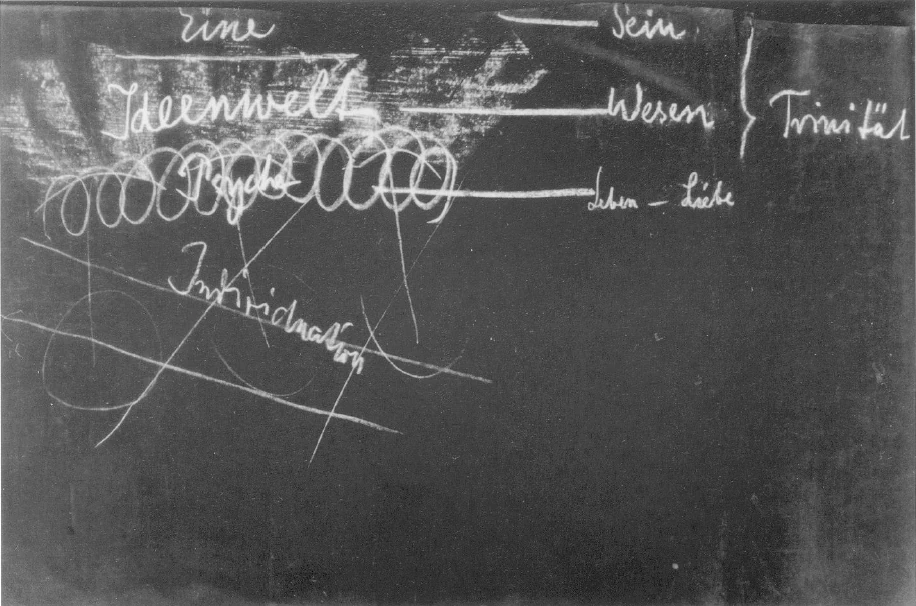
[ 26 ] Regarding this third-century philosopher, we must first say this: What we experience as the content of our understanding, as the content of our reason—what we experience as the sum of the concepts we form about the world—is by no means the same thing to him as it is to us. I would like to say—if I may speak figuratively (it is being drawn)—that we grasp the world through sensory perceptions, then, through abstraction, transform these sensory perceptions into concepts, and thus end up with the concepts. We have these concepts as an inner psychological experience, and—if we are average people of the present—we are more or less aware that we are dealing with abstractions, something we have, as it were, extracted from things. The essential point is that we end there; we turn our attention to sensory experience and end up where we form the sum of our concepts, our ideas.
[ 27 ] This was not the case for Plotinus. For Plotinus, this entire world of sensory perceptions was, in essence, initially barely existent. But that which was something for him—that of which he spoke just as we speak of plants, minerals, animals, and physical human beings—was something he now saw as lying above the concepts; it was a spiritual world, and this spiritual world had a lower boundary for him. This lower boundary was the concepts. While for us concepts are derived by turning to sensory objects, abstracting from them, and forming concepts—and we say: Concepts are the summaries, the extracts of an ideal nature derived from sensory perceptions—Plotinus, who initially paid little attention to sensory perceptions, said: “We as human beings live in a spiritual world, and what this spiritual world ultimately reveals to us—what we regard as its lower limit—are the concepts.”
[ 28 ] For us, the sensible world lies beneath the concepts; for Plotinus, however, a spiritual world lies beyond the concepts—the true intellectual world, the world of the true realm of the spirit. I could also use the following image: Let us imagine for a moment that we have submerged ourselves in the sea, and we look up toward the surface of the sea, seeing nothing but this surface, nothing above it—then the surface of the sea would be the upper boundary. We would be living in the sea, and we might have the feeling deep within our souls: “This boundary encloses us within the element of life in which we exist”—if we were beings organized for the sea.
[ 29 ] For Plotinus, it was different. He paid no attention to this sea surrounding him. For him, however, the boundary he saw there was the boundary of the world of concepts in which his soul lived—the lower boundary of that which lay above it; just as if we were to conceive of the edge of the sea as the boundary facing the airspace and the world of clouds, and so on. For Plotinus—who firmly believed that he was continuing Plato’s true, authentic vision—what lies beyond concepts is at the same time what Plato calls the world of Ideas. This world of Ideas is, first and foremost, something that is spoken of as a world in the sense of Plotinism.
[ 30 ] Surely it would not occur to any of you—even if you are subjectivists or adherents of modern subjectivist philosophy—when looking out at the meadow to say: “I have my meadow, you have your meadow, the third person has his meadow”—even if you are convinced that you all merely have the idea of the meadow. You speak of the unified meadow, of the one meadow that is out there; just as Plotinus speaks first of the one world of ideas, not of the world of ideas in this mind, or in a second mind, or in a third mind. The soul now participates in this world of ideas—and this is already evident from the very way in which one must characterize the train of thought that leads to this world of ideas—the soul participates in this world of ideas. So that we can say: In a sense, the soul, the psyche, unfolds out of the world of ideas, experiencing this world of ideas. And just as the world of ideas creates the psyche, the soul, so too does the soul, for its part, first create the matter in which it is embodied. Thus, that from which the psyche takes its body is, in essence, a creation of this psyche. |
[ 31 ] But it is only there that individuation begins; it is only there that the psyche—which otherwise participates in the unified world of ideas—begins to divide itself into body A, body B, and so on, and it is through this process that individual souls first come into being. The individual souls come into being as the psyche is, so to speak, incorporated into the individual material bodies. Just as if I had a large quantity of liquid as a single unit, then took twenty glasses and filled each one with this liquid, so that I would now have this liquid—which as such is a single unit—inside each one, so too do I have the psyche present everywhere by virtue of the psyche incarnating itself in bodies that it creates for itself. Thus, in the Plotinian sense, a person can first look at their outer appearance, at their vessel. But this is, in essence, merely the means through which the soul reveals itself, through which the soul also individualizes itself. Then the person must experience their soul internally, as it rises up to the world of ideas. Then there is a higher kind of experience. To speak of abstract concepts would make no sense to a Plotinist; for such abstract concepts—indeed, a Plotinist would have said: What are these, abstract concepts? Concepts cannot be abstract; concepts cannot hang in the air; they must somehow have been brought down from the Spirit; they must be the concrete manifestations of the spiritual.
[ 32 ] It is therefore incorrect to interpret what has been presented as “ideas” as mere abstractions. This is the expression of an intellectual world, a world of spirituality. It is precisely what was also present in the everyday experience of those people from whose circumstances Plotinus and his followers emerged. For them, such discourse on concepts—as we develop it today—made no sense at all, for to them there was only a penetration of the spiritual world into the soul. And at the threshold of this penetration, in the experience itself, this world of concepts emerged. But only then—when one delved deeper, when one further developed the soul—did that emerge which the ordinary person could not know, which was experienced precisely by one who soared to a higher level of experience. He then experienced that which lay even beyond the world of ideas—the One, if one wishes to call it that—the experience of the One, which for Plotinus was that which could not be reached by concepts, precisely because it lay beyond the conceptual world; it could only be attained if one could immerse oneself inwardly without concepts, and this is characterized by what we here in our spiritual science call imagination. You can read about this in my book *How Does One Attain Knowledge of the Higher Worlds?*, except that what is meant in this book is conceived in the sense of the present, whereas in Plotinus it was conceived in the sense of antiquity. What can be called “imagination” there, according to Plotinus, immerses itself in that which stands above the world of ideas.
[ 33 ] For Plotinus, this holistic view of the world actually gave rise to all knowledge concerning the human soul. After all, it is already inherent in it. And one can only be an individualist in Plotinus’s sense by being, at the same time, a person who recognizes how human beings elevate themselves into something that transcends all individuality—how they elevate themselves into a spiritual realm into which they, so to speak, rise upward—whereas in our age today we are more accustomed to immersing ourselves in the sensual. But all of this—which is the expression of something that even a true scholastic would regard as mere fantasy—is not, for Plotinus, something merely imagined; for Plotinus, these are not hypotheses. For Plotinus, this was a perception so certain—extending all the way to the One, which could be experienced only in exceptional cases—that for him it was as certain and as self-evident a perception as the perception of minerals, plants, and animals is for us today. He spoke only in the sense of something that is truly and immediately experienced by the soul when he spoke of the soul, the Logos, which participates in the Nous, in the world of ideas, and in the One.
[ 34 ] For Plotinus, the entire world was, in a sense, spiritual; this represented yet another nuance of worldview, distinct from Manichaeism and from the one to which Augustine aspired. Manichaeism recognizes a sensory-super-sensory realm; for it, the words and concepts of “matter” and “spirit” have no meaning yet. Augustine strives, starting from his sensory perception, to arrive at a non-sensory spiritual experience of the soul. For Plotinus, the entire world is spiritual; for him, sensory objects do not exist. For what appears to be material is merely the mode of manifestation—the lowest mode of manifestation—of the spiritual. Everything is spirit, and if we only penetrate deeply enough into things, everything reveals itself as spirit.
[ 35 ] This is something Augustine could not quite accept. Why? Because he did not share that perspective. Because he was already living in his own era as—well, if I were to call Plotinus a laggard from the old days when such insights were held, yet who still extended into the third century, then Augustine was precisely a forerunner, in contrast to that laggard—a forerunner of those people who could no longer feel, sense, or perceive that in the world of ideas a spiritual world reveals itself downward. He simply no longer saw that. He could only have it told to him. He could only learn of it from others. He could only conclude that this was what was said, and he could still develop a sense that there was something in it that constitutes a human path to truth. That was the conflict in which Augustine found himself when confronted with Plotinism. But in truth, he was never entirely deterred from striving for an inner understanding of this Plotinism. But the vision did not open up to him. He merely sensed: There must be something within this world. But he could not bring himself to do it. That was the state of mind in which Augustine withdrew into solitude, from which he then came to know the Bible and Christianity, and later the sermons of Ambrose and the Epistles of Paul. And it was this state of mind that finally led him to say: That which Plotinus sought as the essence of the world—first in the essence of the world of ideas, the Nous, or in the One, which can only be attained in special states of the soul—has indeed appeared in the flesh on earth in human form through Jesus Christ. — This leapt out at him as a conviction from the Bible: You do not need to strive upward toward the One; you need only look to what historical tradition conveys to you about Jesus Christ. There, the One has descended and become human.
[ 36 ] And Augustine exchanges the Church for the philosophy of Plotinus. He actually states quite clearly that he is exchanging the Church. He makes this clear by saying: “Who could be so deluded as to say that the Church of the Apostles does not deserve belief, a Church that is so faithful and supported by the consensus of so many brothers that it has conscientiously handed down their writings to posterity, just as it has preserved their cathedrals down to the present-day bishops through a strictly secured succession?” This is what Augustine, from the state of mind described above, now emphasizes as the primary value—that, after all, if one simply traces the history through the centuries, it can be demonstrated: There have been people who still knew the Lord’s disciples, and there exists a continuous and credible tradition that what Plotinus sought to attain through the method indicated has appeared on earth.
[ 37 ] And now Augustine felt the urge, to the extent that he could penetrate Plotinism, to use that Plotinism to understand what Christianity had revealed to him through his feelings, his sensibilities, and his inner perception. He did, in fact, apply what he had gained through Plotinus to understand Christianity and its content. For example, he reformulated the concept of the One. For Plotinus, the One was an experience; for Augustine, who could not penetrate to this experience, the One became something he designated with the abstract term “Being,” the world of ideas something he designated with the abstract concept of “Essence,” and the psyche something he designated with the abstract concept of “Life” or also with the concept of “Love.” The fact that Augustine proceeded in this way best characterizes us: he attempted to grasp the spiritual world—from which he conceived Christ Jesus as originating—using Neoplatonic, Plotinian concepts: that there is a spiritual world above humanity from which Christ originates. This tripartite structure was something that had become clear to Augustine through Plotinus. For Augustine, the three persons of the Trinity—the Father, the Son, and the Holy Spirit—became clear through Plotinus.
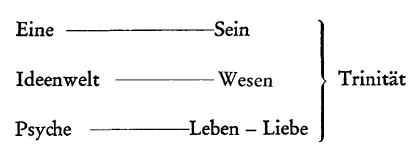
[ 38 ] And if one were to ask in all seriousness: What filled Augustine’s soul when he spoke of three Persons? — one must answer: He was filled by what he had learned from Plotinus. And he also incorporated into his understanding of the Bible what he had learned from Plotinus. One can see how this continues to have an effect, for this trinity comes to life again, for example, in Scotus Erigena, who lived at the court of Charles the Bald in the ninth century and who wrote a book on the division, on the structure of nature, in which we still find a similar trinity. Christianity interprets its content from the perspective of Plotinism.
[ 39 ] But what remained particularly strong in Augustine from this Plotinism was something fundamental to that very Plotinism. Just consider that, in fact, it is only by the psyche reaching down into the material world—as into a vessel—that a human being is an earthly individual. If we ascend even slightly into the higher realm of being—if we rise from the human to the divine or spiritual, where the Trinity is rooted—then we are no longer dealing with the individual human being; rather, we are dealing, so to speak, with the species, with humanity.
[ 40 ] We no longer derive our conceptions of all humanity so strongly from our present-day concepts, as Augustine did from Plotinus. I would say that, viewed from below, human beings appear as individuals; viewed from above—if one may put it that way hypothetically—all of humanity appears as a single entity. From this perspective, viewed from the front, all of humanity coalesced for Plotinus into Adam. Adam was all of humanity. And in that Adam emerged from the spiritual world, he was a being connected to the earth who possessed free will and who—because within him lived that which was still up above (not that which stems from the perversion of matter)—was incapable of sinning. It was impossible for this human being, who was initially Adam, to sin or to be unfree, and thus it was also impossible for him to die. Then came the influence of what Augustine perceived as the counter-spirit, as the satanic entity. It tempted and seduced the human being. He fell into matter, and with him, all of humanity.
[ 41 ] You see, in this respect, with the insight he had gained, Augustine is fully immersed in what Plotinism is. For him, all of humanity is one. It is not the individual human being who sins; rather, all of humanity sins in Adam. If one delves into what often lies between the lines—particularly in Augustine’s later writings—one sees how extraordinarily difficult it had become for Augustine to cast his gaze upon all of humanity, upon the possibility that all of humanity sins. For within him already lay the modern human being—the forerunner in contrast to the straggler. The individual human being lived within him—one who sensed that the individual becomes more and more responsible for what he does and learns. At certain moments, it seemed almost impossible to Augustine to feel that the individual human being is merely a link in the chain of all humanity. But Neoplatonism, Plotinism, was so deeply ingrained in him that he could, after all, only cast his gaze upon all of humanity. And so this condition of all human beings—the condition of sin, of sinning, of dying—had given way to the condition of being unable to be free, of being unable to be immortal.
[ 42 ] All of humanity had thus fallen, having turned away from its origin. And God, if He were merely just, would now simply have rejected humanity. But He is not merely just; He is also merciful. This is how Augustine understood it. Therefore, God decided to save a portion of humanity—note well: a portion of humanity. That is to say, God’s decree designated a portion of humanity to receive grace, through which this portion of humanity is restored from the state of being unable to be free, of being unable to be immortal, to the state of being able to be free, of being able to be immortal—though this can only be fully realized after death. A portion of humanity is restored to this state. The other portion of humanity—that is, the unchosen—remains in the state of sin. Thus, humanity is divided into these two parts: those who are chosen and those who are rejected. And if one views humanity from an Augustinian perspective, it is simply divided into these two groups: those who are destined for bliss through no merit of their own, merely because it is wisely ordained in the divine plan for the world; and those who, no matter what they do, cannot attain grace—those who are determined and predestined to fall into damnation. This view, also known as the doctrine of predestination, arose for Augustine from the way he directed his gaze toward all of humanity. If all of humanity sinned, then all of humanity was, in fact, deserving of the fate of that part of humanity that was rejected.
[ 43 ] We will discuss tomorrow the terrible intellectual struggles that arose from this doctrine of predestination, and how Pelagianism and Semipelagianism grew out of it. But today, I would just like to add one final point: We now see how Augustine, as a vividly struggling personality, stands right in the midst of that perspective which ascends toward the spiritual, and through whose gaze humanity becomes a whole. He interprets this in his own way, in the spirit of the doctrine of predestination. Yet within his soul lives the urge to rise from human individuality to a spiritual realm free of sensuality—a spiritual realm that, in turn, can originate only from individuality. This was precisely the defining characteristic of the age of which Augustine is the forerunner: that this age became aware of what people in antiquity had not perceived—individual experience.
[ 44 ] Today, so much is dismissed as mere rhetoric. Klopstock was still serious—not a mere rhetorician—when he began his *Messiah* with the words: “Sing, immortal soul, of the redemption of sinful mankind.” — Homer began just as honestly and sincerely: “Sing, O Goddess, of the wrath...” . or: “Sing to me, O Muse, of the man, the far-traveled Odysseus.” — These people did not speak of what lives within the individual; they spoke of what speaks through them as universal humanity, as the soul of the human race, as the psyche. It is no mere phrase when Homer has the Muse sing in his stead. The ability to perceive oneself as an individual is only now emerging. And Augustine is one of the first to have, in essence, actually perceived the individual existence of the human being with its individual responsibility. That is why he lived within this inner conflict. But it was precisely in his experience that the individual striving for the non-sensory spiritual arose. Within him was a personal, subjective struggle.
[ 45 ] In the period that followed, even whatever understanding Augustine might have had of Plotinism was lost. And after the Greek philosophers—the last followers of Plato— and Plotinus were forced to go into exile in Persia—and after these last philosophers found their successors at the Academy of Gundishapur—this aspiration toward the spiritual dried up in the West, and all that remained was what the philistine Aristotle passed down to posterity as filtered Greek philosophy, and even that only in isolated fragments. This took root and then, as we shall see, found its way into Europe via the Arabs—a roundabout route. This was that which no longer had any awareness of the actual world of ideas, which no longer had any Plotinism within it. And so the great question remained: Human beings must, after all, spin the spiritual out of themselves. Human beings must give birth to the spiritual as an abstraction. When they see lions and conceive of the concept of “lion,” when they see wolves and conceive of the concept of “wolf,” when they see human beings and conceive of the concept of “human being”—these concepts are alive only within them; this is what rises up from individuality.
[ 46 ] The whole question would not yet have made sense to Plotinus; now this question takes on meaning. And now this question takes on yet another, deeper meaning. Augustine was still able to grasp the mystery of Christ Jesus through what had shone into his soul from Plotinus’s teachings. What had existed as Plotinism had been buried; with the closure of the school of philosophy in Athens in 529 by Emperor Justinian, the living connection to such views was severed. Various people have deeply sensed what it means: We hear of a spiritual world in tradition, in Scripture; we experience, from within our individuality, supersensory concepts—concepts abstracted from the sensible. How do these concepts relate to Being? How do they relate to the essence of the world? Does what we form as concepts exist within us merely as something arbitrary, or does it have some connection to the external world?
[ 47 ] The questions arose in this form—in the most extreme abstraction, yet an abstraction that concerned the deepest human matters and those of the medieval Church. In this abstraction, in this heartfelt sincerity, the questions arose in the two figures of Albertus Magnus and Thomas Aquinas. They were then, in yet another level of abstraction, termed the questions of realism versus nominalism. How does one relate to a world described to us through concepts that can only be born within ourselves, out of our own individuality? That was the great question the medieval scholastics set before themselves. And if you consider the form that Plotinism took in Augustine’s doctrine of predestination, you will be able to sense the full depth of this scholastic question: Only a portion of humanity—and that only by God’s decree—could partake of grace, that is, attain salvation; the other portion was destined from the outset for eternal damnation, no matter what it might do. But what human beings were able to attain as the content of their knowledge arose precisely from that which Augustine had not yet been able to transform into his concept—the terrible concept of the doctrine of predestination—namely, human individuality. For Augustine, humanity was a whole; for Thomas, every single human being was an individual.
[ 48 ] How does this grand cosmic process of predestination, as Augustine saw it, relate to what the individual human being experiences? How does that which Augustine actually rejected entirely relate to what the individual human being can achieve? Consider this: because Augustine did not wish to give human individuality its due, he accepted the doctrine of predestination, thereby obliterating human individuality for the sake of humanity; Thomas Aquinas, on the other hand, had only the individual human being, with his quest for knowledge, before him. From what Augustine had excluded from his view of humanity, Thomas had to seek human knowledge and its relationship to the world.
[ 49 ] It is not enough to pose such a question in an abstract, intellectual, and rationalistic manner. It is necessary to grasp such a question with one’s whole heart, with one’s entire human personality. Only then will one be able to appreciate how heavily this question weighed upon those who bore it in the 13th century.