

What was the Purpose of the Goetheanum and of Anthroposophy?
GA 84
14 April 1923, Dornach
Translate the original German text into any language:
Versions Available:
What was the purpose of the Goetheanum, and of Anthroposophy?, tr. SOL
2. Die Steigerung der Menschlichen Erkenntnisfähigkeit zu Imagination, Inspiration und Intuition
2. The Expansion of Human Cognitive Abilities Toward Imagination, Inspiration, and Intuition
[ 1 ] Während dieser Kursus für Lehrer und pädagogisch Interessierte stattfindet, werde ich die Vorträge, die gleichzeitig mit diesem Kursus als besondere anthroposophische Kurse stattfinden, so halten, daß sie auch für diejenigen Persönlichkeiten verständlich sein können, welche in der letzten Zeit erst sich zur Anthroposophie gefunden haben, oder ganz in ihrem Anfange stehen. Daher wird manches von dem, was ich gerade im Laufe dieser Woche hier in diesen Vorträgen vorbringen werde, für die «erleuchteten Anthroposophen» eine Art Wiederholung sein. Aber ich denke, auch eine solche Wiederholung kann von dem einen oder dem anderen Gesichtspunkte aus ganz nützlich sein.
[ 1 ] While this course for teachers and those interested in education is taking place, I will deliver the lectures—which are being held concurrently with this course as special anthroposophical courses—in such a way that they can also be understood by those who have only recently discovered anthroposophy or are just beginning their journey. Therefore, some of what I will present here in these lectures over the course of this week will be a sort of review for the “enlightened anthroposophists.” But I think that even such a review can be quite useful from one perspective or another.
[ 2 ] Was ich heute vorbringe, soll zunächst eine Art weiterer Ausgestaltung sein dessen, was ich in dem öffentlichen Vortrag vorbrachte, den ich in der letzten Woche an verschiedenen Orten der Schweiz zu halten hatte. Es soll an diesen Vortrag anknüpfen und einiges davon weiter ausführen.
[ 2 ] What I am presenting today is intended, first and foremost, to be a further elaboration of what I discussed in the public lecture I gave last week at various locations throughout Switzerland. It is meant to build on that lecture and expand on some of its points.
[ 3 ] Wenn wir das menschliche Leben in seiner Ganzheit überblicken, so finden wir ja, daß dieses Leben zerfällt in zwei voneinander streng getrennte Lebensinhalte: in einen Lebensinhalt, den wir immer durchmachen in der Zeitzwischen dem Aufwachen und Einschlafen, also im gewöhnlichen Tagesbewußtsein; der andere Teil des Lebens, der beim normalen Menschen ja der kürzere ist, das ist der, den wir durchmachen jeweilig zwischen dem Einschlafen und Aufwachen. Es ist derjenige, welcher in die Unbewußtheit getaucht ist, und in das Bewußtsein nur dadurch heraufleuchtet, daß er in dieses Bewußtsein die bunte Mannigfaltigkeit der Traumwelt hineinfließen läßt. So daß, wenn wir vom Gesichtspunkt des menschlichen Bewußtseins sprechen, wir sagen müssen: Dieses Bewußtsein ist erfüllt während des Tagwachens von dem Inhalt, den uns unsere Sinne liefern. Was durch unsere Sinne uns von der Welt bekannt wird, das ist, sagen wir, in bildhafter Weise in unserem Bewußtsein vorhanden. Das erleben wir. Wir knüpfen, sei es im gewöhnlichen Leben, sei es in der Wissenschaft, an dasjenige an, was uns die Sinne überliefern, unsere Vorstellungen, unsere Gedanken; das heißt, wir kombinieren die Sinneswahrnehmungen, versuchen auch in der Welt der Sinneswahrnehmungen Gesetzmäßiges zu finden.
[ 3 ] When we look at human life in its entirety, we find that it is divided into two strictly separate aspects: one aspect that we always experience during the time between waking and falling asleep—that is, in our ordinary daytime consciousness; the other part of life—which, in the case of the average person, is the shorter of the two—is the one we experience between falling asleep and waking up. It is the part that is immersed in unconsciousness and shines up into consciousness only by allowing the colorful diversity of the dream world to flow into that consciousness. So that, when we speak from the standpoint of human consciousness, we must say: This consciousness is filled, during waking hours, with the content supplied to us by our senses. What we come to know of the world through our senses is, so to speak, present in our consciousness in a pictorial form. That is what we experience. Whether in everyday life or in science, we base our ideas and thoughts on what our senses convey to us; that is, we combine sensory perceptions and also attempt to find regularities within the world of sensory perceptions.
[ 4 ] Das alles treiben wir mit unserem Denkvermögen. Wir schließen die Gedanken, die Vorstellungen, die wir durch unser Denkvermögen erhalten können, an die Sinneseindrücke an. Dann entwickeln wir aber innerhalb unseres tagwachen Lebens noch etwas anderes. Wir sind von dem einen Ereignis, von dem einen Eindruck des Tages angenehm, von dem andern unangenehm berührt; wir sympathisieren mit dem einen Eindruck, der andere Eindruck ist uns antipathisch. In der mannigfaltigsten Weise und in den mannigfaltigsten Abstufungen ist diese Sympathie und Antipathie vorhanden. Und wir bezeichnen ja das, was wir da, ich möchte sagen, nach unserem menschlichen Inneren zu gelegen, an den Dingen so erleben, daß sie uns Freude machen, daß sie uns Schmerz machen, daß sie uns erheben, daß sie uns bestürzt machen, wir bezeichnen ja das als unser Fühlen mit den Dingen, und wir unterscheiden wohl deutlich zwischen unserem Fühlen und unseren Gedanken, die uns etwas Äußerliches repräsentieren. Unsere Gedanken leben nicht bloß in uns, sie repräsentieren uns etwas Äußerliches. Durch unsere Vorstellungen gewinnen wir etwas über die äußere Welt. Es liegt ja schon im Worte «Vorstellung», daß wir dadurch etwas über die äußere Welt gewinnen. Dasjenige, was wir vorstellen, das stellen wir nicht in, sondern wir stellen es vor uns. Der Gedanke weist uns also nach außen. Das Gefühl weist uns nach innen. Wir haben das deutliche Erlebnis, daß dasjenige, was wir fühlen, nach innen zu erlebt wird, und daß es mit dem Äußeren nicht in demselben Maße etwas zu tun hat wie der Gedanke, wie die Vorstellung.
[ 4 ] We do all of this with our power of thought. We link the thoughts and ideas that we can receive through our power of thought to our sensory impressions. But then, within our waking life, we develop something else as well. We are pleasantly affected by one event or one impression of the day, and unpleasantly affected by another; we sympathize with one impression, while another impression is repulsive to us. This sympathy and antipathy exist in the most varied ways and in the most varied degrees. And we do, in fact, describe what we experience in things—I would say, in accordance with our inner human nature—in such a way that they bring us joy, cause us pain, uplift us, or distress us; we describe this as our feeling toward things, and we make a clear distinction between our feelings and our thoughts, which represent something external to us. Our thoughts do not merely exist within us; they represent something external to us. Through our mental images, we gain insight into the external world. It is already implied in the word “mental image” that through it we gain insight into the external world. What we mentally image, we do not place within ourselves, but rather before us. Thought, then, directs us outward. Feeling directs us inward. We have the clear experience that what we feel is experienced inwardly, and that it has less to do with the external world than thought or imagination does.
[ 5 ] Aber wir erleben noch ein Weiteres an der Welt. Wenn bei manchem Menschen es vorkommt, daß ihm, sagen wir, da oder dort ein bösartiger Hund begegnet, so läuft er davon. Mancher läuft schon davon, wenn er eine Maus sieht; aber auch unter anderen Eindrücken der Außenwelt geschieht etwas Ähnliches. Wir sagen in diesem Falle, es wird unser Wille erregt. Während das Fühlen so verläuft, daß wir dabei ruhig bleiben, bringen wir durch unseren Willen, zunächst grob gesprochen, unseren ganzen Organismus in bezug auf die Außenwelt in Bewegung.
[ 5 ] But there is yet another aspect of the world we experience. When some people happen to encounter, say, a vicious dog here or there, they run away. Some run away even when they see a mouse; but something similar happens in response to other impressions from the outside world as well. In this case, we say that our will is stirred. While feeling proceeds in such a way that we remain calm, through our will—roughly speaking—we set our entire organism in motion in relation to the outside world.
[ 6 ] So sprechen wir, wenn wir von unserem Bewußtsein sprechen wollen, wie es während des Tagwachens sich entwickelt. Von diesem Bewußtsein unterscheiden wir deutlich die Unbewußtheit, die ja auch zu unserem Leben gehört, und die wir zubringen zwischen dem Einschlafen und dem Aufwachen. Nur strömt eben aus dieser Unbewußtheit des Schlafens die bunte Mannigfaltigkeit der Traumeswelt herauf.
[ 6 ] This is how we speak when we want to describe our consciousness as it develops during waking hours. We clearly distinguish this consciousness from the unconscious state, which is also part of our life and which we experience between falling asleep and waking up. It is precisely from this unconscious state of sleep that the colorful diversity of the dream world emerges.
[ 7 ] Nun wollen wir uns einmal ein wenig aufklären über das, was so für das gewöhnliche menschliche Bewußtsein einen bestimmten Wert hat. Wir können sagen: Für dieses gewöhnliche menschliche Bewußtsein spielt aus dem Unbewußten heraus die Traumeswelt. Sie glänzt herein in das Bewußtsein. Und dann tritt im Bewußtsein auf aus den Erlebnissen des Tages heraus, aus den Erlebnissen des Wachzustandes heraus Denken, Fühlen und Wollen.
[ 7 ] Now let’s take a moment to shed some light on what holds a certain value for ordinary human consciousness. We can say: For this ordinary human consciousness, the world of dreams emerges from the unconscious. It shines into consciousness. And then, arising from the experiences of the day—from the experiences of the waking state—thinking, feeling, and willing emerge in consciousness.
[ 8 ] Wie können wir zunächst in einer, ich möchte sagen, populär-äußerlichen Weise diesen Unterschied angeben zwischen dem unbewußten Zustand des Menschen, aus dem die Träume herausglänzen, und dem vollwachen Zustand?
[ 8 ] How can we begin by describing—in what I would call a popular, superficial way—this difference between the unconscious state of the human mind, from which dreams emerge, and the fully awake state?
[ 9 ] Nun, Sie werden nicht lange nachzudenken brauchen darüber, Sie werden finden, daß der Mensch im Wachzustand sich in dasjenige eingeschaltet fühlt, was er seinen physischen Organismus nennt.
[ 9 ] Well, you won't have to think about it for long; you'll find that, when awake, a person feels connected to what he calls his physical organism.
[ 10 ] Nehmen Sie die Welt des Traumes. Sie läuft in Bildern vor Ihnen ab. Sie müssen sich sagen, während die Welt des Traumes in Bildern vor Ihnen abläuft, sind Sie’in Ihren physischen Organismus nichteingeschaltet. Beim Aufwachen fühlt der Mensch vor allen Dingen: der Wille durchdringt seinen physischen Organismus. Auch unsere Sinne brauchen wir ja wachend dadurch, daß wir sie durch unseren Willen beherrschen. So also können wir sagen: Der Schlafzustand, aus dem der Traum herausquillt, geht in den Wachzustand dadurch über, daß wir den Willen einschalten gewissermaßen in den physischen Organismus.
[ 10 ] Consider the world of dreams. It unfolds before you in images. You must tell yourself that while the world of dreams unfolds before you in images, you are not connected to your physical body. Upon waking, the first thing a person feels is that the will permeates their physical body. We also need our senses while awake by controlling them through our will. Thus, we can say: The state of sleep, from which the dream springs, transitions into the waking state by our will, as it were, becoming engaged in the physical body.
[ 11 ] Sehen wir also einmal jetzt auf diesen physischen Organismus hin. Schon indem ich sage: Sehen wir auf den physischen Organismus hin — appelliere ich eigentlich an Ihr sinnliches Anschauungsvermögen. Ich appelliere an dasjenige, was Sie durch dieses sinnliche Anschauungsvermögen wissen. Sie können zunächst von diesem physischen Organismus des Menschen auch nichts anderes wissen, als was Ihnen die Sinne überliefern, was Sie über den physischen Organismus denken können. Auch keine Anatomie, auch keine Physiologie weiß über diesen physischen Organismus anderes als dasjenige, was die Sinne erkennen lehren, und was durch das Denken, die Sinneswahrnehmungen kombinierend, von dem Menschen erfaßt werden kann.
[ 11 ] So let us now turn our attention to this physical organism. Simply by saying, “Let us turn our attention to the physical organism”—I am in fact appealing to your sensory perception. I am appealing to what you know through this sensory perception. At first, you cannot know anything else about this physical organism of the human being other than what your senses convey to you—what you can think about the physical organism. Neither anatomy nor physiology knows anything more about this physical organism than what the senses teach us to recognize, and what can be grasped by human beings through thinking, which combines sensory perceptions.
[ 12 ] Dadurch werden wir aber darauf aufmerksam gemacht, daß es zunächst die Sinne sind — wir werden uns darüber ja auch im Gebrauch unseres Bewußtseins klar —, an die wir uns wenden müssen, wenn wir über die Welt im allgemeinen und über den physischen Organismus des Menschen etwas wissen wollen — die Sinne und das Denken.
[ 12 ] This, however, draws our attention to the fact that it is first and foremost the senses—as we realize when we use our consciousness—to which we must turn if we wish to know anything about the world in general and about the human physical organism—the senses and thought.
[ 13 ] Sehen wir uns einmal die Sinne an und prüfen wir in ganz populärer Weise, was wir durch die Sinne haben in bezug auf die zwei charakteristisch unterschiedenen Zustände des Wachens und des Schlafens.
[ 13 ] Let's take a look at the senses and examine, in very simple terms, what we experience through them in relation to the two distinct states of wakefulness and sleep.
[ 14 ] Der Mensch denkt über dasjenige, was da in Betracht kommt, allzuwenig nach, weil, wenn er nicht gerade blind ist, der Löwenanteil dessen, was er in seinem Erleben bewußt hat, von den Augen her kommt, und die Augen gerade diejenigen Organe sind, die im schlafenden Zustand beim Menschen geschlossen werden, wodurch die äußeren Eindrücke abgehalten werden. Aber denken Sie einmal an die anderen Sinne. Können Sie glauben, daß Ihr Ohr, wenn Sie es nicht verstopfen, Ihnen andere Erlebnisse während des Schlafes liefert als während des Tages in bezug auf den physischen Leib? Wenn Sie den physischen Leib ordentlich ins Auge fassen und Ihr Ohr nicht verstopfen in der Nacht, so können Sie unmöglich denken, daß durch das Ohr in Ihrem physischen Organismus, wenn Sie schlafen, etwas anderes vorgeht, als wenn Sie wachen. Es ist ja gar kein Grund dazu da. Daß Sie das nicht wissen, das ist eine ganz andere Sache.
[ 14 ] People give far too little thought to this matter because—unless they are actually blind—the lion’s share of what they are consciously aware of in their experience comes from the eyes, and the eyes are precisely those organs that close when a person is asleep, thereby blocking out external impressions. But just think for a moment about the other senses. Can you believe that your ear—if you do not block it—provides you with different experiences during sleep than during the day with regard to the physical body? If you consider the physical body properly and do not block your ear at night, you cannot possibly think that anything different takes place through the ear in your physical organism when you sleep than when you are awake. There is simply no reason for it. The fact that you do not know this is an entirely different matter.
[ 15 ] Oder fragen wir in bezug auf den Wärmesinn. Wir nehmen Wärme und Kälte wahr. Ja, glauben Sie, daß die Wärme, die Sie während des Tages wahrnehmen, vor Ihrer Haut haltmacht, wenn Sie schlafen? Sie wird selbstverständlich auf die Haut ganz dieselbe Wirkung ausüben. Sie sind also während des Schlafens mit Ausnahme des Gesichtes genau denselben Eindrücken ausgesetzt, denen Sie während des Wachens ausgesetzt sind.
[ 15 ] Or let’s consider the sense of heat. We perceive heat and cold. Yes, do you believe that the heat you perceive during the day stops at your skin when you sleep? It will, of course, have exactly the same effect on your skin. So while you sleep—with the exception of your face—you are exposed to exactly the same sensations as when you are awake.
[ 16 ] Wenn das nicht der Fall wäre, müßten Sie ja annehmen, daß Sie während des Schlafens einen Wärmemantel um sich haben, der die Wärme abhält. Sie müßten denken, daß Ihnen ein guter Geist die Ohren zustopfe, damit die Vorgänge, die sonst von außen bewirkt werden, nicht bewirkt werden. Wenn Sie sich das alles vorhalten, kommen Sie darauf, sich zu sagen: Nun ja, das Auge ist eben so empfindlich, daß sich der menschliche Organismus darauf eingerichtet hat, seinen Willen dazu zu benützen, die Vorhänge der Lider über die Augen zu hängen während des Schlafzustandes.
[ 16 ] If that were not the case, you would have to assume that while you sleep, you are wrapped in a thermal blanket that keeps the heat out. You would have to think that a benevolent spirit is plugging your ears so that the processes that would otherwise be triggered by external stimuli do not occur. When you consider all this, you come to the conclusion: Well, the eye is simply so sensitive that the human organism has adapted to use its will to draw the curtains of the eyelids over the eyes during sleep.
[ 17 ] Allerdings, ein wenig sorgt ja die Außenwelt dafür, daß die Sinneseindrücke ausbleiben während der Schlafenszeit. Aber wenn auch erst neulich hier in der Zeitung zu lesen war, daß es angenehmer wäre für diejenigen Leute in Basel, die schlafen wollen und in der Nähe von Wirtschaften wohnen, daß für die Konzerte der Schluß schon um halb elf sei und nicht um elf, so weist das deutlich darauf hin, daß man die Ohren geschützt haben will; aber man muß sie von außen schützen. Wenn das auch alles der Fall ist, so muß man doch sagen: Wie auch die Außenwelt während des Schlafens gestaltet ist, wie sie einmal ist, so wirkt sie auf unsere Sinne mit Ausnahme der Augen.
[ 17 ] That said, the outside world does play a small part in ensuring that sensory stimuli are kept at bay during sleep. But even though it was reported just recently in this newspaper that it would be more pleasant for those people in Basel who want to sleep and live near restaurants if concerts ended at half past ten instead of eleven, this clearly indicates that people want to protect their ears—but they must be protected from the outside. Even if all of that is true, one must still say: No matter how the outside world is structured during sleep, no matter what it is like, it still affects our senses—with the exception of the eyes.
[ 18 ] Und dann müssen wir uns weiter fragen: Wie ist es denn nun mit unserem Denken, mit unseren Gedanken? Sehen Sie, man könnte, um diese Frage zu beantworten, von mancherlei Gesichtspunkten ausgehen; aber für den heutigen Menschen ist ja nun einmal die moderne Wissenschaft populär geworden, und daher weiß der moderne Mensch, daß von jedem Sinn nach dem Innern des Organismus eine Fortsetzung geht, nämlich die Nervenstränge, und daß dadurch, daß die Nervenstränge als Fortsetzung der Sinne nach innen gehen, sich an die Sinnesempfindung das Denken, das Vorstellen anschließt.
[ 18 ] And then we must ask ourselves: What about our thinking, our thoughts? You see, to answer this question, one could start from various points of view; but for people today, modern science has, after all, become popular, and therefore modern people know that each sense has a continuation into the interior of the organism—namely, the nerve tracts—and that, because the nerve tracts extend inward as continuations of the senses, thinking and imagination follow on from sensory perception.
[ 19 ] Ja, wenn Sie nun, und sei es auch nur die relative Stille in der Nacht, hören — und es ist ja ganz natürlich, daß Sie sie hören, denn Ihr Ohr ist offen, dasjenige, was in Ihrer Umgebung ist, ist hörbar, das verursacht dieselben Vorgänge, die es verursachen würde, wenn Sie wach wären —, warum sollte denn das haltmachen vor den Nerven, das heißt vor dem Denken?
[ 19 ] Yes, if you now hear—even if it is only the relative silence of the night—and it is, after all, perfectly natural that you hear it, because your ear is open, and whatever is in your surroundings is audible, triggering the same processes that would be triggered if you were awake—why should that put a stop to your nerves, that is, to your thinking?
[ 20 ] Sie müssen sich also sagen, durch Ihren physischen Organismus halten Sie — wie gesagt, immer mit der Ausnahme der Augen — die Sinneseindrücke nicht ab. Aber Sie halten auch die Gedanken nicht ab. Und Sie können sogar — es bleibt das ja zunächst für die äußere Beobachtung hypothetisch — vorstellen; wenn auch durch die sozialen Einrichtungen eine relative Ruhe da ist während der Nacht für gewisse Sinne — für andere Sinne ist sie ganz gewiß nicht vorhanden; für den Wärme- und Kältesinn zum Beispiel ganz gewiß nicht, für den Tastsinn auch nicht, denn, nicht wahr, wenn Sie mit dem Daumen auf die Tafel drücken, nehmen Sie den Druck wahr. Warum sollte denn das Wahrnehmen des Druckes just nicht der Fall sein, wenn Sie Ihren Rücken auf das Bett legen? Sie müssen natürlich diesen Druck, den der Tastsinn vermittelt, während der ganzen Nacht wahrnehmen. Ebenso wenn Sie etwas auf Ihre Hand legen, nehmen Sie das wahr. Warum sollten Sie nicht die ganze Nacht hindurch die Bettdecke wahrnehmen, die Sie auf sich legen, und so weiter? Aber nicht nur das, sondern die Fortsetzung nach innen, die Ausbildung der Vorstellungen und Gedanken, warum sollte denn vor denen haltgemacht werden? Denn die sind ja durch den Organismus vermittelt.
[ 20 ] So you must tell yourself that your physical organism does not block sensory impressions—as I said, with the exception of the eyes. But it does not block thoughts either. And you can even—though this remains hypothetical for external observation at first—imagine that, even if social institutions provide a relative calm at night for certain senses, this calm certainly does not exist for other senses; certainly not for the senses of heat and cold, for example, nor for the sense of touch, because, isn’t it true that when you press your thumb against the blackboard, you perceive the pressure? Why, then, should the perception of pressure not be the case when you lie on your back in bed? You must, of course, perceive this pressure—conveyed by the sense of touch—throughout the entire night. Likewise, when you place something on your hand, you perceive it. Why shouldn’t you perceive the bedspread you lay over yourself throughout the night, and so on? But not only that—what about the inward continuation, the formation of ideas and thoughts? Why should the process stop there? For these, after all, are mediated by the organism.
[ 21 ] So daß wir, wenn wir unbefangen betrachten, was da eigentlich vorliegt, uns sagen müssen: Auch wenn der physische Leib während des Schlafes im Bette liegt, hat er die gewöhnlichen Eindrücke durch die Sinne. Er hat auch die gewöhnlichen Erlebnisse, die uns beim Tagwachen als bewußte Vorstellungen auftreten. Geradeso, wie wir bei Nacht nichts wissen von den Sinneseindrücken und sie doch da sein können, so wissen wir nichts von unseren Gedanken; sie sind aber da.
[ 21 ] So that, when we look impartially at what is actually the case, we must say to ourselves: Even though the physical body lies in bed during sleep, it still receives the usual sensory impressions. It also has the usual experiences that appear to us as conscious perceptions when we are awake during the day. Just as we are unaware of sensory impressions at night, even though they may still be present, so too are we unaware of our thoughts; yet they are there.
[ 22 ] Das macht sich der Mensch gewöhnlich nicht klar, daß, wenn er schläft, er fortwährend denkt. Nur weiß er nichts davon. Geradesowenig, wie er von dem Druck der Bettdecke etwas weiß, die auf ihm liegt, so weiß er nichts von den Gedanken, die fortwährend im Schlafe ablaufen. Die sind da. Der Mensch denkt die ganze Zeit seines Lebens, nicht nur während des Tages. Wenn er auch nicht bewußt Gedanken hat, so denkt er doch, so sind diese Gedanken doch eben in ihm. So daß wir da geführt werden darauf, wie der Mensch auch vom Einschlafen bis zum Aufwachen von einer Gedankenwelt durchsetzt ist.
[ 22 ] People usually don’t realize that when they sleep, they are constantly thinking. They are simply unaware of it. Just as they are unaware of the pressure of the blanket lying on them, so too are they unaware of the thoughts that are constantly flowing through their minds while they sleep. They are simply there. People think throughout their entire lives, not just during the day. Even when they are not consciously thinking, they are still thinking; these thoughts are simply within them. This leads us to the realization that people are permeated by a world of thoughts from the moment they fall asleep until they wake up.
[ 23 ] Nun nehmen Sie den aufwachenden Menschen. Er wacht auf. Er wacht aus den Träumen auf, sagen wir. Man kann sehr leicht dadurch, daß man gewisse Träume studiert, wahrnehmen, wie rasch der Traum abläuft, so, daß er unmittelbar eigentlich im Erwachen sich abgespielt hat. Sie brauchen sich nur daran zu erinnern, daß Sie etwa träumen können — ich will natürlich keinem das zumuten, jeder einzelne ist ausgenommen, aber es könnte doch einem Menschen passieren —, daß Sie mit jemandem in heftigen Wortwechsel kommen, der in eine Rauferei ausartet. Sie wissen, in den Träumen ist man manchmal viel unartiger als während des Tages. Es artet in eine Rauferei aus; der andere haut Ihnen eine herunter, wie man sagt, und siehe da, Sie wachen auf: Da bemerken Sie, daß ein Regentropfen auf Ihre Backe gefallen ist. Der hat Sie sogar aufgeweckt, der Regentropfen. Der ganze Traum, der so aussieht, als wenn er lange Zeit gedauert hätte, ist nur durch diesen Regentropfen verursacht im Moment des Aufwachens.
[ 23 ] Now take the person who is waking up. He wakes up. He wakes up from his dreams, let’s say. By studying certain dreams, one can very easily perceive how quickly the dream unfolds—so much so that it actually took place right in the moment of waking. You only need to recall that you might dream—I certainly don’t want to suggest this to anyone; every individual is exempt, of course—but it could happen to someone: that you get into a heated argument with someone, which escalates into a brawl. You know, in dreams people are sometimes much more unruly than they are during the day. It escalates into a brawl; the other person punches you, as they say, and lo and behold, you wake up: That’s when you notice that a raindrop has fallen on your cheek. It was actually the raindrop that woke you up. The entire dream, which seems as though it had lasted a long time, was caused solely by that raindrop at the moment of waking.
[ 24 ] So können Sie das bei unzähligen Träumen erleben. Sie verlaufen eigentlich im Nu, durch irgend etwas veranlaßt, haben einen ganz dramatischen Inhalt. Wir können also sagen: Sie wachen auf mit einem Traum. Sie werden fiinden, wenn Sie wirklich richtig zu Werke gehen, daß der Traum Ihnen irgend etwas gibt, was Sie nach Ihren Erlebnissen sonst auch hätten denken können, aber Sie würden es wachend anders gedacht haben. Wir wissen, daß der Traum dasjenige, was er zum Erleben bringt, in eine gewisse Phantastik kleidet.
[ 24 ] You can experience this with countless dreams. They actually pass in the blink of an eye, triggered by something, and have quite dramatic content. So we can say: You wake up with a dream. If you really set about analyzing it properly, you will find that the dream gives you something that you might otherwise have thought of based on your experiences, but you would have thought of it differently while awake. We know that the dream cloaks what it brings to our experience in a certain fantastical quality.
[ 25 ] Nehmen Sie das Beispiel, das ich eben gesagt habe. Wenn Ihnen bei Tag ein Regentropfen auf die Backe fällt, so haben Sie andere Bilder von dem ganzen Vorgang als jenen dramatischen Vorgang, wo Sie mit jemandem in Wortwechsel kommen und zu raufen beginnen; der Wortwechsel kann vielleicht sehr lange dauern, das Raufen auch noch verhältnismäßig lange, und dann kommt, sagen wir, der Backenstreich, und das ist das Ende, da wachen Sie auf. Bei Tag hätten Sie ein sehr einfaches Erlebnis gehabt, eine Sinneswahrnehmung und eine sich daran knüpfende Vorstellung. Im Aufwachen haben Sie ein sehr dramatisches Erlebnis. Es ist ausgeschmückt. Aber sehen Sie, Sie werden kaum anderes träumen, als was sich zusammensetzt aus Sinneserlebnissen, die Sie irgendwie schon gehabt haben oder haben könnten, oder etwa innere Leibeserlebnisse und dergleichen. Das träumen Sie dann.
[ 25 ] Take the example I just mentioned. If a raindrop falls on your cheek during the day, you have a different perception of the whole event than you do of that dramatic situation where you get into an argument with someone and start fighting; the argument might go on for a very long time, the scuffle might also last a relatively long time, and then comes, let’s say, the slap, and that’s the end—that’s when you wake up. During the day, you would have had a very simple experience: a sensory perception and a mental image associated with it. Upon waking, you have a very dramatic experience. It is embellished. But you see, you will hardly dream of anything other than what is composed of sensory experiences that you have somehow already had or could have, or perhaps internal bodily sensations and the like. That is what you will dream.
[ 26 ] Sehen Sie sich den ganzen Vorgang an, so werden Sie, je mehr Träume Sie beobachten, desto mehr darauf kommen, worin das Träumen eigentlich besteht. Wenn Sie wach sind, da sehen Sie durch Ihre Augen Farben — hell, dunkel; Sie hören dies oder jenes, Sie nehmen Wärme und Kälte wahr. Sie kombinieren das durch Ihren Verstand. Sie haben das deutliche Gefühl: Wenn Sie das alles tun, so wirken Sie von innen nach außen. Sie haben innen den Willen, mit dem Sie das alles durchdringen. Sie wirken von innen nach außerhalb. Lassen wir zunächst ganz unberührt, was da von innen nach außen wirkt; aber Sie haben das Gefühl: Sie ergreifen Ihre Sinneseindrücke, Sie bringen die Sinneseindrücke durch die Vorstellungen irgendwie in Ordnung. Sie kombinieren diese Sinneseindrücke und so weiter. Aber das machen Sie alles von innen aus. Ja, wenn Sie träumen, denken Sie nur einmal darüber nach, da haben Sie ähnliche Bilder, wie die Sinneseindrücke sind. Sie brauchen sich nur an einen lebhaften Traum zu erinnern, so werden Sie sich sagen: Da sind ähnliche Bilder. Sie sehen Farben, Sie sehen, wie sich jemand bewegt und so weiter; Bilder sind da, wie sie zuletzt auch da sind in der Sinneswelt. Nur daß bei der Sinneswelt gewissermaßen diese Bilder über die harten Gegenstände darübergelegt sind; im Traume schweben sie frei, diese Sinnesbilder. Und Vorstellungen sind auch darinnen im Traum, sogar Ursache und Wirkung, auf die die Naturwissenschaft so stolz ist. Man träumt ja nicht bloß Bilder, man träumt Zusammenhänge. Das ist alles darinnen.
[ 26 ] If you observe the entire process, you will find that the more dreams you observe, the more you will come to understand what dreaming actually consists of. When you are awake, you see colors through your eyes—light and dark; you hear this or that; you perceive warmth and cold. You process all of this through your mind. You have the distinct feeling that when you do all this, you’re acting from the inside out. You have the will within you with which you permeate all of this. You act from the inside out. Let’s leave aside for now what exactly is acting from the inside out; but you have the feeling that you take in your sensory impressions and somehow organize them through your ideas. You combine these sensory impressions and so on. But you do all of this from within. Yes, when you dream, just think about it for a moment—you have images similar to sensory impressions. You need only recall a vivid dream, and you will say to yourself: There are similar images. You see colors, you see how someone moves, and so on; images are there, just as they are in the sensory world. Except that in the sensory world, these images are, so to speak, superimposed on solid objects; in dreams, these sensory images float freely. And concepts are also present in dreams—even cause and effect, of which the natural sciences are so proud. After all, one does not merely dream images; one dreams of connections. It’s all there.
[ 27 ] Nur, wenn Sie genau hinschauen auf den Traum, dann werden Sie sich sagen müssen: Ja, wie ich im Traum erlebe, das ist eigentlich just umgekehrt, als wie ich während des Wachens erlebe. Es ist umgekehrt. Während des Wachens weiß ich, ich empfange Sinneseindrücke, ich beherrsche diese durch meine Gedanken. Wenn ichtträume, da überfallen mich zunächst dieSinneseindrücke, und dann lebt so in den Sinneseindrücken drinnen eine Art Zusammenhang, wie er sonst durch die Gedanken lebt. So wie wenn der Zusammenhang hinter den Sinnesbildern stünde, so ist es im Traume. Und denken Sie über diese Dinge ordentlich nach, so werden Sie finden: dieses Träumen ist eigentlich umgekehrt. Da ist es so, wie wenn Sie zuerst auf die Sinnesempfindungen auftreffen würden und dann das Denken nicht recht erhaschen könnten. Daher sind die Sinnesbilder so inkonsequent, so unlogisch. Sie können das Denken nicht erhaschen. Wenn Sie wach sind, dann haben Sie mehr oder weniger, je nachdem Sie mehr Philister oder phantasievoller Mensch sind, die Sinnesbilder in Ihrer Gewalt, in Ihrer Kraft. Sie wissen, da ist das Denken in Ihnen selbst drinnen, und mit dem Denken beherrschen Sie die Sinnesbilder, die etwas weiter von Ihnen sind. Beim Traume, da stoßen Sie auf die Sinnesbilder auf. Das Denken, das ist jetzt weiter weg, das können Sie nicht erhaschen. Kurz, Sie bekommen, wenn Sie die Sache vernünftig betrachten, den Eindruck: Wenn Sie wachen, so leben Sie von innen nach außen, da sind die Sinnesbilder außen (gelbe Pfeile), und da drinnen ist das Denken (violette Pfeile). Das macht sich geltend.
[ 27 ] Only when you look closely at the dream will you have to admit to yourself: Yes, what I experience in the dream is actually the exact opposite of what I experience while awake. It is the opposite. While awake, I know that I receive sensory impressions, and I control them through my thoughts. When I’m not dreaming, sensory impressions first overwhelm me, and then a kind of coherence lives within those sensory impressions—the kind that otherwise lives through thoughts. Just as if the coherence were behind the sensory images, so it is in a dream. And if you think carefully about these things, you will find: this dreaming is actually the other way around. It is as if you were to encounter sensory perceptions first and then be unable to quite grasp thought. That is why the sensory images are so inconsistent, so illogical. You cannot grasp thought. When you are awake—depending on whether you are more of a philistine or a person of imagination—you have the sensory images more or less under your control, within your power. You know that thought is within you, and through thought you control the sensory images, which are somewhat further removed from you. In a dream, however, you come face to face with the sensory images. Thinking is now farther away; you cannot grasp it. In short, if you look at the matter rationally, you get the impression that when you are awake, you live from the inside out: the sensory images are on the outside (yellow arrows), and thinking is on the inside (purple arrows). This is how it works.
[ 28 ] Wenn Sie träumen, dann ist es umgekehrt (rote Pfeile), dann nähern Sie sich erst den Sinnesbildern, können aber nicht das Denken dahinten erhaschen; an das kommen Sie nicht ordentlich heran. Daher spielt das Denken im Traum drinnen so bunt.
[ 28 ] When you dream, it’s the other way around (red arrows)—you first approach the sensory images, but you can’t grasp the thought behind them; you can’t really get to it. That’s why thought plays out so vividly in dreams.
[ 29 ] Sie können durch eine richtige Beobachtung unterscheiden, wie es mit Traum und sinnlicher Wirklichkeit ist. Bei der gewöhnlichen tagwachenden sinnlichen Wirklichkeit leben Sie von innen nach außen. Da sind Sie mit Ihrem Denken recht intim zusammen. Da ist Ihnen das Denken näher. Mit diesem Denken kombinieren Sie die Sinneseindrücke.
[ 29 ] Through careful observation, you can distinguish between dreams and sensory reality. In ordinary, waking sensory reality, you experience life from the inside out. There, you are quite intimately connected with your thoughts. Your thoughts are closer to you there. You combine your sensory impressions with these thoughts.

[ 30 ] Beim Träumen — es ergibt sich das aus der Betrachtung — da muß man draußen sein, denn an das Denken kommt man nicht ordentlich heran. Daher spielt der Traum eine so kuriose Logik, weil das Denken jenseits ist. Man ist also, wenn man wacht, da, und wenn man träumt, dort draußen (siehe Zeichnung). Aber man ist gerade eben hereingekommen, denn das geht dann über in den gewöhnlichen Wachzustand, wo man mit dem Denken intim ist. Fühlen Sie nur, wenn der Traum verläuft, verläuft er ja in das gewöhnliche Tagesbewußtsein. Sie sausen hinein in Ihr ordentliches Denken, Sie passieren Ihre Körperoberfläche. Sie passieren die Augen, aber von außen. Sie haben noch nicht den Sehnerv. Sie haben die Augen, die passieren Sie. Und der Sehnerv, der wirkt von der andern Seite, von einer Art Jenseits, gaukelt da mit den Bildern noch herum, wenn Sie hereinschlüpfen; dann sind Sie mit dem Nerv intim, der macht aus den Bildern eine ordentliche Welt. So ist es mit allen übrigen Sinnen.
[ 30 ] When dreaming—as becomes clear upon reflection—one must be “out there,” because one cannot properly access one’s thinking. That is why dreams follow such a curious logic: because thinking is beyond one’s reach. So when one is awake, one is “here,” and when one dreams, one is “out there” (see drawing). But you’ve just come back in, because it then transitions into the ordinary waking state, where you’re intimately connected with your thinking. Just notice: as the dream fades, it dissolves into ordinary daytime consciousness. You rush back into your normal thinking; you pass through the surface of your body. You pass by your eyes, but from the outside. You don’t yet have the optic nerve. You have the eyes—they pass by you. And the optic nerve, which acts from the other side, from a kind of beyond, is still playing around with the images as you slip in; then you become intimately connected with the nerve, which turns the images into an orderly world. It is the same with all the other senses.
[ 31 ] Sie können also sehen, einfach indem Sie die Tatsachen konstatieren, wie das Erwachen wirklich in einem Hineinschlüpfen in den Leib besteht. Worin muß denn also der Schlaf bestehen? Sie brauchen nur diesen Tatbestand ordentlich sich vor das Seelenauge zu rücken, so werden Sie sich sagen: Da muß ich irgendwie außer meinem Leibe sein.
[ 31 ] So you can see, simply by stating the facts, that awakening truly consists of slipping back into the body. What, then, must sleep consist of? You need only clearly picture this fact in your mind’s eye, and you will say to yourself: “I must somehow be outside my body.”
[ 32 ] Und jetzt gehen wir einmal das gewöhnliche Bewußtsein des Tages durch. Die «Erleuchteten», die werden eben nur eine Wiederholung in dem haben, was ich jetzt zu sagen habe. Gehen wir die Vorstellungen durch, da werden wir finden: In dem Vorstellen wachen wir wirklich, da sind wir mit unserem Denken intim zusammen, da wachen wir wirklich. Also mit dem, was da als unser Denken in uns sitzt, mit dem sind wir intim zusammen im Wachen, mit Bezug auf das wachen wir wirklich.
[ 32 ] And now let’s go through our ordinary daily consciousness. The “enlightened ones”—for them, what I am about to say will simply be a repetition. Let’s go through the concepts, and we will find: In imagination, we are truly awake; there we are intimately connected with our thinking; there we are truly awake. So with what resides within us as our thinking—with that we are intimately connected in wakefulness; in relation to that, we are truly awake.
[ 33 ] Aber nehmen wir nun das Fühlen. Sie werden, wenn Sie wiederum das, was Sie im Erleben haben, ordentlich beobachten, sich nicht sagen können, daß das Fühlen ebenso intensiv da ist wie das Denken. Sie werden sich sagen müssen: Das Fühlen, das ist weniger logisch schon als das Denken. Man gestattet sich ja auch im Fühlen eine viel geringere Logik als im Denken. Was einem sympathisch oder antipathisch ist, darüber gestattet man sich eine viel größere Freiheit und Willkür als über das, was mathematisch ist. Es ist ja klar, wenn es auf das Gefühl ankäme, wäre es den Hausfrauen lieber, wenn sie zwei Franken und wieder zwei Franken nehmen würden, daß das fünf Franken wären statt vier, und nicht nur den Hausfrauen, sondern ich glaube, allen Leuten wäre es wahrscheinlich lieber. Allein, da kommt es beim Denken eben nicht auf Unbestimmtheit, sondern auf Bestimmtheit an.
[ 33 ] But let’s now consider feeling. If you carefully observe what you are experiencing, you will not be able to say that feeling is just as intense as thinking. You will have to admit: Feeling is, by its very nature, less logical than thinking. After all, we allow ourselves much less logic in feeling than in thinking. When it comes to what we find likable or unlikable, we allow ourselves much greater freedom and arbitrariness than we do with what is mathematical. It’s clear, after all, that if it came down to feeling, housewives would prefer—if they were to take two francs and then another two francs—that the total be five francs instead of four; and not just housewives, but I believe everyone would probably prefer it that way. However, when it comes to thinking, what matters is not vagueness but certainty.
[ 34 ] Kurz, wenn wir auch sehen, wie verschieden in bezug auf den Erlebnisinhalt das Fühlen vom Träumen ist, an Unbestimmtheit gibt das Fühlen dem "Träumen gar nichts nach. Indem wir fühlen, sind wir in demselben Zustand, wie wenn wir träumen. Nur daß der Traum uns Bilder gibt, dagegen das Fühlen eben jenen eigentümlichen Lebensinhalt, den wir Gefühle nennen. Fühlen ist seinem Zustande nach durchaus ein wachendes Träumen.
[ 34 ] In short, even though we can see how different feeling is from dreaming in terms of the content of the experience, feeling is in no way inferior to dreaming in terms of vagueness. When we feel, we are in the same state as when we dream. The only difference is that a dream gives us images, whereas feeling gives us precisely that peculiar substance of life that we call emotions. In terms of its state, feeling is, in every respect, a waking dream.
[ 35 ] Wir wissen ja auch, wenn wir unsere logischen Vorstellungen in Künstlerisches tauchen wollen, da müssen wir das Gefühl anwenden. Ohne Fühlen gibt es kein Künstlerisches. Wir müssen es in das Gefühl eintauchen. Wir empfinden, wir müssen ihm ein Element verleihen, das dem Träumen ähnlich ist. Dadurch schaffen wir nach innen etwas Ähnliches, wie die Traumeswelt von außen her schafft. Wir schaffen nach innen nicht logische Vorstellungen, sondern Bilder der Phantasie. Und das hat man ja zu allen Zeiten gefühlt, wie die Träume von außen mit aller Unbekanntheit und allem Frappierenden, was von außen kommt, angefüllt sind, aber doch ähnlich sind wie die Phantasievorstellungen, die nach innen gehen.
[ 35 ] We also know that if we want to immerse our logical concepts in the artistic realm, we must draw upon our feelings. Without feeling, there is no art. We must immerse ourselves in that feeling. We sense that we must imbue it with an element akin to dreaming. In this way, we create something within ourselves that is similar to what the dream world creates from the outside. We do not create logical concepts within ourselves, but rather images of the imagination. And people have always sensed this: how dreams from the outside are filled with all the unknown and all the startling things that come from the outside, yet are similar to the imaginative concepts that arise within us.
[ 36 ] Und gehen wir zum Wollen über — nun, da seien wir uns nur ganz klar: Vom Wollen weiß das tagwachende Bewußtsein nichts. Es hat zunächst den Gedanken, du willst daoder dorthin gehen. Wenn wir auch vom Wollen sprechen müssen gerade dann, wenn wir aufwachen, weil wir spüren, wir bemächtigen uns dann unseres Körpers, wissen tun wir aber trotzdem nichts vom Wollen. Wir haben einen Gedanken: Du willst da- oder dorthin gehen. Wie der nun hinunterschießt in den Organismus und die Beine bewegt, so daß Wille daraus wird, das bleibt unbekannt. Sie sehen erst wiederum an sich selber, wie Sie sich bewegen. Was zwischen dem Gedanken und der Offenbarung des Willens verfließt, das ist für das Bewußtsein eben unbekannt, so unbekannt wie das, was man verschläft. Sie schlafen in der Tat, indem Sie einen Willen entfalten, in Ihren Organismus hinein.
[ 36 ] And let’s move on to the will—now, let’s be very clear about this: The waking consciousness knows nothing of the will. At first, it has the thought that you want to go here or there. Even though we must speak of the will precisely when we wake up—because we sense that we are then taking control of our body—we still know nothing of the will. We have a thought: You want to go here or there. How this thought then shoots down into the organism and moves the legs, so that it becomes will, remains unknown. You only realize this when you observe yourself moving. What transpires between the thought and the manifestation of will is simply unknown to consciousness—as unknown as what one sleeps through. You are, in fact, asleep while you unfold a will within your organism.
[ 37 ] Wir können also sagen: Das Fühlen ist ein Träumen während des Tagwachens; das Wollen ist ein Schlafen während des Tagwachens. In bezug auf das Wollen wacht man mit dem gewöhnlichen Tagesbewußtsein gar nicht auf. Das verläuft auch während des Tagesbewußtseins im Schlafe. So daß wir sagen können: Wir schlafen zwar, wenn wir anständige Menschen sind, durchschnittlich nur ein Drittel unseres Lebens — ganz ernsthaftig —, manche mehr, manche weniger. Aber auf der andern Seite werden wir dadurch entschädigt, daß wir auch während des Wachens das Schlafen in uns tragen, nämlich im Willen. Und wenn man das zusammenrechnet, dann wird schon was anderes herauskommen als ein Drittel.
[ 37 ] So we can say: Feeling is like dreaming while awake; willing is like sleeping while awake. As far as willing is concerned, we do not truly wake up with our ordinary waking consciousness. It continues in a state of sleep even during waking consciousness. So we can say: Although we sleep—if we are decent people—on average only one-third of our lives—and I mean that quite seriously—some more, some less. But on the other hand, we are compensated for this by the fact that we also carry sleep within us while we are awake, namely in our will. And if you add it all up, the result will certainly be something other than one-third.
[ 38 ] Und das Fühlen, das sind die Träume, die aus dem Wollen, also wiederum aus dem Schlaf heraussteigen und das Vorstellen erregen. Wie aus dem Schlaf heraus die Träume sich offenbaren, so offenbart sich aus dem Willen heraus das Fühlen. Das können Sie auch in einer gewissen Weise beobachten. Denken Sie nur einmal, Sie haben, sagen wir, eine Blume vor sich. Wenn Sie in der Lage sind, sie zu pflücken und mit sich zu nehmen, so haben Sie sie dann. Da haben Sie einen Willensimpuls angewendet. Wenn Sie nicht in der Lage sind, sie mitzunehmen, so begnügen Sie sich mit dem Duft, mit dem Angenehmen des Duftes, mit dem Sympathischen. Sie erleben die Blume nur im Innern, im Gefühlsleben. Aber man könnte fast sagen: Was ist ein angenehmes Gefühl? Ein angenehmes Gefühl ist das innere, das abgeschwächte Erlebnis für dasjenige, wofür das starke Erlebnis, das man eigentlich anstrebt, ein Willensentschluß ist. Man möchte das haben, was einem sympathisch ist; kommt man nicht zum Haben, so bleibt es einem bloß sympathisch. Also das Gefühl ist abgeschwächter Wille. Das Träumen kommt nur auf eine andere Weise während des Tagwachens zustande als während des Schlafens. Das Träumen während des Schlafens ist ein zurückgehaltener Schlaf. Das Fühlen während des Tagwachens ist ein nicht ganz zustande gekommenes Wollen.
[ 38 ] And feeling—that is, the dreams that arise from the will, and thus, in turn, emerge from sleep and stimulate the imagination. Just as dreams reveal themselves from within sleep, so does feeling reveal itself from within the will. You can observe this in a certain way. Just imagine, for example, that you have a flower in front of you. If you are able to pick it and take it with you, then you have it. There you have exercised an impulse of the will. If you are unable to take it with you, you content yourself with the scent, with the pleasantness of the scent, with its charm. You experience the flower only inwardly, in your emotional life. But one could almost say: What is a pleasant feeling? A pleasant feeling is the inner, attenuated experience of that for which the strong experience—the one one actually strives for—is an act of volition. One wants to have what is appealing to one; if one cannot have it, it remains merely appealing. Thus, the feeling is a weakened will. Dreaming occurs only in a different way during waking hours than during sleep. Dreaming during sleep is a form of sleep held back. Feeling during waking hours is a will that has not fully come to fruition.
[ 39 ] Hätten wir nicht Hemmungen in uns, so würden wir alles wollen, was uns sympathisch ist, alles von uns stoßen, auch eine Willensäußerung, was uns nicht sympathisch ist. Wir halten nur an uns das Wollen, wenn wir fühlen. Wir träumen bloß vom Wollen, statt wirklich zu wollen, wenn wir fühlen.
[ 39 ] If we had no inhibitions within us, we would desire everything that appeals to us and reject everything that does not, including any expression of will that does not appeal to us. We retain the desire only when we feel. When we feel, we merely dream of desiring rather than actually desiring.
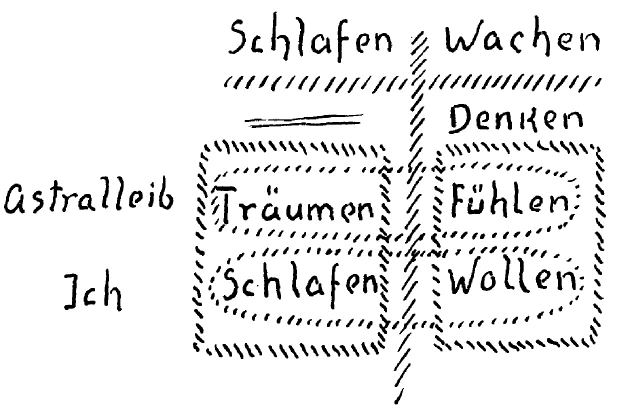
[ 40 ] Nun, so können wir sagen: Wenn wir uns durch einen gewöhnlichen Strich die Grenze zwischen Schlafen und Wachen ziehen, dann haben wir während des Wachens das Denken. Da haben wir nichts dafür während des Schlafens; das ist weg. Wir haben während des Schlafens das Träumen. Dem entspricht während des Wachens das Fühlen. Wir haben während des Wachens das Wollen. Dem entspricht während des Schlafens eben der wirkliche Schlaf, der Schlafzustand, der traumlose Schlaf.
[ 40 ] Well, we can say this: If we draw a line between sleeping and waking, then during waking we have thinking. We have nothing like that during sleep; it’s gone. While we’re asleep, we dream. This corresponds to feeling while we’re awake. While we’re awake, we have volition. This corresponds to actual sleep—the state of sleep, dreamless sleep—while we’re asleep.
[ 41 ] Nun sehen Sie sich das einmal an. Wir haben herausbekommen: Fühlen und Träumen, Wollen und Schlafen lebt eigentlich in demselben Element. Das Träumen ist gewissermaßen das, was wir in der Nacht tun, und das Fühlen ist das, was wir bei Tag tun. Es ist dasselbe, derselbe Zustand. Es muß also einmal dasjenige, was bei Tag fühlt, träumen, und was bei Tag will, traumlos schlafen. Also damit ich bei Tag fühlen und wollen, beim Schlafen träumen und diesen Schlafzustand des Wollens ausleben kann, muß das im Körper darinnen sein. Sie bekommen also eine Anschauung von einem Wesen des Menschen, das drinnen und draußen sein kann in bezug auf den Leib. Ist es außer dem Leibe, schläft es traumlos oder läßt die Träume aufsteigen; ist es in dem Leibe, will es oder fühlt es. Nur wenn es in den Leib kommt, begegnet es dem Denken. Das Denken können Sie äußerlich nicht sehen. Das ist also etwas, was im ganzen Leben, wie wir gesagt haben, im Menschen ist, aber als ein Unsichtbares. Nun, nennen wir, weil es ein Unsichtbares ist — wir werden schon sehen, daß man es auch aus einem anderen Grunde so nennen kann —, zu dem physischen Sichtbaren dazu Atherleib dasjenige, was denkt. Dieser Ätherleib bleibt das ganze Leben schlafend und wachend im physischen Leib drinnen.
[ 41 ] Now take a look at this. We’ve discovered that feeling and dreaming, wanting and sleeping actually exist within the same realm. Dreaming is, in a sense, what we do at night, and feeling is what we do during the day. It is the same thing, the same state. So whatever feels during the day must dream, and whatever wills during the day must sleep without dreaming. Therefore, in order for me to feel and will during the day, to dream while sleeping, and to live out this sleeping state of willing, it must be present within the body. You thus gain an insight into a human being that can exist both inside and outside the body. When it is outside the body, it sleeps dreamlessly or allows dreams to arise; when it is within the body, it wills or feels. Only when it enters the body does it encounter thinking. You cannot see thinking externally. So this is something that, as we have said, is present in the human being throughout life, but as something invisible. Now, since it is invisible—and we will see that there is another reason to call it this as well—let us call that which thinks the “etheric body,” in addition to the physically visible body. This etheric body remains within the physical body throughout one’s entire life, whether asleep or awake.
[ 42 ] Dasjenige, was fühlt, bleibt nicht darinnen; das spaziert heraus während des Schlafens und gibt die Möglichkeit der Träume. Wir nennen es astralischen Leib.
[ 42 ] That which feels does not remain within; it wanders out while we sleep, making dreams possible. We call it the astral body.
[ 43 ] Und dasjenige, was will, und was im traumlosen Schlaf verharrt, das nennen wir das Ich. Und so bekommen wir durch die bloße Beobachtung diese drei unsichtbaren Glieder der menschlichen Wesenheit: Ätherleib, astralischen Leib und Ich. An dem physischen Leib brauchen wir nicht zu zweifeln.
[ 43 ] And that which wills, and which remains in dreamless sleep—that is what we call the “I.” And so, through mere observation, we come to recognize these three invisible aspects of the human being: the etheric body, the astral body, and the “I.” We need not doubt the existence of the physical body.
[ 44 ] Nun handelt es sich darum: Den physischen Leib sehen wir mit den physischen Sinnen. Was sonst noch am Menschen ist, das ist mit den physischen Sinnen nicht wahrzunehmen. Kann es irgendwie sichtbar, wahrnehmbar, anschaubar gemacht werden? Das kann eben geschehen dadurch, daß man folgendes im Menschen bewirkt.
[ 44 ] The point is this: We perceive the physical body with our physical senses. Whatever else there is in a human being cannot be perceived with the physical senses. Can it somehow be made visible, perceptible, or observable? This can be achieved by bringing about the following in a human being.
[ 45 ] Ich sagte Ihnen, lebt man wach, so lebt man von innen nach außen. Nun stellen Sie sich vor, Sie haben meinetwillen das Auge oder irgendein anderes Sinnesorgan. Von dem gehen die Nerven aus. Die endigen im Auge drinnen, haben irgendwo Enden. Nun betrachten wir diesen wachenden Zustand. Wir leben intim mit unserem Denken zusammen, das heißt im physischen Leib mit dem Nerv. Mit diesem Nerv leben wir da zusammen. Aber wir leben nicht nur im Denken, wir leben in dem Sinneseindruck. Der Nerv strahlt gewissermaßen in dasjenige, was das Sinnesbild ist, hinein. Man kann es auch physiologisch ausdrücken: Der Nerv berührt sich mit der Blutzirkulation, und dadurch kommt er ins Sinnesbild hinein. Da nehmen wir wahr die Außenwelt.
[ 45 ] I told you that when one lives awake, one lives from the inside out. Now imagine that, for my sake, you have an eye or some other sense organ. Nerves extend from it. Those that end inside the eye have their terminations somewhere. Now let us consider this waking state. We live in close communion with our thinking—that is, in the physical body with the nerve. We live there together with this nerve. But we do not live only in thought; we live in the sensory impression. The nerve, so to speak, radiates into what constitutes the sensory image. One can also express this physiologically: the nerve comes into contact with the blood circulation, and through this it enters the sensory image. That is how we perceive the external world.
[ 46 ] Denken Sie aber, wir nehmen nicht wahr die Außenwelt, wir entwickeln bloß das Leben im Nerv selber und kommen bloß bis zum Ende des Nerven. Wir gehen nicht in dieBlutzirkulation des Auges hinein, sondern wir machen halt da, wo der Nerv seine Stümpfe hat; wir gehen bloß bis zum Ende des Nerven. Da haben wir eine Einnerungsvorstellung, also auch einen Gedanken. Da bleibt die Sache Erinnerung. Die ist daher schattenhaft, weil sie nicht ans Blut herandringt.
[ 46 ] But consider this: we do not perceive the outside world; we merely develop life within the nerve itself and go only as far as the end of the nerve. We do not enter the blood circulation of the eye, but stop where the nerve ends; we go only as far as the end of the nerve. There we have a mental image of memory—that is, a thought. There, the matter remains a memory. It is therefore shadowy because it does not reach the blood.

[ 47 ] Sehen Sie, im gewöhnlichen Leben, da macht man das so, daß man die Wahrnehmungen hat. Die gehen in die Nerven über. Die Nerven endigen im Körper drinnen. Dann wird erlebt in der Erinnerung bis zum Endzustand des Nerven hin. Da stößt die Vorstellung an, da wird sie Erinnerungsvorstellung. Stößt sie durch bis zum Ende des Nerven, so wird sie Wahrnehmung; kommt es bloß bis zum Stumpf hin, stößt es nicht durch, wird es Erinnerung. Aber man kann zunächst nichts anderes erinnern als das, was man in sich trägt. Nun stellen Sie sich vor, daß man durch gewisse Übungen nicht nur das, was man in sich trägt, bis zum Ende des Nerven bringt, sondern dasjenige, was man von der anderen Seite, von außen aufnimmt. Denken Sie sich also, Sie stoßen nicht nur bis zu Ihren Nervenendigungen dasjenige, was Sie zuerst hereingelassen haben in Ihren Kopf, sondern dasjenige, was Sie von der Welt ohne Wahrnehmung aufnehmen, oder was Sie durch Ihren Rückenmarksnerv ohne Wahrnehmung aufnehmen, dann kommt das Erleben auf der andern Seite in den Nerv herein. Es stößt hier auf. (Siehe Zeichnung.) Das geht nicht an die Wahrnehmung. Dann bekommen Sie diejenigen Bilder, die wir den Inhalt der Imagination nennen. Und dann nehmen Sie diesen Ätherleib, der die Tätigkeit des Denkens in sich enthält, wahr.
[ 47 ] You see, in everyday life, this is how it works: we have perceptions. These are transmitted through the nerves. The nerves terminate inside the body. Then the experience is relived in memory up to the nerve’s terminal point. That is where the mental image begins; there it becomes a memory image. If it penetrates all the way to the end of the nerve, it becomes a sensation; if it reaches only as far as the stump—if it doesn’t penetrate all the way—it becomes a memory. But at first, you can’t remember anything other than what you carry within yourself. Now imagine that, through certain exercises, you bring not only what you carry within yourself to the end of the nerve, but also what you take in from the other side, from the outside. So imagine that you push not only what you first let into your head all the way to your nerve endings, but also what you take in from the world without perception—or what you take in through your spinal cord without perception—then the experience enters the nerve from the other side. It encounters it here. (See drawing.) This does not reach perception. Then you receive those images that we call the content of imagination. And then you perceive this etheric body, which contains the activity of thinking within itself.
[ 48 ] Und ebenso kann man, wie wir morgen sehen werden, auch in das Fühlen dasjenige hineinnehmen, was nicht erst von außen kommt und reflektiert wird, sondern was man gewissermaßen von rückwärts hereinnimmt in den Körper. Dann kommt die Inspiration. Die geht nun nicht in die Nerven, die geht in den Atmungsprozeß und in den Zirkulationsprozeß hinein. Dadurch begreift man den astralischen Leib. Und wenn man endlich die Intuition ausbildet, wenn man nicht nur das, was man im Leben gelernt hat, als Gehen empfindet, sondern wenn man sich als den anderen Menschen fühlt, der wirkt und ist, wenn man ganz übergeht in den anderen Menschen, dann kommt die Intuition. Und dadurch begreift man das Ich und das Wollen. So daß man sagen kann:
[ 48 ] And just as we will see tomorrow, one can also incorporate into one’s feelings that which does not come from outside and get reflected, but rather that which, so to speak, one takes into the body from within. Then inspiration arises. It does not enter the nerves, but rather enters the process of breathing and the process of circulation. Through this, one comes to understand the astral body. And when one finally develops intuition—when one no longer perceives only what one has learned in life as “walking,” but feels oneself to be the other person who acts and exists, when one completely merges with the other person—then intuition arises. And through this, one comprehends the “I” and the will. So that one can say:
Den Ätherleib begreift man durch die Imagination,
den Astralleib begreift man durch die Inspiration,
das Ich begreift man durch die Intuition.
The etheric body is comprehended through imagination,
the astral body is comprehended through inspiration,
the “I” is comprehended through intuition.
[ 49 ] Im gewöhnlichen Leben hat man ja nicht das Ich, sondern das Ich schläft. Man weiß nur etwas von seinem Ich, das schläft, wie man im Dunklen auch weiß, daß es dunkel ist. Aber man hat nicht die Gegenstände, die da sind. So schläft auch das Ich.
[ 49 ] In everyday life, one does not actually have the “I”; rather, the “I” is asleep. One is merely aware of one’s sleeping “I,” just as one knows in the dark that it is dark. But one does not possess the objects that are there. So, too, the “I” sleeps.
[ 50 ] Man kann im allerstrengsten Denken sozusagen diejenigen Dinge finden, die Sie in meiner «Theosophie» von Anfang an beschrieben finden: Physischen Leib, ätherischen Leib, astralischen Leib, Ich. Und dann kann man darauf hinweisen, wie diese Glieder der menschlichen Natur durch Imagination, Inspiration, Intuition eben auch schaubar erfaßt werden können.
[ 50 ] Even in the most rigorous line of thought, one can, so to speak, find those elements that you will discover described from the very beginning in my *Theosophy*: the physical body, the etheric body, the astral body, and the I. And then one can point out how these aspects of human nature can also be grasped visually through imagination, inspiration, and intuition.