

What was the Purpose of the Goetheanum and of Anthroposophy?
GA 84
14 April 1923, Dornach
Translated by Steiner Online Library
2. The Expansion of Human Cognitive Abilities Toward Imagination, Inspiration, and Intuition
[ 1 ] While this course for teachers and those interested in education is taking place, I will deliver the lectures—which are being held concurrently with this course as special anthroposophical courses—in such a way that they can also be understood by those who have only recently discovered anthroposophy or are just beginning their journey. Therefore, some of what I will present here in these lectures over the course of this week will be a sort of review for the “enlightened anthroposophists.” But I think that even such a review can be quite useful from one perspective or another.
[ 2 ] What I am presenting today is intended, first and foremost, to be a further elaboration of what I discussed in the public lecture I gave last week at various locations throughout Switzerland. It is meant to build on that lecture and expand on some of its points.
[ 3 ] When we look at human life in its entirety, we find that it is divided into two strictly separate aspects: one aspect that we always experience during the time between waking and falling asleep—that is, in our ordinary daytime consciousness; the other part of life—which, in the case of the average person, is the shorter of the two—is the one we experience between falling asleep and waking up. It is the part that is immersed in unconsciousness and shines up into consciousness only by allowing the colorful diversity of the dream world to flow into that consciousness. So that, when we speak from the standpoint of human consciousness, we must say: This consciousness is filled, during waking hours, with the content supplied to us by our senses. What we come to know of the world through our senses is, so to speak, present in our consciousness in a pictorial form. That is what we experience. Whether in everyday life or in science, we base our ideas and thoughts on what our senses convey to us; that is, we combine sensory perceptions and also attempt to find regularities within the world of sensory perceptions.
[ 4 ] We do all of this with our power of thought. We link the thoughts and ideas that we can receive through our power of thought to our sensory impressions. But then, within our waking life, we develop something else as well. We are pleasantly affected by one event or one impression of the day, and unpleasantly affected by another; we sympathize with one impression, while another impression is repulsive to us. This sympathy and antipathy exist in the most varied ways and in the most varied degrees. And we do, in fact, describe what we experience in things—I would say, in accordance with our inner human nature—in such a way that they bring us joy, cause us pain, uplift us, or distress us; we describe this as our feeling toward things, and we make a clear distinction between our feelings and our thoughts, which represent something external to us. Our thoughts do not merely exist within us; they represent something external to us. Through our mental images, we gain insight into the external world. It is already implied in the word “mental image” that through it we gain insight into the external world. What we mentally image, we do not place within ourselves, but rather before us. Thought, then, directs us outward. Feeling directs us inward. We have the clear experience that what we feel is experienced inwardly, and that it has less to do with the external world than thought or imagination does.
[ 5 ] But there is yet another aspect of the world we experience. When some people happen to encounter, say, a vicious dog here or there, they run away. Some run away even when they see a mouse; but something similar happens in response to other impressions from the outside world as well. In this case, we say that our will is stirred. While feeling proceeds in such a way that we remain calm, through our will—roughly speaking—we set our entire organism in motion in relation to the outside world.
[ 6 ] This is how we speak when we want to describe our consciousness as it develops during waking hours. We clearly distinguish this consciousness from the unconscious state, which is also part of our life and which we experience between falling asleep and waking up. It is precisely from this unconscious state of sleep that the colorful diversity of the dream world emerges.
[ 7 ] Now let’s take a moment to shed some light on what holds a certain value for ordinary human consciousness. We can say: For this ordinary human consciousness, the world of dreams emerges from the unconscious. It shines into consciousness. And then, arising from the experiences of the day—from the experiences of the waking state—thinking, feeling, and willing emerge in consciousness.
[ 8 ] How can we begin by describing—in what I would call a popular, superficial way—this difference between the unconscious state of the human mind, from which dreams emerge, and the fully awake state?
[ 9 ] Well, you won't have to think about it for long; you'll find that, when awake, a person feels connected to what he calls his physical organism.
[ 10 ] Consider the world of dreams. It unfolds before you in images. You must tell yourself that while the world of dreams unfolds before you in images, you are not connected to your physical body. Upon waking, the first thing a person feels is that the will permeates their physical body. We also need our senses while awake by controlling them through our will. Thus, we can say: The state of sleep, from which the dream springs, transitions into the waking state by our will, as it were, becoming engaged in the physical body.
[ 11 ] So let us now turn our attention to this physical organism. Simply by saying, “Let us turn our attention to the physical organism”—I am in fact appealing to your sensory perception. I am appealing to what you know through this sensory perception. At first, you cannot know anything else about this physical organism of the human being other than what your senses convey to you—what you can think about the physical organism. Neither anatomy nor physiology knows anything more about this physical organism than what the senses teach us to recognize, and what can be grasped by human beings through thinking, which combines sensory perceptions.
[ 12 ] This, however, draws our attention to the fact that it is first and foremost the senses—as we realize when we use our consciousness—to which we must turn if we wish to know anything about the world in general and about the human physical organism—the senses and thought.
[ 13 ] Let's take a look at the senses and examine, in very simple terms, what we experience through them in relation to the two distinct states of wakefulness and sleep.
[ 14 ] People give far too little thought to this matter because—unless they are actually blind—the lion’s share of what they are consciously aware of in their experience comes from the eyes, and the eyes are precisely those organs that close when a person is asleep, thereby blocking out external impressions. But just think for a moment about the other senses. Can you believe that your ear—if you do not block it—provides you with different experiences during sleep than during the day with regard to the physical body? If you consider the physical body properly and do not block your ear at night, you cannot possibly think that anything different takes place through the ear in your physical organism when you sleep than when you are awake. There is simply no reason for it. The fact that you do not know this is an entirely different matter.
[ 15 ] Or let’s consider the sense of heat. We perceive heat and cold. Yes, do you believe that the heat you perceive during the day stops at your skin when you sleep? It will, of course, have exactly the same effect on your skin. So while you sleep—with the exception of your face—you are exposed to exactly the same sensations as when you are awake.
[ 16 ] If that were not the case, you would have to assume that while you sleep, you are wrapped in a thermal blanket that keeps the heat out. You would have to think that a benevolent spirit is plugging your ears so that the processes that would otherwise be triggered by external stimuli do not occur. When you consider all this, you come to the conclusion: Well, the eye is simply so sensitive that the human organism has adapted to use its will to draw the curtains of the eyelids over the eyes during sleep.
[ 17 ] That said, the outside world does play a small part in ensuring that sensory stimuli are kept at bay during sleep. But even though it was reported just recently in this newspaper that it would be more pleasant for those people in Basel who want to sleep and live near restaurants if concerts ended at half past ten instead of eleven, this clearly indicates that people want to protect their ears—but they must be protected from the outside. Even if all of that is true, one must still say: No matter how the outside world is structured during sleep, no matter what it is like, it still affects our senses—with the exception of the eyes.
[ 18 ] And then we must ask ourselves: What about our thinking, our thoughts? You see, to answer this question, one could start from various points of view; but for people today, modern science has, after all, become popular, and therefore modern people know that each sense has a continuation into the interior of the organism—namely, the nerve tracts—and that, because the nerve tracts extend inward as continuations of the senses, thinking and imagination follow on from sensory perception.
[ 19 ] Yes, if you now hear—even if it is only the relative silence of the night—and it is, after all, perfectly natural that you hear it, because your ear is open, and whatever is in your surroundings is audible, triggering the same processes that would be triggered if you were awake—why should that put a stop to your nerves, that is, to your thinking?
[ 20 ] So you must tell yourself that your physical organism does not block sensory impressions—as I said, with the exception of the eyes. But it does not block thoughts either. And you can even—though this remains hypothetical for external observation at first—imagine that, even if social institutions provide a relative calm at night for certain senses, this calm certainly does not exist for other senses; certainly not for the senses of heat and cold, for example, nor for the sense of touch, because, isn’t it true that when you press your thumb against the blackboard, you perceive the pressure? Why, then, should the perception of pressure not be the case when you lie on your back in bed? You must, of course, perceive this pressure—conveyed by the sense of touch—throughout the entire night. Likewise, when you place something on your hand, you perceive it. Why shouldn’t you perceive the bedspread you lay over yourself throughout the night, and so on? But not only that—what about the inward continuation, the formation of ideas and thoughts? Why should the process stop there? For these, after all, are mediated by the organism.
[ 21 ] So that, when we look impartially at what is actually the case, we must say to ourselves: Even though the physical body lies in bed during sleep, it still receives the usual sensory impressions. It also has the usual experiences that appear to us as conscious perceptions when we are awake during the day. Just as we are unaware of sensory impressions at night, even though they may still be present, so too are we unaware of our thoughts; yet they are there.
[ 22 ] People usually don’t realize that when they sleep, they are constantly thinking. They are simply unaware of it. Just as they are unaware of the pressure of the blanket lying on them, so too are they unaware of the thoughts that are constantly flowing through their minds while they sleep. They are simply there. People think throughout their entire lives, not just during the day. Even when they are not consciously thinking, they are still thinking; these thoughts are simply within them. This leads us to the realization that people are permeated by a world of thoughts from the moment they fall asleep until they wake up.
[ 23 ] Now take the person who is waking up. He wakes up. He wakes up from his dreams, let’s say. By studying certain dreams, one can very easily perceive how quickly the dream unfolds—so much so that it actually took place right in the moment of waking. You only need to recall that you might dream—I certainly don’t want to suggest this to anyone; every individual is exempt, of course—but it could happen to someone: that you get into a heated argument with someone, which escalates into a brawl. You know, in dreams people are sometimes much more unruly than they are during the day. It escalates into a brawl; the other person punches you, as they say, and lo and behold, you wake up: That’s when you notice that a raindrop has fallen on your cheek. It was actually the raindrop that woke you up. The entire dream, which seems as though it had lasted a long time, was caused solely by that raindrop at the moment of waking.
[ 24 ] You can experience this with countless dreams. They actually pass in the blink of an eye, triggered by something, and have quite dramatic content. So we can say: You wake up with a dream. If you really set about analyzing it properly, you will find that the dream gives you something that you might otherwise have thought of based on your experiences, but you would have thought of it differently while awake. We know that the dream cloaks what it brings to our experience in a certain fantastical quality.
[ 25 ] Take the example I just mentioned. If a raindrop falls on your cheek during the day, you have a different perception of the whole event than you do of that dramatic situation where you get into an argument with someone and start fighting; the argument might go on for a very long time, the scuffle might also last a relatively long time, and then comes, let’s say, the slap, and that’s the end—that’s when you wake up. During the day, you would have had a very simple experience: a sensory perception and a mental image associated with it. Upon waking, you have a very dramatic experience. It is embellished. But you see, you will hardly dream of anything other than what is composed of sensory experiences that you have somehow already had or could have, or perhaps internal bodily sensations and the like. That is what you will dream.
[ 26 ] If you observe the entire process, you will find that the more dreams you observe, the more you will come to understand what dreaming actually consists of. When you are awake, you see colors through your eyes—light and dark; you hear this or that; you perceive warmth and cold. You process all of this through your mind. You have the distinct feeling that when you do all this, you’re acting from the inside out. You have the will within you with which you permeate all of this. You act from the inside out. Let’s leave aside for now what exactly is acting from the inside out; but you have the feeling that you take in your sensory impressions and somehow organize them through your ideas. You combine these sensory impressions and so on. But you do all of this from within. Yes, when you dream, just think about it for a moment—you have images similar to sensory impressions. You need only recall a vivid dream, and you will say to yourself: There are similar images. You see colors, you see how someone moves, and so on; images are there, just as they are in the sensory world. Except that in the sensory world, these images are, so to speak, superimposed on solid objects; in dreams, these sensory images float freely. And concepts are also present in dreams—even cause and effect, of which the natural sciences are so proud. After all, one does not merely dream images; one dreams of connections. It’s all there.
[ 27 ] Only when you look closely at the dream will you have to admit to yourself: Yes, what I experience in the dream is actually the exact opposite of what I experience while awake. It is the opposite. While awake, I know that I receive sensory impressions, and I control them through my thoughts. When I’m not dreaming, sensory impressions first overwhelm me, and then a kind of coherence lives within those sensory impressions—the kind that otherwise lives through thoughts. Just as if the coherence were behind the sensory images, so it is in a dream. And if you think carefully about these things, you will find: this dreaming is actually the other way around. It is as if you were to encounter sensory perceptions first and then be unable to quite grasp thought. That is why the sensory images are so inconsistent, so illogical. You cannot grasp thought. When you are awake—depending on whether you are more of a philistine or a person of imagination—you have the sensory images more or less under your control, within your power. You know that thought is within you, and through thought you control the sensory images, which are somewhat further removed from you. In a dream, however, you come face to face with the sensory images. Thinking is now farther away; you cannot grasp it. In short, if you look at the matter rationally, you get the impression that when you are awake, you live from the inside out: the sensory images are on the outside (yellow arrows), and thinking is on the inside (purple arrows). This is how it works.
[ 28 ] When you dream, it’s the other way around (red arrows)—you first approach the sensory images, but you can’t grasp the thought behind them; you can’t really get to it. That’s why thought plays out so vividly in dreams.
[ 29 ] Through careful observation, you can distinguish between dreams and sensory reality. In ordinary, waking sensory reality, you experience life from the inside out. There, you are quite intimately connected with your thoughts. Your thoughts are closer to you there. You combine your sensory impressions with these thoughts.

[ 30 ] When dreaming—as becomes clear upon reflection—one must be “out there,” because one cannot properly access one’s thinking. That is why dreams follow such a curious logic: because thinking is beyond one’s reach. So when one is awake, one is “here,” and when one dreams, one is “out there” (see drawing). But you’ve just come back in, because it then transitions into the ordinary waking state, where you’re intimately connected with your thinking. Just notice: as the dream fades, it dissolves into ordinary daytime consciousness. You rush back into your normal thinking; you pass through the surface of your body. You pass by your eyes, but from the outside. You don’t yet have the optic nerve. You have the eyes—they pass by you. And the optic nerve, which acts from the other side, from a kind of beyond, is still playing around with the images as you slip in; then you become intimately connected with the nerve, which turns the images into an orderly world. It is the same with all the other senses.
[ 31 ] So you can see, simply by stating the facts, that awakening truly consists of slipping back into the body. What, then, must sleep consist of? You need only clearly picture this fact in your mind’s eye, and you will say to yourself: “I must somehow be outside my body.”
[ 32 ] And now let’s go through our ordinary daily consciousness. The “enlightened ones”—for them, what I am about to say will simply be a repetition. Let’s go through the concepts, and we will find: In imagination, we are truly awake; there we are intimately connected with our thinking; there we are truly awake. So with what resides within us as our thinking—with that we are intimately connected in wakefulness; in relation to that, we are truly awake.
[ 33 ] But let’s now consider feeling. If you carefully observe what you are experiencing, you will not be able to say that feeling is just as intense as thinking. You will have to admit: Feeling is, by its very nature, less logical than thinking. After all, we allow ourselves much less logic in feeling than in thinking. When it comes to what we find likable or unlikable, we allow ourselves much greater freedom and arbitrariness than we do with what is mathematical. It’s clear, after all, that if it came down to feeling, housewives would prefer—if they were to take two francs and then another two francs—that the total be five francs instead of four; and not just housewives, but I believe everyone would probably prefer it that way. However, when it comes to thinking, what matters is not vagueness but certainty.
[ 34 ] In short, even though we can see how different feeling is from dreaming in terms of the content of the experience, feeling is in no way inferior to dreaming in terms of vagueness. When we feel, we are in the same state as when we dream. The only difference is that a dream gives us images, whereas feeling gives us precisely that peculiar substance of life that we call emotions. In terms of its state, feeling is, in every respect, a waking dream.
[ 35 ] We also know that if we want to immerse our logical concepts in the artistic realm, we must draw upon our feelings. Without feeling, there is no art. We must immerse ourselves in that feeling. We sense that we must imbue it with an element akin to dreaming. In this way, we create something within ourselves that is similar to what the dream world creates from the outside. We do not create logical concepts within ourselves, but rather images of the imagination. And people have always sensed this: how dreams from the outside are filled with all the unknown and all the startling things that come from the outside, yet are similar to the imaginative concepts that arise within us.
[ 36 ] And let’s move on to the will—now, let’s be very clear about this: The waking consciousness knows nothing of the will. At first, it has the thought that you want to go here or there. Even though we must speak of the will precisely when we wake up—because we sense that we are then taking control of our body—we still know nothing of the will. We have a thought: You want to go here or there. How this thought then shoots down into the organism and moves the legs, so that it becomes will, remains unknown. You only realize this when you observe yourself moving. What transpires between the thought and the manifestation of will is simply unknown to consciousness—as unknown as what one sleeps through. You are, in fact, asleep while you unfold a will within your organism.
[ 37 ] So we can say: Feeling is like dreaming while awake; willing is like sleeping while awake. As far as willing is concerned, we do not truly wake up with our ordinary waking consciousness. It continues in a state of sleep even during waking consciousness. So we can say: Although we sleep—if we are decent people—on average only one-third of our lives—and I mean that quite seriously—some more, some less. But on the other hand, we are compensated for this by the fact that we also carry sleep within us while we are awake, namely in our will. And if you add it all up, the result will certainly be something other than one-third.
[ 38 ] And feeling—that is, the dreams that arise from the will, and thus, in turn, emerge from sleep and stimulate the imagination. Just as dreams reveal themselves from within sleep, so does feeling reveal itself from within the will. You can observe this in a certain way. Just imagine, for example, that you have a flower in front of you. If you are able to pick it and take it with you, then you have it. There you have exercised an impulse of the will. If you are unable to take it with you, you content yourself with the scent, with the pleasantness of the scent, with its charm. You experience the flower only inwardly, in your emotional life. But one could almost say: What is a pleasant feeling? A pleasant feeling is the inner, attenuated experience of that for which the strong experience—the one one actually strives for—is an act of volition. One wants to have what is appealing to one; if one cannot have it, it remains merely appealing. Thus, the feeling is a weakened will. Dreaming occurs only in a different way during waking hours than during sleep. Dreaming during sleep is a form of sleep held back. Feeling during waking hours is a will that has not fully come to fruition.
[ 39 ] If we had no inhibitions within us, we would desire everything that appeals to us and reject everything that does not, including any expression of will that does not appeal to us. We retain the desire only when we feel. When we feel, we merely dream of desiring rather than actually desiring.
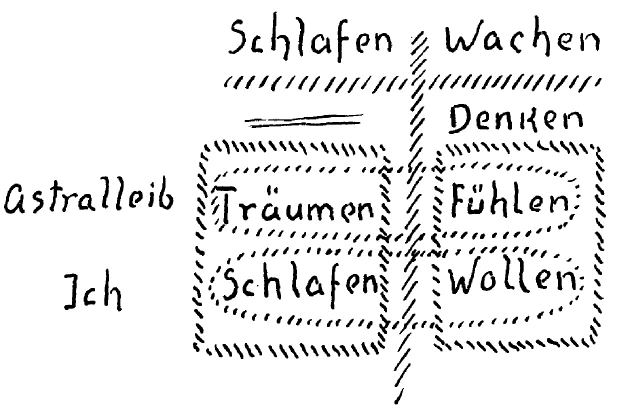
[ 40 ] Well, we can say this: If we draw a line between sleeping and waking, then during waking we have thinking. We have nothing like that during sleep; it’s gone. While we’re asleep, we dream. This corresponds to feeling while we’re awake. While we’re awake, we have volition. This corresponds to actual sleep—the state of sleep, dreamless sleep—while we’re asleep.
[ 41 ] Now take a look at this. We’ve discovered that feeling and dreaming, wanting and sleeping actually exist within the same realm. Dreaming is, in a sense, what we do at night, and feeling is what we do during the day. It is the same thing, the same state. So whatever feels during the day must dream, and whatever wills during the day must sleep without dreaming. Therefore, in order for me to feel and will during the day, to dream while sleeping, and to live out this sleeping state of willing, it must be present within the body. You thus gain an insight into a human being that can exist both inside and outside the body. When it is outside the body, it sleeps dreamlessly or allows dreams to arise; when it is within the body, it wills or feels. Only when it enters the body does it encounter thinking. You cannot see thinking externally. So this is something that, as we have said, is present in the human being throughout life, but as something invisible. Now, since it is invisible—and we will see that there is another reason to call it this as well—let us call that which thinks the “etheric body,” in addition to the physically visible body. This etheric body remains within the physical body throughout one’s entire life, whether asleep or awake.
[ 42 ] That which feels does not remain within; it wanders out while we sleep, making dreams possible. We call it the astral body.
[ 43 ] And that which wills, and which remains in dreamless sleep—that is what we call the “I.” And so, through mere observation, we come to recognize these three invisible aspects of the human being: the etheric body, the astral body, and the “I.” We need not doubt the existence of the physical body.
[ 44 ] The point is this: We perceive the physical body with our physical senses. Whatever else there is in a human being cannot be perceived with the physical senses. Can it somehow be made visible, perceptible, or observable? This can be achieved by bringing about the following in a human being.
[ 45 ] I told you that when one lives awake, one lives from the inside out. Now imagine that, for my sake, you have an eye or some other sense organ. Nerves extend from it. Those that end inside the eye have their terminations somewhere. Now let us consider this waking state. We live in close communion with our thinking—that is, in the physical body with the nerve. We live there together with this nerve. But we do not live only in thought; we live in the sensory impression. The nerve, so to speak, radiates into what constitutes the sensory image. One can also express this physiologically: the nerve comes into contact with the blood circulation, and through this it enters the sensory image. That is how we perceive the external world.
[ 46 ] But consider this: we do not perceive the outside world; we merely develop life within the nerve itself and go only as far as the end of the nerve. We do not enter the blood circulation of the eye, but stop where the nerve ends; we go only as far as the end of the nerve. There we have a mental image of memory—that is, a thought. There, the matter remains a memory. It is therefore shadowy because it does not reach the blood.

[ 47 ] You see, in everyday life, this is how it works: we have perceptions. These are transmitted through the nerves. The nerves terminate inside the body. Then the experience is relived in memory up to the nerve’s terminal point. That is where the mental image begins; there it becomes a memory image. If it penetrates all the way to the end of the nerve, it becomes a sensation; if it reaches only as far as the stump—if it doesn’t penetrate all the way—it becomes a memory. But at first, you can’t remember anything other than what you carry within yourself. Now imagine that, through certain exercises, you bring not only what you carry within yourself to the end of the nerve, but also what you take in from the other side, from the outside. So imagine that you push not only what you first let into your head all the way to your nerve endings, but also what you take in from the world without perception—or what you take in through your spinal cord without perception—then the experience enters the nerve from the other side. It encounters it here. (See drawing.) This does not reach perception. Then you receive those images that we call the content of imagination. And then you perceive this etheric body, which contains the activity of thinking within itself.
[ 48 ] And just as we will see tomorrow, one can also incorporate into one’s feelings that which does not come from outside and get reflected, but rather that which, so to speak, one takes into the body from within. Then inspiration arises. It does not enter the nerves, but rather enters the process of breathing and the process of circulation. Through this, one comes to understand the astral body. And when one finally develops intuition—when one no longer perceives only what one has learned in life as “walking,” but feels oneself to be the other person who acts and exists, when one completely merges with the other person—then intuition arises. And through this, one comprehends the “I” and the will. So that one can say:
The etheric body is comprehended through imagination,
the astral body is comprehended through inspiration,
the “I” is comprehended through intuition.
[ 49 ] In everyday life, one does not actually have the “I”; rather, the “I” is asleep. One is merely aware of one’s sleeping “I,” just as one knows in the dark that it is dark. But one does not possess the objects that are there. So, too, the “I” sleeps.
[ 50 ] Even in the most rigorous line of thought, one can, so to speak, find those elements that you will discover described from the very beginning in my *Theosophy*: the physical body, the etheric body, the astral body, and the I. And then one can point out how these aspects of human nature can also be grasped visually through imagination, inspiration, and intuition.