

What was the Purpose of the Goetheanum and of Anthroposophy?
GA 84
15 April 1923, Dornach
Translated by Steiner Online Library
3. The Life of the Human Soul and Its Development Toward Imagination, Inspiration, and Intuition
[ 1 ] Yesterday I attempted to consider the nature of the human being and the nature of human life from the perspective that arises when one places human life in its entirety before the soul. I said that this human life does not merely pass during waking hours, but that approximately one-third of a person’s entire life is spent in sleep. And when we consider only ordinary human consciousness, we initially stand before this human life in such a way that, when we look back on our earthly existence from memory, we actually only ever have in mind the days—those periods of our lives that we spend awake. In a sense, we always overlook what passes during the time we have spent asleep. Now, of course, it must be said: Our waking daily life is what counts for what we have to create externally for earthly culture and earthly life; but the question is whether, when it comes to the inner life of the human being, only those perceptions are taken into account that unfold before ordinary consciousness during waking daily life.
[ 2 ] Even a cursory examination shows that this is not the case. The reflections I intend to offer today and in the remaining days of this week will show that, while the events the human soul experiences from falling asleep to waking up remain hidden, these events are, in fact, far more important for the inner life of the human being on Earth than the events that take place during the day.
[ 3 ] Today, continuing where we left off yesterday, we will first consider some aspects that arise from a comparison of the life of sleep and ordinary waking life. The life of sleep, after all, consists in part of completely dreamless sleep. The time we spend in our earthly life during this dreamless sleep—if it contains events relevant to our lives—is entirely unconscious. From this unconsciousness, from this complete darkness of consciousness, dreams then emerge; and from the dreams we either awaken to ordinary consciousness—in which earthly reality is presented to us through sensory perception and intellectual synthesis—or we drift from this reality, through the dream, into dreamless consciousness.
[ 4 ] Let us once again clarify what, from the perspective of ordinary external observation, constitutes the difference between dreaming and external sensory perception, which takes the form of images and concepts of the intellect.
[ 5 ] We can say that, for many people, the content of a dream often constitutes a more vivid reality than that which unfolds in waking daily life. But this is a reality of images that we follow not by our own will, but compulsively with our soul. And we can very precisely point out the difference between following these dream images and following the ordinary images of reality in waking daily life. We do not wish to engage in specific philosophical speculations here. Such speculations could be made, but we will refrain from them for now. We simply wish to focus on what is evident in common consciousness. Here we can say: The dream images are such that we live within them. We live in the images themselves. We live with the images. In waking daily life, of course, we have images of color, sound, and so on before us in the same way as in the experience of dreaming. But we are compelled to relate these images—whether they be visual images, auditory images, thermal images, tactile images, and so on—to hard reality, so to speak. In everyday reality, we see everywhere the necessity of, in a sense, also engaging with our will what the image shows us.
[ 6 ] That is not the case with, well, let’s call it “dream reality.” Dream reality is, so to speak—if I may put it bluntly—permeable from all sides. We can find the perspective from which to assess the reality of a dream only within our waking daily life. As long as we are dreaming, we regard the dream as reality, and if we were to dream our entire lives, dream reality would be the only reality for us. We need not even imagine that external life would then unfold any differently than it does now. We could, of course, imagine that individual people did not encounter one another in life through their own will, but were drawn toward one another automatically by natural forces—or even by some higher beings. We could also imagine that people were driven to their work, propelled by higher beings or by natural forces. In short, everything we experience in our waking daily life could happen. We would need to know nothing of this. If we were merely dreaming, we would have a dream reality before us. It would not even occur to us to want to break through this reality in any way to reach another reality. We wake up through the natural organization of our organism and then, within sensory reality, gain the perspective needed to assess the other, relative reality of the dream.
[ 7 ] Only when we go through this transition from dreaming to waking do we gain the perspective needed to assess the relative reality of the dream.
[ 8 ] But we must now ask ourselves: Is everything we experience while awake truly a waking state? Well, I explained in detail yesterday that this is not the case. I explained in detail that it is actually only our ideas—and even then, only to the extent that they reflect external reality—that bring us into a waking state. So that we are, in fact, awake only within our ideas. In our feelings, we face no different reality with regard to the state of the soul than we do in a dream; the only difference is that the dream appears to us in images, while feelings arise from the depths of the soul’s life with that very vagueness.
[ 9 ] But if one is not just an ordinary psychologist who forces everything to fit some preconceived notions, but instead approaches the emotional content of the soul with an unbiased, observant eye, one sees how the feelings—which, admittedly, “shoot up” against the life of the imagination, if I may put it that way—exhibit a blurriness, a fluctuating intermingling, just like dream images. We also dream through feeling when we are awake. Simply because—I would say—the substance in which dream images appear is different from the substance of feelings, we do not realize that, in fact, all feeling has only the same reality as a dream. So that, while we are truly imagining while awake, our ideas are constantly permeated by indeterminate subjective emotional contents.
[ 10 ] Imagine vividly how, upon waking, the images of your dreams flow into your waking consciousness, how in those dream images everything is fluctuating—enlarged or reduced, as the case may be—and you will be able to say to yourself: Something approaches people—seemingly naturally—in images, something that otherwise, in emotional life, approaches them from within in a blurred way, subjectively magnifying or minimizing things.
[ 11 ] And as far as our will is concerned, we are in a deep sleep even while awake. After all, all we know about the will are our intentions. But these are merely thoughts and ideas. When I want to go for a walk, I first have the idea of taking that walk. This is my intention. How this intention steadily enters my organism is just as much beyond the grasp of ordinary consciousness as is what transpires from the moment I fall asleep until I wake up. I can, in turn, only gauge the success of this intention by the movement I make, by the change in the aspects that appear before me as I take the walk—that is, once again, by mental images. What actually takes place within my organism between the idea of the intention and the idea of the success—I am just as unaware of this to ordinary consciousness as I am of what unfolds from the moment I fall asleep until I wake up.
[ 12 ] Thus we can say that, in terms of volition, a person is in a deep, dreamless sleep even when awake; that, in terms of feeling, a person is dreaming even when awake; and that a person is awake—in a certain sense—only when living in the realm of ideas. But when a person looks honestly into their inner self, they realize: these images are awake only in relation to external nature, not in relation to their own life. In relation to the image’s own life, a person cannot attain true wakefulness. One need only be clear about the fact that, for most people, when they cannot imagine anything external, the activity of imagination ceases to exist altogether. But this is really only because, particularly in today’s culture, human beings are so absorbed in the external world that we can compare this absorption to existing in a roaring, tumultuous world.
[ 13 ] Just imagine someone playing the piano or some other instrument here, while out there the machines are roaring in a truly extraordinary way. You would hear the machines. You would hardly be able to make out the piano, especially if you were a little further away from it. That’s basically how it is with what actually lives within a person through the activity of thought. We just have to use the comparison correctly. When we study the external natural sciences today, when we take in all the concepts presented to us in the external theory of evolution, it is essentially a clamour of thought, a din of thought. And this din of thought, to which modern people—especially scientists—surrender themselves, interferes with their finer perception of inner thought activity. That is why they also overlook their inner thought activity.
[ 14 ] In my *Philosophy of Freedom*, I referred to this pure thinking, which does not think of anything external but takes place entirely within the human being. But I am also aware that, in describing this pure thinking, I have actually depicted something that many of our contemporaries say does not exist at all—just as someone who hears the roar of machines out there but not the piano would say, “That doesn’t exist at all.”
[ 15 ] But if that is the case, we can discern something extraordinarily important from it, namely this: that we are actually awake only for thinking, insofar as it has an external, natural content; whereas, with regard to the inner activity we are carrying out there, we are, at most, merely dreaming. Furthermore, we dream our feelings and remain asleep in our will. So the activity of the soul—that which lives within us—is, in essence, not awake when we are awake to the sensory world. We continue to sleep, even while awake during the day, with regard to our thinking, feeling, and willing. We are awake only to the external natural world. And this awakening we still cultivate through instruments and experimental methods, thereby arriving precisely at the significant natural science of the present day. This must arise as external processes are, so to speak, reflected in our concepts. But we do not awaken to the same extent to our thinking, feeling, and willing. And anyone who can observe impartially how the dream actually differs from the external world of physical-sensory perception will find that the inner life of thinking, feeling, and willing is not similar to what external sensory impressions are; rather, they will find this inner life, at most, similar to its most significant element: dreaming. With regard to the content of our soul, we are actually dreaming and sleeping continuously. We awaken only to the content of nature. We do not awaken at all to the content of our soul in ordinary consciousness; there we continue to sleep gently. And as we said: Dream images are, in a sense, such that one can pierce through them; they do not rest upon a hard, external reality that is subject to the will. But the content of our soul is the same. It lives in images. And anyone who has the ability to compare qualities—not merely quantities—will find that if they attribute an “imaginative character” to the content of a dream—which at first does not point to a reality—they must also attribute an “imaginative character” to the content of their own soul.
[ 16 ] But this raises a significant question. If I am living in dreams, I wake up to physical reality; and because I am connected to my body through my will, I feel connected to physical reality as a reality, and from the perspective of this physical reality, I attribute to the dream, at most, a relative reality—one that is entirely different.
[ 17 ] The question is: Can I now awaken to the life of the soul in the same way that I awaken to nature? Can I engage myself—just as I use my will, which I direct into my body, to engage the images of dreams within the structure of reality—can I likewise, through a higher awakening, engage thinking, feeling, and willing within a corresponding reality? That, you see, is the question: Can I awaken to the life of the soul in the same way that I awaken to nature? The content of nature that I, as a human being, experience during my earthly existence through external physical-sensory reality appears to me in images in my dreams. But the entire life of the soul also appears to me only in images, as in a dream. So, can I awaken to the life of the soul?
[ 18 ] Yes, one can awaken. One can awaken by engaging in exercises such as those I have described in the book *How Does One Attain Knowledge of the Higher Worlds?* and in my *Secret Science*, one first sharpens and internalizes one’s thinking—so that one is not merely stimulated by thought content from the outside, but rather gives oneself from within a manageable thought content that is not suggested to one, then rests upon this thought content, and concentrates on such thought content actively given from within the soul. In this way, one gradually arrives at a true consciousness of thinking.
[ 19 ] One is not even aware of one’s own thinking if one allows oneself to be stimulated by ideas solely from the outside. Only when one repeatedly stimulates one’s own thinking from within—through meditation, through concentration on the content of thoughts—does one become aware within the act of thinking. Then it dawns on one that one actually lives within this thinking, but that one simply does not realize it when one allows oneself to be stimulated solely from the outside. In this way, thinking comes alive, whereas otherwise it is abstract and lifeless. Thinking becomes something that does not merely consist of the shadows of thought we receive from the outside, but something that stirs within us like the blood of the soul. One is, as it were, filled with a second humanity.
[ 20 ] Thoughts become living forces, formative forces, as I have also called them in my book *Theosophy*. And one becomes aware that one actually carries thinking within oneself as a second body—the etheric body, the body of formative forces—for one realizes that what otherwise exists only as a shadow in thought is in fact the very same forces that bring about our growth. One withdraws into the growth of one’s human being, and one comes to realize how the processes that would otherwise proceed merely chemically, according to the properties of the substances we take in, are transformed by the very same inner spiritual corporeality, the etheric corporeality that forms our thoughts; how we become a unified inner human being through these inwardly living, active thoughts. In this way, one comes to know a second human being within oneself.
[ 21 ] But there is something else to consider. This second human being that one comes to know is not merely a cloud that vaguely fills the physical, spatial body. This second human being is actually in constant motion, and it is not at all possible to capture him or her in a single moment. You see, it’s actually like this: When we have a person’s physical body at a specific point in life, then we can sketch—for a moment—what we experience in this way, and what is identical to our thinking—except that in ordinary thinking we have the shadows of thoughts, not the living thoughts themselves (see drawing). What permeates the human being as such a second etheric or formative body can be captured only for an instant. In the previous moment, it was quite different; in the next moment, it will be different again, and so on, backward and forward.
[ 22 ] But this leads us, when we come to realize through inner, contemplative experience, that this body of formative forces—which manifests itself to ordinary consciousness as shadowy, abstract thoughts—is not at all spatial, but rather something that unfolds in time. This takes us back, like a living tableau, to a certain moment in our earliest childhood. I will now sketch this schematically.
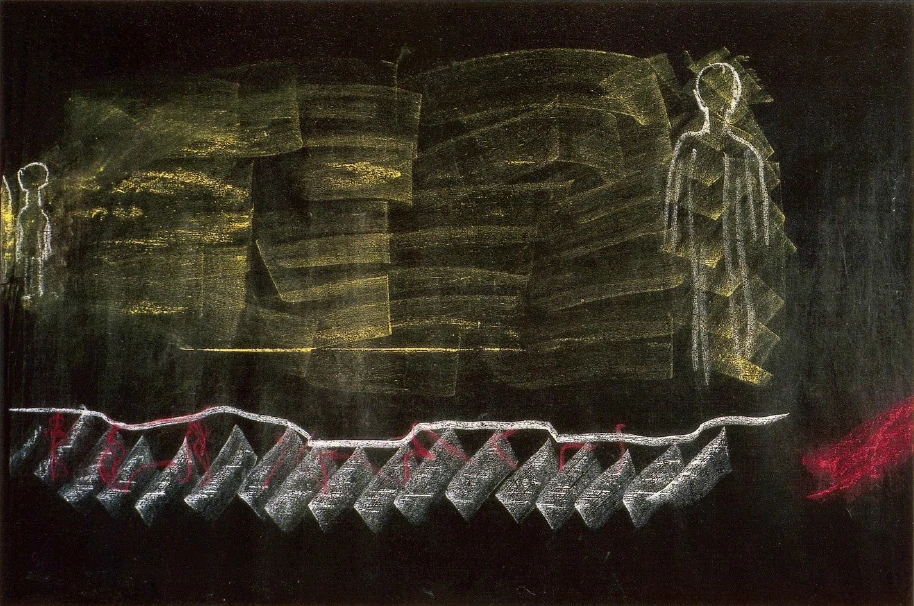
[ 23 ] Let’s imagine we are already an older person in this moment; but this body of imagery is not limited to a single moment in time—it extends all the way back to our childhood. We do not survey our lives through memories, but rather as a single tableau. What I am depicting here spatially is temporal. This now leads back to our childhood, to the point in our childhood up to which we generally remember.
[ 24 ] There is also this etheric body, this body of formative forces. But if, through careful exercises, one acquires the ability to look back that far, one reaches the point in time when, as a small child, one first learned to think. It is as if, through thinking—initially through ordinary thinking—one were to reach a limit. For ordinary consciousness, for ordinary memory, one reaches this limit. Through imagination, one can go further back, to the other side. One looks into that part of the child’s soul that one possessed when one was not yet able to think, when, as a child, one dreamed one’s way into the world. For it was only at a certain moment that thinking first arose—namely, after speech.
[ 25 ] Now, through this, one can look back into time and see what it was like in the soul before one had those shadowy, abstract thoughts. Back then, one still possessed living thought. And living thought worked powerfully and creatively on the human brain, on the entire human organism. Later, when much of this thinking is absorbed into abstraction, into the lifeless, only remnants remain to shape the human physical organism. While a child dreams, not yet able to think, thinking is still active. Precisely because, in later life, the clamor of the world prevents us from observing such thinking, it never occurs to us to look back at the thinking that was still actively at work. Now we can look back. And then this thinking appears as the sum of the forces that actually built us up as human beings—as forces of growth, as nourishing forces, and so on. One notices how the human organism is built up out of the ether of the world, for these forces lie within it. One comes closer and closer to the etheric body. One knows how this etheric body is most active from the outside into the child during the very earliest years, when the child cannot yet think, when it still spends its life dreaming. Thus one advances toward imagination.
[ 26 ] But something can remain with you. You don’t notice it unless you engage in the exercises I’ve described in the books mentioned—exercises that stand in contrast to our present-day culture, which is so overwhelmingly focused on scientific rigor. But then you realize that something of this way of thinking—from the other side, as you experienced it as a small child—has remained with you. This way of thinking, which is constructive and formative for the organism to which one owes one’s external physical body in the first place—this active thinking—I have called “imaginative thinking” in my books. But something of this imaginative thinking does indeed remain with one, and through practice, one can rediscover it even in later life, so that one can approach the etheric body.
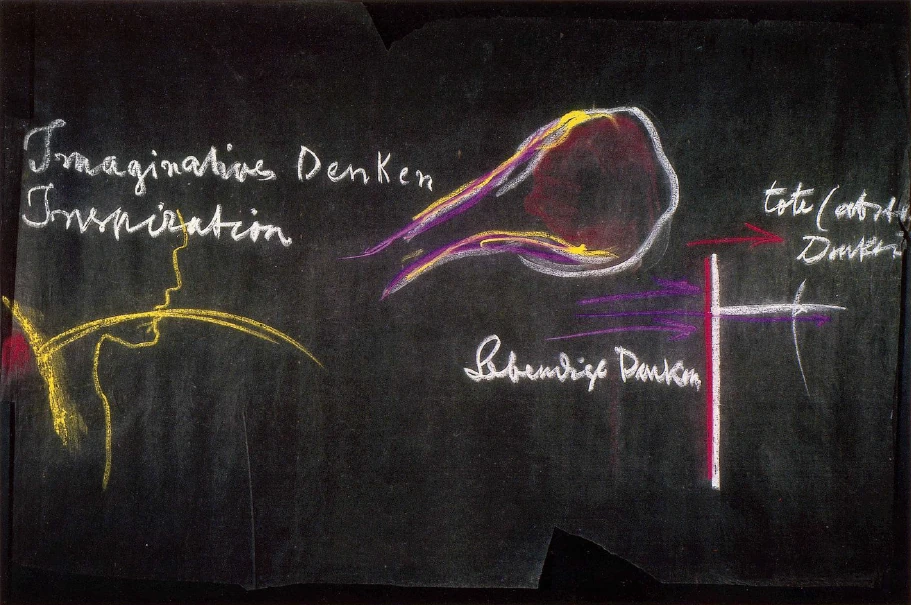
[ 27 ] I already pointed this out yesterday, but since not everyone was there, I’d like to mention it again: Take the human eye; from the human eye, take the optic nerve, which runs inward and branches out within the eye. If you follow the form-forming body (purple-red)—which essentially follows the outer physical nerve processes (yellow)—far enough to reach those processes (red) where the outer world is reflected through the eye, then you have perception of the outer world. And what is then fixed in the nerve—I will now only describe this approximately, as it would take too much time to describe the exact process—that which is fixed through the nerve in the form-forming body can then always be stimulated into activity again. Through the activity of the form-forming body, the nervous system, one reaches the point where the nerves end (yellow). One does not, so to speak, penetrate the nerve all the way to the processes that mirror the external world; one merely gives an impulse to what lives within them in the body of formative forces, propels this body of formative forces to the point where the nerve stumps terminate—and then one obtains the memory impression. The memory impression essentially consists in the fact that one’s inner activity reaches only as far as the nerve endings; whereas, in the case of sensory impressions, one penetrates the nerve endings and advances to the processes in the senses that are primarily brought about by the blood.
[ 28 ] There you see the lively activity of the body of formative forces. But everything you are now pushing into your memory must have entered the nervous system; thus, it originates from that time, from when we first learned to think as very young children. What came before is now like this—and when, having trained one’s thinking through exercises, one looks back, one sees this in retrospect through the second human being, who unfolds over time—: There one becomes aware of how, along the very same paths that impressions from the outside normally take to enter, they now reverse course through memory into the faculty of recollection; how, as it were, from behind, that which is now also the activity of the body of formative forces enters. In fact, one constantly has these two activities. It is just that in ordinary consciousness, a person is aware of only one of them—memory. But one does have these two activities: that which arises from external sensory perceptions—which are pushed back and can in turn be pushed forward to the nerve endings, so that the images of memory emerge; but there is also something that, in a sense, flows creatively from that side into the entire nervous system—a side where sensory perception does not occur with the same intensity as on the front of the body.
[ 29 ] From the past—though, of course, this is not entirely accurate—the creative forces enter into human beings: very powerfully in early childhood, when one is not yet able to think, and later more weakly. This is the kind of thinking that does not originate in the sensory world, but is drawn from the entire universe, from the world-ether—a faculty we acquire as we descend from our pre-earthly existence into our earthly one, and which we retain in a superhuman form until the moment we learn to think. At the moment we learn to think, we effectively close the door—in accordance with the ongoing flow of our life—to this active thinking, to this development of the human formative powers in the formative body, in the etheric body. To learn to think in relation to the external sensory world means to close the door to the universal, world-forming powers of thought.
[ 30 ] So, when we were children, we closed the door to the thought forces that shape our worldview. Yet they remain within us, for we need these formative forces continuously in the early stages of our lives—first as growth forces, and later as the forces that process what we take into ourselves, such as nourishment and so on. But we do not notice them. We notice only what the body of formative forces reflects from the impressions we have taken in, which then reach all the way to the nerve endings in our memories.
[ 31 ] But through exercises in concentration and meditation, we can become aware of that which now shapes us from within the world-etheric. There, in our self-perception, we become aware of processes that also unfold in time—processes that we have not absorbed through external impressions, but which flow in only one direction. If we then trace these processes to the point where the nerves terminate—where we would otherwise have memories of external impressions—we gain not only an image of our etheric body, but also an image of how we, as human beings, are contained within the entire world ether. We become aware of ourselves as a second human being. We learn to recognize how the etheric forces ebb and flow, and how everything that exists out there as the universal interplay of the world’s forces—and draws into us—is the very same as the weaving of thoughts within us, as seen in a shadow image. We become aware of how the thoughts within us are the shadow image of the etheric body, how the etheric body is actually a living entity, and how it is a link in the entire world ether. We have ascended to the first stage of supersensible knowledge.
[ 32 ] One might say: What emerges in thought is actually formed as if through a mirror (see drawing). There is the surface of the mirror. Thus, the mirror is directed forward, toward the senses (red arrow). What is perceived by the senses is reflected back and enters consciousness the moment it reaches the nerve endings. But there is also an inner activity that does not proceed in this way, but rather passes through the mirror (purple arrows). If we follow this, we find a body of formative forces that is part of the formative forces of the entire universe. Through this, however, we have, so to speak, crossed over to the other side for the sake of thinking.
[ 33 ] What, exactly, is this practice that leads to imaginative thinking? It consists in this: whereas one usually sees only as far as the mirror of one’s inner self—that which is reflected from within, but which is nothing other than external nature—one now acquires the ability to see beyond the mirror. What lies there is not the same as in external nature; there lie the creative powers of the human being. This is the other side of thinking. Here is dead thinking, also called abstract thinking. There is living thinking. And in living thinking, thoughts are forces.
[ 34 ] The secret of thinking is precisely this: what we actually possess in our ordinary thinking is merely a shadow of what true thinking is. But true thinking pervades the world; it exists as a structure of forces in the world, not merely within human beings.
[ 35 ] It is not at all wise for a person to believe that thinking exists only within them. It is roughly like someone who scoops water from a stream, drinks it, and then thinks: “Yes, my tongue—it is the one that has been producing the water all along.” We draw water from the Earth’s entire water supply. Of course, we do not succumb to the illusion that our tongue produces the water. Yet we do exactly that when it comes to thinking. We speak of the brain producing thought, whereas we are merely drawing from the totality of thought that is universally spread throughout the world—which we then possess within ourselves as a sum of thoughts.
[ 36 ] When people think about their imagination, they succumb to yet another illusion—one that I can compare to the following. Imagine there is a path here, something like the one leading down to Arlesheim and Dornach—a soft path! So I walk along it. You can then see the tracks of my feet (see drawing, in red). Now someone comes from Mars, having never seen anything like this on Earth, and sees the footprints. He doesn’t know any humans, because he’s just come from Mars, and it’s a time of day when no one has walked there yet. So he sees the footprints. Aha, he thinks, there’s the Earth, there are the footprints; down there is Earth, that’s substance—he already knows that from Mars—down there in the Earth’s substance are all kinds of forces, vibrating forces, or whatever—for my sake, ions or electrons, whatever it may be. These forces are at work down there, and they’re what cause the footprints here, and that’s why you can see the footprints.
[ 37 ] But the good Martian is mistaken; he fails to realize that I walked right over that area and the Earth did absolutely nothing—this Earth, all the way down to Arlesheim, is completely innocent of these tracks. There are no forces down there that could have caused them to form; rather, they came from outside.
[ 38 ] People also succumb to these illusions when it comes to the brain. Such structures do exist, and people believe that these structures are generated from within and that this then manifests itself in thoughts. But these are traces made from the outside. We truly find in the brain a complete imprint of thought. There is nothing better one can do than to trace how a person’s thinking is reflected, down to the smallest detail, in the forms of the brain. But just as the footprints in the earth did not arise from below, so too these formations in the brain did not arise from anything other than impressions that living thought—which originates in the world-ether, which dwells and lives in the world-ether—has carved into it.
[ 39 ] What I am about to tell you becomes a living perception when one advances to this imaginative thinking. And just as one can, in a sense, grasp thinking from the other side, so too can one now grasp another element—speaking, which one experiences somewhat earlier in ordinary human life—from behind, so to speak, from the other side.
[ 40 ] Imagine that you let air flow inward through your lungs, through your larynx, and through the other speech organs. The sounds are formed outwardly through the configuration of the larynx, the tongue, the palate, and so on. If you trace this entire process from a specific point in the body, you have speech as it moves outward. But imagine that you are not tracing speech outward from the speech organs, but rather tracing the process backward (see diagram, red) all the way to the point where speech arises. This, again, cannot be achieved with ordinary consciousness; it must be attained through exercises, so that one traces the inner process all the way to the point where speech in earthly life takes shape outwardly—to the very point where language first begins to form. This is not found in the physical body or the etheric body; it is found in a part of the human organism that is even higher than the etheric body or the body of formative forces—it is found in what I have called the astral body in my books.
[ 41 ] What is spoken outwardly is language for earthly life. What, so to speak, approaches a person from behind, what reaches the speech organs, what does not resound outward as speech but rather speaks inward—that is, what does not arise from the larynx as earthly, audible speech, but rather comes from behind, stops at the larynx, and falls silent there, instead of giving rise to the speech that goes out into the earthly world: that is a spiritual language. That is something that can be called spiritual language, spoken to us from the spiritual world.
[ 42 ] The impression one gains from this is inspiration, understood in a purely rational sense. One must bring about this inspiration by diverting one’s consciousness—again through the exercises I have described in the books mentioned—away from being absorbed in external words. Particularly strong, again, was what reaches down to the larynx or the speech organs, and what speaks to us from the world, while we otherwise speak to the world through our speech organs—this inspiring force was particularly strong in childhood, before we learned to speak. As we learned external language, these forces ceased to act in this way. They now exist only within us, and we regain them when we rise to the gift of inspiration.
[ 43 ] Then we become aware of a third element within us, a third being that does not belong to space and time, but which is powerful and formative within us. This is the astral body. This is the astral body, in which the processes are inspirations, where we experience what actually underlies our emotional life. The emotional life is the dreaming of what flows into us as inspiration. And this emotional life is intimately connected with the processes of breathing and speaking.
[ 44 ] That is why, in earlier times, when people sought to ascend into the spiritual world by other means, they influenced this breathing process—the inner breathing process—through exercises. And the ancient yoga exercises were designed precisely to direct one’s attention to what lies beyond language. By substituting artificial breathing for natural breathing, one became aware of this—just as one becomes aware of anything when one deviates from the ordinary.
[ 45 ] Just think for a moment about how you perceive the water in a river differently depending on whether you are swimming at the same speed as the current, or swimming slower or faster. When you swim at the same speed as the current, you do not perceive a certain amount of resistance. When you swim more slowly, you do perceive it. By shaping their breathing differently from how it occurs naturally, Indian yogis perceive what is spiritual within the stream of breath—that spiritual element through which we possess our astral body and through which we, in turn, extend into a world higher than the etheric world.
[ 46 ] For us, these exercises—which I described in *How Does One Attain Knowledge of the Higher Worlds?*—are the right ones, for humanity is moving forward. But you see, everywhere one can point to the concrete processes that underlie what the outside world finds so fantastical when anthroposophy speaks of the human being as consisting not only of the physical body, but of the physical body, the etheric body, the astral body, and the I. We will speak of this next time. But these things are not plucked out of thin air, nor are they mere speculations; rather, they have come about through careful research that takes the scientific method a step further—all the way to the human being, to the human being’s entire being—though this research depends on the human capacity for knowledge being raised higher and higher.
[ 47 ] So what is the nature of the imagination through which one penetrates into the etheric world and into the very essence of etheric life? This imagination consists not only in tracing back through the senses the processes that have first been pushed backward through the senses and can then be pushed forward again to the nerve endings, but also in perceiving that which comes from the universe, from the cosmos—and is of the same nature as sensory perceptions— but now belongs to the supersensible world—that one becomes aware of this, as is otherwise possible only through memories.
[ 48 ] If one becomes aware of the world-creating forces in the same way one otherwise perceives memories, then one possesses an imaginative nature; then one experiences the etheric essence of the world. If one becomes aware, behind language, of that which does not come forth from the larynx but speaks in from the other side—from the universe, from the cosmos—yet falls silent at the larynx, then through inspiration one becomes aware of another world to which we belong with our third human organism, the astral body.
[ 49 ] One thing becomes clear, however. Here in the physical, sensory world, we have, on the one hand, physical processes and, on the other, moral impulses that arise from within us. These stand in such a relationship to one another that even today theology would prefer that the sensory world be perceived solely through the senses, while for the moral world there would be an entirely different kind of knowledge. The moment we advance to the realm of inspiration—where we no longer live merely in the world of speech that originates from the larynx onward, but rather in the world that speaks through our entire being, yet falls silent at the larynx because we erect a barrier there when we learn external language, so that we experience external language as a substitute for the language of the heavens — at the very moment we immerse ourselves in this world, which now ends at the larynx, we experience the world’s inspirational content; we experience the world’s mysteries; and we experience not merely a nature that moral impulses cannot reach, but we experience, behind natural existence, a world where natural impulses, natural laws, and moral laws are interwoven, where they are one. We have lifted the veil and found a world in which the moral and the physical resonate together. And we shall see that this is the world in which we lived in our pre-earthly existence before we descended to Earth, and into which we re-enter after we have passed through the gate of death.