

What was the Purpose of the Goetheanum and of Anthroposophy?
GA 84
20 April 1923, Dornach
Translated by Steiner Online Library
4. The Intuitive Experience of Thinking and Language Use
[ 1 ] In my recent lectures, I have discussed the nature of the human being in such a way that I believe the reflections presented there can also be understood by those esteemed visitors who are now doing us the honor of attending the teachers’ course here. And as I noted at the beginning of these reflections, what I am saying must, in many respects, be a kind of repetition for the “enlightened anthroposophists.” Today I would like to continue these reflections by first briefly reviewing the essential points and then moving on to what follows from the previous lecture.
[ 2 ] I have pointed out how, in regard to external perception—that is, to what is given to sensory observation, and what the intellect can then combine from these sensory observations, perhaps with the aid of experimentation—how, in regard to all of this, human beings initially reveal only their physical body. Underlying this physical body is what might be called the etheric or formative body—a finer human constitution, a second human being within the human being, so to speak. How does one arrive at a true perception of this second human being? It is—and this must be emphasized again and again—actually not at all particularly difficult to arrive at a true perception of this second human being, one that stands before us just as validly as what the senses observe and what the intellect can synthesize. One need only—because people today do not live as deeply within the elements of thought themselves as was the case in earlier periods of human development, but rather adopt a more passive attitude toward the element of thought and expect impressions from the sensory world—one need only strengthen this element of thought through exercises. Certainly, people today also have thoughts, but they can hardly arrive at a true understanding of the essence of thinking and the activity of thought, because they are completely accustomed to immediately allowing external sensory impressions to flow into their thoughts as soon as they awaken; because they actually attach importance only to these external sensory impressions. This does indeed provide them with content for their thoughts—namely, the content of external sensory perception—but it prevents them from feeling and experiencing the activity of thinking itself. For people today, this is achieved precisely through exercises such as those I have discussed, for example, in my book *How Does One Attain Knowledge of the Higher Worlds?*
[ 3 ] Such exercises require a person to, as it were, immerse his entire being in the act of thinking, to devote himself with all his inner strength to thinking, and, while thinking, to remain indifferent to what his external senses convey to him—that is, to live quite consciously solely within the act of thinking.
[ 4 ] Once you have seriously engaged with mathematics—particularly geometry—it can be of great help in this inner exercise of thought. This mental activity, which one must practice in geometry, one need only—I would say through a powerful jolt to one’s own being—experience in its independence, in its pictorial nature, in its inner life and interplay; then, simply by drawing a triangle, one already has an experience of the activity of thought. You can, of course, draw a triangle on the blackboard. (A triangle is drawn.) But is that a triangle? What is on the blackboard is not a triangle; it is a large number of lumps of chalk stuck to the blackboard, which one could even count if one had a sufficiently powerful microscope. That is not a triangle. It is nonsense to believe that the triangle is actually there on the blackboard. You can only have the triangle in your mind, in the thought you form with the help of these lumps of chalk stuck to the blackboard. And even if you disregard the lumps of chalk on the blackboard — and for all I care, you may have scribbled on the blackboard with chalk quite often — then, even without a blackboard, simply by sitting or standing, without even moving a finger, you can hold the mental image of the triangle, and then you can follow how you—but all only in your mind—begin to draw a line here, then a second, then a third. You can live within this inner activity without doing anything externally. You can do more and more of these exercises, especially more complicated ones. For example, imagine that you have—once again—doodled on the blackboard with red chalk chunks and are now doodling with green chalk chunks. And now I’ll doodle again, and for my sake, you do the following: You’ve used these two figures to illustrate what you should do inwardly, and now imagine—quickly, just like that, just as you drew the triangle in your mind earlier—the red extending into the green here, stopping here, and the green pushing its way under the red, so that this figure emerges from that one, and that figure from this one—all in your mind. There you have the red in the middle, the green all around it. Now imagine: the red expands, the green contracts. Now you have before you the contracted green circle, with the red around it—the red wheel; now the reverse: the red pushes inward, the green expands, and you let them alternate in a rhythmic sequence, with a circle on the inside and a wheel on the outside: red, green; green, red; red, green; green, red. Imagine this without needing to do anything externally. You will gradually become aware that thinking means doing something internally just as doing something externally means using your hand or your arm. When you use your arm, you feel it. Now you must learn to feel what it means to use your powers of thought. When you use your arms and feel them, you experience your physical body. When you begin to use your thoughts in this way, you feel your second self—your etheric body, your body of formative forces. As soon as you have truly progressed to the point where you need only give yourself a little nudge to transition from sensing arm movements and leg movements to sensing your inner powers of thought, at that very moment you experience your second self—your etheric self, your self of formative powers. But you experience it as if it were actually woven entirely from thoughts. And at that very moment, your entire earthly life becomes present to you all at once. As if in a single, comprehensive view, you look back on your entire earthly life all the way back to your earliest childhood.
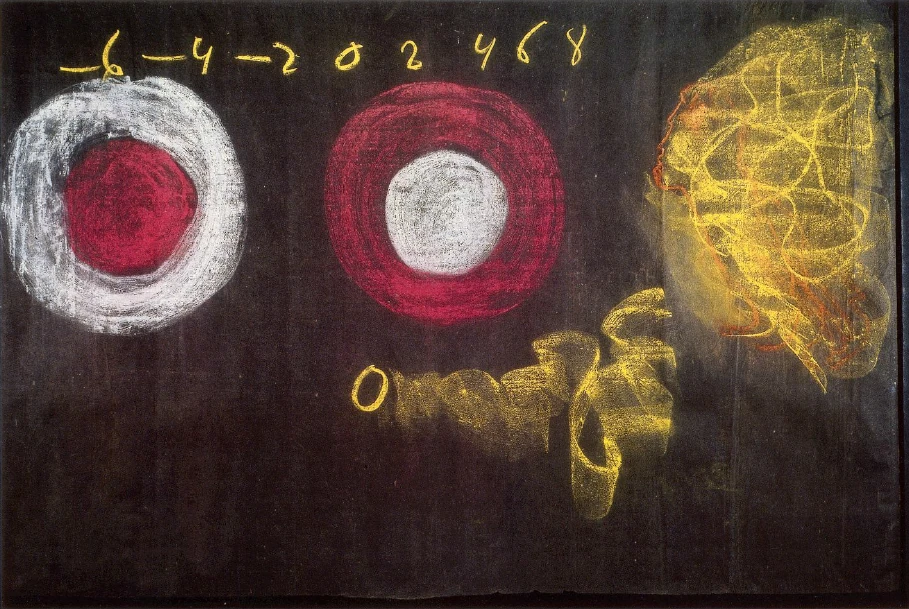
[ 5 ] What you experience there as the second human being is not a spatial body, but a temporal body. And, as I have already said in these lectures, when you draw the physical human being, you can draw this temporal body into the picture. But only a single phase is captured—just as when one captures a phase of a flash of lightning. This body of pictorial forces does not exist in space; it exists in space only for an instant. In the next instant, it is something else. It is in constant fluctuation, in constant change. And this change is what one experiences as the tableau of life.
[ 6 ] But at the same time, one experiences that one now feels like a part of the entire universe, that one no longer believes one is confined within one’s own skin, but rather naturally comes to believe that one fluctuates within the entire universe—that one is, in fact, merely a wave in the ethereal universe.
[ 7 ] And one gains other insights into this second human being. One also gains the insight that he constantly strives to dissolve the physical matter he carries within himself into nothingness. I have said to a number of you recently in another context: Physical matter, the physical substance, exerts pressure; that which lives in the etheric draws in—it draws out of space that which fills space, absorbing everything. And in our earthly life, we actually live constantly within this interplay. We nourish ourselves, thereby bringing physical matter into our being. This physical matter flows into our body to some extent through nutrition, where it sets in motion all kinds of processes and events oriented toward the nature of this physical matter. When we eat sauerkraut, the sauerkraut initially behaves—as it enters our organism—in the way it can behave according to its chemical and physical properties as sauerkraut. When we drink milk, the milk behaves in a manner characteristic of milk. But this quality is soon driven out of the milk and the sauerkraut. Then the etheric body begins its activity and strives to extinguish the “milk-ness” and “sauerkraut-ness,” so that there is a constant struggle within us between “sauerkraut-ness” and “milk-ness” on the one hand, and the extinguishing of “sauerkraut-ness” and “milk-ness” on the other. This struggle is present, and it unfolds. The existence of this struggle is evident in what the human being excretes, and in that which, as formative forces—as the supersensible organization of humanity—moves toward the head. Exactly as much as we excrete through the various excretory organs is transformed on the other side into negative matter, into negative substance, which lives as a sucking principle in our nervous system, especially in our brain. And no one can come to know the human being by looking only at the physical body, for there one learns, so to speak, only from the periphery a fragment of the processes taking place within the human organism. There one learns a fragment of those processes that run along the digestive tract. And then one comes to recognize that part which is excreted through sweat or other means. But for everything that is secreted—that is, everything that decays into gross matter—there is the other pole: that which extends from the nervous system as the etheric. For everything we excrete as external material substance, the etheric enters into us. This etheric, which swirls, undulates, and weaves within our etheric body—or body of formative forces—pervades us entirely in the way I have described.
[ 8 ] And, as I have already hinted, one comes to know oneself as this “second human being” by observing how the power of memory, the capacity to remember, can change. In everyday life, we perceive external impressions. These continue inwardly in thoughts and mental images, and then come to a halt. We can recall them. But when we recall them, our inner power reaches only as far as the nerve endings. So when we look at the eye, when we make an external perception, we penetrate through the nerve endings of the optic nerve extending into the eye, all the way into the eye’s blood circulation. This is how perception arises. If we merely recall, we penetrate only as far as the end of the nerve in the eye, to the point where the nerve, so to speak, terminates. We do not penetrate through the nerve endings into the blood with our etheric body or body of formative forces.
[ 9 ] If we then intensify our thinking, it is as if we were not merely experiencing that repulsion we encounter in ordinary memory—where we first take in a perception, transform it into mental images, which then stagnate within us and are repelled; but rather, when we—coming, as it were, from the rear—take in what is ethereal in the world, we advance with this ethereal content of the world’s thoughts within our organism just as far as we otherwise advance with our memories, which are, however, merely reminiscences of life. Then we acquire an awareness of the etheric happenings in the world; then we live within the etheric happenings of the world. And the person who experiences themselves within the etheric happenings of the world—if I were to sketch this out—experiences themselves as follows: There are the etheric happenings of the world in the most manifold ways (yellow). You have to imagine it as a configuration. Everything is weaving and living within it. And then the human being experiences themselves within this etheric activity. It will look strange there, but it is so—what I am sketching here (red) must be understood this way—: one hardly notices the feet or the legs. One now experiences the etheric activity in such a way that, so to speak, one grows out of this etheric activity at a single point. One experiences the etheric activity all the way to one’s nerve endings. It passes through the back and extends to the nerve endings of the front of the body, and one is thus the outermost extension of the etheric world. This is how it appears in relation to the etheric world as it currently exists. One perceives the etheric world in such a way that, when one finds oneself pushed out as it were into a farthest corner of the etheric process, the very last part still extends into one, and the etheric process then comes to an end within one. In short, one immerses oneself in this way into the etheric process of the world.
[ 10 ] And it is truly true: It would not be all that difficult to achieve if people today were only inclined to immerse themselves in the act of thinking itself, as I have described.
[ 11 ] The easiest way to immerse oneself in this very act of thinking is to truly live through what is contained in my *Philosophy of Freedom*. There, for example, reference is made to this life of thought as it pertains to the ethical and moral world. Qualitatively, it is the same as what I have described there. And if one studies *The Philosophy of Freedom* in the right way, one comes to understand what this experience of the ether, this experience of the formative forces, actually is.
[ 12 ] The next experience can then arise in such a way that one does not merely engage in the activity of thinking, but rather engages in the activity of speech, rising to a contemplation of the activity of speech. Here, one can even begin with the most ordinary speech activity of everyday life. However, one must take the activity of speech just as far as one has taken the activity of thought. With the activity of thought, one must progress to the point where the senses fall silent, where one lives actively only in thought, and where one is not influenced by the senses. With the activity of speech, one must reach the point where one has much to say, where one is not poor in words but rich in them, where one has an immense amount to tell, yet can also, at will and for a certain period of practice, remain completely silent. I know that this is an extremely demanding ask for some people; but it is absolutely necessary for learning to recognize the third human being. One must truly understand what this means: One has made all the inner preparations for words to flow from one’s tongue; but one learns to be silent—to be actively silent. Learning to remain passively silent when one is in an empty room—not, of course, a vacuum, but a room devoid of people—where one has nothing to say to anyone; merely learning to remain passively silent is of no help; rather, one must learn to remain actively silent.
[ 13 ] Now you might say: You’d turn into quite a boring fellow if you went around among people and practiced silence—that is, stood in front of them and, instead of telling them something, just kept quiet. Now, I certainly do not deny that, as unpleasant as it might be socially, this could yield extraordinarily fruitful results, even in terms of intellectual progress. Yes, it could indeed yield quite fruitful results if, for example, a person were to enter a social setting where people do not usually remain silent—and where he is not otherwise accustomed to remaining silent—and he were now to begin keeping silent. He says nothing, even though he knows an immense amount, and in fact used to talk endlessly about precisely what he knows. I say one could do that; but one need not do it outwardly, and although it might be fruitful, it will nevertheless not yield all that much in terms of higher intentions. Rather, it is a matter of carrying out the entire process I have described inwardly—of allowing all the impulses to speak, but not letting them come to speech inwardly.
[ 14 ] You will understand better what I mean if, for example, I tell you that in everyday life we don’t really think at all. We think, for example, about mathematics when we draw a triangle the way I described earlier; we think in particular when we do such peculiar things for which there are no words in language. But if one thinks only in terms of the things that are so commonly accepted among people today, one isn’t really thinking at all, because in this kind of thinking, the speech organs are constantly vibrating along with it—albeit so quietly that one cannot hear it. The thinking of people today—who love thinking so little, and for whom nothing external or sensory corresponds to it—is not real thinking at all. It is merely a soulful weaving in the shadows of words. One need only examine oneself to see how this soulful weaving exists in the shadows of words. If one is now able to truly bring one’s larynx to complete inner stillness—and yet still carry out within the soul the inner activity that otherwise underlies laryngeal movement—if, in other words, the exercise of stepping out of words remains entirely inner, if one does with the ability to speak—in other words—the same thing one previously did with the activity of thinking, which is a transformed capacity for recollection—then one reaches only as far as the nerve endings; one now exercises the activity of speech only as far as the larynx, precisely to the point where it is about to begin to speak—then, little by little, precisely that which I have recently called “the deep silence of the human soul” in my public lectures begins to take shape. Namely, not allowing inner speech to arise means cultivating the deep silence of the soul.
[ 15 ] The deep silence of the soul must be understood this way: Imagine you are in a city—perhaps not exactly Basel, but London or an even noisier city. You are right in the middle of the loud roar. Now move away from the city. The roar grows fainter. You keep walking, and the roar grows ever fainter. You may find yourself in the solitary stillness of the forest. You say: it is completely quiet inside and out. There will come a point where silence reaches zero—that is, absolute silence sets in. First there is noise; now it grows quieter; now absolute silence arrives. But now this can go further. And the fact that it goes further—that one does not merely have that stillness where the outer world is silent even within the soul, but that one attains the deep silence—can be precisely a result of this abstention from words, even though one engages in all the inner activity that can give rise to words; one simply does not make use of the physical body. I have described the individual exercises in the book *How Does One Attain Insights into the Higher Worlds?*. There one realizes that there is something more than just the state of absolute stillness. And in my public lectures I used a trivial comparison; I said: Let’s imagine someone has a certain amount of wealth. He spends some of it; now he has less. He spends more; now he has even less. Finally, he has zero. Yes, now if he spends more, he goes into debt, and then he has even less than zero. And so it goes on. Mathematicians have, of course, introduced negative numbers—-6, -4, -2, 0, 2, 4, 6, 8, and so on. In this way, you can also imagine that the stillness of zero transitions into the negative—into that which is quieter than silence, more tranquil than stillness. You can create this within your soul.
[ 16 ] But then, when the outer world not only falls silent in this way but does more than remain silent—when the soul’s reaction goes beyond neutral stillness into the negativity of outer sounds and noises—then the spirit begins to speak from the deep silence of the soul, and then we perceive our third human being, whom we then call the astral human. Terms are irrelevant; it is merely terminology—one could also call it something else. This astral, this third human being—we become aware of it when we arrive at the deep silence of the soul, and out of the deep silence of the soul resounds the other, the spiritual, which is the opposite resonance of the physical resonance. And this astral body takes us further in every respect than the mere etheric body. To illustrate this, let me cite something cosmic.
[ 17 ] What does today’s physicist or astronomer—indeed, today’s natural scientist in general—do? He investigates the laws of nature. He observes and thereby discovers the laws of nature; or he experiments and thereby discovers the laws of nature. Now he has them, these laws of nature; they are his science, they reveal to him what lies within things. That is all he should really say. But now he begins to grow proud and arrogant about his laws of nature and makes a claim that he really has no right to make, namely: that these laws of nature apply throughout the entire universe. He says, if I have researched something here on Earth in my laboratory, and if the same conditions could be created on the most distant stars in the cosmos—from which light takes so many light-years to reach Earth—people do, after all, claim that they can imagine such things— then, if the conditions could indeed be replicated there, the laws of nature would naturally apply there as well, for these laws of nature are, after all, of absolute validity.
[ 18 ] Yes, but that's not how it works. If there is a light source here, it initially shines brightly in the surrounding area. Further away, the light intensity is significantly lower; if we go even further, it’s even lower, and if we go all the way out, it becomes very dim. There, the light intensity decreases with the square of the distance. That’s how it is with light. And, curiously enough, that’s also how it is on Earth according to the laws of nature.
[ 19 ] What you observe on Earth as laws of nature becomes less and less valid the farther you move away from Earth. Isn’t it true—it’s terrible to say something like that, and in the eyes of a conventional natural scientist, you’d have to be a real idiot to say such a thing, of course. That is quite understandable, for when one comes to these matters, it is very easy to put oneself in the mind of a contemporary natural scientist. Only the reverse is not true: he cannot put himself in the mind of the spiritual researcher. The spiritual researcher knows very well how the natural scientist arrives at all that he asserts; it is just that the reverse is not true. Therefore, the criticisms of spiritual research that come from the natural sciences are, for the most part, entirely justified from that perspective; but they mean nothing more than that the natural scientist cannot make sense of the statements of the spiritual researcher. One must, however, take his word for it, for that is the case. He simply cannot make sense of it. He must first become a spiritual researcher if one wishes to engage in any kind of debate with him at all. Therefore, any polemic with someone who wishes to remain a natural scientist and cannot make sense of the findings of spiritual research is entirely futile.
[ 20 ] Well, the natural scientist will admit this with regard to light—after all, that is his own conclusion—but he will not admit it with regard to the laws of nature. Yet even with regard to light, the spiritual scientist must make a qualification. You see, the natural scientist says that when light radiates out, its intensity decreases more and more the farther out you go, until finally it reaches a point where you can no longer distinguish its intensity from zero. But you see, such a claim is just as sensible as if someone were to say: I have a ball here that is elastic; I’m going to squeeze it now. — Well, in reality, as you know, the ball then tends to spring back in the opposite direction. Its elasticity causes the surface to move back and forth. Now someone might say: “That can’t possibly be true; if I bend something elastic at all, it must keep bending farther and farther; it just becomes so faint here in the end that you can no longer see it, can no longer perceive it.” — But that’s simply not the case. The elastic material snaps back. It’s exactly the same with light. Light does not spread out in such a way that one can say: “Out there it is so faint that it will soon merge into darkness,” but rather that it keeps spreading farther and farther. That is simply not true. It spreads only up to a certain point, up to a certain spherical shell, and then it snaps back. And as it returns, only the spiritual researcher sees it, not the natural scientist. For when the light has exhausted its elasticity and snaps back, it returns as spirit, as the supersensible. There it is then not perceived by the natural scientist. It does not radiate any light that does not reach a certain limit, reflect back, and return as spirit. But what I would like to say here about light also applies to the laws of nature. The validity of the laws of nature diminishes the farther I would venture out into the surrounding space. But this only goes as far as a certain spherical shell; then everything comes back again. But then the laws of nature return as meaningful thoughts. And that is the world ether.
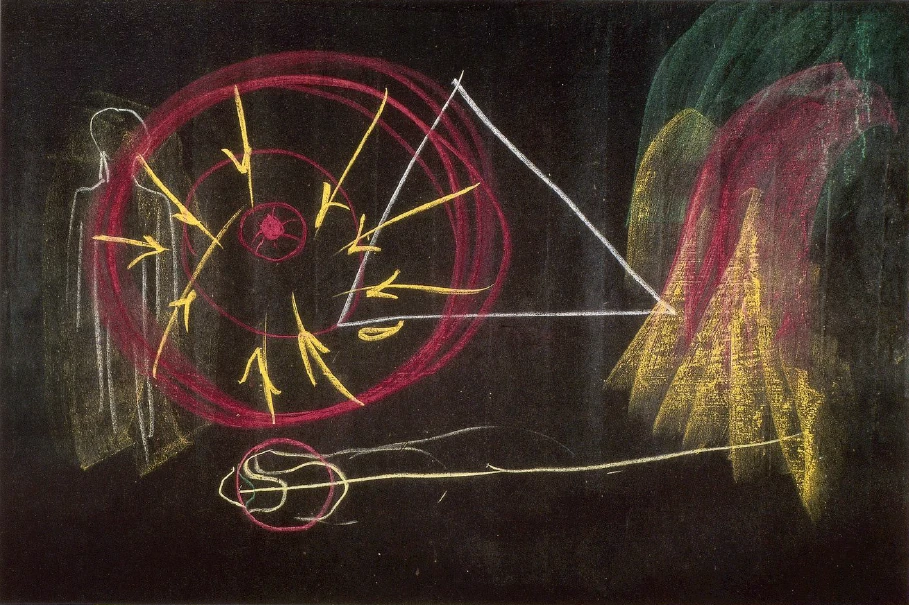
[ 21 ] The world ether does not have a radially outward movement in relation to the Earth, but rather an inward movement—a movement approaching from all sides. But what lives within this influx onto the Earth are, everywhere, thought-creating ideas. The world-ether is, at the same time, a world of thought-forming forces. But there is another catch to this. When I conceive of thoughts here on Earth in the way they are usually conceived—so as to arrive at the laws of nature—these thoughts are so neatly formed into lines, if I may speak figuratively, that one can then say: there is a certain constancy of matter, a constancy of force. There is a refractive index in the science of light, and so on. Through thoughts, one formulates what lives in the material realm. But when the thoughts return—when one experiences how thoughts live in the world ether—they are not such logical thoughts, nor are they thoughts with sharp contours; rather, they are image-thoughts, images, and imaginations.
[ 22 ] In these matters, one experiences some truly remarkable things, especially when compared to today’s spiritual life. A few days ago, I said to some of those sitting here: Over the course of the last forty or fifty years, theory upon theory—or hypothesis upon hypothesis, if you will—has been formulated about the world-ether. Some have conceived of the world-ether as a solid body, others as a liquid body, and still others as a world-gas—as something that exists in a kind of swirling motion, and so on. But what actually happens when one formulates such hypotheses? When one formulates such hypotheses, one simply continues to think in the same way one has become accustomed to thinking about visible natural entities and natural processes. But what comes back to us there has long since ceased to be grasped by the kind of thinking that formulates the laws of nature. One can only grasp what comes back there if one begins to think in images, to think imaginatively. One might say: The content and formulation of our laws of nature decrease in validity with the square of the distance, up to a certain spherical shell. Beyond that, the laws of nature cease to exist altogether. There they all blur into one another, merge into one another, and there they return—but now as images; they return in forms and configurations.
[ 23 ] And now, once one has reached that state of perception I described earlier, one views the world in an ethereal way—that is, in the form of images—and one must admit to oneself: For the time being, while you are living in this ethereal realm, you see nothing of your physical body, but the thinking you employ in the ordinary world has also evaporated. Now it is as if the universe were radiating back from every direction, sending images, sending imaginings. So that one begins to transform logical thinking into plastic, pictorial thinking when one wishes to comprehend the ether. Therefore, it becomes quite natural that the ether could not be understood by all the hypotheses that based their calculations on the perspective here; for as far as the ether radiates, all calculations and all the theories concerning physical natural phenomena have lost their meaning. There, radiation no longer takes place at all; rather, there is an influx—and what enters is not the kind of thinking one applies here in ordinary consciousness, but a form of thinking that, strictly speaking, lives only in art, though even in art it exists only in an earthly sense.
[ 24 ] As paradoxical as what I must now tell you may be, it is simply the truth for anyone who sees through the world. Imagine this: I am creating a wooden sculpture, and I am shaping this wooden sculpture in the form and likeness of a human being; so, for my own sake, I am sculpting a human being. I make this wooden sculpture in a form and design that is quite human-like. Let’s say I really succeed in getting the outer form to match that of a human being. But there is one thing I, as a sculptor, cannot accomplish: that space be sucked out. As a sculptor, I can only master physical matter. If, in the space where I am creating this wooden sculpture, I could also set the etheric laws of the universe in motion—that is, if this deep silence were to manifest outwardly, if negative stillness, not merely zero stillness, were present, if there were not merely space but something in which space itself is also present—then, although a human being would not emerge from my wooden sculpture, something plant-like would. The wooden sculpture remains merely a sculpture because only the physical is taken into account—that is, only the imprint of the form is made—since what is actually characteristic of the form, the drawing out of space, is not also created. This simply cannot happen; otherwise, my wooden sculpture would be a growing entity. So you must be clear that with ordinary artistic thinking, with ordinary artistic feeling, you certainly cannot approach the etheric world, because this approach to the etheric world is something in which one does not merely look into space, but rather grasps space itself, so that the ether empties the space. And then one experiences the living presence in this drained space—or, to put it more accurately, in the very act of draining the space. A completely different way of thinking must take hold if one wishes to ascend to these higher worlds.
[ 25 ] And then, once you have experienced the other thing I told you about—the deep silence of the soul—something else occurs. You will experience how the forms, the etheric forms, approach you from the cosmos. But at the same time, you will experience sentient spirit beings within these etheric forms. It is not merely etheric forms that now approach you, but actual spiritual beings from the so-called higher hierarchies. You experience yourself as a spirit among spirits. You experience a real spiritual world. It approaches through this reflection; wherever the etheric forms approach us, the spiritual world appears. The physical has gone out and is returning in the form of etheric formations. But now spiritual beings can return with these etheric formations. However, if you now ask yourself, “Where do they come from?”—the “where” no longer has any spatial significance. They derive their spatial significance from the fact that they come from the periphery of the universe; they come from all sides of the universe because they are carried by the world ether. The world ether gives them a spatial “where”; this spatial “where,” however, is an approach from the outside.
[ 26 ] These two forms of substance that I discover in the world in this way—the formative power that meets me in etheric forms and overwhelms me, and that which lives within them as spiritual essence—man appropriates, by descending from pre-earthly life into earthly life and filling himself with something that he now holds together within himself with a part of the infinite world of formative power—infinite in the relative sense, namely, only to the extent that the universe extends—and filling himself with the astral body, with that which enters there and which has a “where” only through the ether.
[ 27 ] We carry within us the physical body, which consists of the physical elements of the Earth. We carry within us the etheric body, which actually comes to us from the vastness of the cosmos, and within this etheric body we carry the astral body, which is spirit derived from the spirit of the cosmos. We delimit within ourselves that which appears indeterminate and boundless to the universe.
[ 28 ] And when we engage in even higher exercises—where we do not merely reach the deep silence of the soul, but penetrate this deep silence and awaken within our own will, just as we otherwise awaken only in thought and imagination—then we experience our fourth humanity, our “I.” And tomorrow at the same time, I would like to speak to you about this experience of the “I.”