

What was the Purpose of the Goetheanum and of Anthroposophy?
GA 84
21 April 1923, Dornach
Translated by Steiner Online Library
5. The Physical World and Moral-Spiritual Impulses: Four Stages of Inner Experience
[ 1 ] In our recent reflections, we have examined how, in addition to the physical body, the human being is endowed with the etheric and astral bodies. And we have also pointed out how the etheric body—or body of formative forces—can be perceived when a person becomes aware of the inner life of thought. When a person becomes so aware of this inner vitality of thought that they can live within this thought even when they are not influenced by external sensory perceptions, and when this thinking is not stimulated by combining external sensory perceptions, but rather the person rouses themselves—out of pure inner strength, without the stimulation that thinking otherwise receives from external sensory perceptions—to experience a unique, inner weaving and undulation of thought existing within them, then this body of formative forces can be grasped. This experience of thinking is at the same time the experience of the etheric world. And as I explained yesterday, when, through such inner effort and thinking—which is actually not that difficult to achieve—one feels oneself within one’s second human being, one experiences that in this second human being one has a kind of time-body—something that is not enclosed in space in a state of rest, as the physical body is, but rather something that is constantly fluctuating, constantly in motion, something that can be perceived spatially only for a moment, and even then with barely discernible contours. But this “body of time” reveals itself in experience as the tableau of life that presents our entire earthly journey thus far as a unified whole before the eye of the soul.
[ 2 ] Essentially, it is a deeply spiritual and mental process in which one lives when, through an inner grasp of thought, one enters into the etheric life of the universe. In this imaginative weaving and living of the soul—which becomes an experience of the etheric—one no longer feels that inner shadiness characteristic of the soul life of ordinary consciousness; one no longer feels the dreamlike quality that characterizes the soul life of ordinary consciousness. Nor does one feel as cut off from the world as one does in the physical body, where one feels enclosed within one’s own skin. One feels the outer world flowing into oneself, one’s own being flowing out into the world. One feels oneself to be a moving part of the entire etheric universe, moving along with the world. But still, what one experiences there has something of a deeply unsettling unreality about it. While through habituation a person feels firmly anchored to the earth in their physical body, in the etheric experience they sense a certain insecurity regarding their own existence. They feel lifted above the physical world and not yet firmly grounded in the spiritual world.
[ 3 ] This firm grounding in the spiritual world, however, occurs when the striving human being attains what I mentioned here yesterday: the deep silence of the soul. The human being must reach the point where, in accordance with what I have described in *How Does One Attain Knowledge of the Higher Worlds?*, he no longer uses that force—which he otherwise needs as a modified breath force—to bring forth the external words of external language through the breathing process; rather, he must hold back what is about to overflow into words. Yet they must still develop within themselves that activity which otherwise flows into words; they must make the inner efforts that are otherwise required for speaking aloud, and through this they must attain inner silence. And when the soul not only reaches a silence equivalent to zero but descends even below that silence—to negative silence, to that which sinks below the level of silence in experience—when, as it were, we do not drown out our own spiritual nature with the forces that seek to enter the breath through speech, and yet we still develop the impulse to speak inwardly, but hold back the speech before it seeks to take hold of the larynx—that is, when we hold back the speech and yet develop the capacity for speech inwardly—then we attain not merely an inner stillness, but something that is precisely the deep silence of the soul. We attain this deep silence of the soul, which relates to the unfolding of language—the words that resound outwardly in the physical world—not merely as zero, but as a negative quantity. Then, out of this deep silence, resounds that which the spiritual world—or, to use an ancient term, the Logos—wishes to reveal to us from the universe. Then it is not we who speak; then we have become the instrument through which the Logos speaks here. And then we become aware of our own astral body within us and of that astral world of which I spoke yesterday. This astral world is fundamentally different from the world experienced through the senses and the reasoning mind in ordinary consciousness.
[ 4 ] In this world of the senses and the combining intellect, as experienced in ordinary consciousness, we perceive—in a coarse, dense form—the material things and material processes that fill space; which, to put it imprecisely but in layman’s terms, press upon our senses, so that we are able to perceive them sensually. If, on the one hand, we have, as it were, the coarse material things and processes of the external world as the basis for our experience through the senses and the reasoning mind, then on the other hand there are the unreal thoughts, the unreal sensations—as we say, those unreal thoughts and unreal sensations—about which philosophers have always debated their relationship to reality. The person who relies solely on ordinary consciousness would, so to speak, always like—whenever mere thoughts and sensations arise before his soul—to reach out with his hands to touch something somewhere in the material world, in order to assure himself of its real existence.
[ 5 ] On the other hand, then, there is existence in thoughts and feelings, which does not immediately appear as real; and from these thoughts and feelings the moral world—the world of moral impulses—emerges for human beings, as it were, flowing forth. When a person views the world in this duality—on the one hand, the coarse, material, concrete, which is initially the real for him; on the other, the thoughts and feelings, whose reality is doubtful, which contain the moral impulses—it has for him something one might say, oppressive about it when he then looks into the matter and finds, through scientific proof, that by virtue of the conservation of matter and energy, the outwardly real possesses a certain eternity, whereas that which emerges as a moral world order from mere thoughts and feelings is then annihilated within a certain vast graveyard of material existence—one that inevitably emerges from the hypothetical investigation of natural phenomena. To ordinary consciousness, it appears precisely as a duality: the material world on one side, the moral-spiritual world on the other, and man stands within this world—or rather, these two worlds—which have so little to do with one another. He stands within them; one aspect of his being is devoted to the material world, in which his processes of sustenance take place, in which his instincts arise from these processes, in which his senses receive impressions, and in which his intellect combines these sensory impressions. Human beings become aware that they belong to this material world, but they also become aware that their human dignity is fulfilled only when the moral and spiritual impulses that flow to them from thoughts and feelings—whose reality is disputed—have real significance for them.
[ 6 ] This presents people of ordinary consciousness with the challenge of filling the physical body—through which they are integrated into the physical world—with that whose reality must seem doubtful to them. They see that nowhere in the external natural world does that which is contained in the impulses of the moral-spiritual realm come to dominate. There they see the stones, which bring about their processes according to ironclad laws; nothing of the moral-spiritual impulses flows into these events within the mineral world. There he sees the plant world in its gentle stillness; he sees it called to its blossoming existence by the neutral sunlight and the neutral warmth of the sun, and even there he does not perceive how moral impulses are supposed to flow in any way into the awakening warmth of the sun, into the awakening light of the sun, which brings the Earth’s plant cover to full bloom.
[ 7 ] And finally, he looks upon the third realm of the natural world—the animal kingdom—with which he himself has so much in common in terms of his physical constitution, and he must admit to himself: In the animal kingdom, morality has taken on such forms that it no longer appears as morality. There, the predator exercises cruelty without one having the right to describe it as cruelty even in the moral sense, because the animal has descended below the level at which the moral impulse may be designated as a moral-spiritual impulse. And then the human being looks upon his own physical-material nature and finds that he, too, has descended to that level with a part of his being. Nevertheless, if he wishes to fulfill his full human dignity, he faces the demand to introduce moral impulses into this degraded nature—into himself. Within ordinary consciousness, there is no way to perceive a harmonious unity, a blending of the physical-material impulses and the spiritual-moral impulses. Here, the spiritual and the material diverge. And the human being looks upon the earthly course that lies before him until death and tells himself, he will live in this dichotomy with regard to his own being until death—that on the one hand he has his physical-material organization, which demands the introduction of moral-spiritual impulses, and on the other hand nature shows him that moral-spiritual impulses cannot take effect anywhere within the immediate laws of nature. He sees himself thrust into this dualism until his death.
[ 8 ] But then, when a person, in the way I have described, hears the sounds rising from the deep silence of his soul—his astral body and the world to which he belongs through his astral body—a world appears before his soul’s experience that he cannot have here with ordinary consciousness, a world that he nevertheless longs for here with his ordinary consciousness when he is confronted with the duality of the physical-material and the spiritual-moral. Then he gains a view into a world that is not unreal, that appears to him just as real as the gross, material, concrete world of the physical-sensory appears to him, but also a world in which, wherever processes take place, moral-spiritual impulses flow into the physical-material impulses. There, the human being looks into a world in which, on a higher level, it is as if—in this earthly world—when chemical processes take place, moral impulses were to flow into the chemical processes of combination and decomposition. Human beings look into a world in which there is no such thing as hydrogen and oxygen combining solely according to indifferent, neutral laws of nature, but rather a world in which hydrogen and oxygen combine in such a way that they follow moral impulses in their union. There are no processes there that do not simultaneously possess a moral-spiritual meaning.
[ 9 ] But now the human being comes to realize this: You enter the world—where the material, which has been heightened there, and the moral-spiritual, which has attained true creative power, interpenetrate one another—when you have passed through the gate of death. You descended from this world into the physical earthly world when you descended from pre-earthly life into earthly life. There, human beings come to know that only this physical earthly world is the world of dualism, the world of duality, where nature and spirit stand opposed to one another, as if separated by an abyss, where one cannot enter into the other. But there, too, a person comes to understand how he had to be placed in this physical earthly world so that he might experience how the spirit in this physical earthly world cannot approach matter—so that he, this person, is the sole being within this physical earthly world who can now bring about this connection out of his own freedom, out of his very own innermost individual impulse.
[ 10 ] If, anywhere in this physical world, a moral-spiritual impulse were to flow—through objective laws—into a chemical process, into plant growth, or into the instinctual life of an animal, then—because human beings are a synthesis of everything that exists in the cosmos—human beings would never have been able to attain inner freedom, that self-determined union of the spiritual with the material.
[ 11 ] Now, however, two states stand in opposition to one another in human life on Earth: the state of wakefulness, from the moment of waking until falling asleep, and the state of sleep, from the moment of falling asleep until waking. During the waking state, a person lives entirely in that world where spirit and matter stand in stark opposition to one another, where the spirit cannot approach matter to permeate it, and where matter is powerless to rise to the spiritual in its processes. But then, when a person has entered that world of which I have said that it resounds from the deep silence of the soul, then the person beholds that activity to which they devote themselves between falling asleep and waking up—the activity of their astral body. And then they know that with every falling asleep they leave earthly life, and with every waking up they return to it. Then they know that during these sleeping interludes of earthly life, they live in that world where they can first prepare the union of spirit with matter. But in all that which is woven there in the states of sleep between birth and death within a subtle etheric-astral element—so that it re-enters, upon waking, into the duality between spirit and matter as that which the human being lives and weaves throughout all the periods of life he undergoes while asleep between birth and death: In all of this lives that which, when a human being carries his or her being through the gate of death, enters that world in which there is no such thing as matter being powerless to rise to spirituality through its own processes, nor is there any such thing as the spirit being unable to reach matter. Rather, the human being enters that world—with all that he has woven for himself in sleep—where everything resembling matter rises to spiritual processes, where the spirit continually intervenes in matter. And he sees that the duality between spirit and matter exists only in the world he experiences episodically between birth and death. He further knows that he enters there into an entirely different world, which appears to him only as a mirror image, as a mirage, between falling asleep and waking up, where he prepares himself for the reality of this world.
[ 12 ] But once he has passed through the gate of death, he truly enters this world, and he now continues to weave the life he lived between birth and death. But he now continues to weave it in such a way that, on the one hand, there is no matter-free spirit that must await the moment when it will one day vanish along with its spiritual-moral impulses—for example, when the Earth has reached heat death. Human beings enter a world where what appeared to them between falling asleep and waking up—as in a vision, as in a spiritual-psychic mirage—exists within a real world in which there is no duality between spirit and matter, in which spiritual substance continually permeates material substance—that substance resembling matter— in which there are no mere laws of nature, but rather the laws of nature are only the lowest spiritual laws; in which there are no merely abstract spiritual laws, but rather the lower spiritual processes and laws already spill over into the matter-like processes found there. The human being enters this world in order to now undergo what lies between death and a future birth.
[ 13 ] Human beings become acquainted with this world by listening, from the deep silence of the soul, to how the Spirit—the universal Logos, yet in its individual manifestations—speaks to them; not in a physically audible language, but in a language that is not only inaudible but less than inaudible, and which, precisely for that reason, is in turn perceptible to the spirit. And by attaining the inner word—which does not become an outer word—yet by applying inwardly that power which otherwise reveals itself only through the mediation of the breath in the outer word, human beings work their way toward knowing that world from which they have descended—a spiritual world, but one whose reality leaves no room for even the slightest doubt that human beings have descended from it into physical earthly existence and will ascend to it again after passing through the gate of death. In this world, all spirit is just as active as the material is here on Earth. In this world, everything material has been elevated to such an extent that it does not resist the influences of moral and spiritual impulses through its coarseness or density.
[ 14 ] If one wishes to enter the ethereal-imaginative world, one must, so to speak, go beyond thinking—beyond abstract, lifeless thinking—to inner, living thinking. If one wishes to enter the world of deep silence—that is, the world where all matter-like activity is spiritual, and all spiritual life within matter is creative, then one must not only go beyond ordinary, lifeless thinking to living thinking, but also beyond audible speech to the inaudible speech that lies beyond it—which is not sound, but deep silence, from which inaudible words do not emerge, but rather the Logos speaks from the silence, acting precisely through the intensified silence.
[ 15 ] But if one wishes to go even further, one must not only ascend from living thought—which is, relatively speaking, merely a figurative process—to that which, as I would like to say, weaves and flows through the world, yet speaks in its weaving and flowing from the deep silence, so that one feels oneself within it as in something that flows right through the world and in which one flows along with one’s hearing, with one’s third human being—but if one wishes to go even further, one must rise to another process, to yet another inner process.
[ 16 ] On the second level, one lives in the living thought directed toward the etheric. One lives in the process—not one set in motion by us, but one illuminated by the Logos—that otherwise exists only in the physical air when we speak. On the third level, one must recognize something that is the antithesis of a process of destruction in the physical life of the Earth. One must now reach the third level not only through an elevation of thought—through an elevation of the power of speech that takes place in silence—but also through an internalization of what occurs when we, as human beings here on Earth, do something. One must simply be clear that “action” here does not refer merely to external, physical action. We also do something when we are merely working inwardly in thought, for the will unfolds there as well. Everything through which a human being rouses themselves to activity—whether an inner or an outer process—flows into action and not into mere suffering. But every time such an act takes place—even if it occurs only in thought, which serves as an initiative for activity—a physical process takes place within the person. Just as a cerebral process takes place in physical thinking, and a modified respiratory process occurs in physical speech, so too does an inner process occur when such an initiative of the will flows into action—a process we can compare to the destruction of material substance that we observe in all combustion processes. When we see how a flame destroys the substance of a candle, we see—I do not wish to go into any finer chemical details here, but merely to explain in layman’s terms what can and should be regarded as a sensory-physical process— we see there—regardless of whether it undergoes a metamorphosis and disappears into something else, something more invisible—how the flame, how the act of burning, destroys the constitution of the material.
[ 17 ] Such processes, in which something is grasped by something similar—as the flame grasps the substance of the candle—are always at work when acts of the will take place within us: those dark processes of the will that a person otherwise overlooks in ordinary consciousness, into which he does not look. He knows nothing of what happens between the intention he has for the action of a hand movement and the actual raising of the hand. He does not know how the intention, which lives in thought, shoots into the muscles and then causes the hand to rise. He only sees the unfolding of the movement in the moving hand. But what lies in between is a process akin to combustion. It is just that within the human organism we do not have the ability, so to speak, to observe this combustion process—which is the material process underlying the unfolding of human will—through a higher spiritual perspective. When we observe this combustion-like process, we cannot conclude that only matter is being transformed; rather, what matters is the destruction of those processes that are first kindled when a person engages in ordinary nutrition. All those physical, combustion-like processes that take place as the foundation for the unfolding of the will—all these processes, which, as mentioned, are combustion-like—occur between the continuation of the nutritional process and the formation of blood.
[ 18 ] Where we see blood being formed, we gain insight into these combustion-like processes. But there we also see how, within these combustion-like processes, the human will sparks and exerts its power. We look into a descending material process. There we see—to put it simply—how matter disappears. But there we can perceive something similar to what we perceive during careful meditation, when we transition from externally stimulated thinking to internally moved thinking. In this inwardly moved thinking, we then have something that we become aware of only through our own activity. In the deep silence of the soul, we have something that lies behind our physical breathing process and resounds from the spiritual-soul world in the opposite negative as the Logos resounding forth from the silence.
[ 19 ] But we also gain insight into those processes that function as combustion processes in our organism when we are able to see what lies behind them in our organism, when we can observe how the World Will is at work precisely in the destruction and in the development of these combustion processes within our organism: Just as the power of the Logos lies behind the breathing power of the outwardly audible word, so too does the creative power of the World Will, which works within us, sparkle behind this power of combustion that is constantly at work in our organism. If, in the modified breath (red) that develops from our larynx into the outwardly audible word, we come to know the spiritual element (light blue, white) lying behind it—which arises from the deep silence in a direction opposite to that of the physical words, yet in such a way that we must not allow it to pass through the larynx— if we come to know this spiritual element—which makes present to us the silent yet clearly speaking voice of the World Logos—then we perceive, in all the combustion-like processes (red; see illustration on page 127) that we can observe within our organism, the World Will (yellowish) surging and undulating within them, in which we ourselves participate; not Schopenhauer’s “thoughtless” will, but a will that is everywhere sparkling with and permeated by the Spirit.
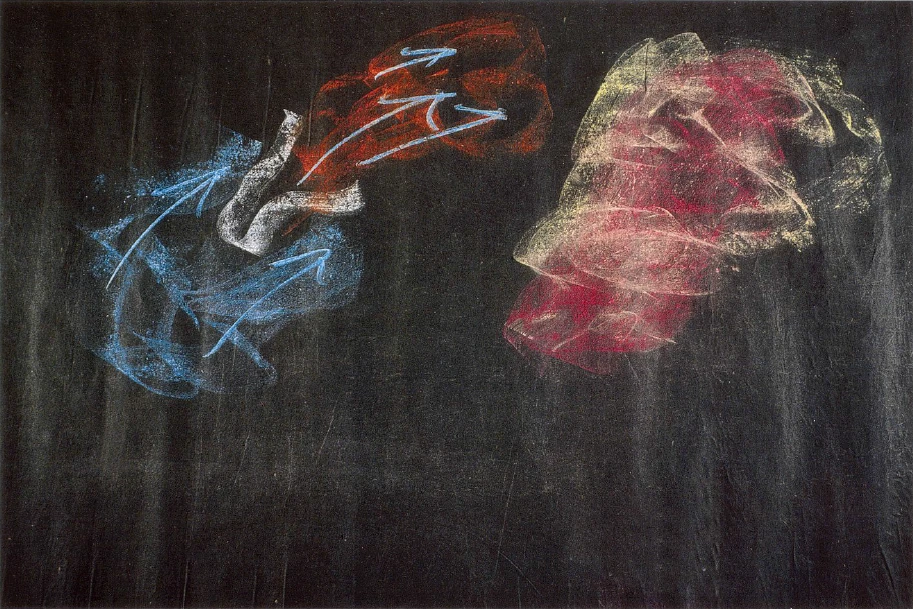
[ 20 ] We now sense a fourth human being within us. We sense creative processes wherever processes of combustion and decomposition are at work in the physical organism. We feel ourselves to be within the creative world. And in this creative world, we now become aware of everything within ourselves that is creative.
[ 21 ] And if, earlier, by becoming aware of our own third human being—the astral human—we came to know a world in which there is no distinction between matter and spirit, we now come to know a world in which the spirit not only lives in all processes, but in which the spirit is the creative force in all processes—a world in which there is no matter-like substance that is not formed out of the spirit. And we come to know within ourselves that which is of such a creative nature that, within its realm, there is nothing matter-like that is not its creation. And just as we have previously come to know a world in which the duality between spirit and matter does not exist, so we now come to know a world in which the moral-spiritual impulses themselves are the only reality. And as we look into this world—of which the corresponding drop reigns within us—as we look into what, as the fourth human being, is our share in this world to which we have now ascended, we come to recognize within this fourth human being a creative force within us—but one of such a nature that we say to ourselves: “That is not to be found anywhere here in this world of the natural environment, where the spirit cannot reach matter; nor is it to be found, at first, in the world that appears to us within our own astral body.” But it makes itself felt wherever something higher, something essential, enters this astral world. Just as the human being, as a physical human being, enters the air that is permeable to him as a physical human being, so do we become aware of astral life—a spiritual-soul atmosphere—and of spiritual beings moving about within this atmosphere, just as we, as physical human beings, move about here in the physical atmosphere. We now look not only into the generally speaking Logos of the astral world, but we look into that which moves and dwells in this astral world as spiritual beings.
[ 22 ] And there we come to recognize our own being as one that cannot possibly be present now, but which has passed through this ethereal world in its pre-earthly existence, and which was present in a previous earthly life. There we become aware of how the moral impulses from our previous—or from our various previous—earthly lives are inherent in the destructive process of combustion, and how this fourth human being lives within us, who is at the same time the creator of our fundamental destiny. There we discover, behind the burning of our body, the creative power of the essence of our previous earthly life, which has now been able to ascend to this region, where it counteracts the destructive power of combustion as a creative force, precisely because it is not present existence, but rather a past earthly life that has shed everything connected with the duality of spirit and matter, that has passed through the spiritual world and, in this spiritual world, has taken on the character of the spiritual-creative. There, within that which pulses up from the depths of our otherwise so dark will in our human being, we discover precisely that which bursts in, surges in as something that was once just as we now stand in earthly life, but which has become different by first becoming etheric, then living in an astral world, and in that astral world has ascended to a third higher stage. And now it appears within us as that which, in our present, merely shadowy “I,” is the creative, will-filled force of the previous earthly lives—a force that hardens it and imbues it with reality.
[ 23 ] Here we have ascended from the physical nature of the human being to his three higher natures: the etheric body, or the formative power; the astral body, which is the true soul; and the true “I,” which is the result of previous earthly lives, while that which functions as the “I” in the present earthly life merely weaves within us between falling asleep and waking up. I described to you earlier how, between falling asleep and waking up, the astral body weaves and moves within the essence of the astral world; but within this astral body, we still carry within us, between falling asleep and waking up, the “I,” just as I have described it. However, insofar as it is the “I” of the present, it is not yet capable of exerting its power within the physical body. For here, human beings share the fate of the rest of nature: the duality of spirit and matter. Here, human beings themselves are confronted by the spirit—which is not yet active in matter—and by matter, which is powerless and cannot approach the spirit.
[ 24 ] What lies within a human being in this struggle between spirit and matter—which shines into his being and consists in the will to overcome the dualism of spirit and matter in the outer, physical world of the Earth— as an inner conflict behind the scenes of their existence, which also plays out in waking life as mere will—this takes place behind the scenes of existence during sleep, between falling asleep and waking up. For human beings, as they unfold in ordinary consciousness, this is initially veiled by sleep. But it is there, in sleep, that what is now woven together—and which, when it becomes etheric and astral again after death, rises to become that very creative force—will have added a new link, once the next period between death and a new birth has elapsed, to that which is active in our will from long-past earthly lives.
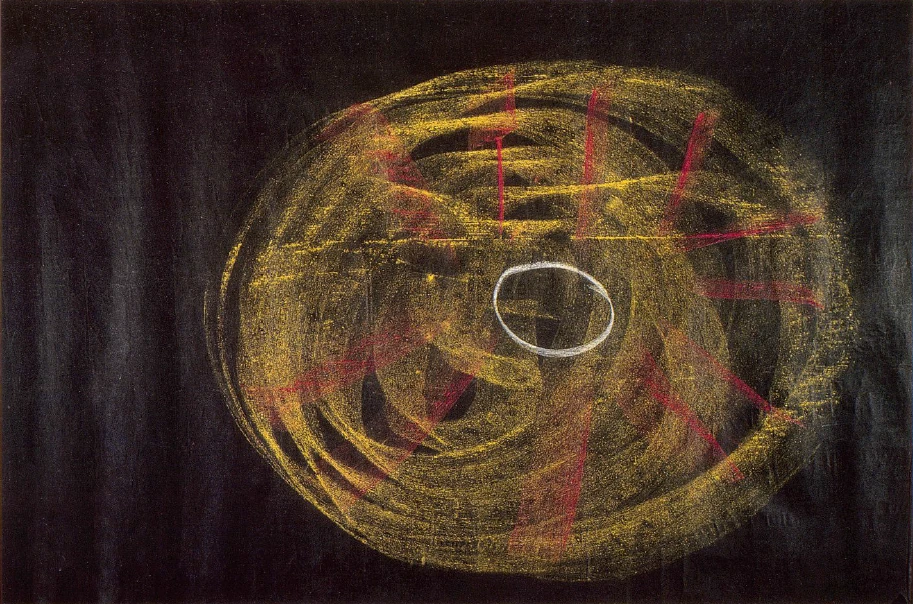
[ 25 ] And so we can look at human life. At first, we do not look down into the will; we do not look into sleep. But true spiritual insight reveals to us what is actually at work there as a creative principle—opposed to combustion—from long-past earthly lives. And we become aware of how, through our will—preparing our destiny from moral impulses—our past earthly lives pulse within us; how, when we fall asleep, that which the human will otherwise accomplishes even while awake—through its instincts, emotions, and conscious intentions—weaves itself, between falling asleep and waking up, into the being which is veiled from the human being in the present by sleep, but which in our next earthly life, as an active will pulsing through our blood in the metabolic processes of the future body, will unfold as the creative “I”—this creative “I,” which will then in turn have been augmented by that element which we have developed in this earthly life between birth and death and added to that which has come to us from our earlier earthly lives in the manner described.
[ 26 ] In this way, we can gain insight into the constitution of the human being, which consists of four elements. And as we become aware of how these four elements are actually present in the human being, we simultaneously look at human life as a whole. As I showed yesterday, earthly life expands into life in the world ether, which extends up to a certain spherical shell, but the cosmic-astral realm radiates back from all directions. With our astral body, we live within this cosmic-astral realm, which is imperceptible to earthly observation. But if we attune ourselves to this cosmic-astral realm as I have described today, then this cosmic-astral realm resounds not only as the World Logos, but from the words of the World Logos approach us—as if through real foundations of spiritual life—the real beings of the higher and lower hierarchies, and among them our own spiritual being from long-past earthly lives.
[ 27 ] Thus, as we come to know the human being, our spiritual and soul-based understanding of the cosmos—of the universe—expands at the same time, not only of the cosmos as a physical or etheric entity, but also of the cosmos as a spiritual and soul-based entity. Our understanding of humanity expands into an understanding of the world. Just as we can never have inhalation and exhalation in isolation in our physical earthly life—just as inhalation, in constant interaction with exhalation, must permeate and flow through us, and just as we live rhythmically through inhalation and exhalation— so on a higher level we cannot acquire merely knowledge of humanity or knowledge of the world in isolation; rather, knowledge of humanity demands—just as inhalation demands exhalation—knowledge of the world, and knowledge of the world demands—just as exhalation demands inhalation—knowledge of humanity. The systole and diastole of the great physical-psychic-spiritual life of the world are knowledge of the world and knowledge of humanity, which cannot exist side by side on a higher level, but only within one another, apart from one another, intertwining and influencing one another in an eternally changing rhythm, just like the immortal life of the cosmos itself, to which the immortal human being also belongs.