What was the Purpose of the Goetheanum and of Anthroposophy?
GA 84
22 April 1923, Dornach
Translated by Steiner Online Library
6. Human Cognitive Abilities in the Etheric World
[ 1 ] In recent days, I have tried to place the human being within the context of the entire universe, so that, on the one hand, one can recognize the structure of the human being as consisting of the physical body, the etheric or formative body, the astral body, and the true “I,” which passes from one earthly life to the next. At the same time, however, I have tried to point out how the various parts of the human being, each in its own way, are connected to the universe. Thus, one can say that the human physical body is connected to everything that constitutes the physical-sensory earthly world. This physical body of the human being therefore belongs to the physical-sensory world. But if we turn our attention to the etheric body, or body of formative forces, we must be aware that it actually belongs to a world of a completely different nature—that it belongs to the world that is itself etheric, and of which I have told you that human beings must actually perceive it as coming toward them from the vastness of the cosmos. So if one imagines, for example, that the forces of the Earth radiate outward from the Earth in all directions, and that the human being lives within these forces—which are the forces of the physical world—then we must imagine that the etheric world emanates from all sides, from the entire spherical shell of the universe, the cosmos, and approaches the human being, moving toward the physical forces and thus meeting them head-on. Consequently, the human etheric body is subject to entirely different laws than the physical body. And again, when we consider the human astral body, we find it connected to worlds that we do not encounter at all within that cosmos which is confined to the physical and etheric realms—in which we live between birth and death—but rather we find that with our astral body we belong to a world that we enter between death and a new birth.
[ 2 ] And finally, with the “I” itself, one belongs to a world that flows through worlds which, like our world, for example, are in turn threefold. Our world is threefold: physical, etheric, and astral. The world of the “I” passes through this world and through other similar threefold worlds. It is therefore a much more comprehensive world. It is a world that we must describe as the world of the eternal as opposed to the temporal.
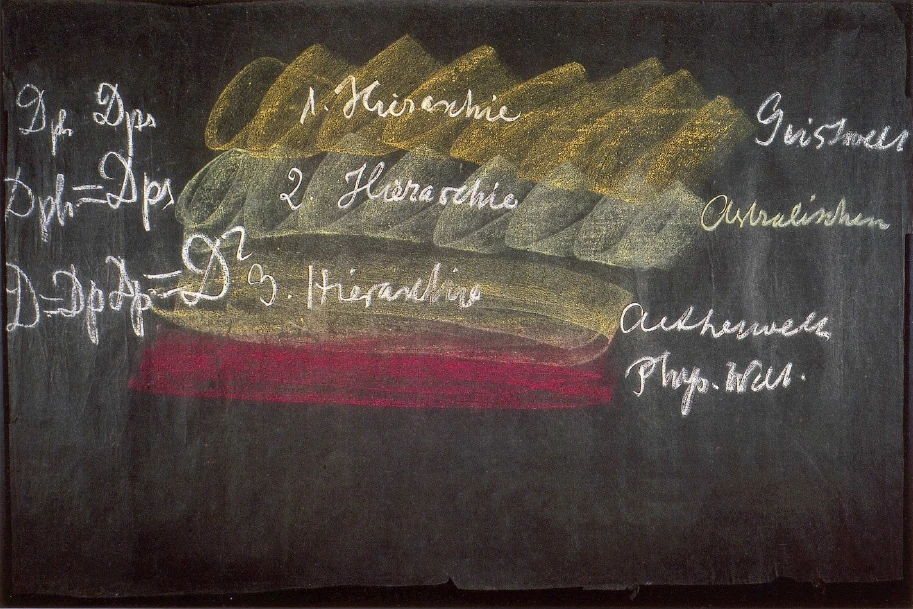
[ 3 ] But the fact is that when we approach those human faculties of perception and cognition that familiarize us with the etheric body—or body of formative forces—the astral body, and the “I,” we are actually always entering entirely different worlds. We must enter the sphere of active thinking, of lived thinking, if we wish to approach our etheric body. We need only imagine how everything around us—the world as we know it—is different from when we are within the physical-sensory world. Above all, the things and processes with which we are familiar from the physical world appear quite differently in these higher worlds. After all, we perceive only the final effects of the things and physical processes in the physical world around us. These things and these effects, however, have their roots in the higher worlds. So we then see, in a sense, what is more primordial in these things than what presents itself to us in the physical world. But apart from that: When we are in the physical world, we first have that world which is well known to ordinary consciousness—the world in which human beings are surrounded by the three kingdoms of nature and by their own kingdom; but when we ascend to those powers of cognition—which I have called “imaginative cognition” in my books—through which we become aware of our own etheric or formative body, then we enter the etheric world. And when we have developed the strength to do so, when we have purified ourselves inwardly to such an extent, and experience ourselves, as it were, in the second human being, in the body of formative forces, then we also enter the world that reveals itself to us, at least initially, through its images—the world of the Angeloi, Archangeloi, and Archai.
[ 4 ] The fact is that when one, so to speak, breaks through into that sphere of the world where the etheric body or body of formative forces becomes visible to us, then within the surging world of images into which one enters, the manifestations of those beings belonging to the third hierarchy appear: Angels, Archangels, Archai. We are thus surrounded by beings who are not present around us in the physical-sensory world. The way in which we are surrounded by these beings is such that they appear to us in qualities—I would say—that are also given to us here in the sensory world through our senses.
[ 5 ] But here in the sensory world, for example, colors are such that they are spread across the surface of things or that they appear to us in a purely physical configuration, such as in a rainbow. Sounds are such that they appear to us to be connected with this or that thing in the physical-sensory world. Heat and cold, for example, are also such that they ‘emanate from these or those things in the physical-sensory world.’ If we consider this world in which the third hierarchy appears to us, then we do not have colors adhering to things, nor sounds emanating from things, and so on; rather, we have—one cannot even say “through space”—but rather, colors flowing through time, flowing sounds, and vibrating warmth and cold. This is not stretched across the surface of things; what is colored fluctuates and undulates. But one simply knows, through the very forces by which one has transported oneself into these worlds, that just as one suspects something material lies behind the colors in the physical world, so too, when one beholds any surging cloud of color—a surging, one might even say, color organism—in this world, a spiritual-soul element reigns and weaves within it that belongs to the third hierarchy. So at the very moment when that tableau of life appears to the human being—the one I have spoken of, which vividly shows, in a single moment, the entirety of what we have lived through since our birth—at that very moment, within this flow of our own life events, there lives that which one can say: “Within the flowing world of colors, sounds, and so on—now freed from matter—the third hierarchy now lives.”
[ 6 ] When we then, through the power of our cognitive faculties, rise to the point where we can survey our own astral body—that is, what existed of us before we descended into earthly existence, and what we will carry with us again once we have passed through the gate of death—then we know: this is another world—but one that we do not find in the ether of the cosmos, one that lies beyond the gate of birth and death. It is another world that we enter there. It is the astral world.
[ 7 ] These things do not coincide exactly with what I have described in my *Theosophy*; there, the matter is characterized from a different perspective. But just as we encounter the third hierarchy when we organize ourselves upward into our body of formative forces, so too do we encounter the second hierarchy—Exusiai, Kyriotetes, Dynamis—in this world, where our own astral body becomes visible to us. And this second hierarchy now appears to us in actual vision not in flowing colors or flowing tones, but in such a way that it proclaims and reveals to us individual meanings within the Logos that permeates the world. It speaks to us.
[ 8 ] If one wishes to suggest how one might relate to these worlds after attaining the corresponding powers of insight—if one wishes to suggest this by using words to which one is accustomed, words that naturally no longer have their original meaning in relation to the sensory world, but from which one can nevertheless glean something about this relationship to the higher worlds—then one must say: In the etheric world, inner, living thought becomes a kind of tactile organ. Through inner, living thought, we touch this flowing world of colors and so on. We must not imagine that it is the case that we see red in a way similar to how we see the red of the senses—which is spread over things, as it were, with an eye—but rather we feel and touch red and yellow and so on. We touch the tones. So that we can say: In the etheric world, living thinking is the touching of that which lives in the world of the third hierarchy.
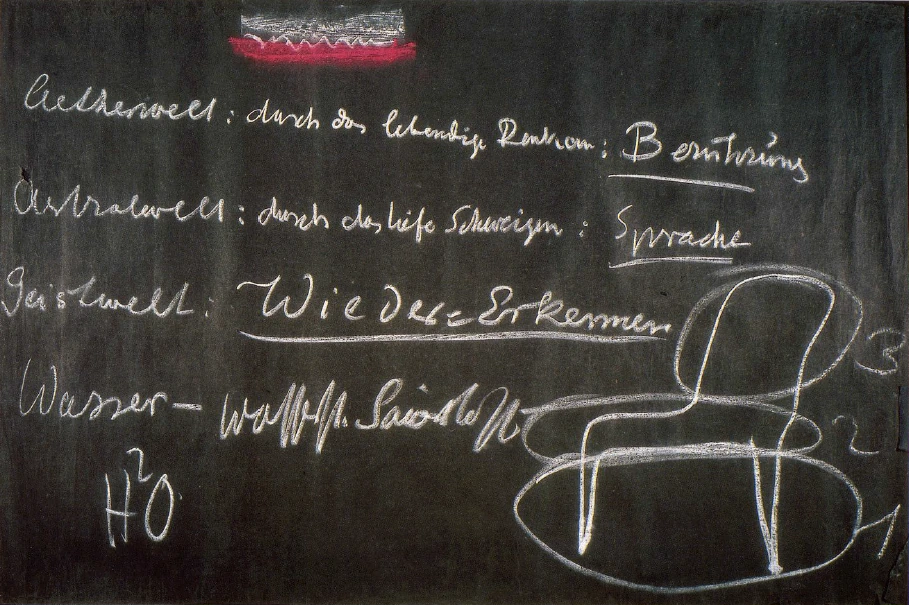
[ 9 ] When we then enter the world to which our own astral body, so to speak, belongs, we can no longer say of this astral world that we merely touch it; rather, we must say: We understand this world as a revelation of the beings of the second hierarchy. We understand every single expression as a link, as a part of the World Logos. Through the deep silence comes the language of the spiritual beings. Thus, after the contact comes the language, the communication.
[ 10 ] And if, as I hinted at yesterday, we bring ourselves to experience the “I” that passes from one earthly life to the next, and in between goes through the other lives—between death and a new birth in each case—then we enter a world that is the true spiritual world, the higher spiritual world. In this world, we first and foremost enter into a very special relationship with our true “I.” That “I” which we experience inwardly here in earthly existence between birth and death is, after all, bound to the physical body. It is perceptible to us as long as we experience ourselves in the physical body, and we are, in a certain sense, compelled to selflessness when we ascend into the etheric world, into the astral world. There we have, at most, something like a memory of this earthly “I.”
[ 11 ] But we then discover the true self in the manner described, as it passes from one earthly life to the next. We discover this true self in such a way that it initially appears to us as a completely different being. We say to ourselves: Here I stand within this life, between birth and death, in earthly existence. I look back through the portion of the etheric world that appears to me, all the way back to my birth on Earth. Then I look further on into worlds, into vast realms that actually have only a spiritual existence, where speaking of space is, in essence, an absurdity; yet it appears to me as a vast perspective—the world with all its contents, as it lives around us between death and a new birth. As I look through the ether, through the world of the third hierarchy; as I look through the astral realm, in which I existed between death and a new birth—as if in a supersensible world living in the revelation of the Logos, revealing itself through the language of the worlds; as I look through all of this, I finally look toward a being that is at first far removed from me—toward that which was the substance of my life in my previous earthly existence. At first, the matter appears to me in such a way that I say to myself: I am standing right here in earthly life with my present, ghostly “I,” and then I look far back through everything I have just described, toward the substance of my previous earthly life. But at the same time, I see how that “I,” unravering itself, had passed through the worlds—through which I have looked as if in perspective—all the way into my present earthly life. At first, I truly see my living, true “I” as a strange, distant being. And I recognize myself again in this being that at first appears to me as, so to speak, a stranger.
[ 12 ] Every word in this sentence should actually be taken very seriously, because each individual word has a very special significance in this sentence. Part of the whole experience is that, through the perception of one’s own “I” as something initially foreign, one brings oneself to say: What initially appeared to you as something foreign—that is, in fact, yourself. It seemed to you as if another being had lived in the distant past, but it is, in fact, yourself.
[ 13 ] And then one becomes aware of how this Self has just flowed in from the previous earthly existence into this earthly life, but how it is now, so to speak, veiled within this earthly life, and would only appear if all the events that occur between falling asleep and waking up were to come before the human soul. Within, that which has reached us from the previous earthly life—flowing through the astral and etheric worlds—continues to weave and live on.
[ 14 ] You see, there lies a world of earthly contradictions and heavenly harmonies in this inner struggle: earthly contradictions such that, through everything one initially considers part of everyday life here on earth, one is fundamentally unable to reach one’s own true self. In this earthly “I,” only the first rudiment of love actually lives. And life on Earth is already imbued with a radiance simply because the power of love shines into this earthly existence. But this love must be intensified. This love must be intensified to such an extent that, through the intensification of love, a person becomes capable of perceiving the etheric world and the astral world—and thereby overcoming that which lives within them as their “I,” as egoism, as the opposite of love—that which, in life, as the opposite of love, gives them the ability to perceive themselves as a separate “I” within earthly life. Love must become so strong that one learns to overlook this earthly “I,” to forget it, and to no longer pay attention to it. Love is the merging of one’s own being into the other. This must be so strong that one no longer pays attention to one’s own “I” as it lives in the earthly body. Then the paradox arises that it is precisely through selflessness, through the highest capacity for love, that one approaches one’s own true “I,” which then shines out to meet us from the distant past.
[ 15 ] One must lose one’s earthly self in order to perceive one’s true self. And anyone who fails to develop this devotion simply cannot reach this true self. One might say: The true self does not wish to be sought when it is to appear, when it is to reveal itself; and it hides itself when it is sought. For it is found only in love. And love is the surrender of one’s own being to another being. Therefore, the true self must be found as if it were another being.
[ 16 ] And at the very moment one enters into this realization of one’s own true self, one simultaneously becomes aware of what now lives in a broader world—the actual spiritual world. One encounters the beings of the first hierarchy: Seraphim, Cherubim, and Thrones.
[ 17 ] And just as one rediscovers one’s true self—of which one actually has only a reflection here in earthly life—so too does one discover the true spiritual form of the entire world of one’s earthly surroundings. One must also lose this earthly world in order to gain this insight, so as to find its true world of origin at the same time as our true self.
[ 18 ] So one can say: What is revealed in the spiritual world is recognition, contact, language, recognition—but recognition of something that one had previously come to know only as a reflection, as an image.
[ 19 ] In this way, by experiencing one’s own human nature and gaining insight into it, one lives one’s life within the totality of the universe. And this structure of the human being—comprising the physical body, the etheric body, the astral body, and the “I”—is only fully represented when one simultaneously describes how these individual aspects of human nature are connected to the corresponding worlds of the universe.
[ 20 ] What I have just described must be thoroughly understood and grasped if one wishes to arrive at what underlies it, if one is to approach the enumeration of these four aspects of human nature at all. This is certainly one of those points where it becomes quite clear that a person must not only think differently if they wish to ascend to the truth of the spiritual world, but that they must think in a different way altogether. They must transform the entire process of thinking—which is, in fact, merely a lifeless, pictorial construct within purely sensory-physical perception—into something living.
[ 21 ] And there, within contemporary culture and the spiritual life of our time, one can experience something truly special that reveals the obstacles that must be overcome if anthroposophy is to find its way into people’s souls.
[ 22 ] When my *Secret Science* was published, a much-cited contemporary philosopher took it to task. Well, this contemporary philosopher first read the chapter that discusses the division of human nature into the physical body, the etheric body, the astral body, the “I,” and so on. Many naive people have also read this *Secret Science*, though they possess common sense. They were able to make sense of it because such things can always be understood through common sense, just as one can understand a painting even if one is not a painter. But for quite a few people—including a much-cited philosopher of our time—understanding is far more of a struggle than it is for the naive individual. For this much-cited philosopher, upon reading: physical body, etheric body, astral body, I—well, strange—what am I supposed to make of this? What is all this? Physical body, of course; etheric body—well, that may be true; what is dense matter in the physical body may well be finer matter, but it is still matter. So this is just an arbitrary dividing line between the physical body and the etheric body. Astral body—one knows something, said this oft-cited philosopher, about a soul, but an astral body? In the soul there is thinking, feeling, and willing. These are functions of the physical body. Once one has understood the physical body, one has thereby also grasped thinking, feeling, and willing. And the “I”—that is simply the synthesis of all of this.
[ 23 ] And now, see how this much-cited philosopher formulated his critical thought? This is how it took shape: He regarded what he had before him in “The Secret Science” much as one might regard an armchair, and he said to himself: One can, after all, divide the armchair into the legs, the seat, and the backrest—the first, second, and third parts. So, he believed, I can now also divide the human being, just as one divides an armchair. Well, he found that while this provided a nice overview of the human being, it didn’t really say anything particularly new—because he thought that if one divided the human being into these four parts, it would be just like dividing an armchair.
[ 24 ] You see, in the natural sciences, things would actually go more smoothly. There, one could no longer speak of mere classifications. For when one has water, the chemist breaks it down into hydrogen and oxygen, \(H_2O\); the natural scientist will not accept that water is merely divided abstractly into two parts, hydrogen and oxygen. He cannot accept that, because he knows that hydrogen does not have to be bound only to oxygen, as in water, but can be bound to something entirely different—for example, as in hydrochloric acid, to chlorine. So the hydrogen that is in water is not just a small part, a component of the water; rather, when it is removed from the water, it can form entirely different compounds. And likewise, the oxygen, when removed from the water, can form entirely different compounds and can be bound to entirely different substances—for example, to the calcium in lime. So, the hydrogen can separate and combine with chlorine to form hydrochloric acid, and the oxygen can separate and combine with calcium to form lime. You can’t just say that you have to classify water abstractly, like an armchair.
[ 25 ] With human beings, we are on an even higher level. Here we are not dealing with a mere classification—physical body, etheric body, astral body, and I—but rather we must say: that which is the human being’s physical body belongs to the Earth. And when a human being passes through the gate of death and leaves behind his physical body, the physical body returns to the Earth, while the etheric body ascends into the ether. The astral body, however, departs from both and enters those worlds where the second hierarchy resides. And the I, in turn, belongs to yet another world—the world in which the first hierarchy resides. These four members are not merely categories of division; these four members belong to entirely different spheres of the universe. This classification simultaneously points to the very essence of the human being. This essence exists on a far higher level than that which one must already seek on the path from the chair to the water.
[ 26 ] But of course, within the current state of our intellectual development, this creates yet another significant obstacle, for the oft-mentioned philosopher might learn—even from chemistry—that one cannot always speak solely in terms of abstract classifications; that one may well do so when sitting in an armchair, but not when dealing with water. But the philosophy of the so-called philosopher simply did not extend from the armchair to water. It did not extend from the conception of life’s trivialities—which are reduced to abstract concepts—into the natural sciences. And the natural sciences, on the other hand, do not extend into philosophy. As a result, chemists today do not reflect on such things at all.
[ 27 ] Thus, in philosophy—which, viewed from this perspective, could also be called “armchair philosophy”—scientific thinking does not yet prevail. In chemistry and the natural sciences, on the other hand, philosophy is absent. Thus, the conditions do not exist—especially within the scholarly world—to approach the deeper inner truth of the universe in its connection to humanity.
[ 28 ] That man, who approached the matter so critically, did, after all, send me the essay in manuscript form at first. But what is one supposed to do with something like that? You can’t really discuss anything with someone like that; he lacks the very basic prerequisites. I set the essay aside. Then I found it again, already in print with all the errors—and, really, all the nonsense—contained in that armchair philosophy. These are simply the twists of fate that anthroposophy encounters along its path. And one must see what the situation is between anthroposophy and what is often critically leveled against it. It is precisely on this side that there is initially not the slightest possibility of understanding.
[ 29 ] And this philosopher—whose name is frequently cited among philosophers today—even admits to certain things that are more in line with the common notions of today’s civilization. For example, he admits that there once was an Atlantis, a continent between Europe and America, and that the ancient Atlanteans—a pre-human civilization—lived there. Now, in that essay of his, there is a hypothesis—though not expressed in exactly those words—that goes: How does anyone come to classify human beings in this way today, when there is, after all, a well-established physiology and a well-established psychology? —Of course, in anthroposophy, one does not classify a human being as one would a chair, but he believes that. For this philosopher—who was, in his own way, quite conscientious—this presented a puzzling question: How does one come to make such a classification? It is, after all, something so primitive compared to what today’s philosopher has! —Well, today’s philosopher may not have particularly much from the standpoint of truth, but he thinks he has an awful lot. Two days ago, I demonstrated to the esteemed participants of the teachers’ course how one should actually understand what is known today as so-called psychoanalysis.
[ 30 ] This psychoanalysis—and I would like to repeat this here as well—has the peculiar characteristic that, on the one hand, it stems from an amateurish physiology that does not rise up to the spirit within the soul but remains stuck at the level of the body, and, on the other hand, it in turn proceeds from an amateurish psychology. The two do not come together. And as a result, grotesque connections are sought between what is attempted as dilettantism in psychology and what is attempted as dilettantism in physiology. And the dilettantism is immense and equally great in both cases. Psychological amateurism is just as widespread among psychiatrists themselves as physiological amateurism; but when both are equally widespread and work together, they multiply each other’s effects. That is dilettantism squared, according to a very simple calculation. So that, in fact, psychoanalysis, as a genuine worldview, is precisely dilettantism squared, because it arises from the multiplication of dilettantism by dilettantism.
[ 31 ] For this much-cited philosopher, the situation was this: He could not understand how anyone today could come to divide human beings into four parts in such a primitive way—just as one might divide a chair into three parts. He could not fathom it. Therefore, he hypothesized that I was a resurrected Atlantean. That’s actually quite witty from the standpoint of “chair philosophy.”
[ 32 ] All these things, however, indicate that if one truly wishes to approach authentic anthroposophy, one must indeed resolve to overcome certain things. And among the things that must be overcome is, for example, the following: One learns to recognize the soul and the spirit directly and can then speak of the soul and the spirit as existing outside the physical. One does not speak of the soul and the spirit through some kind of deduction, but rather because one perceives them in their reality. Today, there are people who can no longer help but acknowledge the soul as an inner need in some way. But they then say that one must deduce the soul from the effects of the physical.
[ 33 ] I did say that for some of the “enlightened” anthroposophists, this will be a repetition. So, some things you already know will be repeated. For example, there are philosophers today who engage in natural philosophy—or natural historians who engage in philosophy—who say: There is a plant called the Venus flytrap. It has uniquely shaped leaves and flowers. When an insect comes near, it closes up. The Venus flytrap captures this insect and consumes it. — Yes, if one wants to infer the soul from such outward behavior—to claim that the plant also has a soul—then I can name something for you that must also have a soul. It is a certain instrument, even one constructed by humans. You put some smoked bacon inside it, and it has a trap that snaps shut when a mouse comes along, drawn by the bacon, and enters the device. When the trap snaps shut, it is exactly the same as with the Venus flytrap, the plant. One can infer the existence of a soul in the mousetrap just as that literary natural philosopher infers the existence of a soul in plants. Such external appearances simply do not allow us to deduce these things at all.
[ 34 ] Now, however, one must be clear that what we have here goes far beyond the notions of ordinary proof or refutation that people generally hold. For you see, when one comes to know human beings from this true perspective, one experiences that which manifests itself in human beings as physical nature; which, in earthly life, becomes a complete imprint of what the human being is as a spiritual being. And just as you can see the engraving of a seal in the sealing wax, so too can you find, everywhere in the human physical body, the imprint of what the human being is spiritually and soulfully. What the human being is spiritually and soulfully, you can demonstrate everywhere in the convolutions of the brain. And so, if you wish to close yourself off from the spiritual world, you can say: after all, everything is contained within the physical realm. One can, if one wishes, be a materialist through and through. Nothing is lacking in human nature. One must not merely insist on evidence or refutations of the conventional sort, as are otherwise sought in the world, but one must be clear that one must have a disposition toward the spirit, that one must recognize the spiritual as something independent. Then one will not deny that there is a seal, because there is an imprint in the sealing wax. The materialist says: There is no seal; it’s all just a result of the sealing wax. In this way, he can prove that there is indeed nothing else in the seal: it says “Josef Müller,” and that is what’s in the sealing wax; the whole person is contained within the sealing wax.
[ 35 ] One can be a materialist if one has no way of finding, through the powers of the soul—in the self-realization of the spiritual-soul—the starting point for the path into the spiritual-soul, into the archetype. Coarse proofs are not enough, for you can prove materialism if you simply remain within the physical world with your proofs. That is what this is all about. It must be an inner human act to find one’s way from the physical into the spiritual, not an abstract proof. True anthroposophy is attained precisely through an inner human act that actively advances knowledge. And all this squabbling over evidence is of no use, for those who remain confined to the physical-sensory world with their evidence will see all their evidence collapse, and you cannot refute the evidence of a person who does not find the beginning of the path into the spiritual world from within the primal force of their own human life.
[ 36 ] One must recognize this fact. One must recognize that human freedom includes the ability to rise from the physical to the spiritual, that this ascent to the spiritual worlds is not an act of unfree reasoning, but an act of inner, conscious human experience. And only when one truly feels this inwardly does one have what is needed to properly understand the relationship of anthroposophy to purely physical forms of knowledge.
[ 37 ] But that is so very necessary in our time. We cannot demand that a philosophy—which, in terms of its analysis, is applicable only to chairs—truly comprehend what is worthy of a human being; it can comprehend only what is worthy of a chair. But humanity today needs that which leads the human being to the human being itself, not merely to its image. In contemplation, the image offers everything that is contained in the archetype within the spiritual being, but not in experience. For in experience, the human being must find himself as a spiritual-soul being. Then he also finds the world as a spiritual-soul being. Therefore, fundamentally, every path of knowledge is connected with recognizing oneself as the image of the true human being.
[ 38 ] If, in the ascent of love, one rises so far in knowledge that one’s own self initially appears as something foreign and one only recognizes it again later, and if one rises to the point of recognizing the earthly world in one’s surroundings, then one is not merely engaged in an abstract process of knowledge, but in a living process of knowledge.
[ 39 ] And it is within this living process of cognition that the world reveals itself to human beings through their own nature, and that human beings’ own nature reveals itself through their experience of the external world. There, human beings truly become beings who find themselves within the entire universe; for, in recognizing themselves, they learn to recognize the world, and in recognizing the world, they learn to recognize themselves. And in the interplay between the world and human beings, that which connects human beings to the divine-spiritual is revealed—that which infuses them inwardly with the religious spirit of all true higher knowledge. And when, in this way, serious knowledge is finally brought to fulfillment in religious experience, then the radiance of the religious is bestowed upon knowledge, and the clarity of knowledge is raised into the realm where faith becomes knowledge through its own inner power of insight. The world is found within the human being, and the human being within the world, through the journey of knowledge through the world.
[ 40 ] There, the world and humanity are united into a single, all-encompassing, cosmic, spiritual-divine being, in which humanity then finds itself and the world, and thereby rises to its true, genuine human dignity—a dignity that can then truly be reflected in its religious and moral ethos, making it a fully realized human being.
[ 41 ] In the etheric world, through living thought: touch. In the astral world, through deep silence: speech. In the spiritual world: recognition.