

Appendix to the Public Lectures
GA 85
21 March 1921, Stuttgart
Translate the original German text into any language:
Versions Available:
Appendix to the Public Lectures, tr. SOL
31. Erkenntnistheorie und Geist-Erkenntnis
31. Epistemology and the Spirit-Mind Relationship
Antwort Rudolf Steiners auf Ausführungen des Philosophen Kurt Grelling
Rudolf Steiner's response to remarks by the philosopher Kurt Grelling
[ 1 ] Meine verehrten Anwesenden! Ich möchte zunächst ein paar Bemerkungen machen bezüglich der Problemstellung, und dann eingehen auf die eigentlichen angeblich erkenntnistheoretischen Fragen: Zunächst, wenn man von einer gewissen Vorstellung von Erkenntnissen a priori ausgeht, dann ist es ganz richtig, wenn man sagt, dass durch Erkenntnis a priori, nun nicht wahr, man kann nun das im Kant’schen Sinne oder sonst wie definieren, durch Erkenntnis a priori lässt sich über die Wirklichkeit eigentlich nichts ausmachen. – Ich möchte Herrn Dr. Grelling bitten, wenn ich von dem abirre, was er meint, mich aufmerksam zu machen.
[ 1 ] Ladies and gentlemen! I would first like to make a few remarks regarding the problem at hand, and then address the actual, supposedly epistemological questions: First of all, if one starts from a certain conception of a priori knowledge, then it is quite correct to say that through a priori knowledge—and now, isn’t that right?—one can define this in the Kantian sense or in some other way—through a priori knowledge, one cannot actually determine anything about reality. – I would like to ask Dr. Grelling to point out to me if I stray from what he means.
[ 2 ] Es ist in solchen subtilen Sachen wichtig, dass man sich versteht. Nun scheint mir schon in der Festlegung des Begriffes a priori eine gewisse Schwierigkeit zu liegen. Ich würde sehr gerne hören von Leuten, die es mit diesen subtilen Problemen ernst nehmen, wie sie sich zurechtfinden mit diesen Schwierigkeiten, die hier vorliegen. Wenn man von Erkenntnissen a priori ausgeht, können wir Erkenntnisse a posteriori als Gegensatz annehmen. Nun sehen wir ab von jeder schon, ich möchte sagen, psychologisch gearteten Beschreibung der Erkenntnisse a posteriori, nehmen wir einfach das Merkmal, dass dann doch, wenn man überhaupt von diesem Gegensatz spricht, zwar Erkenntnis a priori und Erkenntnis a posteriori da ist, nehmen wir einfach das Merkmal der Erfahrung. Es ist ja ganz zweifellos: Das Merkmal der Erfahrung müsste den Erkenntnissen a posteriori in irgendeiner Weise beizulegen sein. Nun fragt es sich, ob man wirklich unter einem einzigen Gesichtspunkte unterscheidet, wenn zwei Dinge vorliegen, Erkenntnis a priori und Erkenntnis a posteriori, so müsste man eigentlich einen Gemeinsamkeitsbegriff haben, man müsste die Möglichkeit haben, um zu einer Unterscheidung zu kommen, sie auf ein Gemeinsames beziehen zu können. Aber ich komme doch zu nichts anderem, als dass ich mir sagen muss: Erkenntnisse a priori, sie müssen so präsent werden, dass sie in meiner Bewusstseinssphäre oder Wahrnehmungssphäre irgendwie auftreten. Sie waren vorher nicht da. Sie kommen, und ich konstatiere sie. Sie müssen eintreten gewissermaßen von außen in meine Beobachtungssphäre. Ich möchte wissen, ob es berechtigt ist, zu unterscheiden Erkenntnisse a priori und Erkenntnisse a posteriori, da ja doch Erkenntnisse a posteriori irgendwie in mein Bewusstsein eintreten müssen. Ob es da berechtigt ist, so ohne Weiteres zu unterscheiden? Für meine Erfahrung müssen eben Erkenntnisse a priori auch einmal Erfahrung werden. Sie müssen ebenso präsent werden in meiner Beobachtungssphäre wie die Erkenntnisse a posteriori, und ich glaube, dass hier einfach eine begriffliche Schwierigkeit vorliegt, die nun scheitern macht die Möglichkeit, das a priori und das a posteriori im kantischen Sinne zu formulieren, weil man ja schließlich doch immer dahin kommt, in dem Begriff des a posteriori etwas von subjektiven Prozessen hineinzubringen. Das bekommt man nicht heraus. Wir finden zunächst, dass kein genügender Grund gefunden werden kann, diese Erkenntnisse a priori und Erkenntnisse a posteriori zu unterscheiden.
[ 2 ] In such subtle matters, it is important that we understand one another. Now, it seems to me that there is a certain difficulty even in defining the term “a priori.” I would very much like to hear from people who take these subtle problems seriously how they deal with the difficulties presented here. If we start with a priori knowledge, we can take a posteriori knowledge as its opposite. Now, setting aside any—I would say—psychological description of a posteriori knowledge, let’s simply take the characteristic that, if we are to speak of this opposition at all—since there is indeed both a priori and a posteriori knowledge—let’s simply take the characteristic of experience. It is, after all, quite beyond doubt: The characteristic of experience must be attributable to a posteriori knowledge in some way. Now the question arises: if one is truly distinguishing between two things—a priori knowledge and a posteriori knowledge—from a single perspective, one would actually need a concept of commonality; one would need the possibility, in order to arrive at a distinction, to relate it to something they have in common. But I can come to no other conclusion than to say to myself: a priori knowledge must become present in such a way that it somehow appears within my sphere of consciousness or perception. It was not there before. It comes, and I take note of it. It must, so to speak, enter my sphere of observation from the outside. I would like to know whether it is justified to distinguish between a priori and a posteriori knowledge, since a posteriori knowledge must, after all, enter my consciousness in some way. Is it justified to make such a distinction without further ado? For my experience, a priori knowledge must also become experience at some point. They must become just as present in my sphere of observation as a posteriori knowledge, and I believe that there is simply a conceptual difficulty here that ultimately prevents us from formulating the a priori and the a posteriori in the Kantian sense, because, after all, one always ends up introducing an element of subjective processes into the concept of the a posteriori. You can’t get that out of it. We find, first of all, that no sufficient reason can be found to distinguish between a priori and a posteriori knowledge.
[ 3 ] Also es scheint mir, dass vor allen Dingen man über die Frage sich unterhalten müsse, inwiefern unterscheiden sich Erkenntnisse a priori und Erkenntnisse a posteriori. Man kommt nicht zurecht, wenn man redet vom Verhältnis vom Objekt zum Subjekt. Wenn es aber eigentlich doch dazu führen sollte, dass wir Erkenntnis a priori auch nennen müssten Erkenntnis a posteriori in gewissem Sinn, dann würde sich der ganze Weg als außerordentlich schwierig erweisen. Es müsste also irgendwie die Frage als nicht zu Recht bestehend anerkannt werden, ob man durch Erkenntnis a priori etwas ausmachen kann über übersinnliche Erkenntnisse. Weil ich sogar glaube, dass die Meinung, dass man irgendwelche Erkenntnis a priori hat, einfach eine Täuschung ist.
[ 3 ] Well, it seems to me that, above all, we need to discuss the question of how a priori and a posteriori knowledge differ. One gets nowhere by talking about the relationship between the object and the subject. But if this were actually to lead us to the conclusion that we would have to call a priori knowledge a posteriori knowledge in a certain sense, then the entire path would prove to be extraordinarily difficult. So, in some way, the question of whether a priori knowledge allows us to say anything about supersensible knowledge would have to be recognized as unfounded. Because I even believe that the idea that we have any kind of a priori knowledge is simply an illusion.
[ 4 ] Es gibt hier keine rechte Unterscheidung in Bezug auf das Verhältnis von Objekt zu Subjekt, daher fällt mir eben dasjenige, was das Erfahrungsmäßige ist, einfach nicht heraus aus dem Begriff der Erkenntnis a priori, und daher ist es außerordentlich schwierig, sich auf diesen formalen Unterschied zu berufen.
[ 4 ] There is no real distinction here regarding the relationship between object and subject; therefore, I simply cannot separate what is empirical from the concept of a priori knowledge, and it is thus extremely difficult to invoke this formal distinction.
[ 5 ] Nun möchte ich noch auf etwas anderes eingehen, wo wiederum eine Schwierigkeit vorliegt. Sie sehen, es ergeben sich hier lauter Schwierigkeiten. Herr Dr. Grelling hat in einer sehr präzisen Weise den Unterschied formuliert zwischen seiner Anschauung der Entwicklung der Vernunft und der Nelson’schen Anschauung, und ich möchte bemerken, wenn ich sage, und ich kann es in einem gewissen Sinne sagen, ich stehe in dieser Beziehung mehr auf Nelsons Standpunkt als auf Ihrem. Ich will es gleich präzisieren. Sehen Sie, Sie werden bemerkt haben, Herr Dr. Grelling war genötigt, von einer Entwicklung zu sprechen, ob die Vernunft entwicklungsfähig ist oder nicht. Ich lege einen großen Wert darauf, das können Sie aus dem Duktus meiner Schriften sehen, ich lege einen großen Wert darauf, dass man bei dem Begriff anfängt, auf den es ankommt, der zuerst auftritt, wenn man von Entwicklung der Vernunft spricht, sonst steht man auf einem Boden, dem man keinen Untergrund gegeben hat.
[ 5 ] Now I would like to address another point, which again presents a difficulty. As you can see, one difficulty after another arises here. Dr. Grelling has very precisely articulated the difference between his view of the development of reason and Nelson’s view, and I would like to note—and I can say this in a certain sense—that in this regard I side more with Nelson’s position than with yours. Let me clarify this right away. You see, you will have noticed that Dr. Grelling was compelled to speak of a development—whether reason is capable of development or not. I attach great importance—as you can see from the style of my writings—to starting with the concept that matters most, the one that first arises when one speaks of the development of reason; otherwise, one stands on ground that lacks a foundation.
[ 6 ] Aber etwas hängt noch damit zusammen, wie ich glaube: Es wird heute viel diskutiert darüber, ob die mehr ideellen Entitäten im geschichtlichen Werden die Ursachen sind, oder ob – wie es die materielle Geschichtsauffassung lehrt –, ob es die materiellen, ökonomischen Vorgänge sind. Nun, diese Diskussion, die auf diesem Boden stattfindet, die erweist sich für mich als nichts anderes als das alte Problem – Sie werden das trivial finden, wenn ich so spreche –, als das alte Problem, ob das Ei oder die Henne zuerst da war. Es ist genau dasselbe Problem für die Erkenntnis, einmal wenn das Ei zuerst da ist, und das andere Mal, wenn die Henne zuerst da ist. So können Sie sagen: Die Produktionsprozesse sind zuerst, oder die ideellen [Prozesse] sind zuerst. Da muss man überhaupt zurückgehen auf das Problem der Entwicklung und muss sich auf dieses Problem einlassen.
[ 6 ] But there is something else connected to this, I believe: There is much debate today about whether the more ideal entities in the unfolding of history are the causes, or whether—as the materialist conception of history teaches—it is the material, economic processes that are the causes. Well, this discussion, which takes place on this ground, strikes me as nothing other than the old problem—you’ll find this trivial when I put it this way—the old problem of whether the chicken or the egg came first. It is exactly the same problem for understanding, whether the egg came first or the hen. So you can say: the production processes come first, or the ideal [processes] come first. Here one must go back to the problem of development and engage with this problem.
[ 7 ] Nun könnten Sie sagen: Also behandeln Sie das Problem der Entwicklung! Aber das Problem der Entwicklung ist für mich nun ein solches, dass, soweit man es auch konstruiert, sich als ein Problem erweist, das man eigentlich immer herumkugelt. Man wird das Problem der Entwicklung auf etwas Einwandfreies kaum zurückführen können. Das Problem der Entwicklung ist ein solches, das für mich zu einem der auf der Philosophie stehen bleibenden gehört; man muss stehen bleiben dabei, und es löst sich dieses Problem erst dann, ich sage das aus Erfahrung, es löst sich dieses Problem erst auf dem Gebiet der übersinnlichen Erkenntnis. Das ist eine Erfahrung, die man macht. Und man kommt zu minutiöseren und intimeren Problemen, die nicht lösbar sind, wenn man nicht die übersinnliche Welt betritt.
[ 7 ] Now you might say: So address the problem of development! But for me, the problem of development is such that, no matter how one frames it, it turns out to be a problem that one actually always ends up skirting around. One will hardly be able to reduce the problem of development to something uncontroversial. The problem of development is one that, for me, belongs to those that remain within the realm of philosophy; one must remain with it, and this problem is resolved only—I say this from experience—only in the realm of supersensible knowledge. That is an experience one has. And one arrives at more minute and intimate problems that cannot be solved unless one enters the suprasensory world.
[ 8 ] Das ist eine Erfahrung; es kann manches dagegen eingewendet werden, aber es würde zu weit führen, wenn ich das alles beschreiben sollte. Aber wir brauchen es zunächst gar nicht, um in die Diskussion einzutreten. Wir brauchen gar nicht einzugehen auf das Problem der Entwicklung, sondern bloß die Methode anzuwenden, durch die sich mir die Notwendigkeit ergibt, mehr auf dem Standpunkt Nelsons zu stehen. Vielleicht dass ich es Ihnen nun durch eine kleine Zeichnung klarmache.
[ 8 ] This is an experience; there are many objections that could be raised against it, but it would take us too far afield if I were to describe them all. But we don’t need that at all, at least not yet, to enter into the discussion. We don’t need to address the issue of development at all; we simply need to apply the method that leads me to conclude that I must adopt Nelson’s perspective to a greater extent. Perhaps I can now make this clear to you with a small drawing.
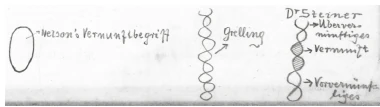
[ 9 ] Ich meine so: Würde man Nelsons Vernunftbegriff ins Auge fassen, so würde er als etwas Begrenztes aufzufassen sein, was in sich eine Absolutheit haben würde. Nun, in Ihrem Sinn ist der Vernunftsbegriff als Entwicklungsbegriff aufzufassen, also etwa so, dass er aus seinen Anfängen sich weiterentwickelt als ein sich Fortentwickelndes, über sich selbst hinaus Entwickelndes. Nun ist das, was der Vernunftbegriff einschließt, ganz prinzipiell gesagt für mich so wie für Nelson. Prinzipiell ist die Vernunft ebenso etwas Abgeschlossenes wie für Nelson. Aber sie ist für mich etwas, was nicht in allen Phasen der Menschheitsentwicklung auch Menschheitsbetätigung ist. Die Menschheit entwickelt sich von einem Vorvernünftigen durch das Vernünftige hindurch zu einem übervernünftigen Standpunkt. Die Menschheit entwickelt sich von einem vorvernünftigen Standpunkt, wo wir noch nicht reden können von einer Vernunft, sie nimmt gewissermaßen das auf, was Vernunft ist, sie eignet sich das an, macht durch das, was Vernunft ist. Die Vernunft bleibt etwas in sich Abgeschlossenes; sie ist eine Entwicklung, von Seite der Menschheit gesehen. Im Grunde genommen bewegen wir uns dann auf dem Boden, der durchaus nur, wenn man feinere Unterscheidungen macht, eine Bedeutung hat, und es ist auch nützlich, diese feineren Unterscheidungen zu machen. Aber ich möchte doch sagen, es ist eben dann durchaus notwendig, wenn man gewisse Begriffe festsetzt.
[ 9 ] What I mean is this: If one were to consider Nelson’s concept of reason, it would have to be understood as something finite that possesses an absoluteness in and of itself. Now, in your sense, the concept of reason must be understood as a developmental concept—that is, as something that evolves from its beginnings as a process that continues to develop, extending beyond itself. Now, what the concept of reason encompasses is, in principle, the same for me as it is for Nelson. In principle, reason is just as self-contained a concept for me as it is for Nelson. But for me, it is something that is not, in all phases of human development, also a human activity. Humanity develops from a pre-rational state through the rational to a post-rational state. Humanity develops from a pre-rational state—where we cannot yet speak of reason—and, in a sense, absorbs what reason is, appropriates it, and acts in accordance with what reason is. Reason remains something self-contained; it is a development, viewed from the perspective of humanity. Essentially, we are then operating on a plane that has significance only when one makes finer distinctions, and it is also useful to make these finer distinctions. But I would still like to say that it is absolutely necessary when defining certain concepts.
[ 10 ] Nicht wahr, diese Dinge musste ich voraussetzen, aber auf Grundlage dessen kommt man ja auch erst auf das, was geltend gemacht worden ist als Denkfehler. Jetzt erst kann man darauf eingehen. Ich möchte nun zuerst darauf aufmerksam machen, dass ich mir bewusst bin, und wenn ich nicht irre, habe ich in Parenthesis am vorigen Freitag, als ich hier sprach, hingewiesen, das ist mir durchaus bewusst, dass ich in der Frage: «Was ist Erkenntnis?» eine Voraussetzung habe.
[ 10 ] Isn’t that right? I had to assume these things, but it is precisely on that basis that one arrives at what has been identified as a flaw in reasoning. Only now can we address it. I would like to begin by pointing out that I am aware—and if I am not mistaken, I mentioned this in parentheses last Friday when I spoke here—that I am fully aware that I have a presupposition regarding the question: “What is knowledge?”
[ 11 ] Es handelt sich mir darum, formale Begriffe in Ordnung zu bringen. Nehmen Sie – gehen wir gleich zum Gottesbegriff über. Wir könnten nun denken, es fragt jemand: «Wie wirkt Gott in der Welt?» Wir müssen voraussetzen, dass er den Gottesbegriff als solchen schon hat, denn er könnte die Frage nicht aufwerfen. Frage ich daher: «Was ist Gott?», so kann ich unter Umständen nichts anderes meinen als das Anstreben einer Verständigung zur Auffindung eines Weges mit mir, um zu einem reinen Begriff zu kommen. Und im Grunde genommen meine ich mit der Frage «Was ist Erkenntnis?» eigentlich gar nicht das Hintendieren zu einer Erklärung, sondern nur zu einer Verständigung. Also ich habe das nicht aufgefasst als eine Erklärung, sondern nur als eine Verständigung des menschlichen Bewusstseins mit sich selbst. Also die Frage «Was ist Erkenntnis?», die führt ja tatsächlich zu dem, was, wie ich glaube, Herr Dr. Grelling mit Recht gesagt hat, dass die Dinge mehr nebensächlich auftreten, weil ich sie gar nicht gar so prinzipiell halte, die Frage «Was ist Erkenntnis?». Ich habe mich nur mit dem Leser auseinandersetzen wollen, damit wir einer gleichen Meinung sind. Mir ergibt sich das: Was Nelson auch in seinem Bologneser Vortrag, der mich außerordentlich interessiert hat, was er auf mehr, ich möchte sagen, dialektische Weise auseinandergesetzt hat, darüber, dass Erkenntnis, dass also die Frage, nicht wahr, die Frage über die Gültigkeit des Verhältnisses des Objekts zum Subjekt, ein Scheinproblem involviert. Mir ist diese Frage, ich möchte sagen, auch eine Erfahrungsfrage. Nämlich insofern ich ihr gegenüber nicht dialektisch vorgehen möchte. Sobald man sich darauf einlässt, auf diese Frage dialektisch einzugehen, entscheiden die Begriffe. Man kommt in eine Art von Bodenlosem hinein. Nicht wahr, man kann die Dinge etwas gröber auffassen und kann in Brentanos Sinn definieren – das ist nicht mein Standpunkt, was ich jetzt sage – ich sage: Erkenntnis ist überhaupt die Übereinstimmung zwischen Wahrnehmung und Vorstellung. Man kann auf diesen Standpunkt sich stellen. Dann kann man nicht mehr weiterreden, aber, wenn man den Versuch macht, die Erlebnisse anzufassen im Erkenntnisproblem, so beginnen sich die Schleier wie eine Erlösung abzuheben. Daher versuchte ich das, und obwohl ich noch ein junger Dachs war dazumals, im Prinzip ist es durchaus festzuhalten. Es handelt sich darum, mehr den Vorgang des Erkennens festzuhalten. Und da kommt es mir darauf an, dass man diese Differenziertheit doch auffasst, die trotz der Richtigkeit des Einwandes von der nicht numerischen Identität zu Recht besteht, trotzdem es eigentlich selbstverständlich ist, dass ja auch, wenn ich mir einen Gedanken über Gedanken bilde, diese Gedanken über den Gedanken nicht numerisch identisch sind. Das ist selbstverständlich. Es kann ja nicht numerisch identisch werden. Ich hätte kein Objekt, dann würde ich nichts bemerken, ich würde eine unbewusste Tätigkeit ausführen. Es ist ganz selbstverständlich, dass es nicht numerisch identisch ist. Aber es fragt sich, ob es unerlaubt ist, auf das Qualitative einzugehen, und sobald man auf das Qualitative eingeht, dann ist trotzdem eine wesentliche Differenziertheit, ob ich über einen anderen Gegenstand nachdenke oder ob ich über das Denken denke. Also denke ich über einen anderen Gegenstand nach, so bleibt mir auf dem Felde der sinnlichen Erfahrung stets ein Rest, der nicht in mein Denken eingeht, während beim Denken über das Denken, wenn ich es nicht so nehme, dass ich die Zeit einbeziehe natürlich, sondern wenn ich einfach den Prozess seiner Qualität nehme, mir in einer gewissen Beziehung durchaus zusammenfällt dasjenige, was ich als ein Objektives habe, mit dem, was ich als Tätigkeit ausführe. Ich möchte sagen, es ist für mich durchaus eine andere Erfahrung, ob ich sage, wir denken über einen äußeren Gegenstand, und sei es noch so ein abstrakter, oder ob ich über das Denken denke; dieses trotz der numerischen Verschiedenheit. Auch beim Denken handelt es sich um etwas, was qualitativ unterscheidet das Denken über das Denken von einem Denken über irgendetwas, was ein Nichtdenken ist. Nun, formal ist es nicht verschieden, und darin liegt das Problem.
[ 11 ] My aim is to put formal concepts in order. Take—let’s move straight to the concept of God. We might now imagine someone asking, “How does God act in the world?” We must assume that this person already has the concept of God as such, for otherwise they could not pose the question. Therefore, when I ask, “What is God?”, under certain circumstances I may mean nothing other than striving for mutual understanding—to find a path together with the other person toward arriving at a pure concept. And fundamentally, when I ask, “What is knowledge?”, I do not actually intend to arrive at an explanation, but only at mutual understanding. So I did not interpret this as an explanation, but only as a process of understanding of human consciousness with itself. So the question “What is knowledge?” actually leads to what, as I believe Dr. Grelling rightly said, is that things appear more incidental, because I do not consider the question “What is knowledge?” to be all that fundamental. I simply wanted to engage with the reader so that we might be of one mind. This is what it comes down to for me: What Nelson also addressed—in a more, I would say, a dialectical manner—namely, that knowledge, that is, the question—isn’t it so?—the question of the validity of the relationship between the object and the subject, involves a pseudo-problem. To me, this question is, I would say, also a matter of experience. Namely, insofar as I do not wish to approach it dialectically. As soon as one agrees to address this question dialectically, the concepts take over. One enters a kind of bottomless abyss. Isn’t it true that one can grasp things in somewhat cruder terms and define them in Brentano’s sense—this is not my position, what I am saying now—I say: knowledge is, in general, the correspondence between perception and representation. One can take this position. Then one can’t go on talking, but if one attempts to grasp the experiences involved in the problem of knowledge, the veils begin to lift as if in a moment of redemption. That is why I tried this, and although I was still a young upstart back then, in principle it is certainly worth noting. The point is to focus more on the process of cognition itself. And what matters to me here is that one does grasp this distinction, which rightly exists despite the validity of the objection regarding non-numerical identity—even though it is actually self-evident that, even when I form a thought about a thought, these thoughts about the thought are not numerically identical. That goes without saying. It simply cannot be numerically identical. I would have no object; then I would not notice anything—I would be performing an unconscious activity. It is perfectly self-evident that it is not numerically identical. But the question is whether it is impermissible to address the qualitative aspect, and as soon as one addresses the qualitative aspect, there is nevertheless a fundamental distinction between whether I am thinking about another object or whether I am thinking about thinking. So, when I think about another object, there always remains a residue in the realm of sensory experience that does not enter into my thinking; whereas when thinking about thinking—if I do not approach it by including time, of course, but simply consider the process in terms of its quality—what I have as an objective reality and what I perform as an activity do, in a certain sense, coincide entirely. I would like to say that, for me, it is an entirely different experience whether I say we are thinking about an external object—no matter how abstract it may be—or whether I am thinking about thinking; this is true despite the numerical difference. Even in the case of thinking, there is something that qualitatively distinguishes thinking about thinking from thinking about anything that is not thinking. Well, formally speaking, there is no difference, and therein lies the problem.
[ 12 ] Und nun glaube ich ja, dass Dr. Grelling der Erste sein wird, der zugibt, dass es im Grunde genommen unmöglich ist, ein solches Problem nicht anzuerkennen. Was wir da haben im Moment, wo wir denken, ist formaliter kein Unterschied, und trotzdem sind das Denken über das Denken und das Denken über ein Nichtgedachtes zwei qualitativ verschiedene Akte, und diese Verschiedenheit ist es, auf die mir außerordentlich viel anzukommen scheint. Sobald ich mir diesen Unterschied erlebnismäßig klarmache, dann kann ich auch nicht mehr anders, als – wenn auch in absolutem Sinn, und wenn auch, ich möchte sagen, in sublimiertestem Sinn – schon in einem wirklichem Denken über das Denken inhaltlich genau dasselbe sehen, [wie] was ich in einer übersinnlichen Erfahrung sehe, sodass ich immer gerade das behauptet habe: Kommt man zu einem Erlebnis [dessen], was ich versuchte, in allen meinen Schriften als das innere Geschehen im Denken über das Denken hinzustellen, [so] geht man fehl, wenn man das nicht ebenso «Hellsehen» nennt wie ein anders entwickeltes Hellsehen. Es liegt hier natürlich ein Hellsehen primitivster Art vor. Es hängt von dem Erfassen dieser Erkenntnistatsache im Grunde alles ab, was die Beziehung herstellen soll zu einer übersinnlichen Erkenntnis.
[ 12 ] And now I do believe that Dr. Grelling will be the first to admit that it is, in essence, impossible not to acknowledge such a problem. What we have here at the moment, when we think, is, strictly speaking, no difference; and yet thinking about thinking and thinking about something unthought are two qualitatively different acts, and it is this difference that seems to me to be of extraordinary importance. As soon as I make this difference clear to myself through experience, then I can no longer help but—albeit in an absolute sense, and, I might add, in the most sublimated sense—see in genuine thinking about thinking, in terms of content, exactly the same thing [as] what I see in a supersensory experience, so that I have always maintained precisely this: If one arrives at an experience of what I have attempted to present in all my writings as the inner process of thinking about thinking, one is mistaken if one does not call this “clairvoyance” just as one would a differently developed form of clairvoyance. This is, of course, a form of clairvoyance of the most primitive kind. Essentially, everything that is meant to establish a connection to a supersensible insight depends on grasping this fact of cognition.
[ 13 ] Und diese Diskussion über diese Frage – ich muss gestehen, ich habe sie mündlich und schriftlich nach allen Seiten hin mit Eduard von Hartmann erörtert, und zuletzt hat sich Folgendes abgespielt: Es war in den Achtzigerjahren, ich war bei ihm in Berlin, und ich sagte ihm: Ja, es wäre doch notwendig, wenn Sie davon sprechen, dass die Vorstellung für sich selber nicht etwas Wirkliches ist, dass Sie irgendwie darauf hinführten, zu zeigen, was denn eigentlich Vorstellung ist, sodass man dann irgendetwas hätte, wenn man von der Wirklichkeit spricht. – Und da sagte er mir: Wenn man «Vorstellung» sagt, dann sagt man, es sei nicht Wirklichkeit. – Und ich sah damals in diesem Ausgehen von einem dogmatischen Postulat bei ihm die Unmöglichkeit, sich überhaupt in diese besondere Art des Erlebens einzufinden, die gerade auftritt, wenn man über diese Punkte sich innerlich aufklärt.
[ 13 ] And this discussion on this question—I must admit, I’ve debated it with Eduard von Hartmann, both verbally and in writing, from every angle, and this is what ultimately happened: It was in the 1880s; I was visiting him in Berlin, and I said to him: “Yes, it would be necessary—since you’re saying that a representation is not, in and of itself, something real—for you to somehow lead up to it and show what a representation actually is, so that one would then have something to refer to when speaking of reality.” – And then he said to me: “When you say ‘representation,’ you’re saying it’s not reality.” – And at the time, I saw in his starting from this dogmatic postulate the impossibility of even entering into that particular kind of experience that arises precisely when one clarifies these points for oneself internally.
[ 14 ] Nun bin ich mit Dr. Grelling ganz einverstanden, wenn er Erkenntnisse als etwas als wie sui generis bezeichnet, was nicht auf Begriffe zurückgeführt werden kann, sie muss erlebt werden, muss angeschaut werden, in der Anschauung erkannt werden. Und eigentlich auch, wie ich glaube, dann, wenn ich sage, das Denken bringen wir hervor, ist durchaus nicht darin gelegen, dass ich irgendeine Erklärung des Denkens in kausalen Begriffen hineinnehme. Mindestens liegt es nicht in mir, solche kausale Begriffe hineinzunehmen.
[ 14 ] Now, I fully agree with Dr. Grelling when he describes insights as something sui generis that cannot be reduced to concepts; they must be experienced, must be observed, and must be recognized through observation. And, in fact, I believe that when I say we bring forth thought, this does not at all imply that I am incorporating any explanation of thought in causal terms. At the very least, it is not my intention to incorporate such causal terms.
[ 15 ] Wenn ich sage: Wir denken das Denken in einer gewissen Weise durch uns, weil wir dabei sind –, und auf der anderen Seite sage: Weil wir es selber machen –, so meine ich damit nicht, dass wir es im kausalen Sinn produzieren, sondern ich meine es eher so, dass wir es aus uns bei völligem Dabeisein herausversetzen, ausgestalten so, dass man natürlich nicht davon sprechen kann, dass dasjenige, was anfänglich in uns präsent ist, sich wie die Causa verhält zu dem, was nachher in uns präsent ist, wenn wir denken.
[ 15 ] When I say: We think through thinking in a certain way because we are in the midst of it—and, on the other hand, say: ‘Because we do it ourselves’—I do not mean by this that we produce it in a causal sense, but rather that we bring it forth from within ourselves through our complete presence, shaping it in such a way that one cannot, of course, say that what is initially present within us behaves as the cause of what is subsequently present within us when we think.
[ 16 ] Hier liegt ein Problem vor, auf das ich doch hinweisen möchte, weil ich glaube, es ist ein außerordentlich wichtiges Problem. Sehen Sie, wir reden vielfach von Entwicklung – auf das Begriffliche wollen wir hier nicht eingehen –, wir reden von Entwicklung, niederer Organismen zu höheren Organismen, wenn wir davon reden, so handelt es sich darum: Wir können notwendig haben einen Begriff von dem niederen Organismus, sodass wir auf dem Weg der inneren Entwicklung aus unserem Begriff des niederen Organismus den Begriff des Höheren gewinnen würden, und der sich decken würde mit der Anschauung des höheren Organismus. Das Letztere ist das, was in einer empirischen Wissenschaft der Fall ist. Ich kann nicht finden, dass die Goethe’sche Methode in den Tatsachen in den Wissenschaften berücksichtigt wird. Wenn man sich solches klarmacht, dann bekommt man heraus, wie eigentlich ein wirkliches Verhältnis unserer Begriffe zu den Realitäten ist. Das Problem gewinnt noch immer neue Seiten, wenn wir es so betrachten. Und, nicht wahr, von dieser Voraussetzung müsste man ausgehen eigentlich, man müsste sich noch weiter verständigen, dann würde man in die ganz subtilen Probleme hineinkommen können. Nun, dass dann das Erkenntnisproblem als ein Scheinproblem aufgefasst werden kann, ist für mich dies, dass es einem im Denken zerflattert. Es ist daher eine dialektische Scheinauseinandersetzung, wenn man das hinterher konstruiert. Aber in gewissem Sinn ist auch dies berechtigt.
[ 16 ] There is a problem here that I would like to point out, because I believe it is an extraordinarily important one. You see, we often speak of evolution—we won’t go into the conceptual aspects here—we speak of the evolution from lower organisms to higher organisms; when we speak of this, what we are referring to is: We must necessarily have a concept of the lower organism, so that through the process of inner development we would derive the concept of the higher organism from our concept of the lower one, and this concept would correspond to our perception of the higher organism. The latter is what occurs in an empirical science. I cannot find that Goethe’s method is taken into account in the facts of the sciences. When one makes this clear to oneself, one begins to grasp what the actual relationship between our concepts and realities really is. The problem continues to reveal new aspects when we view it in this way. And, isn’t it true that we should actually start from this premise—we would need to reach a deeper understanding—and then we would be able to delve into the very subtle problems. Now, the fact that the problem of knowledge can then be understood as a pseudo-problem means to me that it dissolves in thought. It is therefore a dialectical pseudo-controversy when one constructs it retrospectively. But in a certain sense, this, too, is justified.
[ 17 ] Sehen Sie, zu solchen Dingen kommt man nicht nur dann, wenn man experimentell die Dinge behandelt. Zu solchen Dingen kann man Stellung nehmen. Aber bedenken Sie doch nur, dass ich meine Auseinandersetzung mit Kant mit 16 Jahren angefangen habe. Damals begann ich Kant zu studieren. Meine Auseinandersetzung mit Kant beruhte auf dem Versuch, zu zerfasern dasjenige, was mir bei Kant als das Gewissheitsproblem entgegentrat. Und indem ich gerade versuchte, dieses noch scholastisch gefärbte Streben, eine Theorie über die Gewissheit zu bekommen, dieses zu zerfasern, habe ich mich gewendet gegen die Auffassung des Scheinproblems, das ja heute ganz richtig diskutiert worden ist, und wiederum, indem ich mich in eine Kritik eingelassen habe, habe ich praktisch versucht, die Sache so zu gestalten, dass ich einen Irrtum nachweisen wollte. Es ist tatsächlich so, dass man nichts anderes tun kann, als darauf hinweisen, wie man in Irrtum verfallen kann. Und zuletzt kommt die Sache doch auf das heraus. Und ich erinnere mich noch heute sehr genau, wie Nelson das in seinem Bologne[se]r Vortrag auseinandergesetzt und erklärt hat.
[ 17 ] You see, one doesn’t arrive at such conclusions merely by approaching things experimentally. One can take a position on such matters. But just consider that I began my engagement with Kant at the age of 16. That was when I started studying Kant. My engagement with Kant was based on an attempt to unravel what struck me as the problem of certainty in Kant’s work. And precisely by attempting to unravel this still scholastically tinged endeavor to formulate a theory of certainty, I turned against the conception of the problem of appearance—which, as has been quite correctly discussed today—and, in turn, by engaging in a critique, I practically tried to frame the matter in such a way that I sought to demonstrate an error. The fact is that one can do nothing other than point out how one can fall into error. And ultimately, that is what it all boils down to. And I still remember very clearly today how Nelson analyzed and explained this in his lecture in Bologna.
[ 18 ] Eigentlich freuen mich solche Dinge, wenn von praktischen Vorstellungen ausgegangen, und sachlich genommen, nicht spintisiert wird. Ich finde da, dass tatsächlich in seiner Erklärung etwas liegt von dem, was ich etwa so bezeichnen möchte: Man kann, wenn man von Wahrheit spricht – oder von Übereinstimmung von der Vorstellung mit dem Gegenstand –, man kann doch im Grunde nichts anderes tun, als praktisch hinzuarbeiten zur Erkenntnis. Wenn die Leute nur nicht so viel von Erkenntnistheorie reden möchten, sondern lieber trachten würden, dass man etwas Anständiges erkennt. Es kommt auf das an, dass man etwas erkennt, und man kann das nur erleben, wenn man erkennt den Irrtum, die Kriterien für den Irrtum. Ich halte ein praktisches Verfahren, das von vorneherein sich auf eine Erkenntnistheorie beruft – so erkennt man, und so erkennt man nicht –, für höchst bedenklich. Da ist die Möglichkeit, dass wir irren können! Wir müssen vorbereitet sein und die Irrtümer ausschalten. Wir hätten nicht die Möglichkeit, nachzuprüfen, wenn wir nicht die Möglichkeit des Irrtums hätten! Das sind die Dinge, die ich sagen möchte.
[ 18 ] Actually, I’m pleased by such things when they’re based on practical ideas and approached objectively, without getting carried away. I find that there is indeed something in his explanation that I would like to describe something like this: When one speaks of truth—or of the correspondence between an idea and the object— one can, after all, do nothing else but work practically toward knowledge. If only people would talk less about epistemology and instead strive to recognize something worthwhile. What matters is that one recognizes something, and one can only experience that by recognizing error and the criteria for error. I consider a practical method that relies from the outset on epistemology—this is how one comes to know, and this is how one does not—to be highly questionable. There is the possibility that we might be mistaken! We must be prepared and eliminate errors. We would have no way to verify anything if we did not have the possibility of error! These are the things I would like to say.