

Appendix to the Public Lectures
GA 85
21 March 1921, Stuttgart
Translated by Steiner Online Library
31. Epistemology and the Spirit-Mind Relationship
Rudolf Steiner's response to remarks by the philosopher Kurt Grelling
[ 1 ] Ladies and gentlemen! I would first like to make a few remarks regarding the problem at hand, and then address the actual, supposedly epistemological questions: First of all, if one starts from a certain conception of a priori knowledge, then it is quite correct to say that through a priori knowledge—and now, isn’t that right?—one can define this in the Kantian sense or in some other way—through a priori knowledge, one cannot actually determine anything about reality. – I would like to ask Dr. Grelling to point out to me if I stray from what he means.
[ 2 ] In such subtle matters, it is important that we understand one another. Now, it seems to me that there is a certain difficulty even in defining the term “a priori.” I would very much like to hear from people who take these subtle problems seriously how they deal with the difficulties presented here. If we start with a priori knowledge, we can take a posteriori knowledge as its opposite. Now, setting aside any—I would say—psychological description of a posteriori knowledge, let’s simply take the characteristic that, if we are to speak of this opposition at all—since there is indeed both a priori and a posteriori knowledge—let’s simply take the characteristic of experience. It is, after all, quite beyond doubt: The characteristic of experience must be attributable to a posteriori knowledge in some way. Now the question arises: if one is truly distinguishing between two things—a priori knowledge and a posteriori knowledge—from a single perspective, one would actually need a concept of commonality; one would need the possibility, in order to arrive at a distinction, to relate it to something they have in common. But I can come to no other conclusion than to say to myself: a priori knowledge must become present in such a way that it somehow appears within my sphere of consciousness or perception. It was not there before. It comes, and I take note of it. It must, so to speak, enter my sphere of observation from the outside. I would like to know whether it is justified to distinguish between a priori and a posteriori knowledge, since a posteriori knowledge must, after all, enter my consciousness in some way. Is it justified to make such a distinction without further ado? For my experience, a priori knowledge must also become experience at some point. They must become just as present in my sphere of observation as a posteriori knowledge, and I believe that there is simply a conceptual difficulty here that ultimately prevents us from formulating the a priori and the a posteriori in the Kantian sense, because, after all, one always ends up introducing an element of subjective processes into the concept of the a posteriori. You can’t get that out of it. We find, first of all, that no sufficient reason can be found to distinguish between a priori and a posteriori knowledge.
[ 3 ] Well, it seems to me that, above all, we need to discuss the question of how a priori and a posteriori knowledge differ. One gets nowhere by talking about the relationship between the object and the subject. But if this were actually to lead us to the conclusion that we would have to call a priori knowledge a posteriori knowledge in a certain sense, then the entire path would prove to be extraordinarily difficult. So, in some way, the question of whether a priori knowledge allows us to say anything about supersensible knowledge would have to be recognized as unfounded. Because I even believe that the idea that we have any kind of a priori knowledge is simply an illusion.
[ 4 ] There is no real distinction here regarding the relationship between object and subject; therefore, I simply cannot separate what is empirical from the concept of a priori knowledge, and it is thus extremely difficult to invoke this formal distinction.
[ 5 ] Now I would like to address another point, which again presents a difficulty. As you can see, one difficulty after another arises here. Dr. Grelling has very precisely articulated the difference between his view of the development of reason and Nelson’s view, and I would like to note—and I can say this in a certain sense—that in this regard I side more with Nelson’s position than with yours. Let me clarify this right away. You see, you will have noticed that Dr. Grelling was compelled to speak of a development—whether reason is capable of development or not. I attach great importance—as you can see from the style of my writings—to starting with the concept that matters most, the one that first arises when one speaks of the development of reason; otherwise, one stands on ground that lacks a foundation.
[ 6 ] But there is something else connected to this, I believe: There is much debate today about whether the more ideal entities in the unfolding of history are the causes, or whether—as the materialist conception of history teaches—it is the material, economic processes that are the causes. Well, this discussion, which takes place on this ground, strikes me as nothing other than the old problem—you’ll find this trivial when I put it this way—the old problem of whether the chicken or the egg came first. It is exactly the same problem for understanding, whether the egg came first or the hen. So you can say: the production processes come first, or the ideal [processes] come first. Here one must go back to the problem of development and engage with this problem.
[ 7 ] Now you might say: So address the problem of development! But for me, the problem of development is such that, no matter how one frames it, it turns out to be a problem that one actually always ends up skirting around. One will hardly be able to reduce the problem of development to something uncontroversial. The problem of development is one that, for me, belongs to those that remain within the realm of philosophy; one must remain with it, and this problem is resolved only—I say this from experience—only in the realm of supersensible knowledge. That is an experience one has. And one arrives at more minute and intimate problems that cannot be solved unless one enters the suprasensory world.
[ 8 ] This is an experience; there are many objections that could be raised against it, but it would take us too far afield if I were to describe them all. But we don’t need that at all, at least not yet, to enter into the discussion. We don’t need to address the issue of development at all; we simply need to apply the method that leads me to conclude that I must adopt Nelson’s perspective to a greater extent. Perhaps I can now make this clear to you with a small drawing.
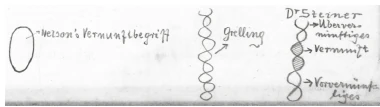
[ 9 ] What I mean is this: If one were to consider Nelson’s concept of reason, it would have to be understood as something finite that possesses an absoluteness in and of itself. Now, in your sense, the concept of reason must be understood as a developmental concept—that is, as something that evolves from its beginnings as a process that continues to develop, extending beyond itself. Now, what the concept of reason encompasses is, in principle, the same for me as it is for Nelson. In principle, reason is just as self-contained a concept for me as it is for Nelson. But for me, it is something that is not, in all phases of human development, also a human activity. Humanity develops from a pre-rational state through the rational to a post-rational state. Humanity develops from a pre-rational state—where we cannot yet speak of reason—and, in a sense, absorbs what reason is, appropriates it, and acts in accordance with what reason is. Reason remains something self-contained; it is a development, viewed from the perspective of humanity. Essentially, we are then operating on a plane that has significance only when one makes finer distinctions, and it is also useful to make these finer distinctions. But I would still like to say that it is absolutely necessary when defining certain concepts.
[ 10 ] Isn’t that right? I had to assume these things, but it is precisely on that basis that one arrives at what has been identified as a flaw in reasoning. Only now can we address it. I would like to begin by pointing out that I am aware—and if I am not mistaken, I mentioned this in parentheses last Friday when I spoke here—that I am fully aware that I have a presupposition regarding the question: “What is knowledge?”
[ 11 ] My aim is to put formal concepts in order. Take—let’s move straight to the concept of God. We might now imagine someone asking, “How does God act in the world?” We must assume that this person already has the concept of God as such, for otherwise they could not pose the question. Therefore, when I ask, “What is God?”, under certain circumstances I may mean nothing other than striving for mutual understanding—to find a path together with the other person toward arriving at a pure concept. And fundamentally, when I ask, “What is knowledge?”, I do not actually intend to arrive at an explanation, but only at mutual understanding. So I did not interpret this as an explanation, but only as a process of understanding of human consciousness with itself. So the question “What is knowledge?” actually leads to what, as I believe Dr. Grelling rightly said, is that things appear more incidental, because I do not consider the question “What is knowledge?” to be all that fundamental. I simply wanted to engage with the reader so that we might be of one mind. This is what it comes down to for me: What Nelson also addressed—in a more, I would say, a dialectical manner—namely, that knowledge, that is, the question—isn’t it so?—the question of the validity of the relationship between the object and the subject, involves a pseudo-problem. To me, this question is, I would say, also a matter of experience. Namely, insofar as I do not wish to approach it dialectically. As soon as one agrees to address this question dialectically, the concepts take over. One enters a kind of bottomless abyss. Isn’t it true that one can grasp things in somewhat cruder terms and define them in Brentano’s sense—this is not my position, what I am saying now—I say: knowledge is, in general, the correspondence between perception and representation. One can take this position. Then one can’t go on talking, but if one attempts to grasp the experiences involved in the problem of knowledge, the veils begin to lift as if in a moment of redemption. That is why I tried this, and although I was still a young upstart back then, in principle it is certainly worth noting. The point is to focus more on the process of cognition itself. And what matters to me here is that one does grasp this distinction, which rightly exists despite the validity of the objection regarding non-numerical identity—even though it is actually self-evident that, even when I form a thought about a thought, these thoughts about the thought are not numerically identical. That goes without saying. It simply cannot be numerically identical. I would have no object; then I would not notice anything—I would be performing an unconscious activity. It is perfectly self-evident that it is not numerically identical. But the question is whether it is impermissible to address the qualitative aspect, and as soon as one addresses the qualitative aspect, there is nevertheless a fundamental distinction between whether I am thinking about another object or whether I am thinking about thinking. So, when I think about another object, there always remains a residue in the realm of sensory experience that does not enter into my thinking; whereas when thinking about thinking—if I do not approach it by including time, of course, but simply consider the process in terms of its quality—what I have as an objective reality and what I perform as an activity do, in a certain sense, coincide entirely. I would like to say that, for me, it is an entirely different experience whether I say we are thinking about an external object—no matter how abstract it may be—or whether I am thinking about thinking; this is true despite the numerical difference. Even in the case of thinking, there is something that qualitatively distinguishes thinking about thinking from thinking about anything that is not thinking. Well, formally speaking, there is no difference, and therein lies the problem.
[ 12 ] And now I do believe that Dr. Grelling will be the first to admit that it is, in essence, impossible not to acknowledge such a problem. What we have here at the moment, when we think, is, strictly speaking, no difference; and yet thinking about thinking and thinking about something unthought are two qualitatively different acts, and it is this difference that seems to me to be of extraordinary importance. As soon as I make this difference clear to myself through experience, then I can no longer help but—albeit in an absolute sense, and, I might add, in the most sublimated sense—see in genuine thinking about thinking, in terms of content, exactly the same thing [as] what I see in a supersensory experience, so that I have always maintained precisely this: If one arrives at an experience of what I have attempted to present in all my writings as the inner process of thinking about thinking, one is mistaken if one does not call this “clairvoyance” just as one would a differently developed form of clairvoyance. This is, of course, a form of clairvoyance of the most primitive kind. Essentially, everything that is meant to establish a connection to a supersensible insight depends on grasping this fact of cognition.
[ 13 ] And this discussion on this question—I must admit, I’ve debated it with Eduard von Hartmann, both verbally and in writing, from every angle, and this is what ultimately happened: It was in the 1880s; I was visiting him in Berlin, and I said to him: “Yes, it would be necessary—since you’re saying that a representation is not, in and of itself, something real—for you to somehow lead up to it and show what a representation actually is, so that one would then have something to refer to when speaking of reality.” – And then he said to me: “When you say ‘representation,’ you’re saying it’s not reality.” – And at the time, I saw in his starting from this dogmatic postulate the impossibility of even entering into that particular kind of experience that arises precisely when one clarifies these points for oneself internally.
[ 14 ] Now, I fully agree with Dr. Grelling when he describes insights as something sui generis that cannot be reduced to concepts; they must be experienced, must be observed, and must be recognized through observation. And, in fact, I believe that when I say we bring forth thought, this does not at all imply that I am incorporating any explanation of thought in causal terms. At the very least, it is not my intention to incorporate such causal terms.
[ 15 ] When I say: We think through thinking in a certain way because we are in the midst of it—and, on the other hand, say: ‘Because we do it ourselves’—I do not mean by this that we produce it in a causal sense, but rather that we bring it forth from within ourselves through our complete presence, shaping it in such a way that one cannot, of course, say that what is initially present within us behaves as the cause of what is subsequently present within us when we think.
[ 16 ] There is a problem here that I would like to point out, because I believe it is an extraordinarily important one. You see, we often speak of evolution—we won’t go into the conceptual aspects here—we speak of the evolution from lower organisms to higher organisms; when we speak of this, what we are referring to is: We must necessarily have a concept of the lower organism, so that through the process of inner development we would derive the concept of the higher organism from our concept of the lower one, and this concept would correspond to our perception of the higher organism. The latter is what occurs in an empirical science. I cannot find that Goethe’s method is taken into account in the facts of the sciences. When one makes this clear to oneself, one begins to grasp what the actual relationship between our concepts and realities really is. The problem continues to reveal new aspects when we view it in this way. And, isn’t it true that we should actually start from this premise—we would need to reach a deeper understanding—and then we would be able to delve into the very subtle problems. Now, the fact that the problem of knowledge can then be understood as a pseudo-problem means to me that it dissolves in thought. It is therefore a dialectical pseudo-controversy when one constructs it retrospectively. But in a certain sense, this, too, is justified.
[ 17 ] You see, one doesn’t arrive at such conclusions merely by approaching things experimentally. One can take a position on such matters. But just consider that I began my engagement with Kant at the age of 16. That was when I started studying Kant. My engagement with Kant was based on an attempt to unravel what struck me as the problem of certainty in Kant’s work. And precisely by attempting to unravel this still scholastically tinged endeavor to formulate a theory of certainty, I turned against the conception of the problem of appearance—which, as has been quite correctly discussed today—and, in turn, by engaging in a critique, I practically tried to frame the matter in such a way that I sought to demonstrate an error. The fact is that one can do nothing other than point out how one can fall into error. And ultimately, that is what it all boils down to. And I still remember very clearly today how Nelson analyzed and explained this in his lecture in Bologna.
[ 18 ] Actually, I’m pleased by such things when they’re based on practical ideas and approached objectively, without getting carried away. I find that there is indeed something in his explanation that I would like to describe something like this: When one speaks of truth—or of the correspondence between an idea and the object— one can, after all, do nothing else but work practically toward knowledge. If only people would talk less about epistemology and instead strive to recognize something worthwhile. What matters is that one recognizes something, and one can only experience that by recognizing error and the criteria for error. I consider a practical method that relies from the outset on epistemology—this is how one comes to know, and this is how one does not—to be highly questionable. There is the possibility that we might be mistaken! We must be prepared and eliminate errors. We would have no way to verify anything if we did not have the possibility of error! These are the things I would like to say.