

Appendix to the Public Lectures
GA 85
19 August 1908, Karlsruhe
Translated by Steiner Online Library
8. Germanic Myths and Legends of the Gods
[ 1 ] The Karlsruhe Lodge has expressed a desire to speak today about Germanic myths and the Germanic gods from a theosophical perspective. In doing so, we must prepare ourselves for a topic that delves deeply into the foundations of the theosophical worldview—a topic that, in a certain sense, does require some prior theosophical preparation; not so much preparation in the sense that one must know just as much, but rather a theosophical mindset—an familiarity with accepting certain difficult spiritual facts not as something fantastical, as something figurative or presented in a tangible way, but as something that is, in fact, truth within the world hidden from us and underlying the external sensory world.
[ 2 ] It was necessary to include these few introductory words because this topic—if it is to be discussed at all—must be addressed with complete impartiality and from certain deeper perspectives. In doing so, we are entering a realm—the realm of myths and the teachings of the gods—a realm that, in our so-called “enlightened” age, is subject to quite a few misunderstandings.
[ 3 ] Modern man, who takes pride in his scientific achievements and in his seemingly so enlightened concepts, probably views legends, fairy tales, and myths of times long past, and likely regards them as something that may have played a certain role in the early history of peoples—when they were not yet able to think clearly and distinctly about the things of the world—which may indeed be interesting if one considers [these] stories, [when one] delves into them to see how primitive peoples conceived of gods, of regions of the earth, and of human beings—but which, when all is said and done, can really tell today’s enlightened person nothing particularly significant.
[ 4 ] And in yet another respect, there is [a] rather significant misunderstanding in this regard. It is also said that in those times when mature male thinking—[as one] is accustomed to saying—[had not yet developed], [when] human beings had not yet matured, the imagination—the popular imagination—played a role when people sought to recall how things came into being, how things unfolded, and so on. And what certainly plays a major role here is [that] a certain allegorical, symbolic interpretation of fairy tales, legends, and [myths] truly took place in the most comprehensive way, such that such allegorical interpretations of the tales of the gods and “lower” legends were carried out in such a way that, whenever there was talk of a spiritual trait—a trait of changing forms—people thought: “That must refer to the clouds, which are always changing their shape.” Or wherever one has always heard that an evil spirit overcomes a god: that must personify [something like] when [the] fall approaches [and] the power of winter overwhelms the power of summer.
[ 5 ] Myths of nature—today we say: The people personified the power of winter’s struggle [and its defeat] by summer [as Baldur], [or the forces that enable] the leaves to sprout [from the buds in spring], as Venus. All of this is said to have been represented in images by what is called the folk imagination, and such visualizations of natural processes, natural forces, and natural struggles are said to have been explicitly passed down to us in the myths of the gods and in the myths of the origin of the world.
[ 6 ] There is an element of fantasy in all these things, but this fantasy is merely [based on]—[has only been postulated]—by scholars who have reflected on mythological problems. What they have put forward as theories about such folk imagination is really just an academic exercise. One immediately gets the impression that [those who] speak this way—that [it] seems to be folk imagination, as if the struggle between summer and winter were personified in myths—that those who believe this could never have had any experience of so-called poetic folk imagination. In the sense that our learned mythologists speak of “poetic folk imagination,” in that sense, folk imagination does not exist. One would like to [urge] the scholars, to advise one [of them], that they should go out among the people [and see] whether they encounter evidence that people personify clouds, personify the struggle between winter and [the] summer—that is fanciful scholarship. That is pure scholarly superstition, smacking of armchair theorizing.
[ 7 ] But we can understand this superstition among scholars if we realize that our scholars today have absolutely no way of gaining access to what is actually contained in the teachings and legends about the gods. They would first have to recognize that, just as everything in the world is subject to evolution, so too is human consciousness subject to evolution. People today believe in the evolution of the external natural world, even though in various naturalistic theories they attempt to form rather fanciful ideas—such as those regarding the transformation of animal groups and so on, even if there is quite a bit of imagination involved in this endeavor—and [by incorporating imagery, they seek to derive a kind of point of reference for evolution and development]. Thus, within the external form of events and beings, people today have formed a certain concept of development; but this becomes a tremendous [challenge] for [human] beings when they are to conceive that [even] human consciousness—the life of the soul itself in the most comprehensive sense—is subject to development, that which people today would call consciousness.
[ 8 ] Let us first consider the consciousness one has from morning until [the] evening. This consists in a person perceiving objects around them, in these objects appearing to them as sensory impressions: as colors, sounds, [and as being] hard or soft. Everything a person can perceive consists, fundamentally, of colors, sounds, sensations of warmth and cold, hardness and softness, and so on, as well as taste sensations and so forth. This is what makes up what a person perceives in the so-called objective world around them. Then he reflects on objects [illegible], forming ideas, concepts, and so on.
[ 9 ] This form of consciousness, which originates from external objects in the sensory world, developed only gradually; this form of consciousness did not always exist. As many [of you] know from other lectures, human beings are older than this present form of consciousness, and this form of consciousness developed from another—from a completely different form of consciousness, from different experiences of consciousness.
[ 10 ] We can better recognize this present-day consciousness of objects to the extent that we relate it to something with which it alternates. This present-day consciousness of humanity—from the morning, when [the human being] wakes up, until the evening, when he falls asleep—alternates with another state, which the human being, unfamiliar with the higher realities of the spiritual world, calls unconsciousness; but [theosophists] by no means call this unconsciousness, rather a lower degree of consciousness. When [a] person falls asleep in the evening and, instead of the colors of [sensory objects], [instead] of sounds and tastes around him, silence [and] darkness reign, then something has happened to that person. The person has withdrawn two parts of their [organization]; in bed, they consist [only of] the physical body and [the] etheric body. But what has emerged are what we call the astral body and the “I”—that is, the bearer of pleasure and pain, desire and passion, and of dreams—[and] the “I” have withdrawn from the body; and because this body of the human species has no organs, it cannot perceive the world around it—a spiritual-soul world—today. Thus, a person can only perceive again when, in the morning, they re-enter the physical body, which makes use of the eyes and ears and thereby receives impressions from the surroundings.
[ 11 ] Thus, we must say that object consciousness and what [we] call unconsciousness alternate, though the latter is a lower degree of consciousness: what we call dreamless sleep consciousness. It is such a low level of consciousness that a person cannot have any perception during this low level of consciousness. You all know that there is an intermediate state between these two states of consciousness—between dreamless sleep and clear waking consciousness. This intermediate state of consciousness is dream-filled sleep, where dream images ebb and flow, where a person perceives something but has come to realize: This does not correspond to an external reality in the same sense as waking perception. When we look at this human dream world today, it appears to most people as disorderly and chaotic; dream images ebb and flow in a confused manner, taking shape and reshaping themselves. They either recall immediate external experiences or are reminiscences from a more or less distant past—memory images and the like.
[ 12 ] Now, those who have not yet been able to delve more deeply into spiritual science can, precisely through these true dream images—which are, for this reason, seemingly chaotic—form a certain conception of a former state of human consciousness from which today’s consciousness has evolved. There was a time in human evolution—and indeed a time in the Earth’s evolution of humankind—when human beings could not yet possess the consciousness they have today, in which they perceive objects externally; nor did they experience, in the sense we do today, a sort of complete extinction of consciousness from the evening, when they fell asleep, until the morning, when they awoke. Rather, it was different: There was a stage of human development on our Earth when, upon looking at objects, people by no means saw such sharp contours in them as they do now. There were no such sharp boundaries; he would have seen the flower, for example, as being quite indistinctly blurred, clearly surrounded by [something], by powerful color formations that were attuned to the character of the flower. He would not have seen the white within the flower’s outline, but would have seen the [color] on the outside [around it], [not] within the flower’s color formation.
[ 13 ] You can get an idea of this by walking around in thick fog and seeing [a] burning lantern. You can’t make out the image in the light, but you see all kinds of rainbow colors around the lantern. Imagine the colors of the fog, vaguely surrounded by plays of color, rainbows, and so on. [Instead] of what you experience today—from the morning when you wake up until the evening when you fall asleep—the soul experienced such an external world in that early state of humanity. But the night, too, was something different back then than it is today. Today, when a person steps out of their physical and etheric bodies in the evening, it becomes dark and gloomy around them. Back then, they left a hazy world, but they did not gaze into darkness and gloom; rather, they gazed into another world. There were [stimuli] around them, albeit in a certain haziness that would become clearer later on. There were spiritual-soul beings around them. Human beings lived consciously [there] at that time. [Thus] we see how he lived within [a] quite vivid dream state; from a dream state that signified reality, [illegible] [he learned of] a spiritual world, [illegible] [from the] formation of colors [flowing] from it, that there are plants and animals there. Thus, when he emerged into the physical world, he knew that he had been in a world of spiritual-divine beings. There he encountered, in particular, the formation of colors and sounds. But he knew: They emanate from soul-spiritual beings. Thus, the human being lived, so to speak, in an even duller, more dim consciousness during the day; by contrast, his consciousness at night—though twilight-like—was nevertheless a consciousness that, compared [to] today’s nighttime consciousness, was much brighter. A dull, twilight-like clairvoyance.
[ 14 ] Where in ancient times can we find people who possessed this state of consciousness? To this day, no branch of the natural sciences has provided a reasonably satisfactory answer to this question. But spiritual science, with its research, goes back to ancient, primeval times of pre-humanity—to those times when, in many places now occupied by Europe, Asia, and Africa, there was still sea, vast sea; when there was little landmass where Europe, Asia, and Africa are today, but instead there was a large continent to the west of us, between Europe and America. That [continent], the floor of the Atlantic Ocean—imagine it [as] having been raised and no longer covered by the sea; thus you have a vast landmass. This landmass was inhabited by the ancestors of humankind. However, these people who lived there in ancient Atlantis were in a state of consciousness entirely different from that of the Earth we have described today.
[ 15 ] Now you must take a step back quite a long way—thousands upon thousands of years—to ancient Atlantis. There we would encounter conditions that are radically different from our current human condition. For example, if we were to go back just a few million years—which is, in essence, a mere blink of an eye in the grand scheme of human evolution—if we were to go back just a few million years, we would find humans [on Earth] who [could not] yet set their feet on solid ground; we would find them as a kind of floating, hovering being; of course, they could not float as we do today [when we swim]. Because the air was completely filled with water vapor—humans lived in a fog so dense that they themselves could easily remain in this mass near the Earth’s surface, as if swimming, floating, or flying. Humans must have been organized quite differently back then. Legs such as [those we have today] had not yet developed at that time. [The leg] was merely [an] organ for maintaining balance in this dense air.
[ 16 ] So we could go back to times when human conditions were entirely different, and then you can understand how, out of human consciousness, a human being gradually developed—[in whom] the nocturnal consciousness is fading away, where [the] human being [lived] in [a] world of spiritual flashes, [which] grew darker and darker as our dreamless night set in; and the other consciousness that humans possess during the day grew brighter, the [auric] color of animals and plants disappeared, and objects with sharp boundaries and contours appeared.
[ 17 ] Now, you must not think that during [that] night, when [a] person was out of [their] physical body and experienced a wondrous world of images around them, that this was a dream, that it was something that did not correspond to reality. Well, what the human being used to see with blurred boundaries—and what he sees today with clear boundaries around him—corresponded just as much to reality. For in the reality of the night, the human being ascends into another world, the world that is always around us, [but he perceives nothing] because he has no [perceptual] organ [for it]. He has lost the old organs and has not yet formed new ones. We are in fact surrounded—as if by physical beings—by spiritual-soul beings, some of whom are initially ahead of, and some behind, human beings in [their] development. Thus, the human beings of antiquity ascended from the physical world into [the] world of spirits, into [the] world of the gods. Among the gods [illegible], he ascended in the night [illegible], equal to the soul and [the] spirit, [which] are not in the physical body [during] the night.
[ 18 ] And as the great flood increasingly [illegible] the ancient Atlantic landmass, humans migrated from west to east [and formed the] original populations of Europe, Asia, and [illegible] Africa; and the present-day inhabitants of these parts of the world are descendants of the ancient [Atlanteans] and migrated here with them.
[ 19 ] Gradually, the old clairvoyant consciousness and the old way of living among the gods were lost, and today’s sober, everyday consciousness took their place. They were not lost at the same time for all people. [However] they were preserved among the astral [illegible]. Time and again, there are such [people] who, due to special circumstances in their lives, were able to consciously peer across the new boundary between sleep and wakefulness into the spiritual world—people who, as it were, had inherited this ability to look into the spiritual world as a legacy from earlier times.
[ 20 ] What is the basis for this? The basis for all of this is that the people who had made their home in Europe and had immigrated from the West preserved, in what oral tradition had recorded, [that which] was part of their ancient [Atlantic] homeland, [and preserved it as] a memory of the realm of the gods. [It] was [the] memory that people lived among spiritual beings, [illegible passage] like spirits, the [gods]. Many must have said to themselves: Now we can no longer see them, these spiritual beings that are the truth and reality all around us, but in the past people saw them; we remember that it was observed from time immemorial that a being was seen whom we call Wotan, Thor, Tyr, Baldur, Loki, and so on—these names were not names of mere personifications of natural forces. That is scholarly fantasy. These beings were the primordial beings that people had experienced when they ventured into the spiritual world at night. That is how they [could] appear as bright and [luminous] in their perception of objects. Therefore, these could be spiritual-soul entities that did not manifest in a physical body—though what people called Tyr and Thor were great, exalted entities, leading figures whom people rarely saw even back then, just as they rarely see an emperor or king today. But just as people today rarely see an emperor or king, they nevertheless knew that he was there; in the same way, they also knew that the Thors were there and could be perceived by those who, so to speak, came into their vicinity during the twilight [clairvoyance] that a person experiences when stepping out of their physical body [illegible] during the state of sleep. So the gods Wotan, Thor, and so on did not spring from some fantastical nocturnal personification, but were actually experienced. And this is not [merely] the origin of mythology—and in particular the origin of European mythology—[but also] the memory of the mythology of a spiritual-soul experience from ancient times. That is the reality of primeval times. The gods disappeared for only one reason: because human beings had become incapable of rising to the level of the gods; because we no longer had the faculty to see and experience the gods.
[ 21 ] Only in the unique character of Germanic mythology—the mythology that extends across northern Russia, Scandinavia, northwestern Europe, and Central Europe—[is it the case] that it has, so to speak, preserved for us the ancient memory, a memory from long, long ago. You see, the point of origin for the people who migrated westward from ancient Atlantis was in the Atlantic Ocean, or rather near present-day Ireland; from there, people migrated eastward in various waves. Those who migrated to Asia and established the Indian and [Persian]-Asian cultures there [and the Egyptian] culture in Africa—these are the ones [illegible] who were the advanced people … [gap] those who had lost the ancient, twilight-like clairvoyance [and] were best able to see physical objects; in contrast, in Europe alone there remained people with natural clairvoyance who did not rely on memories of the [Atlantic] homeland, who could still, even now, in [a] certain liminal state, see the gods whom one had formerly regarded as companions when one entered into their realm spiritually.
[ 22 ] And so it came to pass that within the European countries mentioned, [a] wondrous ancient memory of the spiritual world once experienced has been preserved. And perhaps—if one understands it correctly and develops this in [illegible]—perhaps Germanic mythology belongs among the very deepest expressions of wisdom that one can experience from earlier times on Earth. The other peoples, having emerged at a much later stage in Earth’s evolution, have created new memories than the European peoples in particular; nevertheless, [there is] [illegible] a deep penetration into the myths and legends, into the doctrine of the gods.
[ 23 ] To today’s materialistic person, this ancient European Germanic pantheon appears in a rather mysterious way. He hears that [people] today learn from the various written documents that have survived—and people don’t believe in documents other than written ones—they hear that in ancient Germanic lands there was a belief in all sorts of spiritual beings who, for example, are said to have become visible to certain people at night, who were up to all sorts of mischief, but who could not be seen with the normal senses. Most often, these entities—which represent a kind of lowly spirit—are already understood as some sort of personifications.
[ 24 ] What, for example, is being questioned? How, in very ancient times, a man who had persecuted many people in his life and wronged them was, during his imprisonment, haunted by all sorts of wild spirits that took on animal forms, and so on [illegible]. [Then] the one who speaks from the ivory tower of scholarship thinks: Yes, there was the old Germanic belief that personifies pangs of conscience as mice that pursue the person in question. No one who knows the national soul would assume that this national soul [illegible] [would do so], when it is inspired by [nothing from us], that [it] personifies pangs of conscience as [something], namely as mice. Only the one who must shape the myths into the behavior of a sick person does that. But those who truly [illegible] know that in fact, in ancient times, in other states of consciousness from which gods first developed, a person who had done wrong did not have it as easy as a person today, because when a person stepped out of their physical body, they actually saw their own passions—their own persecutory passions that had flowed out of them—in the form of animal figures, in their soul-spiritual distinctiveness. It is not just any visualization, not just any personification standing in for something abstract. What folk legends have provided is a description of a real, actual spiritual reality.
[ 25 ] And so it is not only true for such subordinate spiritual beings; it is also true for that great divine figure who has been preserved in the memory of posterity under the name of Wotan and so on. When Wotan is described to us as an individual, a spiritual personality, wearing a sky-blue cloak studded with golden stars; when he is described to us as having one eye, wearing a gray hat with two ravens perched on his shoulders, [illegible]. Much has already been said about his outward appearance, but what more can today’s research into myths and legends [say] other than: Well, yes, that is a personification, a representation. The blue sky, the stars upon it, the sun, the single eye, the shadow of a cloud falling over the [other] eye [illegible], and the gray hat—and then a thought of remembrance: Hugin and Munin, the two ravens—this is how the imagination of the peoples would have visualized Wotan. Yet the one who speaks in this way of a poetic folk imagination does not know what a peculiar event lies at the root of it, when a person, upon leaving the physical body, is able to perceive within the spiritual processes—provided he does not thereby [lose] his surroundings and [sinks] into an indeterminate, pitch-black darkness—when they do not cease to perceive, but continue to perceive.
[ 26 ] The first perception is that he is growing, becoming larger, that everything is expanding, that [first and foremost at night] he feels as vast as the expanses of space. This is something that occurs initially and [thus] existed at a certain time. What [the] person saw there—when, so to speak, he remains himself as he falls asleep—was simply reflected in the description of Wotan. This is nothing other than a description, [a] nocturnal occurrence.
[ 27 ] But how? Let us take a close look at what a person experiences. He fell asleep; he experienced how he rose out of his physical body, how he grew larger and larger. Then came a moment when something strange happened. What happened there can only be compared to the following. Imagine a person who is nearsighted. He stands up high and approaches the flower; from that height, he cannot yet see the flower. At a certain point, he sees the flower—that is when it enters his field of vision. He connects with the flower. The perception in that nocturnal state I have just described was similar. The person feels large and growing larger. But in the moment [of that state], they do not feel as if they were merely perceiving, but as if they were entering into something, as if they were receiving something—a being on which they feel they depend, that belongs to them, that sets their powers in motion; he feels safe, as it were, as if in a kind of “creation” of his own. Yes, that one [sensation] went much further. The person felt: I am leaving my physical body and my astral body. What [my] astral body does during the day, I cannot do myself, but this being into which I enter now fills my physical body as well as [my] etheric body; it is a kind of god, a kind of creator who remembers [illegible], who remembers even during the day, but during the day the external objects were only visible as blurred shapes. That is why, in ancient times, people made vows to [the] god whom they later called Wotan. This Wotan was a real being of the astral space surrounding them, and so were the other gods as well.
[ 28 ] And now, so to speak, each and every one of these traits becomes [clear] to us. We cannot delve into all of them, but from the described nature of these or other details—if you see how one can look out [or] through [illegible] into the mysteries of this divine wisdom—we encounter, in these Germanic mythologies, a contrast between gods in their own unique way. A god [illegible] was among the gods. One group is called the Aesir. Aesir means “beings,” but of a spiritual nature. That is one divine lineage. Now, however, in the various myths [illegible] appear as a second kind of gods: the Vanir. Vanir is likely a word related to water. These Vanir stand in a very peculiar contrast to the Aesir.
[ 29 ] Such an external interpretation naturally [implies]: There are certain peoples who, since ancient times, have worshipped the Aesir, Wotan, Thor, Tyr, Baldur, and so on—that is to say, spiritual beings who act in the way we have described Wotan—but there are other tribes and other peoples who worshipped other gods, the Vanir, and then there was a war between the followers of the Aesir and the followers of the Vanir, and the followers of the Aesir prevailed, and—as one might imagine from a materialistic perspective—the victors, in order to get along with the vanquished people, incorporated some of the gods of the defeated population. Thus, some Vanir were added to the Aesir, and it is said that some Vanir had to be taken as hostages. Thus [one concludes]: A war that took place among the tribes [necessarily involves] a war among the gods as well. Strange gods, among whom war breaks out and whom they wage war when war breaks out among humans!
[ 30 ] These are all scholarly speculations, even though they engage in all manner of polemics, which have long since become a familiar custom among the people. What, then, are the Vanir really, and who are their adversaries [illegible], [the] Aesir? In truth, the Vanir are older spiritual divine beings, and the Aesir are divine-spiritual beings who emerged only later, beyond their own era. If a person recalls even further back in the direction I have described, then—when entering other states of consciousness—he remembers [how] he became a companion of the Vanir. At that time, the Aesir had not yet advanced to the stage of development that they later retained in their memory.
[ 31 ] It was not until later times, when the Vanir had lost their significance for human development, that the Aesir entered the scene, and only when we comprehend how this transition [took place], only when we think through the principle of the development of consciousness with our whole soul [can we understand it], including the consciousness we have described as the waking state—situated between a dull, twilight-like daytime consciousness and a spiritual, though also twilight-like, nocturnal clairvoyant consciousness.
[ 32 ] But even this state of consciousness is not yet fully described. We must realize that it, too, has undergone a wide variety of subforms and subdegrees. Thus, we must now also put ourselves in the context of a certain period in Earth’s evolution, when human consciousness was still quite different from what it became later. You see, there was a time when human consciousness on Earth was such that people spent longer periods living more in the spiritual world and longer periods living more in the [illegible] physical world. Let’s be clear: There were ancient times when, if a person stepped out of their physical body in the evening and immersed themselves in the spiritual world, their consciousness was particularly vivid and strong; [illegible], on the other hand, when they immersed themselves in the depths—in the body—during the day, the effect was that it weakened their consciousness. This was the case at certain times—let us say, [at] certain times of the year—when nocturnal consciousness was strong and daytime consciousness was weak, as when a person is asleep.
[ 33 ] There were other times when consciousness in the physical body was clearer and consciousness in the spiritual body was more dull. If we go back far enough—as gruesome as it may seem to [the] materialistic consciousness—[to] a time when even certain activities, [which] humans [today] can spread out over time—while [in] other states of consciousness it was such that [illegible]—what today belongs to ordinary object consciousness fell into the period when the dullest consciousness prevailed: the reproductive function, the function of fertilization; everything related to sex fell within the period when the most dull consciousness prevailed, when human beings were completely immersed in almost total—in ancient times, indeed, total—unconsciousness. And while he was in that clairvoyant state, living among spiritual divine beings, he perceived nothing of what constituted sexual function; one can sense this by imagining it this way: for the purpose of procreation, the human being plunges into the sea of [astrality], of such feelings, and one sees: The sensual nature and the guiding spiritual beings would, at certain times of the year, emerge from the bright, clear spiritual stirrings into the sea of sensual passion—but into unconsciousness. This was, of course, during the time when human beings were organized quite differently. That was the time when those spiritual beings reigned on Earth who have been preserved under the name of the Vanir. That time when the Earth’s surface was covered by water. “Vani” rightly brings to mind “waters,” in the time when [human] beings were water beings among the other divine water beings.
[ 34 ] It was during that time, when he experienced the Vanir, that he emerged in spring from [the] dullness of passionate life, that he [ascended] to divine-spiritual beings [whom he] perceived with relative clarity, that he [experienced] warmth that had [been missing] in winter; in [that] particularly unconscious state, something had happened—in [that] sea of unconsciousness, something had emerged: the human beings who had since come into being and risen up. This entire evolution—in which, from the sea of passions, that which had come into being down below emerged in the springtime of the soul—was guided and directed by the ancient Vanir.
[ 35 ] And then came the time when the air was increasingly free of water, and as humans began to breathe air, they began to take on a form somewhat more similar to their present one. As a result, the act of procreation and sexuality became increasingly conscious. In contrast, the actions associated with the higher human nature were learned from and guided by divine-spiritual beings, just as their element was no longer water but the earth [and the] element of air. Wodan is connected to “Wa-” and to “Wehen,” as well as to “Wind,” just as the air is outside and when humans breathe it in. He is the god who lives in the air. Humans retain the old consciousness; the soul no longer experiences the Vanir gods, but rather the Aesir.
[ 36 ] The Vanir were thus an ancient race of gods, and we come to realize that they are connected with procreation. But unconsciously, the deity disappears once a year. Where they disappear and consciousness fades, there a new generation of humanity is born. These gods of fertility have been preserved under the name “Nerthus.” It is once again a true, spiritually true figure. A completely nonsensical fantasy has, in turn, […] [illegible passage] when, in an image of a god that exists in an extensive [illegible, gap?] can. The original figure [of Nerthus] is a real astral entity who went into hiding during the winter of the senses, and she was a genuine, real memory [of the processes] of birth and conception, which she governed annually in the sea of oblivion and which, in particular, served a “minor secondary purpose” within us, otherwise, one might say, [it is] too remote for people less immersed in such matters to grasp what it is actually about.
[ 37 ] You can imagine that development does not proceed uniformly, so that at a time when normal humanity was still in a state of reproductive maturity, the same thing had already entered the consciousness of others—the very thing that for others had sunk into the sea of oblivion—[that it had] already become conscious to them. In ancient European times, this was even subject to punishment; one did not go unpunished if, in those times, one already perceived sexuality; only the pure were considered true human beings—those who had submerged the sexual aspect in the sea of oblivion. Those who had already perceived this were put to death in the earliest times. [The one] who had seen this was a disgrace, an evil person; they were killed. All of this, insofar as it was a fact, has been preserved in the Nerthus legend, to which Tacitus also drew attention.
[ 38 ] The image of the gods—images are what humans see in the astral realm—now plunges [into] the sea of passions, but into oblivion; and those—[who] were slaves, [who] drove the chariot with which the gods plunged beneath the waves—they are slain; they must not survive the sight of Nerthus; these were the ones who had seen. They were regarded as inferior human beings, they were labeled as inferior human beings, and they were killed—those who had become guilty. This was a custom that persisted well into later times, a strict adherence to this practice.
[ 39 ] It was a very special kind of aberration when a nineteenth-century scholar took it into his head, in reference to [such a tradition], to claim that this was indeed how it had happened—that the idol had been submerged. It is precisely in this example that you can see to what depths of human memory, to what memory of an ancient state of consciousness, we are transported by a genuine understanding of what the Germanic, the [Alemannic] myths mean to us; that is why the Vanir gods are associated with those human functions and activities that were abandoned quite [much] later [illegible] [and elevated into] consciousness. As people then came to focus more and more on [the] physical world and the Aesir faded away—and [those] whom he could see only in a nocturnal state—the rules had to be codified into laws. These laws were attributed to the Aesir, the beings of a later spiritual age; thus, the Aesir were credited with subduing that passion which had become [illegible] in those beings. This is implied when it is said: From the Vanir, instead of [illegible] as spirits, [they] come to the Aesir. That which is connected with [the] spiritual power of human beings is interpreted [in such a way] that the Vanir and the Aesir, in their later divine capacities, intermingled with one another.
[ 40 ] Thus, we must view these Germanic gods as real entities; humanity lost its other states of consciousness, but also experienced the other aspect of this Germanic mythology, so that [we], even if [we] take the latest version, [find] references everywhere to [the] spiritual world as it truly is.
[ 41 ] For example, we encounter a very strange account—one that our scholars even consider to be a later scholarly fabrication—a strange account of the origin of the world and so on. We are told: Before there was anything that exists around us today, there was an endlessly yawning abyss, a kind of chaos; at one point in the chaos, a cold, misty world took shape, and at another point, a hot, fiery world; and sparks flew from the fiery world into the cold, misty land, and from the mingling of the sparks with [the] stream of water that came from the cold, misty land, a form was created: the giant Ymir. Beside the giant Ymir [arose] the cow Audhumbla, whose milk the giant Ymir drank. The heat caused the giant to break out in a sweat, so to speak, and fruits emerged from him—other giants. In short, we came to the conclusion that at the beginning of the Earth’s formation, something quite remarkable was taking shape.
[ 42 ] Let’s try to see the reality behind this as well. What might the ancient inhabitants of Europe have said to themselves when they recalled this: In the Atlantic Ocean lived our ancestors; there was also a land there, largely covered by dense waters, and our ancestors lived within these masses of mist. He knew even more; he knew that in the very place where a chosen people now believes itself to be, that was where it was coldest. Out of that cold was born what would later become human intellect—the power of judgment. In contrast, passions were more highly developed on the equatorial shores, which certainly had a hot climate even in ancient times. Thus, a warm, hot climate developed at one end of the Earth, and a cold, watery one at the other; and when the ancient myths speak of Nebelheim or “Newilheim” in contrast to the other end, where fire came from—in contrast to Muspellsheim— then Nebelheim was a truly ancient formation, the ancient Land of Mist, from which, so to speak, humanity’s cool and rational faculties originated; for there, beings had long been spiritual entities that [in humans] primarily developed their intelligence, their spirituality—that cool, dispassionate spirituality [illegible]. In contrast, in the southeast, the ancient European inhabitants knew that other peoples dwelt in different climates. There were beings [who] were still much more similar to the Vanir, where passion, feelings, and sensibility were primarily developed.
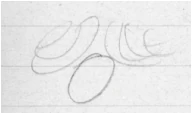
[ 43 ] And when the human being was then in the state he was in at that time—now I am going to say something that I ask you to pay very special attention to, for you will see there what depths are hidden in what we encounter in [the ancient] myths. When [the] human being [was], so to speak, in his sensory state, his etheric body would leave him. The human being could perceive external objects only in a blurred state; on the other hand, during the night—from the moment of falling asleep onward—it became possible for him to perceive all manner of [see drawing] currents through his spirit and soul. These currents, which radiate out into space in such a different way, he perceived as cold currents—as actual cold currents—that flowed in and out of him. This was a genuine astral perception, which the clairvoyant can still experience today if he elevates himself to the point of initiation. It involved such currents that flow in and out.
[ 44 ] These twelve currents, which flow in and out, are the creators of the cranial nerves; they have created those [nerves]—the cranial nerves—from the outside. What human beings possess within themselves today has been created from the astral realm. Their sober, cold calculation arose from [what] was actually perceived back then. That is why [the myth] describes [a] stream flowing in from the cold realm of mist. And that, again [illegible] [gap?], would be perceived [by the heart] as the organ of passion, as that which shaped the blood into its present form. What the ancient Germanic myths describe is nothing other than what could be perceived in the astral world.
[ 45 ] So you can see that there was [an] ancient tradition in this Germanic mythology, which—in a very early stage of human consciousness—had actually been partially preserved in the collective memory of this population. This will give you, my dear Theosophical friends, some idea of how [a] myth, how [a] legend actually arises and what it is. It is not something that the people invented to personify some natural forces or gifts of nature. Legends and myths are true descriptions of actual past perceptions in the spiritual world. What was experienced has, so to speak, flashed up in memory, and what has been preserved there is what has been handed down in myths and legends.
[ 46 ] Just as there is an initiation today—an initiation into the higher spheres of human knowledge—where a person, by undergoing certain states and undertaking [a] certain kind of work on themselves, on their soul, elevates themselves to higher states of consciousness, so too could this be said of the time when [human] beings were citizens of the spiritual world and lived in the world in entirely different forms—forms similar to those sought by people today when they are to ascend to higher states of initiation—the divine-spiritual beings, too, had to undergo this process if they wished to ascend to higher realms: [They had to] undergo an initiation, especially if they [were to lead an ancient people].
[ 47 ] The one described to us as Wotan had to undergo his initiation. He underwent this initiation by learning only what these beings—since they had not descended into materiality to the point of full human nature—were actually incapable of doing. Ordinary spirits and gods did not die and were not born. Wotan, however, had to come to know death. What do the myths tell us? That Wotan hung from the World Tree for nine days, and only by beholding [the runic] characters beneath the gallows while in this state of torment on the gallows tree, only through this was he able to free himself, to overcome death, to drink that potion which is neutrally called the “mead of life,” the elixir of life, through which he truly attained real inner immortality within himself beyond death. Thus, the initiation of Wotan is correctly recounted to us in the Germanic myths—correctly recounted. We are even told that Wotan had to enter a cave and unite with Gunnlöd. Gunnlöd is the higher consciousness; the mystical element of consciousness is characterized in the form of a female individuality. For Wotan, it is Gunnlöd from whom he acquires the potion of immortality.
[ 48 ] We could cite many examples; we could mention various “individual features” as well as a whole host of fundamental characteristics. But what mattered more to me was that we penetrate the spirit of the myths, that we learn the path one must take to connect myths and legends with their inner meaning. This is how the modern era has come to view myths. What has been preserved is the idea that myths have always been seen as the expression of spiritual reality.
[ 49 ] Thus—even if we say that words, so to speak, do not quite fit, but must be taken in their true meaning—that is, as expressions of facts that are difficult to describe—even the Siegfried myth is a relatively late myth; it is itself the expression of a spiritual reality. It is an expression of the spiritual reality that states: Yes, there are people who transcend ordinary, normal humanity, who develop within themselves the precious power of humanity. They are gradually initiated and become bearers of a higher consciousness. Even during their lifetime, they experience the world that human beings themselves experience only when they pass through the gate of death.
[ 50 ] But even when he passes through the gate of death, he experiences various things. The one who lives more in [the] physical-sensory world cannot break free from the sensory world even afterward. But those who strive to spiritualize themselves even while in the material [world] always experience a deeper insight into spiritual science first. Every people experiences these things in its own unique way. The ancient European, who was essentially a warrior, regarded that honor as the right to a higher life—the right to die in battle as a hero, in contempt of physical life, when one no longer regards the ordinary physical personality; at the moment of death, he unites with the Valkyrie, who comes to meet him as the consciousness from above.
[ 51 ] Only the one who regards physical life as the highest form of life dies a straw death and enters the realm of Hel, where he is bound to earthly conditions; but for one who is to be shown that, through his very special qualities, he has already attained that higher consciousness in life—one who, [as] a warrior in battle, [as] a hero, [not only] after death [reaches] that state—for Siegfried, it is shown that he had already united with the Valkyrie while still alive. What the other experiences in death, Siegfried experienced in life—as [if one] were to experience in life what a person otherwise experiences in death: the entry into spiritual worlds. It is wondrous how this is prophetically pointed to as a foreshadowing of the coming Christ. The Siegfried myths point to this: Siegfried has a vulnerable spot on his shoulder; he can be wounded there. Thus, even one who is portrayed as possessing such spiritual [powers] is vulnerable, and he is wounded there. This is the spot where the cross of Christ was later [placed]. That is where the Savior, Christ, is said to have borne the cross; there was still the vulnerable spot for the Germanic Siegfried; and it was also present in the prophetic consciousness of [people in] Central Europe that full consciousness could not yet be attained through ancient initiation into the spiritual world, but only when the vulnerable spot is crushed by the cross. Thus, in the figure of Siegfried, a reference to Christianity is given in a truly wondrous form, if one does not take the word and the concept literally, but rather in the subtlety with which they must be understood.
[ 52 ] There is a connection between these entities, which under certain circumstances may take on a different form at any given moment, and this is related to the fact that the divine figures of Wotan or Thor are portrayed in the Germanic consciousness in such a way that they can appear one way at one time and another way at another. Depending on [the nature of] their inner essence, their outer form changes—this during that [illegible]—[and thus] the result of an early consciousness [in] humanity is reflected through and through in these Germanic myths. If we view them in this way, we can see, in a certain sense, that through what we can gain from theosophical writings about the course of the world and [the] development of humanity, the key can be found to what others, in their different state of consciousness, already knew but had to forget—[which] will, however, be regained once they have reclaimed that crystal-clear consciousness in today’s state of awareness.
[ 53 ] Thus, theosophy alone provides the key to understanding such an important [myth] as [the] Germanic pantheon, and shows that there is far more wisdom regarding those great secrets and mysteries of the world contained in these so-called childlike and childish legends of the peoples than in our seemingly so advanced science. For what does this science know today of its wonderfully profound and mighty realities, which are expressed in the submersion of Nerthus into the sea—realities that introduce us to the true [meaning] of human development through myths and legends, taking us further and deeper than our science, which appears to have [advanced] so far?