

Self-Knowledge and God-Knowledge I
Theosophy, Christology and Mythology
GA 90a
16 November 1903, Berlin
Translated by Steiner Online Library
4. Where Does Diversity Come From? — From Unity
[ 1 ] Human beings consist of body, soul, and spirit, and of three epochs of the cosmos: past, present, and future.
[ 2 ] Our present cycle: the present; the past that preceded it; what is to come—the subsequent cycles: the future. [...]
[ 3 ] “The past” as an expression of the Primordial Spirit. Imagine the Primordial Spirit as water; everything physical is the solidified state of water. “The present” is the soul; “the future” lies within us as a seed. We cannot yet see the soul, but we are moving toward the time when the soul, too, will be visible. The past is equal to the future—the content of both is the present. Diverse and manifold is the content—emanating from the One—the multiplicity returning to unity. —The Primordial Spirit, conceived as creative power, as the center.
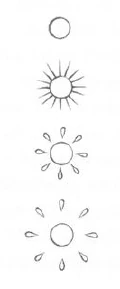
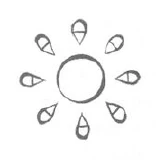
[ 4 ] Now, the creative force emits thoughts as rays radiating from the center. Each such ray is a soul. Now, not every soul [...] is the creative force itself, but rather a part of it—and it acts and strives to return to the whole. If we were to compare the soul itself to this creative force: The soul continuously produces thoughts and sends them out into space; but not every thought is independent and can act as an independent being, just as the soul acts as a thought of God. The path of development is twofold: the Primordial Source as the creative force—and thoughts.
[ 5 ] We cannot fathom the reason for God’s self-giving. With a machine, we can understand how it works by studying it. With a plant, although we can also study the laws governing it, it is already more difficult to determine its form and development. With an animal, it is even more difficult. In the case of the lower human being, we can still determine through observation what he does, which is no longer possible with the more highly developed. There, it is an act of freedom. Thus, the Creator’s highest act of freedom is this groundless devotion to the world out of love. No compulsion. Thus, there is no logical reason for us in the presence of the Great Spirit. Plato, as an initiate—like other sages—called love the foundation of the universe.
[ 6 ] The present, as a link between the past and the future, is the power within us as the astral body.
[ 7 ] The Third Logos: Wisdom. Why, then, should we refrain from asking “why”? Because God, as Creator, created the world in an act of His supreme freedom:
[ 8 ] God, the Original Source, Unity, becoming a multitude through self-giving to the world out of love. — Example: Water scattered into countless drops; yet each drop is still the same water —, then Annie Besant: Fire, and bursting forth — sparks.
[ 9 ] Since we are now thoughts—drops, sparks—of the Supreme, we remember our origin. Remembrance = memory—Plato.
[ 10 ] In the beginning was the Word—unpronounceable! When I speak it, it consists of letters; each letter has a different sound. We—every being—are one such letter of the Word. That is why there is diversity among beings: because different sounds are necessary to speak a word.
[ 11 ] Word—Diversity—that is you—it is I—I am I!
[ 12 ] I. The Omnipotence of the Logos — II. The Power of the Logos — III. The Wisdom of the Logos