

Self-Knowledge and God-Knowledge II
Theosophy, Christology and Mythology
GA 90b
17 March 1905, Cologne
Translated by Steiner Online Library
25. On the Significance of the Catholic Mass from a Mystical Perspective
[ 1 ] Anyone who wants to understand the origins of the Catholic Mass must trace its history back to the Mysteries. — Mysteries are places of worship where higher knowledge is not only taught and acquired, but where the phenomena in question are also demonstrated. The Mysteries took on a particularly popular form in the religious movements that came from Persia and Egypt. It is from these that the Mass emerged.
[ 2 ] Anyone who wished to gain knowledge of higher worlds before the coming of Christ had to be admitted as a student to a secret school. First, they had to learn how the world and humankind came into being. They learned about the debate concerning the origin of the world and the significance of humankind within it. They were taught how the divine world spirit has taken form everywhere. In minerals, plants, animals, and so on, one saw manifestations of the world spirit. Human beings are a convergence of everything that exists in the world. Paracelsus once said: All beings in the world are letters, and human beings are the word in which all of them are found. — Human beings are the microcosm within the macrocosm.
[ 3 ] The student was taught how the divine essence divides into many parts, only to be reunited within the human being. The rest of the teaching was based on allowing the student to experience this division of the divine and its return to the human being.
[ 4 ] Human beings have introduced base desires, passions, and instincts into the world. The lower animal forms are decadent products of humanity. Everything that is expressed in animals as base passions has been introduced into the world by human beings. The original state of the world was as we now see it realized in the mineral kingdom. A gemstone has no desire, no craving, no wish; the gemstone is chaste and unassuming. Imagine the other beings possessing the same chaste, unassuming nature, and you will have before you the ideal of the secret student. The feeling had to awaken vividly within him: You must become once again like the pure, desireless creation that emerged so chaste from the hand of the Creator. — He sacrificed everything base—that was the “catharsis,” the purification from instincts, desires, and passions—this corresponds to the “sacrifice” or “Oblatio” in the Mass, the second part of the Mass.
[ 5 ] The first part is the Proclamation, or the “Gospel,” in which the message of the dissolution of the World Spirit in nature was conveyed—the intellectual understanding of how the world came to be. This is followed by the second part: the Sacrifice. The initiate had to have the will to retrace the path back to the original, chaste form of creation. If he was ready for this, he was admitted to the actual mysteries. In the Egyptian mysteries, he then had to spend three days alone in a locked room and was brought into a state of consciousness in which he could experience higher forms of perception. He now experienced the descent of the god into the world and his distribution in the soul world or the astral world, after he himself was ready to sacrifice himself in a similar manner.
[ 6 ] At first, he experienced an image of which he was certain: This was you once, in that time when you were still free of instincts and passions, when you were still without desires. He saw his own image in the distant past, a human form on a higher plane. The second vision was that he saw how this human form on a higher plane gave rise to a male human figure whose face shone like the sun. This was Osiris. He saw Osiris emerge from the primordial human, surrounded by a radiant aura. From the second image then emerged the present form, after a second being had separated itself—Isis—and Horus, the present-day human, was born from it. Now he was an awakened soul.
[ 7 ] In the modern human being, when he lies asleep, one first perceives the physical body, then the etheric body, and finally the actual aura, which rises up from the sleeper. The human being is within his aura; he has then left his physical body. Deep within the temple mysteries, the initiate consciously experienced the states described while in the astral body. He was then a “transformed one,” a “consecrated one.” Those who are transformed in this way perceive the luminous manifestations of the lower beings.
[ 8 ] This process was the third stage of the Mysteries, the “transformation” of the human being into his astral form. Then the initiate had come to realize: Just as you saw Osiris, so were you once; you were astral and then became physical; a second time you must resolve to become incarnated.” Through free will, the soul was to return once more to the physical body. When he emerged from the Mysteries, he was to consciously bear the physical body within himself. Now he also received a new name. He perceived it as his eternal name. Each of us has such a name, which we bear in all our incarnations. The initiate bore this eternal name. He had incarnated voluntarily into his body. The human being now addresses his own body as “I.” But the one who was initiated knew that he was not the same as his body. He carries his body on his back. Such a one is crucified within his body; he is the one crucified in matter. Now he steps out and does consciously all that he had previously done unconsciously. This union with the body was called “Communio,” the fourth stage in the Mysteries. Only the one who was transformed in this way and reunited with his body was a true initiate.
[ 9 ] Now Christ appeared on earth. This appearance of Christ on earth meant that what had previously taken place within the Mysteries was now unfolding before the world in physical space. Previously, individuals had passed through the Mysteries. All of this had now become a historical event—a truly historical event in the sacrificial death of Christ Jesus. Christ Jesus has now established a memorial as a reminder of these mysteries. Those who joined Christ would no longer need to look. “To look” means “to look into a mystery.” Those who were to attain inner knowledge no longer had to learn to look through the mysteries. They could remain with the outward sign. This outward sign has a deeper meaning.
[ 10 ] The three highest aspects of the human being are Atma, Budhi, and Manas. In the past, when people spoke of “man,” they were referring to Atma, Budhi, and Manas. At that time, everyone believed that each life was merely one in a long series of many, and that it was a life earned through merit. This belief permeated the human spirit completely. At the same time, personal life had a quality that man essentially looked beyond. He did not attach great value to it.
[ 11 ] The task of the first two millennia after Christ was to educate humanity for the higher Self through KamaManas. Personal life was to be taken seriously and with great importance. A person spends approximately two millennia in Devachan. During this period, all of humanity will go through an incarnation in which emphasis is placed on the personal.
[ 12 ] Christ went up the mountain with Peter, James, and John—that is, into the sanctuary. This was the introduction to devachanic vision. There they saw Moses and Elijah standing beside Jesus. “El”—in “Elijah”—means “the Way”; Moses means “the Truth”—moral truth—; Jesus is “Life.” Jesus said to the disciples: Elijah has appeared again. John was this Elijah. He went on to tell them: “But do not tell anyone until I appear again.” — They were not to speak of the doctrine of reincarnation until he returned in a new world cycle. For two millennia, the world was to come to know the value of the personal. That which extends from one human incarnation to the next is the finer substance of the human being—the water, the spiritual. This is also what is referred to in the phrase, “The Spirit of God hovered over the waters”—the waters representing human beings. The impersonal human being is symbolized by water.
[ 13 ] Wine is the symbol of the personal human being. Christ turned water into wine. He transformed impersonal religion into a religion of personality. Just as water relates to wine, so does the impersonal nature of human beings relate to the personal. Anyone who can comprehend the doctrine of reincarnation and wishes to rise above the personality must abstain from wine. Anyone who enjoys wine will never arrive at their own understanding of what is impersonal in human beings.
[ 14 ] The lower body was to be ennobled and transfigured; therefore, for two millennia, Christianity was to exist without the doctrine of reincarnation. Christ had appeared to sanctify the personality. As a sign that Christ had taken upon Himself the entire sacrifice that had previously taken place in the mysteries, Christ instituted the sacrifice of the Mass. In it, the act of the mysteries was reenacted as an outward sign.
[ 15 ] The external order of the Mass is as follows: The priest proceeds to the altar with the altar server. First come a preparatory act, the “Introductory Prayer,” and the “Kyrie Eleison.” The deeper structure of the Mass consists of four parts: “Gospel,” “Offertory” — Oblatio, “Consecration,” and “Communion.”
[ 16 ] During the “Gospel,” a passage from the Gospels is read. This takes place to the right of the altar. The altar itself is oriented toward the east. The priest stands on the north side. This is where he reads the message aloud. This refers to the fact that human beings in the first root race—the polaric race—were also in the north, from where they descended further and further into matter.
[ 17 ] The second part of the Mass is the “Oblatio” or “Offering.” The priest offers that which represents the higher human being, just as human beings once offered themselves. The chalice is the outward symbol of the human heart. What we have in our hearts represents something future; it is less developed at present, but contains the spiritual. When human beings no longer think in terms of the material but in terms of the spiritual, then the heart will become the organ of thought. Today, the heart is still personal. The wine in the chalice represents the personal. The wafer symbolizes the brain. Bread and wine are now transformed into the higher nature, into Christ himself.
[ 18 ] The sacrifice brings about the transformation of the human being. This act is spoken softly, so that only the priest himself can hear it. This is a symbolic indication that the truly divine within the human being is something that he speaks only to himself. Every human being can only say “I” to himself. That is why Jewish esoteric teaching could only allow the name—the name Yahweh, which is the true “I” within—to be uttered with particular reverence. That is also why the words during the “Offertory” are spoken half in silence, half in a murmur. Hence, the third part is the “Transubstantiation” in the Mass.
[ 19 ] All of this demonstrates that something in external nature serves as a symbol of what the Deity itself is. The Deity is represented in both coarser and finer matter. The bread and the wine, the Body and the Blood. The moment we become fully aware that we are dealing with transformed matter, we indeed have on the altar, in the Host, matter such as that found in our brain, and in the wine, matter such as that found in our heart—in our blood.
[ 20 ] The priest breaks the host in a specific way, into a specific number of pieces—namely, nine pieces:
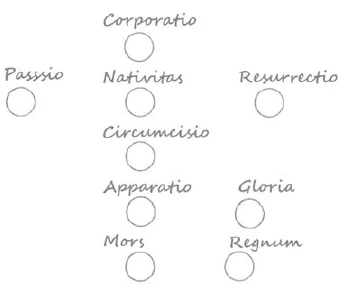
1. Corporatio = Incarnation
2. Nativitas = Birth
3. Circumeisio = Envelopment
4. Apparitio = Appearance
5. Passio = Passion
6. Mors = Death
7. Resurrectio = Resurrection
8. Gloria = Glory
9. Regnum = Kingdom
[ 21 ] These nine parts represent the transformed human being who partakes in the Higher. They are the nine parts of the human being. The parts that a person experiences within their personality are 1 through 7, while 8 and 9 extend beyond the personality; that is why they are placed separately.
[ 22 ] Thus, in the “Communion,” man unites with his sevenfold nature and strives for 8 and 9: “Gloria” and “Regnum.” This is accompanied by the Lord’s Prayer. First, the Lord’s Prayer refers to the God of heaven who is, then “Your Name”—the name of God, the Logos, who became flesh in Christ—and then “Your Kingdom.” The whole is a parable for the world that exists. Human beings are to understand their communion with the existing world. Only those who emerged from the Mysteries understood the world. This is expressed in the Lord’s Prayer.
[ 23 ] On particularly festive occasions, the procession with the “Sanctissimum” is also held; this is the consecrated monstrance, inside of which the Holy Body is enshrined. At the top of the monstrance is a sun-like circle with rays; the circle rests within a crescent-shaped shell. This is also how Osiris and Isis were depicted. The union of Isis and Osiris—which stands as the “Sanctissimum” above the Mass—is a symbol of the time when the sun still encompassed the moon.
[ 24 ] No priest who is not ordained or authorized to wear the stole may celebrate the Mass. The stole is the actual priestly vestment. The priest first puts on a cassock, then the “alba,” a shirt-like garment with a belt, followed by a symbolic garment, then the stole, which is crossed over the chest, and finally the chasuble.
[ 25 ] The stole is the true insignia of priestly dignity. Therefore, when he wears the stole, he feels himself to be a servant of the Church. He may then no longer proclaim his own opinion. He keeps his personal opinion to himself; he tells himself that it may also be wrong, and he proclaims what has been believed for millennia.
[ 26 ] The modern era shifted all spiritual matters toward the material realm in the fourteenth, fifteenth, and sixteenth centuries. People learned to judge the world according to material conditions. Following Galileo and Copernicus, all attention was focused on the physical plane. Everything was determined by karma. As a later religion, Protestantism no longer had any understanding of the sacrifice of the Mass. When we see and hear the Mass being celebrated with full understanding, we have before us the last reflection of the consecration performed in the ancient Egyptian pyramids.
[ 27 ] The physical human being arose from the Solar Being Osiris; he is to become the Solar Being once more. He descended from the heights of the Sun unconsciously; he is to ascend to them again consciously. Solar Heroes are those who walk their spiritual path with as much certainty as the Sun follows its course. These Sun Heroes have attained the sixth degree of initiation. Among the Persians, the degrees of initiation were as follows: first, a raven; second, a secret one; third, a warrior; fourth, a lion; fifth, a Persian; sixth, a Sun Hero—a Sun Runner; seventh, a father.