

Self-Knowledge and God-Knowledge II
Theosophy, Christology and Mythology
GA 90b
18 August 1905(?), Berlin
Translated by Steiner Online Library
13. The Seven Principles
[ 1 ] In humans, Atma consists of seven principles: 1. the auric sheath, 2. Budhi, 3. Manas, 4. Kama Manas, 5. Kama, 6. the physical body.
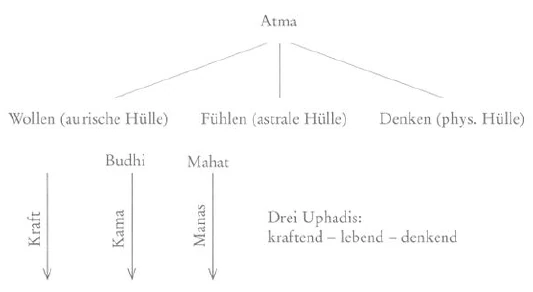
[ 2 ] This being, consisting of seven principles, has three states of consciousness, also called “determinations” or “upadhis.” Atma dwells in three upadhis:
1. physical - physical
2. vital - astral
3. mental - manasic
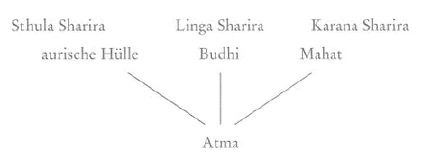
[ 3 ] Sthula Sharira: The entire mineral kingdom is not self-aware. It exists—that is, it is—but it neither feels nor thinks about its own existence.
[ 4 ] Linga Sharira: Plants and animals are partially self-aware. They live—that is, they feel—but do not reflect on their own existence.
[ 5 ] Karana Sharira: People are awakened. They think—that is, they think their being.
[ 6 ] Let us imagine a person: she is, and she is perceived. We thus have a subject and an object. Furthermore, the subject perceives itself; it, as it were, steps outside itself and makes itself into an object; its “I” stands above the external expression of its “I.” It is, perceives itself, and thinks.
[ 7 ] Let us consider Atma. In order to perceive itself, Atma must manifest itself—that is, make itself known through an act of will; it must exist and therefore surrounds itself with a subtle sheath that we call the auric sheath. — First aspect: the world as will/Atma.
[ 8 ] Now Atma becomes aware of itself; it feels and perceives itself as a being, thereby forming the astral sheath within the auric sheath. — Second aspect: the world as feeling/Budhi.
[ 9 ] In order to form a conception of itself, Atma must step outside of itself; it now becomes objective and thereby creates its physical form. — Third aspect: the world as thought / Mahat.
[ 10 ] Here we have Atma, which permeates everything seven times: three times subjectively, three times objectively in its aspects, and once as itself.
[ 11 ] If we consider the objective aspect in its descent, in its separation from Atma, we find will without spirit as power, feeling without spirit as Kama, and thinking without spirit as concrete Manas. In its ascent—that is, in its return to the wellspring of Atma—Kama becomes Budhi, Manas becomes Mahat, and the force becomes the auric sheath. Everything merges back into Atma: For a being to come to itself, it must consist of seven principles. The number seven in the objective world and in human beings:
[ 12 ] A being can awaken in three states of consciousness—that is, in its three sheaths: energetic, vital (or sensory), and mental.
[ 13 ] In the mineral kingdom, the being has awakened only to the level of force; in the plant kingdom, it is alive; in the animal kingdom, it is alive and sentient; in humans—it thinks.