

Self-Knowledge and God-Knowledge II
Theosophy, Christology and Mythology
GA 90b
11 December 1905, Berlin
Translated by Steiner Online Library
20. Insights into the Higher Worlds I
[ 1 ] You have heard of the spirits that manifest themselves in human beings: “Will, Wisdom, Form.” I would like to say a few more things about these entities.
[ 2 ] You need to familiarize yourself with it. Anyone who considers only the physical aspect knows very little.
[ 3 ] All teachings are derived from observations made using higher faculties that do not belong to the physical body, but rather to the higher bodies, and which are not yet developed even in ordinary people. To become familiar with this is achieved through higher vision.
[ 4 ] The names of the [four] stages of perception [are]:
[ 5 ] 1. Material cognition: This is the subordinate form of cognition [used] only in everyday life.
[ 6 ] 2. Imaginative Cognition — Perceiving spiritual beings in images: The images of the dream world, surging up and down, are chaotic, disordered, and meaningless. But meaning can be developed within the soul. The imago—the image with which a person surrounds themselves. Therein lies the fabric from which knowledge is composed [...]
[ 7 ] Through reality, which is perceived imaginatively, one can reach through it and pass through it.
[ 8 ] 3. Voluntaristic—will-based—cognition: One is no longer dealing with images. All image-based cognition belongs to the astral worlds; all will-based cognition belongs to the mental world. L.]
[ 9 ] Beings that we perceive have a substance similar to our human will. Expressions of the will.
[ 10 ] 4. Intuition: The will is particularly highly developed and sensitive. The will stirs. When the will becomes perceptive, this is the highest form of knowledge a human being can attain on the third plane. The highest plane is intuition; the stages lead up to the three worlds, where we have reached the limit of what initially concerns human beings.
[ 11 ] Intuition is the realm of knowledge for the student who has reached the third degree.
[ 12 ] The third degree, or the Swan, is the one that connects ordinary people with the Masters—Lohengrin.
[ 13 ] Intuition enables people to perceive the inner objects. We must learn to truly understand the meaning of the name “I”; one must investigate such matters. Through meditation, clarify the distinction between the “I” and other names. Then you will discern the fundamentals of the Royal School of Yoga.
[ 14 ] There is an indescribably great difference between the “I” and other names. There is no thing that has a name that anyone could assign to it, but there is one name you all know—the meaningful “I”—that only each person can say to themselves. The “I” must resound from within a person; then the person enters the realm that is supersensible and the path through which they can come only from within. There, the person first enters the realm that has no [gap in the transcript]
[ 15 ] That is why, in Jewish esoteric teaching, the unpronounceable name [Yahweh]—which means “I am,” the God who reveals Himself in the innermost depths of the soul—is the first object of intuition. If you now learn to recognize all things in this way, if you elicit their names just as you do your own, if you penetrate into things through self-abnegation, through the dissolution of the self, then you will learn all mysteries; then every object will reveal its own “I,” and then all things will speak. All illusion of the separate self will then have vanished. All things will then proclaim the words lying within them. [...]
[ 16 ] What I am about to tell you is an illustration of what has been taught in all schools. I am speaking to you, and you hear me because I am able to cause the air to vibrate in very specific patterns that are an exact representation of my words and sounds. Now you know that all things in the form of air can be made fluid. Now imagine that someone could solidify the air at the very moment I speak—then my words would fall like snowflakes. This is how the person who looked more deeply into these matters rightly imagined the world in the first place. Thus, the World Soul once spoke the primordial words into an infinitely fine substance—into Akashic matter. Everything that exists here on Earth is fallen Akashic matter. The crystal is the condensed word of the Primordial Soul. Everything around us is the word of the Primordial Soul that has become solid. When a person rises to intuitive knowledge, they hear the words that the Primordial Soul once spoke.
[ 17 ] The four stages of knowledge lead to the mental plane. These four stages are taught in all Rosicrucian schools and constitute the content of the first seven degrees of initiation. Freemasonry, too, before it degenerated into the three degrees of St. John, had these seven stages.
[ 18 ] One gains insight into the higher worlds through feeling and through calm, clear inquiry. Trust is necessary, as is faith, which arises from an intuitive sense. Human beings are predisposed toward truth and clarity; when the occultist tells them something, they already sense that there is some truth to it.
[ 19 ] First, I would like to outline the higher world, proceeding in a completely logical and elementary manner. When you observe human development, you will perceive the fourfold nature of human beings as they appear before your senses.
[ 20 ] First: The physical body shares certain characteristics with the mineral kingdom. When a human being stands before us, he or she is a mixture of the physical body and the higher bodies. The eye is a physical apparatus without sensation, yet it is animated and endowed with sensation. Out in the world lies the realm of the inanimate, which human beings have taken possession of.
1. The Realm of the Inanimate: Physical Body
2. The Plant Realm: Etheric Body
3. The Animal Realm: Astral Body, Ego, Manas, Budhi [Atma]
[ 21 ] Second: The etheric body: You can cut off a piece of a mineral and set it aside; after a year, it will still be just the same. It is different with a plant: if you cut off a leaf, it will wither after a short time.
[ 22 ] Third: The astral body or the body of sensation.
[ 23 ] These three kingdoms of nature are also present in human beings. Then there is the fourth element, the “I.” The “I” holds together the essence of the entire world within the human body. Schiller expressed this in a thoroughly theosophical way in his description of Goethe’s view of nature: “You seek to understand nature, but by a difficult path, by synthesizing all three kingdoms in order to comprehend the human being.”
[ 24 ] Here we have reached the point where humanity stands today. We possess what the forces of nature have made of us. The physical body is what the deities have created; it is the most intelligent. The physical body is wisely constructed; the other bodies are still imperfect. The astral body commits follies against the heart; it intervenes in an irregular and chaotic manner in this wise structure.
[ 25 ] The “I” is the true baby; it is at the very beginning. Through these imperfections, human beings must first develop upward. Europeans know how to distinguish between “good” and “evil,” “true” and “false.” To the extent that the “I” possesses unadulterated truth, to that extent Manas is present in the “I.” There is no need to first reach agreement on anything that is Manasic. No matter how much a person achieves in common with everyone else, he must recognize the truth for himself.
[ 26 ] Becoming dispassionate. The more dispassionate feeling there is in a person, the more Budhi there is within them. As the “I” develops, it, too, becomes as rhythmic as the physical body. Two worlds.
[ 27 ] Human beings live in three realms, but a new world is opening up to them, into which they must learn to live. Just as the “I” of the infant has risen above the animal realm, so it rises into higher realms. All religions have sought to elevate the “I.” When we ascend, we gain a broader perspective.
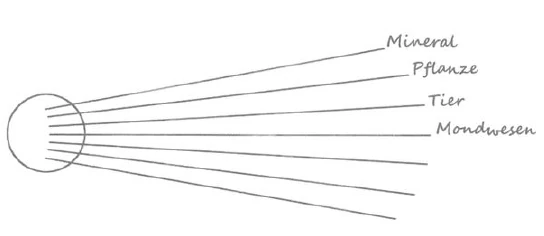
[ 28 ] The ancient Christian esoteric teachings refer to the lunar beings as angels. The Asuras are the source of all forms of egoism; without them, however, we would not have independence—individuality, but also selfishness. The gods of form are the constructive, architectural ones. The spirits of form have worked on the physical body. Jehovah is the spirit of form. Lunar gods have been particularly active on the etheric body; that is why Helena Petrovna Blavatsky calls Jehovah the moon god. The occultist approaches these beings and states that they did not evolve out of nothing.
[ 29 ] Addendum from the notes of Alfred Reebstein
[ 30 ] Human beings—the “I”—have taken possession of the other realms, formed an essence from them, and now govern it. The physical body is the most fully developed of its kind; the higher bodies—the etheric and astral bodies—are far less developed in their own way, and the “I” does not attain greater perfection until later stages.
[ 31 ] That which is completely flawless truth within human beings is called Manas.
[ 32 ] “Budhi” refers to that which is completely independent of sensations and passions. Concurrently with the human realm, the following undergo their development:
- Mineral Kingdom
- Plant Kingdom
- Animal Kingdom
- Human Kingdom — Kingdom of the “I”
- Angelic Kingdom, Lunar Pitris, Lunar Beings, People of the Moon
- Archangelic Kingdom, Fire Spirits, Solar Beings, People of the Sun
- Archai, Spirits of Time, Spirits of Personality; Asuras, People of Saturn
- Spirits of Form, Exusiai
- Spirits of Movement — Activity - Dynamis
- Spirits of Wisdom
- [Thrones]
- Cherubim
- Seraphim