

Basic Elements of Esotericism
GA 93a
4 November 1905, Berlin
Translated by Steiner Online Library
Lecture XXX
[ 1 ] Today, following the last lecture, I will offer some aphoristic remarks on the development of the various races. But first, I would like to draw attention to a few points whose reasons are explained in only a few books.
[ 2 ] The so-called dietary laws in various cultures seem, at first glance, to be very arbitrary. However, they are not; they are born of knowledge and wisdom. We must, however, strictly take into account that humanity today is not at all capable of following the things we intend to discuss here. Nevertheless, they will later provide certain foundations for specific laws of social life. So no one should believe that one immediately becomes an adept simply by switching to vegetarianism and so on.
[ 3 ] There is a certain form of medical practice among Eastern peoples that is carried out in such a way that the physicians in question place the greatest emphasis, above all else, on the nourishment of their own physical bodies. Where the ancient spiritual way of life still persists, there are people who have become healers in the old manner by nourishing themselves exclusively on milk. They are well aware that, by excluding everything else, they develop physical healing powers within themselves, particularly for the treatment of so-called mental illnesses.* They have their own specific duties. They know full well that by consuming only milk, they develop certain powers.
[ 4 ] Let us clarify the intuition on which this is based. We can understand this deep intuition in the following way. We know of a specific course of events in human evolution. In the middle of the Lemurian epoch, the original human nature split into an ascending human nature and an animal nature. Linked to this was the fact that the forces the Earth possessed when it was still united with the Moon also split, and a part of them separated from the Earth along with the Moon.
[ 5 ] Let us imagine the time when the Earth was still united with the Moon. At that time, humankind was at a completely different stage of development. Even then, humans were warm-blooded, but had not yet been divided into two sexes. With the separation of the Moon, we can observe the division into two sexes, so that when you look up at the Moon today, you can say: Your departure from the Earth has caused the human creative power to split into two parts. - There was also a time on Earth when humanity was directly connected to the animal realm, immersed in it, and sustained by it. This form of nourishment will be difficult to comprehend for those who lack clairvoyant powers. We can, however, form a conception of it by observing the regular feeding habits of mammals, which nourish their young with their own milk. This form of nutrition emerged with the division of productive forces. In the past, humans were able to absorb nourishment from their immediate surroundings, just as the lungs absorb air today. At that time, humans were connected to the entire natural world around them through suction threads, much like the human embryo is nourished in the mother’s womb today. That was the ancient form of nutrition on Earth. A remnant of this is the nursing of mammals today, and milk is like the food that humans consumed in the pre-Lemurian era; it is the ancient food of the gods, the first form of nourishment on Earth. At that time, the nature of the Earth was such that this nourishment could be drawn from everywhere. Thus, milk is a product of the earliest form of human nutrition. When human beings were still physically closer to the divine, they drew milk from their surroundings. Occultists know how human beings are connected to nature.
[ 6 ] Milk consumption is an ancient, transformed form of nutrition. Milk was always the first food for humans. In the saying, “The milk of pious thought,” it is intentionally referred to as such.
[ 7 ] We ask: What was the original cause of the milk being drawn out of the environment in the way it was back then? The lunar forces within the Earth made this possible; they were like a universal lifeblood for the entire Earth. But when the Moon separated from the Earth, the lunar forces could only be concentrated in specific organs within living beings.
[ 8 ] The occultist calls milk “the food of the moon.” The sons of the moon are those who nourish themselves with milk. The Moon has ripened the milk. It has been proven that the Eastern healers, who live on milk alone, reclaim the primal forces that existed on Earth when milk still flowed in streams across the land. They said to themselves: These are the forces that called humanity into existence. These life-giving forces must also be beneficial to health; therefore, we acquire the power to promote health if we consume only milk and exclude everything else.
[ 9 ] Let us transport ourselves back to the pre-lemurian era. At that time, milk was obtained externally from the environment. Then came a period when milk became a common human food, followed by a period when breast milk was consumed. Before the time when milk was generally drawn from nature, there was a time when the sun was still connected to the Earth. At that time, there was “sun food.” Just as milk was left behind by the moon, so too were products that had ripened under the sun. Everything that is illuminated by the sun—the blossoms and fruits of plants—belongs to the sun. They used to be oriented toward the center of the Earth, which was connected to the sun. They were immersed in the sun along with their blossoms. When the Earth separated from the sun, the plants retained their old nature: they now turned their blossoms toward the sun once again. Human beings are the reverse of plants. What grows above the earth in a plant relates to the sun in the same way that milk relates to the moon; it is, therefore, nourishment from the sun. A kind of plant-based nourishment—specifically from the upper parts of the plant—gradually took the place of a diet consisting solely of milk. This was the second type of human nutrition.
[ 10 ] Thus, as the Lemurian era drew to a close, two races stood opposed to one another: one race, the true Sons of the Moon, who raised animals and sustained themselves on what the animals provided—on the milk of the animals; and a second race, which sustained itself on plants, on what the earth yielded.
[ 11 ] This fact was illustrated in the story of Cain and Abel. Abel is a shepherd, Cain a farmer; Abel [represents] the lunar lineage and Cain the solar lineage. This allegory is truly magnificent. The Secret Doctrine alludes to this in a somewhat veiled manner. That divine being who gave humans the ability to be lunar beings—to nourish themselves from transformed lunar sustenance—was called Jehovah by the Jewish people. He was the nourishing force of nature: it flows to Abel, who draws it from his flocks. And the transition to solar nourishment was a turning away from Jehovah. That is why Jehovah did not accept Cain’s offering—because it was an offering of solar nourishment.
[ 12 ] If we go back to the earliest times, we find that we had no other food at all than milk—the food that humans obtain from living animals. This is the original form of nourishment, just as it is still today during the first few weeks of life, and the Eastern healer applies the saying, “Unless you become like little children, you cannot enter the kingdom of heaven,” to this way of eating. All these things have their significance.
[ 13 ] Now we move from the Lemurian era to the Atlantean era, to the peoples who lived in the region of what is now the Atlantic Ocean. Among the Atlanteans, something emerges that did not exist before: they begin, for the first time, to nourish themselves with what is not taken from the living; they feed on the dead. They take into themselves what life has given up. This is a very important transition in human development. Because people now nourished themselves from the dead, it became possible to make the transition to selfishness. This nourishing oneself from the dead signifies the true connection with selfishness. Human beings become independent by taking in the dead. Human beings now take in the dead in its various forms: first among the emerging hunter-gatherer peoples who kill animals. Later, peoples emerge who consume not only what has ripened in the sun but also what has ripened underground. This is just as dead as the dead animal. Everything that lives in the animal’s basest nature—everything steeped in blood—has turned away from the power of the Moon. The power of the moon is still present in milk, which is connected to the life process. When humans consume what is dead, they take in the dying parts. Equally dead is everything that grows underground from the plant—that which is not warmed and infused by the life principle of the sun. Thus, the root corresponds to what, in the animal, is the body saturated with blood.
[ 14 ] Later, a new type of food was added that had not existed before. Humans began to include purely mineral components in their diet—those they extracted from the earth, such as salt and so on. Thus, in their diet, human beings passed through the three kingdoms. This is roughly the path that Atlantean development took with regard to nutrition: First came the hunter-gatherer peoples; second, the farmers—the lineage of Cain; and third, the art of mining developed, bringing to the surface what lies beneath the earth.
[ 15 ] All these things represent that which has been turned away from the actual life force or productive power. What is dead in an animal is turned away from life. What is in the soil from the plant is also turned away from life. All salt is the dead matter of the mineral kingdom, that which remains as a residue.
[ 16 ] Now we come to the fifth human race. The milk-drinkers continue to exist alongside the fruit-eaters; other elements are added as something new. What comes to the fore in the fifth root race is that which is initially extracted in mineral form—that is, through a chemical process. This is hinted at in Genesis. What is it that is obtained through the chemical process? We advance in evolution; we apply chemistry to plants, to fruit. From this, wine is produced. This did not exist in Atlantis. That is why the Bible states that Noah, the forefather of the new post-Flood race, is first intoxicated by wine. Through a mineral-chemical process, something is produced from the plant kingdom. Wine then plays a specific role throughout the entire fifth root race. All initiates from the beginning of the fifth root race had carried over their traditions from the time of the Atlantean race, when there was still no wine: the Indian, Persian, and Egyptian initiates had no need for wine. The only thing that played a role in the sacred rites was water.
[ 17 ] With the fifth root race, then, wine emerged, a process in which the mineral treatment of the plant must play a role. The first three sub-races were repetitions of what had come before. The fourth sub-race was the first to develop the new elements that had emerged with the fifth root race. It ascribed a certain sacredness to wine. Consequently, ritual practices emerged in which wine played a role (the cult of Dionysus). A god of wine even came into being.
[ 18 ] This has gradually taken shape within humanity. First, the culture of wine emerges among the Persians. But there, wine is still something entirely worldly. Only gradually does it find its way into the cultic realm, into the cult of Dionysus. The fourth sub-race is the one that first gives rise to Christianity, and it is also the one that announced its mission seven hundred years earlier through the Dionysian festivals. They were the first to incorporate wine into their cult. This fact was wonderfully depicted by the evangelist who knew the most about Christianity: John. Right at the beginning, he discusses the transformation of water into wine, for Christianity first came for the fourth sub-race of the fifth root race. A teaching was needed that sanctifies what must emerge onto the physical plane. Wine cuts people off from everything spiritual. Anyone who enjoys wine cannot attain the spiritual. They can know nothing of Atma, Buddhi, Manas—of that which remains, that which reincarnates. This had to be so. The entire course of human development consists of a descent and an ascent. Humanity had to descend to the lowest point at some point. And so that it might descend fully onto the physical plane, the Dionysian cult emerged. The human body had to be prepared for materialism through the Dionysian culture; therefore, a religion had to arise that transforms water into wine. In the past, there was a strict prohibition against wine for priests; they were able to experience Atma, Buddhi, and Manas. There now had to be a religion that led all the way down to the physical plane; otherwise, people would not have descended completely. This religion, which led them down, had to have an external revelation—one that set aside Atma, Buddhi, and Manas, as well as reincarnation, and referred only to the universal. The next step is that the wine is transformed back into water.
[ 19 ] If the water had not been turned into wine earlier, man would not have absorbed everything that is down here in the earthly valley. At the beginning of the Gospel of John [in the account of the turning of water into wine at the wedding in Cana], we see how Christ made use of what was there. But he also looked toward the future by instituting the Last Supper. This Last Supper is the greatest symbol of the One who began his cultural current with this fourth sub-race. If, then, he was the true “Son of Man” who descended the farthest in order to lift humanity up again with the greatest power, he had to rely on what was already there and show humanity how the physical substance of the race is connected to his true mission. If humanity was to rise again, it had to have a symbol that in turn leads from the dead to the living: bread and wine. In the occult sense, bread is what arises after the plant has first been killed. Wine, in turn, arises by killing the plant and treating it with minerals. When we bake the plant, we do the same thing as when we kill an animal. When we extract wine from the plant kingdom, we are, in a certain sense, doing the same thing as when we draw blood from an animal. Bread and wine stand there as symbols of the fourth sub-race. What is to develop in the future is a further ascent from plant-based to mineral-based nourishment. Bread and wine must once again be sacrificed, renounced. In this respect, then, when Christ appears in the fourth sub-race, he points to bread and wine: “This is my body—this is my blood.” In doing so, he sought to create a transition from animal-based to plant-based nutrition—a transition to something higher.
[ 20 ] At that time, there were two classes of people: First, those who fed on flesh and blood; these are the pre-Christian people, whom Christ did not even take into account. Second, those who kill only plants, draining the blood from the plant: those who drink wine and eat bread. He still counts on them; they are the harbingers of the humanity that will exist in the future.
[ 21 ] The significance of the Lord’s Supper is the transition from a diet of dead animals to a diet of dead plants. When our fifth subrace has come to an end, in the sixth subrace, the Lord’s Supper will be understood. No animal products will be consumed there. By then, it will be possible for the third form of nutrition—the purely mineral form—to emerge. Humans will then be able to produce their own food. They now consume what the gods have created for them. Later, they will ascend and prepare the nutrients they need themselves in a chemical laboratory.
[ 22 ] So you see that everything arises from deep intuitions. When we find all sorts of rules in ancient Eastern traditions about what should be eaten, these are not really commandments, but rather stories: You should not expect substances to act differently than they do.
[ 23 ] What Christ subsequently puts to death—what is truly sacrificed after he has taken the Lord’s Supper—is the physical body. This dies. It will die for the entire human race. Toward the middle of the sixth subrace, in the last third, there will no longer be a physical body. Then the whole human being will once again be ethereal. He will transition into a finer form of matter. However, this will not occur unless the human being brings it about himself. To achieve this, he must first switch to food that he prepares himself in the laboratory. Thus, to the extent that man no longer derives his nourishment from nature but from his own wisdom—the God within—he also hastens toward his own deification.
[ 24 ] When humans begin to feed themselves, they also lay the foundation for something higher—namely, the ability to reproduce. They gradually create a life for themselves out of the mineral world.
[ 25 ] This is the grand course of human evolution. What natural scientists know today is only a small part of the great cycle.
[ 26 ] With Saturn, we enter the mineral era. In the Atlantean era, the consumption of the dead lays the groundwork for what gives rise to egoism. Up until the fifth subrace—the Proto-Semites—the human “I” develops very slowly in this way. In the sixth subrace of the fifth root race, this “I” will reach a higher stage of development once again. This means that we are standing on the threshold of a new so-called “vortex” of existence. The current vortex began at the time when the Proto-Semites laid the foundation for the present root race.
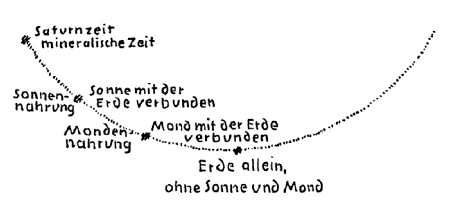
[ 27 ] We owe everything that has existed up to now to the Proto-Semitic culture. But now a new phase is beginning with the Slavic peoples, one that extends into the future. A people is bringing a new direction into the world, accompanied by a certain break with the past. This is emerging as a hidden spirituality from within the Russian peasantry. This forms the second part of the coming upheaval. At present, a certain culture is in the process of disintegration, and something new is taking shape. It is taking shape in the West and will play out in the East. But the old must inspire the new. Wherever we see new beginnings in our time, everything is embryonic, clumsy, and awkward. The old, on the other hand, is finely chiseled, yet it bears the character of criticism and dissolution. From the Semitic branch are born the bearers of the old culture, who are the bearers of that which is swirling into the vortex.
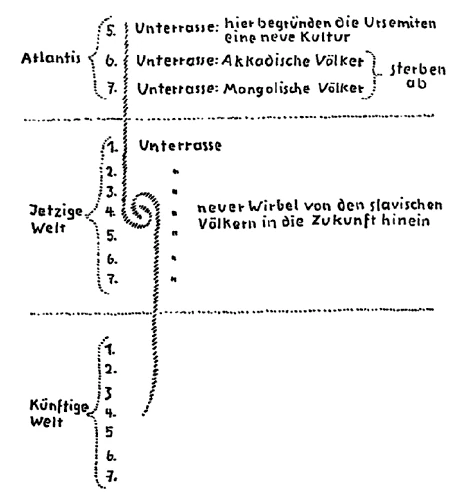
[ 28 ] They all have something Semitic about them. Examples: Lassalle, Marx. This is now coming into play. It is not possible to continue from there. A leap must now be made, as if from one shore to the other, toward the spirituality of the future culture of the East. This is an entirely new approach.
[ 29 ] The future is, at first, clunky and, naturally, tainted by the past. Haeckel is a man swimming right in the middle of that current, swept along by both whirlpools. The first part of Haeckel’s *The Riddle of the Universe* is positive, elementary theosophy; the second part is negative, all-consuming; that is a whirlpool.
[ 30 ] One can also observe these contrasts in Eastern and Western socialism. Western socialism is a socialism of production; Eastern socialism is a socialism of consumption. Those who regulate what is produced on a social basis take greed and selfishness into account. Those who regulate consumption focus on what others want from them; they look to their fellow human beings and rely on brotherhood. The socialism of production—Marx, Lassalle—views the worker solely as a producer. In the East, consumption is emphasized—for example, in Kropotkin, Bakunin, and Herzen. You can see the contradictions coming to a head if you follow Kropotkin’s work. He immediately grasped the principle of mutual aid among animals. Western socialism is built entirely on struggle. This is how the currents of world development intertwine.