

The Gospel of St. John
GA 94
2 November 1906, Munich
Translate the original German text into any language:
Versions Available:
The Gospel of St. John, tr. SOL
Die Theosophie anhand des Johannes-Evangelium IV
Theosophy Based on the Gospel of John IV
[ 1 ] Wir sind vorgestern in unserer Betrachtung dahingekommen, festzustellen, welche großen Gesichtspunkte im Johannes-Evangelium liegen. Heute wollen wir von den Beziehungen des Menschen zu der uns hier auf dieser Erde umgebenden Welt reden. Der Mensch sieht gewöhnlich sich selbst als ein viel zu einfaches Wesen an. In Wirklichkeit ist er aber ein sehr kompliziertes Gebilde. Eine Eigenart des Gegenwartsmenschen ist die Bequemlichkeit, die bis in unser Vorstellungswesen herauf wirkt. Die Wahrheit ist etwas Einfaches nur für jenen, der sich zuerst durch die Mannigfaltigkeit durchgerungen hat. Sie ist wie ein Faden, an dem viele, viele Perlen aufgereiht sind.
[ 1 ] In our reflection the day before yesterday, we came to identify the major themes in the Gospel of John. Today we want to talk about the relationships between human beings and the world that surrounds us here on Earth. Human beings usually view themselves as far too simple beings. In reality, however, human beings are very complex beings. A characteristic of modern people is a tendency toward complacency that permeates even our imagination. The truth is simple only to those who have first struggled through diversity. It is like a thread on which many, many pearls are strung.
[ 2 ] Aus den öffentlichen Vorträgen haben wir bereits entnommen, wie der Mensch verwandt ist mit dem ihn umgebenden Kosmos, mit der ihn umgebenden irdischen Natur. Durch seinen physischen Leib ist er verwandt mit der mineralischen, sogenannten leblosen Welt, durch seinen Ätherleib mit der ganzen Pflanzenwelt, der Vegetation, durch seinen Astralleib mit allen tierischen Wesen. Erst durch das Ich-Bewußtsein erhebt er sich über die anderen drei Reiche. Ohne diesen Werdegang gründlich zu verstehen, und ohne zu verstehen, was eine Einweihung oder Erweckung ist, können wir nicht in die Tiefen des Johannes-Evangeliums dringen.
[ 2 ] From the public lectures, we have already learned how the human being is connected to the cosmos that surrounds him and to the earthly nature that surrounds him. Through his physical body, he is related to the mineral, so-called lifeless world; through his etheric body, to the entire plant world, to vegetation; and through his astral body, to all animal beings. It is only through ego-consciousness that human beings rise above the other three kingdoms. Without thoroughly understanding this process, and without understanding what an initiation or awakening is, we cannot penetrate the depths of the Gospel of John.
[ 3 ] Betrachten wir die drei Reiche der Natur um uns. Der Kristall hat kein Selbstbewußtsein, kein Ich in der physischen Welt. Diese Behauptung beruht auf klaren Erkenntnissen, die aus der okkulten Forschung stammen. Doch nur hier auf dieser Erde haben der Stein, die Pflanze, das Tier kein Selbstbewußtsein. Es taucht ja die Frage auf: bewußt sei doch alles? Wie das zu verstehen ist, kann uns erst durch okkultes Studium klarwerden. Gehen wir zunächst vom Bewußtsein des Menschen aus. Das Wesen des Menschen in seiner Viergliedrigkeit beruht darauf, daß er sein Bewußtsein in dieser physischen Welt hat, daß er seine vier Glieder in dieser Welt hat. Machen wir uns dies durch ein Schema klar:
[ 3 ] Let us consider the three kingdoms of nature around us. The crystal has no self-awareness, no “I” in the physical world. This assertion is based on clear insights derived from occult research. Yet it is only here on Earth that the stone, the plant, and the animal lack self-awareness. The question naturally arises: isn’t everything conscious? Only through occult study can we understand what this means. Let us begin by considering human consciousness. The nature of the human being, in its fourfold structure, is based on the fact that the human being has consciousness in this physical world and possesses its four members in this world. Let us clarify this with a diagram:
| physischen Welt | Astralwelt | Rupa-Devachan | Arupa-Devachan | |
|---|---|---|---|---|
| Mineral | Physischer Leib | Ätherleib | Astralleib | Ich |
| Pflanze | Physischer Leib Ätherleib |
Astralleib | Ich | |
| Tier | Physischer Leib Ätherleib Astralleib |
Ich | ||
| Mensch | Physischer Leib Ätherleib Astralleib Ich |
| physical world | astral world | Rupa-Devachan | Arupa-Devachan | |
|---|---|---|---|---|
| Mineral | Physical Body | Etheric Body | Astral Body | Self |
| Plant | Physical Body Etheric Body |
Astral Body | Self | |
| Animal | Physical Body Etheric Body Astral Body |
Self | ||
| Human | Physical Body Etheric Body Astral Body I |
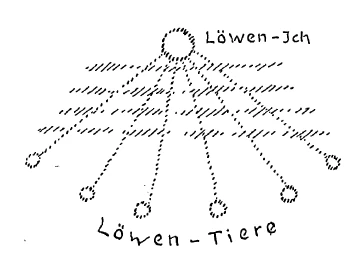
[ 4 ] Das Tier hat seine drei Leiber hier, sein Ich in der Astralwelt; das Tier hat darum keine individuelle Seele, sondern eine Gruppenseele. Wenn Sie des Menschen zehn Finger betrachten, sind sie alle belebt, aber nicht selbständig - sie sind nur ein Glied an dem ganzen Leibe. So wie wir das Ich der Finger in uns suchen müssen, so müssen wir in die astralische Welt hinaufgehen, um die gemeinsame Seele der Tiere zu finden. Die einzelnen Löwen sind Glieder des Löwen-Ich, der Löwen-Seele. Alle Löwen sind astralisch verbunden, von jedem geht ein Faden in die Astralwelt, wo das Ich sich befindet.
[ 4 ] The animal has its three bodies here, and its “I” in the astral world; therefore, the animal does not have an individual soul, but rather a group soul. If you look at a human’s ten fingers, they are all animated, but not independent—they are merely a part of the whole body. Just as we must seek the “I” of the fingers within ourselves, so must we ascend into the astral world to find the collective soul of the animals. The individual lions are members of the lion “I,” the lion soul. All lions are astral-connected; from each extends a thread into the astral world, where the “I” resides.
[ 5 ] Für den Materialisten ist das unglaublich; der Geistesforscher muß aber sagen: es ist wahr! Man kann der Gruppenseele der Tiere genau solch eine Evolution zuschreiben, wie dem menschlichen Ich in der physischen Welt. Wenn wir Gruppen von Tieren auf dem Astralplan verfolgen, dann sehen wir dort ihre Entwickelung so vor sich gehen, wie die des Menschen auf dem physischen Plan als Individuum.
[ 5 ] For the materialist, this is unbelievable; but the spiritual researcher must say: it is true! One can attribute to the group soul of animals exactly the same kind of evolution as to the human “I” in the physical world. When we observe groups of animals on the astral plane, we see their development unfolding there in the same way as that of human beings on the physical plane as individuals.
[ 6 ] Die Pflanze hat ihren Astralleib in der Astralwelt, den physischen und Ätherleib in der physischen Welt und das Ich im unteren Devachan. Was ist aber die Wesenheit einer solchen Pflanzengruppe? Es haben gleichartige Pflanzen ihr Ich, ihre Gruppenseele im Devachan. Der Mensch im traumlosen Schlaf ist genau in derselben Lage wie die Pflanze ihr ganzes Leben lang. Die ganze Pflanzenwelt der Erde ist ein schlafendes Wesen; die Pflanze führt ein Traumleben.
[ 6 ] The plant has its astral body in the astral world, its physical and etheric bodies in the physical world, and its “I” in the lower Devachan. But what is the essence of such a plant group? Plants of the same kind have their “I,” their group soul, in the Devachan. A person in dreamless sleep is in exactly the same state as a plant is throughout its entire life. The entire plant world of the Earth is a sleeping being; the plant leads a dreamlike existence.
[ 7 ] Betrachten wir den schlafenden Menschen: Im Bette liegt der physische und Ätherleib, der Astralleib befindet sich auf dem Astralplan und das Ich im traumlosen Schlaf im Devachan. Gehen wir zum Mineral über. Es hat seinen physischen Leib in der physischen Welt, seinen Ätherleib in der Astralwelt, den Astralleib in Rupa-Devachan, und das Ich ganz oben in Arupa-Devachan.
[ 7 ] Let us consider a sleeping person: The physical and etheric bodies lie in bed, the astral body is on the astral plane, and the “I” is in dreamless sleep in Devachan. Let us turn to the mineral. It has its physical body in the physical world, its etheric body in the astral world, its astral body in Rupa-Devachan, and the I at the very top in Arupa-Devachan.
Unterer Devachan, Rupa: die Welt der geistigen Gestalten
Oberer Devachan, Arupa: die Welt, die noch nicht gestaltet ist
Lower Devachan, Rupa: the world of spiritual forms
Upper Devachan, Arupa: the world that has not yet taken form
[ 8 ] Das Mineral denkt, fühlt und will wie der Mensch, nur nicht auf dem physischen Plan, sondern im Devachan. Es erstreckt nur seine leblosen Teile in die physische Welt. Das Verhältnis vom Mineral zu seiner Seele ist dasselbe, wie beim Menschen dasjenige von seinen Nägeln und Knochen zu seinem Ich. Ein Insekt, das über einen Fingernagel kröche und ihn für leblos hielte, weil es das ganze Individuum nicht überschaut, wäre mit einem Menschen zu vergleichen, der einen Kristall für leblos hielte. Der Kristall ist also ein Gegenstand, der einem Wesen zugehört, das hinaufreicht bis in die geistige Welt; so ist der Zusammenhang seiner physischen Erscheinung mit der geistigen Welt.
[ 8 ] The mineral thinks, feels, and wills just as a human being does, only not on the physical plane, but in Devachan. It extends only its lifeless parts into the physical world. The relationship of the mineral to its soul is the same as that of a human being’s nails and bones to his or her self. An insect crawling over a fingernail and mistaking it for something lifeless—because it cannot perceive the whole individual—would be comparable to a human being who mistook a crystal for something lifeless. The crystal is thus an object belonging to a being that extends all the way up into the spiritual world; such is the connection between its physical appearance and the spiritual world.
[ 9 ] Der Mensch hat seine vier Wesensglieder auf dem physischen Plan. Was am Menschen physischer Natur ist, bleibt physischer Leib, hat aber im Devachan für sich ein Bewußtsein, von dem der Mensch allerdings nichts weiß, das indessen in seinen Gliedern spukt. Ein anderes Bewußtsein hat der Ätherleib, das sich im unteren Devachan auslebt. Endlich hat auch der Astralleib ein ihm eigenes Bewußtsein auf dem Astralplan. So daß der Mensch also ein sehr kompliziertes Wesen ist. Folgendes Schema mag uns zur Erläuterung dienen:
[ 9 ] Human beings have their four constituent parts on the physical plane. That which is of a physical nature in a human being remains the physical body, but in Devachan it possesses a consciousness of its own—of which the human being is, of course, unaware, but which nevertheless haunts his constituent parts. The etheric body possesses a different consciousness, which manifests itself in the lower Devachan. Finally, the astral body also has its own consciousness on the astral plane. Thus, human beings are very complex beings. The following diagram may serve to illustrate this:
Oberer Devachan: Physischer Leib
Unterer Devachan: Ätherleib
Astralplan: Astralleib
Physischer Plan: Ich
Upper Devachan: Physical Body
Lower Devachan: Etheric Body
Astral Plane: Astral Body
Physical Plane: Self
[ 10 ] Sein Ich ist heimisch in der physischen Welt; das kann ihm niemand streitigmachen. Weiter lebt im Menschen und gehört zu ihm dasjenige von seinem Astralleib, das ein unbewußtes Bewußtsein hat und heimisch ist auf dem Astralplan. Ferner besteht ein unbewußtes Bewußtsein des Ätherleibes auf dem unteren Devachanplan, und ein solches vom Ich im oberen Devachanplan. Das Wichtigste nun ist, daß der Mensch vom Ich aus in die anderen Körper hineinarbeitet, und daß dadurch erst die verschiedenen Bewußtseine ihm bewußt werden.
[ 10 ] His “I” is at home in the physical world; no one can dispute that. Furthermore, that part of his astral body which possesses an unconscious consciousness and is at home on the astral plane lives within the human being and belongs to him. Furthermore, there is an unconscious consciousness of the etheric body on the lower Devachan plane, and a similar one of the Self on the upper Devachan plane. The most important thing, however, is that the human being works into the other bodies from the Self, and that it is only through this process that the various consciousnesses become conscious to him.
[ 11 ] Eine eigentümliche Verbindung des Menschen mit den verschiedenen Welten gibt es, die ein höchst wichtiges Mysterium ist. Lernt man das erkennen, dann weiß man allmählich, was eine Einweihung ist. Wenn der Mensch von seinem Ich aus hineinarbeitet in seinen Astralleib, dann steigt er hinauf zum Astralplan und wird ein Genosse aller astralischen Wesenheiten. Alles das, was ein Astralbewußstsein hat, ist rings um ihn. Wenn er mit seinem Ich in seinen Ätherleib hineinarbeitet, dann steigt er zugleich hinauf in die unteren Partien des Devachan; es tauchen dann um ihn herum ätherische Wesenheiten auf. Das ist ein großer und gewaltiger Moment: Er sieht das Licht nicht nur als Licht, sondern als den Träger lichtvoller Wesenheiten; mit den physischen Sonnenstrahlen dringen heran Engelwesenheiten, die das Licht als Leib haben. Das ist ein Ergebnis der Einweihung.
[ 11 ] There is a unique connection between human beings and the various worlds, which is a most important mystery. Once one learns to recognize this, one gradually comes to understand what an initiation is. When a person works inward from their “I” into their astral body, they ascend to the astral plane and become a companion of all astral beings. Everything that possesses astral consciousness surrounds them. When they work inward with their “I” into their etheric body, they simultaneously ascend into the lower regions of Devachan; and etheric beings then appear all around them. This is a great and momentous moment: they see the light not merely as light, but as the bearer of luminous beings; along with the physical rays of the sun, angelic beings approach, beings whose very bodies are light. This is a result of initiation.
[ 12 ] Wenn der Mensch noch höher hinaufsteigt oder hinuntersteigt erinnert sei an das Goethe-Wort:
[ 12 ] If one ascends or descends even further, one should recall Goethe’s words:
«Versinke denn! Ich könnt' auch sagen: steige!
’s ist einerlei ...»
“Then sink! I might as well say: rise!
It doesn’t matter ...”
[ 13 ] - dann ist der Augenblick da, wo er zunächst mit dem Urvater der Welt eins wird. Dann kann er sagen: «Ich und der Vater sind eins.» Dann tauchen Wesenheiten auf - noch höhere als die geschilderten. Nun stellen Sie sich eine Persönlichkeit vor, welche so hoch eingeweiht ist, daß sie in ihren eigenen Leibern bewußt die Natur der höheren Wesen trägt, wie dies Johannes an dem Christus Jesus erlebt. In dem Einen Christus Jesus sieht der Schreiber des JohannesEvangeliums die Wesenheiten der drei Welten. Und er läßt Philippus zu Nathanael sagen (Joh. 1, 45-51)
[ 13 ] —then comes the moment when he first becomes one with the Primordial Father of the world. Then he can say, “I and the Father are one.” Then beings appear—even higher than those described. Now imagine a person who is so highly initiated that he consciously bears within his own body the nature of the higher beings, just as John experienced this in Christ Jesus. In the One Christ Jesus, the author of the Gospel of John sees the beings of the three worlds. And he has Philip say to Nathanael (John 1:45–51)
[ 14 ] «Wir haben den gefunden, von welchem Moses im Gesetz und die Propheten geschrieben haben, Jesum, Josephs Sohn von Nazareth.
[ 14 ] “We have found the one about whom Moses wrote in the Law and the Prophets—Jesus, the son of Joseph from Nazareth.
[ 15 ] Und Nathanael sprach zu ihm: Was kann von Nazareth Gutes kommen? - Philippus spricht zu ihm: Komm und sieh es!
[ 15 ] And Nathanael said to him, “Can anything good come out of Nazareth?” Philip said to him, “Come and see!”
[ 16 ] Jesus sah Nathanael zu sich kommen und spricht von ihm: Siehe, ein rechter Israeliter (also Eingeweihter im fünften Grad), an welchem kein Falsch ist.
[ 16 ] Jesus saw Nathanael coming toward him and said of him: “Behold, a true Israelite (that is, one initiated into the fifth degree), in whom there is no deceit.”
[ 17 ] Nathanael spricht zu ihm: Woher kennest du mich? Jesus antwortete und sprach zu ihm: Ehe denn dich Philippus rief, da du unter dem Feigenbaum warest, sah ich dich.»
[ 17 ] Nathanael said to him, “How do you know me?” Jesus answered and said to him, “Before Philip called you, when you were under the fig tree, I saw you.”
[ 18 ] Dies unter dem Baume-Sein ist der okkulte Ausdruck für die Einweihung, das Geheimnis der Vervielfältigung und Erweiterung der Bewußtseine. Jetzt erst erwidert Nathanael:
[ 18 ] “Being under the tree” is the occult term for initiation, the mystery of the multiplication and expansion of consciousness. Only now does Nathanael reply:
[ 19 ] «Meister, Du bist Gottes Sohn» - also ein noch höherer Eingeweihter —, «und ein König in Israel.
[ 19 ] “Master, you are the Son of God”—that is, an even higher initiate—“and a king in Israel.
[ 20 ] Jesus antwortete und sprach zu ihm: Du glaubest, weil ich dir gesagt habe, daß ich dich gesehen habe unter dem Feigenbaum; du wirst noch Größeres denn das sehen.
[ 20 ] Jesus answered and said to him, “You believe because I told you that I saw you under the fig tree; you will see even greater things than these.”
[ 21 ] Und er spricht zu ihm: Wahrlich, wahrlich sage ich euch: Von nun an werdet ihr den Himmel offen sehen und die Engel Gottes hinaufund herabfahren auf des Menschen Sohn.»
[ 21 ] And he said to him, “Truly, truly, I say to you, from now on you will see heaven open and the angels of God ascending and descending upon the Son of Man.”
[ 22 ] Das heißt: dasjenige sehen, was seine vier Bewußtseine durchleuchtet. Der Mensch wird eine Leiter, auf welcher man sehen kann die Engel Gottes hinauf- und herabfahren. Auch in dieser physischen Welt gibt es höhere Wesenheiten als den Menschen. Der Mensch hatte früher, ehe er auf den physischen Plan herabstieg, zur Zeit als der «Blut-Rubikon» noch nicht überschritten war, eine Gruppenseele auf dem Astralplan. Der ganze Stamm lebte da in dieser Gruppenseele. Ebenso werden die Tiergruppenseelen später herabsteigen und sich individualisieren. Hier berühren wir ein hohes Mysterium, welches zu den sieben Geheimnissen gehört, die man die unaussprechlichen nennt.
[ 22 ] That is to say: to see that which illuminates one’s four states of consciousness. Human beings become a ladder upon which one can see the angels of God ascending and descending. Even in this physical world, there are beings higher than human beings. Before descending to the physical plane—at a time when the “Rubicon of Blood” had not yet been crossed—human beings had a group soul on the astral plane. The entire tribe lived there within this group soul. Likewise, the animal group souls will later descend and become individualized. Here we touch upon a great mystery, one of the seven secrets known as the “unspeakables.”
[ 23 ] Eines dieser Geheimnisse ist das Geheimnis der Zahl. Wahr ist es, daß ganze Gruppen von Menschen eine Seele hatten. Das Geheimnis lautet: Aus dem Einen fließt es und wird zur Zahl: zahlreich wie die Körner der Ähren. Beim Herabsteigen einer solchen Gruppenseele geschieht dasselbe wie beim Samenkorn: ein Korn wird in die Erde gelegt, und es entsteht daraus die Ähre mit den vielen Körnern.
[ 23 ] One of these mysteries is the mystery of the number. It is true that entire groups of people had one soul. The mystery is this: it flows from the One and becomes a number—as numerous as the grains of an ear of wheat. When such a group soul descends, the same thing happens as with a seed: a single seed is placed in the earth, and from it springs the ear of grain with its many grains.
[ 24 ] Aber alles in der Welt ist in einer bestimmten Weise nur einmal vorhanden. So ist auch diese Menschheit, wie sie jetzt ist, nur einmal da. Nichts in der Welt wiederholt sich in gleicher Weise. In den Tiergruppenseelen haben wir solche zu sehen, die später Individualseelen werden, aber unter ganz anderen Verhältnissen als die Menschen, in einer ganz anderen Beschaffenheit. Gibt es nun auch Seelen, die schon Individualseelen waren und die dann wieder hinaufstiegen auf den Astralplan und zu Gruppenseelen geworden sind? - Ja, solche Seelen gibt es. Sie entstehen dann, wenn sich um einen Eingeweihten eine Anzahl von Menschen kosmisch zusammenfinden und wie die Glieder eines gemeinsamen Leibes werden. Eingeweihte werden so zu Volksseelen. So hatte das jüdische Volk, das auserwählte Volk, eine die Einzelnen verbindende gemeinsame Seele, die einmal Mensch war und wieder hinaufgestiegen und zur Volksseele geworden ist. Im Schoße des Vaters Abraham konnte sie ruhen.
[ 24 ] But everything in the world exists only once in a specific way. Thus, humanity as it is now also exists only once. Nothing in the world repeats itself in exactly the same way. In the animal group souls, we find those that will later become individual souls, but under entirely different circumstances than humans, in an entirely different form. Are there also souls that were once individual souls and then ascended again to the astral plane to become group souls? — Yes, such souls exist. They arise when a number of people come together cosmically around an initiate and become like the members of a single body. Initiates thus become national souls. Thus, the Jewish people—the chosen people—had a common soul uniting the individuals, which was once human and then ascended again to become a national soul. It could rest in the bosom of Father Abraham.
[ 25 ] Denken Sie sich nun, der Mensch mache als Einzuweihender seine Entwickelung schneller durch. Er geht dann als Einzelseele denselben Weg, den jene Volksseele gemacht hat: Er wird Gruppenseele. Der Einzelne geht auf in einem solchen erweiterten Bewußtsein. Er ist dann in Wahrheit als Eingeweihter an kosmischem Werte gleich einer ganzen Volksseele. Das können Sie noch an den alten Benennungen sehen. Man nannte diese Stufe der Entwickelung mit dem Namen des ganzen Volkes, zum Beispiel Israeliter.
[ 25 ] Now imagine that a human being, as one undergoing initiation, progresses more rapidly through this development. As an individual soul, he then follows the same path that the national soul has taken: he becomes a group soul. The individual merges into such an expanded consciousness. As an initiate, he is then, in truth, equal in cosmic value to an entire national soul. You can still see this in the old terms. This stage of development was named after the entire people, for example, “Israelite.”
[ 26 ] In der persischen Mithras-Einweihung wurden sieben Stufen unterschieden. Der Eingeweihte des ersten Grades trug die Bezeichnung der Rabe. Er ist der Bote zwischen der physischen und der astralischen Welt. Dem Sinnbild des Raben ist bis in die ältesten Zeiten hinein Bedeutung beigelegt worden. Im Alten Testament wird der Prophet Elias von den Raben versorgt. Raben sind die Boten Wotans, die täglich über das Erdenrund fliegen und ihm berichten, was sie wahrgenommen haben. Auch der Kyffhäuserberg, in dem Barbarossa schlummert, wird von Raben umkreist, die ihm Nachricht geben sollen, wenn die Stunde des Erwachens für ihn gekommen ist.
[ 26 ] In the Persian Mithraic initiation, seven degrees were distinguished. The initiate of the first degree was called the Raven. He is the messenger between the physical and astral worlds. The symbol of the raven has been imbued with significance since the earliest times. In the Old Testament, the prophet Elijah is fed by ravens. Ravens are Wotan’s messengers, flying daily across the globe and reporting to him what they have observed. Even Mount Kyffhäuser, where Barbarossa slumbers, is circled by ravens, who are to bring him word when the hour of his awakening has come.
[ 27 ] Der zweite Grad ist der des Okkulten. Dieser darf schon im inneren Heiligtum leben.
[ 27 ] The second degree is that of the Occult. Those in this degree are already permitted to dwell in the inner sanctuary.
[ 28 ] Der Eingeweihte des dritten Grades, der Streiter, darf die okkulte Weisheit, die er in sich aufgenommen hat, in der Welt vertreten. Ein solcher Streiter ist Lohengrin. Auf diesen Grad wird in dem Buch von Mabel Collins «Licht auf den Weg» angespielt.
[ 28 ] The third-degree initiate, the warrior, is permitted to represent the occult wisdom he has absorbed in the world. Lohengrin is such a warrior. This degree is alluded to in Mabel Collins’ book Light on the Path.
[ 29 ] Der vierte Grad ist der des Löwen. Das ist die Bezeichnung für einen Initiierten, der mit seinem Bewußtsein bis zur Stammesseele aufgestiegen ist. Daher stammt der Ausdruck: Löwe aus dem Stamme Juda.
[ 29 ] The fourth degree is that of the Lion. This is the term used for an initiate whose consciousness has risen to the level of the tribal soul. This is the origin of the expression: “Lion of the tribe of Judah.”
[ 30 ] Im Eingeweihten des fünften Grades ist das Bewußtsein des Volkes selbst erwacht. Er trägt den Namen seines Volkes; in der Mithras-Einweihung heißt er also der Perser.
[ 30 ] In the fifth-degree initiate, the consciousness of the people itself has awakened. He bears the name of his people; in the Mithraic initiation, he is therefore called the Persian.
[ 31 ] Der Eingeweihte des sechsten Grades ist der Sonnenheld. Er kann so wenig von seiner Bahn abweichen wie die Sonne selbst.
[ 31 ] The sixth-degree initiate is the Hero of the Sun. He can deviate from his path no more than the Sun itself.
[ 32 ] Die siebente Stufe ist die des Vaters. Es ist die Vereinigung mit dem Urgeist.
[ 32 ] The seventh stage is that of the Father. It is union with the Primordial Spirit.
[ 33 ] Der «Perser» trägt also den Namen des ganzen Volkes; seine Individualseele wird zur Volksseele. Das Bild, das diese Stufe der Einweihung zum Ausdruck bringt, ist das Sitzen unter dem Baume. Diese Ausdrucksweise werden Sie überall in der okkulten Sprache finden. Buddha sitzt zum Beispiel unter dem Bodhi-Baume. Der Baum stammt von dem einen Samenkorn und ist zu den vielen geworden. So ist der Vorgang beim Eingeweihten; er hat die Fähigkeit erlangt, sich in jede einzelne Seele hineinzuversetzen. Wie wird nun also bei den Israeliten ein solcher genannt worden sein? «Israeliter» natürlich. Wie wir gesehen haben, erkennt Jesus den Nathanael als einen Eingeweihten des fünften Grades, als den, der ein Volksbewußtsein erlangt hat. Nathanael erkennt in Christus den höher Eingeweihten: «Rabbi, du bist Gottes Sohn.» Christus ist ein Eingeweihter des siebenten Grades, der sein Bewußtsein bis zum Vater erweitert hat: «Ich (oder das Ich-Bin) und der Vater (oder das Göttliche) sind Eines.» Er ist das Leben und das Licht der Menschen, denn er hat sein hohes Bewußtsein bis in den physischen Leib hereingebracht.
[ 33 ] The “Persian,” then, bears the name of the entire people; his individual soul becomes the soul of the people. The image that expresses this stage of initiation is that of sitting under a tree. You will find this figure of speech everywhere in occult language. Buddha, for example, sits under the Bodhi tree. The tree sprang from a single seed and has become many. So it is with the initiate; he has attained the ability to empathize with every single soul. How, then, would such a person have been called among the Israelites? “Israelite,” of course. As we have seen, Jesus recognizes Nathanael as an initiate of the fifth degree—one who has attained a collective consciousness. Nathanael recognizes in Christ the higher initiate: “Rabbi, you are the Son of God.” Christ is a seventh-degree initiate who has expanded his consciousness to the Father: “I (or the I Am) and the Father (or the Divine) are One.” He is the life and the light of humanity, for he has brought his high consciousness into the physical body.
[ 34 ] Manche werden denken, eine solche Auslegung werde in das Evangelium hineinspintisiert. Viele, und meistens heutige Theologen, meinen, die Bibel müsse «schlicht» ausgelegt werden, womit eigentlich bequem gemeint ist. Das Evangelium ist aber nicht in der heute üblichen Weise und für Menschen geschrieben, die gewohnt sind, ein Buch höchstens einmal zu lesen und dann wieder aus der Hand zu legen. Das Evangelium ist für eine Zeit geschrieben, wo der Inhalt ein Lebensbuch darstellte, das wieder und immer wieder gelesen wird. So muß es gelesen und aufgenommen werden, denn erst dann wird man erkennen lernen, daß in jeder dieser hohen Wahrheiten immer eine noch höhere, und in jeder Erkenntnis eine noch tiefere Erkenntnis enthalten ist, und daß selbst der Weiseste in der Erkenntnis der religiösen Urkunden und in ihrem vollen Verständnis niemals auslernt. Früher trat man an diese Schriften so heran, daß man einen Satz lernte; danach hat man ihn oft und oftin der Seeleleben lassen, und wenn man dann das Glück, die seltene Gelegenheit hatte, einem Eingeweihten zu begegnen, so ließ man ihn sich noch von diesem erklären. Denn religiöse Urkunden, und ganz besonders das Johannes-Evangelium, sind geschrieben aus der Tiefe der Weisheit heraus, und können daher nicht tief genug erfaßt werden. Die Weisheit ist aber nicht da für die Bequemen. Die Weisheit ist da für diejenigen, die da suchen und forschen.
[ 34 ] Some may think that such an interpretation is being read into the Gospel. Many—and mostly contemporary theologians—believe that the Bible must be interpreted “simply,” which is really just a convenient way of putting it. But the Gospel was not written in the manner common today, nor was it written for people who are accustomed to reading a book at most once and then setting it aside. The Gospel was written for a time when its content constituted a book of life, to be read again and again. It must be read and absorbed in this way, for only then will one come to recognize that within each of these lofty truths there is always an even loftier one, and within every insight there is an even deeper insight, and that even the wisest person never ceases to learn in the study of religious texts and in their full understanding. In the past, people approached these writings by learning a single sentence; they would then let it live in their souls time and again, and when they had the good fortune—the rare opportunity—to meet an initiate, they would have him explain it to them once more. For religious texts—and especially the Gospel of John—are written from the depths of wisdom and therefore cannot be grasped deeply enough. But wisdom is not meant for those who seek the easy path. Wisdom is meant for those who seek and search.
[ 35 ] Die ersten fünf Einweihungsstufen macht der Einzuweihende durch, während er auf dem Astralplan hinauf- oder hinuntersteigt. Dies ist ganz einerlei, denn hier gilt der hermetische Satz: Es ist oben alles so wie unten. Alles im Geistigen hat sein Gegenbild im Physischen. Steigen Sie so bis zum Astralplan, dann sind Sie in einer Volksseele darinnen, denn diese lebt auf dem astralischen Plan.
[ 35 ] The initiate goes through the first five degrees of initiation while ascending or descending on the astral plane. It makes no difference which, for here the Hermetic principle applies: As above, so below. Everything in the spiritual realm has its counterpart in the physical realm. If you ascend in this way to the astral plane, you will find yourself within a national soul, for it lives on the astral plane.
[ 36 ] Die sechste Stufe bedeutet so viel wie die anderen fünf zusammen: da steigt der Mensch in seinem Ätherleib auf und bewirkt dessen Entwickelung. Ein Volk entsteht immer aus dem anderen dadurch, daß der Astralleib anders wird; überall stehen hinter der Volksseele astralische Wesenheiten. Der Ätherleib der Menschheit und der des Einzelnen bleibt aber unverändert von Volk zu Volk; ein neuer Ätherleib entsteht erst bei dem Aufstieg von Rasse zu Rasse. Selbst der physische Leib ist der Veränderung unterworfen. Die alten Atlantier hatten einen ganz anderen und die ersten Lemurier hatten überhaupt noch keinen wirklichen physischen Leib. Der Sonnenheld umfaßt in seinem Bewußtsein eine ganze Menschenrasse wie einzelne Atome. Er ergreift mit seinem Bewußtsein die ganze Rasse. — Die siebente Stufe, die Vater-Einweihung, führt über die Rasse hinaus zur ganzen Erdenmenschheit, zu allen Völkern und Rassen des ganzen Planeten. Christus Jesus ist der Repräsentant dafür; er trägt die ganze Menschheit in sich. Darum heißt im Johannes-Evangelium die Menschheit die Braut, der eingeweihte Menschensohn der Bräutigam. Christus Jesus ist derjenige, der im Extrakt das Bewußtsein der ganzen Menschheit umfaßt. Damit sind wir dort angelangt, wo wir den vorigen Vortrag bei der Betrachtung der Hochzeit zu Kana abgeschlossen haben.
[ 36 ] The sixth stage is as significant as the other five combined: here, the human being ascends in his etheric body and brings about its development. One people always emerges from another through a change in the astral body; astral beings stand behind the soul of every people. However, the etheric body of humanity and that of the individual remain unchanged from one people to another; a new etheric body arises only with the ascent from one race to another. Even the physical body is subject to change. The ancient Atlanteans had a completely different one, and the first Lemurians did not yet have a true physical body at all. In his consciousness, the Solar Hero encompasses an entire human race just as he does individual atoms. He embraces the entire race with his consciousness. — The seventh stage, the Father Initiation, extends beyond the race to all of humanity on Earth, to all peoples and races of the entire planet. Christ Jesus is the representative of this; he carries all of humanity within himself. That is why, in the Gospel of John, humanity is called the bride, and the initiated Son of Man the bridegroom. Christ Jesus is the one who, in essence, encompasses the consciousness of all humanity. This brings us back to where we concluded the previous lecture in our consideration of the wedding at Cana.