

Cosmology
GA 94
2 November 1906, Munich
Translated by Steiner Online Library
Theosophy Based on the Gospel of John IV
[ 1 ] In our reflection the day before yesterday, we came to identify the major themes in the Gospel of John. Today we want to talk about the relationships between human beings and the world that surrounds us here on Earth. Human beings usually view themselves as far too simple beings. In reality, however, human beings are very complex beings. A characteristic of modern people is a tendency toward complacency that permeates even our imagination. The truth is simple only to those who have first struggled through diversity. It is like a thread on which many, many pearls are strung.
[ 2 ] From the public lectures, we have already learned how the human being is connected to the cosmos that surrounds him and to the earthly nature that surrounds him. Through his physical body, he is related to the mineral, so-called lifeless world; through his etheric body, to the entire plant world, to vegetation; and through his astral body, to all animal beings. It is only through ego-consciousness that human beings rise above the other three kingdoms. Without thoroughly understanding this process, and without understanding what an initiation or awakening is, we cannot penetrate the depths of the Gospel of John.
[ 3 ] Let us consider the three kingdoms of nature around us. The crystal has no self-awareness, no “I” in the physical world. This assertion is based on clear insights derived from occult research. Yet it is only here on Earth that the stone, the plant, and the animal lack self-awareness. The question naturally arises: isn’t everything conscious? Only through occult study can we understand what this means. Let us begin by considering human consciousness. The nature of the human being, in its fourfold structure, is based on the fact that the human being has consciousness in this physical world and possesses its four members in this world. Let us clarify this with a diagram:
| physical world | astral world | Rupa-Devachan | Arupa-Devachan | |
|---|---|---|---|---|
| Mineral | Physical Body | Etheric Body | Astral Body | Self |
| Plant | Physical Body Etheric Body |
Astral Body | Self | |
| Animal | Physical Body Etheric Body Astral Body |
Self | ||
| Human | Physical Body Etheric Body Astral Body I |
[ 4 ] The animal has its three bodies here, and its “I” in the astral world; therefore, the animal does not have an individual soul, but rather a group soul. If you look at a human’s ten fingers, they are all animated, but not independent—they are merely a part of the whole body. Just as we must seek the “I” of the fingers within ourselves, so must we ascend into the astral world to find the collective soul of the animals. The individual lions are members of the lion “I,” the lion soul. All lions are astral-connected; from each extends a thread into the astral world, where the “I” resides.
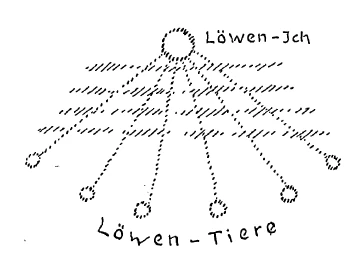
[ 5 ] For the materialist, this is unbelievable; but the spiritual researcher must say: it is true! One can attribute to the group soul of animals exactly the same kind of evolution as to the human “I” in the physical world. When we observe groups of animals on the astral plane, we see their development unfolding there in the same way as that of human beings on the physical plane as individuals.
[ 6 ] The plant has its astral body in the astral world, its physical and etheric bodies in the physical world, and its “I” in the lower Devachan. But what is the essence of such a plant group? Plants of the same kind have their “I,” their group soul, in the Devachan. A person in dreamless sleep is in exactly the same state as a plant is throughout its entire life. The entire plant world of the Earth is a sleeping being; the plant leads a dreamlike existence.
[ 7 ] Let us consider a sleeping person: The physical and etheric bodies lie in bed, the astral body is on the astral plane, and the “I” is in dreamless sleep in Devachan. Let us turn to the mineral. It has its physical body in the physical world, its etheric body in the astral world, its astral body in Rupa-Devachan, and the I at the very top in Arupa-Devachan.
Lower Devachan, Rupa: the world of spiritual forms
Upper Devachan, Arupa: the world that has not yet taken form
[ 8 ] The mineral thinks, feels, and wills just as a human being does, only not on the physical plane, but in Devachan. It extends only its lifeless parts into the physical world. The relationship of the mineral to its soul is the same as that of a human being’s nails and bones to his or her self. An insect crawling over a fingernail and mistaking it for something lifeless—because it cannot perceive the whole individual—would be comparable to a human being who mistook a crystal for something lifeless. The crystal is thus an object belonging to a being that extends all the way up into the spiritual world; such is the connection between its physical appearance and the spiritual world.
[ 9 ] Human beings have their four constituent parts on the physical plane. That which is of a physical nature in a human being remains the physical body, but in Devachan it possesses a consciousness of its own—of which the human being is, of course, unaware, but which nevertheless haunts his constituent parts. The etheric body possesses a different consciousness, which manifests itself in the lower Devachan. Finally, the astral body also has its own consciousness on the astral plane. Thus, human beings are very complex beings. The following diagram may serve to illustrate this:
Upper Devachan: Physical Body
Lower Devachan: Etheric Body
Astral Plane: Astral Body
Physical Plane: Self
[ 10 ] His “I” is at home in the physical world; no one can dispute that. Furthermore, that part of his astral body which possesses an unconscious consciousness and is at home on the astral plane lives within the human being and belongs to him. Furthermore, there is an unconscious consciousness of the etheric body on the lower Devachan plane, and a similar one of the Self on the upper Devachan plane. The most important thing, however, is that the human being works into the other bodies from the Self, and that it is only through this process that the various consciousnesses become conscious to him.
[ 11 ] There is a unique connection between human beings and the various worlds, which is a most important mystery. Once one learns to recognize this, one gradually comes to understand what an initiation is. When a person works inward from their “I” into their astral body, they ascend to the astral plane and become a companion of all astral beings. Everything that possesses astral consciousness surrounds them. When they work inward with their “I” into their etheric body, they simultaneously ascend into the lower regions of Devachan; and etheric beings then appear all around them. This is a great and momentous moment: they see the light not merely as light, but as the bearer of luminous beings; along with the physical rays of the sun, angelic beings approach, beings whose very bodies are light. This is a result of initiation.
[ 12 ] If one ascends or descends even further, one should recall Goethe’s words:
“Then sink! I might as well say: rise!
It doesn’t matter ...”
[ 13 ] —then comes the moment when he first becomes one with the Primordial Father of the world. Then he can say, “I and the Father are one.” Then beings appear—even higher than those described. Now imagine a person who is so highly initiated that he consciously bears within his own body the nature of the higher beings, just as John experienced this in Christ Jesus. In the One Christ Jesus, the author of the Gospel of John sees the beings of the three worlds. And he has Philip say to Nathanael (John 1:45–51)
[ 14 ] “We have found the one about whom Moses wrote in the Law and the Prophets—Jesus, the son of Joseph from Nazareth.
[ 15 ] And Nathanael said to him, “Can anything good come out of Nazareth?” Philip said to him, “Come and see!”
[ 16 ] Jesus saw Nathanael coming toward him and said of him: “Behold, a true Israelite (that is, one initiated into the fifth degree), in whom there is no deceit.”
[ 17 ] Nathanael said to him, “How do you know me?” Jesus answered and said to him, “Before Philip called you, when you were under the fig tree, I saw you.”
[ 18 ] “Being under the tree” is the occult term for initiation, the mystery of the multiplication and expansion of consciousness. Only now does Nathanael reply:
[ 19 ] “Master, you are the Son of God”—that is, an even higher initiate—“and a king in Israel.
[ 20 ] Jesus answered and said to him, “You believe because I told you that I saw you under the fig tree; you will see even greater things than these.”
[ 21 ] And he said to him, “Truly, truly, I say to you, from now on you will see heaven open and the angels of God ascending and descending upon the Son of Man.”
[ 22 ] That is to say: to see that which illuminates one’s four states of consciousness. Human beings become a ladder upon which one can see the angels of God ascending and descending. Even in this physical world, there are beings higher than human beings. Before descending to the physical plane—at a time when the “Rubicon of Blood” had not yet been crossed—human beings had a group soul on the astral plane. The entire tribe lived there within this group soul. Likewise, the animal group souls will later descend and become individualized. Here we touch upon a great mystery, one of the seven secrets known as the “unspeakables.”
[ 23 ] One of these mysteries is the mystery of the number. It is true that entire groups of people had one soul. The mystery is this: it flows from the One and becomes a number—as numerous as the grains of an ear of wheat. When such a group soul descends, the same thing happens as with a seed: a single seed is placed in the earth, and from it springs the ear of grain with its many grains.
[ 24 ] But everything in the world exists only once in a specific way. Thus, humanity as it is now also exists only once. Nothing in the world repeats itself in exactly the same way. In the animal group souls, we find those that will later become individual souls, but under entirely different circumstances than humans, in an entirely different form. Are there also souls that were once individual souls and then ascended again to the astral plane to become group souls? — Yes, such souls exist. They arise when a number of people come together cosmically around an initiate and become like the members of a single body. Initiates thus become national souls. Thus, the Jewish people—the chosen people—had a common soul uniting the individuals, which was once human and then ascended again to become a national soul. It could rest in the bosom of Father Abraham.
[ 25 ] Now imagine that a human being, as one undergoing initiation, progresses more rapidly through this development. As an individual soul, he then follows the same path that the national soul has taken: he becomes a group soul. The individual merges into such an expanded consciousness. As an initiate, he is then, in truth, equal in cosmic value to an entire national soul. You can still see this in the old terms. This stage of development was named after the entire people, for example, “Israelite.”
[ 26 ] In the Persian Mithraic initiation, seven degrees were distinguished. The initiate of the first degree was called the Raven. He is the messenger between the physical and astral worlds. The symbol of the raven has been imbued with significance since the earliest times. In the Old Testament, the prophet Elijah is fed by ravens. Ravens are Wotan’s messengers, flying daily across the globe and reporting to him what they have observed. Even Mount Kyffhäuser, where Barbarossa slumbers, is circled by ravens, who are to bring him word when the hour of his awakening has come.
[ 27 ] The second degree is that of the Occult. Those in this degree are already permitted to dwell in the inner sanctuary.
[ 28 ] The third-degree initiate, the warrior, is permitted to represent the occult wisdom he has absorbed in the world. Lohengrin is such a warrior. This degree is alluded to in Mabel Collins’ book Light on the Path.
[ 29 ] The fourth degree is that of the Lion. This is the term used for an initiate whose consciousness has risen to the level of the tribal soul. This is the origin of the expression: “Lion of the tribe of Judah.”
[ 30 ] In the fifth-degree initiate, the consciousness of the people itself has awakened. He bears the name of his people; in the Mithraic initiation, he is therefore called the Persian.
[ 31 ] The sixth-degree initiate is the Hero of the Sun. He can deviate from his path no more than the Sun itself.
[ 32 ] The seventh stage is that of the Father. It is union with the Primordial Spirit.
[ 33 ] The “Persian,” then, bears the name of the entire people; his individual soul becomes the soul of the people. The image that expresses this stage of initiation is that of sitting under a tree. You will find this figure of speech everywhere in occult language. Buddha, for example, sits under the Bodhi tree. The tree sprang from a single seed and has become many. So it is with the initiate; he has attained the ability to empathize with every single soul. How, then, would such a person have been called among the Israelites? “Israelite,” of course. As we have seen, Jesus recognizes Nathanael as an initiate of the fifth degree—one who has attained a collective consciousness. Nathanael recognizes in Christ the higher initiate: “Rabbi, you are the Son of God.” Christ is a seventh-degree initiate who has expanded his consciousness to the Father: “I (or the I Am) and the Father (or the Divine) are One.” He is the life and the light of humanity, for he has brought his high consciousness into the physical body.
[ 34 ] Some may think that such an interpretation is being read into the Gospel. Many—and mostly contemporary theologians—believe that the Bible must be interpreted “simply,” which is really just a convenient way of putting it. But the Gospel was not written in the manner common today, nor was it written for people who are accustomed to reading a book at most once and then setting it aside. The Gospel was written for a time when its content constituted a book of life, to be read again and again. It must be read and absorbed in this way, for only then will one come to recognize that within each of these lofty truths there is always an even loftier one, and within every insight there is an even deeper insight, and that even the wisest person never ceases to learn in the study of religious texts and in their full understanding. In the past, people approached these writings by learning a single sentence; they would then let it live in their souls time and again, and when they had the good fortune—the rare opportunity—to meet an initiate, they would have him explain it to them once more. For religious texts—and especially the Gospel of John—are written from the depths of wisdom and therefore cannot be grasped deeply enough. But wisdom is not meant for those who seek the easy path. Wisdom is meant for those who seek and search.
[ 35 ] The initiate goes through the first five degrees of initiation while ascending or descending on the astral plane. It makes no difference which, for here the Hermetic principle applies: As above, so below. Everything in the spiritual realm has its counterpart in the physical realm. If you ascend in this way to the astral plane, you will find yourself within a national soul, for it lives on the astral plane.
[ 36 ] The sixth stage is as significant as the other five combined: here, the human being ascends in his etheric body and brings about its development. One people always emerges from another through a change in the astral body; astral beings stand behind the soul of every people. However, the etheric body of humanity and that of the individual remain unchanged from one people to another; a new etheric body arises only with the ascent from one race to another. Even the physical body is subject to change. The ancient Atlanteans had a completely different one, and the first Lemurians did not yet have a true physical body at all. In his consciousness, the Solar Hero encompasses an entire human race just as he does individual atoms. He embraces the entire race with his consciousness. — The seventh stage, the Father Initiation, extends beyond the race to all of humanity on Earth, to all peoples and races of the entire planet. Christ Jesus is the representative of this; he carries all of humanity within himself. That is why, in the Gospel of John, humanity is called the bride, and the initiated Son of Man the bridegroom. Christ Jesus is the one who, in essence, encompasses the consciousness of all humanity. This brings us back to where we concluded the previous lecture in our consideration of the wedding at Cana.