

The Gospel of St. John
GA 94
5 November 1906, Munich
Translate the original German text into any language:
Versions Available:
The Gospel of St. John, tr. SOL
Die Theosophie anhand des Johannes-Evangelium VII
Theosophy Based on the Gospel of John VII
[ 1 ] Heute sollen die Einweihungsstufen der sogenannten rosenkreuzerischen, abendländischen okkulten Schulung uns beschäftigen. Alles was da angeführt wird, ist durchaus nicht als allgemeine Lebensvorschriften aufzufassen, sondern kann nur die Aufgabe desjenigen sein, der sich dieser Schulung ganz freiwillig unterwirft und sich damit zunächst heraushebt aus der allgemeinen Menschheit, um später dann das Errungene weitergeben zu können. Hat er sich zur Schülerschaft entschlossen, so sollte für ihn keine Möglichkeit mehr bestehen, an dieser Schulung, an der Art ihrer Vorschriften, an dem Gebaren des okkulten Lehrers Kritik zu üben. Er muß sich den Erfahrungen des. Lehrenden anvertrauen. Ist ihm dieses nicht möglich und hegt er irgendeine Spur von Mißtrauen oder Unzufriedenheit gegenüber seinem Lehrer, dann ist es besser, das Band zwischen sich und dem Lehrer zu zerschneiden. Denn nur eine auf Vertrauen begründete, die Autorität des Lehrers anerkennende Zuneigung kann die richtige Beziehung des Schülers zum Lehrer herstellen, die dem Schüler gedeihlich sein soll. Es bleibt dem Schüler jederzeit der freie Wille, dieokkulteSchulung zu lassen. Will man sich ihr aber unterziehen, so muß man sich auch klar darüber sein, daß die betreffenden Regeln aus einer festbegründeten Wahrheit heraus im Sinne der am weitesten fortgeschrittenen Individualitäten gegeben sind, jener, die wir als die großen Lehrer der Menschheit anzusehen haben, und daß man nur dann vorwärtskommen kann, wenn man die Regeln befolgt. Klar sein muß man sich auch darüber, daß dieser Weg mit seinen Anweisungen schon von vielen Hunderten erprobt und mit Erfolg gegangen worden ist.
[ 1 ] Today we will focus on the initiation stages of the so-called Rosicrucian, Western occult training. Nothing stated here is to be understood as general rules for life, but can only serve as the task of one who voluntarily submits to this training and thereby initially sets himself apart from the general populace, so that he may later pass on what he has attained. Once he has decided to become a student, there should be no further possibility for him to criticize this training, the nature of its guidelines, or the conduct of the occult teacher. He must place his trust in the teacher’s experience. If this is not possible for him, and if he harbors even a trace of distrust or dissatisfaction toward his teacher, then it is better to sever the bond between himself and the teacher. For only an affection based on trust and recognizing the teacher’s authority can establish the proper relationship between the student and the teacher—a relationship that is meant to be beneficial to the student. The student retains the free will at all times to abandon occult training. However, if one wishes to undergo it, one must also be clear that the relevant rules are given based on a firmly established truth in the spirit of the most advanced individualities—those whom we must regard as the great teachers of humanity—and that one can make progress only by following the rules. One must also be clear that this path, with its instructions, has already been tested and successfully followed by many hundreds of people.
[ 2 ] Bei den drei Wegen, die wir nun besprochen haben, ist das Verhältnis des Schülers zum Lehrer je ein verschiedenes. In der indischen Yogaschulung ist das Verhältnis zwischen Schüler und Guru ein sehr strenges: absolute, vollständige Unterwerfung unter den Guru ist unbedingte Voraussetzung. Da beim Beschreiten des indischen Weges der Schüler sich in den höheren Welten noch nicht auskennt, ist es notwendig, daß er von seinem persönlichen Guru geführt wird.
[ 2 ] In the three paths we have now discussed, the relationship between the student and the teacher is different in each case. In Indian yoga training, the relationship between student and guru is very strict: absolute, complete submission to the guru is an unconditional prerequisite. Since, when following the Indian path, the student is not yet familiar with the higher worlds, it is necessary for him to be guided by his personal guru.
[ 3 ] Anders ist das Verhältnis bei der christlichen Schulung. Da ist der Lehrer der Führer zu dem großen Guru, dem Christus Jesus. Ein persönlicher Zusammenhang, ein persönliches Gemütsverhältnis zu dem Christus Jesus ist für den Schüler unbedingt notwendig. Kann er nicht mit der ganzen Kraft seiner Seele an den Christus Jesus und an das, was Er für die Menschheit getan und dargelebt hat, glauben, so kann er den christlichen Weg nicht gehen.
[ 3 ] The relationship is different in Christian education. There, the teacher is the guide to the great Guru, Christ Jesus. A personal connection, a personal spiritual bond with Christ Jesus, is absolutely essential for the student. If the student cannot believe with all the strength of his or her soul in Christ Jesus and in what He did and exemplified for humanity, then he or she cannot walk the Christian path.
[ 4 ] Bei der rosenkreuzerischen Schulung ist das Verhältnis das freieste und leichteste. Der Lehrer ist der treue Freund, der Führer innerhalb der engeren Grenzen des okkulten Erlebens seines Schülers. Er bekümmert sich nicht um dessen tägliches Tun und Lassen, er vertraut ihm und läßt ihm volle Freiheit. Es gibt nirgends einen Zwang oder einen Befehl, nur ein Rat wird erteilt. Aber ein freundschaftliches Vertrauensverhältnis zwischen Lehrer und Schüler muß da sein. Ohne dieses verbliebe die Schulung im Bereich des Manasischen, ohne dieses könnte Budhi überhaupt nicht eingepflanzt werden. Die Kraft, die durch das Vertrauensverhältnis erzeugt wird, ist notwendig bei der okkulten Schulung. Ohne sie können die im Schüler schlummernden Kräfte nicht geweckt werden.
[ 4 ] In Rosicrucian training, the relationship is the freest and most easygoing. The teacher is a faithful friend, a guide within the narrower limits of the student’s occult experience. He does not concern himself with the student’s daily comings and goings; he trusts him and grants him complete freedom. There is no coercion or command anywhere; only advice is given. But a friendly relationship of trust between teacher and student must exist. Without this, the training would remain within the realm of the Manasic; without this, Budhi could not be implanted at all. The power generated by this relationship of trust is essential to occult training. Without it, the powers lying dormant within the student cannot be awakened.
[ 5 ] Da der rosenkreuzerische Weg als erste Stufe das Studium angibt, könnte vielleicht gedacht werden, diese Schulung sei nicht für jeden Menschen. Das ist jedoch nicht richtig; sie ist für jeden Menschen da, auch für den allereinfachsten. Denn unter diesem Studium versteht man populäre Theosophie, alles das, was Sie hier in diesen Vorträgen und in meinen oder in anderen geisteswissenschaftlichen Schriften hören und lesen; das ist schon ein solches Studium. Es ist die elementare okkulte Lehre, die dem Menschen gegeben wird. Frei soll er dadurch werden von den Vorurteilen des Lebens, von der Suggestion der Wissenschaft, die den modernen Menschen vollständig beherrscht und schon viel Unheil angerichtet hat, ihm den unbefangenen Blick ins Freie versperrt, den Weg zur Vorurteilslosigkeit, den er finden muß, um ein klares Urteil zu haben. Im Abendlande ist kein freies Denken mehr üblich, sondern da ist alles Suggestion, aufgestelltes Dogma durch Macht und Autorität. Sogar bis in die einfachen Begriffe hinein haben wir diese suggestive Beeinflussung: die Suggestion durch die Gelehrten, die Suggestion durch die Wissenschaft, die Suggestion, die von dem einzelnen ausgeht. Unser modernes Leben wird beherrscht durch die Familie, durch die Beziehung der Geschlechter zueinander. Der Theosoph aber soll tiefer eindringen in vorbereitendes, logisches, sinnlichkeitsfreies Denken. Er soll sich in solche Gedankengänge möglichst versenken. Zu diesem Zweck, zur Schulung solcher Denkweise wurden die beiden Schriften «Wahrheit und Wissenschaft» und «Philosophie der Freiheit» von mirgeschrieben, damit man sich in solche Gedankengänge vertiefe. Es kommt dabei weniger darauf an, den betreffenden Inhalt zu verstehen, als in diesen Gedankengängen zu leben. Ein freies, scharfes, vernünftiges Denken ist notwendig, weil es dem Schüler eine gewisse Selbständigkeit verleiht, aber dieses Denken ist auch ein sicherer Führer für die höheren Welten. Neues, anderes tritt uns in den verschiedenen Welten entgegen; was aber in allen Welten das gleiche bleibt, das ist das Denken. Überall gibt es andere Wahrnehmungen, andere Erlebnisse, aber die Logik ist in allen Welten gleich. Das ändert sich erst auf dem Budhiplan. Es tritt jetzt eine merkwürdige Veränderung im Schüler auf. Seine Gedanken erweitern sich, erfassen andere Weltenkreise. Die Gedanken, die der Mensch gewöhnlich hier faßt, sind nichts Mentales, beziehen sich nur auf den physischen Plan. Sie sind nur die Schattenbilder der mentalen Realität. Jetzt nähert er sich ihrer Wirklichkeit.
[ 5 ] Since the Rosicrucian path identifies study as its first stage, one might think that this training is not for everyone. However, that is not correct; it is available to everyone, even the simplest of people. For this study refers to popular theosophy—everything you hear and read here in these lectures and in my writings or those of other spiritual scientists; that in itself constitutes such a study. It is the elementary occult teaching given to humankind. Through it, he is to become free from the prejudices of life, from the suggestion of science, which completely dominates modern man and has already caused much harm, blocking his unbiased view of the outside world—the path to freedom from prejudice that he must find in order to form a clear judgment. In the West, free thinking is no longer the norm; instead, everything is suggestion—dogma established through power and authority. This suggestive influence extends even into the simplest concepts: the suggestion from scholars, the suggestion from science, and the suggestion that emanates from the individual. Our modern life is dominated by the family and by the relationship between the sexes. The Theosophist, however, should delve deeper into preparatory, logical thinking free from sensuality. He should immerse himself in such lines of thought as much as possible. To this end—to cultivate such a way of thinking—I wrote the two treatises Truth and Science and Philosophy of Freedom, so that one might immerse oneself in such trains of thought. What matters here is not so much understanding the content in question as living within these trains of thought. Free, sharp, rational thinking is necessary because it grants the student a certain degree of independence, but this thinking is also a sure guide to the higher worlds. New and different things confront us in the various worlds; but what remains the same in all worlds is thinking. Everywhere there are different perceptions, different experiences, but logic is the same in all worlds. This changes only on the budhi plane. A remarkable transformation now takes place in the student. His thoughts expand, encompassing other spheres of existence. The thoughts that a person usually forms here are not mental in nature; they relate only to the physical plane. They are merely shadows of mental reality. Now he is approaching that reality.
[ 6 ] Nächst dem Studium haben wir als zweites die Imagination. Jeder muß sie einmal durchmachen. Der Mensch macht sich allmählich frei von der trockenen sinnlichen Anschauung der Dinge. Er versucht in ihnen nur den Ausdruck zu sehen für etwas, was dahinter steht und fängt an, die Welt im Goetheschen Sinne nach dem Wort zu betrachten: «Alles Vergängliche ist nur ein Gleichnis.» Diese vertiefte Denkweise muß der Schüler systematisch durchführen. Die Dinge müssen ihm zu Gleichnissen, zu Symbolen werden. Wenn wir die Rose betrachten, so ist sie uns das Sinnbild für eine gewisse Form der Schönheit, die Herbstzeitlose das Bild einer feinen melancholischen In-sich-Abgeschlossenheit.
[ 6 ] After study comes, secondly, the imagination. Everyone must go through this stage at some point. Human beings gradually free themselves from the dry, sensory perception of things. They try to see in them only the expression of something that lies behind them and begin to view the world in the Goethean sense, according to the words: “Everything transitory is but a parable.” The student must systematically cultivate this deeper way of thinking. Things must become parables and symbols to him. When we look at a rose, it is for us the symbol of a certain form of beauty; the autumn crocus, the image of a subtle, melancholic self-containment.
[ 7 ] Und so liegt jedem Ding eine Bedeutung zugrunde. Gleichnisse sind die Dinge nämlich in Wirklichkeit. Die ganze sinnliche Welt ist eine Einbildung, die geistige Welt ist das Reale. Es muß eine Wechselwirkung zwischen den Menschen und der geistigen Welt bestehen und erzielt werden. Wir müssen unsere Gedankenbilder, unser Seelenleben flüssig erhalten, nicht starre Formen uns bilden. Schon in Lucifer-Gnosis ist darauf hingewiesen worden, daß sich durch eine andauernde, liebevolle Betrachtung die Eigenschaften aus den Dingen herauslösen und dann den Raum durchfluten und durchströmen. So scheint zum Beispiel aus einer Pflanze etwas wie eine Flammenbildung heraufzusteigen; dahinter steht das Geistige. In diesen strömenden, flutenden Farben- und Geschmacksempfindungen, die hier auf dem physischen Plan kein Korrelat haben, hat der Mensch sich nun zurechtzufinden, und dann ist er so weit, daß die Unterweisung in der okkulten Schrift einsetzen kann.
[ 7 ] And so every thing has an underlying meaning. For in reality, things are parables. The entire sensory world is an illusion; the spiritual world is the reality. There must be—and we must strive to achieve—an interaction between human beings and the spiritual world. We must keep our mental images and our inner life fluid; we must not form rigid shapes. It has already been pointed out in Lucifer-Gnosis that through sustained, loving contemplation, the qualities are released from things and then flood and flow through space. For example, something like a flame seems to rise from a plant; behind this lies the spiritual. Human beings must now find their way within these flowing, surging sensations of color and taste, which have no counterpart here on the physical plane; only then are they ready for instruction in the occult scriptures to begin.
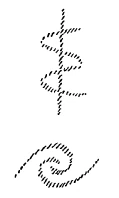
[ 8 ] Als drittes ist zu lernen das Lesen der okkulten Schrift. Das hilft uns, die mannigfachen Erscheinungen richtig aufzureihen wie Perlen an einer Schnur. Die okkulte Schrift ist nicht willkürlich erdacht, sondern stellt die Strömungen dar, welche die Welt durchfließen. Etwas, das in der geistigen Wirklichkeit eine große Rolle spielt, sind zwei ineinandergerollte Spiralen, die einen Wirbel bilden. An der Nasenwurzel befindet sich die Anlage zu der zweiblättrigen Lotusblume, die sich in der Zukunft zu einem höheren Wahrnehmungsorgan entwickeln wird. Diesem ätherischen Organ entspricht ebenfalls das Zeichen des Wirbels. Es ist dem Zeichen des Krebses ähnlich, in dem die Sonne bei Anbruch der atlantischen Rasse stand. Wir haben noch im Kalender diese und die anderen Zeichen der Sternbilder. Ein sehr wichtiges okkultes Schriftzeichen ist der Merkurstab mit der Schlange daran. Es ist die Urform des Konsonanten S. Wer die okkulte Schrift kennt, kann die betreffenden Zeichen als Gedankenform hervorrufen; er hat dann in gewissen Fällen Macht über Andere. Im Johannes-Evangelium 8, 3-11, wird über Christus und die Ehebrecherin berichtet: Christus schrieb mit dem Finger Zeichen der okkulten Schrift auf die Erde, um die richtigen Gedankenformen bei der anklagenden Menge zu erzeugen, und sie zu der im Augenblick richtigen Tat zu veranlassen. «Wer ohne Schuld ist, der werfe den ersten Stein auf sie.» Er übergibt ihre Schuld dem Karma, der ausgleichenden Gerechtigkeit. Christus wollte sagen: jede Tat trägt ihren Lohn in sich. «Gehe hin und sündige hinfort nicht mehr.» Eine Unterweisung im Sehen dieser okkulten Zeichen erhält Moses in seinem Gespräch mit Gott (2. Mose, 3 und 4). Da lernt Moses die okkulte Schrift kennen und wird ausgerüstet mit der Macht, die ihn befähigt, seine Aufgabe zu erfüllen. Daß er einen Stab werfen mußte, der zur Schlange wurde, bedeutet, daß er die okkulte Schrift lernte.
[ 8 ] Third, we must learn to read the occult script. This helps us to correctly string together the manifold phenomena like pearls on a string. The occult script is not arbitrarily devised, but represents the currents that flow through the world. Something that plays a major role in spiritual reality is two spirals rolled into one another, forming a vortex. At the root of the nose lies the seed of the two-petaled lotus flower, which will develop in the future into a higher organ of perception. The sign of the vortex also corresponds to this ethereal organ. It resembles the sign of Cancer, in which the Sun stood at the dawn of the Atlantean race. We still have this and the other signs of the constellations in the calendar. A very important occult symbol is the caduceus with the serpent. It is the archetype of the consonant S. Anyone familiar with occult writing can evoke the relevant symbols as thought-forms; in certain cases, they then have power over others. In the Gospel of John 8:3–11, the story of Christ and the woman caught in adultery is recounted: Christ wrote symbols of the occult script on the ground with his finger to generate the correct thought-forms among the accusing crowd and to prompt them to perform the action that was right at that moment. “Let him who is without sin cast the first stone at her.” He entrusts her guilt to karma, the balancing justice. Christ meant to say: every deed carries its own reward. “Go and sin no more.” Moses receives instruction in seeing these occult signs during his conversation with God (Exodus 3 and 4). There, Moses becomes acquainted with the occult script and is endowed with the power that enables him to fulfill his mission. The fact that he had to throw down a staff that turned into a serpent signifies that he learned the occult script.
[ 9 ] Stellen wir uns einen Wirbel vor und denken uns seine beiden Teile in Rot und Blau, halten wir diese Vorstellung fest und führen sie zum eigenen der zu einem fremden Herzen, so schauen wir die beiden ätherischen Strömungen, welche dem roten und dem blauen Blut zugrunde liegen.
[ 9 ] If we imagine a vortex and picture its two parts as red and blue, hold on to this image, and apply it to our own heart or to someone else’s, we can see the two ethereal currents that underlie the red and blue blood.
[ 10 ] Ein viertes ist der Lebensrhythmus. Auf ihm beruht alles höhere Leben. Natur und Kosmos kennen lauter rhythmische Gesetze. Die Sternenbahnen, jede Blume, selbst das intime Tierleben kennen exakten Rhythmus. Könnten Sie sich denken, daß ein Veilchen im August blüht, statt im März? In der Natur ist der Rhythmus überall vorhanden. Aber je näher wir dem Menschen kommen, desto mehr verwandelt sich der Rhythmus in ein Chaos. Ein wahres Glück ist noch der wöchentliche Stundenplan unserer Schulkinder. Der Mensch soll sich einen gewissen Rhythmus selbst bringen, einen neuen Kosmos schaffen. Dies geschieht durch täglich sich wiederholende Handlungen, Meditationen zu einer bestimmten Tageszeit, auch durch eine Regelung des Atmungsprozesses.
[ 10 ] A fourth is the rhythm of life. All higher life is based on it. Nature and the cosmos are governed entirely by rhythmic laws. The orbits of the stars, every flower, even the innermost life of animals—all follow an exact rhythm. Could you imagine a violet blooming in August instead of March? Rhythm is present everywhere in nature. But the closer we get to human beings, the more that rhythm turns into chaos. The weekly schedule of our schoolchildren is a true blessing. Human beings should establish a certain rhythm for themselves, creating a new cosmos. This is achieved through daily repetitive actions, meditations at a specific time of day, and also through regulating the breathing process.
[ 11 ] Das fünfte ist die Entsprechung von Makrokosmos und Mikrokosmos. Wenn der Mensch in sich etwas findet, was einer Tatsache im Makrokosmos entspricht, dann lernt er sich erst wirklich kennen. Woher kann der Mensch wissen, wann sich die Sonne von der Erde gelöst hat? Das kann er erfahren, wenn er sich in das Innere seines Auges vertieft. Ein anderer Zeitpunkt ist der, als der Mensch begann, Ich zu sich zu sagen. Das geschah in der Atlantis, zur Zeit der Ursemiten, dadurch daß sich ein bestimmter Punkt im physischen Kopf mit einem anderen im Ätherkopf deckte. Die Erde war noch mit dichtem Nebel bedeckt, und gewisse Verhältnisse draußen und im Inneren des Menschen entsprachen sich. Eine wichtige Übung besteht darin, daß sich der Schüler auf eine bestimmte Stelle zwischen den Augenbrauen konzentriert und sich dabei einer Vorstellung hingibt, die ihm von seinem Lehrer gegeben wird.
[ 11 ] The fifth is the correspondence between the macrocosm and the microcosm. When a person finds within himself something that corresponds to a fact in the macrocosm, only then does he truly come to know himself. How can a person know when the Sun separated from the Earth? They can discover this by delving into the innermost part of their eye. Another significant moment is when a person began to say “I” to themselves. This occurred in Atlantis, during the time of the Proto-Semites, when a specific point in the physical head aligned with another in the etheric head. The Earth was still shrouded in dense mist, and certain conditions outside and within the human being corresponded with one another. An important exercise consists of the student concentrating on a specific point between the eyebrows while surrendering to an image given to him by his teacher.
[ 12 ] Auf einer sechsten Stufe, der Kontemplation, geht der Schüler aus sich heraus und erweitert sein Bewußtsein über die ganze Welt. Das höhere Selbst ist außer uns, wir müssen es inallen Wesen suchen, denn alles sind wir. Es spricht auch aus dem Jupiter und der Venus. Es gibt Theosophen, die das Göttliche nur in sich suchen wollen. In Wahrheit istesaber dieniedere Persönlichkeit, die aus ihnen spricht. Ein solcher ging einmal umher und sagte immer: Ich bin Atman, ich bin Atman. Das war auch das einzige, was er wußte. Das In-sich-Hineinbrüten führt zu nichts. Alles sind wir, und wir müssen uns in alle Wesen versenken. Das Versenken in das eigene Innere ist nur der Umweg dazu.
[ 12 ] At a sixth stage, that of contemplation, the student steps outside of himself and expands his consciousness to encompass the entire world. The Higher Self is outside of us; we must seek it in all beings, for we are everything. It also speaks through Jupiter and Venus. There are theosophists who wish to seek the Divine only within themselves. In truth, however, it is the lower personality that speaks through them. One such person once went about saying repeatedly, “I am Atman, I am Atman.” That was also the only thing he knew. Brooding within oneself leads nowhere. We are everything, and we must immerse ourselves in all beings. Immersion in one’s own inner self is merely a detour toward that end.
[ 13 ] Wenn man soweit gekommen ist, daß man sich in alle Wesen hineinversetzen kann, dann ist man auf der siebenten Stufe angelangt, der Gottseligkeit. Das ganze Wesen der Welt bekommt eine geistige Physiognomie. Alles, was der Mensch um sich herum sieht, wird zum Ausdruck von etwas Höherem. Wie die Tränen nicht nur salzige Tropfen von einer bestimmten chemischen Zusammensetzung sind, sondern Ausdruck seelischen Erlebens, so ist die Pflanzendecke der Erde Ausdruck der Erdenseele, die eine Wirklichkeit ist. Die einen Blumen erscheinen uns als freudig blickende Augen, die anderen als Tränen des Erdgeistes, die er weint über die viele Traurigkeit, die im Kosmos herrscht. Es ist wahr, was Goethe den Erdgeist sagen läßt:
[ 13 ] When one has reached the point where one can empathize with all beings, one has arrived at the seventh level: divinity. The entire essence of the world takes on a spiritual character. Everything a person sees around them becomes an expression of something higher. Just as tears are not merely salty drops of a certain chemical composition, but an expression of soul experience, so too is the Earth’s vegetation an expression of the Earth soul, which is a reality. Some flowers appear to us as joyfully gazing eyes, others as tears of the Earth Spirit, which weeps over the great sadness that reigns in the cosmos. It is true what Goethe has the Earth Spirit say:
In Lebensfluten, im Tatensturm
Wall’ ich auf und ab,
Webe hin und her
Geburt und Grab,
Ein ewiges Meer,
Ein wechselnd Weben,
Ein glühend Leben:
So schaff’ ich am sausenden Webstuhl der Zeit
Und wirke der Gottheit lebendiges Kleid.
In the torrents of life, in the storm of deeds
I surge back and forth,
Weaving to and fro
Birth and grave,
An eternal sea,
A shifting weave,
A blazing life:
Thus, at the whirring loom of time,
I weave a living garment for the Deity.
[ 14 ] So haben wir das Gerippe der rosenkreuzerischen Schulung kennengelernt.
[ 14 ] This is how we came to know the framework of Rosicrucian training.
[ 15 ] Welcher Schulung Sie sich unterziehen, ist nicht entscheidend. Sie können auf allen drei Wegen Ihre Seelenkräfte entwickeln und Erkenntnisse der übersinnlichen Welt erlangen. Nur ist es natürlich gut, wenn man bei der Wahl des Weges Rücksicht darauf nimmt, auf welcher Seite man selbst am Fuße des zu erklimmenden Berges bereits steht.
[ 15 ] The specific training you undergo is not the deciding factor. You can develop your soul forces and gain insights into the supersensible world through all three paths. However, it is, of course, advisable to consider, when choosing a path, which side of the mountain you are already standing on at the foot of the mountain you are about to climb.
[ 16 ] Was erreicht nun der Schüler, wenn ihn die Einweihung auf den Gipfel dort oben hingebracht hat? Ein sehr Reales. Erinnern Sie sich an dieSchilderung der menschlichen Wesenheit. Zur Zeit des Christus Jesus hatte die Mehrzahl der Menschen einen Teil des Astralleibes, einen Teil des Ätherleibes entwickelt. Anders war es bei den Eingeweihten. Wenn der Chela die nötigen Stufen durchschritten hatte, wurde er zur Einweihung zugelassen. Durchgearbeitet mußte er seinen ganzen Astralleib haben. Nichts war mehr in seinem Astralleib, das er nicht beherrschte. Im allgemeinen herrschen die Leidenschaften über den Menschen, nicht der Mensch über die Leidenschaften. Der Mensch muß Herr seiner Begierden und Leidenschaften sein, wenn er Schüler werden will. Dann muß er an seinem Ätherleibe arbeiten, er muß die Eigenschaften seines Temperaments umwandeln und es soweit bringen, daß er bewußt seine Bewegungen, seinen Gang, seineSchriftändern kann. Nicht nur handeltessich also darum, moralisch zu werden, sondern man muß ein ganz anderer Mensch werden.
[ 16 ] What, then, does the student achieve once initiation has brought him to the summit up there? Something very real. Recall the description of the human being. At the time of Jesus Christ, the majority of people had developed part of their astral body and part of their etheric body. It was different for the initiates. Once the chela had passed through the necessary stages, he was admitted to initiation. He had to have thoroughly worked through his entire astral body. There was nothing left in his astral body that he did not control. In general, the passions rule over man, not man over the passions. A person must be master of his desires and passions if he wishes to become a disciple. Then he must work on his etheric body; he must transform the characteristics of his temperament and bring it to the point where he can consciously alter his movements, his gait, and his handwriting. It is not merely a matter, then, of becoming moral, but of becoming a completely different person.
[ 17 ] Wenn der ganze Astralleib vom Ich durchgearbeitet ist, dann ist er zu Manas, zum Geistselbst geworden, ist in dieses umgewandelt. Die Umwandlung des Ätherleibes heißt Budhi, er ist Lebensgeist geworden. — Wenn der Eingeweihte den physischen Leib zur Umwandlung erfaßt, dann wirkt er auf den Planeten ein und macht sich zum Mittelpunkt kosmischer Kräfte; dann entwickelt er in sich Atman, den Vater, den Geistesmenschen.
[ 17 ] When the entire astral body has been transformed by the “I,” it has become Manas, the spiritual self, and has been transformed into it. The transformation of the etheric body is called Budhi; it has become the life spirit. — When the initiate grasps the physical body for transformation, he influences the planet and makes himself the center of cosmic forces; then he develops within himself Atman, the Father, the spiritual man.
[ 18 ] Erst ist es eine unbewußte Arbeit, die der Mensch an seinem Ätherleibe und seinem Astralleibe verrichtet. Diese vollzieht sich im allgemeinen Entwickelungsgang der Menschheit. Der Chela beginnt diese Arbeit bewußt in die Hand zu nehmen. Es wird bei unablässigem Üben ein bestimmter Moment erreicht, wo der ganze astralische Leib umgewandelt ist. Dann kann sich alles, was im astralischen Leibe ist, in den Ätherleib hinein abdrücken. Dann erst darf dieses geschehen, früher nicht, denn früher kämen schlimme Eigenschaften hinein. Das Erworbene geht dann mit dem Kausalleib durch alle Inkarnationen hindurch. Die Verewigung, Verlebendigung alles dessen, was der Astralleib enthält, ist ein ungeheuer wichtiger Vorgang. Das kann er in keinem Kamaloka abwerfen, das trägt er für immer in sich. Deshalb ist die vorherige Reinigung sehr notwendig.
[ 18 ] At first, it is an unconscious process that a person carries out on his etheric body and astral body. This takes place within the general course of human evolution. The chela begins to consciously take this work into his own hands. Through unceasing practice, a certain point is reached where the entire astral body is transformed. Then everything that is in the astral body can be imprinted into the etheric body. Only then may this happen—not before, for before that, negative qualities would enter. What has been acquired then passes through all incarnations together with the causal body. The immortalization and enlivening of everything contained in the astral body is an immensely important process. The chela cannot cast this off in any kamaloka; he carries it within himself forever. Therefore, prior purification is absolutely necessary.
[ 19 ] Das Abdrücken dessen, was der Astralleib enthält, in den Ätherleib, wurde in der alten Einweihung so vollzogen, daß der Schüler in eine Krypta gebracht und dort in eine Art Sarg gelegt wurde. Manchmal wurde er auch an eine Art Kreuz gebunden und in einen lethargischen Zustand versetzt, bei dem der Ätherleib zugleich mit dem Astralleib aus dem physischen Leib heraustrat. Etwas ähnliches, nämlich das Heraustreten eines Teiles des Ätherleibes, geht beim Einschlafen eines Gliedes vor sich; man kann dann den betreffenden Teil des Ätherleibes aus dem Körper heraushängen sehen. Die Einweihung selbst nahm ein besonders hoher Initiierter vor. Vieles andere noch wurde da nach vorgeschriebenen Regeln gemacht. Solch ein Schlaf war etwas anderes als ein gewöhnlicher Schlaf. Es blieb bloß der physische Leib in dem sogenannten Sarg zurück, und der Ätherleib und Astralleib gingen heraus; es war also eine Art Tod. Dies war notwendig, daß man den Ätherleib frei bekam, denn nur dann kann sich der Astralleib in den Ätherleib abdrücken. Dreieinhalb Tage dauerte dieser Zustand. Wenn der Novize dann von dem Initiator wieder hingelenkt wurde zu dem physischen Leib, so wurde ihm noch eine letzte Formel eingeprägt, mit der er aufwachte. Das waren die Worte: «Eli, Eli, lama sabachthani!», das heißt: «Mein Gott, mein Gott, wie hast Du mich verherrlicht!» Zugleich schien ihm ein bestimmter Stern, in der ägyptischen Einweihung der Sirius, entgegen. Jetzt war er ein neuer Mensch geworden. Man nannte nun den ganz vergeistigten Astralleib aus einem ganz bestimmten Grunde mit einem ganz besonderen Namen: «Jungfräulich» nannte man diesen Astralleib, die «Jungfrau Sophia». Und den Ätherleib, der aufnimmt, was die Jungfrau Sophia in sich trug, nannte man den «Heiligen Geist». Und das, was aus beiden entstand, das war der «Menschensohn». Der Verkündigung und Geburt des Jesus von Nazareth liegen diese Mysterieninhalte zugrunde.
[ 19 ] In the ancient initiation, the process of imprinting the contents of the astral body onto the etheric body was carried out by bringing the initiate into a crypt and placing him there in a kind of coffin. Sometimes he was also bound to a kind of cross and placed in a lethargic state, during which the etheric body, together with the astral body, emerged from the physical body. Something similar—namely, the emergence of a part of the etheric body—occurs when a limb falls asleep; one can then see the relevant part of the etheric body hanging out of the body. The initiation itself was performed by a particularly high-ranking initiate. Many other things were also carried out there according to prescribed rules. Such a sleep was different from ordinary sleep. Only the physical body remained behind in the so-called coffin, while the etheric body and astral body departed; it was, therefore, a kind of death. This was necessary in order to free the etheric body, for only then can the astral body imprint itself onto the etheric body. This state lasted three and a half days. When the novice was then guided back to the physical body by the initiator, a final formula was imprinted upon him, with which he awoke. These were the words: “Eli, Eli, lama sabachthani!”—which means: “My God, my God, how have You glorified me!” At the same time, a certain star—Sirius in the Egyptian initiation—shone upon him. Now he had become a new human being. For a very specific reason, this fully spiritualized astral body was given a very special name: “ ‘Virgin-like’—this astral body was called the ‘Virgin Sophia.’ And the etheric body, which receives what the Virgin Sophia carried within her, was called the ‘Holy Spirit.’ And what arose from both of them was the ‘Son of Man.’ These mysteries underlie the Annunciation and the birth of Jesus of Nazareth.
[ 20 ] Dieses innere Erlebnis wurde im Bilde auch so dargestellt, daß der Heilige Geist als die Taube über dem Kelch schwebt. Das ist der Moment, der im Johannes-Evangelium 1,32, beschrieben wird: «Und Johannes zeugete und sprach: «Ich sah, daß der Geist herabfuhr wie eine Taube vom Himmel und blieb auf Ihm».» Denken Sie sich das auf dem astralen Plan erlebt, so haben Sie ein wirkliches Ereignis. Derjenige, der diese großen Dinge darleben durfte außerhalb der Mysterien in der physischen Welt, der durfte als Initiator andere einweihen. Johannes-Evangelium 11, 1-45: die Auferweckung des Lazarus ist nichts anderes als eine Initiation, an Lazarus vollzogen.
[ 20 ] This inner experience was also depicted in the image, with the Holy Spirit hovering over the chalice as a dove. This is the moment described in the Gospel of John 1:32: “And John bore witness, saying, ‘I saw the Spirit descend like a dove from heaven and remain upon Him.’” Imagine this experienced on the astral plane, and you have a real event. The one who was permitted to experience these great things outside the Mysteries in the physical world was then permitted, as an initiator, to initiate others. The Gospel of John 11:1–45: the raising of Lazarus is nothing other than an initiation performed upon Lazarus.
[ 21 ] Wir können das Johannes-Evangelium nicht tief genug nehmen. So ist auch die Namengebung etwas außerordentlich Wichtiges. Die Namengebung, um die es sich in der Bibel handelt, ist genommen von der inneren Wesenheit der Menschen, Ein Beispiel dafür sind die Namen der zwölf Apostel. Sie weisen hin auf die Beziehung zwischen ihnen und dem Herrn, dem Christus, der das Haupt ist und als Zeichen den Widder oder das Lamm hat. Johannes bedeutet der die Budhi Verkündende. Sie können den Menschen in zwölf Teile einteilen, der ganze Mensch ist eine Zwölfheit. Der Mensch so, wie er jetzt ist, entstand allmählich. Jedesmal, wenn die Sonne in ein neues Sternbild trat, entwickelte sich ein neues Organ im Menschen. Als die Sonne im Zeichen des Löwen stand, bildete sich zum Beispiel das Herz aus. Wenn der Mensch höher aufsteigt, involviert er in sich eine Gruppenseele. Das nun, was die Teile des Menschen sind, finden Sie wieder in den Namen der zwölf Apostel, da sind sie hineingeheimnißt. Was in einem gewöhnlichen Leib die zwölf Wesensbestandteile sind, bedeuten die zwölf Apostel im Kollektivleib Christi. Der Teil, der das Ich darstellt, in welchem der Egoismus herrscht, der dem Christus den Tod bringt, der ist genannt Judas Ischariot. Hinzugesetzt wurde bei dieser Namengebung noch, daß er den Beutel hatte, das Geld, das niedere Habsuchtsprinzip.
[ 21 ] We cannot take the Gospel of John seriously enough. Thus, the naming of people is also something extraordinarily important. The naming referred to in the Bible is derived from the inner essence of human beings; an example of this is the names of the twelve apostles. They point to the relationship between them and the Lord, the Christ, who is the Head and whose symbol is the ram or the lamb. John means “the one who proclaims the Budhi.” You can divide the human being into twelve parts; the whole human being is a twelvefold entity. The human being, as he is now, came into being gradually. Every time the sun entered a new constellation, a new organ developed within the human being. When the sun was in the sign of Leo, for example, the heart formed. As the human being ascends to higher levels, he incorporates a group soul within himself. The parts that make up the human being are reflected in the names of the twelve apostles; they are enshrined within them. Just as the twelve essential components exist in an ordinary body, so do the twelve apostles represent these components in the collective body of Christ. The part that represents the “I,” in which egoism reigns and which brings about the death of Christ, is called Judas Iscariot. It was further implied in this naming that he held the purse—the money, the base principle of greed.
[ 22 ] Welche Bedeutung diese Namengebung hat, sehen Sie auch noch darin, daß eben derjenige, der in dem großen Weltenplan der geistige Repräsentant der Menschheitsentwickelung ist, den Namen «der Menschensohn» erhält. Sein Vater ist der «Heilige Geist» und seine Mutter «die Jungfrau Sophia». Wieder finden Sie das im JohannesEvangelium 19, 25 - 27, in der Szene unter dem Kreuz: «Weib, siehe, das ist dein Sohn!» «Siehe, das ist deine Mutter!» Der Schreiber des Johannes-Evangeliums, der Jünger, den Christus selbst eingeweiht hat, nahm die Weisheit zu sich und schrieb das Johannes-Evangelium, das die Weisheit des Christentums enthält.
[ 22 ] You can also see the significance of this naming in the fact that the very one who, in the great plan of the world, is the spiritual representative of humanity’s development is given the name “the Son of Man.” His father is the “Holy Spirit” and his mother “the Virgin Sophia.” You find this again in the Gospel of John 19:25–27, in the scene at the foot of the cross: “Woman, behold, your son!” “Behold, this is your mother!” The author of the Gospel of John—the disciple whom Christ Himself initiated—took the wisdom to heart and wrote the Gospel of John, which contains the wisdom of Christianity.
[ 23 ] Diese Dinge, das dürfen wir nicht vergessen, sind zugleich Tatsachen, aber als solche der Ausdruck tiefer geistiger Zusammenhänge.
[ 23 ] We must not forget that these things are facts, but as such, they are the expression of deep spiritual connections.