

Cosmology
GA 94
5 November 1906, Munich
Translated by Steiner Online Library
Theosophy Based on the Gospel of John VII
[ 1 ] Today we will focus on the initiation stages of the so-called Rosicrucian, Western occult training. Nothing stated here is to be understood as general rules for life, but can only serve as the task of one who voluntarily submits to this training and thereby initially sets himself apart from the general populace, so that he may later pass on what he has attained. Once he has decided to become a student, there should be no further possibility for him to criticize this training, the nature of its guidelines, or the conduct of the occult teacher. He must place his trust in the teacher’s experience. If this is not possible for him, and if he harbors even a trace of distrust or dissatisfaction toward his teacher, then it is better to sever the bond between himself and the teacher. For only an affection based on trust and recognizing the teacher’s authority can establish the proper relationship between the student and the teacher—a relationship that is meant to be beneficial to the student. The student retains the free will at all times to abandon occult training. However, if one wishes to undergo it, one must also be clear that the relevant rules are given based on a firmly established truth in the spirit of the most advanced individualities—those whom we must regard as the great teachers of humanity—and that one can make progress only by following the rules. One must also be clear that this path, with its instructions, has already been tested and successfully followed by many hundreds of people.
[ 2 ] In the three paths we have now discussed, the relationship between the student and the teacher is different in each case. In Indian yoga training, the relationship between student and guru is very strict: absolute, complete submission to the guru is an unconditional prerequisite. Since, when following the Indian path, the student is not yet familiar with the higher worlds, it is necessary for him to be guided by his personal guru.
[ 3 ] The relationship is different in Christian education. There, the teacher is the guide to the great Guru, Christ Jesus. A personal connection, a personal spiritual bond with Christ Jesus, is absolutely essential for the student. If the student cannot believe with all the strength of his or her soul in Christ Jesus and in what He did and exemplified for humanity, then he or she cannot walk the Christian path.
[ 4 ] In Rosicrucian training, the relationship is the freest and most easygoing. The teacher is a faithful friend, a guide within the narrower limits of the student’s occult experience. He does not concern himself with the student’s daily comings and goings; he trusts him and grants him complete freedom. There is no coercion or command anywhere; only advice is given. But a friendly relationship of trust between teacher and student must exist. Without this, the training would remain within the realm of the Manasic; without this, Budhi could not be implanted at all. The power generated by this relationship of trust is essential to occult training. Without it, the powers lying dormant within the student cannot be awakened.
[ 5 ] Since the Rosicrucian path identifies study as its first stage, one might think that this training is not for everyone. However, that is not correct; it is available to everyone, even the simplest of people. For this study refers to popular theosophy—everything you hear and read here in these lectures and in my writings or those of other spiritual scientists; that in itself constitutes such a study. It is the elementary occult teaching given to humankind. Through it, he is to become free from the prejudices of life, from the suggestion of science, which completely dominates modern man and has already caused much harm, blocking his unbiased view of the outside world—the path to freedom from prejudice that he must find in order to form a clear judgment. In the West, free thinking is no longer the norm; instead, everything is suggestion—dogma established through power and authority. This suggestive influence extends even into the simplest concepts: the suggestion from scholars, the suggestion from science, and the suggestion that emanates from the individual. Our modern life is dominated by the family and by the relationship between the sexes. The Theosophist, however, should delve deeper into preparatory, logical thinking free from sensuality. He should immerse himself in such lines of thought as much as possible. To this end—to cultivate such a way of thinking—I wrote the two treatises Truth and Science and Philosophy of Freedom, so that one might immerse oneself in such trains of thought. What matters here is not so much understanding the content in question as living within these trains of thought. Free, sharp, rational thinking is necessary because it grants the student a certain degree of independence, but this thinking is also a sure guide to the higher worlds. New and different things confront us in the various worlds; but what remains the same in all worlds is thinking. Everywhere there are different perceptions, different experiences, but logic is the same in all worlds. This changes only on the budhi plane. A remarkable transformation now takes place in the student. His thoughts expand, encompassing other spheres of existence. The thoughts that a person usually forms here are not mental in nature; they relate only to the physical plane. They are merely shadows of mental reality. Now he is approaching that reality.
[ 6 ] After study comes, secondly, the imagination. Everyone must go through this stage at some point. Human beings gradually free themselves from the dry, sensory perception of things. They try to see in them only the expression of something that lies behind them and begin to view the world in the Goethean sense, according to the words: “Everything transitory is but a parable.” The student must systematically cultivate this deeper way of thinking. Things must become parables and symbols to him. When we look at a rose, it is for us the symbol of a certain form of beauty; the autumn crocus, the image of a subtle, melancholic self-containment.
[ 7 ] And so every thing has an underlying meaning. For in reality, things are parables. The entire sensory world is an illusion; the spiritual world is the reality. There must be—and we must strive to achieve—an interaction between human beings and the spiritual world. We must keep our mental images and our inner life fluid; we must not form rigid shapes. It has already been pointed out in Lucifer-Gnosis that through sustained, loving contemplation, the qualities are released from things and then flood and flow through space. For example, something like a flame seems to rise from a plant; behind this lies the spiritual. Human beings must now find their way within these flowing, surging sensations of color and taste, which have no counterpart here on the physical plane; only then are they ready for instruction in the occult scriptures to begin.
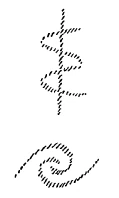
[ 8 ] Third, we must learn to read the occult script. This helps us to correctly string together the manifold phenomena like pearls on a string. The occult script is not arbitrarily devised, but represents the currents that flow through the world. Something that plays a major role in spiritual reality is two spirals rolled into one another, forming a vortex. At the root of the nose lies the seed of the two-petaled lotus flower, which will develop in the future into a higher organ of perception. The sign of the vortex also corresponds to this ethereal organ. It resembles the sign of Cancer, in which the Sun stood at the dawn of the Atlantean race. We still have this and the other signs of the constellations in the calendar. A very important occult symbol is the caduceus with the serpent. It is the archetype of the consonant S. Anyone familiar with occult writing can evoke the relevant symbols as thought-forms; in certain cases, they then have power over others. In the Gospel of John 8:3–11, the story of Christ and the woman caught in adultery is recounted: Christ wrote symbols of the occult script on the ground with his finger to generate the correct thought-forms among the accusing crowd and to prompt them to perform the action that was right at that moment. “Let him who is without sin cast the first stone at her.” He entrusts her guilt to karma, the balancing justice. Christ meant to say: every deed carries its own reward. “Go and sin no more.” Moses receives instruction in seeing these occult signs during his conversation with God (Exodus 3 and 4). There, Moses becomes acquainted with the occult script and is endowed with the power that enables him to fulfill his mission. The fact that he had to throw down a staff that turned into a serpent signifies that he learned the occult script.
[ 9 ] If we imagine a vortex and picture its two parts as red and blue, hold on to this image, and apply it to our own heart or to someone else’s, we can see the two ethereal currents that underlie the red and blue blood.
[ 10 ] A fourth is the rhythm of life. All higher life is based on it. Nature and the cosmos are governed entirely by rhythmic laws. The orbits of the stars, every flower, even the innermost life of animals—all follow an exact rhythm. Could you imagine a violet blooming in August instead of March? Rhythm is present everywhere in nature. But the closer we get to human beings, the more that rhythm turns into chaos. The weekly schedule of our schoolchildren is a true blessing. Human beings should establish a certain rhythm for themselves, creating a new cosmos. This is achieved through daily repetitive actions, meditations at a specific time of day, and also through regulating the breathing process.
[ 11 ] The fifth is the correspondence between the macrocosm and the microcosm. When a person finds within himself something that corresponds to a fact in the macrocosm, only then does he truly come to know himself. How can a person know when the Sun separated from the Earth? They can discover this by delving into the innermost part of their eye. Another significant moment is when a person began to say “I” to themselves. This occurred in Atlantis, during the time of the Proto-Semites, when a specific point in the physical head aligned with another in the etheric head. The Earth was still shrouded in dense mist, and certain conditions outside and within the human being corresponded with one another. An important exercise consists of the student concentrating on a specific point between the eyebrows while surrendering to an image given to him by his teacher.
[ 12 ] At a sixth stage, that of contemplation, the student steps outside of himself and expands his consciousness to encompass the entire world. The Higher Self is outside of us; we must seek it in all beings, for we are everything. It also speaks through Jupiter and Venus. There are theosophists who wish to seek the Divine only within themselves. In truth, however, it is the lower personality that speaks through them. One such person once went about saying repeatedly, “I am Atman, I am Atman.” That was also the only thing he knew. Brooding within oneself leads nowhere. We are everything, and we must immerse ourselves in all beings. Immersion in one’s own inner self is merely a detour toward that end.
[ 13 ] When one has reached the point where one can empathize with all beings, one has arrived at the seventh level: divinity. The entire essence of the world takes on a spiritual character. Everything a person sees around them becomes an expression of something higher. Just as tears are not merely salty drops of a certain chemical composition, but an expression of soul experience, so too is the Earth’s vegetation an expression of the Earth soul, which is a reality. Some flowers appear to us as joyfully gazing eyes, others as tears of the Earth Spirit, which weeps over the great sadness that reigns in the cosmos. It is true what Goethe has the Earth Spirit say:
In the torrents of life, in the storm of deeds
I surge back and forth,
Weaving to and fro
Birth and grave,
An eternal sea,
A shifting weave,
A blazing life:
Thus, at the whirring loom of time,
I weave a living garment for the Deity.
[ 14 ] This is how we came to know the framework of Rosicrucian training.
[ 15 ] The specific training you undergo is not the deciding factor. You can develop your soul forces and gain insights into the supersensible world through all three paths. However, it is, of course, advisable to consider, when choosing a path, which side of the mountain you are already standing on at the foot of the mountain you are about to climb.
[ 16 ] What, then, does the student achieve once initiation has brought him to the summit up there? Something very real. Recall the description of the human being. At the time of Jesus Christ, the majority of people had developed part of their astral body and part of their etheric body. It was different for the initiates. Once the chela had passed through the necessary stages, he was admitted to initiation. He had to have thoroughly worked through his entire astral body. There was nothing left in his astral body that he did not control. In general, the passions rule over man, not man over the passions. A person must be master of his desires and passions if he wishes to become a disciple. Then he must work on his etheric body; he must transform the characteristics of his temperament and bring it to the point where he can consciously alter his movements, his gait, and his handwriting. It is not merely a matter, then, of becoming moral, but of becoming a completely different person.
[ 17 ] When the entire astral body has been transformed by the “I,” it has become Manas, the spiritual self, and has been transformed into it. The transformation of the etheric body is called Budhi; it has become the life spirit. — When the initiate grasps the physical body for transformation, he influences the planet and makes himself the center of cosmic forces; then he develops within himself Atman, the Father, the spiritual man.
[ 18 ] At first, it is an unconscious process that a person carries out on his etheric body and astral body. This takes place within the general course of human evolution. The chela begins to consciously take this work into his own hands. Through unceasing practice, a certain point is reached where the entire astral body is transformed. Then everything that is in the astral body can be imprinted into the etheric body. Only then may this happen—not before, for before that, negative qualities would enter. What has been acquired then passes through all incarnations together with the causal body. The immortalization and enlivening of everything contained in the astral body is an immensely important process. The chela cannot cast this off in any kamaloka; he carries it within himself forever. Therefore, prior purification is absolutely necessary.
[ 19 ] In the ancient initiation, the process of imprinting the contents of the astral body onto the etheric body was carried out by bringing the initiate into a crypt and placing him there in a kind of coffin. Sometimes he was also bound to a kind of cross and placed in a lethargic state, during which the etheric body, together with the astral body, emerged from the physical body. Something similar—namely, the emergence of a part of the etheric body—occurs when a limb falls asleep; one can then see the relevant part of the etheric body hanging out of the body. The initiation itself was performed by a particularly high-ranking initiate. Many other things were also carried out there according to prescribed rules. Such a sleep was different from ordinary sleep. Only the physical body remained behind in the so-called coffin, while the etheric body and astral body departed; it was, therefore, a kind of death. This was necessary in order to free the etheric body, for only then can the astral body imprint itself onto the etheric body. This state lasted three and a half days. When the novice was then guided back to the physical body by the initiator, a final formula was imprinted upon him, with which he awoke. These were the words: “Eli, Eli, lama sabachthani!”—which means: “My God, my God, how have You glorified me!” At the same time, a certain star—Sirius in the Egyptian initiation—shone upon him. Now he had become a new human being. For a very specific reason, this fully spiritualized astral body was given a very special name: “ ‘Virgin-like’—this astral body was called the ‘Virgin Sophia.’ And the etheric body, which receives what the Virgin Sophia carried within her, was called the ‘Holy Spirit.’ And what arose from both of them was the ‘Son of Man.’ These mysteries underlie the Annunciation and the birth of Jesus of Nazareth.
[ 20 ] This inner experience was also depicted in the image, with the Holy Spirit hovering over the chalice as a dove. This is the moment described in the Gospel of John 1:32: “And John bore witness, saying, ‘I saw the Spirit descend like a dove from heaven and remain upon Him.’” Imagine this experienced on the astral plane, and you have a real event. The one who was permitted to experience these great things outside the Mysteries in the physical world was then permitted, as an initiator, to initiate others. The Gospel of John 11:1–45: the raising of Lazarus is nothing other than an initiation performed upon Lazarus.
[ 21 ] We cannot take the Gospel of John seriously enough. Thus, the naming of people is also something extraordinarily important. The naming referred to in the Bible is derived from the inner essence of human beings; an example of this is the names of the twelve apostles. They point to the relationship between them and the Lord, the Christ, who is the Head and whose symbol is the ram or the lamb. John means “the one who proclaims the Budhi.” You can divide the human being into twelve parts; the whole human being is a twelvefold entity. The human being, as he is now, came into being gradually. Every time the sun entered a new constellation, a new organ developed within the human being. When the sun was in the sign of Leo, for example, the heart formed. As the human being ascends to higher levels, he incorporates a group soul within himself. The parts that make up the human being are reflected in the names of the twelve apostles; they are enshrined within them. Just as the twelve essential components exist in an ordinary body, so do the twelve apostles represent these components in the collective body of Christ. The part that represents the “I,” in which egoism reigns and which brings about the death of Christ, is called Judas Iscariot. It was further implied in this naming that he held the purse—the money, the base principle of greed.
[ 22 ] You can also see the significance of this naming in the fact that the very one who, in the great plan of the world, is the spiritual representative of humanity’s development is given the name “the Son of Man.” His father is the “Holy Spirit” and his mother “the Virgin Sophia.” You find this again in the Gospel of John 19:25–27, in the scene at the foot of the cross: “Woman, behold, your son!” “Behold, this is your mother!” The author of the Gospel of John—the disciple whom Christ Himself initiated—took the wisdom to heart and wrote the Gospel of John, which contains the wisdom of Christianity.
[ 23 ] We must not forget that these things are facts, but as such, they are the expression of deep spiritual connections.