

Original Impulses of Spiritual Science
GA 96
19 October 1906, Berlin
Translated by Steiner Online Library
8. The Relationship of the Human Senses to the Outside World
[ 1 ] As we have gathered on the eve of our General Assembly—and with an eye toward the coming days, which we hope will be quite stimulating—it seems quite appropriate to open our gathering today with a lecture for our guests from out of town and, of course, for our Berlin members as well. Such a lecture, which is being included outside the program as a special offering, may also present something that would not fit so well into the normal course of Theosophical lectures—something for the advanced Theosophist and, at the same time, for those who are just beginning. The latter, however, must first strive to rise to the level of the topics at hand. Only by engaging with them more seriously and intensely will they be able to fully keep up. On the other hand, something should also be offered to those who wish to hear about the realms accessible to us from the higher worlds.
[ 2 ] We will address the relationship of the human senses to the external world—to what surrounds us mentally and physically in the world. In doing so, we will touch upon a topic that is still far too little appreciated even in our circles: namely, the question of how we are actually to conceive of the relationship among the four members of the human being.
[ 3 ] One of the very first teachings of theosophy is that the human being consists of the physical body, an etheric body, an astral body, and a body that we have always referred to in our discussions as the “I-body.” The seeds for the human being’s even higher development are embedded in the I-body. All of this is communicated to the theosophist through elemental works and through what he gradually hears in the initial lectures. It is often said, however, that of these four components of human nature, the I-body is initially the highest, the astral body is lower, the etheric body is even lower, and the physical body is the lowest.
Atma
Budhi
Manas
-----
Kama-Manas
Astral Body
Etheric Body
Physical Body
[ 4 ] Anyone can read about how these things relate to one another in my *Theosophy*. We are interested in the lower four components, which are called the Pythagorean square. What is referred to as the “I” or Kama-Manas is often regarded as the highest component of the being, while the astral body, the etheric body, and the physical body are considered the lower components. This view, however, is very one-sided, and I have often emphasized that it is incorrect. In its own way, the physical body is the most perfect, and it is also the oldest thing that a human being possesses. Consider this physical body in all its parts; study it using the methods of science! You need only think about it thoroughly once, and you will have to admit to yourself: This physical body is wonderfully and wisely constructed in all its parts—the wisest thing known in the world. There is nothing in this world—as far as it can be explored by physical means—that is more perfect than the human physical body. Whether you contemplate an entire cosmic system of stars or delve into a human mechanical masterpiece, no matter how artfully assembled, you will not discover anything more perfect than the physical body. If you study the human heart—with the tasks assigned to it—as a purely physical apparatus, or even just a piece of bone with all its marvelous beams, you will find this to be true. Just take a piece of the femur. It has beams that run like this:

[ 5 ] Even the most brilliant engineer could not construct a framework as perfect as the one built by the cosmos to support the human torso. The same is true of the human brain and of all the organs that make up the human physical body. If you study all of nature, there is nothing that rivals this physical body in perfection.
[ 6 ] Why is this physical body so perfect? Human beings were not always as they are today. They have become this way; they have undergone a long process of evolution. What stands before you today as a human being—that is, what consists of these four members—has not only undergone a long evolution on this outer planet, Earth. This was preceded by another planet, which was the predecessor of our Earth. That was the ancient Moon. This was preceded by the ancient Sun, and the Sun by ancient Saturn. Imagine it in the same way that a human being passes through his various incarnations. The Earth, too, has passed through similar states. We can trace four such states. Here we look back over immeasurably long periods of time—periods of which an earthly human being cannot even conceive. But in each of these states, some aspect of the human physical body was already present. On the ancient planet Saturn, the first rudiments of the physical body were already present. At that time, nothing of the present etheric body, nothing of the astral body, and certainly nothing of the human ego existed. This shows that this physical body has undergone four stages. First, it emerged on the ancient planet Saturn as a simple physical body, like a basic framework. Then it underwent a transformation and entered a twilight state, a Pralaya. Then this physical body reemerged on the ancient Sun—which is something entirely different from today’s Sun—but at a higher stage. Only now did the etheric body come into being. The etheric body is thus considerably younger than the physical body. Under the influence of what was already present in the physical body—which had now emerged at a second stage of perfection—the young etheric body began to develop. At that time, when the physical and etheric bodies coexisted on the Sun, there was still no astral body present. This was added only during the third incarnation of the Earth, on the ancient Moon. There, the human physical body thus underwent its third stage of perfection, while the etheric body was only in its second stage. On the Moon, the physical body is, so to speak, in the third class, the etheric body in the second class, and the astral body in the first class. The “I” is added only on Earth and has not yet undergone any development. When the physical body appears on Earth, it is already present for the fourth time. Once three more planets have been passed through, the human “I”-body will have reached the same level of development as the physical body has today. Once two more planets have been completed, the astral body will be at the same level of perfection as the physical body is today. And once another planet has been completed, the etheric body will have attained the same degree of perfection that the physical body possesses today.
[ 7 ] Even the most trivial reflection is enough to convince one that the astral body is far more imperfect than the physical body. The physical body, in its wisdom, would never commit such gross errors as the astral body does. Just imagine what the instincts, desires, and passions residing in the astral body get up to, what kinds of cravings they develop. The heart must remain healthy for decades, even though the astral body indulges in pleasures that are detrimental to the heart. This is the case, for example, when we drink coffee or tea, and so on. The heart does not want these pleasures, but the astral body does. The astral body does what the physical body, at its level, resists. On the planet we call Venus, the astral body will have reached a stage where it behaves as wisely as the physical body, provided it is not disturbed.
[ 8 ] We must therefore regard the physical body as the most carefully crafted and most perfectly constructed part of the human being. Every time the physical body has passed through a planetary stage, it has always learned something and has become increasingly perfect. When you look at the physical human being, you see that he consists of various organs. But people do not think much about how these organs came into being. Anatomy, the science, describes the human being as consisting of these or those organs—that he has a liver, a heart, a nose for smelling, ears for hearing, and eyes for seeing. And science also describes these organs in detail. But in doing so, it does something quite special that can only be compared to the following:
[ 9 ] Just imagine placing an old table and a new table side by side and describing them in very simple terms. One has four legs, one has a tabletop, and one is this color—the other also has four legs, the other has a tabletop, the other is that color, and so on. The descriptions may be entirely accurate, and yet—the crucial point is not even addressed in this description: namely, that one is an old table and the other is a new one. You can describe the eyes and ears in the same way. You can describe what they look like today. You can describe the outer ear, the ear canal leading to the auditory nerve, and so on. In the same way, you can describe the human eye. Both will sound very nice, and it might seem as if these descriptions were equivalent. They are not, in the highest occult sense. They are not equivalent because these two organs—the eyes and the ears—have very different times of origin.
[ 10 ] If you were to go back to ancient Saturn and examine the very first rudiments of the physical human body—where there was still no question of the later etheric body, astral body, or I—and if you were to examine that peculiar physical body as it existed in those primeval times, you would search in vain for the very first rudiments of the eyes. You would not be able to find them, for they were not yet present in their earliest form at that time. On the other hand, you would already find the rudiments of the human ear in the Saturn body. Therein lies this difference in age, which will be understandable to you if you consider that the physical body has undergone just as many stages as there have been planetary incarnations. At the first stage, it had progressed to the point where it had fully developed the ears according to their rudiments. In fact, they were already preformed when human beings came to Saturn from entirely different worlds. Human beings had already entered this evolutionary chain with the capacity for hearing. On this first planet, they then added the capacity for what might be called the sense of warmth—or, one might also say, the sensation of warmth. This is generally referred to as a skin sense. However, a precise distinction must be made between two aspects here. First, it is the sense of touch, which perceives hard and soft; but it is also the sense of warmth, which perceives heat and cold. It is this sense of warmth that we are now discussing. The following sequence of stages thus emerges: first we have hearing, and then the sense of warmth. This sense of warmth was developed during the planetary incarnation of Earth, which we call Saturn. Such a sense is, of course, transformed at the various stages of evolution. When it first appears, it is something entirely different from what it later becomes. That ancient sense of hearing with which humanity entered planetary evolution was a very peculiar sense of hearing. It could best be characterized by saying: This physical human body was, in essence, nothing but one large ear. Humanity was entirely an ear back then, when it began its planetary evolution. As a physical body, the human being hardly differed from the rest of his surroundings. He resonated, and everything resonated with him. Throughout his entire body, he perceived what existed as the sounds of the outside world. Just as one string resonates when another is struck, so for every sound that rang out in the world, there was a corresponding vibration in the human physical body. Everything resonated with it.
[ 11 ] And now the further development of the senses consists in their specialization. Whereas human beings were at first entirely “ear,” the sense of warmth was now added to them. Thus, what had previously been unified differentiated into two distinct entities. This was also expressed physically. Certain organs emerged that conveyed only hearing, and others that conveyed only the perception of warmth. Thus, with each new incarnation of the physical body, the whole human being changes. His senses become specialized, and he transforms more and more from a simple being into an immensely complex one. With the capacity for hearing, the human being thus entered the Saturn phase of development. On Saturn, they acquired the sense of warmth. In the Solar phase that followed Saturn, human beings acquired the sense of sight. The predisposition toward the sense of sight during the Solar period is thus the third stage, in which the other senses are transformed accordingly, so that on the Sun, human beings are beings who hear, feel, and, in a sense, perceive.
[ 12 ] Now let us continue to trace the course of evolution and turn to the Moon. The Sun has previously entered another Pralaya. It then rises anew as the Moon. On the Moon, the sense of taste develops in addition to the three other senses that human beings possess. Human beings have now developed four of the present senses. In the process, the other senses specialize—that is, they are distributed among the individual organs. You can literally trace how this physical body opens itself up as an organ for the external world. The sympathetic nervous system had already formed on the Sun. During life on the ancient Moon, the development of the other organs also continues step by step, but let us limit ourselves to the senses. Thus, the sense of taste is added on the Moon, and on Earth, the youngest of the senses: the sense of smell. If you study the senses today, you can say to yourself that the sense of smell is the youngest sense, the one that formed last in human beings. The sense of taste was already present during lunar evolution and has been restructured once. Every restructuring is a perfection. The sense of smell is the most imperfect. The sense of taste has already corrected its flaws once. The sense of sight has corrected its flaws twice, and the sense of warmth three times. The sense of hearing, however, is the most perfect, because it has already undergone four stages of transformation and experienced the fifth on Earth.
[ 13 ] You must therefore view the human body as a highly complex entity and realize that much was required to gradually build up the human physical body. One must know the relative age of the various parts of this body if one wishes to form a judgment about it. And so the senses, also in terms of their degree of perfection, stand in different relationships to other beings. A sense organ that is more perfect—one that has undergone more transformations—is connected to entirely different worlds than a sense organ that has undergone only a few transformations.
[ 14 ] So let us first focus on the sense of hearing. This sense has gone through a whole series of stages. It was already present as a potential on Saturn when humankind began its evolution. So what happened? Physical development on Saturn took the sense of hearing a step further and added the first rudiment of the sense of warmth. Then came the solar phase of development, and the etheric body was added to the physical body. This introduced a new element into human nature, which contributed to the transformation of the senses. From the lunar phase onward, the astral body plays a role, and from the Earth phase onward, the ego-body plays a role. But this entire process also gives rise to something else. Because the sense of smell did not join the ranks of the senses until the Earth stage, the “I” has no influence yet on the sense of smell. It is still entirely embedded in the purely physical development. The human etheric body exerts an influence only on the sense of taste. The human astral body exerts an influence on the sense of sight, while the ego-body influences the senses of warmth and touch. And what has developed in the human being as the first glimmer of Manas—as the first predisposition toward this higher spiritual self—exerts an influence on the sense of hearing. In fact, therefore, that which belongs to the higher nature of the human being currently exerts an influence only on the sense of hearing. Of all that the lower four senses take in, nothing is yet incorporated into the eternal soul. Only what can be expressed in words, what a human being can clothe in words—the word need only be thought, and yet it is heard inwardly—belongs to the eternal, imperishable part of the human being. All thoughts that can be clothed in words, the feelings that live so clearly within a person that they could be expressed through words, all the impulses that a person can truly name—those that do not live within them as dark drives but are so clear that they can be translated into words—all of this belongs to the eternal part of the human being. The Word is therefore something that belongs to the eternal foundation of the human being. So when one begins to speak of the eternal at all, one must speak of the Word in the most literal sense. Back then, when the Earth entered its evolution, when Earth’s evolution began on Saturn, this first predisposition toward the Word was already present. It was only on Earth that this predisposition came to fruition. The sentence “In the beginning was the Word” must be taken quite literally. Such passages from the Gospels are not to be understood merely symbolically; rather, their meaning must be worked out in such a way that they can be understood literally. The Word is also the beginning of what is eternal in human beings. Therefore, the Word—the audible Word—is the first human element that will be useful in the future structure of the world. Everything produced by the other senses is of no use whatsoever for the evolution that the Earth is yet to undergo.
[ 15 ] Legends and myths often contain the deepest wisdom. Or does the legend not know that what is produced by the sense of smell is, for the time being, of no use to Earth’s evolution? That only once further planetary developments have been undergone will what is contained in the sense of smell be of use? That is why the father of all obstacles is the one who leaves behind a foul stench: The devil is perceptible only in retrospect through the foul odor he leaves behind. Thus, the deepest wisdom is found in the world of legends; one must simply understand how to take it literally in the highest sense.
[ 16 ] Reflection on the senses and their connection to the world can take us even further. Let us single out one of these senses—the sense of sight. It is the middle of the senses. Now follow me into something quite subtle. You know that the astral body, in which a person’s inner drives, desires, and passions dwell, appears to the clairvoyant as a body of light. In this body of light, the most diverse figures and colors appear. Every passion, every impulse has a specific color. All of this—even the basic mood—is expressed in this light body. If you look at the light body of a person who is very nervous, you will see it completely filled with sparkling and glowing points. All of this glitters and disappears, playing in the most varied colors.
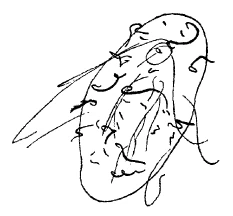
[ 17 ] When a terrible emotional state is present, you will find such rays:

[ 18 ] A person who harbors a restrained grudge (GV) has figures like snakes within them.

[ 19 ] But it is difficult to draw, since it is constantly in motion, much like lightning. Internally, then, there is anger, resentment, or nervousness when the soul is restless within. What a person experiences internally is the state of their soul. Externally, this state of the soul becomes visible to the clairvoyant as a luminous phenomenon.
[ 20 ] The physical eye perceives lights and colors all around it. Just as the clairvoyant perceives the aura around the astral body as red, blue, yellow, and green, so too does the physical eye see red, blue, yellow, and green all around it. In both cases, the cause is exactly the same. Just as a desire lies behind the red in the astral body, so too does a desire lie behind the red of the flower as the “thing-in-itself.” The red in the flower is a desire at work within the flower. What the sense of sight does when it crosses this threshold is no different from turning a skirt inside out, turning it to the other side. While the human astral nature manifests itself in the aura, the outer astral nature lies behind the entire world of color and light—behind the world of the sense of sight. There would never be colors in the world if things were not completely permeated by astral beings. What appears in the world as colors originates from the astral beings, who express themselves externally through color. By turning the inner world outward, the entity descends from the higher to the lower plane. You can achieve the following through meditation: If you have a green surface—such as a leaf—in front of you and now step outside yourself to view the object from the other side, you would see the astral entity that lies behind the green color and reveals itself through it. You must imagine it this way: As you look out into the world and see it covered in colors, you must assume that behind these colors lie the astral entities. Just as the colors of your aura appear to the clairvoyant from within you, so too is the world’s blanket of color an expression of the cosmic aura. Everything colored in the world is a reversed aura. If you could turn your aura inside out like a skirt, you would also see your aura physically visible on the reverse side. This applies to the sense of sight, and thus you can see that the sense of sight is intimately connected to the astral world.
[ 21 ] If you consider the sense of feeling, the sense of warmth, it in turn stands in a universal relationship to the lower regions of the astral world. While the sense of sight is more closely related to the higher regions of the astral world, the sense of touch—or the sense of warmth—is, in turn, in a similar relationship to the lower regions of the astral world, more specifically to the region where the astral world already merges into the etheric world. The sense of hearing stands in direct relation to the physical world, and what you perceive as the sense of hearing are vibrations of physical air.
[ 22 ] This is something I ask you to understand in the most subtle and accurate way possible. If you want to see something, there must be an astral being behind the color you perceive. Likewise, behind the warmth you feel, there must be an astral being. If you want to hear something, then—because the sense of hearing is the most perfect of the senses—you have entered fully into the physical world, and you can hear a physical being. It is only through speech that the spiritual world has truly descended into the physical world. If we start from the top, we can therefore say: The phenomena of the sense of hearing lie entirely on the physical plane; those of warmth rise higher; those of the sense of sight are on the astral plane; and the phenomena we perceive through the most imperfect senses belong to the higher regions of the spiritual world. And what reaches down into the physical world is only the most imperfect. Thus, what the sense of smell can grasp—what it brings down into the physical world—is the most imperfect. If this becomes independent, it separates itself from the course of the worlds, from evolution. What manifests itself through the sense of smell today can only occur in intimate connection with the highest worlds. — Let us therefore consider those beings who, precisely when the sense of smell had begun to develop on Earth, separated themselves from the course of evolution and became independent. These are beings who make themselves known primarily through the sense of smell. Hence, it is a beautiful feature of legend that the fallen angels are perceptible to the sense of smell in an unpleasant way. Because they have split off from evolution, they are perceptible to the sense of smell.
[ 23 ] So when one asks what actually lies beyond the skin—which encloses the human sensory organs—one must conclude: There indeed lie the various higher planes and their beings.
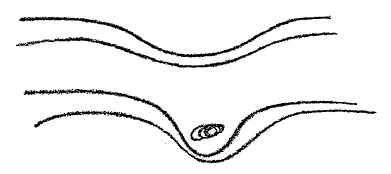
[ 24 ] Now, physical research harmonizes wonderfully with all of this. Just consider how an eye develops! The eye originally forms from the outside in. A small indentation first appears in the skin of the being that is developing an eye. This indentation then deepens,

[ 25 ] so that after a while it looks like this. It then fills with a kind of fluid and finally closes up. This is how the eye actually pushes its way in from the outside. Human organs do not form from the inside out, but push their way in from the outside. This is true of all human and animal organs. “Inversion” is the technical term. In animals that have a spinal cord, a groove originally formed, and the spinal cord folded into this groove from the outside. The senses also fold in from the outside.
[ 26 ] What, then, causes the eye to curve inward in this way? This is the work of the beings active in the light. It is the beings active in the ray of light who form the eye from within the organism—that is, those beings who stand astral behind the outer appearance and of whom we have said that we would see them if we could turn our consciousness around. It is they who have bored the eye into the physical organism. Thus, the eye is formed by beings of light. Likewise, the other organs are formed by beings from the various worlds. By feeling within your own skin, you can sense it as though beings from various sides had been working together on your body. When humanity reached Saturn in its very earliest stage of development, only the highest beings could work on its organ of hearing. Higher and also lower beings taught him to hear, until, on Earth, the beings embodied in the outer air also began to work on his organ of hearing. Through the organ of hearing, human beings perceive the movement of air; this is what carries sound.
[ 27 ] If we truly take this to heart, it will become clear to us in a very profound way why air plays such a special role in the story of creation, why it first had to be breathed into human beings so that it could also play this role in relation to their sense of hearing: “The Creator breathed the breath of life into man, and he became a living soul.” Man himself is created at his highest level through the Word, through sound. From this you can also see the connection that exists between man and his entire environment through his senses. If you look at a person’s face, you can say to yourself: Beings who live on the astral plane have worked on the face. They live in the ray of light. The ray of light consists of a physical and an astral part. Now imagine that a ray of light strikes somewhere. When this happens, the ray of light contains both the outer physical light and, at the same time, the astral beings living within it. Just position yourself once so that you block the beam of light. Stand so that the sun shines on your back. When you do this, you block the physical light, but you do not block the astral beings. The astral being is then in front of you, in your shadow. In your shadow, which falls forward like this, an astral being lives. And this astral being, which lives in the shadow, is nothing other than an afterimage—an afterimage of what? It is an afterimage of the body, and what lives within it takes its form from the soul. This is one of the methods for gradually seeing one’s own soul. That is why primitive peoples were not wrong in saying that the soul lives in the shadow. You can find this in numerous legends: the soul departs in the shadow. For astral vision, the soul first becomes visible in the shadow, in its form.
[ 28 ] Now you will also appreciate the deeper meaning behind Chamisso’s description of Peter Schlemihl as the man without a shadow. Peter Schlemihl lost his soul along with his shadow. If you read Chamisso’s novella with this thought in mind, you’ll realize that there is something much deeper behind many such stories.
[ 29 ] In fact, it will become increasingly clear to you that a person who knows nothing about these things goes through life more or less like a blind person. A person who knows nothing of the spiritual worlds has not even the faintest idea of what he carries with him in his shadow. All those subtle things that surround us will only be revealed to people once again through spiritual scientific knowledge. The world is full of mysteries for those who are willing to perceive them. When a person perceives these mysteries, they will no longer regard the spiritual-scientific worldview as something superfluous or as the musings of a few dreamers, but will recognize that the reality surrounding us becomes accessible to us only through the spiritual-scientific perspective. We must not grow weary of studying what surrounds us. Many spirits have contributed to the complex structure that is the human being. That is why this structure exhibits such varying degrees of perfection. It is only through this process that the physical ear has earned the right to hear on the physical plane, because it has passed through many stages. A chela who, under a Master, anticipates the Venusian stage can perceive his fellow human beings on the physical plane through the effect of light; then the effect of light also descends to the physical plane.
[ 30 ] The course of development is entirely regular. Just as the sense of hearing has descended to the physical plane, so too does the sense of sight descend to the physical plane, all the way to true clairvoyance. This can be understood quite logically. Anyone willing to think can see this, and no one can refute it by mere thought alone. This is true of all matters in spiritual science. Only those who do not want to think—or who apply their thinking only to what they are accustomed to thinking about—will oppose spiritual science. After all, there may be people who say, “I don’t want to ride a train”—but that does not mean the reality of the train can be denied. Similarly, there may be people who say, “There’s nothing to the higher worlds.” But that does not mean the higher worlds can be denied: they exist.
[ 31 ] We have spoken of the human sensory organs and attempted to shed light on the environment. In doing so, we have found that the sensory organs exist only because other beings construct them. Similarly, we could have spoken of the inner being that constructs itself in relation to its surroundings. Physical science is not capable of understanding these things. It can certainly demonstrate the structural differences between the eye and the ear, but it can never reveal the difference in age between them. Only occult science, which looks beyond outward appearances, can do this. Likewise, we could have shown how the liver is a much younger organ than the spleen. It would have become apparent that the spleen was already present when the etheric body was united with the physical body, whereas the liver only came into being with the astral body, along with human passions. This is something that, in turn, is wonderfully expressed in the legend of Prometheus. The vulture gnawing at the liver of Prometheus, who is chained to the rock, has a profound significance.
[ 32 ] In this way, you could study the great truths contained in the legends in a new way. There is profound wisdom in the ancient legends and myths. Myths did not arise from the “poetic imagination of the people”—that is a superstition held by scholars. Scholars are the most superstitious people there are. Those who believe in ghosts are not as superstitious as the scholars. It is a superstition to believe that there is such a thing as a “blindly operating folk imagination.” In truth, the great myths originate from the initiates, who knew what is now being made accessible to humanity once again through the great theosophical truths.
[ 33 ] Thus, even in ancient times, on the very land where we stand, there were societies in which “theosophy” was taught. And from there, emissaries went out and proclaimed to the people, in the form of myths, what they had heard within their inner circle. Thus, the myth is a garment for spiritual truths, and those who make the effort can recognize them again within it. Only the lesser myths do not trace back to the great initiates. The genuine myths originate from the initiates as their own creation. If you keep this in mind, you will see that a record of wonders is inscribed in the myths of the most diverse peoples. First learn to read the myths and look deeply into the souls of past peoples—those peoples who, so to speak, created from within. And turn the myths inside out, just as we turned the astral plane inside out earlier; then you will have, in concept, today’s natural science.
[ 34 ] In the natural sciences, you encounter the same truths—the truths of evolution contained in the myths. This explains the remarkable correspondence between a deeper understanding of the concept of evolution and the most ancient teachings of humanity. Mythical phenomena are viewed from within—science views them from without, yet they are the same phenomena. This points to the astonishing fact that, when scientific facts are properly understood, the truths found in the oldest religious creeds reappear. This should come as no surprise when one realizes that natural science is a reversed mythology. Therefore, in its structure, it must correspond to what already existed. — This was a reflection on the relationship of the senses to the world around us.
[ 35 ] Tomorrow at two o'clock, we want to discuss theosophical questions that are not so far-fetched, but nevertheless have an impact on practical life.