

Original Impulses of Spiritual Science
GA 96
1 April 1907, Berlin
Translated by Steiner Online Library
18. The Purification of the Blood from Egoism through the Mystery of Golgotha
[ 1 ] Today we will speak about the Mystery of Golgotha and, at the same time, offer an esoteric reflection on Easter. Eight days ago, I had the opportunity to point out here that the Mystery of Golgotha does not merely signify something in the historical development of humanity, like any other historical event, but that it has the deepest significance for the entire development of the Earth—insofar as we, of course, include humanity in this development. Even then, I was able to draw your attention to how the transformation of our planet would have appeared to an observer of our globe who, from a distant planet, could direct his gaze toward our planet through the millennia. In fact, such an eye, looking down from a distant planet, would see how the appearance of the Earth changed over the millennia before our era. And if it were a clairvoyant eye—that is, an eye capable not only of observing what is happening in the physical realm on our planet but also of observing the spiritual transformation—it would see that with the appearance of Christ Jesus on Earth, the entire spiritual atmosphere of the Earth changes and becomes something different.
[ 2 ] Just as human beings have a physical body, an etheric body, and an astral body, so too does the Earth have a physical body, an etheric body, and an astral body. We are all not only enveloped by the air; we are also enveloped by the Earth’s etheric body and astral body. With our physical bodies, we live not only in the air, but also in the Earth’s etheric and astral bodies, and such an observer would see these etheric and astral bodies of the Earth with his clairvoyant eye. These etheric and astral bodies of the Earth had a certain color and a certain movement until the appearance of Christ Jesus. But then they were transformed and took on new colors and new movements. This event is so profound that the entire spiritual content of our Earth changes, both for our Earth and for the development of humanity.
[ 3 ] You should not interpret this as though the birth, suffering, and death of Christ had happened suddenly. It has been in the making for centuries within the spiritual fabric of our planet, and it is not yet complete today. With such an eye, one could still see how what the Earth received back then as a new spiritual influence is still densifying and consolidating. It will be a long time before all the fruits that were brought forth at that time with the appearance of Christ Jesus have been absorbed by the Earth.
[ 4 ] If we want to understand what this is all about, we must let the entire history of Earth’s development pass before our minds once more. We must go back to that era of Earth’s development in which, so to speak, human beings were just beginning to develop and take shape in their present form. We call it the Lemurian era. We arrive at this time as we move backward through the various historical epochs of our present age.
[ 5 ] We are now living in what is known as the fifth sub-age of the fifth main age of our Earth. If we go back to the time of the Greco-Roman peoples—that is, to the era in which that wonderful art, which actually first emerged in the Greek era, took shape, and in which Roman legal concepts were formed—then we would be in the fourth sub-era of our calendar. Going back even further, we would arrive at an age that witnessed the high development of the Egyptian-Babylonian-Assyrian period. Going back even further still, we would find the age in which the first seeds of spiritual life sprouted, when Zarathustra imparted the first spiritual culture to humanity. That would have been the second age. Going back even further, we would arrive at the ancient Indian people—not the one described in the Vedas and the Bhagavad Gita, but the pre-Vedic people who were taught by the holy Rishis themselves. There we encounter a wondrous ancient culture that the clairvoyant can still perceive. It is the first age of development, immediately preceded by the flooding of our Earth, which washed away the Atlantean continent that lay between Europe and America.
[ 6 ] Our ancestors lived in Atlantis—the people of the fourth main epoch—who did not yet live in a social order as we do today, where there were no commandments and no laws. Nor did logical thinking or arithmetic exist at that time. It was not until the final period of the Atlantean Age that the elements of counting emerged. Memory gradually became the highest power of the soul. Human beings lived in a wonderful interplay with nature. However, we can only truly imagine the age of Atlantean culture if we realize that the physical conditions on our Earth were quite different back then than they later became. In Central European legends, a memory of that ancient Atlantean age has been preserved in the form of Niflheim or Nebelheim. That Nebelheim was indeed completely permeated by heavy, dense mists, and because all beings lived in such heavy, dense mists, the soul-spiritual conditions were also entirely different.
[ 7 ] It would take us too far afield to elaborate further on the description of the Atlantean Age. I merely wanted—and had to—touch on it if we are to reach the point where human beings took on their present form. There we would have to go back not to a flood, but to powerful revolutions brought about by fiery forces. These fiery revolutions destroyed the land known in theosophical literature as Lemuria. It was located deep in the south and stretched from northern Africa to southern Australia. It was the region where humanity first appeared in its present form.
[ 8 ] If we go back far enough to this Lemurian era, we would see beings walking the Earth whose form was quite different from that of modern humans—beings who cannot yet be called human, because they did not yet possess the seed of the human soul within them, which was what first enabled them to ascend to higher levels of development. We would find there human forms that possessed only the outer shell for the human soul—people who had only a physical body, an etheric body, and an astral body. And the astral bodies had a sort of indentation—to be understood figuratively—to accommodate the “I”-consciousness. Essentially, the four members of the human sheath were already present, but that which you today call “I”—what lives within you today—was at that time still in the bosom of the Godhead.
[ 9 ] So beings walked upon this Earth. If I were to describe them to you—these human beings who were ready to receive the core of human existence—I would have to say: They were quite different from people today. They would strike you as utterly grotesque, standing at the very limits of ugliness. These human “vessels” were enveloped on all sides—just as people today are enveloped by air—by a spiritual atmosphere. They were enveloped by a spiritual atmosphere; they lived and wove within a spiritual atmosphere.
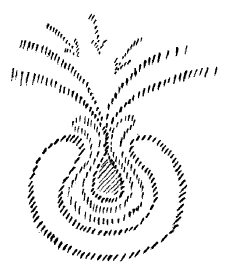
[ 10 ] If I were to provide a schematic drawing of what people were like back then, I would have to depict them, as it were, as vessels ready to receive a higher spiritual substance within themselves. The inner space is meant to represent a cavity within the astral body that is ready to absorb a higher spiritual substance. This higher substance was still present in the surrounding atmosphere, in the spiritual layer of air. So what is within each of you today was not yet within the human being back then; it surrounded and enveloped the human being. Of course, you must realize that the spirit can take on various forms, and that what was your spirit back then did not require a physical body. Its further development consists precisely in the fact that it took up residence in the physical body in order to develop further inwardly as a soul. What lives within you today lived outside of you back then, in the spiritual atmosphere that surrounded you. But the individual souls, which today live separately in their bodies, did not yet live separately back then.
[ 11 ] Let’s imagine it this way: as if there were thousands of drops of water in this glass, all connected to one another. In the same way, all the souls that were then distributed among human beings were like drops of soul in this spiritual atmosphere, but dissolved as if in a single, uniformly flowing element. And you can imagine it even further: If I were to take a thousand small sponges and let them absorb a thousand drops of water, those thousand drops would now be distributed among the thousand sponges. That is how you must imagine the distribution of the spiritual in the Lemurian Age. What had previously existed in the surrounding space descended into the bodies; they became distinct entities. Just as the thousand drops of water become individualized within the thousand little sponges, so the collective spiritual substance became individualized within the individual physical bodies during the Lemurian Age. Not every such human body immediately received the soul in the early phase of the Lemurian epoch. If I were to schematically illustrate how the soul’s content was received, I would have to show it to you like this (see drawing on p. 277). But I would also have to point out that much remained in the surrounding space outside the body, so that the body was simultaneously surrounded by spiritual content that was of the same nature as the part that was already within the vessel.
[ 12 ] Evolution through the Lemurian and Atlantean eras up to the present consisted in the gradual drawing into the physical body of that which was outside it, throughout the Lemurian era and the entire Atlantean era. You must imagine that human beings were constantly in a state of being half-asleep and half-awake. This state was, however, linked to a kind of clairvoyance. If someone whose spiritual eye were open could have looked upon the people of the Atlantean era, they would have appeared to him just as a sleeping person does today. When a person is asleep, the physical and etheric bodies lie in bed, and the higher spiritual content spreads out around them. It is precisely because this is outside the body that the state of sleep is brought about. You would see the Atlantean people in such a constant state of sleep, which is, however, filled with vivid dreams.
[ 13 ] When a person in those days approached another person, he did not see him as we see him today, with boundaries, but rather a certain form of color arose in his soul. And this form of color signified—when approaching a being they found likable—precisely that likability, whereas in the case of a being they found unlikable, it manifested as shades of color associated with antipathy. It was thus the case that people in those days perceived their entire surroundings in a more clairvoyant way, and that the more spiritual substance sank into them, the more their consciousness became like what we recognize today as clear, daytime consciousness.
[ 14 ] What I have described here as the soul’s descent into the physical body also has a physical aspect; it also has a physical corollary. This physical aspect is significantly alluded to in the Old Testament in the words: “And God breathed into the man the breath of life, and he became a living soul.” In fact, at that time, it was not merely a stream of air that was breathed into the human being, but that which lived through him as the spiritual human being. You must realize that what exists around us as matter is by no means merely matter, merely substance. When you feel the air, you must realize that it is a spiritual substance that completely surrounds the physical body, and that with every breath you take in not only physical air but also spirit. It is entirely true that in those days, when physical air was inhaled in the same way as it is by human beings in their present form—for this is alluded to in the Old Testament—everything that has been described here sank into the physical body. And if you were to ask: What was the human body like back then, when the soul descended from the bosom of the Deity?—The body was the air, and even today you still breathe what sank into the bodies of human beings back then. For what is called the spirit is in the air. The air is merely the body, the substance of this spirit.
[ 15 ] Now you must also realize how something else was connected to this kind of breathing—this sinking of the spirit into the human shell. It is intimately connected to what we call the warm blood of the human being—or rather, blood that is warmer than the surrounding environment. Before this stage in Earth’s evolution had been reached, there were no warm-blooded beings. Warm-blooded animals did not emerge until later. Warm-bloodedness was linked to this form of respiration, so that something else happened at that time: a certain amount, a certain sum of heat—the warmth of the blood that you carry within you and which is a higher temperature than that of your surroundings—flowed into each such human body. Back then, in the time preceding this actual becoming-human, there was still something entirely different, something essentially different from the spirit embodied in the air, in the environment of the physical human ancestors on Earth. You can get an idea of what was still present in the Earth’s atmosphere if you imagine the following—not entirely accurately, somewhat figuratively, yet real nonetheless—if you imagine the warmth that existed within the various people who have lived on Earth, [if you imagine] the warmth that lives in your blood, and then the warmth that has radiated out into your surroundings, and all this warmth enveloping the Earth—that is, all the warmth of the blood, all the warmth that comes from the blood and flows within us: it is the warmth that once surrounded us. You have absorbed the warmth that once surrounded us. Just as surely as the spirit that was outside of you is now within you, so surely is the warmth that was outside of you now within you.
[ 16 ] We would thus be entering the era when the entire Earth was enveloped in a warm atmosphere. In this warm atmosphere, a different spirituality was embodied—a spirituality that was like the spirits who were on the Sun—which was one of the three planets that preceded the Earth—and who had once, when the Sun was still a planet, attained their perfection. The spirituality embodied in this heat possesses a level of perfection found only in those spirits who, back then, had reached the goal of their development on the solar planet and who now inhabit the Sun. Indeed, back then, when this warmth enveloped the Earth, it served as the vehicle of a single spirituality for all of humanity. And for a long, long time, the warmth surrounding the Earth remained for all people the vehicle of a single spirituality—that spirituality which is none other than that of the Spirit of the Earth itself.
[ 17 ] Just as every human being has a spirit, just as every human being is permeated by their spirituality, so too, for those who see through these things, every planet and every material being is at the same time the expression of a spiritual being. Thus, our Earth is the body or the spiritual expression of the Earth Spirit. The means by which the Earth Spirit can penetrate into human beings is this warmth of the blood. In the warmth of the blood that lives within human beings—which, in the pre-Lemurian era, existed outside of them—we find the means by which the Earth Spirit penetrates into human beings themselves.
[ 18 ] You must imagine that back then, when the actual process of human incarnation began during the Lemurian epoch, on the one hand the spirit belonging to the air descended upon human beings, and that then the higher spirit contained within the warmth of the blood—the actual Earth spirit—began to descend. These two spirits relate to one another in such a way that one can say: It is the spirit that has its body in the air that made it possible for human beings to develop speech. — For the very structure of the human organism that makes its present breathing process possible is also what makes speech possible. Language developed during the Atlantean epoch, and the highest expression of language was what, already at the end of the Atlantean epoch, learned to utter the “I.”
[ 19 ] This is a process that begins in the Lemurian era and gradually reaches its perfection toward the end of the Atlantean era. The Bible says: “And God breathed into man the breath of life, and he became a living soul.” This process became increasingly perfected until it became the word “I,” until the spirit began to speak from within the human being himself and began to call out from within the human being: “Y-H-V-H.” This is at the same time the eternal core of being within every single human being: “I am who I am, who was and who will be.” “I Am” is the deepest inner core of being, which sank into the depths at that time and will remain for all eternity as individuality.
[ 20 ] This was the first outpouring of the Deity. It is called the outpouring of the Spirit, the outpouring of Yahweh. This outpouring of the Spirit or of Yahweh is depicted in the myths of religious peoples—which are still wiser than scientific writings—in such a way that this god lives in the passing wind, in that which whispers in the air, that which moves through the air across the globe. It is evident from Germanic legend, as well as from Jewish and Hebrew legend—in which Yahweh is depicted as a god of storms or wind—that we are dealing with a deity whose physical form resides in the air current and who has poured Himself into humanity.
[ 21 ] This deity, in the form in which it descended into human beings, certainly contributed to the individualization of human beings, working to ensure that what was once a unified, flowing element—which in pre-Flood times surrounded human beings in magnificent form—was distributed among individual human beings, just as water is distributed when individual drops are absorbed by sponges. But it was not able to fully individualize human beings. Human beings first had to make the transition to complete individualization. Human beings were not immediately called upon to become fully individual. At first, they formed groups. It has also already been mentioned that human beings formed small tribal groups. At that time, human beings did not yet feel set apart as individuals. The human individual felt like a part of such a tribal group or clan, fully belonging to it, just as the hand belongs to the body. Human beings today, endowed with a completely different consciousness, can no longer truly imagine what it means to belong to a tribe, to feel as though they were inside the body of an entire tribe. But this is how it was, and the more the small tribes spread out, the more the family became a tribe, the more individualized human beings became.
[ 22 ] What we come to understand here as the process of becoming isolated, what we recognize as the ongoing process of becoming an individual—you must imagine this as being bound to human blood. You will understand this connection to human blood when I tell you something that I ask you to bear in mind: This outpouring of the spirit that took place during the Lemurian epoch was not a uniform outpouring. You could have seen many spirits descending from the spiritual surroundings of the Earth onto the Earth. There were many individualities contained within it. When we speak of Yahweh, we are not dealing with a single deity, but with many folk deities. The Jews are aware that it was one among several, among many deities. Because many such folk souls—which I ask you to regard as a reality—descended, the peoples were divided into tribes. And the further they advance in their development, the more they form into families and tribes, which are then united into larger tribal groups. However, uniting into one great, unified brotherhood was not possible in this way. It was only through this that the unification of all humanity on Earth became possible, and this will gradually be realized: that in addition to this outpouring of Spirit and the endowment of human beings with this Spirit—which flowed down into many national souls—something else also flowed in, something that lived in the warmth of the Earth, not in the air, and that this more universal force flowed into human beings. What flowed in first is also called the Holy Spirit in Christian esotericism. When speaking of the ancient spirits that have flowed in, one should actually speak of many holy spirits, of many Yahwes. But when speaking of the Spirit who contains all warmth within Himself, one can speak only of a single One. Within Christian esotericism, He is called the Logos, Christ Himself—the unified Spirit of the human race on Earth.
[ 23 ] If you now consider that everything that lives within the spiritual self—everything we call Manas—descended in a multitude, and that everything referred to as Budhi poured out over humanity as a spiritual unity, then you have the contrast. And you will understand that humanity first had to be prepared through the outpouring of the Spirit for the outpouring of Christos or Budhi, the Spirit of Life. Up until the time when Christ Jesus appeared on Earth, everything that existed of the Christ Spirit was a unity. It was a unified shell that encompassed the entire Earth, which, so to speak, had its skeletal system within the solid Earth. If you take the solid Earth with all that it contains, and then add to it the warmth that surrounds the Earth, you have roughly what is called the body of the Christ Spirit. Hence the beautiful passage in the Gospel of John, where Christ Jesus refers to himself as the Spirit of the Earth: “Whoever eats my bread tramples me underfoot.” What does a person eat when he eats? Bread. He eats the bread that is the Body of Christ. And as he walks upon the Earth, the person does the opposite: he tramples him underfoot. This is to be taken quite literally.
[ 24 ] Just as the Spirit of Yahweh poured into the individual souls during the Lemurian era, so too did the Christ Spirit—which has its body in the warmth of the blood—gradually pour into them throughout the ages that preceded Christ Jesus and those that now follow him. And when the entire Spirit of Christ has been poured into human individualities, then Christianity—the great brotherhood of humanity—will have conquered the earth. Then there will no longer be any awareness of cliques or small groups, but only the awareness that humanity is a brotherhood. Even in the greatest individualization, each person will nevertheless be drawn to the other. The small tribal and ethnic communities will have given way to the community of the Spirit of Life, Budhi, the community of Christ.
[ 25 ] This is what a soul’s eye—a clairvoyant eye looking down upon our planet—would see. It could observe how, in those days, the Christ Spirit was fully present in all that surrounds the Earth, and how it pours itself into each individual human being. The Earth would see itself changing more and more. Different colors and moods would emerge. What was once found in the Earth’s surroundings would now have to be sought within each individual human being. This is what the appearance of Christ Jesus signifies, and this is its cosmic significance.
[ 26 ] Everything else you can find in the spiritual development of our Earth is preparation. Over the course of centuries, the world prepared for the coming of the Christ. It prepared for the momentous event in the entire cosmic development of the Earth, as He demonstrated how to overcome narrow tribal boundaries. You are familiar with Mercury, Hermes Trismegistus, the Persian Zarathustra, the Indians Krishna and Buddha, and the Greek Pythagoras. The Christ spirit, which was previously present in the Earth’s atmosphere, is beginning to enter into human beings. Then begins an era of religious founders, in which we see the process of transformation increasingly take hold and learn to understand the spirit of Christianity.
[ 27 ] The outpouring of the Spirit—what could it accomplish? It could accomplish that love was bound to blood. People loved one another just as much in ancient times, when they still formed small tribal communities, as they do today. They even loved one another more, but they loved one another in the manner of a mother’s love for her child. This love was therefore more a matter of nature. Blood was drawn to blood, and this mutual attraction of blood to blood expressed the sense of belonging among people. But as those who had been drawn into this blood kinship evolved, people began to form individual bonds of sympathy. This led to the development of smaller groups—families and communities—which in turn were united into larger communities. But individuals became more selfish and self-centered. Thus we have: on the one hand, humanity becoming increasingly self-centered, and on the other hand, the emergence of the unifying influence of Christ. On the one hand, we have individualization—the emergence of the independent individual—and on the other, the unifying spirit of Christianity. Only when these two currents are allowed to run their full course will it be possible to bring about a state on Earth in which everyone is independent yet, at the same time, connected to all others, because each person is permeated by the so-called Christ spirit.
[ 28 ] We must realize that all of this is connected to the blood, and that human blood originally expressed something that brought to light the feelings and sensations which, while operating within the bonds of kinship, gave rise to the love of blood, and that these feelings then became more selfish. Selfishness became increasingly ingrained in the blood. This is the secret of human evolution: that the blood increasingly took on the character of selfishness. This blood, which had become selfish, had to be overcome.
[ 29 ] That which was the excess of egoism in human blood flowed out in a mystically real way from the wounds of Christ Jesus on the cross; that was sacrificed. Had this blood not flowed, then in the course of evolution, the ego-obsession in human blood would have grown ever greater and greater. The purification of the blood from self-centeredness is brought about by the Mystery of Golgotha. Through this act of love, human blood was saved from its self-centeredness.
[ 30 ] No one who sees only a man hanging on the cross and bleeding because he was pierced with a lance can understand the cosmic significance of what took place on Golgotha. The profound mystical significance of this event lies in the fact that it is, symbolically, the blood that humanity had to shed for its redemption. No one can ever understand Christianity who views these things solely in materialistic terms, who knows only the material event and not the spiritual reality behind it. This spiritual reality, however, is the regenerative power of the Savior’s blood that flowed on the cross. We can understand the further development of humanity only if we grasp how profound this fact is, if we understand that the most momentous turning point in the spiritual evolution of humanity on Earth is connected with this fact.
[ 31 ] If one traces the course of development on Earth, one finds that in ancient times, before the Christos principle entered the human soul, the mysteries of the Spirit were the profound centers of teaching and worship. The more Christos entered the world, the more the mysteries of the Son unfolded, and in the future, the mysteries of the Father will be cultivated. These are already foretold to us in the Book of Revelation.
[ 32 ] Let us return to the Mysteries of the Spirit. They were first established in a place that lay between Europe and America and has long since perished. There, the school of the great adepts was founded, and there the Mysteries of the Spirit were inaugurated, which have been passed down to our time. Those who had passed the tests of their maturity could be initiated into the Mysteries of the Spirit. Anyone who was sufficiently instructed and purified was admitted. He had then absorbed the teachings that underlie all religions as “theosophy” and that we today embrace as spiritual science. They had purified their instincts, cultivated an orderly train of thought, and then accustomed themselves to loving not only those bound by blood ties but to embracing all of humanity with love. They had become what is called a “homeless human being.” What is happening today in the highest stages of human development is a foreshadowing of the future.
[ 33 ] In the initiations of the ancient mystery temples—which continued into the last pre-Christian centuries and are revealed to us when we look inside the Egyptian pyramids—the student who had progressed to the point of being able to love all of humanity was plunged into a three-day sleep. His physical body was as if dead, in a state of complete lethargy. The initiator was now able to draw his spirit out of him, just as your spirit is drawn out of your body every night during sleep. Just as it is true that this spirit is unconscious during ordinary sleep, so it is true that it became conscious in these sufficiently prepared students. Only the disruptive qualities of the physical body were no longer present. However, during this three-day sleep, the students were able to recall exactly what they had learned earlier; they were able to bring this into their bodies.
[ 34 ] Because the initiate had studied and had absorbed the relevant concepts and feelings, the initiator was now able to allow him to experience as spiritual reality what he had previously worked through as a student and internalized as feelings. While the soul was outside the body during those three days, it wandered through the astral and devachanic worlds. In this way, it experienced in reality what it had previously learned, and thus the person had become a person of knowledge. The theosophical teachings were now no longer mere teachings to him; they were for him that in which he had sustained himself as in an element of life. When he then awoke within his body again and looked out at his physical surroundings, a sound arose on his lips—a sound that breaks forth of its own accord from the soul, that must break forth, when that soul, after a three-and-a-half-day journey through the spiritual world, finds itself transported back into the physical world. Then the soul sensed that the “I” had become a citizen of higher worlds, that the “I” had dwelt in higher worlds and could now step before people and speak of its experiences. By speaking thus of the spiritual world, the human being has become a herald of the Spirit in the physical world, a missionary of the Spirit. And this is expressed in the words: “Eli, Eli, lama sabachthani!” That is to say: My God, my God, how have you glorified me! — That was what could be heard from anyone who had been initiated in this way.
[ 35 ] If you had examined such a person in the fullness of his being, you would have found that such an initiate into the mysteries of the Spirit was a foreshadowing of what was present in Christ Jesus for all humanity. However, it was only inwardly—specifically in the so-called etheric body—that the buddhi had awakened in such an initiate. Thus, throughout the entire pre-Christian era, there were initiates of the Spirit in whom the Son, the Christos, had awakened inwardly. This Christos had not penetrated as far as the physical body, but he had awakened within the etheric body. As etheric beings, these initiates had become immortal.
[ 36 ] The great advance for humanity now lies in the fact that what applies to the great spiritual initiates also applies to the appearance of Christ Jesus on Earth. But in the case of the One who died on the cross, this applies right down into the physical body. Everything that could be experienced outside the body in the ancient mysteries could, in this one instance, be seen on the physical plane through the event at Golgotha. It was visible even to those endowed only with physical eyes. In ancient times, those who had advanced to that level could see it. They were blessed because, as the chosen ones, they experienced inwardly how life must triumph over death. From then on, this was no longer necessary. Through the event at Golgotha, it had unfolded before physical human beings. There it had happened: life had overcome death. And through the connection with this One, through the bond that links each individual to Him like a family bond, a substitute was created for what had been experienced in the mysteries of the spirit.
[ 37 ] I must describe one of the great, significant images within the mysteries of the Spirit if you are to understand the mysteries of the Son. I must describe how the one who lay asleep for three and a half days was surrounded by twelve human figures, with whom he sat together as if around a table. And how must they have appeared to anyone who, as an initiate, had experienced the realities of the higher world? Before such a person, twelve of his incarnations had appeared—twelve of his various bodies through which he himself had passed. These twelve bodies were nothing other than what he carried within himself as the members of his body. In occult terms, the human body is divided into twelve members, and these are said to be nothing other than the reflection of twelve incarnations, through which the human being is gradually purified and led up to a higher stage of perfection. Thus, the man felt surrounded by the forms through which he himself had once passed, and he said to himself: The form you once bore lives in one of your limbs; in another lives the second form, in another the third, in another the fourth, and so on. Thus they surround you, just as guests surround the host at a meal.
[ 38 ] This was an image that could be seen before every soul in the mysteries of the Spirit. The one who brought it to completion was the Son of Man, who is no longer the son of a family, a tribe, or a people, but the son of all humanity. The Thirteenth actually possessed the highest perfection among the Twelve. And because he was outside his earthly self, he saw himself as the Thirteenth.
[ 39 ] Let us now trace how what was experienced by every initiate in the higher world was repeated in the person of Christ Jesus. It is veiled, just as everything presented outwardly and exoterically is shrouded in a veil. The Last Supper, which Christ celebrates with the Twelve, is not meant to be an ordinary meal. It is meant to be something else: it is meant to be, on the physical plane, a reenactment of what the initiates of the Spirit have experienced so many times on the higher plane.
[ 40 ] The Gospel of Luke, chapter 22, verses 7–12, reads: “Now the Day of Unleavened Bread came, and the disciples said to Jesus, ‘Where do you want us to prepare the Passover lamb?’ He said: ‘Behold, when you enter the city, a man carrying a jar of water will meet you. Follow him into the house where he enters, and say to the owner of the house: “The Master sends word to you: Where is the guest room where I may eat the Passover with my disciples?”—And he will show you a large room; prepare it there.’”
[ 41 ] During the Passover meal, He explained once again that the bread is His body, and that the blood flowing in His body is like the sap in the body of a plant. He may say, with regard to the sap of the plant and with regard to the wine, “This is my blood,” and He may say this because He is the Spirit of the Earth. He may say of all substances, “This is my body,” and of all sap, “This is my blood.”
[ 42 ] Then comes the scene where Christ Jesus further develops the Mysteries of the Spirit into the Mysteries of the Son, in order to then lead them on to the Mysteries of the Father. Once again, you must imagine that the twelve apostles sitting around him are an embodiment of his own twelve physical limbs. If you truly bring this to mind, if you try to grasp—with sensitivity and inner spiritual intuition—a passage that reveals—or rather, veils—the very depths of what Christianity contains, then you will be able to spiritually comprehend the transition from the Mysteries of the Spirit to the Mysteries of the Son.
[ 43 ] Think once more about what had to happen as the Mysteries of the Son drew near: it had to be indicated that blood must lose its bond to blood ties. Blood ties would one day mean less to people than selfishness. As Christ Jesus looked toward the future mission of Christianity, he sensed that this could only be achieved through his sacrifice. It had to be this way. For times would come when people would become more and more selfish in order to attain freedom. Therefore, the excess of selfish blood had to be sacrificed through a cosmic act, so that people, despite their independence, might one day be united into the great brotherhood. That which exists—precisely through humanity—and which is to be spiritualized and ennobled through Christianity—the selfish element—has grown ever larger and larger. As a result, people are becoming more and more independent. But let us take a look at what has since enveloped the globe; let us consider the means of transportation: What are they but devices for satisfying selfishness? Everything that intellect and reason have devised has been devised solely to satisfy selfishness, even if indirectly. Humanity was less selfish back when grain was still ground with two stones. But because humanity had to become independent, it also had to pass through selfishness, and our entire material culture serves as the foundation for this.
[ 44 ] Just as one who has been initiated into the mysteries of the Spirit sees his own incarnations, with himself at their head—that which is now the most perfect—just as the Son of Man saw the circle of his disciples as manifestations of himself, so too does one who looks into the future see the forms that humanity must undergo. Whoever experiences the mysteries of the Son sees into the future all the way to the end of Earth’s evolution, where the earthly state transitions into a new stellar state. Christ Jesus could therefore say of the first state at that time: “You who sit around me represent various degrees of perfection, and when I look into the future, you, as you sit here, are the twelve stations.” But these must be overcome. I must lead them through myself to the Father. Just as I must lead you through myself to the Father, so that the Earth may ascend to a higher degree of perfection. — Everything that is sensual, everything bound up with human instincts, passions, and emotions, must be overcome. This is symbolically illustrated by what happens to the Twelve.
[ 45 ] The age that follows is represented by Judas Iscariot. The representative of the highest morality is linked to the representative of base sensuality. It is Judas Iscariot who, in fact, betrays Christianity immediately afterward. Oh, a time will come when it will seem as if what happened on Golgotha were happening all over the earth! It will seem as if selfishness were to bring about the death of the Christ, of the buddhi. That will be the time of the Antichrist. It is the law that everything that happened around the cross must also happen on the physical plane. What happened on Golgotha also has a profound symbolic meaning. Judas’ betrayal signifies the triumph of the lower instincts. But everything sensual must become spiritual.
[ 46 ] This points to the future development of humanity within the Earth. I have mentioned this on several occasions. Everything that is base in human beings will fall away from them. What they will later become is already taking shape within them. They will not be creative in the same way as they are today. He will not create out of his base passions. Just as he produces the word today—the word that can embody the highest—so will he become ever more creative through the word. Just as he has become more selfish through sexuality, so will he become selfless again through the elimination of sexuality. What is produced today solely through the flow of air from the larynx—the word—will become a creative force for humanity in the future. The change in the voice is connected to sexual maturity. The voice will become the creative force. And as the word becomes the creative force, this word will at the same time—in the future, because the entire relationship will be reversed—be the expression of humanity’s mastery over the air. Thus, that which originally breathed life into humanity will have a transforming effect on something even more deeply connected to its essence. The word will become creative in the formation of blood. Even human blood will be transformed. It will be able to produce only pure, selfless feelings. There will be a human race that will be creative through the Word. Selflessness will be transformed into a quality of the blood, and the organ of thought will be transformed into the heart. Here we have one of the two evolutions that follow Christianity. The age in which egoism reigns is represented by Judas Iscariot. Anyone who observes world events impartially sees how sexuality in human beings is capable of betraying them as spirits, of killing them. But human beings—just as they today generate their Higher Self through the Word—will one day act creatively through the Word when the heart becomes their spiritual organ.
[ 47 ] Now I ask you to apply this to the Gospel and to consider a passage that, in a marvelous way and with magnificent symbolism, expresses what I have just said. See what will result when Christianity becomes selfless and fraternal; how that which makes people selfish is embodied in Judas Iscariot; and also see where humanity will evolve through the twelve stages: toward the form that Christ Jesus himself assumed. It all rises up to the heart.
[ 48 ] The transformation takes place as the creative force surges upward from the womb toward the heart. This must be expressed in the one who is the embodiment of the highest form and closest to Jesus. And now read: “One of the disciples, the one whom Jesus loved, was reclining at the table against Jesus’ chest. Simon Peter motioned to him to ask who it was. Then this disciple leaned against Jesus’ breast and said to him, ‘Lord, who is it?’” This is a passage that expresses how the lowest creative force in man rises up into the breast, represented by the most intimate disciple of Christ Jesus. With a tenderness that could not be more magnificently conceived, the mystery of the Son—the mystery of Jesus—is hinted at. That it is meant to be a mystery, you can read for yourself in the words of the initiated disciple at the end of this entire scene, after he had experienced how he would be transformed and come to the Father through the Son. What can he say then? On a higher level, he himself can say what the initiates said: “Eli, Eli, lama sabachthani.” That is what he says. Read it for yourself in John: “Then Jesus said, ‘Now the Son of Man is glorified, and God is glorified in him.’”
[ 49 ] This Passover meal was the preparation for what then took place on the physical plane. Therefore, through Christ’s death, we learn about the overcoming of death on the physical plane—the overcoming of selfish blood through the flow of blood from His wounds. And we also come to know that great perspective as these words resound once more from the cross, emerging from the consciousness of the future: The Earth has reached the goal of great brotherhood, of spiritualization, and of the overcoming of everything that could drag down the human spirit.
[ 50 ] Those who have participated in this alongside Christ will, when they leave the earthly evolution behind and ascend to a higher stage of development, be able to gather around Christ; and Christ Jesus, beholding the end of earthly perfection, will once again be able to cry out the words He cried out on the cross: “Eli, Eli, lama sabachthani!” “My God, my God, how you have glorified and spiritualized the ‘I’ within humanity.” That is what these words mean. There is also a later, incorrect translation that sought to draw on the words of the Psalms, but the true translation of the words is the one you now know. These are the words that express the Mystery of Golgotha: My God, my God, how powerfully, how profoundly have you glorified me, spiritualized me.
[ 51 ] This word reveals to us the Spirit’s struggle to free itself from the body. The Mystery of the Son reveals to us that, at that time, the inner, visionary gaze of the Savior of the World looked all the way to the end of the Earth’s perfection and articulated the great goal of humanity in these words: the overcoming of all differences and the establishment of universal love. This goal can be achieved only as people learn to enter more and more deeply into the spiritual world. For in the Spirit lies the unification of humanity. Just as human beings were one when they emerged from the Spirit, from the One, from the all-pervading Divinity—just as they then became individualized by descending into individual human bodies—just as water becomes individualized when drops of water are absorbed by small sponges— so too will the individual human beings, having become distinct, become unified again when, while maintaining their individuality, they enter the great brotherhood and thereby prepare themselves to be deified creators, just as they were gods and creators before they appeared on Earth as human beings.
[ 52 ] Humanity’s evolution originates from a divine being, and it returns to a divine being. The various “I’s” will be individual, but at the same time, by being united in the brotherhood, they will form a unity that will give birth to a new star—that new star which is called “the New Jerusalem” in the Book of Revelation. The human “I’s” will be affirmed in their individuality, and then the harmonies of the spheres will echo the words in which the Mystery of Golgotha was fulfilled: “My God, my God, how have you glorified me!”
[ 53 ] These words were spoken back then, and they are repeated as people ascend to the highest levels and on to ever greater heights, where they will have passed through the Son to the Father. The Son guides people to the end of the Earth’s evolution; then they are welcomed back into the cosmos with their “I” intact. Then the Earth returns to the Father. “No one comes to the Father except through me.”
[ 54 ] The spiritual gaze reaches far, far beyond when a person sets out to comprehend this profound mystery of Golgotha. But festivals—such as the great festivals of the year—exist as major milestones at which people should pause from their ordinary, everyday activities, and at which they should let their gaze wander to the great landmarks of evolution, looking not only across centuries but across millennia. With a vision that dawns in our consciousness, we are to journey through the history of humanity. If we allow this vast, future goal—as taught to us by the great leaders of humanity—to take effect upon our souls; if we allow this distant goal, which is so far away yet can be so close to us, to take effect; if it becomes a force within our hearts—only then will we attain it.
[ 55 ] Let us never let celebrations like this one pass us by without engraving such grand visions for humanity’s future deep within our souls! People have time for the everyday in their daily lives. But when the holiday bells ring, may each person remember that they are not merely a child of time, but also, as a spirit, a child of eternity.