

Nature and Spirit Beings
Their Influence on Our Visible World
GA 98
7 June 1908, Cologne
Translated by Steiner Online Library
5. The Pentecost Festival of Spiritual Striving and Working for the Spiritualization of the World
[ 1 ] It has already been emphasized on various occasions that the kind of spiritual development to which the Spiritual Science movement aspires must bring human beings into a living connection with their entire environment. Much of the environment has become lifeless and mundane to people, whereas it once filled our ancestors with reverence. For example, a large number of people view our annual festivals with indifference and coldness. The urban population, in particular, has only a faint memory of the significance of Christmas, Easter, and Pentecost.
[ 2 ] That profound emotional significance which our ancestors associated with the festive seasons—because they understood the connection to the great realities of the spiritual world—is something that humanity today no longer possesses. People today view Christmas, Easter, and especially Pentecost with cold detachment and sobriety. For many people, the outpouring of the Spirit has become an abstract event. But this will change: it will only become a living reality when people attain a true spiritual understanding of the whole world.
[ 3 ] People talk a lot today about the forces of nature, but very little is said about the beings that stand behind these forces. When people speak of nature spirits, modern people regard this as a revival of an old superstition. The fact that the words our ancestors used are based on reality—if someone claims that gnomes, undines, sylphs, and salamanders are real—is considered an old superstition. What theories and mental images people hold is, in a certain sense, initially irrelevant; but when people are led astray by these theories to the point of failing to see certain things and applying their theories in practical life, only then does the matter begin to take on its full significance.
[ 4 ] Let’s take a grotesque example: Who believes in beings whose existence is bound to the air or who are embodied in water? For example, if someone says: “Our ancestors believed in certain beings—gnomes, undines, sylphs, salamanders—but that’s all just fantasy!” — then one might reply: Just ask the bees. — And if the bees could speak, they would answer: “For us, the sylphs are no superstition, for we know very well what we gain from the sylphs!” — And the one whose spiritual eyes are open can discern what force it is that draws the little bee to the flower. “Instinct, natural impulse,” as humans say, are empty words. It is beings that guide the bees to the calyx to seek food there, and throughout the entire swarm of bees that swarms out in search of food, there are beings at work whom our ancestors called sylphs.
[ 5 ] Wherever different kingdoms of nature come into contact, an opportunity arises for certain entities to reveal themselves. For example, inside the Earth, where rock comes into contact with a metal vein, special entities settle there. At a spring, where moss covers the rock and thus the plant kingdom touches the mineral kingdom, such entities take root. Where animals and plants come into contact—in the calyx of a flower, when a bee touches a blossom—certain entities incarnate, just as they do where humans come into contact with the animal kingdom. This is not the case in the ordinary course of contact. Not, for example, when the butcher slaughters the cow or when a person eats the meat of animals; not in the normal course of life—such a thing does not occur there. But where, in an extraordinary context—such as with bees and flowers—the kingdoms touch one another as if through an excess of life, there entities take form. And especially where a person’s soul, their intellect, is particularly engaged in their interaction with animals—in a relationship such as that between a shepherd and their sheep, a relationship of the soul—such entities incarnate.
[ 6 ] We find such closer relationships between humans and animals more frequently when we look back to ancient times. In times of less advanced cultures, people often had the kind of relationship that an Arab has with his horse—not like a racehorse owner has with his horses. There we find those emotional forces that flow from one realm to another, as between a shepherd and his lambs. Or where the powers of smell and taste are developed and radiate out, as between the bee and the flower, there an opportunity is created for certain entities to incarnate. When the bee sips from the flower, the clairvoyant can observe a small aura forming at the edge of the blossom. This is the effect of taste: the bee’s sting into the calyx has become a kind of flavoring agent; the bee perceives the taste and radiates it out as a floral aura, which serves as nourishment for sylph-like beings. Likewise, the emotional element that interplays between the shepherd and the sheep serves as nourishment for salamanders.
[ 7 ] That question does not apply to those who understand the spiritual world: Why, then, are these entities present and not absent? We must not ask about their origin; their origin lies in the cosmos. But if we give them cause to feed, the entities are present. For example, negative thoughts that a person radiates attract negative entities into the person’s aura because they find nourishment there. Then certain entities incarnate in his aura.
[ 8 ] Wherever different realms of nature intersect, there is an opportunity for certain spiritual beings to incarnate. Where metal clings to stone deep within the earth, the seer sees—when the miner chisels away the earth—strange beings huddled together in various places, crouching in a very small space. They scatter and scatter as the earth is removed. They are strange entities that, in certain respects, are not at all unlike human beings. Although they have no physical body, they possess intelligence. Yet the difference between them and humans is that they possess intelligence without responsibility. Therefore, they do not feel a sense of wrongdoing when playing all sorts of pranks on humans. These beings are called gnomes, and the earth is home to numerous kinds of them; they dwell where rock meets metal. In the past, they were of great service to humans in the old days of mining—not in coal mining, but in metal mining. The way mines were laid out in ancient times—the knowledge of how the strata are arranged—was gleaned from these beings. And these beings, who know how the strata are arranged within the Earth, were familiar with the most promising veins; thus, they were able to provide the best guidance on how to work them. If one does not wish to work with these spiritual beings and relies solely on the physical world, one ends up at a dead end. One must learn a certain method from these spiritual beings in order to explore the Earth.
[ 9 ] Similarly, beings from the spring take physical form. Where the stone touches the spring, the beings bound to the element of water—the Undines—take physical form. Where animals and plants touch, the Sylphs are at work. The Sylphs are bound to the element of air; they guide the bees to the flowers. Thus, we owe almost all useful knowledge of beekeeping to the ancient traditions, and it is precisely in beekeeping that we can learn much from them. For what exists today as “science” about bees is completely riddled with error, and the ancient wisdom that has been passed down through tradition is thereby only led astray. Science proves to be of no use in this regard. Useful are only the old techniques, whose origins are unknown, because people in those days used the spiritual world as their guide.
[ 10 ] People are familiar with salamanders these days, too, because when someone says, “I feel something flowing toward me, but I don’t know where it’s coming from,” that is usually the effect of the salamanders.
[ 11 ] When a person enters into an intimate connection with animals, as a shepherd does with his sheep, he receives insights whispered to him by beings that live in his surroundings. The shepherd’s knowledge regarding his flock of sheep was whispered to him by the salamanders in his surroundings. This ancient knowledge has been lost today and must now be regained through well-verified occult insights.
[ 12 ] If we take these thoughts further, we will have to admit: We are completely surrounded by spiritual beings! We walk through the air, and it is not merely a chemical substance; rather, every breath of wind, every current of air, is a manifestation of spiritual beings. We are surrounded and completely permeated by these spiritual beings, and in the future, if human beings are not to experience a truly sad, life-destroying fate, they must have knowledge of what lives around them. Without this understanding, they will no longer be able to move forward. Human beings must ask themselves: Where do these beings come from? What is the origin of these beings?
[ 13 ] This question leads us to an important insight, and in order to form an opinion on it, we must understand how certain events unfold in higher worlds, where, through certain processes, that which is harmful and evil is transformed into good through wise guidance. Let us take waste, or fertilizer, as an example: it is what has been discarded and, through wise use in agriculture, serves as the foundation for the germination of future plants. Things that appear to have fallen away from higher development are taken up again and transformed by higher forces. This is particularly evident in the case of the beings we have been discussing, and we recognize this to a very special degree when we trace the origin of these beings.
[ 14 ] How, then, do salamander beings come into being? Let us now examine this question. Salamanders are beings that require a certain relationship between humans and animals. Animals do not possess an “I” such as humans have. Such an “I” exists only in modern humans on Earth. These human “I’s” are such that every human being has an “I” within themselves. It is different with animals: animals have a group “I,” a group soul. What does that mean? A group of animals of the same kind and form has a common “I”; for example, all individual lions have a common “I,” as do all tigers and all pike.
[ 15 ] Animals have their “I” in the astral world. It is as if a person were standing behind a wall with ten holes and had stuck his ten fingers through them. The person cannot be seen, but any reasonable person would conclude: there is a central power behind it that belongs to the ten fingers. So it is with the group “I.” The individual animals are merely the limbs. That to which they belong is in the astral world. These animal “I’s” are not human-like, although, viewed spiritually, they can certainly be compared to one another, for an animal group “I” is a very, very wise being. The human being, as an individual soul, is still far from being that wise. Let us just consider, for example, certain species of birds: what wisdom lies in the fact that they migrate at very specific altitudes and in very specific directions to escape the winter, and then return along different routes in the spring? In this flight of the birds, we recognize the wise forces at work of the group-I’s. We can find them everywhere in the animal kingdom.
[ 16 ] People are very narrow-minded when it comes to acknowledging human progress. Let us recall our school lessons, where we learned how the tide of modern times gradually rose during the Middle Ages. The Middle Ages certainly achieved significant milestones, such as the discovery of America, the invention of gunpowder, the art of printing, and, finally, linen paper. It was certainly a significant advance to use this product in place of parchment, but the collective consciousness of wasps had already done the same thing thousands of years ago, for a wasp nest is made of exactly the same material as man-made paper; it consists of paper.
[ 17 ] Human beings will only gradually discover how certain combinations of their minds are connected to what the group souls have woven into the world.
[ 18 ] Group souls are in constant motion. The seer perceives a constant flickering along the animals’ spines. The spine seems to be enveloped by a flickering light. The animals are permeated by currents that circle the entire Earth in all directions in infinite numbers, like the trade winds, and which affect the animals by flowing around their spinal cords. These animal group souls are constantly engaged in circular motion around the Earth at every altitude and in every direction. These group souls are very wise, but they lack one thing they do not yet possess: they do not know love, as it is called on Earth. Only in human beings is love connected to wisdom within the individual.
[ 19 ] The group soul is wise, but the individual animal experiences love as sexual love and parental love. Love is individual in the animal, but the wise structure—the wisdom of the group ego—is still devoid of love. Human beings have united love and wisdom; animals have love in their physical life and wisdom on the astral plane. Such insights will shed an immense amount of light on human beings.
[ 20 ] Human beings have only gradually come to possess their present sense of self. Human beings used to have a group soul as well, and it was only gradually that the individual soul developed. Let us trace the evolution of humanity backward to ancient Atlantis. In the past, human beings lived in ancient Atlantis, a continent that is now covered by the Atlantic Ocean. At that time, the vast Siberian plains were covered by large seas. The Mediterranean Sea was distributed quite differently back then. There were also vast expanses of sea in our European regions. The further back we go into the ancient Atlantean era, the more all conditions of life change, and the more the waking and sleeping states of human beings change.
[ 21 ] When a person sleeps, the physical body and the etheric body remain in bed; the astral body and the I leave. Consciousness dims; everything becomes dark, gloomy, and silent. In the Atlantean era, the difference between sleeping and waking was not yet so great. At that time, when awake, a person did not yet perceive such fixed boundaries, such sharp outlines, or such strong colors attached to objects. When he awoke in the morning, he felt as if he were emerging from a mass of fog. There was no greater clarity than when, for example, we see lights through the fog with an aura. On the other hand, their consciousness did not cease entirely during sleep; they then perceived spiritual things.
[ 22 ] As humankind progressed, the physical world took on ever clearer contours, but in return, humankind lost its clairvoyance. Then the contrast grew ever greater: up in the spiritual world, it grew ever darker, while down in the physical world, it grew ever brighter. All myths and legends date back to the time when humans could still perceive the astral world above. When they ascended into the spiritual world, they encountered Wotan, Baldur, Thor, and Loki, as well as beings who had not yet descended to the physical plane. These were experiences of the past, and all myths are memories of living realities.
[ 23 ] All mythologies are such memories. These spiritual realities have simply vanished from human consciousness. Back then, when a person descended into their physical body in the morning, they had the feeling: “You are an individual, a unique being.” But when they plunged back into the spiritual world in the evening, they were overcome by the feeling: “You are not an individual at all; you are merely a part of a great whole; you belong to a great community.”
[ 24 ] Tacitus also recounts that the ancient peoples—the Heruli and the Cherusci—felt themselves to be part of a tribal group rather than individual human beings. Certain customs, such as blood feuds, also stem from this sense that the individual belonged to the tribal group and identified with the tribal community. Everything that belonged to the collective soul of the tribal group was one body. Everything unfolds step by step in the course of development. It was only gradually that individual consciousness developed out of this absolute tribal group consciousness.
[ 25 ] Even in the accounts of the Patriarchal Age, we find traces of the transition from the group soul to the individual soul. In the time before Noah, memory was quite different: it extended back beyond what the father, grandfather, and great-grandfather had experienced. The boundary of birth was no boundary. The same memory flowed on through the same bloodline back to generations long past. Today, the authorities are interested in knowing the name of the individual. In the time when people remembered what their father and grandfather had done, this was designated by a common name. What was connected back then through the same blood and the same memory was given a common name. It was called “Adam” or “Noah.” Names like Adam and Noah do not denote the life of an individual between birth and death, but rather the stream of memories as far back as it extended. The ancient names encompass entire human communities that lived out their lives over time.
[ 26 ] What, then, happens when we compare certain beings: the human-like apes with human beings? The enormous difference is that the apes have a group soul, while human beings have an individual soul—or at least the potential to develop one. The ape group soul is in a very special position (drawing) . Let us imagine the Earth (see diagram, the horizontal line). Above it, in the astral world, the group souls of the animals hover like a cloud, spreading out over our physical world. Let us now consider the lion group-I and the ape group-I. Each lion is a single member into which the group soul pours a portion of its substance. When a lion dies, the outer physical form falls away from the group soul, just as a fingernail does in humans. The group soul then takes back what it had sent in and gives it to another lion that is newly born. The group soul remains above. It extends, as it were, tentacles that harden in the physical realm, then fall off and are replaced again.
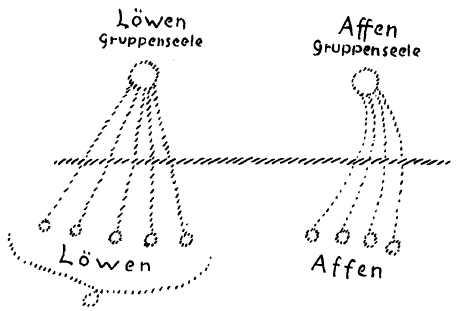
[ 27 ] Therefore, the animal group soul knows neither birth nor death. The individual animal is something that comes and goes; the group soul remains untouched by life and death. For lions, it is certainly the case that every time a lion dies, everything that had been sent out from the group soul returns to the group soul. This is not the case, however, with monkeys. There are individual animals that tear something away from the group soul, and that part cannot return. When the monkey dies, the essential part returns, but a portion of the group soul breaks away. The monkey, as it were, tightens its grip too firmly on what has been extended, and when it dies, a part of the group soul breaks away, so that a piece of it, as it were, breaks off, tears away from it, and cannot return. This is how separations from the group soul arise. Separations from the group soul occur in all species of monkeys.
[ 28 ] We see something similar in certain amphibians, in certain species of birds, and particularly clearly in the kangaroo. Through these separations, a part of the group soul remains behind, and what remains in this way from warm-blooded animals becomes an elemental being, a nature spirit—the salamander. These elemental beings, these nature spirits, are thus, as it were, waste products of higher worlds that are put to work by higher beings. Left to their own devices, they would disrupt the cosmos. Thus, for example, higher wisdom employs the sylphs to guide the bees to the flowers. In this way, the great host of elemental beings is placed under higher, wise guidance, thereby transforming the harm they might cause into something beneficial.
[ 29 ] This is how things are in the realms that lie beneath the human being. However, it can also happen that a human being cuts himself off from his group soul and, as an individual soul, finds no way to continue developing. For while, as a member of his group soul, he was guided and directed by higher beings, he is then left to his own devices. If a person does not acquire the appropriate spiritual knowledge, he is in danger of severing himself. This is the question that arises.
[ 30 ] What, then, is it that protects human beings from becoming cut off, from wandering aimlessly without direction or purpose, whereas in the past the spiritual group soul provided them with a direction? We must be clear that human beings are becoming increasingly individualized and that, in the future, they will have to seek union with others more and more of their own free will. In the past, this connection was based on blood ties, tribes, and races. But this form of union is gradually coming to an end. Everything within the human being is increasingly leading toward becoming an individual. Now, only the opposite path is possible. Imagine a number of people on Earth who say to one another: “We are going our own ways; we want to find the direction and destination of our path within ourselves; we are all on the path to becoming increasingly individual human beings.” — Therein lies the danger of fragmentation. People can no longer tolerate even spiritual unions. Today we have gone so far that everyone has their own religion and holds their own opinion up as the highest ideal. But when people internalize these ideals, it leads to unity, to a common understanding. We recognize inwardly, for example, that 3 times 3 equals 9, or that the three angles in a triangle total 180 degrees. This is an inner realization. There is no need to vote on inner realizations; they do not give rise to differences of opinion—they lead to unity. All spiritual truths are of this nature. What Spiritual Science teaches, a person discovers through his or her inner powers. These lead him or her to absolute unity, to peace and harmony. There cannot be two opinions about a truth without one of them being false. The ideal is the greatest possible internalization; it leads to unity and peace.
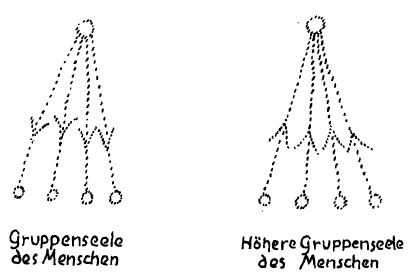
[ 31 ] At first, there was a group soul of humanity. Then, in the past, humanity was released from the group soul. But in the future of human development, people must set a sure goal toward which they can strive. When people unite in a higher wisdom, a group soul descends once more from higher worlds—when free communities arise from the bound natural communities. What the leaders of the Spiritual Science movement intend is that we find within it a community into which the hearts of wisdom flow, just as plants turn toward the sunlight. Where communal truth unites the various “I’s,” there we give the higher group soul the opportunity to descend. By turning our hearts together toward a higher wisdom, we provide a foundation for the group soul. We form, so to speak, the bed, the environment in which the group soul can incarnate. People will enrich earthly life by developing something that allows spiritual beings from higher worlds to descend. That is the goal of the Spiritual Science movement.
[ 32 ] This has been set before humanity once in a magnificent, awe-inspiring form to show that, without this spiritually alive ideal, humankind would slip into a different state: it is a symbol capable of demonstrating to people with overwhelming power how humanity can find the path to offering the common spirit a place of embodiment through spiritual unity. This symbol is set before us in the Pentecost community, when a shared feeling of fervent love and devotion set ablaze a group of people who had gathered for a common purpose. There is a group of people whose souls are still reverberating from the earth-shaking event, so that the same feeling lived within them all. In the convergence of this one, shared feeling, they provided the vessel in which a Higher Being—a collective soul—could incarnate. This is expressed in the words that state that the Holy Spirit, the group soul, descended and divided itself like tongues of fire. This is the great symbol for the humanity of the future.
[ 33 ] Had humankind not found this connection, it would have transformed into an elemental being. Now humanity must seek a place for the beings descending from higher worlds. Through the events of Easter, humankind was given the power to absorb such powerful mental images and to strive toward a spirit. The Feast of Pentecost is the fruit of the unfolding of this power.
[ 34 ] Through the convergence of souls toward a shared wisdom, what establishes a living connection to the forces and beings of higher worlds—and to something that currently holds as little significance for humanity as the Feast of Pentecost—will always come to pass. Through Spiritual Science, it will once again become meaningful to humanity. When people come to understand what the descent of the Holy Spirit will mean for humanity in the future, then the Feast of Pentecost will come alive again. It will then no longer be merely a remembrance of that event in Jerusalem, but rather that everlasting Feast of Pentecost—a gathering of souls—will become a reality for humanity. It will become a symbol of the great Pentecost community of the future, when humanity will come together in a shared truth to give higher beings the opportunity to incarnate. It will depend on human beings themselves how valuable the Earth will become for the future as a result, and how effective such ideals can be for humanity. If humanity strives toward wisdom in this proper way, then higher spirits will unite with humankind.