
Myths and Symbols
GA 101
21 October 1907, Berlin
Translation by Dorothy S. Osmond
A Mongolian Legend. The Hermaphrodite. Man’s Victory over the Physiognomy of Death; the Skeleton. The Flight of Birds.
The different lectures given on the subject of sagas and myths have shown us that ancient knowledge of the spiritual world is contained in narratives which have survived among the peoples or have spread in some other way through humanity. The spirit of man has preserved in these myths a kind of thinking and feeling which once enabled humanity to possess a far higher form of knowledge than can ever be attained by the intellectual observation that is bound up with the outer senses. But one who has the gift of real discernment can perceive the deep wisdom-truths radiating from these brief legends and narratives.
We know that there was once a great migration from West to East; as certain sections of the Atlantean peoples moved from the West across to the East, they carried with them remembrances of conditions prevailing in old Atlantis and in still earlier times. In those who ponder the indications contained in the legends of these peoples with insight quickened by Spiritual Science, a knowledge of ancient times will begin to dawn and feelings that may well be stirred by these wisdom-truths then find their bearings in the divine World Order. The more closely wisdom approaches intellect, the colder, more devoid of feeling it becomes; the higher it ascends, the warmer, the more full of feeling it becomes.
Is there anyone whose feelings glow with real warmth while he is studying some scientific theory? The theory of physical heredity or adaptation never stirs the feelings. But if someone hears how humanity has lived through the conditions of Saturn-, Sun-, and Moon-existence, through the epochs of Lemuria and Atlantis—if he hears these things and remains inwardly unmoved, then the state of his soul cannot be really healthy. Such narratives strike chords in the very heart of a man whose mind and feelings are open and unbiased. Truths of this nature are contained in the sagas and myths and even if a man does not understand them, he will surely glimpse something of their profundity and wisdom in the feelings which arise in him.
Among the Mongolians in Asia there is a simple tale which has found its way to regions in Europe where Mongolian sagas still survive. It is a short, deeply moving narrative.
There is a mother who has at the top of her head a single eye. She wanders despairingly through the world, for she has lost her only child. On her wanderings she picks up every stone she sees, holds it in front of this eye and then, in utter disappointment, casts it away so that it splits into a thousand fragments. She has realised that this is not her child. Believing that she will find the child in every object, she seizes it, holds it in front of her eye and casts it from her. And so she hurries on, never at rest, always meeting the same experience.
This narrative is nothing else than a remembrance living in the peoples who wandered farthest to the East and who in Atlantis had still known of primeval conditions of our Earth, when men themselves were still able to see into the spiritual worlds. You all know that the bones at the top of a child’s head close only by degrees. In very ancient times there was, at this place in the head, a channel of communication between the human being and the outside world. If one had been able to see this connecting-link, it would have appeared as a body of light at the top of the head, raying outwards into the world.
This organ was not an eye but an instrument of feeling—particularly for warmth—by means of which the human being was able to look out freely into the astral world, to perceive not only bodies but the beings within those bodies around him. This organ has shrivelled away to become the pineal gland, as it is called, now covered by the vault of the skull. But as a heritage of this ancient organ which enabled him to experience the spiritual worlds, man still has something within him today, namely, the longing for those worlds which have been shut away from him by the closed door of his head. This longing in the souls of men finds expression in the religions. Just as in days of yore man saw around him beings aglow with warmth and feeling, so nowadays he sees himself surrounded by physical objects.
Truly it is a moving narrative. The woman, the mother of humanity who has the power of clairvoyance, wanders through the world, seeking for something that will satisfy her longing but she does not find it in any of the outer objects which are disclosed to mankind today through the senses. It is with this profundity that the spirit of man speaks to us in the sagas and myths whose real meaning can only be discovered with the help of Spiritual Science. It might be thought that the story is sufficiently explained by linking it with the remembrance of a condition actually prevailing among mankind, but in reality it is far deeper. With these narratives it is not only a matter of what is said but also of how it is said. They contain something deeper still.
There may seem to be a contradiction in the fact that the woman in whom this organ is preserved perceives and recognises external objects with a single eye, whereas the things of the outer world can be perceived only with the two eyes as they are today. But precisely here lies a deep mystery-truth, only to be fathomed by turning our gaze to the happenings in which humanity has been involved. We shall see how applicable this knowledge is in practical life when it is viewed in the light of Spiritual Science.
When a scientist is examining a human body in the dissecting room or studying physiological processes from outside, he feels that the same approach can be made to every one of the organs; he uses the same instruments when dissecting the heart or the stomach; he thinks that the only matter of real importance is that of the particular chemical constituents of which these organs are composed. He has no inkling whatever that they differ fundamentally, according to the sources of their form and structure. None of these organs would exist if an astral body were not membered into man, and because the nervous system is excreted, as it were, from this inner member, the nerve-substance is, in its very essence, different from other substances. The shapers and architects of the nerve-substance have their life and being in the astral world.
In certain realms there are forces, akin to the human ego, which gave the primary impulse for the formation of the red blood. Ego-beings are the shapers and architects of this red blood. They were working from outside before the Ego was able to come down into man. The animals have not an Ego; they are ‘possessed’ by the red blood. But man attains freedom because he is possessed by his ‘I’, by his own very self. It was necessary that he should take possession of himself in order that he might be able to achieve self-mastery.
In the glandular organs the etheric body is working—that is to say, the beings who are active in etheric space. In order to understand the glands we must be clear about one thing;—if there had been no astral body in man, but only an etheric body, then only such beings as are active in etheric space would have worked on the organs in animal and man; the organs we know as glands could never have arisen but only organs similar to those we find in the plant-kingdom around us, for there too the etheric body is working. Every new and additional principle works upon and transforms whatever is already in existence.
Because the astral body penetrates into man and builds the nerve-system, it also works back upon the ether world and transforms the original plant-organs in such a way that they become glands.
If we go back to the original organs from which the liver or spleen or gall-bladder have been formed, we find something altogether different from what comes to light when these organs are dissected with ordinary scientific instruments. When our knowledge of organs is drawn from the higher worlds and then applied in practice, medical science which can be effective in the real sense, will come into being. This is only in the preparatory stage today but will become reality in the future.
In studying the human body it is particularly important to know that certain organs have assumed their present form at a comparatively late stage, whereas others have existed in their present form since primeval times. The organs which only received their present form at a late stage are destined, in a not far distant future, to decay, to wither and fall away from the human body. Other organs are only now in their initial stage of development. These latter organs are destined in the future for an important role in everything that comes to pass through man. Everything connected with the heart and with the larynx will be a creative force. The heart and larynx are still only at the beginning of their development. They will become organs of reproduction, of procreation. An indication of this can be found in the change of the male voice at puberty. Heart and larynx will be transformed into greater and greater perfection of form and later on will bring forth human beings.
On the other hand the procreative organs as they are at present, are in the dying stage; they will harden more and more and sever themselves from the human body. We only understand man’s body when we know how the dying part is related to the progressive part in its evolution. Man has within himself something that is on the way to death and something that is budding more and more into new life. Occult observation can confirm in the case of each of man’s organs whether it is on the way to death or whether it is in the youthful stage.
Once upon a time the pineal gland was very active and powerful; it has now become an organ of almost no importance. The methods for attaining clairvoyance will again conjure forth a new organ from the present pineal gland. Certain organs are imbued with life again when they have reached the stage of death; others die off entirely, disappear from the physical plane and then arise in a new form. Let us study those organs in man which are most obviously on the descending path leading to death, and those in which young life is unfolding on the upward path. The organs of greatest importance are those in which both death and life are contained. The use to which they are put is, from a certain point of view, of supreme importance.
You are all acquainted with the elementary fact that man consists of physical body, etheric body and astral body; within the astral body is the ‘I’, the Ego. The ‘I’ works, to begin with, upon the astral body, continually transforming one part of it. When the ‘I’ came down from the bosom of the Godhead and began for the first time to work upon the astral body, this astral body was, in point of fact, a gift bestowed upon man. Let us picture man at the moment when the ‘I’ penetrated into him. The physical body, the etheric body were there, and penetrating them, the astral body. Then, from above, the ‘I’ strikes into this body and begins to work in the human being. The part of the astral body that is shaped by the ‘I’ is therefore twofold—one part is also possessed by the animal and another arises in the human being because the ‘I’ has worked upon the astral body. In the animal there has been no such incision of the ‘I’; the astral body of the animal has been formed in a particular way, but by powers outside. Everything that comes from the higher worlds shapes and brings about new transformation in the old organ. It is from this standpoint that we must study the relations between these three bodies.
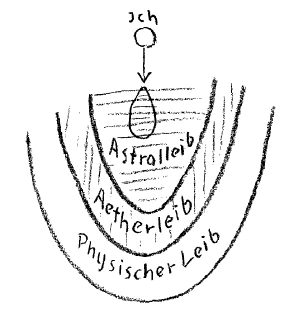
The physical body is composed of the physical and chemical substances existing in the external world; with these alone, without the other bodies, it would simply be mineral. But the ether body, or life body, permeates it in all directions.
What is the function of the life-body? At every moment it counteracts the destruction of the physical body, fights against this destruction; without the life-body the physical body would succumb to the chemical and physical forces and disintegrate, as indeed it does as soon as the life-body has abandoned it at death. While the two are united during life, the etheric body fights all the time against this disintegrating process.
And what is the function of the astral body? It is very important to study this. In a certain sense the astral body is occupied during waking life—not during sleep—with killing the etheric body all the time, with suppressing the forces unfolded by the etheric body; hence the body becomes exhausted during the day. The astral body is constantly destroying the etheric body. But if this did not happen no consciousness would arise. Consciousness is not possible without the gradual destruction of life. The spiritual activity of life which we are describing, the wonderful, scintillating life in the ether-world and the constant suppression of this rhythm by the astral world—this is what gives rise to consciousness. These processes in the spiritual worlds express themselves in the physical world in the following way:—The moment consciousness shoots into what is merely life, a process of hardening, of ossification, begins in the physical body. The more the soft, organic life-masses are permeated inwardly by hard, bony formations, the nearer does the animal approach to a conscious state. In the molluscs and snails these hardened inner organs do not yet exist; the hard shell is excreted in order that the dim consciousness possessed by these animals may arise. In animals with a higher degree of consciousness, all osseous substance is secreted as a secondary activity; the hard, cartilaginous tissues and bony structure are separated out from soft, gelatinous masses. In the highest animal this process has almost reached its culmination in an organic system that is practically finished and complete.
In man, something special happens:—A new incision takes place which partially transforms the astral body. A new direction is given to the earlier tendency towards ossification. If man had left the astral body unchanged and had worked only in the direction of skeleton-formation, no culture would have been possible on the earth. The part of the astral body which was kept separate, brought about a new tendency, a particular task. The hardening process in the skeleton-formation is governed by the astral body.
How does this tendency make itself manifest? Whereas the former tendency led more and more towards hardening, towards fixing a culminating point for the astral system in evolution, the astral body in man keeps something back, something that has a tendency to soften again. This makes it possible for evolution to advance. If this tendency had been absent, if everything had streamed into the bony system, there would be no progress, no culture. Animal species do not progress; the evolution of the tiger species, the lion species, has reached its culmination and goes no further. Man, however, with the part of the astral body which has been kept separate, is able to take what has hardened back again and new organs, soft and pliable organs, can be formed. This is extraordinarily significant! In the animal there is no such tendency.
Let us think of a living human being, with his tendency towards hardening on the one side and on the other, his tendency to hold something back. We see that these two tendencies separate when the human being reaches the age of seven—the time of the change of teeth. The tendency which culminates in ossification is manifest in the teeth. But the human being keeps back sufficient life-force to enable him to evolve. Up to the seventh year in the life of the human being it is only what belongs to the species, the genus, that can come to expression. At this point he is able to take his place in the cultural progress of the times and the school period begins. These two things are inwardly connected: the hardening tendency which comes to expression in the formation of the teeth and the tendency towards softening where something must be kept back, something that the etheric body—which becomes free at the seventh year—needs for its development. The two are connected.
There are many phenomena between which it is difficult to perceive any connection if they are not observed from the vantage-point of the spiritual investigator. Puerperal fever,1Puerperal fever is fever caused by uterine infection following childbirth. as it is called, usually goes together with faulty teeth. The connection between the two tendencies, the tendency to hardening in the teeth and the tendency to carry evolution forward, to give play to the procreative force, becomes evident here; if the one has been impaired, the other is injuriously affected. It is important for these two tendencies to be kept in balance and endeavours must be made to adjust life accordingly. It may happen that the tendency to softening gets the upper hand. For example, workers on the land—whose place in civilisation is essentially different from that of town-dwellers—may be brought into the towns. They would be able to adjust themselves if they and their forefathers had grown up in these conditions; but as things are, there is no harmony, no equilibrium between the hardening and the softening forces of their organism. One of the two will get the upper hand. But if the hardening tendency preponderates, the soft tissues of the organism will begin to harden in a remarkable way. Then when the hardening process becomes unduly strong tuberculosis appears.
As long as animals live in their right environment, no illness of this nature will befall them. But if they are removed from this right environment they too will be prone to this disease in which the hardening tendency preponderates—as for example, in the case with monkeys.
Thus do the spiritual worlds work into our physical world and we can only understand the latter by going back to its spiritual foundations. Just let us reflect how closely everything that has been said is connected with man’s happiness or suffering. Equilibrium in the life of man depends upon his organs having assumed their right form in the evolutionary process at the right time. If an organ remains at an earlier stage, if hardening or softening comes about in the wrong way, a life of unhappiness is the result. Each organ must reach a definite stage in its evolution at a definite time. The development even of those organs in man which are not visible may lag behind or hurry too far ahead. In future times, tuberculosis will no longer be injurious because then certain parts of man’s organism must harden. Diseases that are due to the conditions of civilisation differ from all others.
Do we not hear an echo of this in the tale of the Mongolian woman who vainly seeks her lost child? She has the organ in her head at the wrong time. It brings her woe; never pausing, she hastens through the world and finds nothing that can give her eye satisfaction. She seeks in vain for what belongs to her. What deep wisdom has been woven by the Leaders of humanity into this legend!
Let us now go further and consider man as he is today; he consists of organs on the ascending and descending lines of evolution. Stage by stage the astral body has been membered into him. There was a time when his organs were like plants, of the nature of plants. As the result of the astral body having built the nerve-system, the plant-body took flesh upon itself. This process was only gradual and did not affect all the organs at the same time. If we were to go back to pre-Lemurian times in evolution we should find that the human body still had organs of an entirely plantlike nature.
All the organs in the human body in which the sensual desires work less strongly were the earliest to be transformed into organs of flesh; the organs in which the sensual appetites work most strongly—the sexual organs—were the latest to be so transformed. For long, long ages these organs retained their plant-nature and they will be the first to wither away and pass over into a plantlike existence. It was not until sensual desire had already taken deep root in the human being on his path of descent that the sexual organs were transformed from their plant-nature into organs of flesh. Spiritual Science looks back to a godlike age in remote antiquity when the sexual forces were as yet unknown to man. Such a being could have been seen in the ancient Mysteries—a human being still without sex. At the places where the sexual organs are now situated we should have been able to see in this being creeper-like plant-formations, organs permeated by the etheric body only, untouched as yet by the astral body. Such a being was the figure of the Hermaphrodite in the Mysteries; he appeared in the form which Spiritual Science can confirm as having been a man’s actual form in those remote ages. He has plant organs at the place where the organs of reproduction are situated today and creeper-life plants go out from his loins. We can now understand why among very ancient people and in the Bible legend, the fig-leaf is spoken of. It was not there as a cover but pointed to an ancient, sacred existence when the human being was still plantlike at this place in his organism.
But there is still more to be said. We can observe this overcoming of the hardening tendency in man in yet another way. It is noteworthy that in the occult schools particular account was taken of this. When the ‘I’ of man descended to the Earth from the bosom of the Godhead, it was necessary for this hardening tendency to be overcome. But even before that time there were other creatures in whom this development had already taken place, namely the birds. The birds have an ‘I’ but an ‘I’ that lives much more in the outer external world. Therefore there is something in which they have not shared, something that is important for all human occult development. It is what comes to expression in the development of certain parts of the skeleton, in the development of the bone-marrow. The bones of the birds are hollower than the bones of a human being and the other animals; they have retained a much more ancient condition which man, and the higher animals too, have left behind.
Man sends the forces of the ‘I’ right into the marrow of the bones and a considerable part of his occult development consists in changing the passive relationship in which he stands to his bone-marrow into a conscious one. At the present time he can only work upon what is contained within the bones of the skull, upon his brain, but preparation is being made to enable him to work upon that semi-fluid element which permeates the bones. The fact that the essential force in man penetrated into the very bones, made his present evolution possible; in future time he will acquire the forces to work upon the actual substance in his bones and so to transform his body down to the very bones. First of all he gains dominion over his blood and the blood will then be the instrument whereby he can work right into the bone-substance. The bones are a mineralisation of man’s being. When, down to the very bones, man has gained full mastery over what expresses itself, at the wrong time today, as rickets, then he himself will create his own form; he will transform himself into Atma.2Atma or Atman (anthroposophical term: ‘Spirit Man’) is the highest principle of the human being which is now only in its germinal state and will be fully developed only in the last stage of the cosmic evolution from the Old Saturn to the future Vulcan. He has then gained the victory over the hardening principle, the principle that leads to death, that which expresses its real physiognomy in the human skeleton. The skeleton is a true image of death.
Man will conquer the physiognomy of death when he controls through the power of the spirit the form he now controls from outside through the mechanical organs of the muscles. His thoughts today penetrate into his bones; later on it will be his feelings—and then he will have gained the victory over the physiognomy of death.
What abundant blessing the sciences will bring to man when they come to know about the hardening and softening processes! That is what is meant by saying that Spiritual Science must be put to practical application in life. If legends like the ancient Mongolian fairy-tale have still survived, the truths it contains will be expressed in a different form. Man will observe the world with different senses and be able to understand many of its riddles—for example, the secret of the flight of the birds will then be unveiled. By miraculous ways they travel hundreds upon hundreds of miles from the cold North to the warm South and then back again in the spring by different routes. I have said that the birds are a species that has remained behind at earlier stages of existence.
Progress on the Earth in the real sense began only when the Moon separated from the Earth; before then, when the two were united and there was only Sun and Earth-Moon, this Earth-Moon moved around the Sun with one side always turned towards it. All living creatures on the Earth moved once around the Moon during one of the Moon’s revolutions in order to receive the forces and influences of the Sun. And in the flight of the birds, something of that journey round the planets has been preserved. The birds split off from the progressive course of the evolution of humanity before the ‘I’, the Ego, came to the Earth. With advancing physical evolution, the sexual element entered into possession of each single body. Previously, the astral body—which is filled with desires and works upon the single bodies—was not present. The desires were previously a cosmic force, streaming from the ancient Sun to the ancient Moon. This was the force which directed those ancient movements around the planets, for it determined the manner in which procreation took place. The circling of the birds around the planet is thus nothing else than a bridal procession. In the birds the sexual element is still in the surrounding world and this cosmic force is the directing power, guiding and leading the migration. It guides the birds from outside, whereas in the other case it has penetrated into the single bodies. These are the same forces which work within the body and lead one human being to another in the different sexes. The sexual force that works in man does not work from within in the case of the birds; it comes to expression in the flight around the planets.
When man has acquired the faculty to be united with the whole cosmos, he will also possess the power to work outwards again into the cosmos. The woman of the Mongolian legend too will then again be present. But those forces of spiritual perception which are an attribute of the single eye in the head and which being unappeased made her cast aside and shatter every created thing—those forces will then permeate man. He will then perceive not merely the outer physical objects, but that which lies behind and expresses itself in them. The now hardened physical body will then again be spiritual; the woman of the Mongolian legend will live again and look out as of yore into the spiritual world. And what she then takes hold of she can press lovingly to her heart; she can find in a world made spiritual that which she can hold in her loving embrace.
The evolution of man is towards ascent into the cosmos. Were man unwilling to share patiently in this evolution, the force, the fluid contained in the eye of the men of ancient time would not stream through his whole being, would not permeate his organs. This force would spend itself and man would wither away from lack of love. But the mission of man is to permeate with love everything that lives upon his planet, to pour his forces into the universal All. There can be no redemption of the individual without the redemption of what lies outside us. Man has to redeem his planet together with himself. There can only be redemption when man pours his forces into the cosmos; he must not only be one who is himself redeemed, but he himself must become a redeemer.
Dritter Vortrag
Absterbende und aufsteigende Organentwickelungen im menschlichen Leibe. Die Physiognomie des Todes
Aus den verschiedenen Vorträgen, die über Sagen und Mythen gehalten worden sind, können Sie ersehen, daß in solchen im Volke lebenden oder sonst durch den menschlichen Geist sich fortpflanzenden Erzählungen, Zeichen und dergleichen, uralte Erkenntnisse der geistigen Welt fortleben. Wir finden in den Sagen und Mythen einen Zustand des menschlichen Fühlens und Empfindens sozusagen konserviert, durch den die Menschheit im Besitz eines viel, viel höheren Wissens noch war, als dasjenige ist, das der Mensch gewinnen kann mit Hilfe der gewöhnlichen, an die äußeren Sinne gebundenen Beobachtungsgabe. Wer für solche Dinge eine Ahnung hat, dem können aus kurzen sagenhaften Erzählungen manchmal tiefe Weisheiten herausleuchten.
Sie wissen ja aus den verschiedenen Vorträgen, die da und dort von mir gehalten worden sind, daß einstmals ein großer Zug von Westen nach Osten stattgefunden hat, wo ein gewisser Teil der atlantischen Bevölkerung von Westen nach Osten herüberzog, der mitgenommen hat die Erinnerung an Zustände der alten atlantischen Zeit und an noch ältere Zeiten. Wer mit durch Geisteswissenschaft geschärften Blicken die sagenhaften Andeutungen dieser verschiedenen, da und dort seßhaften Völker betrachtet, dem gehen in diesen Sagen tiefe Erkenntnisse alter Zeiten auf. Und dann lebt sich nicht nur unser Denken, nicht nur unser Philosophieren, sondern dann lebt sich auch unser Gefühl, das tief ergriffen werden kann von jenen Weisheiten, in die göttliche Weltordnung ein. Denn je mehr die Weisheit nach dem Verstande zueilt, desto kälter, desto gefühlloser wird sie; je mehr die Weisheit hinaufeilt, den höheren Regionen des eigentlichen Geisteslebens zu, desto wärmer, desto gefühldurchtränkter wird sie.
Wer vermöchte wohl eine abstrakte Theorie der materialistischen Naturwissenschaft, sei sie auch noch so sehr durchdrungen von wahren Beobachtungen wie der Darwinismus, wer vermöchte diese Theorien mit warmer Empfindung und warmem Gefühl zu verfolgen? Wem könnte wohl das Herz schneller schlagen, wenn er die Worte Vererbung, Anpassung und dergleichen hört? Er empfindet nichts dabei. Aber wer davon hört, wie die Erde hindurchgegangen ist durch die früheren Formzustände von Saturn-, Sonnen- und Mondenzeit, wer davon hört, wie die Menschheit aufgestiegen ist von der lemurischen zur atlantischen Zeit und so weiter -, wer davon hört und dabei unbewegt bliebe, der muß in einem ungesunden Seelenzustand sein. Wer unbefangen zu empfinden vermag, dem schneiden solche Erzählungen tief in das Herz. Wer solche Sagen und Märchen anhört, der ahnt die Tiefe der darin enthaltenen Weisheit in den Gefühlen, die sie in ihm erregen.
Es gibt eine einfache Erzählung, die unter den Mongolen Asiens lebt, und die auch bis nach dem Osten Europas sich verpflanzt hat, da wo mongolische Sagen und Erzählungen leben. Können wir nicht etwas tief Ergreifendes empfinden, selbst wenn wir noch nicht ahnen, welche Weisheit darin liegt, wenn uns diese mongolische Sage mitgeteilt wird, die da sagt:
Es gibt eine Mutter, die hat ein einziges Auge oben am Kopfe. Diese Mutter eilt trostlos durch die Welt, denn sie hat ihr einziges Kind verloren. Sie eilt durch die Welt, sie hebt jeden Stein auf, führt ihn an ihr Auge oben am Kopfe, und enttäuscht wirft sie ihn wieder von sich auf den Boden, daß er in tausend Stücke zerspringt, denn sie hat sich überzeugen müssen, daß er nicht ihr verlorenes Kind ist. Mit jedem Gegenstand macht sie dasselbe, in jedem Gegenstande glaubt sie ihr verlorenes Kind zu finden; sie greift ihn auf, hält ihn an das Auge und wirft ihn enttäuscht von sich. So eilt sie rastlos durch die Welt, immer wieder diese Prozedur wiederholend.
Diese Erzählung ist nichts anderes als die Erinnerung jenes am meisten nach dem Osten getriebenen Volksstammes, der noch gewußt hat von der alten Atlantis, von dem Urzustande der Menschheit, wo der Mensch noch nähergestanden hat den geistigen Welten und noch selbst in die geistigen Welten hat hineinschauen können.
Sie wissen ja alle, daß beim Kinde nach der Geburt die Knochen hier oben am Kopfe sich nur langsam schließen. Da war in uralten Zeiten beim Menschen noch eine Verbindung mit der Außenwelt vorhanden. Hätte man damals sehen können wie heute, so hätte man an jener Stelle des Kopfes ein Organ hervorragen sehen können wie einen leuchtenden Körper, dessen Strahlen die menschliche Begrenzung durchdrangen und langsam in der Außenwelt verschwanden. Man würde etwas wie eine wundersame Laterne haben sehen können, was man nur mit Unrecht ein Auge nennt, denn ein Auge war jenes Organ nicht. Aber es war ein Empfindungs-, ein Wahrnehmungsorgan der Menschheit in jenen ur-uralten Zeiten, mit dem der Mensch noch frei und offen hinausschauen konnte in das, was wir die astralische Welt nennen, mit dem er nicht nur die Körper, sondern auch die Seelen hat sehen können und das, was in diesen Seelen um ihn herum gelebt hat.
Zusammengeschrumpft zu der sogenannten Zirbeldrüse ist dieses Organ, das von der Decke des Kopfes jetzt bedeckt ist. Der Mensch trägt aber heute als Erbstück dieses alten Organs, mit dem er die geistigen Welten um sich erleben konnte, eines in seiner Seele in sich, und das ist die Sehnsucht nach diesen Welten, für die sich ihm das Tor geschlossen hat, das Tor seines eigenen Kopfes. Die Sehnsucht nach dieser Welt ist geblieben, nicht die Möglichkeit des Hineinschauens. In den Religionen drückt sich diese Sehnsucht aus, die in den Menschenseelen lebt. Sah der Mensch früher in den geistigen Regionen warme, fühlende Wesenheiten um sich, so sieht er sich heute durch seine Augen umgeben von physischen, konturierten Gestalten.
Wirkt nun nicht ergreifend jene Erzählung von der Frau, die die Mutter der Menschheit ist, die suchend durch die Welt geht, die sucht, was ihre Sehnsucht stillt, und es nicht findet in all den äußeren Gegenständen, weil sie das nicht mehr sieht, was sie einst wahrnehmen konnte, als das eine Auge oben am Kopfe noch funktionierte? In all den äußeren Gegenständen, die heute der Menschheit durch die Sinne gegeben sind, kann es nicht mehr gefunden werden. So tief spricht der Mund des Weltengeistes zu uns durch die Sagen und Märchen; und erst dann können wir deren tiefen Sinn verstehen, wenn wir sie vom Standpunkte wahrer Geisteswissenschaft betrachten. Wir könnten glauben, wenn wir eine solche Erzählung hören, diese Erklärung, die anknüpft an die Erinnerung eines wahren Tatbestandes bei der Menschheit, sei tief genug. Doch sie ist noch viel tiefer. Es kommt bei diesen Sagen auch nicht nur darauf an, was gesagt wird, sondern auch wie es gesagt wird. Wenn man wirklich ihren Weisheitskern erforscht, so sieht man, daß ein scheinbarer Widerspruch sich löst. Denn es könnte ja als Widerspruch erscheinen, daß die Frau, die sich dieses Organ bewahrt hat, die äußeren Gegenstände an das eine Auge hält und mit diesem Auge sieht und erkennt, während man doch die Dinge der Außenwelt nur mit den jetzigen zwei Augen sehen kann. Gerade darin liegt aber eine tiefe Mysterienwahrheit, die wir nur tief genug fassen müssen; dann können wir einen Blick hinein tun in das Geschehen, in das die Menschheit mit hineinverflochten ist. Wir werden sehen, wie praktisch und ganz alltäglich anwendbar eine solche Wahrheit ist, die wir herausholen aus den Tiefen der Mysterienweisheit.
Der Wissenschaftler, der mit dem äußeren Blick den Menschen betrachtet, im Seziersaal oder sonst, nach den physiologischen und biologischen Bestandteilen, der hat das Gefühl, daß er an jedes der Organe mit der gleichen Stimmung herangeht; er legt in derselben Weise die Instrumente an, wenn er das Herz, das Hirn, die Leber, den Magen zerfasert. Er meint, es komme einzig darauf an zu begreifen, aus welchen chemischen Bestandteilen diese Organe bestehen und geformt seien. Er ahnt nichts davon, daß diese Organe grundverschieden sind, je nachdem, woraus sie gebildet sind. Die Nerven würden nicht da sein, wenn nicht dem Menschen ein astralischer Leib eingegliedert wäre, und diese innere Wesenheit ist es, die heraussondert das Nervensystem und dadurch die Nervensubstanz zu etwas von den anderen Substanzen Wesensverschiedenem macht. In der astralischen Welt wesen und leben die Bildner und Baumeister der Nervensubstanz, und sie bilden weise, sehr weise.
In gewissen noch höheren Gebieten des geistigen Daseins befinden sich Wesen, die identisch, gleichartig sind dem menschlichen Ich-Wesen selber, die zuerst Veranlassung gegeben haben zur Bildung des roten Blutes. Sie können das lesen in der Schrift «Blut ist ein ganz besondrer Saft». Ich-Wesen sind die Bildner und Baumeister dieses roten Blutes. Sie wirkten von außen, damit das Ich sich in den Menschen versenken konnte. Die Tiere haben das Ich noch nicht. Wo beim Tier rotes Blut ist, da wirken Wesen von außen; die Tiere sind vom roten Blute «besessen». Der Mensch aber kommt dadurch zur Freiheit, daß er von seinem Ich, von sich selbst «besessen» ist. Er mußte von sich selbst Besitz ergreifen, um die Herrschaft über sein Blut erlangen zu können.
In den Absonderungsorganen, die wir Drüsen nennen, wirkt der Ätherleib, das heißt, es wirken diejenigen Wesen, die im Ätherraum wirken. Um diese Drüsen zu verstehen, müssen wir uns etwas klarmachen. Würde der Mensch nur einen Ätherleib haben und keinen Astralleib, dann würden auch nur Wesen aus der Welt des Äthers im menschlichen Leibe wirken, und es könnten dann keineswegs die Organe entstehen, die wir als Drüsen bezeichnen, sondern nur solche Organe, die ähnlich wären denen, wie sie sich draußen im Pflanzenreich finden. Denn auch da wirkt der Ätherleib, der die Pflanzen durchsetzt und das Unorganische zum Leben aufruft. Jedes neue Prinzip, das dazukommt, wirkt umgestaltend auf alle vorhandenen. Dadurch, daß das Astralische in den Menschenleib eindringt und für sich selbst das Nervensystem konstruiert, wirkt es auch zurück auf die Welt des Äthers und gestaltet die ursprünglichen Pflanzenorgane um, so daß sie zu Drüsen werden.
Es ist nun möglich, die Organe des Menschen zu studieren in ihrer verschiedenen Wertigkeit, wenn man zurückgeht auf die Urgründe, die in den geistigen Welten zu finden sind. Wir finden, daß Leber, Galle, Milz und so weiter etwas ganz anderes sind, wenn man weiß, wie verschiedene Welten an ihrer Gestaltung beteiligt sind, als wenn wir sie bloß mit den gewöhnlichen Instrumenten der Wissenschaft physiologisch zergliedern. Sie sind Erbteile aus der geistigen Welt heraus. Es müssen alle Organe beim Menschen aus ihren geistigen Ursprüngen heraus von uns betrachtet werden, wenn wir deren Bedeutung richtig verstehen wollen. Da sehen wir hin auf eine zukünftige Behandlungsweise des menschlichen Leibes, wo man sich dieses geistigen Ursprunges der Organe bewußt sein wird und diese Erkenntnisse anwenden wird in der alltäglichen Medizin. Das ist ein Prozeß, der langsam und geduldig durchgemacht werden muß. Das kann nicht von heute auf morgen geschehen, aber es bereitet sich vor und wird in der Zukunft geschehen.
Namentlich eines ist wichtig zu beachten bei der Betrachtung des menschlichen Leibes. Es gibt in ihm solche Organe, die ihre jetzige Gestalt erst verhältnismäßig spät bekommen haben, und andere, welche schon seit Urzeiten ihre jetzige Gestalt haben. Es gibt solche Organe, die durch ihre jetzige Gestalt dazu berufen sind, immer mehr und mehr zu vertrocknen und abzufallen, wegzufallen vom menschlichen Leibe; und es gibt solche Organe, die jetzt ihre Anfangsgestalt haben, die dazu berufen sind, diese mehr und mehr zu vervollkommnen und in der Zukunft geradezu eine wichtige Rolle zu spielen bei allem, was durch den Menschen geschieht. Zu den Organen, welche in der Zukunft geradezu schöpferisch sein werden, gehört alles, was mit dem menschlichen Herzen und dem menschlichen Kehlkopf zusammenhängt. Diese Organe stehen erst im Anfange ihrer Entwickelung, sie werden in Zukunft Reproduktionsorgane, Fortpflanzungsorgane sein. Sie finden das heute schon leise angedeutet dadurch, daß beim Manne sich die Stimme verändert, wenn die Geschlechtsreife eintritt. Herz und Kehlkopf werden sich verändern, sie werden sich vollkommener und vollkommener gestalten, und später werden ihnen menschliche Wesen entspringen.
Die heutigen Fortpflanzungsorgane dagegen sind auf dem Aussterbeetat; sie werden sich immer mehr verhärten und schnüren sich ab vom menschlichen Leibe. Man versteht den menschlichen Leib nur dann in richtiger Weise, wenn man weiß, daß er zusammengesetzt ist aus einem absterbenden Teil und einem in der Entwickelung fortschreitenden Teil und wie sich der absterbende Teil zu dem fortschreitenden Teil verhält. Der menschliche Leib enthält etwas in sich, was immer mehr in den Tod hineingeht, und etwas, was immer mehr zu neuem Leben aufblüht. Wer den Menschen vom okkulten Standpunkte aus betrachtet, kann bei jedem Organ angeben, ob es ein solches ist, das zur abflutenden Entwickelung gehört, das dem Tode zueilt, das die Menschheit künftig nicht mehr haben wird, oder ob es ein solches ist, das auf der Jugendstufe steht und in Zukunft erst größer und gewaltiger ausgebildet sein wird. Sie können solche Organe im menschlichen Leibe sehen, die in ihrer Natur schon zusammengeschrumpft und in ihrer Tätigkeit abgestumpft sind, die nur noch eine spärliche Tätigkeit haben. Ein solches Organ ist die Zirbeldrüse. Sie hatte einstmals eine mächtige Tätigkeit und ist jetzt herabgesunken zu einem fast bedeutungslosen Organ. Gewisse Organe gehen fast bis zur Stufe des Todes und werden dann wieder neu belebt in anderer Weise. Andere Organe sterben ganz ab, sie verschwinden in ihrer Form vom physischen Plan und treten dann wieder auf in anderer Gestalt.
Nun betrachten wir einmal den menschlichen Leib, da wo er am deutlichsten auf der absteigenden Bahn dem Tode zueilt, und da, wo er in aufsteigender Bahn ein neues, junges Leben entfaltet. Diese beiden Dinge gehen durch einander hindurch. Die wichtigsten Organe sind hineingepreßt in diese Bahn der auf- und absteigenden Entwickelung, so daß sie beides, den Tod und das Leben, in sich haben. Ihre Behandlung ist unter Umständen im menschlichen Leben das Allerwichtigste. So wollen wir sie an einem signifikanten Beispiel anschauen.
Sie wissen alle aus meinen sonstigen Vorträgen die ganz elementare Tatsache, daß der Mensch besteht aus dem physischen Leib, dem Ätherleib, dem Astralleib und dem Ich. Sie wissen, daß das Ich zunächst am Astralleib arbeitet und immerfort einen Teil desselben umgestaltet. Wenn Sie zurückblicken auf jenen Zeitpunkt der Menschheitsentwickelung, wo das Ich sozusagen heruntergestiegen ist aus dem Schoße der Gottheit und zum ersten Male angefangen hat, am astralischen Leibe zu arbeiten, da geht Ihnen doch die Anschauung auf, daß einstmals der astralische Leib ein Geschenk der Gottheit an den Menschen war. Wenn wir uns schematisch diesen Menschen klarmachen wollen in dem Moment, wo eben das Ich eingepflanzt worden ist in ihn, so können wir sagen: Es war vorhanden sein physischer Leib (es wird gezeichnet), sein Atherleib und sein astralischer Leib.
Dann schlägt das Ich von oben ein in den astralischen Leib und beginnt zu arbeiten im Menschen, und wir haben dann einen Teil des astralischen Leibes, der vom Ich selbst geformt ist. Dieser astralische Leib besteht heute aus zwei Gliedern, einem Gliede, das auch das Tier hat, und einem anderen, das nur der Mensch hat, das dadurch entsteht, daß der Mensch durch viele Verkörperungen hindurch mit seinem Ich gearbeitet hat am astralischen Leibe. Nun wirkt im Menschen etwas anderes als im Tier. Das Tier hat diesen Einschlag des Ich in den astralischen Leib nicht. Es hat seinen astralischen Leib nur in einer ganz bestimmten Weise geformt, wie es ihn eben von den äußeren Mächten bekommen hat. Nun wirkt alles, was aus den höheren Welten kommt, wieder auf das Ganze des menschlichen Organismus ein, gestaltet alles in einer gewissen Weise um und bewirkt Neugestaltungen der alten Organe, es wandelt die alten Organe um.
Betrachten wir einmal das Verhältnis dieser drei Leiber von diesem Gesichtspunkte aus. Der physische Leib besteht aus ähnlichen Stoffen und Kräften, wie sie in der mineralischen Welt draußen ausgebreitet sind, aus physischen, aus chemischen Stoffen und Kräften. Würde er nur diese haben, wäre er ein Mineral, wenn auch noch so kunstvoll geformt. Ihn durchsetzt von allen Seiten der Äther- oder Lebensleib. Was tut dieser Lebensleib? Er wirkt in jedem Moment dem Zerfall des physischen Leibes entgegen, er ist der Kämpfer gegen diesen Zerfall des physischen Leibes. Ohne ihn würde der physische Leib, wenn er nur sich selbst überlassen bliebe, den physischen Kräften folgen und nach und nach zerfallen. Während des Lebens sind physischer Leib und Ätherleib verbunden, und der Ätherleib kämpft fortwährend gegen den Zerfall des physischen Leibes.
Was tut nun der astralische Leib? Es ist außerordentlich wichtig, das zu wissen. Der astralische Leib ist in gewisser Beziehung während des bewußten Lebens - nicht während des Schlafes - damit beschäftigt, den Ätherleib fortwährend zu töten, fortwährend die Kräfte, die der Ätherleib entwickelt, herabzusetzen, abzudämpfen. Daher ist der Ausdruck für das Leben des Astralleibes die Ermüdung, die Abmüdung des Körpers während des Tages. Der astralische Leib zerstört fortwährend den Ätherleib. Würde er das nicht tun, dann entstünde kein Bewußtsein, denn Bewußtsein ist nicht möglich, ohne daß das Leben fortwährend wieder stufenweise zerstört wird. Das ist außerordentlich wichtig zu beachten. Diese geistige Tätigkeit - das Leben in der Ätherwelt, das wunderbare Aufflackern des Lebens in der Ätherwelt, das sich in den herrlichsten Bewegungen und Rhythmen auslebt, und die fortwährende Dämpfung dieses Rhythmus des Ätherleibes durch den astralischen Leib das ist dasjenige, was das Bewußtsein hervorbringt, auch schon das einfachste tierische Bewußtsein. Diese geistigen Vorgänge drücken sich in der physischen Welt nun so aus, daß in dem Augenblick, wo in das bloße Leben Bewußtsein einschießt, Verhärtung, Verknöcherung im physischen Leibe eintritt. Es gibt natürlich Übergänge, Weichtiere und so weiter; diese haben auch ein ganz eigentümliches Bewußtsein. Das Bewußtsein wird erst dadurch ein eigenes, es nähert sich um so mehr dem Selbstbewußstsein, je mehr sich die weichen, organischen Lebensmassen mit harten, knöchernen Einschlüssen innerlich durchsetzen. Es ist also der astralische Leib in seiner Wirkung auf den Ätherleib, der - wie bei den Weichtieren, Schnecken, Muscheln und so weiter - nach außen die harten Schalenteile absondert, um in ihnen jenes dumpfe Bewußtsein zu erzeugen, das in diesen Tieren lebt. Bei den höheren Tieren, bei denen das Selbstbewußtsein stärker wird, ist es eine Nebentätigkeit des astralischen Leibes neben der Bildung des Nervensystems, alles Knöchertige, Verhärtende abzusondern. In demselben Maße, in dem das Selbstbewußitsein stärker wird, sondert sich aus der weichen, gallertartigen Masse das feste Knorpel- und Knochenartige heraus. Bei den höchsten Tieren ist diese Bildung ungefähr fertig; der astralische Leib hat da ein Knochensystem herausgebildet, das in seiner Art beinah abgeschlossen ist.
Beim Menschen geschieht mit dem astralischen Leibe etwas besonderes, da findet ein neuer Einschlag statt. Der Astralleib wird durch das Ich teilweise umgewandelt, und das bewirkt die Umsetzung der Tendenz der Verknöcherung, die früher da war. Hätte der Mensch den Astralleib unverändert gelassen und weiter fortgearbeitet an der Skelettbildung, so gäbe es keine menschliche Kultur auf der Erde. Aller Fortschritt in der menschlichen Entwickelung ist dadurch bedingt, daß Teile des menschlichen Astralleibes herausgesondert und dem Ich unterworfen werden. Dieser abgesonderte Teil des Astralleibes hat eine besondere Aufgabe, er bewirkt eine neue Tendenz; dadurch kommt die Skelettbildung, die Verknöcherung unter die Herrschaft des abgesonderten Teiles des astralischen Leibes.
Wie äußert sich das? Sehr merkwürdig. Während früher die Tendenz des Astralleibes dahin gegangen ist, das Wesen mehr und mehr zu verhärten, gleichsam einen Schlußpunkt in der Entwickelung des Knochensystems zu setzen, behält der Astralleib des Menschen eine Kraft zurück, eine Tendenz, wiederum zu erweichen, so daß ein Fortschreiten der Entwickelung wiederum möglich ist. Gäbe es das nicht, würde alles das, was fest werden kann, in das menschliche Knochensystem einfließen, so gäbe es keinen menschlichen Fortschritt, keine Kultur. Ebenso wie die tierische Art keinen Fortschritt kennt - die Art der Löwen, der Tiger ist fertig, abgeschlossen -, so würde es auch beim Menschen sein. Der Mensch aber kann mit dem abgesonderten Teil des Astralleibes wiederum das zurücknehmen, was sich verhärtet hat. Neben der Tendenz der Verhärtung, der Knochenbildung, ist im menschlichen Leibe immer die Tendenz vorhanden, etwas zurückzubehalten, so daß neue Organe gebildet werden können, die weich sind. Das ist außerordentlich wichtig zu beachten. Diese Tendenz ist beim Tiere nicht vorhanden.
Betrachten wir jetzt einmal einen Menschen mitten im Leben drinnen, wie er dasteht auf der einen Seite mit seiner Tendenz zu verhärten, und auf der anderen Seite mit seiner Tendenz, etwas zurückzubehalten. Wir sehen diese beiden Tendenzen sich da scheiden, wo der Mensch um das siebente Jahr herum seine zweiten Zähne bekommt. Die Tendenz, in die Knochenbildung hineinzugehen, sich abzuschließen in der Verhärtung, findet ihren Ausdruck in den Zähnen, die das Kind um das siebente Lebensjahr herum bekommt. Der abgesonderte Teil des Astralleibes bewirkt, daß der Mensch abweichend vom Tier - gewisse Lebenskräfte zurückbehält, so daß er sich weiterbilden kann. Bis zum siebenten Jahre kam beim Menschen nur das Artmäßige, das Gattungsmäßige zum Ausdruck; jetzt tritt der Zeitpunkt ein, wo er sich in den Kulturfortschritt unserer Zeit hineinleben kann. Es beginnt die Schulzeit. Diese zwei Dinge hängen wesenhaft zusammen: die Tendenz zur Verhärtung, die sich ausdrückt in der Zahnbildung, und die Tendenz zur Erweichung, die etwas zurückbehalten muß, was der Ätherleib, der im siebenten Jahr frei wird, zu seiner Fortentwickelung braucht. Diese zwei Tendenzen sind aneinandergefesselt, das zeigt sich klar und deutlich im Leben.
Man kann leicht die Beobachtung machen, daß manche Erscheinungen im Leben vorkommen, die man schwer miteinander verbinden kann, wenn man sie nicht vom Standpunkt der Geisteswissenschaft aus betrachtet. Wer zum Beispiel das sogenannte Kindbettfieber beobachtet, kann finden, daß es meistens mit schadhaften Zähnen verbunden ist. Frauen, die Kindbettfieber haben, haben oft schadhafte Zähne. Warum? Weil diese zwei Tendenzen - die Tendenz zur Verhärtung, die sich in der Zahnbildung ausdrückt, und die Tendenz, sich fortzuentwickeln, sich aufzuschließen und über sich hinauszuwachsen, die in der Reproduktionskraft, in der Fortpflanzung zum Ausdruck kommt - zusammenhängen. Ist die eine geschädigt, so ist auch die andere mit geschädigt.
Überall im menschlichen Leben tritt uns das entgegen, wie diese zwei Tendenzen, die nach Verhärtung und die nach dem Weichbleiben gewisser Organe, zusammenhängen. Es ist wichtig, daß diese zwei Tendenzen sich ausgleichen. Man muß das Leben so einzurichten trachten, daß sie sich die Waage halten, denn durch die Kulturverhältnisse, in die der Mensch hineingestellt ist, kommt es oft zu wesentlichen Veränderungen. Holt man zum Beispiel Landarbeiter vom Land weg, aus einem Leben in der freien Natur, aus einer Umgebung, in der schon ihre Vorfahren lebten, und verpflanzt sie in die Stadt, beschäftigt sie in Fabriken und so weiter, so verlieren sie durch die ganz veränderten Lebensbedingungen das Zusammenstimmen, das Äquilibrium zwischen den verhärtenden und erweichenden Kräften in ihrem Organismus. Und was ist die Folge? Eine der beiden Tendenzen wird dann die Oberhand gewinnen, entweder die verhärtenden oder die erweichenden Kräfte. Das sind die Ursachen in der geistigen Welt; die Wirkungen in der physischen Welt können Sie selbst sehen. Nehmen Sie an, die erweichenden Kräfte nehmen die Oberhand, dann treten Kulturkrankheiten auf wie Rachitis und ähnliche Krankheiten. Wenn dagegen die verhärtenden Tendenzen die Oberhand erlangen, dann werden gewisse Weichteile des Organismus anfangen, sich in ganz merkwürdiger Weise zu verhärten. Wenn der Verhärtungsprozeß in ungeeigneter Weise in den Vordergrund tritt, dann entsteht die Tuberkulose. Bei Tieren, die in der Natur leben, finden Sie solche Krankheiten nicht. Versetzen Sie sie aber aus ihrer gewohnten Umgebung in die unsere, zum Beispiel Affen, und sperren Sie sie auch noch ein, da bekommen sie sehr häufig Tuberkulose und gehen in der Gefangenschaft daran zugrunde. Warum geschieht das? Weil da die Verhärtungstendenzen überwiegen, wenn der Affe in eine Umgebung gestellt ist, in die er nicht hineinpaßt.
So sehen Sie die geistigen Kräfte in unser physisches Leben hineinwirken, und so verstehen wir die äußeren physischen Wirkungen aus ihren geistigen Ursachen. Ich müßte noch viel reden, wenn ich diese Zusammenhänge noch genauer erklären wollte. Da aber die wenigsten von Ihnen Mediziner sind, werden Sie sich damit zufrieden geben können.
Und nun bedenken Sie, wie alles das, was jetzt gesagt wurde, zusammenhängt mit des Menschen Glück oder Leid, wie das Äquilibrium des ganzen menschlichen Lebens davon abhängt, daß seine Organe zur rechten Zeit der Entwickelung die richtige Gestalt angenommen haben. Bleibt ein Organ auf einer früheren Stufe zurück, wird die Erweichung oder Verhärtung in unregelmäßiger Weise hervorgerufen, so ist ein unglückliches Leben die Folge. Jedes Organ muß die Ausbildung seiner bestimmten Form auf einer bestimmten Stufe des Lebens erreichen. Wird ein altes Organ auf seiner früheren Stufe erhalten, muß Unglück, Leid kommen. Auch die verborgenen, die nicht ganz sichtbaren Organe des Menschen können in der Entwickelung entweder nachhinken oder vorauseilen. Die Tuberkulose ist etwas, was in der Zukunft den Menschen nicht mehr schaden wird, sie ist nur ein zu frühes Auftreten eines Zustandes, der später selbstverständlich sein wird. Heute ist der Zustand krankhaft, später wird er gesund sein. Von den gewöhnlichen Krankheiten, die auch im Tierleben zu finden sind, unterscheiden sich diese eigentlichen Kulturkrankheiten.
Hören Sie nicht nachklingen diese Wahrheit in dem mongolischen Märchen von der Frau, die vergebens ihr verlorenes Kind sucht? Zur Unzeit hat sie noch das Organ oben am Kopfe. Es bringt ihr Unglück. Rastlos eilt sie durch die Welt, sie findet nicht das, was ihr entspricht, was zu ihr gehört. Welche Weisheit ist da hineingeheimnißt in die einfachen Volkssagen durch die Führer der Menschheit.
Wir können nun noch weitergehen. Betrachten Sie den Menschen, wie er heute ist, wie er besteht aus Organen in aufsteigender und Organen in absteigender Linie der Entwickelung. Nicht immer hat der Mensch den astralischen Leib gehabt; dieser wurde ihm erst nach und nach eingegliedert. Bevor er den astralischen Leib eingegliedert hatte, waren seine Organe pflanzenähnlich, sie waren von pflanzlichem Wesen. Dadurch, daß der Mensch sich eingegliedert hat den astralischen Leib, hat er sich das Fleisch in den ganzen Organismus des Pflanzenleibes hineingegliedert. Dieses Hineinarbeiten des astralischen Leibes in den Pflanzenleib, das ist die Fleischwerdung. Aber dies hat nach und nach stattgefunden, es hat sich nach und nach entwickelt, es hat nicht alle Organe zu gleicher Zeit ergriffen.
Wenn wir zurückgehen in der Menschheitsentwickelung durch die ganze atlantische und Teile der lemurischen Zeit und noch weiter zurück, so würden wir da einen Menschenleib finden, der noch deutlich Pflanzenorgane an sich trug. Teile des menschlichen Leibes waren schon umgewandelt in Fleisch, als andere noch pflanzlicher Natur waren. Alle diejenigen Organe des Menschenleibes, die die Begierden weniger stark in sich tragen, sind am frühesten in Fleisch umgewandelt worden; und die, welche die Begierden am stärksten in sich tragen, die Sexualorgane, sind am spätesten umgewandelt worden. Sie waren lange, lange pflanzlicher Natur, und sie werden auch am frühesten wieder zur pflanzlichen Natur zurückkehren. Erst als in der Entwickelung des Menschen das Ich schon tief in den Astralleib hinuntergestiegen war und die eigensüchtigen Begierden tief eingedrungen waren, da gestalteten sich die ehemals pflanzlichen Organe um und wurden fleischliche Organe.
Auf jene uralte heilige Zeit blickt die Geisteswissenschaft zurück, als der Mensch noch nichts von den sexuellen Kräften wußte. In den alten Mysterien wurde ein Bild verehrt, das den Menschen darstellt, der noch ungeschlechtlich war, bei dem noch nicht umgestaltet war das Geschlechtliche. An der Stelle des Leibes, wo heute die Sexualorgane sind, können wir rankenartige, pflanzliche Organe erblikken, die bloß vom Ätherleib durchzogen sind und noch nichts vom Astralleib in sich tragen. Der Hermaphrodit der antiken Kunst tritt uns so entgegen. Er wurde so abgebildet, wie man den früheren Menschen auch aus der Geistesforschung heraus schildern kann. Er hat Pflanzenorgane an der Stelle der jetzigen Fortpflanzungsorgane, und aus seinem Rücken treiben rankenförmige Pflanzengebilde heraus. Jetzt begreifen wir - in anderer Weise, als es die kindliche Art ist, in der man dies gewöhnlich versteht -, warum die alten Mythen und die biblische Geschichte vom Feigenblatt sprechen: Nicht um etwas zu verdecken, zu verhüllen, sondern um auf eine wirkliche Tatsache in der Menschheitsentwickelung hinzudeuten, auf jenen uralten heiligen Zustand, von dem die Alten noch wußten, daß der Mensch da auf einer höheren Stufe gestanden hatte und die Organe an dieser Stelle noch pflanzlicher Natur gewesen waren.
Aber gehen wir noch weiter. Wir können das Erobern der Verhärtungstendenz beim Menschen noch in anderer Weise beobachten. Es ist merkwürdig, daß in den okkulten Schulen in einer ganz eigenartigen Weise darauf Rücksicht genommen ist. Als das Menschen-Ich hinabgestiegen war auf die Erde aus dem Schoße der Gottheit, da mußte diese Verhärtungstendenz von ihm erobert werden. Aber es gibt andere Wesen, die viel früher den Abschluß ihrer Entwickelung schon erlangt hatten. Das sind die Vögel. Sie haben auch ein Ich, aber ein solches, das viel mehr in der Außenwelt lebt. Sie haben deshalb auch etwas nicht mitgemacht, was wichtig ist für alle menschliche Höherentwickelung, für die okkulte Entwickelung des Menschen. Sie haben nicht mitgemacht dasjenige, was seinen Ausdruck findet in der Herausbildung gewisser Teile des Knochenbaues, des Knochenmarkes, des innersten Inhaltes der Knochen. Vögel haben viel hohlere Knochen als der Mensch und als die anderen Tiere; sie haben einen viel älteren Zustand konserviert. Der Mensch ist über diesen Zustand hinaus-, hinweggeschritten; auch die höheren Tiere sind darüber hinweggeschritten. Es sendet der Mensch die Kräfte des Ich bis in das Knochenmark hinein, und ein guter Teil der okkulten Entwickelung besteht darin, durch Übungen darauf Rücksicht zu nehmen, daß der Mensch jene passive, untätige Art, wie er sich zu seinem Knochenmark verhält, verlebendigt, in eine bewußte umändert. Heute kann er nur wirken auf den Inhalt der Knochenkapsel seines Schädels, auf sein Gehirn. Aber vorbereiten wird sich ein zukünftiger Zustand der Menschheit dadurch, daß er Gewalt bekommen wird über das Element, das als halbflüssiges Element seine Knochen durchsetzt. Die Konstruktion der Knochen hat dem Menschen - und auch den Tieren - auf der Erde die Gestalt gegeben. Daß der Mensch die Knochen so ausgebildet hat, gab ihm die Möglichkeit seiner jetzigen Entwickelung. In Zukunft muß der Mensch die Kräfte gewinnen, seine Knochen wieder zu beleben, ihnen die Verhärtungstendenz zu nehmen und sie umzuwandeln. Er wird die Herrschaft über sein Blut gewinnen, so daß in viel größerem Maße die Kraft des Ich darin sein wird, und dieses Blut wird dann das Instrument sein, mit dem der Mensch wirken kann bis in die Umgestaltung der Knochensubstanz. Was ist denn die Knochenbildung anderes als eine Vermineralisierung? Wenn der Mensch die Tendenz zur Erweichung, die sich heute zur Unzeit als Rachitis ausdrückt, beherrschen wird, wenn er das Blut so beherrschen wird, daß er wirken kann bis in die Knochensubstanz, dann wächst er über die Mineralisierungstendenz hinaus; er wird sich selbst die Gestalt geben, er wird seinen physischen Leib umgestalten bis zu dem, was wir Atma oder Geistesmensch nennen. Da besiegt der Mensch das Verhärtungsprinzip, jenes starke Prinzip, das zum Tode führt, dessen eigentliche Physiognomie ausgedrückt ist im menschlichen Skelett. Es ist eine Intuition richtiger Art, wenn man den Tod im Bilde des Skeletts anschaulich macht. Diese Physiognomie des Todes wird der Mensch unter seine Herrschaft bringen. Er wird sie besiegen, wenn er seine Gestalt, so wie er sie jetzt von außen durch die mechanische Kraft der Muskeln beherrscht, von innen durch die Kraft des Geistes beherrschen und sich selbst die Gestalt geben wird. Heute kann der Mensch erst seine Gedanken bis in seine Knochen schicken; wenn später seine Gefühle in den Knochen wirken werden und noch später der bewußte Wille, dann wird er die Physiognomie des Todes überwunden haben.
Nun denken Sie sich einmal, wie segensreich die Wissenschaften werden wirken können für die Menschen, wenn die, welche dazu berufen sind, die Wissenschaften zu repräsentieren, wieder wissen werden, wie die menschlichen Organe diesem Verhärtungs- und Erweichungsprinzip unterliegen. In diesem Sinne ist es gemeint, daß das, was die Geisteswissenschaft sagt, praktisch anwendbar sei in seiner Wirkung auf das Leben. Wenn diese Dinge Anwendung finden und Wirkung haben im Leben, und wenn man solche Wahrheiten, wie sie angedeutet sind in dem alten mongolischen Märchen, mit geisteswissenschaftlichem Blick durchdringt, dann wird man manches jetzt rätselhaft Erscheinende wieder besser verstehen und seine Wahrheit erkennen können. Man wird mit anderen Sinnen die Welt betrachten und wird zum Beispiel die merkwürdige Erscheinung des Vogelfluges verstehen lernen. Auf wunderbaren Bahnen ziehen die Vögel mit der einbrechenden kalten Herbsteszeit vom äußersten Norden nach dem wärmeren Süden, manchmal Hunderte von Meilen, und gelangen im Frühling zurück auf anderen Wegen. Wir haben gesagt, daß die Vögel ein Geschlecht sind, das auf einer früheren Stufe der Entwickelung stehengeblieben ist. Sie wissen, daß der eigentliche Fortschritt auf der Erde erst begann in dem Zeitpunkt, als sich der Mond von der Erde abtrennte. Früher, als die Erde noch mit dem jetzigen Monde zusammen einen Himmelskörper bildete, den sogenannten Erden-Mond oder die Mond-Erde, da bewegte sich dieser Körper um die Sonne in einer bestimmten Bahn und in einer gewissen Zeit, indem er ihr stets eine Seite zuwendete. In dieser Zeit wanderten alle Lebewesen einmal um den Mond herum, um einmal die Sonneneinwirkung zu empfangen. Jener Zug um den Planeten hat sich heute noch erhalten im Vogelflug, weil die Vögel damals, bevor das Ich in die Erdenentwickelung eintrat, sich abgespalten haben von der fortschreitenden Entwickelung auf der Erde.
Etwas anderes ist noch viel merkwürdiger. Mit der fortschreitenden physischen Entwickelung des Menschen und der höheren Tiere hat sich das Geschlechtliche des einzelnen Leibes bemächtigt. Jene Begierde, die im einzelnen Leibe sitzt, die heute ganz im Geschlechtlichen lebt, war vorher dort nicht vorhanden, sie war eine kosmische Kraft. Dem alten Erden-Monde strömte sie von der Sonne zu. Sie war die Ursache jener Umgänge um den Planeten, mit denen die Art zusammenhing, wie sich die Fortpflanzung vollzog. Der Frühlingszug der Vögel ist in Wirklichkeit nichts anderes als eine Art Brautzug. Bei diesen Wesen ist das Geschlechtliche noch in der Umwelt, und die kosmische Kraft ist die dirigierende Macht, die den Zug von außen lenkt und leitet, während bei den anderen Wesen diese Kraft eingezogen ist in die einzelnen Leiber. Dieselben Kräfte, die im Innern des Menschen, in seinem Leibe wirken, wirken auch im äußeren Makrokosmos. Dieselbe Kraft, die Mensch und Mensch zusammenführt, die im Leibe des Menschen als Geschlechtskraft wirkt, wirkt bei der Vogelspezies nicht im Innern der Wesen, sondern von außen und drückt sich in dem äußeren Zuge der Vögel um den Planeten aus.
So wandern die Kräfte, die außen sind, in das Innere der Wesenheiten hinein, um im Menschen die Möglichkeit zu finden, wiederum hinauszuwirken, wenn er die Fähigkeit erobert haben wird, wieder eins zu werden mit dem ganzen Kosmos, dem Außerirdischen. Was die Menschen an solchen großen Wahrheiten in so ergreifender Weise in den alten Sagen und Märchen ausdrückten - wie in dem mongolischen Märchen von der Frau mit dem einen Auge -, das wird eine zukünftige Menschheit in anderen Formen ausdrücken. Die Kraft des geistigen Schauens wird im Menschen wieder lebendig werden. Jene Kraft des geistigen Schauens, die eine Eigenschaft des Kopfauges ist, sie wird nicht mehr den Menschen sich unbefriedigt fühlen lassen beim Schauen der physischen Dinge der uns umgebenden Welt, wie die Frau in der Legende, die jedes Wesen, das in ihre Nähe gebracht wird, wegwirft. Diese Kraft wird durchdringen des Menschen jetziges Wesen, und er wird dann nicht nur das Äußere, Physische der Dinge sehen, sondern das, was sich in den äußeren Gegenständen an Geistigem ausdrückt. Was heute materiell geworden ist, wird geistig für ihn sein; sein jetzt verhärteter physischer Leib wird dann wiederum vergeistigt sein. Jene Frau aus der mongolischen Legende wird wieder leben und hinausschauen in die Welt. Und während sie heute die Wesen, die ihr nur ihre sinnliche Seite zeigen, wegwirft, weil sie in ihnen nicht findet, was sie sucht, wird der Mensch der Zukunft wieder den Geist in der Materie sehen und in den Wesen das finden, was zu ihm gehört; er kann es ergreifen und liebevoll ans Herz drücken. Er wird an den Wesen das Geistige der Welt finden, dasjenige, was er liebend umfassen kann.
Des Menschen Entwickelung wird eine Entwickelung zu einem langsamen Aufgehen in den Kosmos hinein sein. Sehr langsam muß sie sein, nicht im Fluge kann sie erhascht werden. Würde der Mensch sie nicht in Geduld mitmachen wollen, dann würde die Kraft des Auges, das da sitzt am Kopfe der Alten, nicht sein ganzes Wesen, alle seine Organe durchströmen als Fluidum der Liebe. Diese Kraft würde sich erschöpfen, und der Mensch müßte dann in Lieblosigkeit dem Äußeren sich verschließen und verdorren. Der Mensch ist aber berufen, alles, was auf seinem Planeten ist, liebend zu durchdringen, den Planeten mit sich zu nehmen und zu erlösen. Die Erlösung des Innern kann sich nicht vollziehen ohne die Erlösung dessen, was außer uns ist. Der Mensch muß seinen Planeten zusammen mit sich selbst erlösen. Die Erlösung kann nur sein, wenn der Mensch seine Kräfte in den Kosmos hineingießt, er muß nicht nur werden ein Erlöster, sondern er muß werden ein Erlöser.
Third Lecture
Dying and rising organ developments in the human body. The physiognomy of death
From the various lectures that have been given on legends and myths, you can see that ancient knowledge of the spiritual world lives on in such stories, signs, and the like that live among the people or are otherwise propagated by the human spirit. In legends and myths, we find a state of human feeling and perception preserved, so to speak, through which humanity was still in possession of a much, much higher knowledge than that which man can gain with the help of ordinary powers of observation bound to the outer senses. For those who have an inkling of such things, deep wisdom can sometimes shine forth from short legendary tales.
You know from the various lectures I have given here and there that a great migration once took place from west to east, when a certain part of the Atlantic population moved from west to east, taking with them the memory of conditions in ancient Atlantic times and even older times. Those who, with eyes sharpened by spiritual science, consider the legendary hints of these various peoples settled here and there, will find deep insights into ancient times in these legends. And then not only our thinking, not only our philosophizing, but also our feelings, which can be deeply moved by those wisdoms, come alive in the divine world order. For the more wisdom rushes toward the intellect, the colder and more insensitive it becomes; the more wisdom rushes upward toward the higher regions of actual spiritual life, the warmer and more imbued with feeling it becomes.
Who could possibly pursue an abstract theory of materialistic natural science, even if it is as permeated with true observations as Darwinism, with warm feeling and emotion? Whose heart could possibly beat faster when they hear the words heredity, adaptation, and the like? They feel nothing. But anyone who hears how the earth passed through the earlier forms of Saturn, Sun, and Moon time, anyone who hears how humanity ascended from the Lemurian to the Atlantean time and so on—anyone who hears this and remains unmoved must be in an unhealthy state of mind. For those who are able to feel impartially, such stories cut deep into the heart. Those who listen to such legends and fairy tales sense the depth of the wisdom they contain in the feelings they arouse in them.
There is a simple story that lives among the Mongols of Asia and has also spread to Eastern Europe, where Mongolian legends and stories live. Can we not feel something deeply moving, even if we do not yet suspect the wisdom contained in it, when we are told this Mongolian legend, which says:
There is a mother who has a single eye at the top of her head. This mother rushes desolately through the world because she has lost her only child. She rushes through the world, lifting every stone, holding it up to her eye at the top of her head, and then, disappointed, throwing it back down on the ground, where it shatters into a thousand pieces, because she has had to convince herself that it is not her lost child. She does the same with every object, believing she will find her lost child in each one; she picks it up, holds it to her eye, and throws it away in disappointment. So she rushes restlessly through the world, repeating this procedure over and over again.
This story is nothing other than the memory of that tribe driven furthest to the east, which still knew about ancient Atlantis, about the primordial state of humanity, when people were still closer to the spiritual worlds and could still see into them themselves.
You all know that in children, after birth, the bones at the top of the head close only slowly. In ancient times, humans still had a connection with the outside world. If one could have seen then as one can see today, one would have seen an organ protruding from that part of the head like a luminous body, whose rays penetrated human limitations and slowly disappeared into the outside world. One would have seen something like a wondrous lantern, which one would be wrong to call an eye, for that organ was not an eye. But it was an organ of sensation and perception for humanity in those ancient times, with which humans could still look freely and openly into what we call the astral world, with which they could see not only bodies but also souls and what lived in those souls around them.
This organ has shrunk to the size of the so-called pineal gland, which is now covered by the roof of the head. However, as a legacy of this ancient organ, with which they could experience the spiritual worlds around them, humans today carry something within their souls, and that is the longing for these worlds, to which the gate has closed for them, the gate of their own heads. The longing for this world has remained, but not the ability to see into it. This longing, which lives in human souls, is expressed in religions. Whereas humans used to see warm, feeling beings around them in the spiritual regions, today they see themselves surrounded by physical, contoured figures.
Is it not moving, then, to hear the story of the woman who is the mother of humanity, who wanders through the world searching for something to satisfy her longing, and cannot find it in any of the external objects because she no longer sees what she once perceived when the single eye at the top of her head still functioned? It can no longer be found in all the external objects that are given to humanity today through the senses. This is how deeply the mouth of the world spirit speaks to us through legends and fairy tales; and only then can we understand their deep meaning when we view them from the standpoint of true spiritual science. When we hear such a story, we might believe that this explanation, which ties in with the memory of a true fact in human history, is profound enough. But it is even more profound than that. In these legends, it is not only what is said that matters, but also how it is said. If we really explore their core of wisdom, we see that an apparent contradiction is resolved. For it might seem contradictory that the woman who has preserved this organ holds external objects up to her one eye and sees and recognizes with this eye, whereas we can only see the things of the outside world with our two eyes. But precisely in this lies a profound mystery truth that we only need to grasp deeply enough; then we can take a look into the events in which humanity is interwoven. We will see how practical and applicable in everyday life such a truth is, which we draw from the depths of mystery wisdom.
The scientist who observes human beings with an external gaze, in the dissection room or elsewhere, according to their physiological and biological components, has the feeling that he approaches each of the organs with the same attitude; he applies the instruments in the same way when he dissects the heart, the brain, the liver, and the stomach. He believes that the only thing that matters is to understand the chemical components of which these organs are composed and formed. He has no idea that these organs are fundamentally different depending on what they are made of. The nerves would not be there if the human being did not have an astral body, and it is this inner entity that secretes the nervous system and thereby makes the nervous substance something different in nature from the other substances. The creators and builders of the nervous substance exist and live in the astral world, and they create wisely, very wisely.
In certain even higher realms of spiritual existence there are beings who are identical, similar to the human ego itself, who first gave rise to the formation of red blood. You can read about this in the book “Blood is a Very Special Juice.” I-beings are the creators and builders of this red blood. They worked from outside so that the I could sink into human beings. Animals do not yet have the I. Where there is red blood in animals, beings work from outside; animals are “possessed” by red blood. Human beings, however, attain freedom by being “possessed” by their ego, by themselves. They had to take possession of themselves in order to gain control over their blood.
The etheric body works in the secretory organs, which we call glands; that is, those beings that work in etheric space work there. In order to understand these glands, we must realize something. If humans had only an etheric body and no astral body, then only beings from the world of ether would be active in the human body, and the organs we call glands could not develop at all, but only organs similar to those found outside in the plant kingdom. For there, too, the etheric body is at work, permeating the plants and calling the inorganic into life. Every new principle that is added has a transforming effect on all existing ones. By penetrating the human body and constructing the nervous system for itself, the astral body also has an effect on the world of ether and transforms the original plant organs so that they become glands.
It is now possible to study the organs of the human being in their various values if we go back to the original sources that can be found in the spiritual worlds. We find that the liver, gallbladder, spleen, and so on are something quite different when we know how different worlds are involved in their formation than when we merely dissect them physiologically with the usual instruments of science. They are hereditary elements from the spiritual world. We must consider all human organs from their spiritual origins if we want to understand their significance correctly. We are looking toward a future way of treating the human body in which people will be aware of the spiritual origin of the organs and will apply this knowledge in everyday medicine. This is a process that must be carried out slowly and patiently. It cannot happen overnight, but it is in preparation and will happen in the future.
One thing in particular is important to note when considering the human body. There are organs in it that have only acquired their present form relatively late, and others that have had their present form since time immemorial. There are organs whose current form means they are destined to dry up and fall away, to disappear from the human body; and there are organs that now have their initial form, which are destined to perfect this form more and more and in the future to play an important role in everything that happens through human beings. The organs that will be truly creative in the future include everything related to the human heart and larynx. These organs are only at the beginning of their development; in the future, they will be reproductive organs. You can already see a slight indication of this today in the fact that a man's voice changes when he reaches sexual maturity. The heart and larynx will change, they will become more and more perfect, and later human beings will spring from them.
Today's reproductive organs, on the other hand, are on the verge of extinction; they will become increasingly hardened and severed from the human body. One can only understand the human body correctly if one knows that it is composed of a dying part and a part that is progressing in its development, and how the dying part relates to the progressing part. The human body contains something within itself that is increasingly moving toward death, and something that is increasingly blossoming into new life. Anyone who views the human being from an occult standpoint can say of each organ whether it is one that belongs to the declining development, that is rushing toward death, that humanity will no longer have in the future, or whether it is one that is at the stage of youth and will only become greater and more powerful in the future. You can see organs in the human body that have already shrunk in nature and become dull in their activity, that now have only a sparse activity. One such organ is the pineal gland. It once had a powerful activity and has now declined to an almost insignificant organ. Certain organs go almost to the stage of death and are then revived in a different way. Other organs die completely, disappearing in their physical form and then reappearing in a different form.
Now let us consider the human body, where it most clearly rushes toward death on a downward path, and where it unfolds a new, young life on an upward path. These two things intertwine. The most important organs are pressed into this path of ascending and descending development, so that they contain both death and life within themselves. Their treatment is, under certain circumstances, the most important thing in human life. Let us look at them in a significant example.
You all know from my other lectures the very elementary fact that the human being consists of the physical body, the etheric body, the astral body, and the I. You know that the I first works on the astral body and constantly transforms a part of it. If you look back to that point in human development when the ego, so to speak, descended from the bosom of the Godhead and began to work on the astral body for the first time, you will realize that the astral body was once a gift from the Godhead to human beings. If we want to schematically visualize this human being at the moment when the ego was implanted in him, we can say: His physical body was present (it is drawn), his etheric body, and his astral body.
Then the I strikes into the astral body from above and begins to work in the human being, and we then have a part of the astral body that is formed by the I itself. Today, this astral body consists of two parts, one part that animals also have, and another that only humans have, which arises from the fact that humans have worked on their astral body with their ego through many incarnations. Now something different is at work in humans than in animals. Animals do not have this impact of the ego on the astral body. It has only formed its astral body in a very specific way, as it has received it from external forces. Now everything that comes from the higher worlds acts back on the whole of the human organism, reshapes everything in a certain way and causes the old organs to be reshaped; it transforms the old organs.
Let us consider the relationship between these three bodies from this point of view. The physical body consists of similar substances and forces as those found in the mineral world outside, of physical and chemical substances and forces. If it only had these, it would be a mineral, however artfully formed. It is permeated on all sides by the etheric or life body. What does this life body do? It works against the decay of the physical body at every moment; it is the fighter against this decay of the physical body. Without it, the physical body, if left to its own devices, would follow the physical forces and gradually decay. During life, the physical body and the etheric body are connected, and the etheric body constantly fights against the decay of the physical body.
What does the astral body do? It is extremely important to know this. In a certain sense, during conscious life—not during sleep—the astral body is constantly busy killing the etheric body, constantly reducing and dampening the forces that the etheric body develops. Therefore, the expression of the life of the astral body is fatigue, the weariness of the body during the day. The astral body is constantly destroying the etheric body. If it did not do so, there would be no consciousness, for consciousness is not possible without the life being constantly destroyed again step by step. This is extremely important to note. This spiritual activity — life in the etheric world, the wonderful flare-up of life in the etheric world, which expresses itself in the most magnificent movements and rhythms, and the constant dampening of this rhythm of the etheric body by the astral body — is what produces consciousness, even the simplest animal consciousness. These spiritual processes are expressed in the physical world in such a way that the moment consciousness enters into mere life, hardening and ossification occur in the physical body. Of course, there are transitions, mollusks and so on; these also have a very peculiar consciousness. Consciousness only becomes its own through this process; it approaches self-consciousness all the more, the more the soft, organic life masses assert themselves internally with hard, bony inclusions. It is therefore the astral body in its effect on the etheric body that — as in mollusks, snails, mussels, and so on — secretes the hard shell parts outwardly in order to produce in them the dull consciousness that lives in these animals. In higher animals, where self-consciousness becomes stronger, it is a secondary activity of the astral body, alongside the formation of the nervous system, to secrete everything bony and hardening. To the same extent that self-consciousness becomes stronger, the firm cartilage and bone-like structures separate from the soft, gelatinous mass. In the highest animals, this formation is almost complete; the astral body has developed a skeletal system that is almost complete in its own way.
Something special happens to the astral body in humans; a new impact takes place. The astral body is partially transformed by the ego, and this causes a reversal of the tendency toward ossification that was previously present. If humans had left the astral body unchanged and continued to work on the formation of the skeleton, there would be no human culture on Earth. All progress in human development is conditioned by the fact that parts of the human astral body are separated out and subjected to the ego. This separated part of the astral body has a special task; it brings about a new tendency, whereby the formation of the skeleton, the ossification, comes under the control of the separated part of the astral body.
How does this manifest itself? In a very remarkable way. Whereas previously the tendency of the astral body was to harden the being more and more, as it were to put an end to the development of the skeletal system, the astral body of the human being retains a force, a tendency to soften again, so that further development is possible. If this were not the case, everything that can become solid would flow into the human skeletal system, and there would be no human progress, no culture. Just as the animal species knows no progress — the species of lions and tigers is complete, finished — so it would be with humans. But humans can use the separate part of the astral body to take back what has hardened. In addition to the tendency toward hardening, toward bone formation, there is always a tendency in the human body to retain something, so that new organs can be formed that are soft. This is extremely important to note. This tendency does not exist in animals.
Let us now consider a human being in the middle of life, standing on the one hand with their tendency to harden and on the other with their tendency to retain something. We see these two tendencies diverge when the human being gets their second teeth around the age of seven. The tendency to go into bone formation, to close oneself off in hardening, finds its expression in the teeth that the child gets around the age of seven. The separated part of the astral body causes humans, unlike animals, to retain certain life forces so that they can continue to develop. Until the age of seven, only the species-specific, the generic, was expressed in humans; now the time comes when they can live their way into the cultural progress of our time. School begins. These two things are intrinsically linked: the tendency toward hardening, which is expressed in the formation of teeth, and the tendency toward softening, which must retain something that the etheric body, which becomes free in the seventh year, needs for its further development. These two tendencies are linked, as is clearly evident in life.
It is easy to observe that some phenomena occur in life that are difficult to connect with each other unless viewed from the standpoint of spiritual science. For example, anyone who observes so-called childbed fever may find that it is usually associated with damaged teeth. Women who have childbed fever often have damaged teeth. Why? Because these two tendencies—the tendency toward hardening, which is expressed in tooth formation, and the tendency to develop, to open up and grow beyond oneself, which is expressed in reproductive power, in procreation—are connected. If one is damaged, the other is also damaged.
Everywhere in human life we encounter how these two tendencies, the tendency toward hardening and the tendency toward remaining soft in certain organs, are connected. It is important that these two tendencies balance each other out. We must strive to organize our lives in such a way that they remain in balance, because the cultural conditions in which humans find themselves often lead to significant changes. For example, if farm workers are taken away from the countryside, from a life in the open air, from an environment in which their ancestors lived, and transplanted to the city, employed in factories and so on, they lose the harmony, the equilibrium between the hardening and softening forces in their organism due to the completely changed living conditions. And what is the result? One of the two tendencies will then gain the upper hand, either the hardening or the softening forces. These are the causes in the spiritual world; you can see the effects in the physical world for yourselves. Suppose the softening forces gain the upper hand, then cultural diseases such as rickets and similar diseases occur. If, on the other hand, the hardening tendencies gain the upper hand, certain soft tissues of the organism will begin to harden in a very strange way. If the hardening process comes to the fore in an inappropriate way, tuberculosis develops. You will not find such diseases in animals that live in nature. But if you take them out of their familiar environment and put them in ours, for example monkeys, and lock them up, they very often get tuberculosis and die in captivity. Why does this happen? Because the hardening tendencies predominate when the monkey is placed in an environment in which it does not fit in.
This is how you see spiritual forces influencing our physical life, and this is how we understand the external physical effects from their spiritual causes. I would have to say a lot more if I wanted to explain these connections in more detail. But since very few of you are doctors, you will have to be satisfied with this.
And now consider how everything that has been said is connected with human happiness or suffering, how the equilibrium of the whole of human life depends on its organs having taken on the right form at the right stage of development. If an organ remains at an earlier stage, if softening or hardening occurs in an irregular manner, the result is an unhappy life. Every organ must reach its specific form at a specific stage of life. If an old organ remains at its earlier stage, misfortune and suffering will ensue. Even the hidden, not entirely visible organs of the human being can either lag behind or rush ahead in their development. Tuberculosis is something that will no longer harm humans in the future; it is only the premature occurrence of a condition that will later be natural. Today the condition is pathological, later it will be healthy. These actual diseases of civilization differ from the common diseases that are also found in animal life.
Can you not hear this truth echoing in the Mongolian fairy tale of the woman who searches in vain for her lost child? At the wrong time, she still has the organ at the top of her head. It brings her misfortune. Restless, she rushes through the world, unable to find what suits her, what belongs to her. What wisdom is hidden in the simple folk tales told by the leaders of humanity.
We can now go even further. Consider human beings as they are today, how they consist of organs in ascending and descending lines of development. Human beings did not always have the astral body; it was only gradually incorporated into them. Before it had incorporated the astral body, its organs were plant-like, they were of a plant nature. By incorporating the astral body, human beings incorporated flesh into the entire organism of the plant body. This incorporation of the astral body into the plant body is the incarnation. But this took place gradually; it developed gradually and did not affect all organs at the same time.
If we go back in human evolution through the entire Atlantean and parts of the Lemurian periods and even further back, we would find a human body that still clearly had plant organs. Parts of the human body had already been transformed into flesh, while others were still of a plant nature. All those organs of the human body that carry less intense desires within them were transformed into flesh earliest; and those that carry the strongest desires within them, the sexual organs, were transformed latest. They were of a plant nature for a long, long time, and they will also return to a plant nature at the earliest. Only when, in the development of the human being, the ego had already descended deep into the astral body and selfish desires had penetrated deeply, did the formerly plant organs transform and become fleshly organs.
Spiritual science looks back to that ancient sacred time when human beings still knew nothing of sexual forces. In the ancient mysteries, an image was worshipped that represented human beings who were still asexual, whose sexuality had not yet been transformed. In the place of the body where today the sexual organs are located, we can see vine-like, plant-like organs that are permeated only by the etheric body and do not yet contain anything from the astral body. This is how the hermaphrodite of ancient art appears to us. He was depicted in the same way that earlier humans can be described from spiritual research. They have plant organs in place of the current reproductive organs, and vine-like plant structures sprout from their backs. Now we understand — in a different way than the childlike way in which this is usually understood — why the ancient myths and the biblical story speak of the fig leaf: not to cover up or conceal something, but to point to a real fact in human development, to that ancient sacred state which the ancients still knew, when human beings had stood on a higher level and the organs in this place had still been of a plant nature.
But let us go further. We can observe the conquest of the tendency toward hardening in humans in another way. It is remarkable that this is taken into account in a very peculiar way in occult schools. When the human ego descended to earth from the bosom of the deity, this tendency toward hardening had to be conquered by it. But there are other beings that had already completed their development much earlier. These are the birds. They also have an ego, but one that lives much more in the outside world. Therefore, they did not undergo something that is important for all human higher development, for the occult development of the human being. They did not participate in what finds expression in the formation of certain parts of the bone structure, the bone marrow, the innermost content of the bones. Birds have much hollower bones than humans and other animals; they have preserved a much older state. Humans have moved beyond this state; higher animals have also moved beyond it. Human beings send the forces of the ego into the bone marrow, and a good part of occult development consists in taking this into account through exercises, so that human beings enliven that passive, inactive way in which they relate to their bone marrow and transform it into a conscious one. Today, they can only act on the contents of the bone capsule of their skull, on their brain. But a future state of humanity will be prepared by gaining power over the element that permeates their bones as a semi-liquid element. The construction of the bones has given humans — and also animals — their form on Earth. The fact that humans have developed their bones in this way has given them the possibility of their current development. In the future, humans must gain the power to revive their bones, to remove their tendency to harden and to transform them. They will gain control over their blood, so that the power of the ego will be present in it to a much greater extent, and this blood will then be the instrument with which humans can work to transform the bone substance. What else is bone formation but mineralization? When human beings master the tendency toward softening, which today expresses itself inappropriately as rickets, when they master the blood so that they can work on the bone substance, then they will grow beyond the tendency toward mineralization; they will shape themselves, they will transform their physical body into what we call Atma or spiritual human. Then humans will defeat the principle of hardening, that powerful principle that leads to death, whose true physiognomy is expressed in the human skeleton. It is a correct intuition to illustrate death in the image of the skeleton. Human beings will bring this physiognomy of death under their control. They will overcome it when they control their form from within through the power of the spirit, just as they now control it from without through the mechanical power of the muscles, and give themselves form. Today, humans can only send their thoughts into their bones; when later their feelings will act in their bones, and even later their conscious will, then they will have overcome the physiognomy of death.
Now imagine how beneficial the sciences can be for people when those who are called upon to represent the sciences once again know how the human organs are subject to this principle of hardening and softening. In this sense, it is meant that what spiritual science says is practically applicable in its effect on life. When these things are applied and have an effect in life, and when one penetrates such truths as are indicated in the old Mongolian fairy tale with a spiritual scientific view, then one will be able to understand better many things that now seem mysterious and recognize their truth. One will view the world with different senses and will, for example, learn to understand the remarkable phenomenon of bird flight. With the onset of the cold autumn season, birds fly along wonderful paths from the far north to the warmer south, sometimes hundreds of miles, and return in the spring along different routes. We have said that birds are a species that has remained at an earlier stage of development. You know that real progress on Earth only began when the moon separated from the Earth. Earlier, when the Earth and the present moon still formed one celestial body, the so-called Earth-moon or moon-Earth, this body moved around the sun in a certain orbit and in a certain time, always facing one side toward it. During this time, all living beings migrated once around the moon in order to receive the sun's influence once. That movement around the planet has been preserved to this day in the flight of birds, because birds separated themselves from the progressive development on Earth before the ego entered into Earth's development.
Something else is even more remarkable. With the progressive physical development of humans and higher animals, sexuality took hold of the individual body. That desire, which resides in the individual body and today lives entirely in sexuality, did not exist there before; it was a cosmic force. It flowed from the sun to the ancient Earth-Moon. It was the cause of those movements around the planet that were connected with the way in which reproduction took place. The spring migration of birds is in reality nothing other than a kind of bridal procession. In these beings, sexuality is still in the environment, and the cosmic force is the directing power that guides and directs the migration from outside, while in other beings this force has been drawn into the individual bodies. The same forces that work within the human being, in his body, also work in the outer macrocosm. The same force that brings human beings together, that works in the human body as sexual energy, does not work within the bird species, but from outside, and is expressed in the outer migration of birds around the planet.
Thus, the forces that are outside migrate into the interior of the beings in order to find the possibility in human beings to act outwards again when they have conquered the ability to become one again with the whole cosmos, the extraterrestrial. What humans expressed in such a moving way in the ancient legends and fairy tales – such as in the Mongolian fairy tale of the one-eyed woman – will be expressed by future humanity in other forms. The power of spiritual vision will come alive again in human beings. That power of spiritual vision, which is a characteristic of the head eye, will no longer leave people feeling unsatisfied when looking at the physical things of the world around us, like the woman in the legend who throws away every being that is brought near her. This power will permeate the current being of human beings, and they will then see not only the outer, physical aspect of things, but also what is expressed in the outer objects in terms of the spiritual. What has become material today will be spiritual for them; their now hardened physical bodies will then be spiritualized again. That woman from the Mongolian legend will live again and look out into the world. And while today she rejects beings who show her only their sensual side, because she does not find what she is looking for in them, the human being of the future will once again see the spirit in matter and find in beings what belongs to him; he will be able to grasp it and lovingly hold it close to his heart. He will find in beings the spiritual aspect of the world, that which he can lovingly embrace.
Human development will be a development toward a slow merging into the cosmos. It must be very slow; it cannot be grasped in a flash. If humans were not willing to participate in it patiently, then the power of the eye, which sits at the head of the ancients, would not flow through their entire being, all their organs, as a fluid of love. This power would be exhausted, and human beings would then have to close themselves off from the outside world in lovelessness and wither away. But human beings are called upon to lovingly permeate everything on their planet, to take the planet with them and redeem it. The redemption of the inner self cannot take place without the redemption of what is outside of us. Human beings must redeem their planet together with themselves. Redemption can only come about when human beings pour their powers into the cosmos; they must not only become redeemed, but they must also become redeemers.
