

The Gospel of John
GA 103
25 May 1908, Hamburg
Translated by Steiner Online Library
Sixth Lecture
[ 1 ] It has already been pointed out in these lectures that we are to regard the conversation between Christ Jesus and Nicodemus as a dialogue between Christ and a person capable of perceiving what is perceived outside the physical body through higher organs of perception developed to a certain degree. This is clearly indicated in the Gospel—for those who understand such things—by the fact that we are told: Nicodemus came to Christ Jesus “at night,” that is, in a state of consciousness in which a person does not make use of their external sense organs. Let us not get caught up in trivial explanations that have been offered by various people regarding this “at night.” Now you know that this conversation speaks of the rebirth of the human being—“of water and the Spirit.” These are very important words that Christ speaks to Nicodemus about rebirth in chapter 3, verses 4 and 5:
“Nicodemus said to him, ‘How can a person be born again when he is old? Can he enter his mother’s womb a second time and be born?’
Jesus answered, ‘Truly, truly, I say to you, unless one is born of water and the Spirit, he cannot enter the kingdom of God!’
[ 2 ] We have already said that these words must be weighed with a golden scale, and it must be firmly established that, on the one hand, the words of such a religious document must be taken in their literal sense; but on the other hand, it is also true that we must first discover and understand this literal meaning. The following phrase is often quoted: “The letter kills, but the Spirit gives life” (2 Cor. 3:6). Those who quote this phrase often apply it in a peculiar way. They regard this phrase as a license to read into these words their own imagination—which they call the “spirit of the matter”—and then say to someone who takes the trouble to understand the letter first before arriving at the spirit: “Oh, what does the letter matter to us; the letter kills, but the Spirit gives life!”—Anyone who speaks this way is on roughly the same level as someone who would say: “The Spirit is what is truly alive; the body is dead; so let’s smash the body, and then the Spirit will come to life!” — Anyone who speaks this way does not realize that the spirit develops in stages, that a person must use the organs of their physical body to take in what they experience in the physical world and then carry it up into the spirit. So first we must know the letter; then we can also kill the letter, just as the human body falls away from the human spirit once the human spirit has drawn everything out of the body.
[ 3 ] There is something extraordinarily profound in this very chapter of the Gospel of John. We can only grasp the meaning of this chapter if we trace human evolution even further back than we have already done for the purposes that have guided our study of the Gospel of John thus far. Today we must trace humanity back to even much earlier periods of Earth’s evolution.
[ 4 ] However, so that you are not too shocked from the outset by what needs to be said about these early stages of human existence, I would like to take you back once more to the ancient Atlantean era.
[ 5 ] We have already pointed out that our human ancestors, prior to that great upheaval on Earth—which is preserved in the flood legends—lived over in the West on a landmass that no longer exists today but now forms the floor of the Atlantic Ocean. This continent, which we call ancient Atlantis, was home to our ancestors. When we examine the final stages of this Atlantean period of human history, we find, however, that even in those very distant times, human beings were at least not entirely dissimilar to their present form. But if we go back to the earliest times of Atlantis, we would find a human form entirely different from that of today. Now we can go back even further.
[ 6 ] Before the Atlantean era, humankind lived in a land that, according to modern terminology, is called Lemuria. It, too, was destroyed by massive upheavals on our Earth. It was located roughly where South Asia, Africa, and Australia lie today. If we examine the human forms that lived in Lemuria—insofar as they reveal themselves to the clairvoyant eye—they are very different from people today, and it is not necessary for me to describe these Lemurian human forms and those of the early Atlantean period in detail. Even if you are already accustomed to certain descriptions in spiritual science, the fundamentally different appearance of these ancient Lemurian people compared to those of today would still seem quite improbable to you. Yet, in a certain sense, if we wish to understand what has happened to humanity in the course of Earth’s evolution, we must describe them—albeit in a rather superficial manner.
[ 7 ] Suppose—which is, of course, not actually possible, but let us assume it for the sake of understanding—that you could, with your present senses (which you naturally did not possess back then), look into the last Lemurian and the first Atlantean periods of human history and observe the Earth’s surface in its various parts. If you expected to find human beings on Earth capable of such sensory perception, you would be mistaken. Human beings did not yet exist in a form that would have allowed you to see them with your present-day senses. You would, however, see that certain areas of our Earth’s surface already protrude almost like islands from the otherwise still molten Earth, which is either surrounded by seawater or shrouded in steam. But those areas that protruded as islands were not yet solid landmasses like our present-day continents, but rather soft masses of earth between which fiery forces raged, so that such island regions were constantly being thrust up and then submerged again by the volcanic forces of that time. In short, there is still an element active in fire within the Earth; everything is still alive, surging, and transforming. You would find that in certain areas that already exist—which have already cooled to such a degree—precursors of our present-day animal world live. You might already perceive something of them here and there: you would find grotesque forms, precursors of our reptiles and amphibians. But you would not be able to see anything of human beings, because at that time human beings did not yet possess such a dense, solid physical body. You would have to look for human beings somewhere else entirely—in the masses of water and vapor, so to speak—just as if you were to swim out into the sea today and see little more of certain lower animals than a soft, slimy mass. In this way, you would find the human physical body of that time embedded in the water-vapor regions. The further back you go, the thinner the human being of that epoch becomes, and the more similar he is to his vaporous, watery surroundings. It was not until the Atlantean period that he began to condense more and more; and if one could follow the entire process with one’s own eyes, one would see how this human being condensed out of the water and descended further and further onto the earth’s surface. So it is indeed true that the physical human being set foot on the surface of our Earth relatively late. He descended from the water-air realm and gradually crystallized out of it. In this way, we have gained a rough picture of how there can be a human being who, so to speak, does not yet differ at all from his surroundings, who consists of the very same element in which he lives. If we go back very far in the Earth’s evolution, we find that this human body becomes thinner and thinner.
[ 8 ] Let us now go back to the very beginning of our present-day Earth. We know that our Earth emerged from the ancient Moon. We have called the ancient Moon the “Cosmos of Wisdom.” At a certain stage of its development, this ancient Moon did not possess what we today call Earth—solid Earth—for we must be perfectly clear that on the planet’s incarnation preceding the Earth, the physical conditions were also entirely different. If we go back to the ancient Saturn stage, we must not imagine that it looked like it does on our Earth today—that there were rocks you could have stepped on, or trees you could have climbed. None of that existed at all. If you had approached ancient Saturn from far out in space during the middle stage of its development, you would not have seen any particular celestial body floating there, but you would have sensed something strange—namely, that you had entered a region where you would have felt as if you had crawled into an oven. The only reality of Saturn was that it had a different thermal state than its surroundings. It could not have been perceived in any other way.
[ 9 ] Occultism does not distinguish, as current trivial physics does, between three states of matter, but rather distinguishes even more such states. The physicist says: At present, there are solid, liquid, and gaseous bodies. But Saturn was not even gaseous. The gaseous state is much denser than Saturn’s most solid state. In occultism, we also distinguish the state of heat, which is not merely a state of motion of matter, but a fourth substantial state. This Saturn consisted solely of heat; and as we move from Saturn to the Sun, we simultaneously witness a condensation of this ancient fiery planet. The Sun is the first gaseous embodiment of our planet. The Sun alone is a gaseous or air-like body. The Moon then condenses further. It is a liquid body that later, when the Sun leaves it, assumes a denser state; but the actual intermediate state, in which it is still united with the Sun, is the liquid state. But what we call the present-day mineral Earth—that is, minerals, rock masses, and topsoil—did not yet exist on the ancient Moon. This first appears on our Earth, where it crystallizes out.
[ 10 ] As the Earth begins its evolution, it must once again repeat all its earlier, various states. Every body and every being in the cosmos repeatedly goes through its earlier states at each new stage of evolution, so that our Earth rapidly passes through the Saturn state, the Sun state, and the Moon state. As it passes through the lunar stage, it consists of water mixed with water vapor—not water as we know it today, but water-like, that is, liquid substance; it brings it to the liquid state as the densest form. This watery sphere, which floated in outer space, is not water as we know it today, but water mixed with water vapor—that is, a mixture of gas and liquid—and humanity is already present within it. Because no solid substances have yet precipitated, humanity can exist within this watery sphere. Within it are the “I” and the astral body of modern man. But this “I” and this astral body do not yet perceive themselves as separate entities, but rather as embedded in the bosom of divine-spiritual beings; they do not yet feel detached from a being whose body is the watery, vaporous Earth. Now, within these astral bodies, which are endowed with the “I,” inclusions begin to form—very thin, delicate human embryos. This is depicted in the first figure.
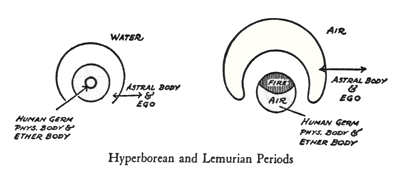
[ 11 ] What is shown there is intended to represent the astral bodies and “I”s—which are invisible to the external eye—that are thus embedded in the watery sphere of the Earth; and from within themselves these bring forth the first rudiment of the physical human body, which exists there together with the etheric body in a very, very subtle state. This takes shape there. If you were to observe this clairvoyantly, you would see the first rudiments of the physical and etheric bodies as if surrounded by the astral body and the “I,” as depicted in the first figure. That which remains behind in bed when you sleep—your physical body and etheric body—forms in its earliest stages within this earthly state as the first human embryo, which is still completely enveloped by the astral body and the I. The watery vapor mass condenses there. The astral body and the “I” cause the first human embryo to integrate itself everywhere into this primordial water-earth. We cannot follow the development of animals and plants any further in this context.
[ 12 ] What happens next is that the water condenses, and in a certain sense, air and water become distinct, so that steam and water are no longer mixed together, but rather water and air separate from one another. The result of this is that the human body—the physical and etheric bodies—becomes somewhat denser again; because the air has now separated from the water, the body itself takes on an airy quality and absorbs the element of fire, so that what was previously water-like now becomes air-like. The physical-etheric human constitution now consists of air through which fire flows; the astral body and the “I” surround it, and all of this moves back and forth—alternately in water and air—within what remains of the water (see Drawing I).
[ 13 ] So we see the human being in such a way that what lies within the sleeping person in bed today is present in a form that has itself become as dense as air and is glowing with fire. Every such “fire-being” has an astral body and an “I.” However, these are completely embedded in the bosom of the Deity; that is to say, they do not yet perceive themselves as a distinct “I.”
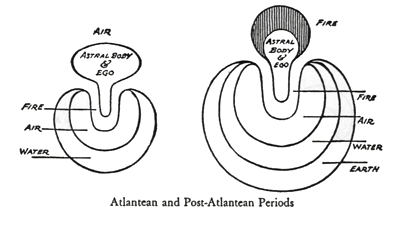
[ 14 ] You must reflect deeply on such matters. For these conditions differ so greatly from the present state of the Earth that they shock people and seem incomprehensible. — Now you will ask: What, then, is the fire that is depicted there in the air? This fire, which humans already possessed back then, still lives within you today. It is the fire that pulses through your blood—it is the warmth of your blood. And the remnants of the ancient air also still live within your organism. When you inhale and exhale, you have air flowing in and out of your otherwise solid body. Imagine that you take a very deep breath; this air is then absorbed into your blood, making it warm air. Now imagine this air rushing through your entire body, penetrating everywhere. But now imagine that everything solid and liquid disappears, and imagine only the form that remains: a person who has just inhaled—that is, who has driven the oxygen all the way to the outermost parts of the body. What remains is a form very similar to a human being, but one consisting of air. The air flowing through the human being takes on the exact shape of the body. What remains is a kind of shadow body, consisting of air, permeated with warmth. Back then you did not have this form, but you were such a human being: the physical and etheric bodies were enveloped by the astral body, which was endowed with the “I.” This state lasted well into the Atlantean era. Anyone who succumbs to the illusion that in the early days of Atlantis people already walked about as they do today is mistaken. Human beings first descended from the airy regions into the denser material region. At that time, there were at most animals on Earth that could not wait to incarnate in the physical realm and therefore remained in their current forms, since the Earth was not yet ripe to provide the material substance for human beings. Thus, the animals remained in lower forms because they could not wait to descend.
[ 15 ] The next stage was that, in terms of his physical body, man was divided into air, heat, and liquid components; but in the occult sense, this means he became a water being. You might now say: But man was already a water being in the past. However, that would not be entirely correct. In the past, the Earth was a sphere of water, and within it were—only in a spiritual sense—the astral body and the I; these floated in the water as spiritual beings; they were not separate entities. Now we have reached the point where you would find the physical human body contained within the water, so to speak, in the form of a jellyfish. You could swim in this primordial ocean and would find within it condensed forms emerging from the water, through which you could see right through. That is how these human beings were at first: they first had a watery body, and while they had this watery body, their astral body and their “I” were still deeply embedded in the divine-spiritual beings.
[ 16 ] Back when human beings had this watery body, the distribution of their states of consciousness was quite different from what it later became. The division between unconscious night and conscious day was not as it is today; rather, back then, when human beings were still embedded within the divine-spiritual beings, they possessed a twilight-like, astral consciousness at night. When he immersed himself in his fluid physical body during the day, it became night for him; and when he emerged again from his physical body, the dazzling astral light dawned upon him. When he immersed himself in the physical body in the morning, it became dim and gloomy, and a kind of unconsciousness set in. But more and more, the physical organs we know today took shape within his physical body. Through this, man gradually learned to see. Daytime consciousness grew ever brighter, and through this he severed himself from the divine bosom. And it was not until around the middle of the Atlantean epoch that human beings had become sufficiently condensed to take on flesh and bone, after the cartilage had first solidified and the bones gradually emerged. And with this, the Earth itself also becomes increasingly solid, and human beings descend to the Earth’s surface. Consequently, the consciousness they had possessed in the divine-spiritual worlds gradually fades; they increasingly become observers of the external world and prepare themselves to become true citizens of the Earth. In the final third of the Atlantean epoch, the human form then becomes increasingly similar to what it is today.
[ 17 ] Thus, the human being literally descends from spheres that we must designate as spheres of water and water vapor, spheres of water and air, and so on. As long as he was in the water-air spheres, his consciousness was an astral, luminous faculty of perception, because whenever he was out of his physical body, he was up among the gods; but as his physical body became denser, he cut himself off, so to speak, from the divine substance. Just as something that is placed in a shell, so did the human being slowly separate himself from his former connection when he ceased to be of a watery and airy nature. As long as he was watery and air-like, he was up among the gods. Although he had not yet been able to develop his “I,” he had not yet detached himself from divine consciousness. As he descended into the physical realm, his astral consciousness grew increasingly dark.
[ 18 ] If we wish to characterize the meaning of this development, we can say: In the past, when human beings were still with the gods, the physical body and the etheric body were watery and airy, and only gradually, as the Earth became denser, did they solidify into their present material form. This is the descent. Just as humanity has descended, so too will it ascend again. After experiencing here what it can experience in solid matter, it will ascend once more into the regions where its physical body is watery and airy. Humanity must carry this awareness within itself: that when it wishes to reconnect in its consciousness with the gods, its true being will be in the regions from which it originated. Humanity has condensed out of water and air; it will once again diffuse back into them. Today, he can only anticipate this state spiritually by inwardly acquiring an awareness of what he will later be physically. But it is only through this that human beings receive the strength to consciously embrace this today. When a person acquires this awareness, he will achieve his earthly goal, his earthly mission. What does this mean? It means that human beings were not originally born of flesh and earth, but of air and water. And later they must truly be reborn in spirit from air and water. — The linguistic usage of the time when the Gospels were written—which we must also study—was such that “water” was simply called “water”; but “pneuma,” which is used today to mean “spirit,” meant “air”; the word certainly had that meaning back then. One must translate the word “pneuma” as “air” or “vapor”; otherwise, one causes a misunderstanding. One must therefore phrase this sentence from the conversation with Nicodemus as follows:
“Amen, amen, I say to you: Unless one is born of water and air, he cannot enter the Kingdom of Heaven.” (3:5) |
[ 19 ] In this way, Christ points to the future state toward which human beings are to evolve, and thus in this discussion we are presented with a profound mystery of our evolution. We need only understand the words correctly and apply them through what anthroposophy can offer us. In everyday language, a trace of this remains in the way we refer to volatile substances as “spirits.” But originally, the word “pneuma” meant “air.” - So you see that it is very much a matter of understanding the words in a very precise, exact sense and weighing them on the scales of gold. But then, precisely from the literal sense, the most wonderful spiritual meaning emerges.
[ 20 ] Now let's try for a little while longer to turn our attention to another aspect of evolution.
[ 21 ] Let us look back once more to the time when the human astral body, together with the “I,” was immersed in the bosom of the universal divine-astral. The process of evolution unfolded in such a way—if you follow this course of development—that we can describe it schematically. Originally, your entire astral body was embedded in the universal astral realm, and through the processes we have just described, the physical and etheric bodies formed around it like shells. As a result, individual human beings were carved out of the universal astral realm as separate parts, as if you were looking at a liquid substance and scooping out portions of it. Parallel to this formation of the physical body was the separation of the individual human consciousness from the divine consciousness. So that, the further we proceed, we can say: We see how—enclosed within the shell of the physical body—the individual human beings emerge as parts that separate themselves from the general astral realm. Of course, human beings must pay for this becoming independent by having their astral consciousness darkened; in return, they look out from the shell of their physical body and see the physical plane. But the old, luminous consciousness is gradually lost to them.
[ 22 ] Thus we see the emergence of what constitutes the inner being of the human being—an independent, individual human inner being that is the bearer of the “I.” When you look at a sleeping person today, what remains in the bed—the physical body and the etheric body—is that which has arisen through densification from these shells that had formed over time. What had previously separated from the general astral realm returns every night to draw strength from the general divine substance. Of course, it does not merge into it as completely as it once did; otherwise, it would be clairvoyant. It retains its independence. This independent individuality is thus something that has arisen in the course of Earth’s evolution.
[ 23 ] To what does this independent, individual human inner being—which seeks sustenance outside the physical body and the etheric body—owe its existence? It owes its existence to the physical body and the etheric body of the human being, which have gradually formed over the course of Earth’s evolution. It has given birth to that which, by day, immerses itself in the physical senses and looks out into the physical world, but which, by night, sinks into a state of unconsciousness because it has detached itself from the state in which it formerly existed. In occult terminology, what lies in bed today is called the actual Earth human. That was the “human being.” And that which contains the “I” day and night—but which has emerged from the physical and etheric bodies—was called the “human child” or the “Son of Man.” The Son of Man is the “I” and the astral body, as they have emerged in the course of Earth’s evolution from the physical and etheric bodies. This is what the technical term “Son of Man” refers to. Why did Christ Jesus come to Earth? What was to be communicated to the Earth through his impulse?
[ 24 ] This “Son of Man,” who has broken free from the bosom of the Godhead, who has detached himself from the context in which he formerly existed, but who has in return attained physical consciousness, is to return to an awareness of the spiritual through the power of Christ, who appeared on Earth. He is to do more than merely perceive his physical surroundings with his physical senses; rather, through the power of his own inner being—which is currently unconscious to him—the awareness of divine existence is to dawn upon him. Through the power of Christ, who came to Earth, the Son of Man is to be raised once more to the divine. Previously, only a select few could glimpse into the divine-spiritual world through the ancient mystery initiations. In ancient times, there was a technical term for such individuals. Those who were permitted to glimpse into the divine-spiritual world and become witnesses to it were called “serpents.” “Serpents” are those people of ancient times who were initiated into the mysteries in this way. These “serpents” were the forerunners of the work of Christ Jesus. Moses demonstrated his mission by raising before his people the symbol of the exaltation of those who could glimpse into the spiritual worlds: he raised up the serpent (Numbers 21:8–9). What these individuals were, every son of man was to become through the power of Christ on earth. Christ expresses this in the further course of the conversation with Nicodemus, saying:
“Just as the serpent was lifted up in the days of Moses, so must the Son of Man be lifted up!” (3:14)
[ 25 ] Christ Jesus certainly makes use of the technical terms of his time. One need only first explore the literal meaning of his words; then one understands the true meaning, which also coincides with the anthroposophical teaching. That is why, in ancient times, only a preliminary proclamation of that “I Am” teaching could take hold. Only through the external authority of the initiates could the peoples hear anything about the power of the “I Am,” which was to be kindled in every son of man. But we will also be sufficiently instructed on this point.
[ 26 ] We have seen what the “I Am” means in the Gospel of John. Was this “I Am” also gradually revealed to humankind? Was it announced step by step? Are there truly prophetic references and preparations in the Old Testament for what is brought to humanity as an impulse through the descent of the incarnated “I Am”?
[ 27 ] Let us remember that everything that happens over the course of time is prepared slowly and gradually. What was brought about through Christ Jesus had to—like a child in the womb—mature slowly within the ancient mysteries and among the believers of the Old Testament. And what was prepared there among the followers of the Old Testament, among the ancient Jewish people, in turn matured among the ancient Egyptians. And the Egyptians had deeply initiated individuals who knew what was to come upon the Earth. We shall hear how, among the Egyptians—who were the third subrace of the post-Atlantean race—the full impulse of the “I Am” gradually took shape; how they, as it were, provided the womb, the outer structure, for the “I Am,” but did not progress far enough for the Christ principle to be born from within them; and how, finally, the ancient Hebrew people emerged from among them. We are shown how Moses was chosen from among the Egyptians to be the forerunner of the God who is the incarnated “I Am.” He was to proclaim this in advance to those who were able to understand it. He was to proclaim that the saying “I and Father Abraham are one” would be replaced by the other: “I and the Father are one!”—that is to say, I and the spiritual source of the world are directly one. For the most part, the Old Testament faithful looked to the group soul of the people, and the individual felt sheltered within this group soul as if in something divine. But it was foretold by Moses—as one initiated in the ancient sense—that the Christ would come; in other words, that there is a divine principle higher than the blood principle flowing down through the generations. True, God has been at work in the blood since Abraham, but that is only the outer manifestation of the spiritual Father, this Father of the blood.
“Moses said to God, ‘Who am I that I should go to Pharaoh and bring the children of Israel out of Egypt?’
He said, ‘I will be with you. And this shall be the sign that I have sent you: When you have brought my people out of Egypt, you shall offer sacrifices to God on this mountain.’
Moses said to God: “Suppose I go to the Israelites and say to them, ‘The God of your fathers has sent me to you,’ and they ask me, ‘What is His name?’ What shall I say to them?” (Exodus 3:11–13)
[ 28 ] He is to prophetically proclaim a higher God who is present within the God of Abraham’s Father, but as it were, as a higher principle. What is his name?
“God said to Moses, ‘I am who I am!’” (Exodus 3:14)
[ 29 ] Here the profound truth of the Word is foretold, which later appears embodied in Christ Jesus.
“And He said, ‘Thus you shall say to the children of Israel: “The “I Am” has told me to tell you.”’” (Exodus 3:14)
[ 30 ] That is exactly what it says. In other words: The “Name”—the Name that underlies the blood name—is the “I Am”; and it appears incarnated in the Christ of the Gospel of John.
“And God said to Moses, ‘Thus you shall say to the children of Israel: “The Lord, the God of your fathers, the God of Abraham, the God of Isaac, and the God of Jacob, has sent me to you.”’” (Exodus 3:15)
[ 31 ] So, what you have seen so far only on the surface—what flowed through the blood—is, in its deeper sense, the “I Am.”
[ 32 ] This is how what comes into the world through Christ Jesus is announced. We hear the name of the Logos; we hear him calling out to Moses back then: “I am the ‘I Am’!” There the Logos calls out his name; there he calls forth that which can initially be grasped about him through the mind, through the intellect. What is called forth there appears in the flesh as the incarnated Logos in Christ Jesus.
[ 33 ] Now let us look at the outward sign through which the Logos flows down to the Israelites, insofar as they can grasp it purely conceptually, in thought. This outward sign is the “manna” of the desert. Manna is, in truth—as those who know the esoteric science are aware—the same word as Manas, the spiritual self. Thus, the first glimmer of the spiritual self flows into that humanity which has gradually attained self-consciousness. But that which lives and arises within Manas itself may be called by another name. It is not merely that which one can know, but a force that one can absorb oneself. When the Logos merely calls out His name, one must understand Him, grasp Him with reason. When the Logos becomes flesh and appears within humanity, he is a force impulse brought among human beings—one that lives not only as a teaching and a concept, but is contained in the world as a force impulse in which human beings can participate. There, however, he no longer calls himself “manna,” but rather the “bread of life” (6:48)—which is the technical term for buddhi, or the spirit of life.
[ 34 ] The water transformed by the Spirit, which is offered to the Samaritan woman in the Symbolum, and the bread of life are the first proclamation of the inflow of Buddhi, or the Spirit of Life, into human beings. We will continue this discussion tomorrow.