

Introduction to the Basics of Theosophy
GA 111
26 September 1907, Hannover
Translated by Steiner Online Library
6. The First Three World Days
[ 1 ] To better understand everything else, it is helpful to trace the development of the world on a grand scale. First, we must consider our planetary evolution. Our Earth is our home and has already undergone many changes. When humanity has reached its goal, the Earth, too, will transform into a different planet. As a planet, our Earth must pass through seven incarnations: Saturn, Sun, Moon, Earth, Jupiter, Venus, and Vulcan. The planet that was Earth as Saturn is not in the sky today. Today’s Saturn was in its infancy back then and is now in its prime. Our Earth has nothing to do with the current Saturn. The names should therefore be understood as generic terms and not as states of the Earth.
[ 2 ] It is by studying human beings themselves that we can best understand the states of the planets. Human beings are the oldest beings on Earth. They already existed in some form when the Earth was Saturn. The mineral, plant, and animal kingdoms developed later. Occultism, in fact, shows us this evolution in a way that is fundamentally different from the Darwinian method.
[ 3 ] The fact that the physical body is the most perfect part of human existence is something to be grasped not merely with the intellect, but with the heart. Let us consider, for example, a thigh bone. With the use of the very least amount of material: what a magnificent bridge-like structure and network of beams! To this day, the art of engineering has not been able to even remotely imitate such a structure, which uses the fewest resources to generate the greatest force.
[ 4 ] What tremendous work the heart does! The astral body assails it with its passions, feeding it a host of poisons; it can only endure because it is so strongly built.
On Jupiter, the etheric body will be perfected.
On Venus, the astral body will be perfected.
On Vulcan, the ego will be perfected.
[ 5 ] The physical body is the oldest; on the Sun, the etheric body was added; on the Moon, the astral body; and in the current Earth stage, the “I” entered the human being. On the Sun, a core of the etheric body entered the human being. On the Moon, the astral body called upon the physical body to achieve perfection. The gods worked on the physical body the longest.
[ 6 ] No physical body can [replace] glands unless it is permeated by an etheric body. On Saturn, we find the first rudiments of eyes, ears, the larynx, the liver, the spleen, and the skeletal system. The chemical processes that occur on the Sun are found on Saturn in a living, structured form. The physical organs took shape. What is the eye if not a photographic apparatus! In the ear, tiny hairs are attuned to sounds; only through them can it capture sounds. The larynx is a trumpet. The entire sphere of Saturn was studded with small reflective points—eyes, ears, and so on.
[ 7 ] Saturn was not a dense mass; there was no water or air either—it was a state of heat, still dark, with no blazing fire. When I look into a human eye, I see my own image; in the same way, Saturn sent its rays out into the entire world and was reflected in it. An echo is a reflected sound. Saturn reflected everything back like a great echo. We actually have seven senses; two are hidden: the senses of time and space. We must actually describe the sense of touch—or the sense of feeling—as a sense of warmth. The sense of space is now quite hidden; it consists of a small canal in the inner ear containing hair cells that point in three directions. In the past, these were large organs. The ability to acquire mathematical knowledge is based on the complete development of these organs. The geometer draws his logical conclusions and judgments not through the brain, but through the sense of space; through it we know the three dimensions of space.
[ 8 ] The sense of time is located in the eye. It is the small black dot in the eye and has the ability to contract and dilate the circular muscles of the pupil.
[ 9 ] A person who lacks this sense is prone to insanity; that is why the psychiatrist observes the condition of the pupils becoming fixed. Morphine causes the pupil to become smaller and smaller. Today, this sense is hard to find.
[ 10 ] Saturn then darkened, entered its [Pralaya] state, and became the Sun.
[ 11 ] What is now called the zodiac was reflected in Saturn and formed its ring. How things are reflected depends on the surface. — A concave mirror reflects objects in a circle around it. Saturn reflects the other celestial bodies, which converge within it as if at a focal point.
[ 12 ] The Sun forms beings with an etheric body. There were already beings here who had not yet evolved to the point of having an etheric body; they remained Saturn beings, possessing only a physical [body], and formed the second kingdom.
[ 13 ] On the Sun, man was a plant—just as he still is [today] in sleep. And just as plants still sleep today, humans in the solar state were in a state of perpetual sleep.
[ 14 ] On Saturn, human beings existed in a mineral state, though we should not imagine them to be as dense as our present-day minerals.
[ 15 ] Unlike Saturn, the Sun did not reflect the heat back, but first absorbed it and then radiated it. If we had wanted to enter its surface, we would have felt as if we were in steam; it is similar to the Sun’s current state.
[ 16 ] While Saturn was transparent and reflected everything, the Sun had spots—the remnants—and the rest were luminous masses of gas. This is the spiritual explanation of sunspots. The occultist need not deny what the physical scientist says; he simply sees more. Just as one sees a mirage, so too did people with their sophisticated instruments see figures within the luminous masses of gas. The end of the gaseous Sun was approaching.
[ 17 ] The lunar state resembled that of water; it was merely denser and jelly-like, similar to the substance of egg white. Here, human beings acquired the astral body in addition to the etheric body. The glandular masses—related to digestion, reproduction, and so on—were determined by the etheric body, while the nervous system arose through the astral body. The sense organs were more highly developed on the Moon.
[ 18 ] The beings that had remained behind on the Sun formed the third kingdom on the Moon, so that we have the mineral, plant, and animal kingdoms. The latter, however, is structured differently from the higher animals. The first kingdom—which developed normally—consisted of animal-men; the other kingdoms remained at various stages of development. The highest kingdom actually consisted of animal-men, the second kingdom of plant-animals, and the third kingdom of mineral-plants; the kingdoms have descended half a level.
[ 19 ] The human-like creatures, however, stood—half a step—higher than our modern apes. The mass of the Moon itself was a plant-mineral realm; it was like a peat bog, a mass of plants, half-alive. The Moon, as a sphere, consisted of the densest part of these masses of wood and bark.
[ 20 ] A separation occurred in the moon’s development. A sun drew its forces from the moon and retained the finest matter for itself. The bodies merged again, and a darkening ensued. An ancient moon with dense matter then orbited the sun. We now have the Sun and the Moon; the human-animal lived on the Moon.
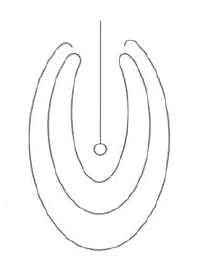
[ 21 ] The Earth rotates on its axis in twenty-four hours; it orbits the Sun once a year. The ancient Moon rotated on its axis in the same amount of time, but always kept the same side facing the Sun. The result was that there was a warm half and a cold half. This is why, during the breeding season, the creatures would move to the warm side and at other times to the cold side; they constantly circled the moon. Thus, the wanderlust of [today’s] migratory birds can still be traced back to a lunar habit. Similarly, the mating seasons of animals and the like are still linked to lunar habits.