

Introduction to the Basics of Theosophy
GA 111
29 March 1909, Rome
Translated by Steiner Online Library
30. Introduction to Theosophy V
[ 1 ] Today we want to talk about Christian initiation. But first, we must clarify the principle of initiation so that we understand what we must do to attain it. My words can only provide a general overview, since it takes decades to fully comprehend it.
[ 2 ] First, we see that there are three fundamental forces within the human being: thinking, feeling, and willing. Each of these forces corresponds to a system, a path to initiation. We have the Indian path, which is connected with the development of thought; the true Christian path, connected with the development of feeling; and finally, the Rosicrucian path, which is connected with the development of the will. Today, then, we will consider the true Christian initiation.
[ 3 ] Let us consider the state of a person when they are asleep, when the “I” and the astral body are outside the physical body. Because the astral body has neither ears nor eyes, a person perceives nothing during the night. For this reason, they must develop spiritual organs in their astral body. This is achieved through “purification” or “katharsis,” as it was called in ancient Greece. This is the first stage. In the second stage, a person must imprint the perceptions of the astral body onto their etheric body. As soon as a perception is made, it is repeated in the etheric body like an imprint.
[ 4 ] In Christian initiation, the initiate had to evoke the most intense feelings within himself in order to bring this about. These are not the feelings of everyday life, which have no connection to the astral body. They must be much deeper feelings that have a powerful effect on the astral body when it is outside the physical body.
[ 5 ] The first sensation that the initiate had to experience within himself arose from the Master’s instruction. The Master led him to a quiet, secluded place, and there he directed the student’s attention to the tranquil natural world, saying: “Look at this plant—how it has sunk its roots into the earth and driven its stem upward with its leaves, flowers, and fruits—how did it do that?” Through the forces it has drawn from the earth. So that, if it could speak, it would say to the lifeless, mineral soil: “I rise above you, but I owe my life to you, and in gratitude I bow down to you.” The candidate had to allow this humble feeling of gratitude to take hold of him for weeks on end.
[ 6 ] Then the Master proceeded to show him the animals, which in turn depend on the plant kingdom for their food. The same connection exists between the human kingdom and the animal kingdom, and among human beings themselves, so that a sense of mutual gratitude unites all the kingdoms of nature. It was precisely this feeling that the candidate had to experience within himself.
[ 7 ] At a certain point, the disciple has a vision that is always the same for all students. He sees what is described in the thirteenth chapter of the Gospel of John. He sees Christ washing the feet of his twelve apostles. This bending down of the Higher toward the Lower indicates that the Higher cannot exist without the Lower. The sensation that accompanies this vision is the feeling of flowing water running over the feet. This is the spiritual washing.
[ 8 ] In this way, the student has become ready for the following experience. The Master tells him: “You must fill your soul with all the suffering of the world, every day and with ever-increasing intensity.” Then, for a time, the disciple feels a piercing pain, because this sensation has become interwoven with his astral body. Then he has a vision of Christ being scourged; as an outward symptom, he feels as if he himself were being scourged.
[ 9 ] Then the astral realm comes to meet him, and the student experiences a third sensation. The Master tells him: You must experience within yourself as if the holiest thing that exists for you in the world were being trampled into dust. After weeks, months, and years, the student sometimes experiences sensations like stabs piercing his head, and in doing so sees Christ crowned with thorns.
[ 10 ] Then comes the fourth stage, and the master says to the student: “Until now, you have called your body ‘I’; now you must learn to regard it as a mere tool. It should become like a foreign object to you, like an axe, and you must remain in this state of mind even if it sustains any injury.” The disciple must reach the point where he says: “I do not walk through the door, but I carry my body through it.” This is easy to say, but it requires great strength and perseverance to truly experience it and put it into practice. The effect is that, while the disciple is completely absorbed in the feeling of separation between himself and his body, he receives the five stigmata on his body—on his hands, his feet, and one on his right side. One must, however, be cautious and [not attribute every such manifestation to spiritual development], because the stigmata can also be caused by certain pathological conditions. At this point, one has a vision of Christ carrying his cross, and the disciple, through his bleeding wounds, becomes the bearer of the cross; the cross is his body, which he drags behind him through the world.
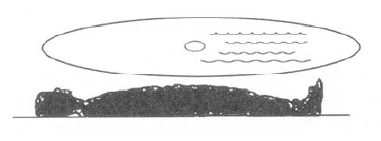
[ 11 ] This is followed by an even higher stage, in which a person contemplates the Crucified One and meditates so deeply on the crucifixion that he becomes blind and deaf to the outside world and feels as if he himself were crucified. Thus he attains “mystical death,” the fifth stage. At this point, the entire world appears darkened to him, the ground vanishes beneath his feet, he hears nothing anymore—it is the most terrible trial. The initiate experiences all pain, all vices, all sins. It is the “journey to hell.” And he realizes that, no matter how much suffering and pain there may be in the world, even more can arise. Then comes a crucial moment: the darkness ceases, and the spiritual world reveals itself. This is precisely the “tearing of the veil.” At that moment, for the first time, the candidate sees the deed of Christ; and only in this way—and in no other—can this deed be fully understood. This transition is experienced as a liberation and may also be described as such. The student learns the meaning of the words: “Die and become.”
[ 12 ] From that moment on, the candidate has formed a clear understanding of the justice that prevails in the moral world, just as equilibrium sustains the physical world, and he sees not only the effects but also the causes; he no longer resists the idea of “divine justice” in the face of any catastrophe, such as the one that recently occurred in Messina, Reggio [Calabria], and so on, where the earthquake destroyed both the guilty and the innocent. He recognizes that there is a constant balance in the world.
[ 13 ] When the candidate looks back in time and considers, for example, the Atlantean catastrophe, in which such an immense number of people perished, he realizes that today’s catastrophes, compared to [that one], are mere trifles, and that the principle of justice is in no way violated. For the Atlanteans knew how to harness the driving forces of nature, which are mysteriously connected to water and air. And because they did not use these forces for good, a devastating reaction was triggered in these two elements, and the continent was flooded.
[ 14 ] In our time, however, the cause of today’s catastrophes is to be found elsewhere, namely in the materialistic way of thinking, which is connected to fire and earth. Thus, the more people feel, think, and desire in a materialistic way, the stronger the impact on these elements becomes. This, in turn, gives rise to earthquakes. And because people do not believe at all in the close connection between human actions and nature—even though this connection does exist—it has a reciprocal effect, not only on the individual but also on the entire human race. Hence the large number of people who are affected. Both the guilty and the innocent die in such catastrophes; but for the innocent, this is compensated for in subsequent incarnations. In Atlantis, entire peoples, through their misguided will, made misuse of their magical powers and brought about the catastrophe just mentioned.
[ 15 ] We, on the other hand, no longer possess those magical powers; yet we cause tremendous upheavals through our thoughts and through the misuse of the forces of nature that we have taken possession of. From this we see that the concept of karma is the same as the concept of action—as it is called in Sanskrit—and one can just as well say “karma” as “action.” The law of karma reveals to human beings their position and their impact. The clairvoyant sees how those who have been affected together by the same catastrophe, when they reincarnate, come together in one and the same group of people and share the same ideal for the good of humanity.
[ 16 ] Let us now return to the stages of initiation and consider the sixth stage. The student learns that everything surrounding him outside his body belongs to his body—that is, the minerals, the plants, the animals—in a word: the entire Earth over which his consciousness extends. In this way, the feeling of separateness is eradicated within him. He understands that this feeling is an illusion, that, on the contrary, he is connected to everything just as a finger is connected to the body, and that the ability to move freely about the earth according to his will does not at all imply detachment from an inner connection with his surroundings. We are connected to our surroundings first and foremost through the functions of breathing and nutrition. This stage is referred to as the “burial.” Then the meaning of Christ’s words becomes clear: “He who eats my bread tramples me underfoot,” which must be taken literally, because everything on earth is the body of Christ. At this sixth stage, the human being is incorporated into Christ, buried in Christ. At that very moment, he becomes an inhabitant of the spiritual world; he lives within it, and is bound to his physical body only in appearance.
[ 17 ] The seventh stage cannot be described in human terms, because only those who can think without the physical brain can grasp it. It is the highest bliss, the inner “ascension.”
[ 18 ] By passing through the seven stages, the astral body of the initiate is completely transformed, and he attains “enlightenment.” The goal of this immensely difficult path is the knowledge of Christ. The candidate then beholds, in perfect light, the truth of what took place in Palestine—that which appears only dimly in history. It is as if he were in a dark room where he can see nothing, and suddenly a light reveals everything to his eyes.
[ 19 ] From the first to the seventh stage, it is a journey from darkness toward an ever-brighter light, until the light reaches its highest intensity through the mission of Christ, who illuminates everything with his rays.