

Introduction to the Basics of Theosophy
GA 111
30 March 1909, Rome
Translated by Steiner Online Library
31. Introduction to Theosophy VI
[ 1 ] Yesterday we described the path of Christian initiation and saw how immensely difficult it is—so difficult that, from its very first steps, it requires a separation from everyday life. That is why life in our time is incompatible with that path. For this reason, the occultists of the thirteenth and fourteenth centuries recognized the need to create a way to make the path of initiation more accessible. As early as the sixteenth and seventeenth centuries, humanity’s concepts had changed, as became particularly evident in the time of Copernicus and Galileo. The path therefore had to align with the new ways of thinking, especially with the natural sciences that were developing at that time. The Rosicrucian path met this need. It leaves not a single question unanswered, whether in the realm of religion or that of science. This initiation reveals to us the deepest depths of biblical wisdom and strengthens us to meet all the demands of modern life. This path is named after the founder of the Rosicrucian school, Christian Rosenkreutz, whose true name, however, is known only to the initiated.
[ 2 ] The Rosicrucian path differs from the Christian one, although it has the same goal. Let us take a look at what it consists of. It consists of deeds and actions in the innermost depths of the soul—so inner, in fact, that other people need not notice them, and they can easily be performed amidst all the ordinary activities of life. These are purifying exercises that are very helpful, namely:
1. Concentration of thought,
2. Initiative in action,
3. Equanimity in joy and sorrow,
4. Positivity in spiritual life,
5. Impartiality of judgment,
6. Harmoniously integrating all of the above.
[ 3 ] The main requirement is the constant repetition of such exercises. The result is the transformation of the etheric body—which serves as the vehicle—in which all our habits, which we owe precisely to repetition, are, so to speak, recorded. The plant, for example, which already has an etheric body, demonstrates this law of repetition to us by constantly producing new leaves; whereas where the plant’s astral body is located, this law fails.
[ 4 ] For human beings, too, the necessity of repetition is evident in relation to their higher development. Mere intellectual understanding is not enough to transform the etheric body. This is, in fact, the basis for the effect of religious practices, in which repetition is always taken into account for the esoteric life. That is why, for example, the “Lord’s Prayer” is repeated several times; and it is not enough merely to understand it.
[ 5 ] [First Exercise:] Let us describe the first exercise, which is concentration. We choose a place and a time when our mind is at its calmest and begin to think about any random object. However, the object must be chosen by us and, if possible, lack any suggestive qualities—that is, it should be uninteresting, such as a pin. Our thoughts must remain firmly fixed on the pin, even as we consider all possible concrete forms of the pin, as well as all concepts related to it. The image of the pin alone should be held firmly in mind. This exercise must last five minutes, and the most important aspect of it is not the object being thought of, but the intensity with which it is thought of. The object of concentration can therefore be different every day; it can even be changed several times a day.
[ 6 ] Second Exercise: Taking the Initiative to Act. You resolve to perform some action at a specific time of day; the more trivial the action, the better, provided you are certain you will not be interrupted. For example, you tell yourself: Tomorrow at this time, you will place a chair in that corner, and nothing will stop you from doing so. Repeating such small actions develops a strong will in a short time.
[ 7 ] Third Exercise: Balance—Impartiality. The esoteric student must be able to control pleasure and suffering, suppress involuntary, automatic laughter and crying, and avoid being either elated to the heavens or deeply sorrowful. This, of course, does not make one unfeeling. On the contrary, the student must become increasingly sensitive and come to understand all degrees of suffering and joy more and more deeply, but in all things, he must always remain in control of himself.
[ 8 ] Fourth Exercise: The positivity of the soul—that is, the disposition of thought and feeling to seek in all things what is good, beautiful, and useful, even when it appears to be the opposite. Even in a madman, one will still find the divine spark of reason. Seeking the truth in a world of error does not mean becoming uncritical, but rather taking criticism so far that one discovers what most people overlook. In a Persian legend, we find an example of such positivity as Christ understood it. As he was walking with his disciples, they saw the carcass of a dog in an advanced state of decomposition. The apostles turned away in disgust, while they talked among themselves about the repulsive sight. Christ, on the other hand, stopped in front of the carcass and pointed out to his disciples what beautiful teeth this dog had.
[ 9 ] Fifth Exercise: Impartiality of Judgment. This refers to letting go of the notion that one’s personal opinion is absolute, and being ready at all times to change it when one realizes that the change is reasonable. We must always be eager to learn something new, whether from a child or from a blade of grass.
[ 10 ] [Sixth Exercise:] Once each of these exercises has been practiced consistently for one month, one must attempt in the sixth month to perform all five of them in harmony. This harmonization, incidentally, must begin gradually as early as the second month, so that the performance of the second exercise in no way interferes with that of the first. In the third month, one should also perform the first two exercises and continue in this manner as far as daily duties permit. These exercises must act upon the astral body; the impression made upon it must be so strong that it persists even into the state of sleep, when it is separated from the physical body. The training of the Rosicrucian must enable him to think without external stimulation. He must be able to draw the impulse to think from within himself, so that thought depends more and more on his will and is not simply produced by external circumstances. These exercises gradually enable us to direct our attention to the realities of the supersensible world, the knowledge of which constitutes the very essence of the occult teachings. Many regret that Theosophy always speaks of worlds that are inaccessible to ordinary powers of perception, whereas science, on the other hand, proves everything it teaches. Elementary Theosophy, however, has always had this transcendental character in all occult schools.
[ 11 ] Anyone who has understood the theory and puts it to the test in real life will see how everything fits together. Incidentally, there is an even higher stage, which is described in my Philosophy of Freedom. I apologize for quoting myself. But this book contains a sequence of thoughts, each of which follows from the preceding one in such a way that one could neither substitute one for another nor remove any of them.
[ 12 ] The second stage consists of attaining what is known as “imagination” through a very special form of self-contemplation. One visualizes images in one’s mind’s eye, devoting one’s full attention to them, thereby awakening the imagination or imaginative consciousness. Once again, a conversation takes place between the master and his student at this point. The Master says: See how the plant has its roots in the earth, how it unfurls its leaves and blossoms; feel how it grows and how it holds its sap within itself, and then look at the human being and learn to understand the difference. The plant is unconscious; but in the human being, everything is reflected back as pleasure and suffering in varying degrees. In human beings, red blood flows as the carrier of passions and instincts, whereas in the plant, the chaste green sap moves—the passionless chlorophyll. Experience this! Then look toward the true ideal of the future, when human beings will have transformed themselves and their blood will have become as pure and chaste as the sap of the plant. The rose can serve as a symbol of this transformation, in which that which is green at the bottom transforms into red at the top without losing its purity and chastity. Feel this development toward ever higher stages! Feel further what is meant by the words: “Die and Become”! All passions must be overcome, and the red blood must once again become pure. You see all this in the symbol of the Rosicrucians: in the black cross, death; and in the seven roses, the signs of higher becoming.
[ 13 ] In Jesus, the blood had become so pure that, according to one legend, when blood flowed from the five wounds, bees alighted on the wound in his side and sucked up the blood, for it had become so pure that honey could be made from it, just as from the pure sap of a plant. The main thing is to immerse oneself imaginatively and deeply in the image one has conjured up, not merely to picture it. The same applies to all symbols, for example, the Key of Solomon: a white flying dragon at the top, a black one at the bottom, which is dying.
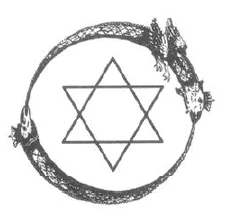
[ 14 ] Through diligent practice, one comes to wake up in the morning with the awareness that one has spent the night in a world of symbols. It is like emerging from the depths of the sea into the light, and the darkness is illuminated.
[ 15 ] Then comes the third stage: “reading the occult scriptures.” The images present themselves to the imagination, and it is no longer possible to think of them as illusions. These images are the language of the higher beings: angels, archangels, seraphim, thrones, and so on. This is how we experience the world of spiritual beings. We learn to distinguish the real image from the imagination by the effect it has on us. For example, the image of a red-hot iron will never burn us as the red-hot iron itself does; and even if the image of a lemonade makes our mouths water, it will never quench our thirst. Through the exercises of imagination, then, we learn to read the occult script, and that is a significant step forward.
[ 16 ] Then comes the fourth stage: the “preparation of the Philosopher’s Stone.” This term might make one laugh when one thinks of the myriad ancient instructions that refer to it; but we know what it is all about. Let us consider the plant once more. Humans inhale oxygen, take in carbon, and exhale carbon dioxide. The plant, on the other hand, inhales carbon dioxide, retains the carbon, and releases oxygen, thereby making the air usable again for humans. The plant’s respiratory process, although considered insignificant as described by science, nevertheless holds great significance in occultism. Because everything in the world is governed and ordered by a law of harmony, the Master prescribes a rhythmic breathing method for the student, which we can only touch upon here, as it belongs to the realm of esoteric teaching. The breathing process is organized in such a way that the human being processes carbon as the plant does, so that what we have here is, in reality, the purification and transformation of the blood, which is thereby made more plant-like. Carbon is, in fact, the Philosopher’s Stone. And here we have a broad outline of its preparation: the human being is the retort; he learns to become a plant in the higher sense. But only those who can understand this in the higher sense will learn it, and not those who would seek in it merely a new source of material gain.
[ 17 ] Let us now turn to the fifth stage. The Master says to the disciple: “Learn the ‘connection between the microcosm and the macrocosm!’ Everything that surrounds a person in the outer world is contained within them. For example, let us consider the connection between the eye and the sun. If one abstracts from all external things and concentrates solely on a single point in the eye or the heart, one will understand the sun’s effect in the cosmos, because the substance of the sun is found precisely in the eye and in the heart. In this way, the student learns that the sun has given him the eye and the heart, just as the moon has given him various parts of the brain. Gradually, in this way, the student penetrates into his surroundings.
[ 18 ] Now we come to the sixth stage: The student no longer thinks, say, of the heart, but of the forces that gave it life, and he does the same with all things. In this way, one penetrates the soul of things and experiences their unique life. One might think, for example, that when a leaf is torn from a plant, it must feel pain, just as a body would when a finger is torn off. But no, that is not the case. The plant delights in being picked or burned, or when it is cut down with a scythe. Nothing is more beautiful for the clairvoyant eye to behold than harvest time, when plants and flowers voluptuously enjoy the cut of the scythe. In contrast, the plant suffers when it is pulled out of the earth by its roots. For the stone, on the other hand, it is a pleasure to be shattered rather than being walled up with other stones to form a structure. For salt, for example, being dissolved in water is a pleasure, whereas the crystallization process is suffering. In ancient times, the entire earth was submerged in water. Gradually it solidified, and it was born as if from the pains of the soul of the stones. We walk upon petrified suffering, just as, on the other hand, their bliss will arise from their spiritualization. Paul said: Every created thing must pay for its birth with pain.
[ 19 ] We have now reached the seventh stage, that of “divinity,” which cannot be expressed in human words. It provides the solution to the mystery of Christ.
[ 20 ] As we can see, to follow this Rosicrucian path upward, one need only turn inward and can at the same time remain in everyday life.