

The Connection Between Man
and the Elemental World
GA 158
20 November 1914, Dornach
Translate the original German text into any language:
Versions Available:
The Balance in the World and Man, tr. Osmond
Die Welt als Ergebnis von Gleichgewichtswirkungen I
Lecture One
[ 1 ] Es ist uns durch unsere Betrachtungen schon geläufig geworden, daß wir unter oder hinter der physischen Welt, die vor uns liegt, den Beginn anderer Welten finden. Ich möchte heute als Einleitung von einigen Eigentümlichkeiten dieser geistigen Welten sprechen, von denen wir zum Teil schon wissen, die wir durch manches ergänzen wollen, um auch sonstiges noch vor die Seele zu rücken.
[ 1 ] The idea of other worlds lying beneath or behind the physical world is very familiar to us, and as an introduction to what I propose to put before you, I want to speak today of certain characteristics of these worlds. By widening and extending the knowledge we already possess, still other aspects of this subject will become clear to us.
[ 2 ] Sie wissen, die nächste Welt, welche an die unsrige angrenzt, ist die sogenannte imaginative Welt. Diese Welt ist in sich viel beweglicher als unsere physische Welt. Unsere physische Welt stellt sich dar mit scharfen Konturen, scharfen Grenzlinien, stellt eine Welt scharf umrissener Gegenstände dar. Eine gleichsam flüssige, flüchtige Welt ist diejenige, in die wir hineinkommen, wenn wir den Schleier zerreißen, den die physische Welt bildet. Auch wissen wir, daß gegenüber dieser ersten geistigen Welt das Gefühl, die Empfindung beginnt, daß wir außerhalb unseres physischen Leibes sind. Zu diesem unserem physischen Leib bekommen wir in dem Augenblicke, wo wir in die geistige Welt hinaufsteigen, gewissermaßen ein neues Verhältnis, ein Verhältnis, wie wir es innerhalb des physischen Leibes etwa haben zu unseren Augen oder zu unseren Ohren. Der physische Leib wirkt mehr als ein Ganzes wie eine Art Wahrnehmungsorgan, aber wir merken sehr bald, es handelt sich eigentlich nicht richtig um den physischen Leib, wenn uns so dieser physische Leib als eine Art Wahrnehmungsorgan zum Gefühl kommt, sondern es handelt sich da um den ätherischen Leib. Der physische Leib gibt uns gleichsam nur ein Gerüst, das den ätherischen Leib hält. Wir blicken von außerhalb nach unserem ätherischen Leibe hin, verspüren ihn auch noch, verspüren ihn als das Sinnesorgan, das eine Welt wahrnimmt webender, schwebender Bilder und Töne. Wie unser Verhältnis zum Ohr und Auge, so wird unser Verhältnis zu dem vom physischen Leibe gehaltenen Ätherleibe.
[ 2 ] As you know, the world bordering upon that known to our ordinary consciousness is the so-called world of Imagination. The world of Imagination is far more inwardly mobile and flexible than our physical world with its clear-cut lines of demarcation and its sharply defined objects. When the veil formed by the physical world is broken through, we enter an ethereal, fluidic world, and when we experience this first spiritual world, the feeling arises that we are outside the physical body. In this spiritual world we are at once conscious of a new and different relationship to the physical body; it is a relationship such as we otherwise feel to our eyes or ears. The physical body in its totality works as if it were a kind of organ of perception; but we very soon realize that, properly speaking, it is not the physical but the ether-body that is the real organ of perception, The physical body merely provides a kind of scaffolding around the ether-body. We begin, gradually, to live consciously in the ether-body, to feel it as a sense-organ which perceives a world of weaving, moving pictures and sounds. And then we are aware of being related to the ether-body within the physical body just as in ordinary life we are related to our ears or eyes.
[ 3 ] Wenn wir uns nun so außerhalb unseres physischen Leibes fühlen, so ist dieses Erlebnis ähnlich dem Schlaferlebnis. Das Schlaferlebnis besteht darin, daß wir mit unserer geistig-seelischen Menschlichkeit außerhalb unseres physischen und Ätherleibes sind, nur daß während des Schlaferlebnisses unser Bewußtsein herabgestimmt ist, und wir nichts wissen von dem, was eigentlich mit uns und um uns vorgeht. Man kann also sagen, daß es noch ein anderes Verhältnis des Menschen zu seinem physischen Leibe gibt als dasjenige, woran wir gewohnt sind. Auf das, worauf die Geisteswissenschaft so aufmerksam machen muß, wird die Menschheit durch ihre Evolution immer mehr und mehr hingelenkt werden, je weiter wir der Zukunft entgegengehen.
[ 3 ] This feeling of being outside the physical body is an experience similar in some respects to that of sleep. As beings of spirit-and-soul we are outside the physical and etheric bodies during sleep, but our consciousness is dimmed during the experience, and we know nothing of what is really happening to us and around us. You will see from this that there can be a relationship to the physical body quite different from that to which we are accustomed in ordinary life. This is a fact to which attention must be called by Spiritual Science and it is an experience which will become more and more common in human beings as evolution leads on into the future.
[ 4 ] Ich habe es aus vielen Zusammenhängen heraus betont, daß es nicht eine Willkür ist, daß wir heute Geisteswissenschaft treiben, sondern daß die Beschäftigung mit dieser Geisteswissenschaft von uns gefordert wird durch die Evolution der Menschheit, durch das, was im gegenwärtigen Zeitpunkte in der Menschheitsevolution sich vorbereitet. Man kann nämlich dieses gleichsam Sich-Getrenntfühlen in seiner menschlichen Wesenheit von seinem physischen Leibe als etwas bezeichnen, was wie ein unverstandenes Erlebnis immer mehr und mehr über die Menschen wie von selbst kommen wird, je weiter wir als Menschheit der Zukunft entgegengehen. Es wird eine Zeit kommen, wo an viele, viele Menschen immer mehr die Empfindung herantreten wird: Ja, was ist denn das, ich fühle mich so, wie wenn ich mich gespalten hätte, wie wenn da noch ein Zweiter neben mir wäre. — Und diese Empfindung, dieses Gefühl, das als etwas Natürliches auftreten wird, geradeso wie Hunger oder Durst oder andere Erlebnisse, darf nicht unverstanden bleiben bei den Menschen der Gegenwart und Zukunft. Verständlich wird es sein, wenn die Menschen sich bequemen werden, durch die Geisteswissenschaft die eigentliche Bedeutung dieses Gespaltenseins zu verstehen. Insbesondere wird auch die Pädagogik, die Erziehung — je mehr wir diesen Dingen entgegengehen — darauf Rücksicht nehmen müssen. Man wird lernen müssen, auf gewisse Erlebnisse der Kinder sorgfältiger zu achten, als man das bisher getan hat, wo diese Erlebnisse auch nicht in demselben Maße da waren.
[ 4 ] I have said repeatedly that the cultivation of Spiritual Science today is not the outcome of any arbitrary desire, but is a necessity of evolution at the present time. This feeling of separation from the physical body is an experience that will arise in human beings more and more frequently in the future, without being understood. A time will come when a great many people will find themselves asking: “Why is it that I feel as if my being were divided, as if a second being were standing by my side?” This feeling will arise as naturally as hunger or thirst or other such experiences and it must be understood by men of the present and future. It will become intelligible when, through Spiritual Science, people begin to understand what this experience of division within them really signifies. In the domain of Education, particularly, attention will have to be paid to it; indeed we shall all have to learn to pay more heed than hitherto to certain experiences which will become increasingly common in children as time goes on.
[ 5 ] Gewiß, in dem späteren, robusteren Leben, unter dem Eindrucke der physischen Welt werden diese Gefühle und Empfindungen, die ich charakterisiert habe, nicht so besonders stark sein in der allernächsten Zukunft, aber in einer ferneren Zukunft werden sie immer stärker und stärker werden. Zunächst werden sie beim heranwachsenden Kinde auftreten, und die Erwachsenen werden von den Kindern gar mancherlei hören, was sie werden verstehen müssen, mancherlei, über das man hinweggehen kann wie über ein Nichts, über das man aber nicht hinweggehen sollte, weil es mit den tiefsten Evolutionsgeheimnissen der Welt zusammenhängt.
[ 5 ] It is true that in later life, when the whole impression made by the physical world is very strong, these feelings and experiences will not be particularly noticeable in the near future, but as time goes on they will become more and more intense. They will occur, to begin with, in children, and grown-up people will hear from children many things which in the ordinary way are pooh-poohed but which will have to be understood because they are connected with deep secrets of evolution.
[ 6 ] Kinder werden andeuten: Da oder dort habe ich ein Wesen gesehen, das hat zu mir dies oder jenes gesagt, was ich tun soll. — Der materialistisch gesinnte Mensch wird sagen: Du bist ein dummer Bub oder ein dummes Mädchen, das gibt es ja gar nicht. — Wer aber Geisteswissenschaft verstehen will, muß wissen lernen, daß es sich da um eine bedeutsame Erscheinung handelt. Wenn ein Kind sagt: Da habe ich jemanden gesehen, der ist wieder verschwunden, aber er kommt immer wieder und wieder; er sagt zu mir immer das und jenes, und ich kann nicht aufkommen gegen ihn —, so wird der, welcher die Geisteswissenschaft versteht, erkennen, daß sich da etwas in dem Kinde ankündigt, was immer deutlicher in der Menschheitsevolution hervortreten wird. Was ist denn das, was sich da ankündigt?
[ 6 ] We shall hear children saying: “I have seen a being who said this or that to me, who told me what to do.”—The materialist, of course, will tell such a child that this is all nonsense, that no such being exists. But students of Spiritual Science will have to understand the significance of the phenomenon. If a child says: “I saw someone who came to me, he went away again but he keeps on coming and I cannot get rid of him”—then anyone who understands Spiritual Science will realize that a phenomenon which will appear in greater and greater definition as time goes on, is here revealing itself in the life of the child. What does this really signify?
[ 7 ] Wir werden es verstehen, wenn wir zwei Grunderlebnisse des Menschen ins Auge fassen, von denen das erste ganz besonders wichtig war für den vierten nachatlantischen, den griechisch-lateinischen Zeitraum, und das andere wichtig ist für unseren Zeitraum, in dem es sich langsam erst vorbereitet. Während das erste Grunderlebnis in dem griechisch-lateinischen Zeitraum seinen Abschluß gefunden hat, gehen wir dem zweiten langsam entgegen. In das menschliche Leben spielen immer Erlebnisse herein, die von Luzifer und Ahriman stammen. In das Grunderlebnis der vierten nachatlantischen Periode spielte insbesondere Luzifer herein; in unsere Periode spielt Ahriman herein und bedingt das Grunderlebnis. Nun hängt Luzifer mit alledem zusammen, was noch nicht bis zur Deutlichkeit der einzelnen Sinne sich ausgewachsen hat, was undeutlich an den Menschen, undifferenziert an ihn herankommt. Mit andern Worten, Luzifer hängt mit dem Atemerlebnis zusammen, mit dem Erlebnis des Ein- und Ausatmens. Das Atmen des Menschen ist etwas, was in einem ganz bestimmten geregelten Verhältnis stehen muß zu seiner Gesamtorganisation. In dem Augenblick, wo der Atmungsprozeß in irgendeiner Weise gestört ist, verwandelt sich sogleich die Atmung aus dem, wie sie sonst auftritt, nämlich als unbewußter Vorgang, auf den wir nicht zu achten brauchen, in einen bewußten, in einen mehr oder weniger traumhaft bewußten Vorgang. Und wenn — wir können es ganz trivial ausdrücken — der Atmungsprozeß zu energisch wird, wenn er größere Anforderungen an den Organismus stellt, als dieser Organismus leisten kann, dann hat Luzifer die Möglichkeit, mit dem Atmen einzudringen in den menschlichen Organismus. Er muß es ja nicht selbst sein, aber seine Scharen tun es, diejenigen, die zu ihm gehören.
[ 7 ] We shall understand it if we think of two fundamental and typical experiences, the first of which was particularly significant in the Greco-Latin age, while the other is significant in our own time, when it is beginning, gradually, to take shape. Whereas the first experience reached a kind of culmination in the Greco-Latin epoch, we are slowly moving towards the second. Experiences deriving from the influences of Lucifer and Ahriman are all the time playing into human life. In this basic experience of man during the Fourth Post-Atlantean or Greco-Roman epoch, Lucifer's influence was the greater; in our own epoch, Ahriman is the predominant influence. Lucifer is connected with all those experiences which, lacking the definition imparted by the senses, remain undifferentiated and obscure. Lucifer is connected with the experience of breathing, of the in-breathing and the out-breathing. The relationship between a man's breathing and the functioning of his organism as a whole must be absolutely regular and normal. The moment the breathing process is in any way disturbed, instead of remaining the unconscious operation to which no attention need be paid, it becomes a conscious process, of which we are more or less dreamily aware. And when, to put it briefly, the breathing process becomes too forceful, when it makes greater claims on the organism than the organism can meet, then it is possible for Lucifer (not he himself but the hosts belonging to him) to enter with the breath into the organism.
[ 8 ] Ich weise damit auf eine Erscheinung hin, welche jeder kennt als Traumerlebnis. Dieses Traumerlebnis kann sich in beliebiger Weise steigern. Der Alptraum, wo also der Mensch durch das gestörte Atmen zum Traumbewußtsein kommt, so daß sich Erlebnisse der geistigen Welt hineinmischen können, und auch alle Angst- und Furchterlebnisse, die mit Alpträumen verbunden sind, haben in dem luziferischen Element der Welt ihren Ursprung. Alles, was vom gewöhnlichen Atmungsprozeß übergeht zum Würgen, zu dem Gefühl des Gewürgtwerdens, das hängt zusammen mit dieser Möglichkeit, daß Luzifer sich einmischt in den Atmungsprozeß. Das ist der grobe Prozeß, wo durch eine Herabminderung des Bewußtseins Luzifer sich in das Atemerlebnis hineinmischt, gestaltenhaft in das Traumbewußtsein tritt und da zum Würger wird. Das ist das grobe Erlebnis.
[ 8 ] I am speaking here of a familiar experience of dream-life. It may arise in many forms and with growing intensity. A nightmare in which the disturbed breathing process makes a man conscious in dream, so that experiences of the spiritual world intermingle with the dream and give rise to the anxiety and fear which often accompany a nightmare—all such experiences have their origin in the Luciferic element. When, instead of the regular breathing, there is a feeling of being choked or strangled, this is connected with the possibility that Lucifer may be mingling with the breathing. This is the cruder form of the process, where, as the result of a diminution of consciousness, Lucifer intermingles with the breathing and, in the dream, takes the form of a strangler. That is the crude form of the experience.
[ 9 ] Es gibt aber auch ein feineres Erlebnis, das uns dieses Würgeerlebnis gleichsam verfeinert, nicht so grob wie ein physisches Würgen darstellt. Man achtet gewöhnlich nicht darauf, daß eine solche Verfeinerung des Würgens zu den menschlichen Erlebnissen gehört. Aber jedesmal, wenn an die menschliche Seele dasjenige herantritt, was zu einer Frage wird oder zu einem Zweifel an diesem oder jenem in der Welt, dann ist in verfeinerter Weise ein Würgeerlebnis da. Man kann schon sagen: Wenn wir eine Frage aufstellen müssen, wenn ein kleines oder ein großes Weltenrätsel sich uns aufdrängt, dann werden wir gewürgt, aber so, daß wir es nicht merken. — Jeder Zweifel, jede Frage ist ein verfeinertes Alpdrücken oder ein verfeinerter Alptraum.
[ 9 ] But there is an experience more delicate and more intangible than that of being physically strangled. It does not, as a rule, occur to people that a certain familiar experience is really a less crude form of that of strangulation. Yet whenever anything becomes a problem in the soul or gives rise to doubt concerning one thing or another in the world, this is a subtler form of the experience of being strangled. It can truly be said that when we feel obliged to question, when a riddle, either great or trifling, confronts us, then something seems to be strangling us, but in such a way that we do not heed it. Nevertheless, every doubt, every problem is a subtle form of nightmare.
[ 10 ] So verwandeln sich die Erlebnisse, die uns sonst grob entgegentreten, in feinere Erlebnisse, wenn sie mehr seelisch auftreten. Man kann sich schon denken, daß die Wissenschaft einmal dazu kommen wird, den Zusammenhang des Atmungsprozesses mit der Fragestellung oder der Empfindung eines Zweifels in der Menschenseele zu studieren. Aber auch alles das, was mit Fragen und Zweifeln zusammenhängt, alles das, was damit zusammenhängt, daß wir unbefriedigt sind, weil die Welt an uns herantritt und eine Antwort verlangt, oder weil wir gezwungen sind, eine Antwort zu geben durch das, was wir sind, hängt mit dem Luziferischen zusammen.
[ 10 ] And so experiences which often take a crude form, become much more subtle and intangible when they arise in the life of soul itself. It is to be presumed that science will be led some day to study how the breathing process is connected with the urge to question, or with the feeling of being assailed by doubt; but whether this happens or not, everything that is associated with questioning and doubt, with feelings of dissatisfaction caused when something in the world demands an answer and we are thrown back entirely upon our own resources—all this is connected with the Luciferic powers.
[ 11 ] Wenn wir nun die Sache geisteswissenschaftlich betrachten, so können wir sagen: Bei allem, wo der Würgeengel im Alptraum uns bedrückt, oder wo wir durch die Fragestellung eine innere Bedrückung, einen Anflug von Beängstigung erfahren, haben wir es mit einem gleichsam stärkeren, energischeren Atmungsprozeß zu tun, mit etwas, was im Atem lebt, was aber, damit die menschliche Natur in der richtigen Weise funktioniert, harmonisiert, abgeschwächt werden muß, damit das Leben richtig verläuft. Was findet nun statt, wenn ein energischerer Atmungsprozeß eintritt? Da ist gleichsam der Ätherleib und alles, was mit der ätherischen Natur des Menschen zusammenhängt, zu weit ausgedehnt, zu sehr auseinandergedrängt, und da sich das dann auslebt im physischen Leibe, so kann es sich nicht auf den physischen Leib beschränken, es will ihn gewissermaßen auseinanderzerren. Ein zu üppiger, ein zu weit ausgedehnter Ätherleib liegt einem verstärkten Atmungsprozeß zugrunde, und dann besteht die Möglichkeit für das luziferische Element, sich besonders geltend zu machen.
[ 11 ] In the light of Spiritual Science it can be said that whenever we feel a sensation of strangulation in a nightmare, or whenever some doubt or question inwardly oppresses or makes us uneasy, the breathing process becomes stronger, more forceful. There is something in the breathing which must be harmonized, toned down and modified if human nature is to function in the right and normal way. What happens when the breathing process becomes excessively vigorous and forceful? The ether-body expands, becomes too diffuse; and as this takes effect in the physical body, it tends to break up the physical body. An over-exuberant, too widely extended ether-body gives rise to an excessively vigorous breathing process and this provides the Luciferic forces with opportunity to work.
[ 12 ] Man kann also sagen: Das Luziferische kann sich in die menschliche Natur hineinschleichen, wenn der Ätherleib geweitet ist. - Man kann auch sagen: Das Luziferische hat die Tendenz, in einem der menschlichen Form gegenüber geweiteten Ätherleibe sich auszudrücken, also in einem Ätherleibe, der mehr Raum braucht, als in der menschlichen Haut eingeschlossen ist, der die Form üppiger gibt. — Man kann sich nun denken, daß man künstlerisch diese Frage beantworten will, und da kann man sagen: So wie der menschliche Ätherleib normal ist, ist er der Bildner der menschlichen Gestalt, die physisch vor uns steht. Aber sobald er sich weitet, sobald er sich einen größeren Raum, weitere Grenzen verschaffen will, als in der menschlichen Haut darinnen sind, will er auch andere Formen geben. Es kann da nicht die menschliche Form bleiben. Er will überall über die menschliche Form hinaus. — Dieses Problem hat man in alter Zeit schon gelöst. Was für eine Form kommt da heraus, wenn der geweitete Ätherleib, der nicht für das menschliche Wesen, sondern für das luziferische Wesen paßt, sich Geltung verschafft und formhaft vor die menschliche Seele tritt? Was kommt da heraus? Die Sphinx!
[ 12 ] The Luciferic forces, then, can make their way into the human being when the ether-body has expanded beyond the normal. One can also say that the Luciferic forces tend to express themselves in an ether-body that has expanded beyond the limits of the human form, that is to say, in an ether-body requiring more space than is provided within the boundaries of the human skin. Of attempts made to find an appropriate form in which to portray this process, the following may be said.—In its normal state, the ether-body moulds and shapes the physical form of man. But as soon as the ether-body expands, as soon as it tries to create for itself greater space and an arena transcending the boundaries of the human skin, it tends to produce other forms. The human form cannot here be retained; the ether-body strives to grow out of and beyond the human form. In olden days men found the solution for this problem. When an extended ether-body—which is not suited to the nature of man but to the Luciferic nature—makes itself felt and takes shape before the eye of soul, what kind of form emerges? The Sphinx!
[ 13 ] Hier haben wir eine besondere Art, uns in die Sphinx hinein zu vertiefen. Die Sphinx ist es, was eigentlich an einem würgt. Wenn der Ätherleib des Menschen durch die Energie des Atmens sich ausweitet, taucht ein luziferisches Wesen in der Seele auf. Es lebt in diesem Ätherleibe nicht die menschliche Gestalt, sondern die luziferische Gestalt, die Sphinxgestalt. Die Sphinx taucht auf als die Zweifelaufwerferin, als die Fragepeinigerin. Diese Sphinx hat also eine besondere Beziehung zum Atmungsprozeß. Wiederum wissen wir aber, daß der Atmungsprozeß eine besondere Beziehung zur Blutbildung hat. Daher lebt das Luziferische auch im Blute, durchwogt und durchwallt das Blut. Überall kann auf dem Umwege durch die Atmung das Luziferische in das Blut des Menschen hinein, und wenn zuviel Energie in das Blut hineinkommt, dann ist das Luziferische, die Sphinx, besonders stark.
[ 13 ] Here we have a clue to the nature of the Sphinx. The Sphinx is really the being who has us by the throat, who strangles us. When the ether-body expands as a result of the force of the breathing, a Luciferic being appears in the soul. In such an ether-body there is then not the human, but the Luciferic form, the form of the Sphinx. The Sphinx is the being who brings doubts, who torments the soul with questions. And so there is a definite connection between the Sphinx and the breathing process. But we also know that the breathing process is connected in a very special way with the blood. Therefore the Luciferic forces also operate in the blood, permeating and surging through it. By way of the breathing, the Luciferic forces can everywhere make their way into the blood of the human being and when excessive energy is promoted in the blood, the Luciferic nature—the Sphinx—becomes very strong.
[ 14 ] So steht der Mensch dadurch, daß er in seinem Atmungsprozeß dem Kosmos geöffnet ist, der Sphinxnatur gegenüber. Dieses Erlebnis, in seinem Atmen der Sphinxnatur des Kosmos gegenüberzustehen, dieses Grunderlebnis ging besonders in der vierten nachatlantischen, der griechisch-lateinischen Kulturperiode auf. Und in der Ödipus-Sage sehen wir, wie der Mensch der Sphinx gegenübersteht, wie die Sphinx sich an ihn kettet, zur Fragepeinigerin wird. Der Mensch und die Sphinx, oder wir können auch sagen, der Mensch und das Luziferische im Weltall sollten gleichsam als ein Grunderlebnis der vierten nachatlantischen Kulturperiode so hingestellt werden, daß, wenn der Mensch sein äußeres normales Leben auf dem physischen Plan nur ein wenig durchbricht, er mit der Sphinxnatur in Berührung kommt. Da tritt Luzifer in seinem Leben an ihn heran, und er muß mit Luzifer, mit der Sphinx fertig werden.
[ 14 ] Because man is open to the Cosmos in his breathing, he is confronted by the Sphinx. It was paramountly during the Greco-Latin epoch of civilization that, in their breathing, men felt themselves confronting the Sphinx in the Cosmos. The legend of Oedipus describes how the human being faces the Sphinx, how the Sphinx torments him with questions. The picture of the human being and the Sphinx, or of the human being and the Luciferic powers in the Cosmos, gives expression to a deeply-rooted experience of men as they were during the Fourth Post-Atlantean epoch, and indicates that when, in however small a degree, a man breaks through the boundaries of his normal life on the physical plane, he comes into contact with the Sphinx-nature. At this moment Lucifer approaches him and he must cope with Lucifer, with the Sphinx.
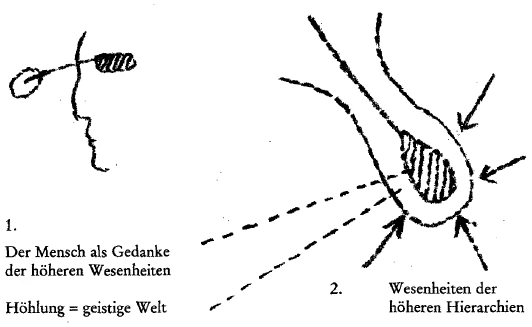
[ 15 ] Anders ist das Grunderlebnis des fünften nachatlantischen Kulturzeitraumes, unseres Zeitraumes. Für unseren Zeitraum ist das besonders vorbereitet, daß der Ätherleib nicht aufgeplustert, nicht ausgedehnt, sondern zusammengezogen ist, daß er nicht zu groß, sondern eher zu klein ist, und das wird immer stärker und stärker werden, je weiter die Evolution fortgeht. Wenn wir sagen können: Die normale Gestalt des Menschen beim Griechen ist so, daß der Ätherleib zu groß ist —, so können wir sagen: Beim modernen Menschen ist es so, daß der Ätherleib sich zusammenschnürt, sich zusammenzieht, zu klein wird. — Je weiter der Mensch kommen wird in der materialistischen Verachtung des Spirituellen, desto mehr wird sich dieser Ätherleib zusammenziehen und austrocknen. Da aber die Durchorganisierung des physischen Leibes davon abhängt, daß der Ätherleib ihn ganz richtig durchdringt, so wird für den physischen Leib immer eine Tendenz auftreten, wenn der Ätherleib zu sehr zusammengedrängt ist, daß der physische Leib auch auszutrocknen beginnt. Und wenn er ganz besonders stark austrocknen würde, so würde er statt der natürlichen Menschenfüße hornartige Füße bekommen. Der Mensch wird sie ja nicht bekommen, aber die Tendenz dazu liegt in ihm, und sie ist begründet in dieser Tendenz des Ätherleibes, auszutrocknen, zu wenig Ätherkraft zu entwickeln. In diesen vertrockneten Ätherleib kann sich nun besonders Ahriman hineinleben, wie Luzifer in den erweiterten Ätherleib. Ahriman wird die Gestalt annehmen, die auf eine Armlichkeit des Ätherleibes hinweist. Er wird zu wenig Ätherkraft entwickeln, um richtig organisierte Füße zu haben, und die erwähnten hornartigen Füße Bocksfüße — ausbilden.
[ 15 ] The basic tendency of our Fifth Post-Atlantean epoch is different. The trend of evolution has been such that the ether-body has contracted and is far less prone to diffusion or expansion. The ether-body, instead of being too large, is too small, and this will become more marked as evolution proceeds. If it can be said that in the man of ancient Greece, the ether-body was too large, it can be said that in the man of modern times the ether-body is compressed and contracted, has become too small. The more human beings are led by materialism to disdain the Spiritual, the more will the ether-body contract and wither. But because the organization and functions of the physical body depend upon the ether-body—inasmuch as the ether-body must permeate the physical in the right way—the physical body too will always tend to dry up, to wither, if the contraction of the ether-body is excessive; and if the physical body became too dry, men would have feet of horn instead of the feet of a normal human being. As a matter of fact, man will not actually find himself with feet of horn, but the tendency is there within him, owing to this proclivity of the ether-body to weaken and dry up. Now into this dried-up ether-body, Ahriman can insinuate himself, just as Lucifer can creep into an extended, diffuse ether-body. Ahriman will assume the form which indicates a lack of power in the ether-body. It unfolds insufficient etheric force for properly developed feet and will produce hornlike feet, goat's feet.
[ 16 ] Mephistopheles ist ja Ahriman; er hat die Bocksfüße nicht umsonst, er hat die Bocksfüße aus diesem Grunde, den ich angedeutet habe. Die Mythen und Sagen sind eben sehr bedeutungsvoll; deshalb erscheint Mephistopheles sehr oft mit Pferdefüßen, wo also die Füße zu Hufen vertrocknet sind. Wenn Goethe das Problem des Mephisto schon vollständig durchdrungen hätte, so hätte er nicht seinen Mephisto wie einen modernen Kavalier auftreten lassen, denn es gehört schon einmal zum Wesen des Ahriman-Mephisto, nicht so viel Ätherkraft zu haben, daß er die menschliche physische Gestalt vollständig durchorganisieren kann.
[ 16 ] Mephistopheles is Ahriman. There is good reason, as I have just indicated, for portraying him with the feet of a goat. Myths and legends are full of meaning: Mephistopheles is very often depicted with horses' hoofs; his feet have dried up and become hoofs. If Goethe had completely understood the nature of Mephistopheles he would not have made him appear in the guise of a modern cavalier, for by his very nature Mephistopheles-Ahriman lacks the etheric forces necessary to permeate and give shape to the normal physical form of a human being.
[ 17 ] Aber noch eine Eigentümlichkeit ist dadurch hervorgerufen, daß der Ätherleib gleichsam zusammengezogen ist, ärmer ist an Ätherkräften, als es im Normalen der Fall ist. Diese Eigentümlichkeit wird uns am klarsten, wenn wir einen Blick auf die gesamte menschliche Natur werfen. Wir sind in gewisser Beziehung schon physisch eine Zweiheit. Denken Sie doch, wenn Sie so dastehen, sind Sie eben der physische Mensch. Aber zu dem physischen Menschen gehört es, daß die Atemluft immerfort in ihm darinnen ist. Diese Atemluft jedoch ist bei dem nächsten Ausatmen schon wieder nach außen befördert, so daß der Atemluftmensch, der Sie durchdringt, fortwährend wechselt. Sie sind nicht bloß das, was aus Muskeln und Knochen besteht, der Fleisch- und Knochenmensch, sondern Sie sind auch der Atemmensch. Der aber wechselt fortwährend, geht hin und her, aus und ein. Und der Atemmensch ist es, der wieder im Zusammenhang steht mit dem immerfort zirkulierenden Blute.
[ 17 ] Yet another characteristic of Mephistopheles-Ahriman is due to this contraction of the ether-body and its consequent lack of etheric force. The best way to understand this will be to consider the nature of man as a whole. Even physically, the human being is, in a certain respect, a duality. For think of it.—You stand there as a physical human being. But the in-breathed air is inside you, is part of you as a physical being. This air, however, is sent out again by the very next exhalation, so that the “man of air-and-breath” pervading you, changes all the time. You are not merely a man of flesh, bone and muscle, but you are also a “breath man.” This “breath man,” however, is constantly changing, passing out and in. And this “breath man” is connected with the circulating blood.
[ 18 ] Wie getrennt von diesem ganzen Atmungsmenschen liegt in Ihnen der Nervenmensch, der andere Pol, in dem das Nervenfluidum zirkuliert, und es ist nur eine Art äußere Berührung, ein äußeres Zusammenkommen zwischen dem Nervenmenschen und dem Blutmenschen. So wie nur diejenigen Ätherkräfte, die nach dem Luziferischen hin tendieren, durch das Atmen leicht an das Blutsystem herankommen können, so können die Ätherkräfte, welche nach dem Mephistophelischen oder Ahrimanischen hin tendieren, nur an das Nervensystem herankommen, aber nicht an das Blutsystem. Ahriman ist es versagt, in das Blut unterzutauchen; er kann fortwährend in den Nerven leben, bis zum Vertrocknen, zur Nüchternheit leben, weil er nicht an die Wärme des Blutes heran kann. Will er aber eine Beziehung zur Menschennatur hin entwickeln, dann wird er lechzen müssen nach einem Tröpfchen Blut, weil er so schwer herankommen kann an das Blut. Ein Abgrund liegt zwischen Mephistopheles und dem Blute. Willer an den Menschen herankommen, an das, was im Menschen lebt, will er mit dem Menschen in Verbindung treten, dann wird er gewahr, daß das Menschliche in dem Blute lebt. Er muß nach dem Blute trachten.
[ 18 ] Within you, separate as it were from this “breath man” is the other pole: the “nerve man” with the circulating nerve-fluid. The contact between the “nerve man” and the blood is a purely external one. Just as those etheric forces which tend towards the Luciferic nature can only find easy access to the blood by way of the breath, so the etheric forces which tend towards the Mephistophelean or Ahrimanic nature can only approach the nervous system—not the blood. Ahriman is deprived of the possibility of penetrating into the blood because he cannot come near the warmth of the blood. If he wants to establish a connection with a human being, he will therefore crave for a drop of blood, because access to the blood is so difficult for him. An abyss lies between Mephistopheles and the blood. When he draws near to man as a living being, when he wants to make a connection with man, he realizes that the essentially human power lives in the blood. He must therefore endeavor to get hold of the blood.
[ 19 ] Sehen Sie, damit hängt zusammen die Weisheit der MephistophelesSage, daß die Verschreibung mit Blut geschieht. Faust muß sich dem Mephisto durch das Blut verschreiben, weil dieser nach dem Blute lechzen muß, weil er abgetrennt ist vom Blute. Geradeso wie der griechische Mensch der Sphinx gegenüberstand, die im Atmungssystem lebt, so steht der Mensch des fünften nachatlantischen Kulturzeitraumes dem Mephistopheles gegenüber, der im Nervenprozesse lebt, der kalt und nüchtern ist, weil er an Blutleere leidet, weil die Wärme des Blutes ihm fehlt. Und dadurch wird er zum Spötter, zum nüchternen Begleiter des Menschen.
[ 19 ] That Faust's pact with Mephistopheles is signed with blood is a proof of the wisdom contained in the legend. Faust must bind himself to Mephistopheles by way of the blood, because Mephistopheles has no direct access to the blood and craves for it. Just as the Greek confronted the Sphinx whose field of operation is the breathing system, so the man of the Fifth Post-Atlantean epoch confronts Mephistopheles who operates in the nerve-process, who is cold and scornful because he is bloodless, because he lacks the warmth that belongs to the blood. He is the scoffer, the cold, scornful companion of man.
[ 20 ] Wie Ödipus mit der Sphinx, so hat der Mensch der fünften nachatlantischen Kulturepoche mit Mephistopheles fertigzuwerden. Er steht diesem Mephistopheles wie einem zweiten Wesen gegenüber. Der Grieche stand der Sphinx durch den energisch gewordenen Blut- und Artmungsprozeß gegenüber; ihm stand gegenüber, was mit der energischeren Atmung in seine Natur hineinkam. Der moderne Mensch steht mit allem, was aus seinem Verstande, seiner Nüchternheit drängt, dem gegenüber, was an den Nervenprozeß gebannt ist. Prophetisch konnte dieses Gegenüberstehen des Menschen dem Mephistophelischen, ich möchte sagen, dichterisch vorausgeahnt werden. Aber es wird immer mehr und mehr heraufziehen als ein Grunderlebnis, je weiter wir in der Evolution des fünften nachatlantischen Zeitraumes kommen. Und das, wovon ich erzählt habe, daß es im kindlichen Erlebnisse auftreten wird, wird dieses mephistophelische Erlebnis sein.
[ 20 ] Just as it was the task of Oedipus to get the better of the Sphinx, so it is the task of man in the Fifth Post-Atlantean epoch to get the better of Mephistopheles. Mephistopheles stands there like a second being, confronting him. The Greek was confronted by the Sphinx as the personification of the forces which entered into him together with excessive vigor of the breathing process. The human being of the modern age is confronted by the fruits of intellect and cold reason, rooted as they are in the nerve-process. Poetic imagination has glimpsed, prophetically, a picture of the human being standing over against the Mephistophelean powers; but the experience will become more and more general, and the phenomenon which, as I have said, will appear in childhood, will be precisely this experience of the Mephistophelean powers.
[ 21 ] Während der griechische Mensch unter der Pein einer Überfülle von Fragen gestanden hat, wird der moderne Mensch nicht so sehr einer Fragepein entgegengehen als vielmehr der Pein, in seine Vorurteile hinein verzaubert zu sein, einen zweiten Leib neben sich zu haben, der seine Vorurteile enthält. Und wie bereitet sich das vor?
[ 21 ] Whereas the child in Greece was tormented by a flood of questions, the suffering awaiting the human being of our modern time is rather that of being in the grip of preconceptions and prejudices, of having as an incubus at his side a second “body” consisting of all these preconceived judgments and opinions. What is it that is leading to this state of things?
[ 22 ] Betrachten Sie einmal ganz unbefangen die Evolution. Wieviel hat im Verlaufe des fünften nachatlantischen Kulturzeitalters aufgehört, in warmer unmittelbarer Weise an den Menschen heranzutreten. Nehmen Sie die unzähligen Fragen, die wirklich an uns herantreten, wenn wir uns in die Geisteswissenschaft vertiefen. Sie sind alle für den modernen materialistisch gesinnten Menschen nicht da. Das Rätsel der Sphinx empfindet er nicht; das hat der Grieche noch in lebendiger Weise empfunden. Der moderne Mensch wird aber ein anderes empfinden müssen. Er weiß eigentlich alles so gut nach seiner Meinung, beobachtet die Sinneswelt, kombiniert sie mit seinem Verstande, und dann lösen sich ihm alle Rätsel. Er ahnt nicht, wie sehr er in der äußeren Phantasmagorie herumtappt. Das aber verdichtet immer mehr seinen Ätherleib, trocknet immer mehr seinen Ätherleib aus und führt endlich dazu, daß das mephistophelische Element wie eine zweite Natur sich heften wird an das Wesen des Menschen der Gegenwart in die Zukunft hinein. Alles das, was an materialistischen Vorurteilen, an materialistischer Beschränktheit sich entwickelt, wird die mephistophelische Natur verstärken, und wir können jetzt schon sagen: Wir sehen in eine Zukunft hinein, wo jeder geboren wird mit einem zweiten Menschen, welcher sagen wird, die da von der geistigen Welt reden, sind Narren. Ich weiß alles, ich verlasse mich auf meine Sinne. — Gewiß, der Mensch wird abweisen, so wie das Sphinxrätsel, auch das Mephistopheles-Rätsel, aber er wird heften an seine Fersen ein zweites Wesen. Das wird ihn so begleiten, daß er den Zwang empfinden wird, matertalistisch zu denken nicht durch sich, sondern durch ein zweites Wesen, das sein Begleiter ist.
[ 22 ] Let us be quite candid about the trend of evolution. During the course of the Fifth Post-Atlantean epoch, so many problems have lost all inner, vital warmth. The countless questions which confront us when we study Spiritual Science with any depth, simply do not exist for the modern man with his materialistic outlook. The riddle of the Sphinx means nothing to him, whereas the man of ancient Greece was vitally aware of it. A different form of experience will come to the man of modern times. In his own opinion he knows everything so well; he observes the material world, uses his intellect to establish the interconnections between its phenomena and believes that all its riddles are solved in this way, never realizing that he is simply groping in a phantasmagoria. But this way of working coarsens and dries up his ether-body, with the ultimate result that the Mephistophelean powers, like a second nature, will attach themselves to him now and in times to come. The Mephistophelean nature is strengthened by all the prejudices and limitations of materialism, and a future can already be perceived when everyone will be born with a second being by his side, a being who whispers to him of the foolishness of those who speak of the reality of the spiritual world. Man will, of course, disavow the riddle of Mephistopheles, just as he disavows that of the Sphinx; nevertheless he will chain a second being to his heels. Accompanied by this second being, he will feel the urge to think materialistic thoughts, to think, not through his own being, but through the second being who is his companion.
[ 23 ] Die materialistische Gesinnung wird den Ätherleib vertrocknen, und in dem vertrockneten Ätherleib wird Mephistopheles leben. Das werden wir verstehen müssen, und die Menschheit wird dem Kinde in zukünftigen Zeiten so viel an Bildung mitgeben müssen — sei es durch Eurythmie, sei es durch geisteswissenschaftliche Gesinnung —, durch welche der Ätherleib belebt werden muß, daß der Mensch seine richtige Stellung wird einnehmen können, daß er erkennen wird, was sein Begleiter bedeutet. Sonst wird er diesen Begleiter nicht verstehen, sonst wird er sich ihm gegenüber fühlen, wie wenn er verzaubert, gebannt wäre. Wie der Grieche mit der Sphinx hat fertig werden müssen, so wird der moderne Mensch mit Mephistopheles fertig werden müssen, mit der satyrhaften, faunhaften Gestalt, dieBocks- oder Pferdefüße hat.
[ 23 ] In an ether-body that has been parched by materialism, Mephistopheles will be able to dwell. Understanding what this implies, we shall realize that it is our duty to educate children in the future—be it by way of Eurythmy or the development of a spiritual-scientific outlook—in such a way that they will be competent to understand the spiritual world. The ether-body must be quickened in order that the human being may be able to take his rightful stand, fully cognizant of the nature of the being who stands at his side. If he does not understand the nature of this second being, he will be spellbound by him, fettered to him. Just as the Greek was obliged to get the better of the Sphinx, so will modern man have to outdo Mephistopheles—with his faunlike, satyrlike form, and his goat's or horse's feet.
[ 24 ] Man kann schon sagen: Ein jedes Zeitalter weiß dasjenige, was sein Charakteristisches ist, in eine Grund- oder Ursage zu fassen. — Solche Grund- oder Ursagen sind die OÖdipus-Sage in Griechenland und die Mephistopheles-Sage in der neueren Zeit. Aber diese Dinge müssen möglichst aus den Fundamenten heraus wirklich verstanden werden.
[ 24 ] Every age, after all, has known how to express its essential characteristic in legend and saga. The Oedipus legends in Greece and the Mephistopheles legends in the modern age are examples, but their basic meanings must be understood.
[ 25 ] Sie sehen, was sonst nur als Dichtung auftritt — die Auseinandersetzungen von Faust und Mephisto —, das wird, man möchte sagen, zum Fundament für die Zukunftspädagogik. Das Vorspiel davon besteht darin, daß das Volk oder der Dichter den Begleiter geahnt haben. Aber das Nachspiel wird darin bestehen, daß ein jeder Mensch diesen Begleiter haben wird, der ihm nicht unverständlich bleiben darf, und daß dieser Begleiter am lebendigsten, am mächtigsten in der Kindheit des Menschen auftreten wird. Und wenn die erwachsenen Erzieher nicht die richtige Stellung einnehmen werden gegenüber dem, was das Kind äußert, dann wird durch das unverstandene Gegenüberstehen den Verzauberungen des Mephistopheles die menschliche Natur verdorben werden.
[ 25 ] You see, truths that are otherwise presented merely in the form of poetry—for instance, the relations between Faust and Mephistopheles—can become guiding principles for education as it should be in the future. The prelude to these happenings is that a people or a poet have premonitions of the existence of the being who accompanies man; but finally, every single human being will have this companion who must not remain unintelligible to him and who will operate most powerfully of all during childhood. If adults whose task it is to educate children today do not know how to deal rightly with what comes to expression in the child, human nature itself will be impaired owing to a lack of understanding of the wiles of Mephistopheles.
[ 26 ] Es ist sehr merkwürdig, daß man in der Sagen- und Märchenliteratur, wenn man sie verfolgt, überall diese Züge finden kann. Sagen und Märchen, die so unverständig von den Gelehrten unserer Gegenwart betrachtet werden, weisen ihrer Struktur nach entweder nach dem Mephistophelischen, dem Ahrimanischen hin, oder nach dem Sphinxartigen, dem Luziferischen. Alle Sagen und Märchen rühren davon her, daß ihr Inhalt ursprünglich entweder durch das Verhältnis, das der Mensch zur Sphinx hat, erlebt worden ist oder durch das Verhältnis, das der Mensch zu Mephisto hat. In den Sagen und Märchen finden wir mehr oder weniger verborgen auftreten entweder das Fragemotiv: das ist das Sphinxmotiv, das Motiv, daß irgend etwas gelöst werden muß, daß eine Frage beantwortet werden muß, oder das Motiv der Verzauberung, des Gebanntseins an irgend etwas: das ist das mephistophelische, das ahrimanische Motiv. Denn worin besteht das ahrimanische Motiv im genaueren? Es besteht darin, daß, wenn wir Ahriman neben uns haben, wir fortwährend in der Gefahr sind, ihm zu verfallen, in seine Natur überzugehen, uns nicht mehr losreißen zu können von ihm. Und man möchte sagen: Der Sphinx gegenüber empfindet der Mensch etwas, was in ihn eindringt und ihn gleichsam auseinanderreißt; dem Mephistophelischen gegenüber empfindet der Mensch etwas wie: er muß untertauchen in dieses Mephistophelische, er muß sich ihm verschreiben, er muß ihm verfallen.
[ 26 ] It is very remarkable that indications of these trends are everywhere to be found in legends and fairy-tales. In their very composition, legends and fairy-tales which seem so unintelligible to modern scholars, point either to the Mephistophelean, the Ahrimanic, or to the Sphinx, the Luciferic. The secret of all legends and fairy-tales is that their content was originally actual experience, arising either from man's relation to the Sphinx or from his relation to Mephistopheles. In legends and fairy-tales we find, sometimes more and sometimes less deeply hidden, either the motif of the riddle, the motif of the Sphinx, where something has to be solved, some question answered; or else the motif of bewitchment, of being under a spell. This is the Ahriman motif. When Ahriman is beside us, we are perpetually in danger of falling victim to him, of giving ourselves over to him to such an extent that we cannot get free. In face of the Sphinx, the human being is aware of something that penetrates into him and as it were tears him to pieces. In face of the Mephistophelean influence he feels that he must yield to it, bind himself to it, succumb to it.
[ 27 ] Die Griechen hatten keine Theologie in unserem modernen Sinne, aber sie standen in bezug auf alles, was Weisheit ist, doch noch der Natur und ihren Erscheinungen näher als der moderne Mensch. Ohne Theologie näherten sie sich den Weistümern der Natur, und dadurch entstand in ihnen die Fragepein.
[ 27 ] The Greeks had nothing like theology in our modern sense, but were very much closer to the wisdom of Nature and the manifestations of Nature. They approached the wisdom of Nature without theology, and questions and riddles pressed in upon them.
[ 28 ] Der Mensch ist näher der Natur in seinem Atmungsprozeß als in seinem Nervenprozesse. Daher empfand der Grieche besonders lebendig dieses Entgegengehen der Weisheit in seinem Verhältnis zur Sphinx. Anders ist das beim Menschen in der modernen Zeit geworden. Die Theologie kommt herauf. Nicht in dem unmittelbaren Verkehr mit der Natur glaubt der Mensch der göttlichen Weltweisheit nahe zu sein, sondern er will sie studieren; er will sich ihr nähern nicht durch den Atmungs- und Blutprozeß, sondern durch den Nervenprozeß. Nervenprozeß wird das Suchen nach Weisheit, Theologie. Aber dadurch bannt der Mensch seine Weisheit in den Nervenprozeß hinein, nähert sich dem Mephistopheles. Und als der fünfte nachatlantische Zeitraum heraufkam, entwickelte sich gerade aus diesem Bannen der Weisheitswandelung in seinen Nervenprozeß die Ahnung, daß man den Mephisto an seine Fersen kettet, daß man ihn neben sich hinstellt.
[ 28 ] Now the breathing process is much more intimately connected with Nature than is the nerve-process. That is why the Greek had such a living feeling of being led on to wisdom by the Sphinx. It is quite different in the modern age when theology has come upon the scene. Man no longer believes that direct intercourse with Nature brings him near to the Divine Wisdom of the world, but he sets out to study, to approach it via the nerve-process, not via the breathing and the blood. The search for wisdom has become a nerve-process; modern theology is a nerve-process. But this means that wisdom is shackled to the nerve-process; man draws near to Mephistopheles, and owing to this imprisonment of wisdom in the nerve-process, the premonition arose at the dawn of the Fifth Post-Atlantean epoch that Mephistopheles is shackled to the human being, stands at his side.
[ 29 ] Wenn man die Faust-Sage von allem Rankenwerk befreit, das sich um sie herumschlingt, so haben wir doch immer die Tatsache, daß ein junger Theologe nach Weisheit strebt, von Zweifeln geplagt wird und sich deshalb dem Teufel, dem Mephisto verschreibt, und dadurch in seinen Wirkungskreis gezogen wird. So wie aber der Grieche mit der Sphinx fertig werden mußte dadurch, daß er die Ich-Natur des Menschen völlig ausbildete, so wie man fertig werden mußte mit der Sphinx durch die Ausbildung der Ich-Natur, so muß man fertig werden in unserem Zeitraum mit Mephistopheles durch die Erweiterung und Erfüllung des Ich mit jener Weisheit, die allein von der Erforschung der geistigen Welt, durch die Erkenntnis der geistigen Welt, durch die Geisteswissenschaft kommen kann.
[ 29 ] If the Faust legend is stripped of all the extraneous elements that have been woven around it, there remains the picture of a young theologian striving for wisdom; doubts torment him and because he signs a pledge with the Devil—with Mephistopheles—he is drawn into the Devil's field of operations. But just as it was the task of the Greek, through the development of conscious Egohood, to conquer the Sphinx, so we, in our age, must get the better of Mephistopheles by enriching the Ego with the wisdom that can be born only from knowledge and investigation of the spiritual world, from Spiritual Science.
[ 30 ] Ödipus sollte der Mächtigste dieser Sphinxbesieger sein. Jeder Grieche, der sein Menschentum ernst nahm, war im Grunde genommen im kleinen mehr oder weniger ein Sphinxbesieger. Ödipus sollte nur das, was jeder Grieche erleben mußte, in besonders typischer Gestalt darstellen. Was geschieht also? Ödipus sollte dasjenige, was im Atmungs- und Blutprozesse lebt, besiegen. Dem Menschen, der in diesem lebt, soll er gegenüberstellen den gleichsam mit verarmten Ätherkräften lebenden Nervenmenschen. Wodurch kommt er dazu? Dadurch, daß er in seine eigene Natur die Kräfte, die mit dem Nervenprozeß verwandt sind, also die mephistophelischen Kräfte, aufnimmt, aber in gesunder Weise aufnimmt, so daß sie nicht nebenhergehen und ihm zum Begleiter werden, sondern daß sie in ihm sind und er durch diese Kräfte der Sphinxnatur gegenübertreten kann.
[ 30 ] Oedipus was the mightiest conqueror of the Sphinx; but every Greek who wrestled for manhood was also, at a lower level, victorious over the Sphinx. Oedipus is merely a personification, in a very typical form, of what every Greek was destined to experience. Oedipus must prove himself master of the forces contained in the processes of the breathing and the blood. He personifies the nerve-process with its impoverished ether-forces, in contrast to those human beings who are altogether under the sway of the breathing and blood processes. Oedipus takes into his own nature those forces which are connected with the nerve-process, that is to say, the Mephistophelean forces; but he takes them into himself in the right and healthy way, so that they do not become a second being by his side, but are actually within him, enabling him to confront and master the Sphinx.
[ 31 ] Da sehen wir, wie im Grunde genommen Luzifer und Ahriman an ihrem richtigen Orte segensreich wirken, an dem Orte, wohin sie gleichsam erst versetzt sind, und daß sie, wo sie nicht stehen sollen, nachteilig wirken. Für den Griechen war die Sphinxnatur etwas, womit er fertig werden sollte, was er aus sich heraussetzen sollte. Wenn er sie in den Abgrund stürzen, also den erweiterten Ätherleib in den physischen Leib hineinbringen konnte, dann hatte er die Sphinx überwunden. Der Abgrund ist nicht da draußen, der Abgrund ist der eigene physische Leib, in den in gesunder Weise die Sphinx untergetaucht werden muß. Aber da muß der andere Pol, der Nervenprozeß, der entgegengesetzte Prozeß, vom Ich ausgehend, stärker werden — nicht das, was draußen ist, sondern das, was drinnen sein muß. Das Ahrimanische wird im Menschen aufgenommen und dadurch an den richtigen Ort gestellt.
[ 31 ] This indicates to us that in their rightfully allotted place, Lucifer and Ahriman work beneficially; in their wrongful place—there they are injurious. The task incumbent upon the Greek was to get the better of the Sphinx-nature, to cast it out of himself. When he was able to thrust it into the abyss, when, in other words, he was able to bring the extended ether-body down into the physical body, then he had overcome the Sphinx. The abyss is not outside us; the abyss is man's own physical body, into which the Sphinx must be drawn in the legitimate and healthy way. But the opposite pole—the nerve-process—which works, not from without but from within the Ego, must here be strengthened. Thus is the Ahrimanic power taken into the human being and put in its right place.
[ 32 ] Ödipus ist der Sohn des Laios. Diesem war vorausgesagt worden, daß, wenn er ein Kind haben würde, dieses Unglück bringen würde für sein ganzes Geschlecht. Daher setzte er das Knäblein, das ihm geboren wurde, aus. Er durchstach ihm die Füße, und daher bekam es den Namen Ödipus, das heißt Klumpfuß. Da haben wir die mephistophelischen Kräfte in dem Ödipus-Drama.
[ 32 ] Oedipus is the son of Laios. Laios had been warned against having a child because it was said that this would bring misfortune to his whole race. He therefore cast out the boy who was born to him. He pierced his feet, and the child was therefore called “Oedipus,” i.e., “club foot.” That is the reason why, in the drama, Oedipus has deformed feet.
[ 33 ] Ich habe gesagt, wenn durch diese Kräfte die Ätherkraft verarmt, können sich die Füße nicht mehr entwickeln, sie müssen verkümmern, verdorren. Bei Ödipus wurde das künstlich bewirkt. Er wurde bekanntlich an einem Baum aufgehängt von dem Hirten gefunden, der ihn aufzieht, während er hätte zugrunde gehen sollen. Er trägt nun die Klumpfüße durch die Welt. Er ist gewissermaßen der ins Heilige übersetzte Mephistopheles. Da ist er an der richtigen Stelle, da kann er das Ich kräftig durchpulsen, wo es gilt, die Aufgabe des vierten nachatlantischen Zeitraumes zu lösen. Alles dasjenige, wodurch der Grieche groß geworden ist, wodurch er so recht zum Griechen geworden ist, der harmonische Einklang zwischen dem Ätherleibe und dem physischen Leibe, den wir noch so lebendig an den griechischen Gestalten in ihrer Wohlgestalt bewundern, alles das geht dem Ödipus ab, damit er «Persönlichkeit» werden kann, damit er gerade der Repräsentant wird des Menschen, in dem das Ich stark wird. Das zum Kopfe heraufwandernde Ich wird stark, indem die Füße verkümmern.
[ 33 ] I have said already that when etheric forces are impoverished, the feet cannot develop normally, but will wither. In the case of Oedipus this condition was induced artificially. The legend tells us that he was found and reared by shepherds after an attempt had been made to get rid of him. He goes through life with clubbed feet. Oedipus is Mephistopheles—but in this case Mephistopheles is working in his rightful place, in connection with the task devolving upon the Fourth Post-Atlantean epoch. The harmony between ether-body and physical body so wonderfully expressed in the creations of Greek Art, everything that constituted the typical greatness of the Greek—of all this, Oedipus is deprived in order that he may become a personality in the real sense. The Ego that has now passed into the head becomes strong, and the feet wither.
[ 34 ] Dem muß gegenüberstehen der Mensch der fünften nachatlantischen Kulturperiode. So wie der Ödipus, um der Sphinx gegenüberzustehen, um sie zu besiegen, den Ahriman aufnehmen mußte, so muß der Mensch der fünften nachatlantischen Kulturperiode, der dem Ahriman-Mephistopheles gegenübersteht, den Luzifer in sich aufnehmen, das heißt, er muß den umgekehrten Prozeß durchmachen wie Ödipus. Er mußte das, was vom Ich aufgehäuft war im Kopfe, hinunterdrängen von dem Kopfe in die andere Menschennatur. Da hat sich angehäuft in dem Ich, insofern dieses Ich im Nervenprozeß lebt, Philosophie, Juristerei, Medizin und leider auch Theologie — alles Nervenprozesse! Da entsteht der Drang, alles wegzukriegen aus dem Kopfe und durch die Sinnlichkeit zur ganzen Welt durchzudringen.
[ 34 ] The man of the Fifth Post-Atlantean epoch has quite a different task. In order to confront and conquer the Sphinx, Oedipus was obliged to receive Ahriman into himself. The man of the Fifth Post-Atlantean epoch, who confronts Ahriman-Mephistopheles, must take Lucifer into himself. The process is the reverse of that enacted by Oedipus. Everything that the Ego accumulates in the head must be pressed down into the rest of man's nature. The Ego, living in the nerve-process, has accumulated “Philosophy, Law, Medicine, and, alas, Theology too”—all nerve-processes. And now there is the urge to get rid of it all from the head—just as Oedipus deprived the feet of their normal forces—and to penetrate through the veils of material existence.
[ 35 ] Jetzt nehmen Sie den Faust, wie er dasteht, mit alledem, was das Ich sich errungen hat, und wie er das alles gleichsam aus dem Kopfe herauswerfen will, das, was Goethe zusammenfaßt in die Worte: «Habe nun, ach! Philosophie, Juristerei und Medizin, und leider auch Theologie durchaus studiert mit heißem Bemühn.» Das suchte er nun alles aus dem Kopfe wegzubekommen. Er tut es auch, indem er sich dem Leben ergibt, das nicht an den Kopf gebunden ist. Er ist der umgekehrte Ödipus, der die Luzifernatur in sich hereinbekommt.
[ 35 ] And now think of Faust standing there with all that the Ego has accumulated; think of how he wants to throw it all out of his head, just as Oedipus deprives his feet of their normal forces. Faust says: “I have studied, alas! Philosophy, Jurisprudence and Medicine too, and saddest of all, Theology” ... he wants to rid his head of it all. And moreover he does so, by surrendering himself to a life that is not bound up with the head. Faust is Oedipus reversed, i.e., the human being who takes the Lucifer-nature into himself.
[ 36 ] Und nun verfolgen Sie, was Faust alles macht, damit er den Luzifer in sich hereinbekommt, damit er den Ahriman, den Mephisto neben sich bekämpfen kann. Das alles zeigt uns, inwiefern wirklich dieser Faust der umgekehrte Ödipus ist. Während alles dasjenige, was durch die umgekehrte Ahrimannatur in Ödipus geschieht, in Zusammenhang steht mit Luzifer, steht alles dasjenige, was durch die umgekehrte Luzifernatur in Faust geschieht, in Zusammenhang mit Ahriman-Mephisto. Wie Ahriman-Mephisto mehr in der äußeren Welt lebt, so lebt Luzifer mehr in der inneren Welt. All das Unglück, das Ödipus dadurch trifft, daß er sich mit der Ahrimannatur durchdringen muß, besteht in äußeren Dingen. Über das Geschlecht kommt Verhängnis, nicht bloß über ihn selber. Und auch das Verhängnis, das über ihn selber kommt, ist äußerlich angedeutet. Daß er sich die Augen durchsticht und sich blendet, das sind auch äußere Dinge. Daß die Pest kommt über seine Vaterstadt, ist etwas Äußeres. Alles, was bei Faust auftritt, sind innere Seelenerlebnisse, ist ein Tragisches in des Menschen Inneren, so daß Faust sich auch hier als der umgekehrte Ödipus darstellt.
[ 36 ] And now think of all that Faust does, so that having Lucifer within him, he may battle with Ahriman, with Mephistopheles who stands beside him. All this shows us that Faust, in reality, is Oedipus reversed. The Ahriman-nature in Oedipus has to get the better of Lucifer; the Lucifer-nature in Faust has to help him to overcome Ahriman-Mephistopheles. Ahriman-Mephistopheles operates more in the external world, Lucifer more in the inner life. All the misfortunes that befall Oedipus because he must take the Ahriman-nature into himself, are connected with the external world. Doom falls upon his race, not merely upon himself. Even the doom that falls upon him is of an external character; he pierces his eyes and blinds himself; similarly, the pestilence which sweeps his native city—this, too, is an external doom. Faust's experiences, however, are of the soul—they are inner tragedies. Again in this respect, Faust reveals himself as the antithesis of Oedipus.
[ 37 ] Wenn wir diese zwei Gestalten oder vielmehr diese zwei Doppelgestalten: Ödipus und Sphinx, Faust und Mephisto, vor unser Auge hinstellen, so haben wir in typischer Weise vor uns die Evolution des vierten und des fünften nachatlantischen Zeitraums. Wenn einmal die Zeit kommen wird, wo man weniger darstellen wird als Geschichte die äußere Phantasmagorie, dasjenige, was als Abdruck des Außeren geschehen ist, sondern darstellen wird, was die Menschen erleben, dann wird man erst sehen, wie bedeutungsvoll und wichtig diese Grunderlebnisse des Menschen sind. Dann wird man erst bemerken, was im fortlaufenden Evolutionsprozeß wirklich lebt, wie übergeht die Geschichte, die äußere Phantasmagorie von derjenigen Darstellung, die gewöhnlich als Geschichte gegeben wird, in das, wovon die äußeren Ereignisse, wenn sie auch noch so bedeutungsvoll auftreten, im Grunde nur der äußere phantasmagorische Abdruck sind.
[ 37 ] In these two figures, both of them dual—Oedipus and Sphinx, Faust and Mephistopheles—we have typical pictures of the evolution of the Fourth and Fifth Post-Atlantean epochs. When history, in time to come, is presented less as a narration of external happenings and more as a description of what human beings actually experience, then and only then will the significance of these fundamental experiences be fully understood. For then man will perceive what is really at work in the onflowing evolutionary process, of which ordinary science knows only the external phantasmagoria.
[ 38 ] Wie das Ich einerseits sich kräftigen mußte dadurch, daß AhrimanMephistopheles in den Ödipus, das heißt, in den Griechen einzog, so ist andererseits im modernen Menschen dieses Ich zu stark geworden. Und der moderne Mensch muß von diesem Ich wieder loskommen dadurch, daß er sich in die geistigen Geschehnisse vertieft, vertieft in dasjenige, was zusammenhängt mit der Welt, der das Ich angehört, wenn dieses Ich sich bewußt wird, daß es nicht nur im Menschenleibe lebt, sondern ein Bürger der spirituellen Welt ist. Und in diesem Zeitalter leben wir. Während im vierten nachatlantischen Zeitalter der Mensch streben mußte, mit aller Gewalt sich bewußt zu werden des Ich im physischen Leibe, so muß der Mensch unseres fünften nachatlantischen Zeitraumes darauf hinarbeiten, sich bewußt zu werden, daß das Ich der geistigen Welt angehört. Und die Erweiterung des Ich-Bewußtseins über die geistige Welt, das ist Geisteswissenschaft. Daher ist diese Geisteswissenschaft auch in tiefstem Zusammenhang mit den höchsten Forderungen der menschlichen Evolution in unserem fünften nachatlantischen Zeitraume.
[ 38 ] In order that the Ego should be strengthened, it was necessary for Ahriman-Mephistopheles to enter into Oedipus—the typical representative of the Greeks. In the man of the modern age, the Ego has become too strong and he must break free. But this he can only do by deepening his knowledge of spiritual happenings, of the world to which the Ego truly belongs. The Ego must know that it is a citizen of the spiritual world, not merely the inhabitant of a human body. This is the demand of the age in which we ourselves are living. The man of the Fourth Post-Atlantean epoch was called upon to strive with might and main for consciousness in the physical body; the man of the Fifth Post-Atlantean epoch must strive to become conscious in the spiritual world, so to expand his consciousness that it reaches into the spiritual world. Spiritual Science is thus a fundamental factor in the evolution of the Fifth Post-Atlantean epoch.