

The Connection Between Man
and the Elemental World
GA 158
21 November 1914, Dornach
Translate the original German text into any language:
Versions Available:
The Balance in the World and Man, tr. Adams
Die Welt als Ergebnis von Gleichgewichtswirkungen II
Lecture Two
[ 1 ] Es wird Ihnen in dem einen Vortrag, den ich im Anschlusse an Kalewala gehalten habe, etwas aufgefallen sein. Als Sie diesen Vortrag durchdacht haben, werden Sie sich gesagt haben, denn das ist naheliegend, da wurde ausgeführt, daß gewissermaßen ein Wesen herüberragt vom Westen nach dem Osten und drei Ausläufer wie drei Gliedmaßen vorstreckt, die von dem alten finnischen Volk empfunden wurden als Wäinämöinen, Ilmarinen und Lemminkäinen, und die man heute in der materialistischen Sprache den Rigaischen, den Finnischen, den Bottnischen Meerbusen nennt. Nur werden Sie sich gefragt haben: Ja, aber wie kann er sagen, daß das etwas zu tun hat mit einer Wesenheit, denn das ist doch nur eine Fläche, die Oberfläche des Meeres mit ihren Grenzen, die da so sich vorgestreckt hat. Es hat nichts Körperhaftes, und doch redet er uns von einer Wesenheit! — So werden Sie sich gesagt haben.
[ 1 ] In the lecture on the Kalevala, (14th November, 1914), I made a statement which you will probably not have found easy to understand. You will remember, I spoke of a “being” that stretches across Europe from west to east; and I spoke of it as having three limbs that reach out in an easterly direction. I said that for the ancient Finnish folk these three limbs were known as Wainamoinen, Ilmarinen, and Lemminkainen, and that they were what we today, in our more materialistic language, call the gulfs of Riga, Finland and Bothnia. You will probably have wondered how I could say that these gulfs had anything to do with a being, when they are obviously nothing else than extensions of the surface of the sea. There is no body; how then can it be possible to speak of a being?
[ 2 ] Dieses, was da in Ihrer Seele vorgegangen ist beim Durchdenken einer geisteswissenschaftlichen Wahrheit, ist typisch, denn immer wieder und wieder muß es vorkommen, daß man gegen dasjenige, was an Wahrheiten zunächst herausgeholt wird aus der geistigen Welt, Widerspruch erhebt. Und gerade dies ist das Bedeutungsvolle und Richtige, daß sich solche Widersprüche erheben. Solche Widersprüche können nur dadurch beseitigt werden, daß man noch tiefer auf die Dinge eingeht. Das wollen wir heute in bezug auf gewisse Fragen der geistigen Erkenntnis tun. Dazu muß ich einiges vorausschicken.
[ 2 ] I can well imagine that this difficulty might arise in your minds, and it is typical. For again and again you will find that truths which come from the spiritual world lay themselves open to the charge of being contradictory. The very fact that they do so is significant and is quite as it should be; and the only way to arrive at a satisfactory solution of the contradiction is in every case to make a still deeper study of the matter in question. And this I want to do today in respect of certain problems in spiritual knowledge. But first let me preface what I have to say with a few introductory words.
[ 3 ] Wir lenken zunächst den Blick hin auf die materialistischen Vorurteile unserer Zeit in bezug auf den Menschen. Nicht wahr, da ist es ein sehr begreifliches Vorurteil, daß im Menschen mannigfaltige physische Vorgänge stattfinden, unter anderem auch Vorgänge in seinem Nervensystem und im Gehirn, und daß, indem diese physischen Vorgänge sich vollziehen, die Seelenprozesse sich abspielen, die eigentlich für den Materialisten nur der Ausdruck dieser physischen Vorgänge sind. Der Materialist studiert dasjenige, was im Körper des Menschen vorgeht, findet — oder setzt es heute noch hypothetisch voraus — gewisse feine Nervenvorgänge und sagt: Das sind die Gründe für die Denk-, Gefühls- und Willensvorgänge; diese Denk-, Gefühls- und Willensvorgänge sind eigentlich nur die Begleiterscheinungen desjenigen, was da physisch vorgeht. — Das ist heute eine weitverbreitete Anschauung, die in dem materialistischen Denken der neueren Zeit selbstverständlich noch tiefer Wurzel schlagen wird. Ebenso gescheit wie diese Ansicht, ist logisch die folgende. Nehmen wir an, jemand findet, indem er einen Weg geht, daß da allerlei Spuren in diesem Wege eingegraben sind; er findet Spuren, die so verlaufen, daß da so etwas wie Rinnen im Wege sind, und auch solche Spuren, welche Eindrücke von Füßen sind. Nun denkt er nach und sagt sich: Nun ja, da hat dasjenige, was diesen Weg bildet, die Materie, die dadrinnen ist, gewisse Prozesse entwickelt, und dadurch hat die Materie sich zusammengezogen, stückweise, und hat solche Rinnen gebildet; und dann hat sie wiederum an gewissen Stellen sich nach unten gezogen, und dann haben sich solche Eindrücke gebildet, die wie Fußsohlen aussehen.
[ 3 ] We will glance, to begin with, at some of the prejudices concerning the nature of man that are prevalent in the materialistic thought of our time. Let us take one example. Various physical processes are to be found in man, among others processes of the brain and nervous system; and it is common knowledge that when these processes take place, processes take place also in the soul. The conclusion is drawn that the processes in the soul are no more than the expression of the physical processes. The materialist studies what goes on in the body of the human being, finds there—or rather pre-supposes hypothetically—delicate nerve-processes, and says: The thinking, feeling and willing processes are in reality only accompanying phenomena of what is going on all the time as physical processes. This view is quite commonly held today and it will undoubtedly strike deeper and deeper root into the materialistic thinking of the near future. From the point of view of logic it is about as clever as the following would be.—Suppose someone walking along a road discovers tracks on it—here, parallel ruts, and here again, marks like the soles of human feet. He thinks this over and says to himself: “The material of which the road is made has undergone certain changes and influences, with the result that it has in some places become packed together so as to form ruts, whilst at other places it has been sucked downwards and we see on the surface what looks like the impress of a human foot.”
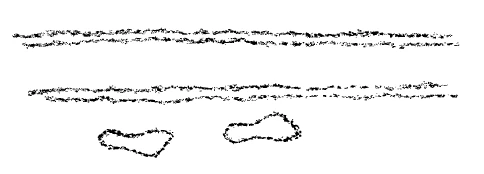
[ 4 ] Nicht wahr, das ist natürlich ein großer Irrtum. Denn die Wahrheit ist, daß da ein Wagen gefahren ist und diese zwei Rinnen mit den Rädern gemacht hat, und daß da ein Mensch gegangen ist, der mit den Füßen diese Eindrücke gemacht hat. Nicht die Natur des Bodens hat diese Eindrücke gemacht, sondern der Mensch mit seinen Füßen und der Wagen mit seinen Rädern.
[ 4 ] Such a conclusion is of course a crudely mistaken one, the truth being that a wagon has passed and made the two ruts with the wheels, and a man has also been walking on the road and made the other impressions with his feet. Not the nature of the soil, but the man and the wagon are responsible for the tracks.
[ 5 ] So ist es aber auch mit den Vorgängen in unserem Nervensystem. Indem wir als Seelen denken, fühlen und wollen, bilden wir fortwährend geistig-seelische Vorgänge. Die verlaufen, solange wir in der physischen Welt leben, gebunden an den physischen Leib, wie der Wagen über den Weg fährt, und der Mensch über den Weg geht, und lassen dort ihre Spuren zurück. Diese Spuren, die sie dort zurücklassen, haben ebensowenig mit der Materie zu tun, wie die Spuren im Wege etwas zu tun haben mit irgendeiner Materie, die darunter liegt. Gar nichts haben im Grunde genommen die Vorgänge in der Gehirnmaterie, in der Nervenmaterie mit den Denkvorgängen zu tun, ebensowenig wie das, was der Wagen oder der Mensch vollführt, mit dem zu tun hat, was da auf der Oberfläche der Erde vor sich geht.
[ 5 ] The case is no different with the processes that go on in our nervous system! Whenever we think or feel or will, we are setting up processes that are of the nature of soul-and-spirit. And so long as we live in the physical world, these processes are united with the physical body, they leave their tracks in it—just as the wagon and the man leave their tracks behind in the road. But these tracks in the body have no more to do with the material of which the body is made than have the tracks in the road to do with the materials of which the road is constructed. In reality, the processes that take place in the matter of the brain and in the matter of the nerves have nothing whatever to do with the actual thought-processes. The relation between them is no nearer than the relation between what the man and the wagon are doing and what is going on in the surface of the earth over which they are moving.
[ 6 ] Das ist sehr bedeutsam, daß man sich einmal einer solchen Betrachtung hingibt, damit man verstehen lernt, daß der Anatom, der Physiologe, wenn er bloß die Vorgänge im Organismus untersucht, einem Geist gleicht, der unten in der Erde sich bewegt, aber niemals über die Oberfläche der Erde empordringt, niemals Menschen und Wagen gesehen hat. Er sieht nur innerhalb der Erde, daß da Unebenheiten entstehen, kommt aber nie heran, sieht sie noch dazu von der andern Seite. Das untersucht er dann und glaubt, daß die Erde selber dies durch ihre eigene Tätigkeit macht. In dem Augenblick, wo ein solcher Geist, der da immer unter der Erde ist, über die Erdoberfläche käme, würde er sich über den wahren Tatbestand aufklären. So ist es auch mit dem materialistischen Anatomen und dem materialistischen Physiologen; er ist immer unter der Erde, das heißt, er weiß nichts von Geisteswissenschaft, und das ist ein Unter-der-Erde-Sein. Er untersucht nur die Vorgänge in der Materie, die gar nichts zu tun haben mit dem, was da oben geschieht im Geistig-Seelischen.
[ 6 ] It is really quite important to take a little trouble to consider the matter in this light. For it reveals to one that the anatomist or physiologist who investigates merely the physical processes in the organism is like a spirit-being who moves about under the earth without ever coming up to the surface, and who has never even seen men or wagons. All he can do is to observe from below that unevennesses occur in the surface of the earth; he never comes close up to them, and he sees them always from the other side. Investigating them in this limited way, he imagines the earth itself has given rise to them by its own activity. The moment such a spirit were to come out on to the surface, he would become acquainted with the true state of affairs. This is exactly how it is with the anatomist and physiologist who work from the materialistic point of view. They are always under the earth—for to know nothing of Spiritual Science is to be “under the earth!” What they investigate is the material processes, and these have nothing to do with what is happening above in the realm of soul-and-spirit.
[ 7 ] Das wird die Aufgabe der neueren Zeit sein, daß die Menschen aus dem anatomischen, physiologischen Denken in das geisteswissenschaftliche Denken eindringen. So ähnlich würde ein Kobold, der bisher nur unter der Erde gewesen ist, eindringen in die Wahrheit, wenn er hinaufgehoben würde über die Erde und sehen würde, wie eigentlich die Eindrücke zustande kommen, die in der Materie sind. Unter der Erde wühlende Kobolde sind im Grunde genommen die materialistischen Forscher, die sich nur mit dem unter der Erde befindlichen Geistigen beschäftigen, denn auch das Materielle ist Geistiges. Und die Menschheit muß durchmachen jenen großen Schock, der sich ergeben wird, wenn diese Kobolde, diese Erdengeister in die Region des GeistigSeelischen eindringen.
[ 7 ] It will be man's task in the near future to free himself from this anatomical and physiological thinking and work through to a spiritual-scientific thinking. Then he will feel as an underground imp might feel who was suddenly lifted up above the earth and saw for the first time how the tracks he had observed from below had really come about. Imps burrowing under the earth—that is what the scientists are, who take account only of the spiritual that is under the earth—for even the material is spiritual! And mankind will have to experience the great shock that must inevitably come when these underground imps come out into the open—into the realm, that is, of the soul-and-spirit.
[ 8 ] Nun, ich mußte das vorausschicken aus dem Grunde, weil ich Ihnen einiges zur Aufklärung sagen will über den vorhin angedeuteten Widerspruch, daß der Bottnische, Finnische, Rigaische Meerbusen eigentlich Flächen sind, Ebenen, und ich doch so gesprochen habe, als ob das Wesen wären oder Teile von einer mächtigen Wesenheit, die sich vom Westen nach dem Osten erstreckt.
[ 8 ] These introductory words were necessary in order to prepare you for the subject of today's lecture, which I think you will find helps to solve the contradiction of which we were speaking—that the gulfs of Bothnia, Finland and Riga are obviously mere surfaces, and yet I spoke as though they were a being, or rather limbs of a mighty being stretching from west to east.
[ 9 ] Nun, sehen Sie, Raumeswesen, räumliche Wesen — ja, Sie sagen so ohne weiteres, ich bin ‘doch als Mensch ein räumliches Wesen. Das ist wohl richtig. Aber das, was Sie als Mensch, als räumliches Wesen sind, sind Sie nicht in der Wirklichkeit. Denn mit diesem Menschen verhält es sich ganz anders, als man glauben kann, wenn man ihn nur in der äußeren Maja, in der äußeren Phantasmagorie anschaut. Da erscheint er allerdings als ein Wesen, das räumlich dasteht, räumlich in der Haut eingeschlossen ist, das räumlich sich ausdehnt. Aber hier verbergen sich in der Tat in bezug auf die menschliche Gestalt drei bedeutsame Rätsel, drei bedeutsame Fragen.
[ 9 ] We are accustomed to speak of ourselves as beings of space, and we are right; as human beings we are spatial beings. When, however, we come to consider what we are in reality, that is quite another matter. The fact is, man is in reality something altogether different from what we imagine him to be when we look at him only in the outer Maya, in the phantasmagoria of external appearance. There he appears of course as a being of space, spatially enclosed within his skin. But directly we try to carry our thought a little deeper, we are confronted with three great problems or riddles in respect of the human form.
[ 10 ] Die erste Frage, die sich da verbirgt, tritt, möchte ich sagen, unter allerlei Vexieransichten auf, unter allerlei Täuschungen. Über unser eigenes Dasein werden wir durch die äußere Phantasmagorie, durch die äußere Maja eigentlich getäuscht. Die Spuren dieser Täuschung finden sich in der heutigen Wissenschaft, und zwar in dem Kapitel, wo diese Wissenschaft recht hilflos ist und alle möglichen Hypothesen aufgestellt hat. Die Frage, die ich meine, verbirgt sich in der Wissenschaft dahinter, daß immer wieder Hypothesen aufgestellt werden, warum der Mensch eigentlich zwei Augen, zwei Ohren hat, und doch die Dinge nicht zweifach sieht und hört, warum eigentlich die Organe symmetrisch angeordnet sind, warum sie nicht einfach, sondern doppelt vorhanden sind. Das einfache Wahrnehmen bildet ein großes Problem, eine große Frage für die Wissenschaft, und wenn Sie die Literatur durchnehmen, werden Sie finden, was da alles geschrieben worden ist über die Frage, warum wir eigentlich mit zwei Augen einfach sehen, mit zwei Ohren einfach hören und so weiter.
[ 10 ] The first of these riddles conceals itself under all manner of puzzling and mystifying illusions. For the external Maya of appearance deceives us again and again in regard to our own existence; and you can find traces of this deception in the science of the present day, particularly at certain points where science is quite at a loss and has been forced to construct all manner of hypotheses. Hypotheses have for example been constantly brought forward to account for the fact that man has two eyes and two ears and yet does not see or hear double. How is it that these organs are symmetrically disposed? How is it that they are present not singly but in pairs? This simple fact offers science a hard nut to crack, and you have only to glance through the literature on the subject to find what a very great deal has been written on this question of why we see with two eyes and hear with two ears.
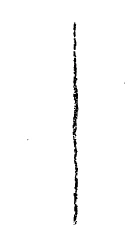
[ 11 ] Der Mensch ist in gewisser Weise recht grob organisiert und drückt das manchmal schon in seiner Sprache aus. Eigentlich hat er auch zwei Nasen, nur sind diese so zusammengewachsen, daß sie sich nicht so leicht überschauen lassen wie die beiden Augen, die beiden Ohren. Deshalb spricht man nicht von zwei Nasen, sondern nur von einer Nase, aber in Wirklichkeit hat der Mensch ebensogut zwei Nasen und nicht eine Nase. Nur ist er so grob organisiert, daß da, wo etwas zusammengewachsen ist, es ihm gar nicht auffällt. Aber auf jeden Fall ist es eine Tatsache, daß sich im menschlichen Wahrnehmen eine ganze Symmetrie, ein LinksRechts ausdrückt. Wenn der Mensch nämlich nicht zwei Ohren hätte, zwei Augen, zwei Nasen, so würde in Wahrheit seine Ich-Empfindung nicht zustande kommen. Auch zwei Hände braucht er dazu. Indem wir die Hände zusammenschlagen und eine Hand an der andern fühlen, kommt schon etwas von der Ich-Empfindung zustande. Etwas ganz Ähnliches aber tun wir, indem wir das Ergebnis der beiden Augen, der beiden Ohren in eine Einheit zusammenfügen. Wir nehmen die Welt immer von zwei Seiten her wahr, von links und von rechts, wenn es sich um die Sinneswahrnehmung handelt. Und nur dadurch, daß wir diese zwei Wahrnehmungsrichtungen haben von links und von rechts und diese zum Schnitt bringen, sind wir dieser Ich-Mensch, der wir sind. Sonst wären wir gar nicht dieser Ich-Mensch. Wenn wir zum Beispiel die Augen so hätten, daß sie in der Nähe der Ohren stehen würden, und wir die Visierlinie nicht zusammenfügen könnten, so würden wir immer ein Wesen bleiben, das in der Gruppenseele befangen ist. Wir müssen, um ein Ich-Wesen zu sein, das Links und Rechts zum Schnitt bringen. Alles, was auf dem Gebiete der Wahrnehmung links und rechts ist, bringen wir zum Schnitt in der Mitte. Stellen Sie sich eine Fläche (es wird gezeichnet) vor, also eine Fläche, die von diesem Strich herausgeht von der Tafel. Da kommt alles zum Schnitt, von links her und von rechts her, und in dieser Ebene sind wir wirklich darinnen. Wir sind gar nicht im Raume, sondern in dieser Ebene darinnen, in dieser Fläche. Wir sind nicht der räumlich ausgedehnte Mensch in Wahrheit, sondern wir sind ein Flächenwesen, das dadurch zustande kommt, daß sich die Linksimpulse mit den Rechtsimpulsen schneiden. Und wenn Sie jemandem Antwort erteilen wollen — ich meine in der Wirklichkeit, nicht in der Maja — auf die Frage: Wo bist du denn eigentlich?, so müssen Sie ihm nicht sagen: Ich bin da oder dort, in dem vom Körper ausgefüllten Raum —, sondern Sie müssen ihm sagen: Ich bin da, wo mein Linksmensch und mein Rechtsmensch sich schneiden. — Da sind Sie in Wirklichkeit nur. Genauso wie Flächen da sind bei dem Wesen, das ich vorher meinte, in welchem sich die Lufthälfte und Wasserhälfte schneiden da sind die beiden Hälften verschieden —, so sind beim Menschen die Linkshälfte und die Rechtshälfte da — aber gleich. In Wahrheit ist auch der Mensch ein Flächenwesen, eine Ebene, und das schon ist Maja, daß er seine wirkliche Gestalt hat.
[ 11 ] Man is really coarsely organized; we can sometimes find evidence of this in the very way we speak. For in reality we have also two noses! Only they have grown together and are not so obvious as the two eyes and two ears. Hence we do not speak of two noses, but of one nose; crudely organized as we are, we never discover that we have two! It is nevertheless the case that in all human perception a symmetry comes to expression, a right-and-left symmetry. Had he not two ears, two eyes, and two noses, man would not attain to the perception of his own I or Ego. Correspondingly, man needs also for the Ego experience two hands. When we clasp the hands together and feel the one with the other, we immediately get something of an Ego experience. And it is really a similar process, when we unite into one whole the perceptions of two eyes or two ears. Every time we make a sense perception, we perceive the world from two sides, from left and from right. And to the fact that we have these two directions of perception left and right, and bring them together—to this fact we owe our Ego-nature as human beings. Otherwise we would not be I- or Ego-men at all. If, for example, our eyes were situated near our ears and we had no possibility of combining the lines of vision, we would always remain beings who are involved in a Group Soul. To be an Ego-being we must make the right and the left meet. Throughout the whole realm of human perception there is always this crossing of right and left in the middle. Look at this vertical line on the blackboard. Imagine that a plane projects out here from the blackboard along this line. Everything comes, from left and right, up to this line of incision. We, my dear friends, are ourselves actually in this plane. We are not in space, we are only in this surface, this plane. We are not beings extended in space, we are surface beings, that come about through the crossing of the impulse from the left with the impulse from the right. And if to the question: Where are you? you want to find an answer, not in accordance with Maya, but in accordance with reality, then you must not point to the space where your body is standing and say: “I am here,” but you will have to say: “I am in the place where my left man and my right man meet.” In reality you are there, and only there. Just as we had surfaces in the case of the being of whom I spoke before, surfaces where air and water meet, so in man we have the left half and the right half. In that being the two halves were different, in man they are alike; but man is also a surface being, man is a plane. It is Maya that we see him as having form and figure.
[ 12 ] Aber woher kommt sie denn, die wirkliche Gestalt? Ja, sehen Sie, sie kommt daher, daß der Mensch mitten darinnensteht in einer Art von Kampf. Von links her kämpft ein Wesen mit einem Wesen, das von rechts her kämpft. Würde das geistig wahrgenommen, was an unserer linken Seite ist, so würden wir dieses eine Wesen wahrnehmen wie Licht. Würde das an unserer rechten Seite Wirkende geistig wahrgenommen, so würden wir das andere Wesen mit andern Eigenschaften wahrnehmen. Als zweierlei Mensch kommen wir nämlich dadurch zustande, daß von links her kämpft die luziferische Wesenheit, von rechts her die ahrimanische Wesenheit.
[ 12 ] Whence then has man this form and figure? He has it because he stands in the midst of a battle. A being from the left is fighting in man with a being from the right. If we were able to be entirely within our left half we would have a powerful perception of the one being, and if we were in our right half we would have a correspondingly powerful perception of the other being. Our existence as a double being arises from the fact that the Luciferic being is fighting in us from the left and the Ahrimanic being from the right.
[ 13 ] Nun denken Sie sich einmal, um sich das genau vorzustellen, von links kämpft die luziferische Wesenheit, staut da auf, was sie aufführt als Befestigungswerk; von rechts kämpft die ahrimanische Wesenheit und staut da auf, was sie aufführt als Befestigungswerk. Das, was Ihr Linksmensch ist, sind die Befestigungswerke des Luzifer; Ihr Rechtsmensch sind die Befestigungswerke des Ahriman. Und Sie haben überhaupt nur die Möglichkeit, zwischendrinnen in der Mitte zu sein. Unsere Lebenskunst besteht darin, daß wir das richtige Gleichgewicht finden. Unbewußt tun wir das, wenn wir sinnlich wahrnehmen. Wenn wir mit dem linken Ohr hören und mit dem rechten Ohr hören, und dann die Impulse zusammenfügen zu einer Wahrnehmung, oder wenn wir mit der linken Hand wahrnehmen und mit der rechten Hand wahrnehmen und die Wahrnehmungen zusammenfügen, so setzen wir uns immer in die Fläche, die gerade an der Grenze des Kampfes zwischen Luzifer und Ahriman liegt. Wie des Messers Schneide, ja noch schärfer als des Messers Schneide ist der Spielraum, der uns in der Mitte gelassen ist. Unser Organismus gehört nicht uns, sondern er ist aufgeworfen durch den Kampf der luziferischen und ahrimanischen Mächte, aber auch derjenigen Mächte, die gleichartig sind mit Luzifer und Ahriman. Das aber ist etwas, was jetzt nicht weiter berührt werden soll.
[ 13 ] Let us try to make a picture of it in our minds. From the left the Luciferic being fights his way through and throws up, as it were, his fortifications, and from the right Ahriman fights his way through and throws up his fortifications. And all that you can do is to stand in the middle between the two. The left part of you—your left man, as it were—is the fortification set up by Lucifer, and your right man is the fortification set up by Ahriman. And the whole art of life consists in finding the true balance between them. We do it unconsciously whenever we perceive with the senses. When we hear with the left ear and with the right ear, and then unite into a single perception the impulses that reach us in this way, or when we feel with the left hand and with the right hand and unite the two perceptions, we are placing ourselves into the surface that lies on the boundary of the conflict between Lucifer and Ahriman. As narrow as—no, narrower than—the blade of a knife is the space that is left to us in the middle, where we have to play our part. Our organism does not really belong to us; we are a battlefield for the Luciferic and Ahrimanic powers—and for other powers too, of like nature with them, but into that subject we cannot enter now.
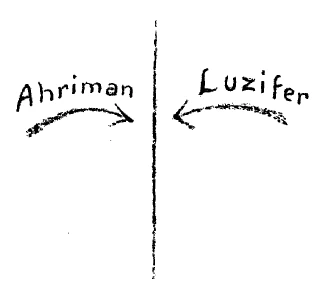
[ 14 ] So sind wir als Flächenwesen eingeschaltet zwischen etwas, was uns als Menschen gar nichts angeht. Unser linker Mensch geht uns eigentlich gar nichts an, unser rechter Mensch auch nicht, sondern der Prozeß, der Vorgang, der sich zwischen beiden abspielt.
[ 14 ] We men are thus in reality surface beings wedged between two entities that are no concern of ours! Our left man does not concern us, neither does our right man: what concerns us is the process that goes on between the two.
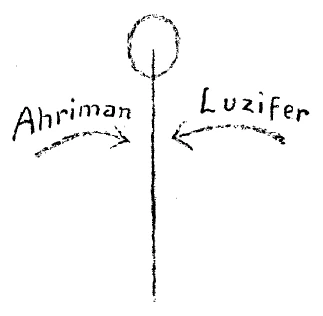
[ 15 ] Und jetzt können Sie sich das Bild, das ich vorhin gebrauchte, weiter ausdenken. Nicht wahr, da geschehen fortwährend Prozesse, Vorgänge. Ja, in der Erde geschehen auch fortwährend Prozesse, Vorgänge. Aber das, was in der Erde vor sich geht, macht nicht diese Spuren. Was in Ihnen geschieht, in der linken oder rechten Hälfte des Organismus, das hat gar nichts zu tun mit dem, was der Mensch seelisch erlebt; das sind Prozesse, die sich zwischen Luzifer und Ahriman abspielen. Die Prozesse, die unten, unter der Erdoberfläche sind, alles, was da geschieht, meinetwegen sagen wir das Herumkriechen der Würmer, das Kalt- und Warmwerden in den Jahreszeiten, all diese Prozesse, die nichts zu tun haben mit diesen Spuren, die da eingedrückt werden, müssen Sie vergleichen mit dem, was drinnen vorgeht in der Menschenorganisation. So daß man sagen muß: Durch die geistige Beobachtung der physiologischen und anatomischen Vorgänge muß man darauf kommen, wie Luzifer und Ahriman miteinander kämpfen, muß sich aber nicht der Meinung hingeben, daß durch diese Prozesse zwischen Luzifer und Ahriman das seelische Leben bewirkt wird. Das ist nicht richtig, denn das verläuft in der Seele selber. Und das verläuft im Grunde genommen in der Fläche, in der Ebene, nicht in dem Organismus darinnen, in dem räumlichen Organismus; es stuft sich ab, und die Betrachtung dieser Abstufung ist außerordentlich interessant. In bezug auf den Kopf des Menschen, da ist es so, daß Luzifer und Ahriman ziemlich gleiche Befestigungswerke links und rechts aufgeworfen haben. Die linke und rechte Kopfhälfte sind sehr ähnlich, da sind die Kräfte so, daß sie wenig ineinanderspielen können, daß sie die Fläche in der Mitte wenig berühren. In der Mitte ist die Fläche, links Luzifer, rechts Ahriman; aber weil linke und rechte Kopfhälfte so ähnlich gebildet sind, prallen sie aneinander ab: Luzifer und Ahriman, und der Mensch kann in der Mitte hier eine ruhige Tätigkeit entwickeln (siehe Zeichnung Seite 121). Sein Denken wird recht wenig gestört durch den Einfluß von Luzifer und Ahriman, weil sie da aneinander abprallen.
[ 15 ] And now we can develop a little further the comparison I made use of before. For, as we all recognize, there are processes perpetually going on under the earth; but it is not these that make the tracks in the road. Similarly, what happens in you in the right and left half of your organism, all the processes that take place between Lucifer and Ahriman, have nothing whatever to do with the experience you have in your soul. What goes on down below the surface of the earth—the worms creeping about, the changes in temperature in accordance with the seasons of the year, and so forth—all this has no connection with the tracks that have come in the road, and it is these tracks that are comparable with what takes place in the organism of man. Our researches in physiology and anatomy reveal to us the fight that is being waged within us between Lucifer and Ahriman, but they do not compel us to give ourselves up to the superstition that the life of the soul owes its origin to these processes going on between Lucifer and Ahriman. That is a complete mistake; the life of the soul takes its course within the soul itself—that is to say, in the surface, in the plane, not in the spatial organism at all. Now the working of Lucifer and Ahriman is not the same in all parts of the human organism, and it is interesting to observe its gradation. Beginning from the head, we find that there Lucifer and Ahriman have thrown up fairly equal fortifications; the left and right halves of the head are very similar. This means that the forces of left and right have in the head not much possibility of interplay and the surface between them is left comparatively undisturbed. There in the middle is the surface, with Lucifer on the left and Ahriman on the right; and because the left and right halves of the head are so similar in form, Lucifer and Ahriman spring back from one another, and in between them man is able to develop a quiet surface activity. Thinking, pure thought as such, is very little disturbed by Lucifer and Ahriman; because in the head they recoil from one another.
[ 16 ] Kommt man weiter nach unten, ist es schon nicht mehr so. Auf der einen Seite gelingt es Luzifer, den Magen aufzutürmen, auf der andern Seite gelingt es Ahriman, die Leber aufzutürmen. Und der Magen ist das Mittel, durch das Luzifer kämpft von links nach rechts, die Leber ist etwas, durch das Ahriman kämpft von rechts nach links. Das Verhältnis von Magen und Leber betrachtet man in der richtigen Weise, wenn man ins Auge faßt, daß es Luzifer gelingt, links den Magen aufzutürmen als eine Art Kampfmittel, und daß es rechts Ahriman gelingt, die Leber aufzutürmen. Das steht in einem fortwährenden Kampf, und die Wissenschaft würde gut tun, diesen Kampf zwischen Magen und Leber wirklich zu studieren. Und wenn die Lage des Herzens einmal ein wenig nach der linken Seite herüber tendiert, so ist diese Lage ein Ausdruck für das, wie auf der einen Seite Luzifer etwas für sich erhaschen will, während auf der andern Seite Ahriman etwas erhaschen will. Das ganze Links-Rechtsverhältnis ist ein Ausdruck für dasjenige, in welchem sich Luzifer und Ahriman im Menschen bekämpfen, nur daß beim Menschen, wie gesagt, das, was auf beiden Seiten der Fläche liegt, in gewisser Beziehung gleich ist. Aber wir sehen ja, eigentlich gleich ist es nur da oben; es hört auf, gleich zu sein, je weiter wir den Menschen nach unten verfolgen.
[ 16 ] When, however, we follow the form of man further down, we find a change. On one side Lucifer works powerfully and builds up the stomach, on the other side Ahriman does the same and builds up the liver. The stomach is the means with which Lucifer fights from left to right; and no true understanding can come about of the relation between stomach and liver, until we see how Lucifer has built up the stomach as a kind of weapon of defence, and Ahriman the liver. These two—stomach and liver—are perpetually waging war one against the other, and physiology would do well to study the conflict. And if the heart of man tends to lean a little over towards the left, then that is an expression of the fact that Lucifer from one side and Ahriman from the other are trying each to grasp something for himself, The whole left and right relationship is an expression of the fight that is being waged in man between Lucifer and Ahriman. We said that in the case of man, what lies on either side of the middle surface is, generally speaking, alike. We have, however, already seen that this is true only for the upper part of man; as we follow the form of man downwards, the similarity gradually disappears.
[ 17 ] Bei dem Wesen, von dem ich gesprochen habe, daß es wie drei Fangarme — Lemminkäinen, Ilmarinen und Wäinämöinen — vorstreckt, ist es so, da ist die eine Hälfte Luft, die andere Wasser; da sind sie noch verschieden. Sobald man nun zur hellsichtigen Erkenntnis kommt, fällt einem aber gleich auf, daß der Mensch im Grunde genommen auch nur eine Fläche ist zwischen zwei Hälften, denn sobald man sich absuggeriert den physischen Leib und auf den Ätherleib hinblickt, findet man, daß die linke Hälfte wesentlich heller wird als die rechte Hälfte. Die linke Hälfte sieht sich an viel mehr durchhellt, durchstrahlt, durchglitzert, durchglimmert; die rechte Hälfte viel mehr durchfinstert, durchdunkelt. So ist es mit Bezug auf den Links-Rechtsmenschen. Nun ist aber der Mensch auch in bezug auf die anderen Richtungen hineingestellt in den Raum, das heißt aber — okkultistisch ausgedrückt — nichts anderes als hineingestellt in den Kampf zwischen Luzifer und Ahriman. So ist er hineingestellt in das Vorne und Hinten, Vorne und Rückwärts.
[ 17 ] In the case of the being of whom I spoke before, with the three outstretched limbs—Lemminkäinen, Ilmarinen and Wainämöinen—the one half is air and the other water; the two halves are totally different in kind. And even in man, when we attain to clairvoyant knowledge it becomes clear to us that there are two distinct halves. For no sooner have we suggested away the physical body and turned our attention to the etheric body, than we find that the left half grows brighter and clearer than the right half. The left half is all shining and gleaming with radiant light, and the right half is wrapped in darkness and gloom. Yes, that is actually how it is with the left-right human being. There are, however, other directions in accordance with which man takes up his position in the world of space. Expressed in the language of occultism, this means nothing else than that he is placed in still other ways into the midst of the fight between Lucifer and Ahriman.
[ 18 ] Wenn Sie sich nun nicht das Links und Rechts denken, sondern das Vorne und Rückwärts am Menschen — den ganzen Menschen müssen Sie sich denken —, dann ist der Mensch auch nicht in der Richtung von vorne nach hinten dieses Raumeswesen (siehe Zeichnung), sondern gerade so, wie von links herüber und von rechts herüber Luzifer und Ahriman sich bekämpfen, und das Räumliche nur die Barrikaden sind, die sie aufgerichtet haben gegeneinander, kämpft auch von rückwärts Ahriman wieder gegen den Menschen und von vorne wiederum Luzifer. Von rückwärts schiebt sozusagen seine Tätigkeit Ahriman vor; von vorne schiebt seine Tätigkeit Luzifer dem Ahriman entgegen. Und der Mensch steht wieder mitten darinnen.
[ 18 ] Let us go on, then, to consider how man stands in space with a forward and backward orientation, looking before and behind. Instead of observing him as a being of left and right, we will now direct our thoughts to the front and back of the human form. From this aspect also we find that man is not the being of space he appears to be. For as from left and from right Lucifer and Ahriman do battle with one another across man, and what shows in space is really only the barricades they put up one against the other, so also from behind Ahriman is fighting and from in front Lucifer. From behind Ahriman thrusts forward his activity, and from in front Lucifer thrusts forward his activity in opposition. Man stands in the middle between them.
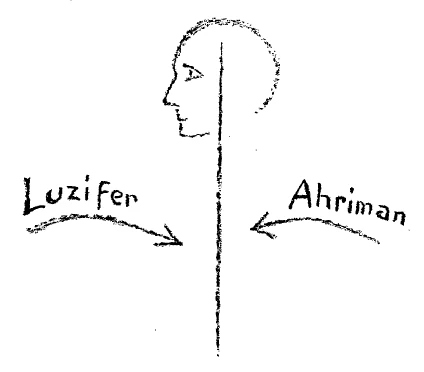
[ 19 ] Allerdings kommen wir jetzt dazu, ausführen zu müssen, daß es in bezug auf diese Richtung vorne-rückwärts den beiden nicht so gelungen ist, ich möchte sagen, so nahe aneinander heranzukommen, daß sie nur eine Fläche bildeten. Hier ist es schon anders. Ahriman kommt nämlich nur bis zu einer Fläche, die Sie sich durch das Rückgrat legen können, und Luzifer kommt bis zu einer Fläche, die Sie sich durch das Brustbein legen können, etwa da, wo die Rippen zusammenstoßen. Und dazwischen ist ein Raum, durch den sie getrennt sind, wo ihre Wirkungen durcheinandergehen. Sie kämpfen da, man möchte sagen, nicht unmittelbar aneinander stoßend, sondern sie senden ihre Geschosse durch diesen Raum hindurch. Aber Ahriman kommt nur bis zum Rückgrat und Luzifer nur bis dahin, wo die Rippen an das Brustbein anstoßen. Und wir stehen da drinnen, zwischen diesem Kampf von Luzifer und Ahriman. Also in bezug auf die Vorwärts- und Rückwärtsrichtung sind wir in der Tat ein solches Wesen, welches Raum hat. In bezug auf links und rechts haben wir keinen Raum.
[ 19 ] In connection, however, with the forward and backward direction in man we discover that Lucifer and Ahriman do not succeed in coming so close to one another as to leave nothing but a surface between them. We find here a somewhat different state of affairs. Ahriman comes only as far as the plane which can be drawn through the spinal column, and Lucifer as far as the plane which can be drawn through the breast bone, where the ribs end and meet. In between these two planes lies a space which separates Lucifer and Ahriman one from the other, where the effects of their working are thrown together in confusion. There they stand and fight—not at close quarters, but as though shooting at one another across the intervening space. And there stand we in the midst of the fight. Thus, in respect of the direction before and behind, man is a being that has space.
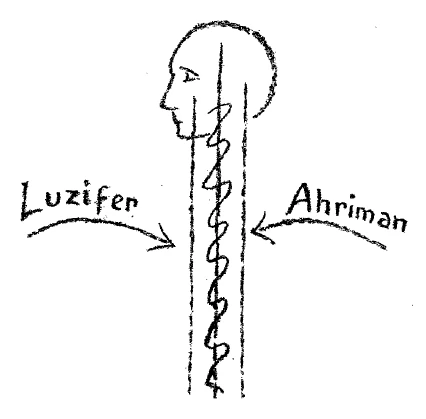
[ 20 ] In der Richtung links-rechts kämpfen Luzifer und Ahriman vorzugsweise durch die Gedanken. Da schwirren die Gedanken von links und von rechts herüber und berühren sich in dieser Fläche. Es sind kosmische Gedankenbildungen, die da aneinanderstoßen und sich in der menschlichen Mittelfläche berühren. Vorne und rückwärts kämpfen Luzifer und Ahriman mehr mit Gefühlen, da wird der Kampf mehr durch die Gefühle geführt. Und weil hier die Kräfte nicht so recht aneinanderkommen, bleibt für uns in der Mitte ein Spielraum, in welchem wir mit unseren Gefühlen in uns selber sind. Wir spüren, wenn wir Gedanken haben, die von links und rechts einander bekämpfen, daß diese Gedanken eigentlich der Welt angehören. Mit den Gedanken denken wir die Dinge, die draußen sind. Wenn wir uns eigene Gedanken machen, so sind das Phantasmagorien, dann gehören sie eigentlich nicht mehr der Welt an. In unseren Gefühlen gehören wir uns selber an, weil Luzifer und Ahriman da nicht ganz aneinanderstoßen, weil wir da Spielraum haben zwischen den beiden Gebieten. Deshalb sind wir mit unseren Gefühlen so in uns selber.
[ 20 ] In the left-right direction the fight between Lucifer and Ahriman is waged principally in the sphere of thought. Thoughts are whirled across from left and from right and meet in the surface in the middle. Cosmic thoughts and cosmic forms of thought impinge upon one another here on the human surface in the middle. In the direction before and behind, Lucifer and Ahriman do battle more in the realm of feeling. And since here the opposing forces do not approach one another so nearly, in the space that is left between them we ourselves have room to be together with our own feelings. When we have thoughts that offer opposition to one another from left and from right, then we have the feeling that these thoughts belong to the world. With our thoughts we think the objects that are in the world outside. When we make our own thoughts, then these thoughts are a mere phantasmagoria; they do not any longer belong to the world. In our feelings, on the other hand, we belong to ourselves; for there Lucifer and Ahriman do not quite meet, there we have room to be active in between them. This is the reason why in our feelings we are so essentially within ourselves.
[ 21 ] Sehen Sie, wir sind als Menschen Geschöpfe durch die Wirkungsweise der Wesen der höheren Hierarchien. Und wir sind dieses Flächenwesen links und rechts dadurch, daß die höheren Hierarchien uns Menschen da hineinstellen als Flächenwesen. Da lassen sie Luzifer und Ahriman nicht zusammenkommen. Wir sind insofern ein Wesen der guten Götter, als diese guten Götter aus ihren Schöpfungsgedanken heraus gesagt haben: Da liegt vor uns ein Kampf zwischen Luzifer und Ahriman. Nun müssen wir eine Grenze aufrichten für ein Gebiet, in das sie nicht hineinkommen, daß sie nicht unmittelbar aneinander herankönnen. — Wir Menschen sind hineingestellt in diesen Kampf als Geschöpfe der guten Götter, und je mehr wir uns bewähren in diesem Kampf, desto mehr sind wir Geschöpfe der guten Götter.
[ 21 ] We human beings are creatures of the beings of the higher hierarchies, and they have created us in accordance with the manner of their working. We are beings of surface between left and right because the higher beings have made us so and placed us so into space. It is they, the Gods, who do not suffer Lucifer and Ahriman to come together in man. We are in this sense creatures of the good Gods. The good Gods, working out of their creative thoughts and purposes, took as it were this resolve. “A conflict is going on,” they said, “between Ahriman and Lucifer. We must set up a wall and enclose a region which they will not be able to enter, where they will not be able to carry on their strife at close quarters.” We human beings have thus been placed into the struggle between Lucifer and Ahriman as creatures of the good Gods; and the better we stand our ground in the struggle, the more truly are we creatures of the good Gods.
[ 22 ] In bezug auf das Vorne und Rückwärts ist es so, daß die guten Götter Luzifer nicht ganz in uns hineinlassen. Da haben sie in dem Rippenabschluß nach vorne ihm Barrikaden aufgerichtet. Und in der Ausbildung dieses wunderbaren Turmes, der das Rückenmark und das Gehirn umschließt, haben die guten Götter ein Befestigungswerk gegen Ahriman aufgerichtet. Das kann er nicht passieren, da kann er höchstens seine Gefühlsgeschosse hinüberschicken zu Luzifer. Da stehen wir wirklich darinnen, um die beiden voneinander zu trennen durch einen Spielraum.
[ 22 ] In respect of the before and behind, there the good Gods do not allow Lucifer to enter right into us; they created a barricade in the place where the ribs meet in the breast bone. And the wonderfully constructed tower that encloses the spine and the brain is a fortification the good Gods have erected against Ahriman. Ahriman cannot pass this line; all he can do is to send his arrows of feeling across to Lucifer. There in the space between stand we ourselves, separating the two from each other.
[ 23 ] Es gibt noch eine dritte Richtung, das ist die von oben nach unten. Da müssen wir uns klar sein darüber, daß die Sache sich auch nicht so verhält, wie sie in der äußeren Phantasmagorie, der Maja aussieht. Da ist es so, daß von unten herauf Ahriman spielt, von oben herunter Luzifer. Und auch da haben die guten, fortschreitenden Götterwesen eine Barriere errichtet gegenüber Luzifer. Seine Wirkungen von oben nach unten werden sozusagen aufgehalten durch eine Fläche. Sie bekommen diese Fläche, wenn Sie ein Skelett nehmen und den Schädel herunternehmen. Da, wo der Schädel auf den Halswirbeln aufsitzt, müssen Sie sich eine Fläche denken. Diese unsichtbare horizontale Fläche, wo der Schädel aufsitzt auf dem Halswirbel, ist die Barriere. Wenn ein Mensch sich da hineinstellt, kann er die von oben nach unten gehenden luziferischen Wirkungen aufhalten. Luzifer kann nur von oben seine Geschosse hineinschicken; und das sind jetzt Willensgeschosse. Von links nach rechts Gedankengeschosse, von vorne nach rückwärts Gefühlsgeschosse, von oben nach unten und von unten nach oben gehen die Willensgeschosse.
[ 23 ] There is still a third direction in man, the direction from above downwards. Here again we have to make the discovery that the true state of affairs is not as it seems in external appearance. For from below upwards works Ahriman, and from above downwards Lucifer. Again we find that the good Gods have thrown up a barrier against Lucifer; at a certain plane in man his influence is held in check. You will find the plane by taking the skeleton and removing from it the skull. There where the skull rested on the cervical vertebrae, imagine a horizontal surface. This invisible horizontal surface is the barrier, where man can take his stand and hold up the Luciferic influence that comes from above. Lucifer can come no further, he can only shoot his arrows thence down into man. And his arrows are now arrows of will. From left to right fly arrows of thought, from front to back arrows of feeling and from above downwards as well as from below upwards, arrows of will.
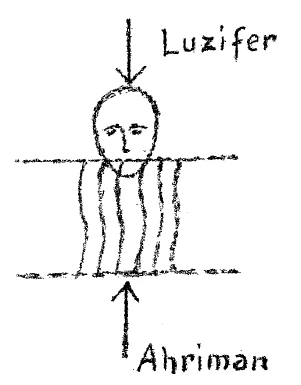
[ 24 ] Aber auch hier ist ein Spielraum. Wenn Sie unten das Zwerchfell nehmen, so haben Sie ungefähr dem Zwerchfell entlang gehend die Fläche, die wieder aufgerichtet ist gegen den von unten nach oben drängenden Ahriman. Also mit seinem Wollen, mit seinen Willensgeschossen, mit seinem eigenen Wesen kann Ahriman nur von unten nach oben bis zum Zwerchfell gelangen. Weiter kann er nie mit seinen Geschossen wirken. Das ist unser eigener Spielraum, was darüber ist.
[ 24 ] Here, too, we have left to us an intermediate field of action. For about in a line with the diaphragm, you have the surface that acts as a barricade against the upward pressure of Ahriman. Ahriman can reach only as far as the diaphragm with his missiles of will, he can come no further with his will, with his essential being; and in between the two planes lies our own field of action.
[ 25 ] Nun sehen Sie, wie kompliziert eigentlich der Mensch ist. Nehmen Ste irgendein Stück der Menschennatur, ich will sagen, die linke Seite des Antlitzes. Als Gedankenwesen kann Luzifer diese linke Seite ganz durchdringen, auch noch als Gefühlswesen kann er sie in gewisser Weise durchdringen bis zu einer gewissen Fläche; als Willenswesen kann er sie wiederum durchdringen von oben nach unten. So können Sie von jeder Partie des Menschen durch diese Angaben herausfinden, wie Luzifer und Ahriman durch kosmische Gedanken-, Gefühls- oder Willensimpulse in dem Raumesmenschen darinnen wirken.
[ 25 ] You see how complicated the human being is! Take any one portion of the human figure—for example, the left side of the face. As a being of thought, Lucifer can fill entirely this left side of the human countenance; as a being of feeling he can also penetrate it up to a point; and as a being of will he can enter right into and through it from above. And you can go on to discover for every part of the body how Lucifer and Ahriman work in the human being of space by means of cosmic impulses of thought and feeling and will.
[ 26 ] Aber klar muß man sich darüber sein, daß wir als Gedankenmensch eigentlich ein Flächenwesen sind. Als Gefühlsmensch haben wir einen gewissen Spielraum zwischen vorn und rückwärts, als Willensmensch haben wir einen gewissen Spielraum zwischen oben und unten, zwischen dieser Fläche hier — durch den oberen Halswirbel — und der Fläche des Zwerchfells. Und nur wenn Sie sich dasjenige aussondern, was gar nicht zum Menschen gehört, dann bekommen Sie die wahre Gestalt des Menschen. Die können Sie sich nun konstruieren.
[ 26 ] Remembering always that as beings of thought we are actually only surface beings, whilst as men of feeling we have a space between the before and the behind where we can unfold an activity of our own, and again as men of will we have a field of activity between the above and the below, between the surface we imagined drawn through the top of the cervical vertebrae and the surface of the diaphragm. You see, you have first to abstract all those parts that do not belong to man at all, before you can build up a true idea of the human form. Then, and only then, are you in a position to do this.
[ 27 ] Aber Sie sehen, daß der Mensch in Wirklichkeit von außen her zusammengefügt ist, daß er von außen her sein Gepräge erhält, und daß wir ihn nicht verstehen, wenn wir einfach die Formen so nehmen, wie sie uns entgegentreten, sondern daß wir ihn erst dann verstehen, wenn wir wissen, wie er mit dem ganzen Geistig-Kosmischen zusammenhängt, wie da von rechts und links, von unten und oben, von vorne und rückwärts die luziferisch-ahrimanischen Kräfte an den Menschen herankommen und wie sie so sein Wesen als Raumeswesen prägen.
[ 27 ] The truth is, the whole form of man has been put together by forces working from without. It receives its distinctive character from outside itself, and we do not understand the form of man so long as we consider it merely as it appears at first sight; we only understand it when we know how it is connected with the whole cosmos of space, when we are able to see how from right and left, from above and below, from before and behind, Luciferic and Ahrimanic forces are bearing in upon man, and giving him the character of a being of space.
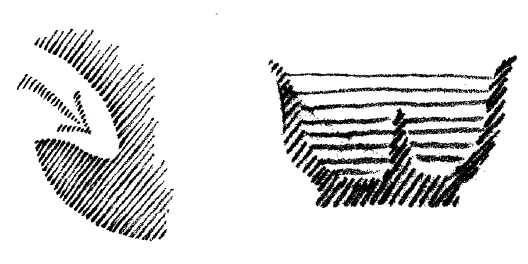
[ 28 ] Sehen Sie, so müssen Sie auch dasjenige betrachten, was in gewisser Weise nachgebildet ist dem wahren kosmischen Wirken in der Welt, so müssen Sie unseren Bau betrachten. Wenn wir ihn als Phantasmagorie betrachten, so könnten wir zunächst glauben, daß das Hauptsächlichste an diesem Bau dasjenige ist, was da von Holz ausgefüllt ist im Raum. Das ist aber nicht die Hauptsache, sondern die Hauptsache ist das, wo scheinbar nichts ist. Wenn irgendeine Form in unserem Bau so geht (siehe Zeichnung 1) und da ist das Holz, so ist das Wesentliche nicht dieses hier, das Holz, sondern dasjenige, wo nichts ist, wo die Luft angrenzt. Und unseren richtigen Bau würden Sie bekommen, wenn Sie einen riesigen Wachsklumpen nehmen würden und einen Abdruck machten von dem Inneren, und würden dann den Abdruck anschauen. Also dasjenige, in dem Sie, wenn Sie in den Bau hineingehen, dariinnenstehen, was Sie nicht sehen können, sondern fühlen müssen, das ist es eigentlich, worauf es ankommt. Ich habe schon früher gesagt: Das Prinzip unseres Baues ist das eines Gugelhupftopfes. — Gugelhupftopf ist ein Ausdruck, den man hier nicht gut verstehen wird. Aber denken Sie sich hier einen Topf: das ist die Form, da drinnen backt man einen Gugelhupf (Zeichnung 2). Auf was kommt es denn da an bei diesem Gugelhupftopfe? Es kommt nicht auf den Topf an,. sondern es kommt auf den Kuchen an, daß der eine richtige Form bekommt und in der richtigen Weise drinnen gedeiht. Der Topf muß nur so sein, daß, wenn man Teig hineingießt und ihn bäckt, der Gugelhupf in der richtigen Weise zustande kommt.
[ 28 ] And now, my dear friends, this is also the way in which you must approach something else that has been shaped and formed in accordance with the true cosmic working in the world. I mean our building here in Dornach. If you look at the Goetheanum [ The first building, destroyed by fire on New Year's Eve, 1922/23. ] merely in its outward appearance, you might be disposed to think that the actual building itself, the space occupied by the wood, was the most important part. That is, however, by no means the case. The most important part is what, judging by appearances, does not exist! Take any one of the forms; the essential part of that form is not the shaped and sculptured wood, but is where there is nothing—where the air bounds the wood. The way to obtain the true and real Goetheanum would be to take an immense mound of wax and make a model of the inside of the building, and then study this model or impression. What you go into when you enter the building, what you stand within and cannot see but can only feel—that is the thing that matters. I said once on a former occasion that our building is built on the principle of a Gugelhopf 1A shaped cake made in Vienna. —Translator. cake mould. Imagine you have a tin mould and you bake your cake in it. Which is the more important—the mould or the cake? Obviously the cake. What matters is that the cake should receive the proper Gugelhopf shape. As far as the mould is concerned, all that matters is that the mixture, when it is poured into the mould and baked, should turn into a cake of the desired form.
[ 29 ] So kommt es bei unserem Bau auch nicht darauf an, was die Umgebung ist, sondern auf das, was darinnen ist. Und darinnen werden sein die Gefühle und Gedanken derer, die im Bau darinnen sind. Die werden dadurch entstehen, daß der Mensch bis an die Grenze des Baues sieht, daß er die Formen fühlt und daß er sich ausfüllt mit Gedankenformen. Das, was darinnen ist, das wird der Gugelhupf sein, und das, was wir bauen, ist die Hülle, die Form. Aber die muß so sein, daß das Richtige darinnen gedacht, gefühlt und empfunden wird. Und das ist das Prinzip, sehen Sie, der neueren Kunst gegenüber der alten Kunst. Bei den alten Künsten kam es immer darauf an, was draußen im Raume ist. Bei der neuen Kunst kommt es nicht darauf an, was im Raume draußen ist. Was draußen ist, .das ist der Topf, und das, worauf es ankommt, das kann man eigentlich gar nicht machen, sondern das ist darinnen. Das gilt nicht nur in bezug auf plastische Formen, sondern auch in bezug auf Malerei. Es kommt auch da nicht darauf an, was gemalt wird, sondern was dabei empfunden und erlebt wird. Auch die Malerei ist bloß «Gugelhupftopf».
[ 29 ] Similarly, in our building it is not the surrounding walls that are of importance, it is what is enclosed within the surrounding walls. And within the walls will be the feelings and thoughts of the people who are in the building. These will develop aright if those who are in the building turn their eyes to its boundary, feel the forms and then fill these forms with forms of thought. What is inside the building will be like the cake, and what we build is the mould that holds and shapes the cake. And the mould has to be of such a kind that it leads to the development of right thoughts and right feelings. This is the principle underlying the new art in contradistinction to the art of olden times. In the art of olden times the essential thing was what is outside in space; but in the new art something else is of account. What is outside is no more than the mould, and the essential thing cannot really be created by the artist at all, it is what is within. Nor is this true only of plastic forms. It is equally true of painting. The important thing is, not what is painted, but the experience in feeling to which the painting gives rise. Painting too is no more than a cake mould!
[ 30 ] Das ist, möchte ich sagen, der Kernpunkt des Evolutionsfortschrittes, in dem wir darinnenstehen, daß wir wirklich — verzeihen Sie den Ausdruck — aus dem Topf in den Kuchen hineinkommen. Im Topfe bleiben, heißt Materialismus; in den Kuchen hineinkommen, heißt bei uns Spiritualismus, und der ist dasjenige, dem wir entgegenarbeiten. Wenn man das nicht berücksichtigt, wird man auch alles Künstlerische, um das es sich bei uns handelt, nicht in der richtigen Weise beurteilen können. Wenn man künstlerisch unseren Bau nach dem Muster des Alten auffaßt, so wird man sagen können: Ja, aber um Gotteswillen, du hast gar keinen schönen Topf gemacht! — Man wird nämlich nicht wissen, daß es auf den Topf nicht ankommt, sondern auf den Gugelhupf. Damit nähern wir uns, mit einem solchen künstlerischen Prinzip, dem ganzen Sinn und der ganzen Bedeutung des Evolutionsfortschrittes durch die Geisteswissenschaft. Der Mensch muß sich durch den Fortschritt der Geisteswissenschaft herausarbeiten aus dem Topf und muß sich in den Gugelhupf hineinarbeiten.
[ 30 ] The truth is, my dear friends, we have here touched the very heart and core of the moment in evolution in which we stand. This is the step in evolution that has now to be taken, the step forgive the trivial comparison—from the cake mould to the cake. The cake is in this case the Spiritual; to enter into the world of the Spirit—that is the direction in which all our endeavor must now be set. If we fail to recognize this fact, we shall never be able to appraise correctly what we are trying to do here in art. For if we look at this art from the standpoint of the old, we can very easily exclaim: “But I see nothing beautiful in it!” We mean, I see no beautiful cake mould—never suspecting that the mould is not what matters at all, but the cake that is to be inside it.
[ 31 ] Und so muß er von dem Glauben loskommen, daß zum Beispiel in den Gehirnprozessen die Ursachen der Gedanken liegen, während in den Eigenprozessen des Gehirns kosmische Vorgänge liegen, und die Kämpfe zwischen Luzifer und Ahriman sich abspielen. Und er muß einsehen, daß die menschlichen Seelenvorgänge, die Gedanken und Empfindungen nur die Spuren sind, die in diese Kampfverschanzungen eingegraben werden, die aber mit den sogenannten materiellen Vorgängen — mit andern Worten mit den luziferisch-ahrimanischen Vorgängen — nichts zu tun haben.
[ 31 ] When we once understand this principle in art, my dear friends, we shall be very near understanding the whole meaning and significance of the step forward in spiritual evolution which is to be made through Spiritual Science. Through Spiritual Science man must learn to work his way out of the “Gugelhopf” mould into the “Gugelhopf” itself. He must, for example, get free of the superstition that the origin of thought lies in the brain processes, when as a matter of fact in the processes that go on in the brain cosmic processes are at work and conflicts are being waged between Lucifer and Ahriman. Man must learn to see that the thoughts and feelings of the human soul are tracks graven into the twistings and turnings of these conflicts and have nothing to do with the material processes—in other words, with the Luciferic and Ahrimanic processes.
[ 32 ] Ich möchte noch ein anderes Bild gebrauchen. Nehmen wir an, wir kommen in einen schönen Garten, schön dadurch, daß die Anordnung der Bäume schön ist, die Arrangements in bezug auf die Blumenverteilung schön sind und so weiter, und wir wollen uns eine Ansicht darüber bilden. Da käme, wenn wir durch ein Loch in die Erde hineinblicken könnten, so ein Kobold an uns heran. Dieser Kobold — nehmen wir an — sagte uns nun: Ich will dir sagen, warum da Rosen, Veilchen, warum da ein Busch und da Blumen sind. Ich krieche nämlich da unten unter der Erdoberfläche überall herum, und da sehe ich den Grund, der die Bäume, Veilchen, Rosen hat hervorsprießen lassen. — Wir können sagen: Ja, du erzählst uns ganz schön diese Vorgänge. Das, was du da erzählst, muß alles geschehen können in der physischen Welt. Aber damit die Pflanzen gedeihen können, der Garten entstanden ist, mußte ein Gärtner da sein. Das aber sind Regionen, in die du gar nicht hineingeschaut hast, um die du dich gar nicht gekümmert hast.
[ 32 ] Let me draw another comparison. Suppose we were to go into a beautiful garden—beautiful particularly in the whole arrangement and lay-out of the flower beds—and we wanted to pronounce an opinion on this beautiful garden. And suppose we were able to look down a hole in the earth and spied there a little underground imp who said to us: “I will tell you how it is that here are roses and over there are violets, and why you find a bush in one place and flowers in another. For I creep about all the time under the surface, and I can see the earth and the soil which has caused all these flowers—violets, roses and the rest—to spring up.” We could answer: “Yes, you describe these processes very nicely; all that you tell me is quite true and must necessarily happen. But for the garden to come into existence as I see it, something else is required—gardeners must have been at work there. They work, however, in a region which you have never seen and about which you have never troubled your head at all.”
[ 33 ] So müssen wir lernen, zu den materialistischen Anatomen, den materialistischen Physiologen zu sagen: Deine Tätigkeit finde ich erst, wenn ich durch das Guckloch in die Erde schaue. Da kriechst du herum und studierst Vorgänge, die geschehen müssen, die aber nichts zu tun haben mit dem, was da oben an Seelisch-Geistigem vorgeht. Und du wirst das, was da unten vorgeht, erst richtig deuten, wenn du dich darauf einläßt, zu erkennen, welche Beziehungen herrschen zwischen Luzifer und Ahriman und den andern Hierarchien, welche Luzifer und Ahriman wieder in den Gleichgewichtszustand bringen. — Und es wird sich dasjenige, was bisher gewissermaßen nur wie in der Ich-Vorstellung gewirkt hat, bereichern durch die Geisteswissenschaft.
[ 33 ] In like manner, we must learn to say to the anatomist and physiologist: “I find your activity when I look down through a hole in the earth. Down there you are creeping about and discovering processes which certainly have to take place, but which have nothing at all to do with what takes place in the soul and spirit above ground. And you will only be able to interpret correctly what takes place down below, when you study the relationships that hold sway between the Luciferic and Ahrimanic worlds and those other hierarchies who bring Lucifer and Ahriman into balance.”
[ 34 ] Es wird eine Zeit kommen, da werden sich die Menschen sagen: Uns wird mitgeteilt in der biblischen Schöpfungsurkunde von dem Hauche, von dem Atemzuge des Jahve, der eingehaucht wurde dem Menschen. — Dann werden die Menschen der Zukunft fragen: Ja, wenn dieser Atemzug eingehaucht wird, wohin wird er denn eingehaucht? — Wenn Sie zusammenhalten, was ich gesagt habe, so werden Sie finden, daß das nächste, wohin gehaucht wurde, diese Zwischenräume sind, wo sich von vorne und rückwärts, von oben und unten gleichsam als einen Kubus Jahve den Menschen schafft (siehe Zeichnung) und ihn so ausfüllt mit seinem eigenen Wesen, mit seinem Zauberhauche, daß dann im übrigen Menschen sich nun ausbreitet die Wirkung dieses Zauberhauches in die Regionen von Luzifer und Ahriman. Aber hier ist ein Zwischenraum, begrenzt von rechts und links, von oben und unten, von vorne und rückwärts, wo hinein unmittelbar als in den Raumesmenschen Jahves Hauch geht. Was ich gesagt habe, ist zunächst in bezug auf diesen physischen Raumesmenschen gesagt.
[ 34 ] Here we must refer to another fact in human evolution, that has hitherto only had influence in man's conception of the Ego, but that we shall learn to know in a much fuller and wider way through Spiritual Science. A time will come in the future when men will say: “We are told in the Bible of the breath of Jehovah which was breathed into man. But into what part of man was the breath breathed?” If you recall all that I have said in this lecture, you will be able to see that the region into which the breath was breathed is the intervening region that is in between the onsets from before and behind and from above and below—there, in the middle, where Jehovah created man, as it were in the form of a cube. There it was that he so filled man with His own being, with His own magic breath, that the influence of this magic breath was able to extend into the regions in the rest of man that belong to Lucifer and Ahriman. Here in the midst, bounded above and below and before and behind, is an intervening space where the breath of Jehovah enters directly into the spatial human being.
[ 35 ] Sie sehen, dies macht uns die Aussicht frei, von der aus wir erblicken den Menschen darinnenstehend im ganzen Kosmos. Ich möchte sagen: In bezug auf dasjenige, was er scheinbar äußerlich räumlich ausfüllt, dieser Mensch, von alledem gibt es auch moralisch-seelische Aspekte. Denn auch in dem, was als Moralisch-Seelisches in uns wirkt, haben wir zunächst, wenn auch nicht in so starkem Grade wie in dem Raumesmenschen, eine Phantasmagorie. Und in allem Moralischen, in allem Logischen, in allem, was in unserer Seelentätigkeit ist, wirken Luzifer und Ahriman aufeinander, und der Mensch ist aufgestellt an der Grenze.
[ 35 ] What I have been giving you in this lecture is spoken in respect of the human being of physical space. As you see, even here we can widen our outlook and learn to behold man as he stands within the cosmos. But there are also moral and spiritual aspects of what is apparently external and spatial. And in these aspects too, where the workings of the human soul are concerned—if not in so striking a way as in the case of spatial man, yet here too, what meets us at first is found to be no reality, but only a phantasmagoria. In morality, in logic and in all the activity of the soul, Lucifer and Ahriman are working one upon the other, and man stands at the boundary between them.
[ 36 ] Wie das ist, dieses für uns ganz besonders bedeutungsvolle und wichtige Kapitel wollen wir dann morgen besprechen.
[ 36 ] Of this most important and significant chapter in the understanding of the human being we will speak tomorrow.